Revascularization/ Regeneration
Performed in immature Molars :
Case Reports
Sonmez IS, Akbay OA, Erkmen AM; J Clin Pediatr Dent;2013;37(3):231-234
Regenerative endodontic procedures can be defined as biologically based
procedures designed to replace damaged structures, including dentin and
root structures, as well as cells of the pulp-dentin complex.
Definition of tissue engineering
LANGER & VACANTI stated that it is “ an interdisciplinary field that
applies the principle of engineering and life sciences towards the
development of biological substitutes that restore, maintain, or improve
tissue function.”
Langer R Vacanti JP ;Tissue engineering, Science 1993:260(5110).920-6
What is Regenerative
Endodontics…?
The objectives of regenerative endodontic procedure, are to
Regenerate pulp like tissue, ideally. The pulp -dentin complex
Regenerate damaged coronal dentin, such as following a caries exposure
Regenerate resorbed root, cervical or apical dentin.
OBJECTIVE
What Is a Stem Cell?
 Unspecialized cells
 Give rise to more than 250
specialized cells in the body
 Serve as the body’s repair system
– Renew itself
– Replenish other cells
Stem Cells
A stem cell is commonly defined as a cell that has the ability to continuously
divide and produce progeny cells that differentiate (develop) into various other
types of cells or tissues
The plasticity of the stem cell defines its ability to produce cells of different tissues
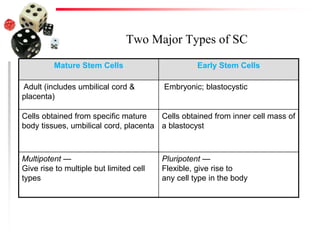
Two Major Types of SC
Mature Stem Cells Early Stem Cells
Adult (includes umbilical cord &
placenta)
Embryonic; blastocystic
Cells obtained from specific mature
body tissues, umbilical cord, placenta
Cells obtained from inner cell mass of
a blastocyst
Multipotent —
Give rise to multiple but limited cell
types
Pluripotent —
Flexible, give rise to
any cell type in the body
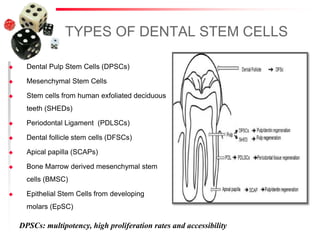
TYPES OF DENTAL STEM CELLS
 Dental Pulp Stem Cells (DPSCs)
 Mesenchymal Stem Cells
 Stem cells from human exfoliated deciduous
teeth (SHEDs)
 Periodontal Ligament (PDLSCs)
 Dental follicle stem cells (DFSCs)
 Apical papilla (SCAPs)
 Bone Marrow derived mesenchymal stem
cells (BMSC)
 Epithelial Stem Cells from developing
molars (EpSC)
DPSCs: multipotency, high proliferation rates and accessibility
Key elements of dental tissue
engineering
scaffold
Stem cells
Growth factors
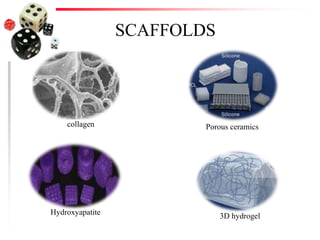
Scaffolds
 Cell attachment & migration
 Permit delivery of growth factors
 Enable influx of oxygen
 Porosity is critical
 Should not be toxic
 Ceramics, natural or synthetic
polymers
SCAFFOLDS
collagen
Hydroxyapatite 3D hydrogel
Porous ceramics
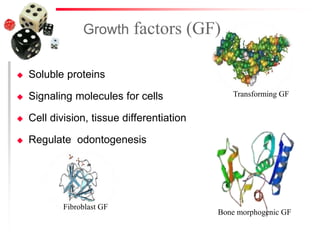
Growth factors (GF)
 Soluble proteins
 Signaling molecules for cells
 Cell division, tissue differentiation
 Regulate odontogenesis
Bone morphogenic GF
Transforming GF
Fibroblast GF
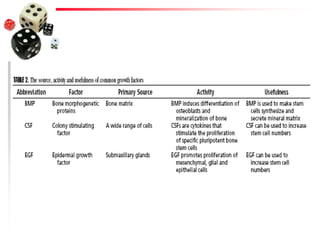
The key elements of tissue engineering and dentin regeneration
Nakashima M. Bone morphogenetic proteins in dentin regeneration for potential use in endodontic therapy. Cytokine growth factor Rev. 2005;16(3):369-76
/Growth factors
The scaffold provides a 3D environment for
cells to attach and grow,
(Therefore mimicking the in vivo
condition)
collagen, gelatin, dextran and fibronectin.
Polylactic acid (PLA),
Polyglycolic acid (PGA),
Poly lactic-co-glycolic acid (PLGA
 Laino and co-workers isolated a selected
subpopulation of DPSCs called; Stromal bone
producing dental pulp stem cells (SBP-DPSCs)
which roughly represent 10% of dental pulp cells
 These cells display a great capability of self-
expanding and differentiating in pre-osteoblasts;
which are able to self-maintain and renew for long
time.
Laino, G., D'Aquino, R., Graziano, A., Lanza, V., Carinci, F., Naro, F., Pirozzi, G., & Papaccio, G. (2005). A new population of human adult
dental pulp stem cells: a useful source of living autologous fibrous bone tissue (LAB). Journal of Bone and Mineral Research, Vol.20,
No.8, (August 2005), pp.1394-1402,
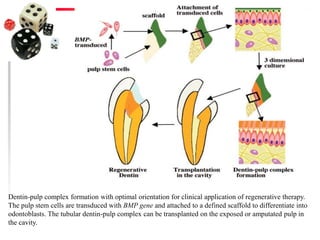
Dentin-pulp complex formation with optimal orientation for clinical application of regenerative therapy.
The pulp stem cells are transduced with BMP gene and attached to a defined scaffold to differentiate into
odontoblasts. The tubular dentin-pulp complex can be transplanted on the exposed or amputated pulp in
the cavity.
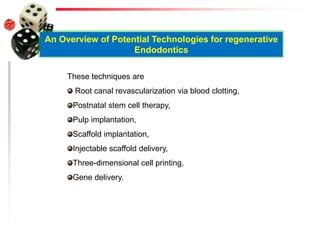
An Overview of Potential Technologies for regenerative
Endodontics
These techniques are
Root canal revascularization via blood clotting,
Postnatal stem cell therapy,
Pulp implantation,
Scaffold implantation,
Injectable scaffold delivery,
Three-dimensional cell printing,
Gene delivery.
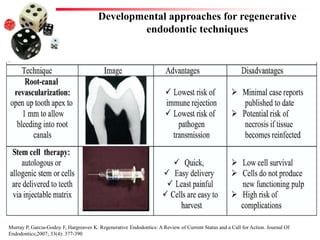
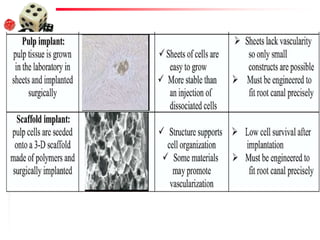
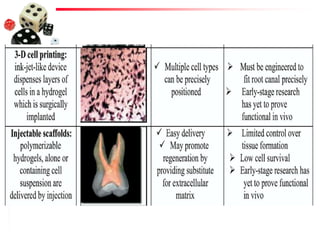
Developmental approaches for regenerative
endodontic techniques
Murray P, Garcia-Godoy F, Hargreaves K. Regenerative Endodontics: A Review of Current Status and a Call for Action. Journal Of
Endodontics;2007; 33(4): 377-390
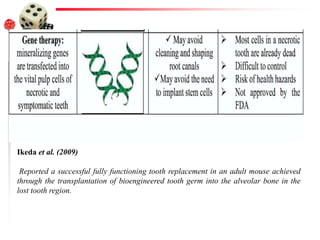
Ikeda et al. (2009)
Reported a successful fully functioning tooth replacement in an adult mouse achieved
through the transplantation of bioengineered tooth germ into the alveolar bone in the
lost tooth region.
REVASCULARIZATION
 Revascularization is the procedure to
reestablish the vitality in a nonvital tooth
to allow repair and regeneration of
tissues.
 A novel concept of revascularization of
immature non vital, infected teeth was
recently introduced by Ostby in 1961, and
in 1966
 Rule and Winter documented root
development and apical barrier formation in
cases of pulpal necrosis in children
MECHANISM OF
REVASCULARIZATION
 A bacteria-free canal is a prerequisite for
tissue regeneration, but tissue will not grow
into an empty space Rather, a scaffold is
required.
 Induction of blood clot from periapical
region acts as this scaffold for the growth of
new tissue.
 In reimplanted and autotransplanted teeth necrotic pulp,
if free of infection, provides a matrix into which the
cells from the periapical tissues could grow and
reestablish pulp vascularity, slowly replacing the
necrotic tissue.
 Some authors have suggested the use of ciprofloxacin
and metronidazole paste , Ca(OH)2 paste , along with
minimal instrumentation, aggressive, copious irrigation
with sodium hypochlorite chlorhexidine, or povidone-
iodine to control the infection.
3MIX-MP
 The use of antibiotic in endodontics was first reported in 1951 by
Grossman which was known as polyantibiotic paste (PBSC). PBSC is
a mixture of penicillin, bacitracin, streptomycin and caprylate sodium.
 PBSC is a mixture of penicillin, bacitracin, streptomycin and caprylate
sodium.
 Penicillin was used for targeting against Gram-positive organisms,
bacitracin for penicillin-resistant strains, streptomycin for Gram-
negative organisms and caprylate sodium to target yeasts .
 Recently triantibiotic paste containing ciprofloxacin, metronidazole
and minocycline has been introduced for lesion sterilization and repair
SatoT. Hosbino E.Uematsu H. Noda T. ; In vitro antimicrobial susceptibility to combinations of drugs on hacteria from carious and endodontic
lesions of human deciduous teeth. Oral Microhiol lnununol 1993;8;172-6
RATIONALE
 Metronidazole is selectively toxic to
anaerobic microorganisms
 Minocycline exhibit broad spectrum of
activity against gram positive and gram
negative microorganisms
 Ciprofloxacin exhibits very potent activity
against gram negative bacteria
COMPOSITION
According to Hoshino et al
 Antibiotic (3Mix) – ratio 1:1:1
- Ciprofloxacin 200mg, Metronidazole 500mg, Minocycline 100mg
 Carrier (MP) – ratio 1:1
- Macrogol ointment, Propylene glycol
3Mix is incorporated into MP using the following
 1:5 (MP:3Mix)
 1:7(standard mix)
II According to Takushige T et al
 The drugs are powdered and mixed in a ratio of 1:3:3 (3 Mix) and
added either with macrogol propylene glycol (3 Mix-MP) or a
canal sealer (3 Mix-sealer).
VEHICLE/CARRIER
 The ideal or optimum vehicle for delivery of antibiotics in root
canal should have ability to facilitate better diffusion of
medicament through dentinal tubules and anatomical aberrations
like fins, isthmuses and blocked canals. Therefore diffusion of
antibiotic into cementum and periradicular tissue may be
advantageous.
 Cruz EV et al investigated the penetration effect of propylene glycol
into root dentine. The area and the depth of penetration of propylene
glycol was significantly greater than distilled water into root dentine.
 In an in vitro study the antimicrobial action of ciprofloxacin,
metronidazole and polyethylene glycol & other vehicle were assessed
against 23 strains & concluded that the vehicle polyethylene glycol
showed antimicrobial effect and the ciprofloxacin/polyethylene glycol
association was most effective one.
Cruz EV Kota K, HuqueJ, Iwaku M, Hoshino E Penetration of propylene glycol through
dentine. Int Endod J 2002; 35,330-6
References
 Skoglund A, Tronstad L. Pulpal changes in replanted and autotransplanted immature teeth of
dogs. J Endod 1981;7: 309–16.
 Skoglund A, Tronstad L, Wallenius K. A microangiographic study of vascular changes in
replanted and autotransplanted teeth of young dogs. Oral Surg Oral Med Oral Pathol
1978;45:17–28.
 Mesaros SV, Trope M. Revascularization of traumatized teeth assessed by laser Doppler
flowmetry: case report. Endod Dent Traumatol 1997;13:24–30.
 Andreasen FM, Yu Z, Thomsen BL, Anderson PK. Occurrence nof pulp canal obliteration
after luxation injuries in the permanent dentition. Endod Dent Traumatol 1987;3:103–15.
 Das S, Das AK, Murphy RA. Experimental apexigenesis in baboons. Endod Dent Traumatol
1997;13:31–5.
 Das S. Apexification in a nonvital tooth by control of infection. J Am Dent Assoc
1980;100:880–1.
 Hoshino E, Kurihara-Ando N, Sato I, Uematsu H, Sato M, Kota K, et al. In-vitro antibacterial
susceptibility of bacteria taken from infected root dentine to a mixture of ciprofloxacin,
metronidazole and minocycline. Int Endod J 1996;29:125–30.

Regenerative endodontics & Revascularization

  • 1.
    Revascularization/ Regeneration Performed inimmature Molars : Case Reports Sonmez IS, Akbay OA, Erkmen AM; J Clin Pediatr Dent;2013;37(3):231-234
  • 2.
    Regenerative endodontic procedurescan be defined as biologically based procedures designed to replace damaged structures, including dentin and root structures, as well as cells of the pulp-dentin complex. Definition of tissue engineering LANGER & VACANTI stated that it is “ an interdisciplinary field that applies the principle of engineering and life sciences towards the development of biological substitutes that restore, maintain, or improve tissue function.” Langer R Vacanti JP ;Tissue engineering, Science 1993:260(5110).920-6 What is Regenerative Endodontics…?
  • 3.
    The objectives ofregenerative endodontic procedure, are to Regenerate pulp like tissue, ideally. The pulp -dentin complex Regenerate damaged coronal dentin, such as following a caries exposure Regenerate resorbed root, cervical or apical dentin. OBJECTIVE
  • 4.
    What Is aStem Cell?  Unspecialized cells  Give rise to more than 250 specialized cells in the body  Serve as the body’s repair system – Renew itself – Replenish other cells
  • 5.
    Stem Cells A stemcell is commonly defined as a cell that has the ability to continuously divide and produce progeny cells that differentiate (develop) into various other types of cells or tissues The plasticity of the stem cell defines its ability to produce cells of different tissues
  • 6.
    Two Major Typesof SC Mature Stem Cells Early Stem Cells Adult (includes umbilical cord & placenta) Embryonic; blastocystic Cells obtained from specific mature body tissues, umbilical cord, placenta Cells obtained from inner cell mass of a blastocyst Multipotent — Give rise to multiple but limited cell types Pluripotent — Flexible, give rise to any cell type in the body
  • 7.
    TYPES OF DENTALSTEM CELLS  Dental Pulp Stem Cells (DPSCs)  Mesenchymal Stem Cells  Stem cells from human exfoliated deciduous teeth (SHEDs)  Periodontal Ligament (PDLSCs)  Dental follicle stem cells (DFSCs)  Apical papilla (SCAPs)  Bone Marrow derived mesenchymal stem cells (BMSC)  Epithelial Stem Cells from developing molars (EpSC) DPSCs: multipotency, high proliferation rates and accessibility
  • 8.
    Key elements ofdental tissue engineering scaffold Stem cells Growth factors
  • 9.
    Scaffolds  Cell attachment& migration  Permit delivery of growth factors  Enable influx of oxygen  Porosity is critical  Should not be toxic  Ceramics, natural or synthetic polymers
  • 10.
  • 11.
    Growth factors (GF) Soluble proteins  Signaling molecules for cells  Cell division, tissue differentiation  Regulate odontogenesis Bone morphogenic GF Transforming GF Fibroblast GF
  • 15.
    The key elementsof tissue engineering and dentin regeneration Nakashima M. Bone morphogenetic proteins in dentin regeneration for potential use in endodontic therapy. Cytokine growth factor Rev. 2005;16(3):369-76 /Growth factors The scaffold provides a 3D environment for cells to attach and grow, (Therefore mimicking the in vivo condition) collagen, gelatin, dextran and fibronectin. Polylactic acid (PLA), Polyglycolic acid (PGA), Poly lactic-co-glycolic acid (PLGA
  • 16.
     Laino andco-workers isolated a selected subpopulation of DPSCs called; Stromal bone producing dental pulp stem cells (SBP-DPSCs) which roughly represent 10% of dental pulp cells  These cells display a great capability of self- expanding and differentiating in pre-osteoblasts; which are able to self-maintain and renew for long time. Laino, G., D'Aquino, R., Graziano, A., Lanza, V., Carinci, F., Naro, F., Pirozzi, G., & Papaccio, G. (2005). A new population of human adult dental pulp stem cells: a useful source of living autologous fibrous bone tissue (LAB). Journal of Bone and Mineral Research, Vol.20, No.8, (August 2005), pp.1394-1402,
  • 17.
    Dentin-pulp complex formationwith optimal orientation for clinical application of regenerative therapy. The pulp stem cells are transduced with BMP gene and attached to a defined scaffold to differentiate into odontoblasts. The tubular dentin-pulp complex can be transplanted on the exposed or amputated pulp in the cavity.
  • 18.
    An Overview ofPotential Technologies for regenerative Endodontics These techniques are Root canal revascularization via blood clotting, Postnatal stem cell therapy, Pulp implantation, Scaffold implantation, Injectable scaffold delivery, Three-dimensional cell printing, Gene delivery.
  • 19.
    Developmental approaches forregenerative endodontic techniques Murray P, Garcia-Godoy F, Hargreaves K. Regenerative Endodontics: A Review of Current Status and a Call for Action. Journal Of Endodontics;2007; 33(4): 377-390
  • 22.
    Ikeda et al.(2009) Reported a successful fully functioning tooth replacement in an adult mouse achieved through the transplantation of bioengineered tooth germ into the alveolar bone in the lost tooth region.
  • 23.
    REVASCULARIZATION  Revascularization isthe procedure to reestablish the vitality in a nonvital tooth to allow repair and regeneration of tissues.
  • 24.
     A novelconcept of revascularization of immature non vital, infected teeth was recently introduced by Ostby in 1961, and in 1966  Rule and Winter documented root development and apical barrier formation in cases of pulpal necrosis in children
  • 25.
    MECHANISM OF REVASCULARIZATION  Abacteria-free canal is a prerequisite for tissue regeneration, but tissue will not grow into an empty space Rather, a scaffold is required.  Induction of blood clot from periapical region acts as this scaffold for the growth of new tissue.
  • 26.
     In reimplantedand autotransplanted teeth necrotic pulp, if free of infection, provides a matrix into which the cells from the periapical tissues could grow and reestablish pulp vascularity, slowly replacing the necrotic tissue.  Some authors have suggested the use of ciprofloxacin and metronidazole paste , Ca(OH)2 paste , along with minimal instrumentation, aggressive, copious irrigation with sodium hypochlorite chlorhexidine, or povidone- iodine to control the infection.
  • 27.
    3MIX-MP  The useof antibiotic in endodontics was first reported in 1951 by Grossman which was known as polyantibiotic paste (PBSC). PBSC is a mixture of penicillin, bacitracin, streptomycin and caprylate sodium.  PBSC is a mixture of penicillin, bacitracin, streptomycin and caprylate sodium.  Penicillin was used for targeting against Gram-positive organisms, bacitracin for penicillin-resistant strains, streptomycin for Gram- negative organisms and caprylate sodium to target yeasts .  Recently triantibiotic paste containing ciprofloxacin, metronidazole and minocycline has been introduced for lesion sterilization and repair SatoT. Hosbino E.Uematsu H. Noda T. ; In vitro antimicrobial susceptibility to combinations of drugs on hacteria from carious and endodontic lesions of human deciduous teeth. Oral Microhiol lnununol 1993;8;172-6
  • 28.
    RATIONALE  Metronidazole isselectively toxic to anaerobic microorganisms  Minocycline exhibit broad spectrum of activity against gram positive and gram negative microorganisms  Ciprofloxacin exhibits very potent activity against gram negative bacteria
  • 29.
    COMPOSITION According to Hoshinoet al  Antibiotic (3Mix) – ratio 1:1:1 - Ciprofloxacin 200mg, Metronidazole 500mg, Minocycline 100mg  Carrier (MP) – ratio 1:1 - Macrogol ointment, Propylene glycol 3Mix is incorporated into MP using the following  1:5 (MP:3Mix)  1:7(standard mix) II According to Takushige T et al  The drugs are powdered and mixed in a ratio of 1:3:3 (3 Mix) and added either with macrogol propylene glycol (3 Mix-MP) or a canal sealer (3 Mix-sealer).
  • 30.
    VEHICLE/CARRIER  The idealor optimum vehicle for delivery of antibiotics in root canal should have ability to facilitate better diffusion of medicament through dentinal tubules and anatomical aberrations like fins, isthmuses and blocked canals. Therefore diffusion of antibiotic into cementum and periradicular tissue may be advantageous.  Cruz EV et al investigated the penetration effect of propylene glycol into root dentine. The area and the depth of penetration of propylene glycol was significantly greater than distilled water into root dentine.  In an in vitro study the antimicrobial action of ciprofloxacin, metronidazole and polyethylene glycol & other vehicle were assessed against 23 strains & concluded that the vehicle polyethylene glycol showed antimicrobial effect and the ciprofloxacin/polyethylene glycol association was most effective one. Cruz EV Kota K, HuqueJ, Iwaku M, Hoshino E Penetration of propylene glycol through dentine. Int Endod J 2002; 35,330-6
  • 31.
    References  Skoglund A,Tronstad L. Pulpal changes in replanted and autotransplanted immature teeth of dogs. J Endod 1981;7: 309–16.  Skoglund A, Tronstad L, Wallenius K. A microangiographic study of vascular changes in replanted and autotransplanted teeth of young dogs. Oral Surg Oral Med Oral Pathol 1978;45:17–28.  Mesaros SV, Trope M. Revascularization of traumatized teeth assessed by laser Doppler flowmetry: case report. Endod Dent Traumatol 1997;13:24–30.  Andreasen FM, Yu Z, Thomsen BL, Anderson PK. Occurrence nof pulp canal obliteration after luxation injuries in the permanent dentition. Endod Dent Traumatol 1987;3:103–15.  Das S, Das AK, Murphy RA. Experimental apexigenesis in baboons. Endod Dent Traumatol 1997;13:31–5.  Das S. Apexification in a nonvital tooth by control of infection. J Am Dent Assoc 1980;100:880–1.  Hoshino E, Kurihara-Ando N, Sato I, Uematsu H, Sato M, Kota K, et al. In-vitro antibacterial susceptibility of bacteria taken from infected root dentine to a mixture of ciprofloxacin, metronidazole and minocycline. Int Endod J 1996;29:125–30.

Editor's Notes