INTRODUCTION
• Proper assessment of the affected tooth is critical in
determining an accurate diagnosis and prescribing
the appropriate treatment plan.
• The complete formation of root and closure of the
apical foramen occurs up to 3 years after the
eruption.
• Injuries during this period may cause pulpal
inflammation or necrosis and subsequent incomplete
development of the dentinal walls and root apices
which allow the penetration of bacteria and their
irritants.
APEXIFICATION
A method to induce a calcified barrier in a root with an open
apex or the continued apical development of an incomplete
root in teeth with necrotic pulp
OPTIONS …!!!
It is today we must create world for future.
•Calcium hydroxide, Surgicel/amalgam,
•Freeze-dried bone or dentin
•Resorbable ceramic,
•Tricalcium phosphate,
•MTA
•BIODENTINE
BIODENTIN
E
BETTER
HANDLING AND
SAFETY
FASTER
SETTING
DOES NOT
REQUIRE TWO
STEP
OBTURATION
LOWER RISK OF
BACTERIAL
CONTAMINATION
It is today we must create world for future.
Case
Report
CASE PRESENTATION
DATE: 18/07/2017 REG. NO:
470774
NAME: Sandeep Kumar
AGE: 28 YEARS
SEX: MALE
CASE PRESENTATION
• CHIEF COMPLAINT: Patient complains of pain in right
upper front tooth region on biting since 1-2 months .
• HISTORY: History of trauma by fall from bicycle 20 years
back and remained asymptomatic. Patient felt pain 1-2
months back in upper front tooth region on chewing. Pain
was dull, boring and intermittent in nature. It initiates on
biting and subsides on its own.
• Past Medical History – No significant finding
• Dental history- No significant finding
• Family History- No significant finding
• Tenderness on percussion- present
INTRA ORAL EXAMINATION
Soft Tissues Examination
GINGIVA – no abnormality detected.
HardTissues Examination
TEETH – No abnormality detected
Color - no discoloration present
VITALITY TEST
Electric Pulp Testing and Cold Test--were
negative irt 21
Heat test– Negative
irt 21
RADIOGRAPHIC
EXAMINATION
• Wide root canal with open apex with 21
• Periapical radiolucency irt 21
PROVISIONAL DIAGNOSIS
• Chronic Periapical Abscess irt 21
• Pulp necrosis with apical periodontitis
FINAL DIAGNOSIS
• Immature root apex with pulp necrosis with
chronic apical periodontitis
TREATMENT PLAN
1 VISIT : Access openingirt 11
2 VISIT: Biomechanical preparation followed by
intracanal medicament.
3 VISIT: apexification with biodentine followed by
obturation
CASE
PRESENTATION
TREATMENT STEPS
Pre-operative IOPA of
21 associated with
periapical radiolucency
Working length
determination IOPA
• Biomechanical preparationwas donetill ISOsize #120 stainlesssteel K file with
copious irrigationof normal saline.
• Canal was driedusing sterile paper points and Calciumhydroxide as intracanal
medicamentwas placedfor 2 weeks.
• The patient was recalledafter2 weeks and theinvolvedtooth was foundto be
asymptomatic.
• The access cavitywas reopened, copious irrigationwas done with Normal saline
solution, the root canal was driedwithsterile paper points.
• A 4 mm diameter of absorbable gelatine sponge (collaplug) was inserted in the
canal withthe help of pluggers to serve as an apical barrier. A slight discomfort
shown by the patient revealed that it had reached the periapical tissues.
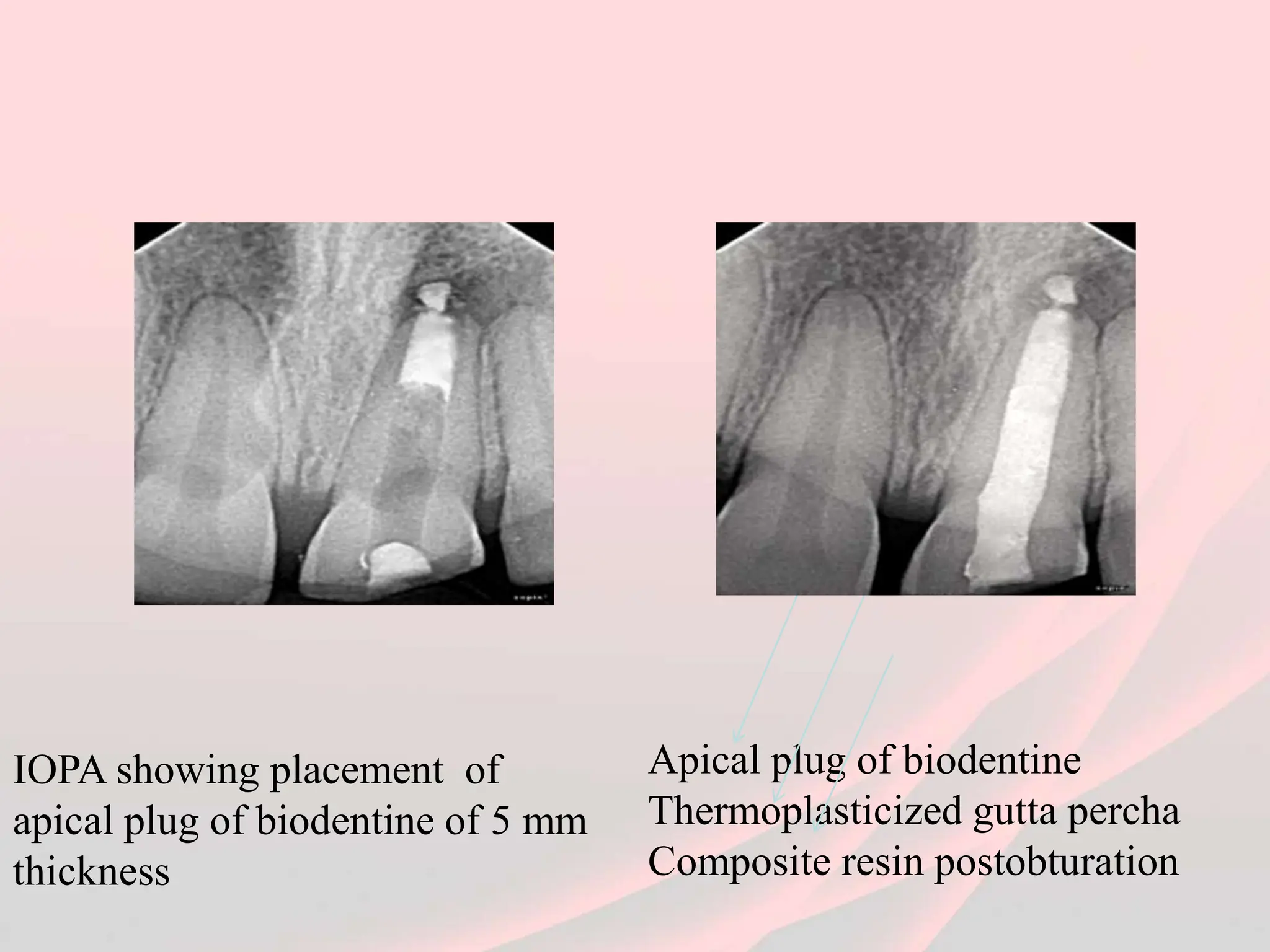
• Subsequently, Biodentine was mixedaccording to manufacturer’s protocol to a
pastelike consistencyin a triturator and delivered to the canal using amalgam
carrier and condensed withSchilder’s pluggers until a thickness of 5 mm .
IOPA showing placement of
apical plug of biodentine of 5 mm
thickness
Apical plug of biodentine
Thermoplasticized gutta percha
Composite resin postobturation
Three month follow up IOPA
showing Periapical healing
DISCUSSION
• The goal of apexification is to obtain an apical
barrier to prevent the passage of toxins and bacteria
into periapical tissues from the root canal.
• Apexification with Biodentine requires significantly
less time. This can lessen the treatment time
between the patient's first appointment and the final
restoration.
• The importance of this approach lies in the effective
cleaning and shaping of the root canal, followed by
apical seal with a material that favors regeneration.
CONCLUSION
• This case report emphasizes the novel approach of
using Biodentine to achieve apexification of the
case with an open apex and large periapical lesion.
• The use of Biodentine has been demonstrated to
induce faster periapical healing for apexification of
the case with large periapical lesions.
• Apexification in one step using an apical plug of
Biodentine can be considered a predictable
treatment and may be an alternative to mineral
trioxide aggregate apexification.
REFERENCES
• Dammaschke T. A new bioactive cement for direct pulp capping.
International Dentistry African 2010;2( 2).64-69.
• American Association of Endodontists. Glossary of endodontitc
terms,7th edn. Chicago: American Association of Endodontists; 2003.
• Komabayashi T, Spångberg LS. Comparative analysis of the particle
size and shape of commercially available mineral trioxide aggregates
and Portland cement: A study with a flow particle image analyzer. J
Endod 2008;34:94-8.
• Pawar AM, Kokate SR, Shah RA. Management of a large periapical
lesion using Biodentine TM as retrograde restoration with eighteen
months evident follow up. J Conserv Dent 2013;16:573-5
APEXIFICATION WITH BIODENTINE , SCOPE N SUCCESS

APEXIFICATION WITH BIODENTINE , SCOPE N SUCCESS

  • 3.
    INTRODUCTION • Proper assessmentof the affected tooth is critical in determining an accurate diagnosis and prescribing the appropriate treatment plan. • The complete formation of root and closure of the apical foramen occurs up to 3 years after the eruption. • Injuries during this period may cause pulpal inflammation or necrosis and subsequent incomplete development of the dentinal walls and root apices which allow the penetration of bacteria and their irritants.
  • 4.
    APEXIFICATION A method toinduce a calcified barrier in a root with an open apex or the continued apical development of an incomplete root in teeth with necrotic pulp
  • 5.
    OPTIONS …!!! It istoday we must create world for future. •Calcium hydroxide, Surgicel/amalgam, •Freeze-dried bone or dentin •Resorbable ceramic, •Tricalcium phosphate, •MTA •BIODENTINE
  • 6.
    BIODENTIN E BETTER HANDLING AND SAFETY FASTER SETTING DOES NOT REQUIRETWO STEP OBTURATION LOWER RISK OF BACTERIAL CONTAMINATION It is today we must create world for future.
  • 7.
    It is todaywe must create world for future. Case Report
  • 8.
    CASE PRESENTATION DATE: 18/07/2017REG. NO: 470774 NAME: Sandeep Kumar AGE: 28 YEARS SEX: MALE
  • 9.
    CASE PRESENTATION • CHIEFCOMPLAINT: Patient complains of pain in right upper front tooth region on biting since 1-2 months . • HISTORY: History of trauma by fall from bicycle 20 years back and remained asymptomatic. Patient felt pain 1-2 months back in upper front tooth region on chewing. Pain was dull, boring and intermittent in nature. It initiates on biting and subsides on its own.
  • 10.
    • Past MedicalHistory – No significant finding • Dental history- No significant finding • Family History- No significant finding • Tenderness on percussion- present
  • 11.
    INTRA ORAL EXAMINATION SoftTissues Examination GINGIVA – no abnormality detected. HardTissues Examination TEETH – No abnormality detected Color - no discoloration present
  • 12.
    VITALITY TEST Electric PulpTesting and Cold Test--were negative irt 21 Heat test– Negative irt 21
  • 13.
    RADIOGRAPHIC EXAMINATION • Wide rootcanal with open apex with 21 • Periapical radiolucency irt 21
  • 14.
    PROVISIONAL DIAGNOSIS • ChronicPeriapical Abscess irt 21 • Pulp necrosis with apical periodontitis FINAL DIAGNOSIS • Immature root apex with pulp necrosis with chronic apical periodontitis
  • 15.
    TREATMENT PLAN 1 VISIT: Access openingirt 11 2 VISIT: Biomechanical preparation followed by intracanal medicament. 3 VISIT: apexification with biodentine followed by obturation
  • 16.
  • 17.
    Pre-operative IOPA of 21associated with periapical radiolucency Working length determination IOPA
  • 18.
    • Biomechanical preparationwasdonetill ISOsize #120 stainlesssteel K file with copious irrigationof normal saline. • Canal was driedusing sterile paper points and Calciumhydroxide as intracanal medicamentwas placedfor 2 weeks. • The patient was recalledafter2 weeks and theinvolvedtooth was foundto be asymptomatic. • The access cavitywas reopened, copious irrigationwas done with Normal saline solution, the root canal was driedwithsterile paper points. • A 4 mm diameter of absorbable gelatine sponge (collaplug) was inserted in the canal withthe help of pluggers to serve as an apical barrier. A slight discomfort shown by the patient revealed that it had reached the periapical tissues. • Subsequently, Biodentine was mixedaccording to manufacturer’s protocol to a pastelike consistencyin a triturator and delivered to the canal using amalgam carrier and condensed withSchilder’s pluggers until a thickness of 5 mm .
  • 19.
    IOPA showing placementof apical plug of biodentine of 5 mm thickness Apical plug of biodentine Thermoplasticized gutta percha Composite resin postobturation
  • 20.
    Three month followup IOPA showing Periapical healing
  • 21.
    DISCUSSION • The goalof apexification is to obtain an apical barrier to prevent the passage of toxins and bacteria into periapical tissues from the root canal. • Apexification with Biodentine requires significantly less time. This can lessen the treatment time between the patient's first appointment and the final restoration. • The importance of this approach lies in the effective cleaning and shaping of the root canal, followed by apical seal with a material that favors regeneration.
  • 22.
    CONCLUSION • This casereport emphasizes the novel approach of using Biodentine to achieve apexification of the case with an open apex and large periapical lesion. • The use of Biodentine has been demonstrated to induce faster periapical healing for apexification of the case with large periapical lesions. • Apexification in one step using an apical plug of Biodentine can be considered a predictable treatment and may be an alternative to mineral trioxide aggregate apexification.
  • 23.
    REFERENCES • Dammaschke T.A new bioactive cement for direct pulp capping. International Dentistry African 2010;2( 2).64-69. • American Association of Endodontists. Glossary of endodontitc terms,7th edn. Chicago: American Association of Endodontists; 2003. • Komabayashi T, Spångberg LS. Comparative analysis of the particle size and shape of commercially available mineral trioxide aggregates and Portland cement: A study with a flow particle image analyzer. J Endod 2008;34:94-8. • Pawar AM, Kokate SR, Shah RA. Management of a large periapical lesion using Biodentine TM as retrograde restoration with eighteen months evident follow up. J Conserv Dent 2013;16:573-5

Editor's Notes

  • #4 The management of a nonvital tooth with open apex consists of the induction of a natural or artificial apical barrier which can act as a stop for the obturating material.
  • #17 Phases of treatment plan ?