Open Access


   Terry M. Owen
   DRUM Coordinator
   13 February 2012
What is Open Access?

Open Access (OA):

    Free, unrestricted, online
    access to scholarly works
What is Open Access?

Open Access (OA):
“…its free availability on the public internet, permitting any users to
read, download, copy, distribute, print, search, or link to the full texts of
these articles, crawl them for indexing, pass them as data to software,
or use them for any other lawful purpose, without financial, legal, or
technical barriers other than those inseparable from gaining access to
the internet itself. The only constraint on reproduction and distribution,
and the only role for copyright in this domain, should be to give authors
control over the integrity of their work and the right to be properly
acknowledged and cited.”
                                                 Budapest Open Access Initiative
                                                http://www.soros.org/openaccess
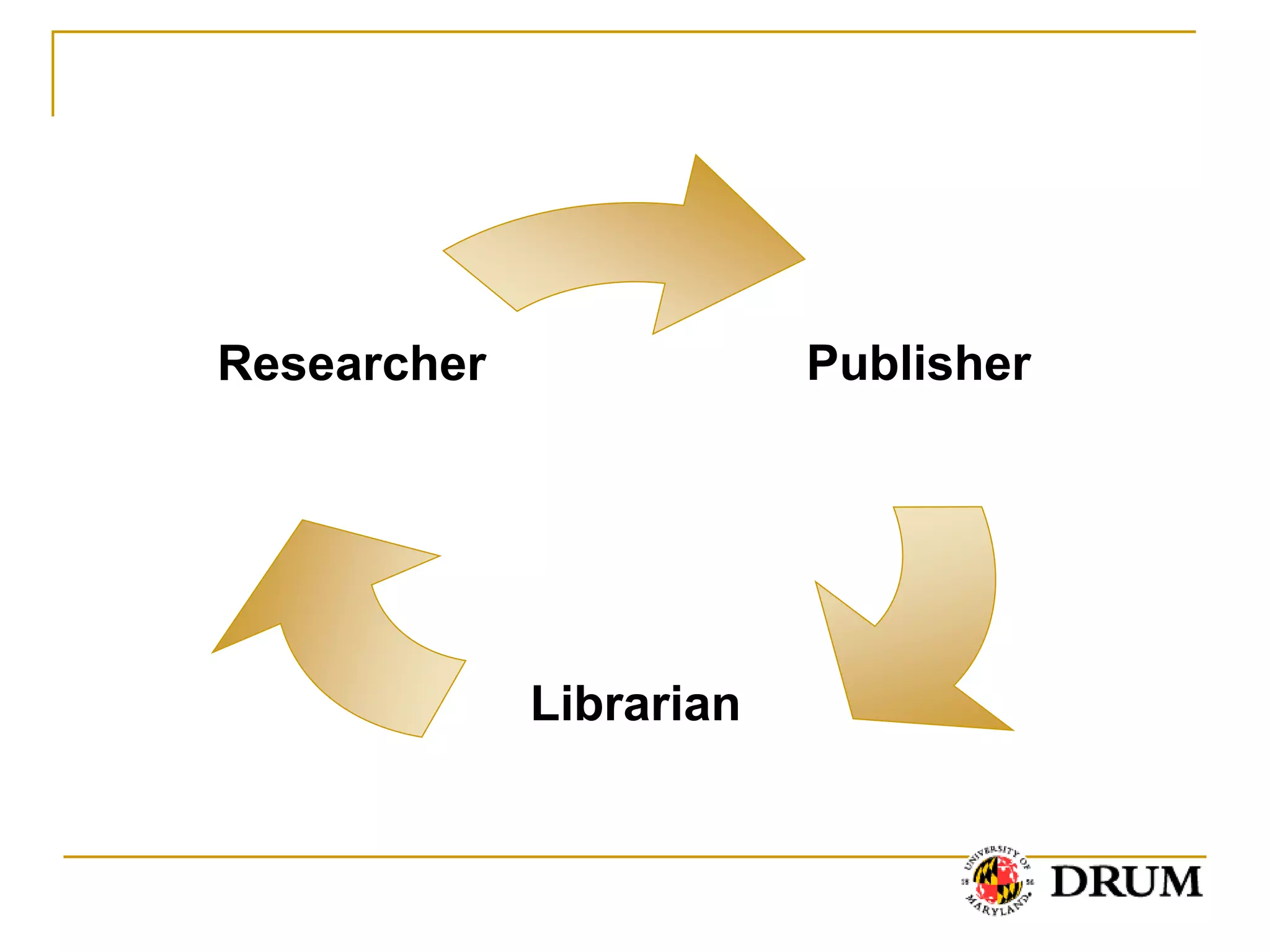
Researcher               Publisher


             Librarian
Scholarly Communication Trends

 Journal titles proliferating
 Journal prices increasing

 Library budget cuts
Scholarly Communication Trends

 Journal titles proliferating
 Journal prices increasing

 Library budget cuts


 Internet access
 Electronic publishing
Why Open Access?

   Wider dissemination of your work
   Wider audience
   Increased potential for your publications to be
    cited by others
   Eliminates barriers for readers
   Helps advance the speed of research
Paths to Open Access

1.   Depositing in a digital repository or
     self-archiving

2.   Publishing in a Open Access
     journal
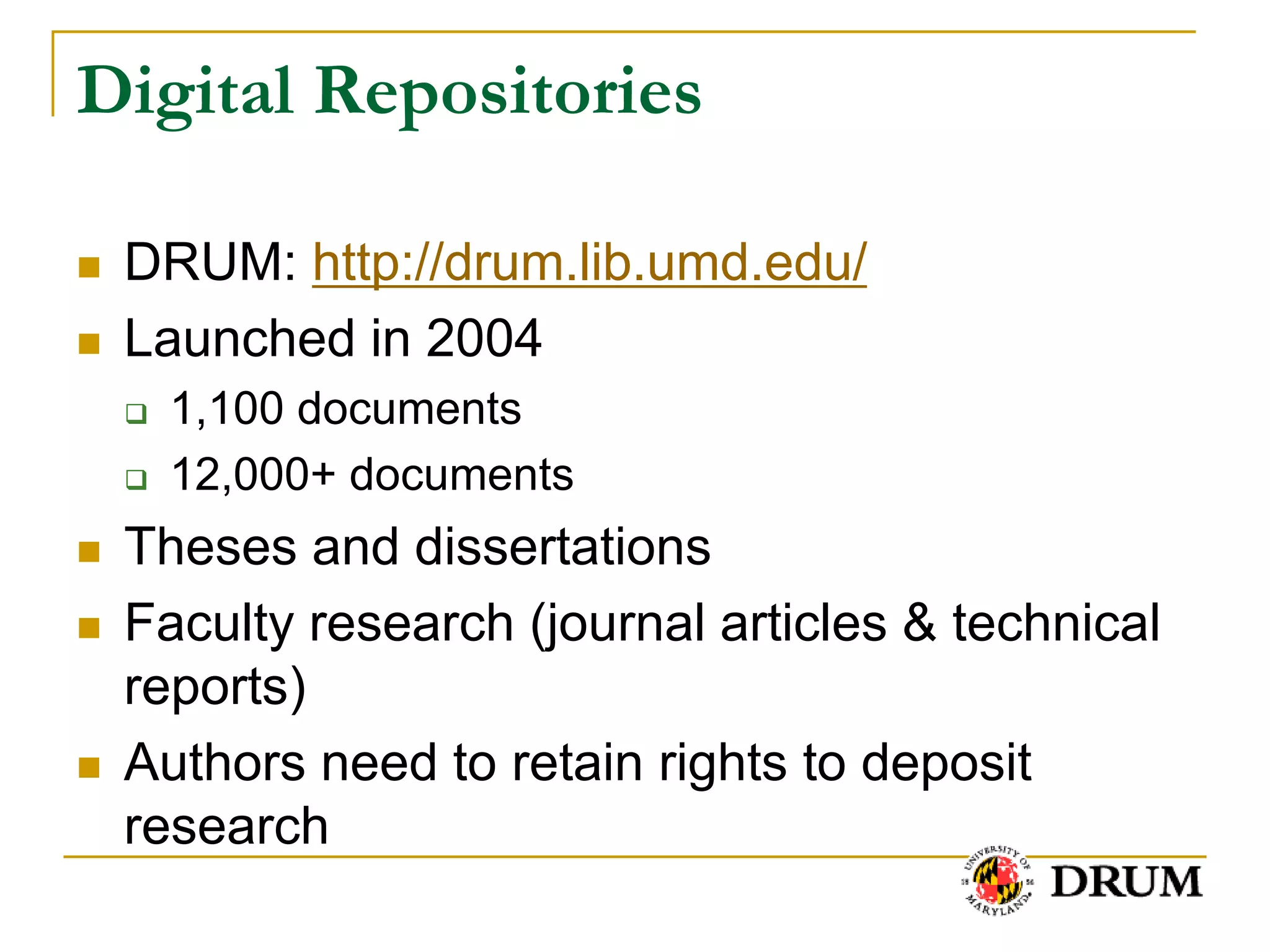
Digital Repositories

   DRUM: http://drum.lib.umd.edu/
   Launched in 2004
       1,100 documents
       12,000+ documents
   Theses and dissertations
   Faculty research (journal articles & technical
    reports)
   Authors need to retain rights to deposit
    research
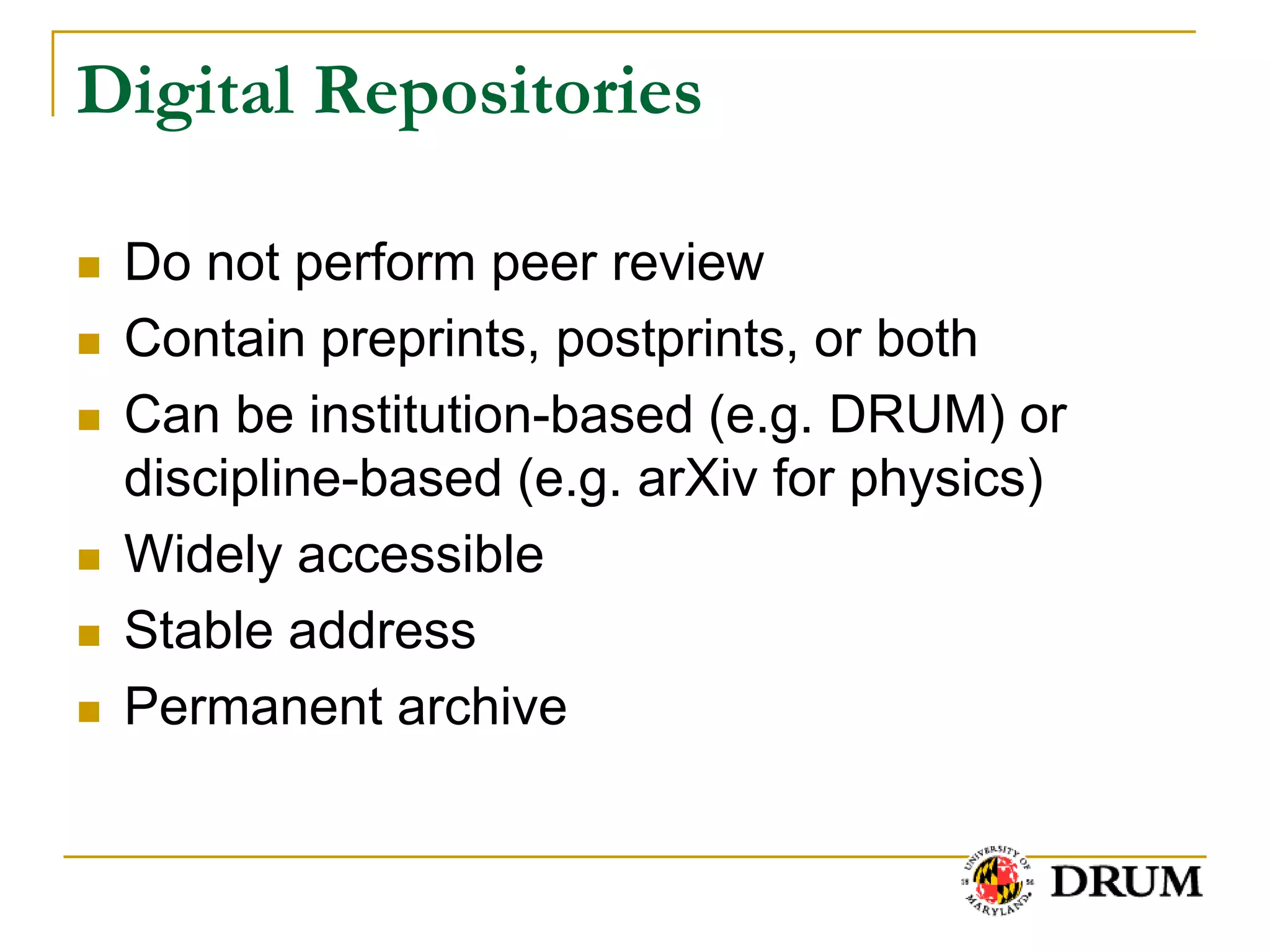
Digital Repositories

   Do not perform peer review
   Contain preprints, postprints, or both
   Can be institution-based (e.g. DRUM) or
    discipline-based (e.g. arXiv for physics)
   Widely accessible
   Stable address
   Permanent archive
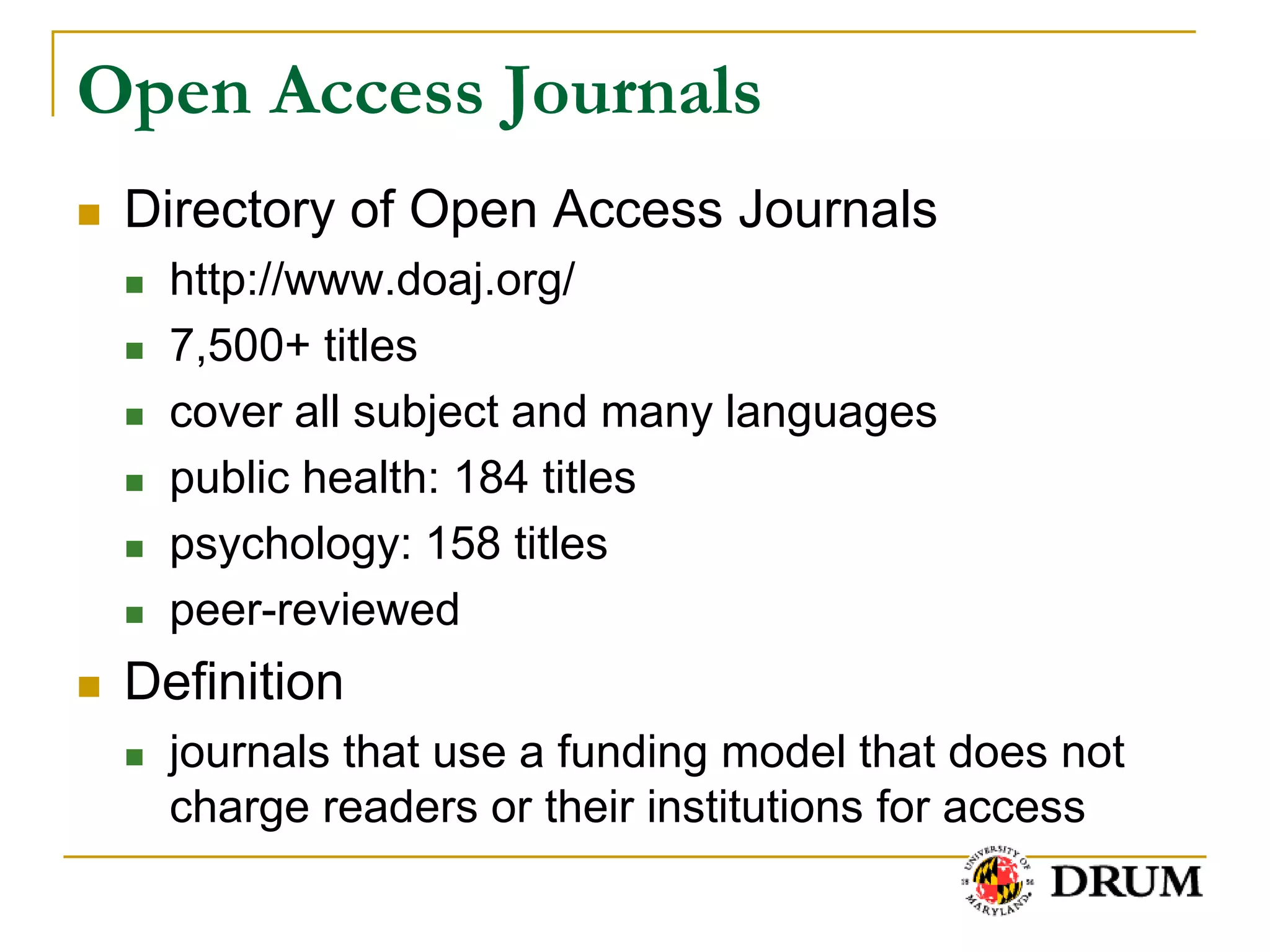
Open Access Journals
   Directory of Open Access Journals
       http://www.doaj.org/
       7,500+ titles
       cover all subject and many languages
       public health: 184 titles
       psychology: 158 titles
       peer-reviewed
   Definition
       journals that use a funding model that does not
        charge readers or their institutions for access
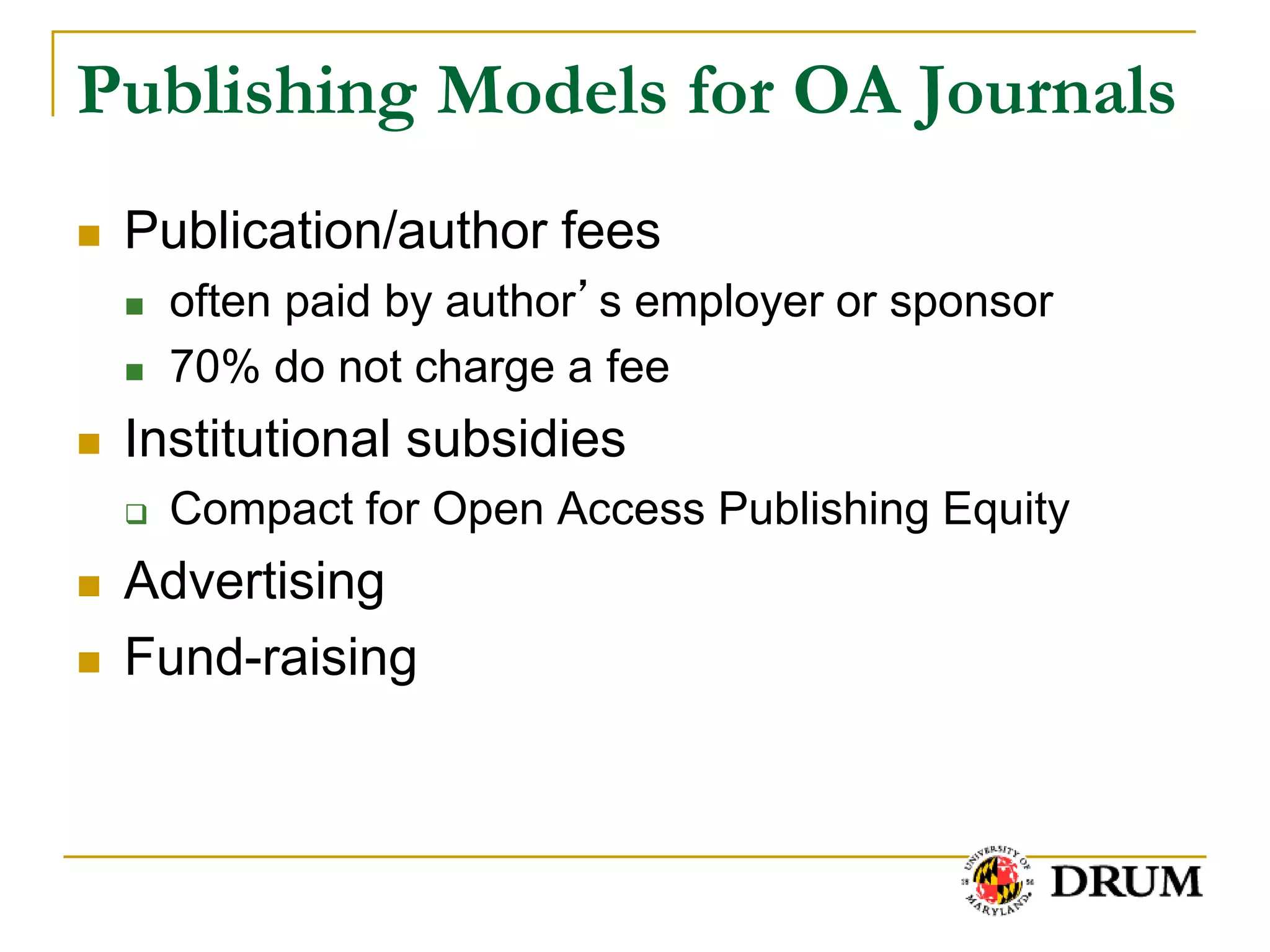
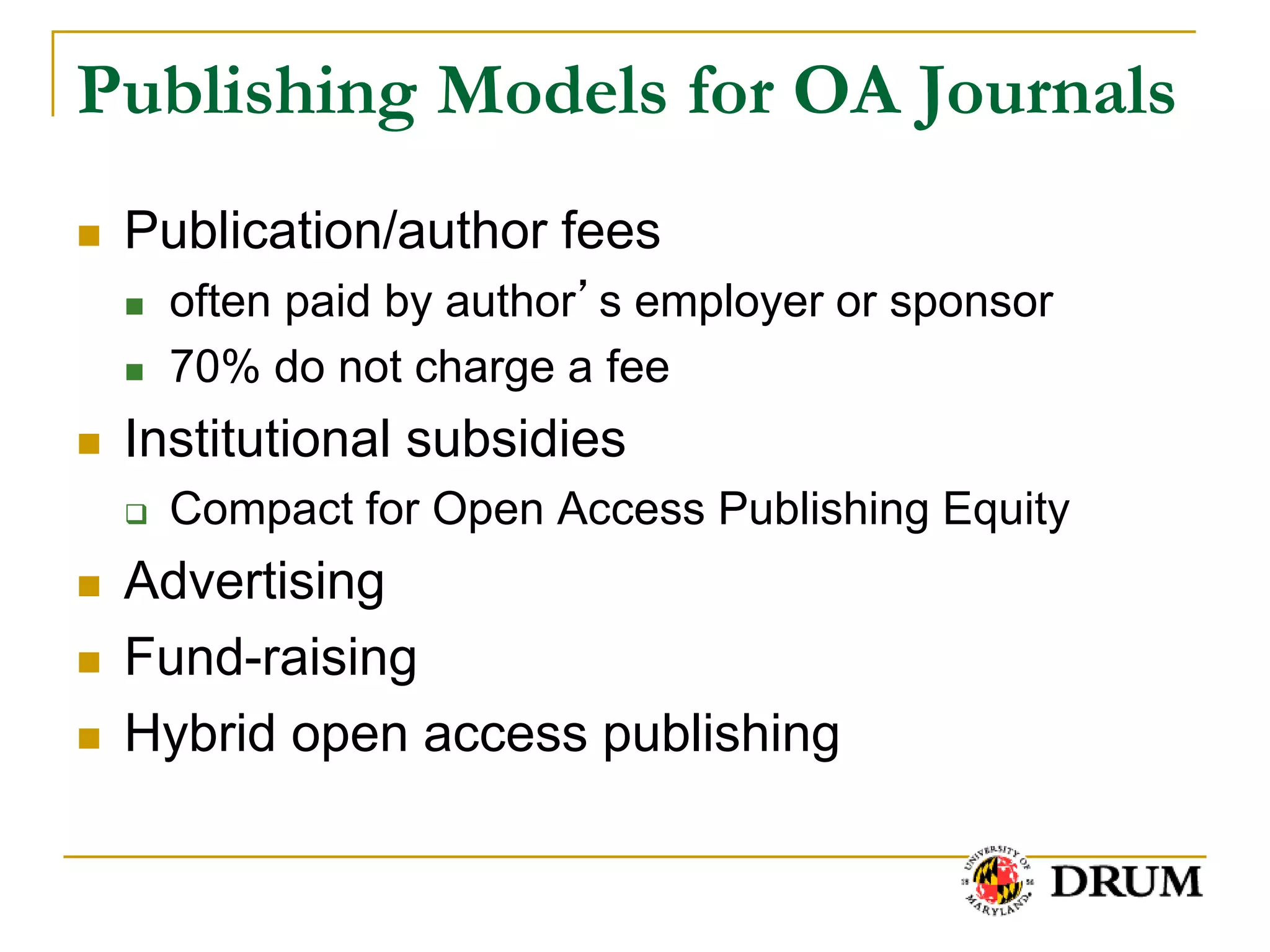
Publishing Models for OA Journals
   Publication/author fees
       often paid by author’s employer or sponsor
       70% do not charge a fee
   Institutional subsidies
       Compact for Open Access Publishing Equity
   Advertising
   Fund-raising
Publishing Models for OA Journals
   Publication/author fees
       often paid by author’s employer or sponsor
       70% do not charge a fee
   Institutional subsidies
       Compact for Open Access Publishing Equity
   Advertising
   Fund-raising
   Hybrid open access publishing
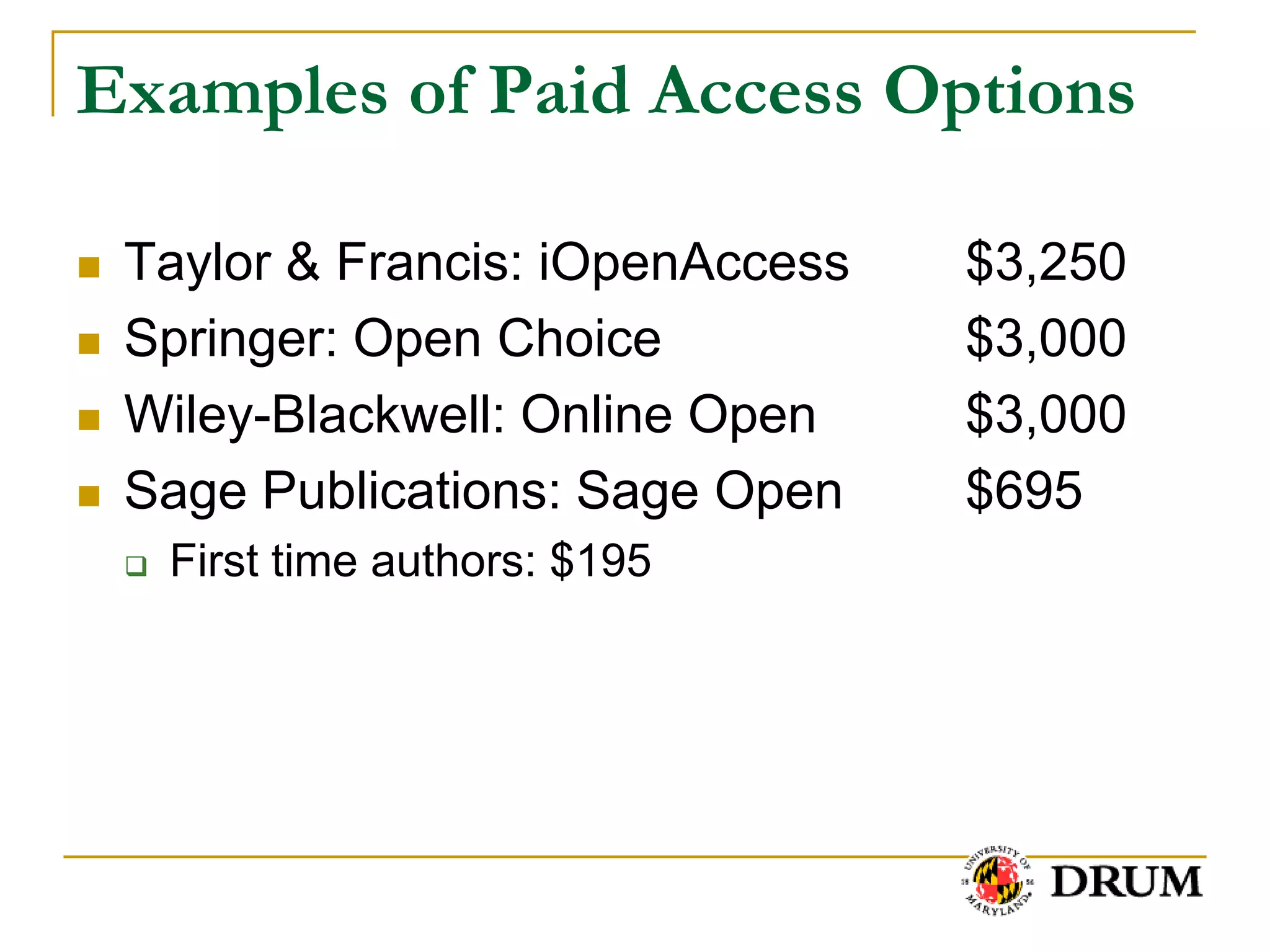
Examples of Paid Access Options

   Taylor & Francis: iOpenAccess   $3,250
   Springer: Open Choice           $3,000
   Wiley-Blackwell: Online Open    $3,000
   Sage Publications: Sage Open    $695
       First time authors: $195
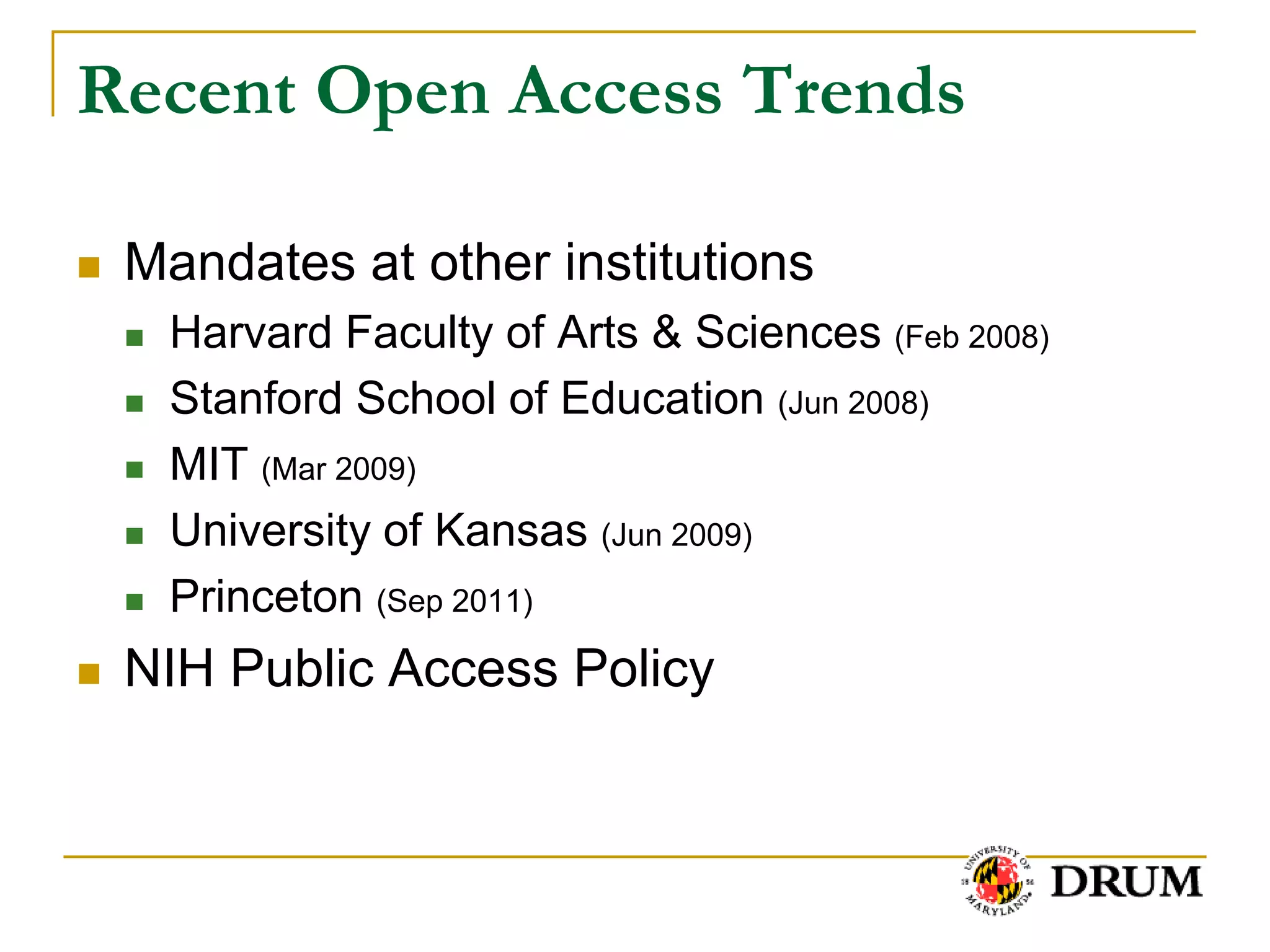
Recent Open Access Trends

   Mandates at other institutions
       Harvard Faculty of Arts & Sciences (Feb 2008)
       Stanford School of Education (Jun 2008)
       MIT (Mar 2009)
       University of Kansas (Jun 2009)
       Princeton (Sep 2011)
   NIH Public Access Policy
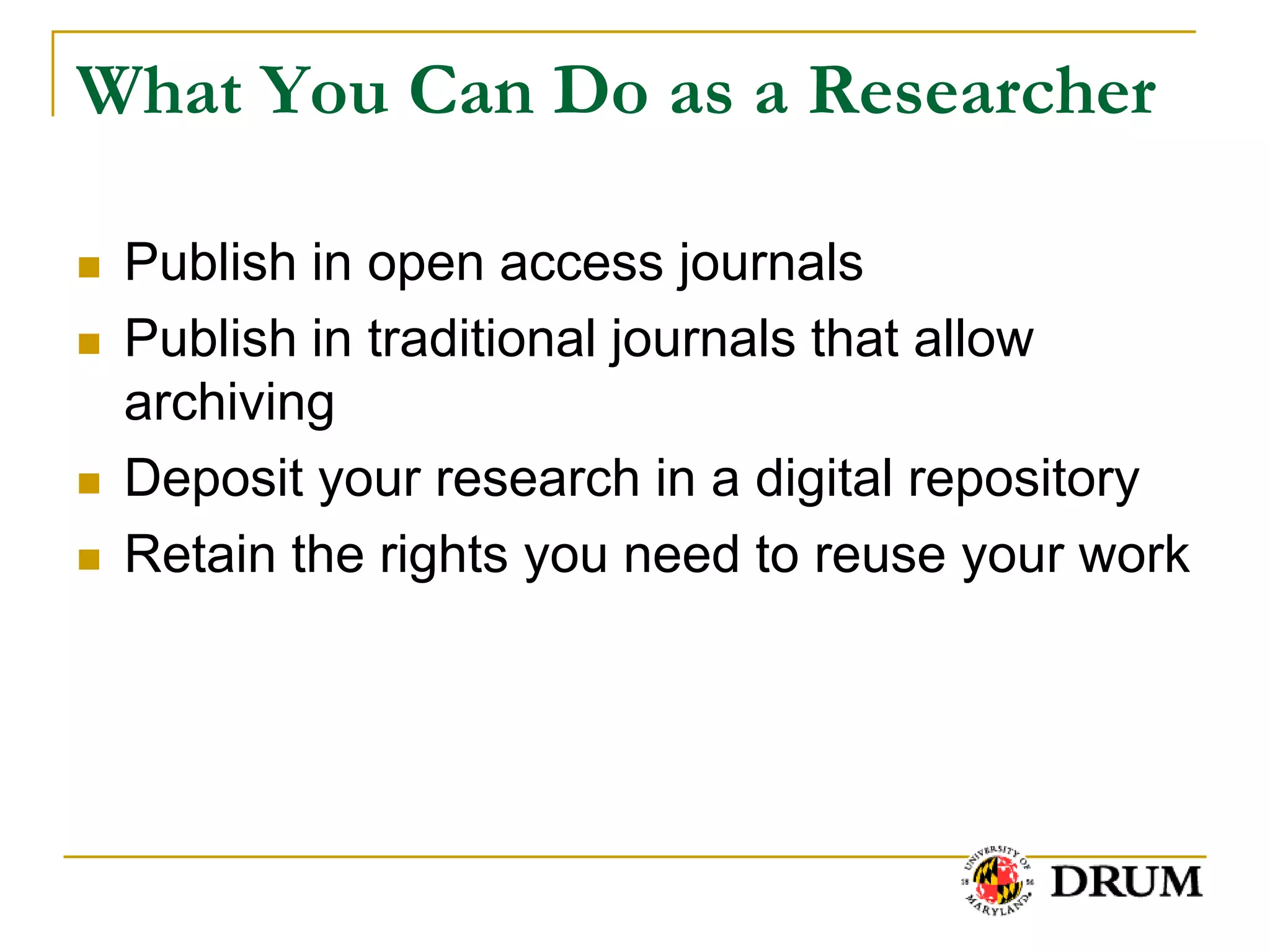
What You Can Do as a Researcher

   Publish in open access journals
   Publish in traditional journals that allow
    archiving
   Deposit your research in a digital repository
   Retain the rights you need to reuse your work
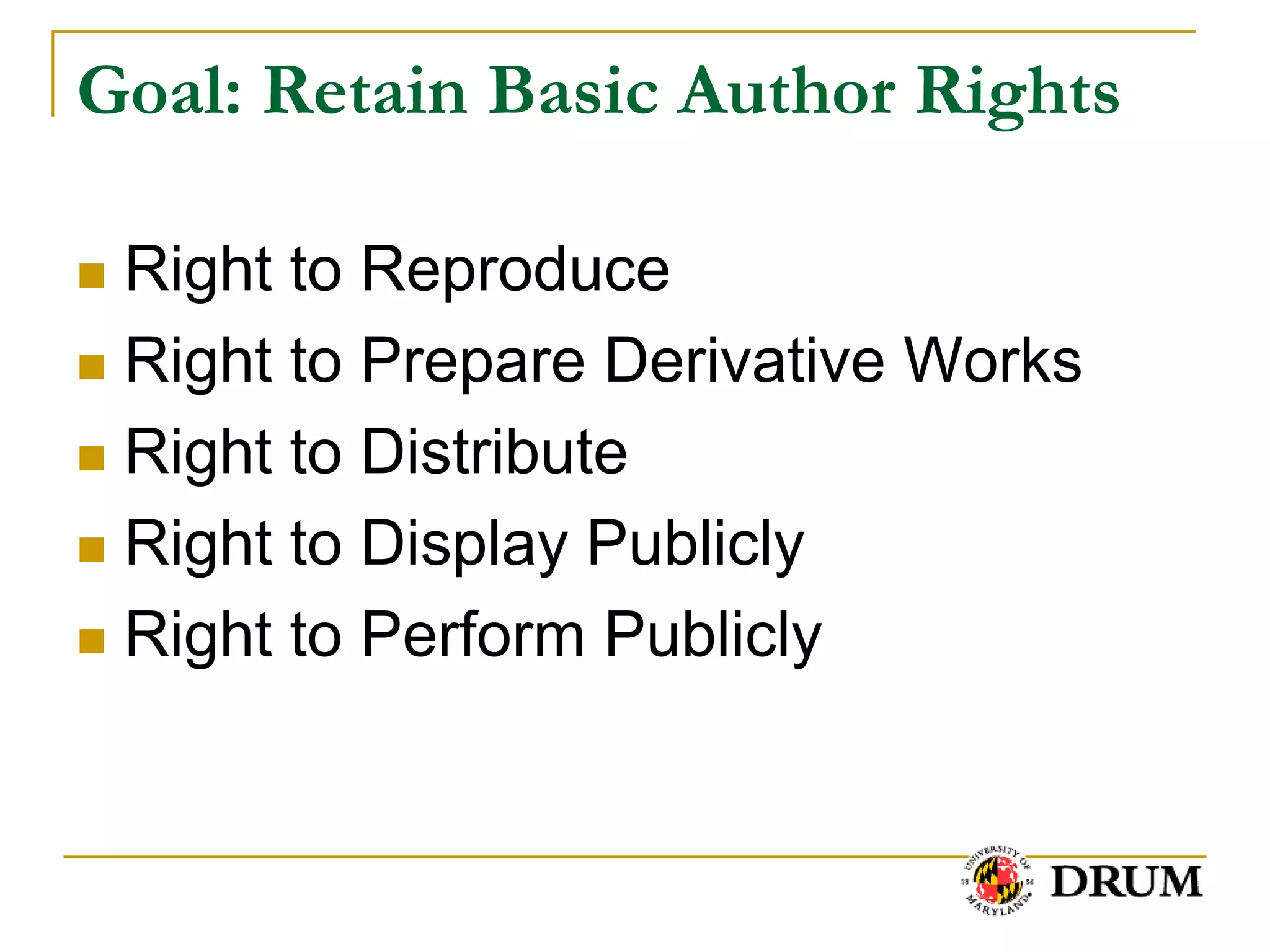
Goal: Retain Basic Author Rights

 Right to Reproduce
 Right to Prepare Derivative Works

 Right to Distribute

 Right to Display Publicly

 Right to Perform Publicly
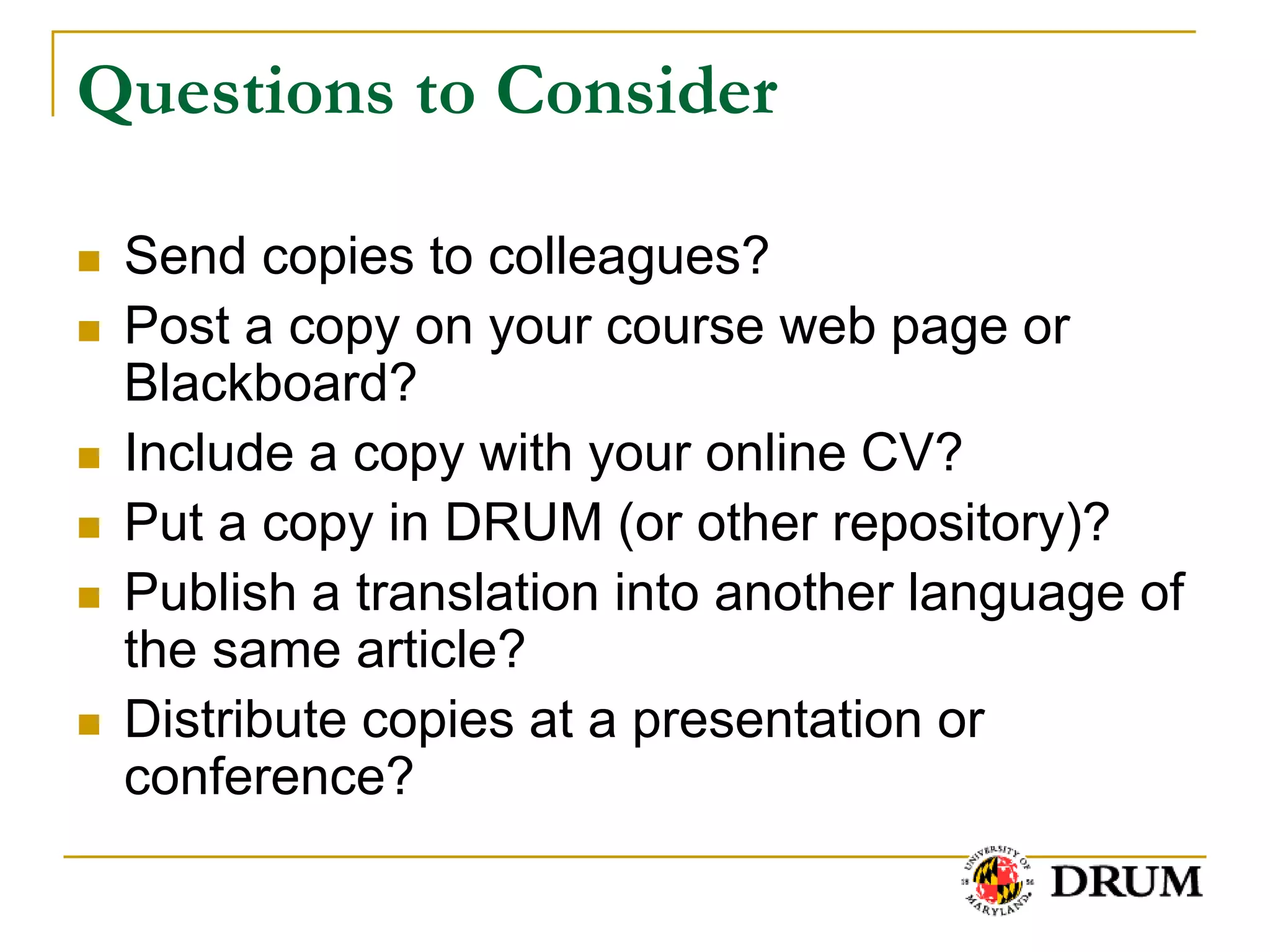
Questions to Consider

   Send copies to colleagues?
   Post a copy on your course web page or
    Blackboard?
   Include a copy with your online CV?
   Put a copy in DRUM (or other repository)?
   Publish a translation into another language of
    the same article?
   Distribute copies at a presentation or
    conference?
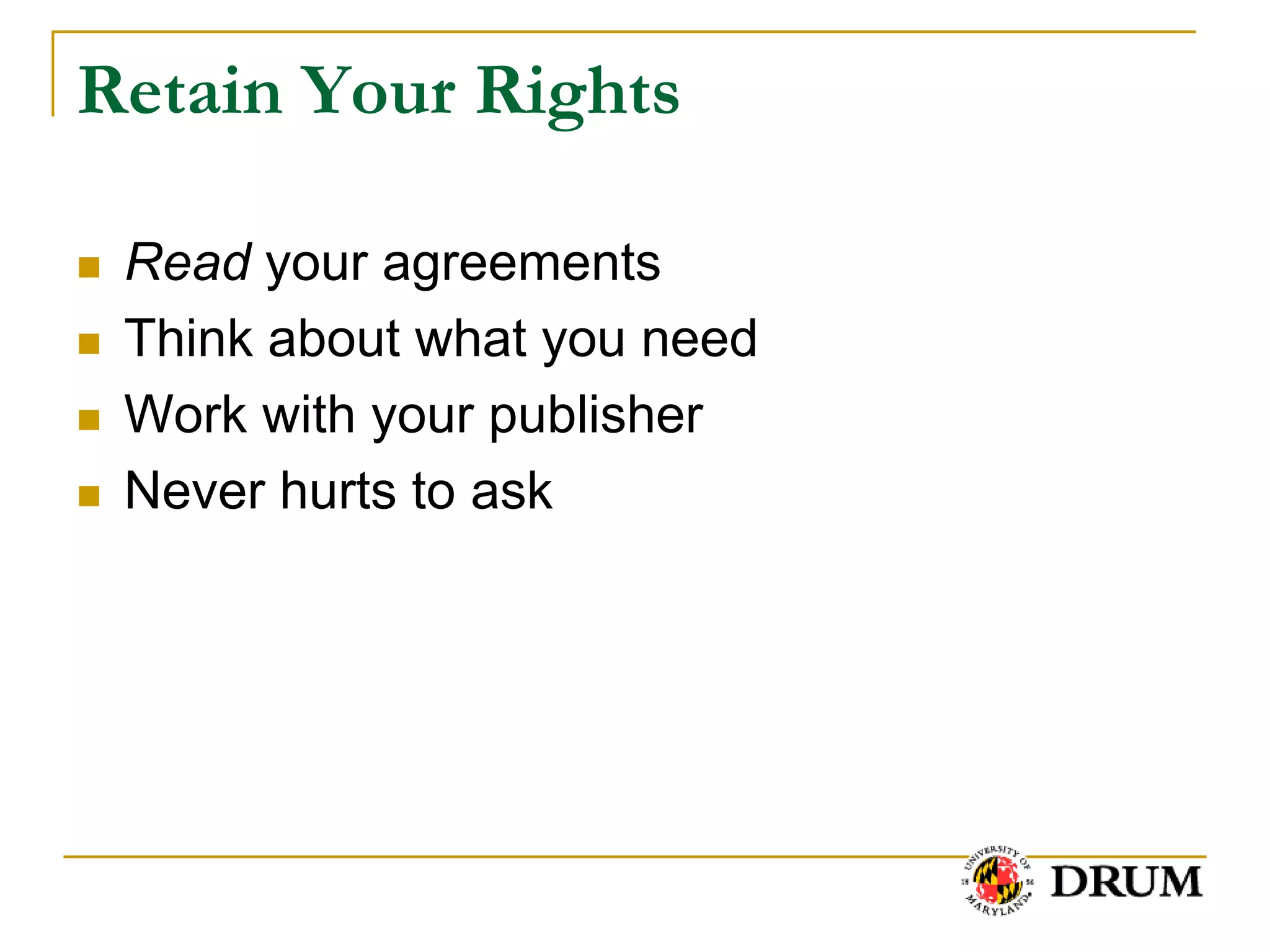
Retain Your Rights

   Read your agreements
   Think about what you need
   Work with your publisher
   Never hurts to ask
Questions?


   Terry Owen
DRUM Coordinator
 towen@umd.edu

Open accesshlth742

  • 1.
    Open Access Terry M. Owen DRUM Coordinator 13 February 2012
  • 2.
    What is OpenAccess? Open Access (OA): Free, unrestricted, online access to scholarly works
  • 3.
    What is OpenAccess? Open Access (OA): “…its free availability on the public internet, permitting any users to read, download, copy, distribute, print, search, or link to the full texts of these articles, crawl them for indexing, pass them as data to software, or use them for any other lawful purpose, without financial, legal, or technical barriers other than those inseparable from gaining access to the internet itself. The only constraint on reproduction and distribution, and the only role for copyright in this domain, should be to give authors control over the integrity of their work and the right to be properly acknowledged and cited.” Budapest Open Access Initiative http://www.soros.org/openaccess
  • 4.
    Researcher Publisher Librarian
  • 5.
    Scholarly Communication Trends Journal titles proliferating  Journal prices increasing  Library budget cuts
  • 6.
    Scholarly Communication Trends Journal titles proliferating  Journal prices increasing  Library budget cuts  Internet access  Electronic publishing
  • 7.
    Why Open Access?  Wider dissemination of your work  Wider audience  Increased potential for your publications to be cited by others  Eliminates barriers for readers  Helps advance the speed of research
  • 8.
    Paths to OpenAccess 1. Depositing in a digital repository or self-archiving 2. Publishing in a Open Access journal
  • 9.
    Digital Repositories  DRUM: http://drum.lib.umd.edu/  Launched in 2004  1,100 documents  12,000+ documents  Theses and dissertations  Faculty research (journal articles & technical reports)  Authors need to retain rights to deposit research
  • 10.
    Digital Repositories  Do not perform peer review  Contain preprints, postprints, or both  Can be institution-based (e.g. DRUM) or discipline-based (e.g. arXiv for physics)  Widely accessible  Stable address  Permanent archive
  • 11.
    Open Access Journals  Directory of Open Access Journals  http://www.doaj.org/  7,500+ titles  cover all subject and many languages  public health: 184 titles  psychology: 158 titles  peer-reviewed  Definition  journals that use a funding model that does not charge readers or their institutions for access
  • 12.
    Publishing Models forOA Journals  Publication/author fees  often paid by author’s employer or sponsor  70% do not charge a fee  Institutional subsidies  Compact for Open Access Publishing Equity  Advertising  Fund-raising
  • 13.
    Publishing Models forOA Journals  Publication/author fees  often paid by author’s employer or sponsor  70% do not charge a fee  Institutional subsidies  Compact for Open Access Publishing Equity  Advertising  Fund-raising  Hybrid open access publishing
  • 14.
    Examples of PaidAccess Options  Taylor & Francis: iOpenAccess $3,250  Springer: Open Choice $3,000  Wiley-Blackwell: Online Open $3,000  Sage Publications: Sage Open $695  First time authors: $195
  • 15.
    Recent Open AccessTrends  Mandates at other institutions  Harvard Faculty of Arts & Sciences (Feb 2008)  Stanford School of Education (Jun 2008)  MIT (Mar 2009)  University of Kansas (Jun 2009)  Princeton (Sep 2011)  NIH Public Access Policy
  • 16.
    What You CanDo as a Researcher  Publish in open access journals  Publish in traditional journals that allow archiving  Deposit your research in a digital repository  Retain the rights you need to reuse your work
  • 17.
    Goal: Retain BasicAuthor Rights  Right to Reproduce  Right to Prepare Derivative Works  Right to Distribute  Right to Display Publicly  Right to Perform Publicly
  • 18.
    Questions to Consider  Send copies to colleagues?  Post a copy on your course web page or Blackboard?  Include a copy with your online CV?  Put a copy in DRUM (or other repository)?  Publish a translation into another language of the same article?  Distribute copies at a presentation or conference?
  • 19.
    Retain Your Rights  Read your agreements  Think about what you need  Work with your publisher  Never hurts to ask
  • 20.
    Questions? Terry Owen DRUM Coordinator towen@umd.edu