Introduction to Open Access

            Robert Perret
     Savvy Skills for Researchers
           October 2011
         University of Idaho
What is Open Access?
• Free of charge(to the reader)
• Free of most copyright and licensing
  restrictions
• Online
• Digital
• Immediate (No delays or embargoes)
• Full-text
What is Open Access?
• Simply removing the price barrier is not
  sufficient
• Tolerating “fair use” is not sufficient
What is Open Access?
• Per the Bethesda and Berlin statements, to be
  OA the copyright holder must consent in
  advance to let users
  copy, use, print, index, distribute, transmit and
  display the work publically, as well as to make
  and transmit derivative works
• Essentially the only right retained under OA is
  the right to proper attribution of authorship
History of Open Access


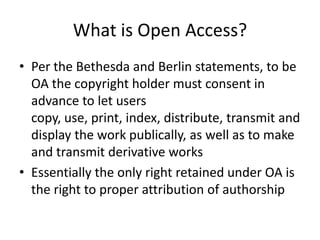
            www.webopedia.com/TERM/A/ARPANET.html


• 1969 – Steve Crocker sends a “Request for
  Comment” on his paper about IMP software
  across ARPANet.
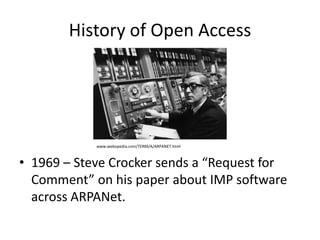
http://www.woldgate50.com/Seventies.htm


• 1970 First free online databases
  – Agricola (Government)
  – Project Gutenberg (Private)
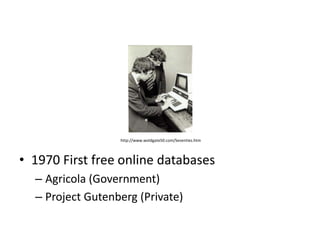
http://s3.media.squarespace.com/production/650702/7578546/wp-
           content/uploads/2009/12/1174631634_faad3aaea7_thumb.jpg


• 1971 First email sent by engineer Ray
  Tomlinson
http://www.chemistryexplained.com/Te-Va/Transactinides.html


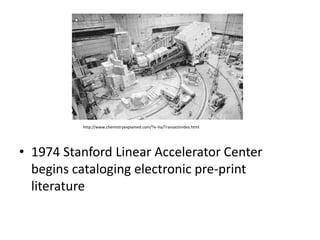
• 1974 Stanford Linear Accelerator Center
  begins cataloging electronic pre-print
  literature
http://echo.gmu.edu/node/5147


• 1979 USENET created
• 1981 JANET and BITNET
http://www.photosfan.com/images/ealy-home-computer-pcs.jpg


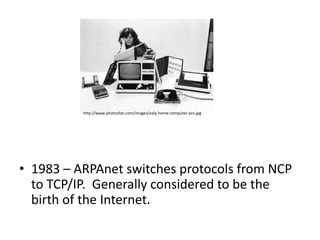
• 1983 – ARPAnet switches protocols from NCP
  to TCP/IP. Generally considered to be the
  birth of the Internet.
http://www.reagan.utexas.edu/archives/photographs/large/c6289-25a.jpg


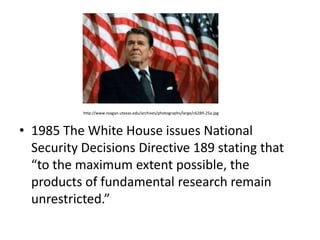
• 1985 The White House issues National
  Security Decisions Directive 189 stating that
  “to the maximum extent possible, the
  products of fundamental research remain
  unrestricted.”
http://t1.gstatic.com/images?q=tbn:ANd9GcTwj-
                 H3pjRpNmynksyoAj5QdDVUFejpl7VixKcvrBarVU367JEw


• 1987 Syracuse University launches New
  Horizons in Adult Education, the first
  free, online peer-reviewed journal
emeraldinsight.com


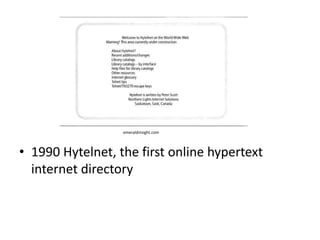
• 1990 Hytelnet, the first online hypertext
  internet directory
www.guardian.co.uk


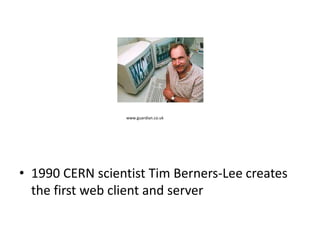
• 1990 CERN scientist Tim Berners-Lee creates
  the first web client and server
http://www.xtimeline.com/evt/view.aspx?id=394653


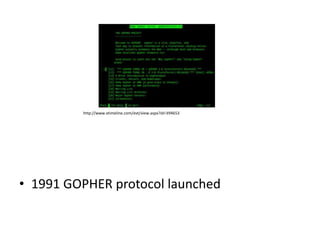
• 1991 GOPHER protocol launched
http://www.library.rochester.edu/images_Dbases/DB_icon_Project_Muse.gif


• 1993 Project MUSE provides free full-text
  searching and authors retain copyright
http://cdn.dipity.com/uploads/events/17257797fb4c1f67145f388dd39519a4_1M.png


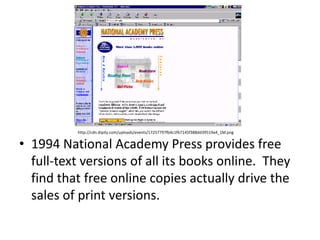
• 1994 National Academy Press provides free
  full-text versions of all its books online. They
  find that free online copies actually drive the
  sales of print versions.
http://web.archive.org/web/19970126045828/http://www.archive.org/


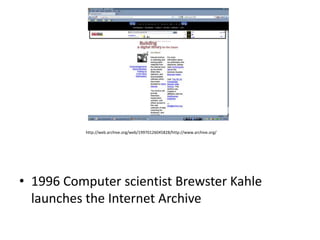
• 1996 Computer scientist Brewster Kahle
  launches the Internet Archive
http://web.archive.org/web/19980113191222/http://slashdot.org/


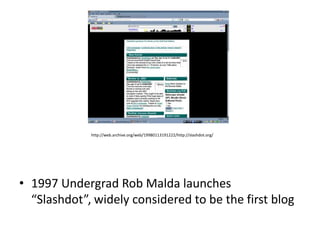
• 1997 Undergrad Rob Malda launches
  “Slashdot”, widely considered to be the first blog
http://web.archive.org/web/20000229093412/http://www.openarchives.org/


• 1999 Open Archives Initiative launched
http://web.archive.org/web/20010727112808/http://www.wikipedia.org/


• 2001 Internet entrepreneur Jimmy Wales
  launches Wikipedia
http://www.researchinformation.info/rimarapr05oaister.html


• 2002 OAIster launched by University of
  Michigan
http://web.archive.org/web/20110628180027/http://creativecommons.org/


• 2002 Stanford law professor Lawrence Lessig
  launches the Creative Commons system
http://web.archive.org/web/20030214235014/http://www.doaj.org/


• 2003 The Directory of Open Access Journals
  launches
http://www.earlham.edu/~peters/fos/bethesda.htm


• 2003 Bethesda Statement on Open Access
  Publishing released
http://web.archive.org/web/20110722063241/http://books.google.com/


• 2004 Google Scholar and Google Books
http://blogs.library.ualberta.ca/libnews/wp-
                   content/uploads/2008/10/oad_120x240.jpg


• 2008 First International Open Access Day
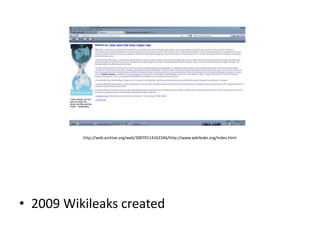
http://web.archive.org/web/20070114162346/http://www.wikileaks.org/index.html


• 2009 Wikileaks created
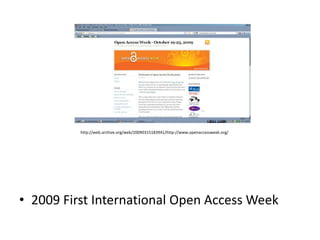
http://web.archive.org/web/20090315183941/http://www.openaccessweek.org/


• 2009 First International Open Access Week
What OA is intended to do
• Block plagiarism and misrepresentation
• Impedes commercial re-use
• Authorizes and facilitates legitimate
  scholarship
What OA is not intended to do
•   Legitimize vigilante behavior (wikileaks)
•   Facilitate expropriating
•   Encouraging infringing
•   Justify piracy
What OA isn’t
• OA is not the same as universal access. OA
  does not address:
  – Filtering and censorship barriers
  – Language barriers
  – Handicap access
  – Connectivity barriers
Issues in Open Access
• Credibility
  – Peer review
  – Impact factor
• Cost
  – Author fees
     • Self-publishing?
  – Institutional Funds
  – Advertising/Sponsorship
OA Credibility
• The value, rigor, and integrity of peer review is
  independent of the price or medium of a
  journal
• The same procedures, standards, and even the
  same reviewers and editors can be used
Journal vs. Repository
• OA journals have the ability to maintain the same
  standards and practices as traditional peer-
  reviewed journals
• Repositories do not have a quality-control
  function, merely a preservation/access function
• Repositories can also contain
  theses, dissertations, course materials, data
  files, audio and video files, institutional
  records, and digitalized special collections
OA “Business Model”
• In the traditional publisher paradigm, authors
  write, reviewers review, and editors edit
  without direct compensation.
• All of this is supported by research
  institutions.
• Publishers package the writing and then sell
  the product back to the research institutions
  that created the writing in the first place.
OA “Business Model”
• Academics write and edit for impact and career
  advancement, not (directly) profit, so OA is compatible
  and even advantageous
• Institutions are already paying for published research
  (twice) with diminishing returns on access
• Supporting the system by paying once upfront instead
  of on an ongoing basis is advantageous for institutions
  in the long run
• Large institutions will publish more articles and bear
  more cost, but will be buying the same prestige and
  impact they are already buying at a lower cost, with
  greater access for everyone, including themselves
Reduced cost
• OA reduces the cost of scholarly publishing by:
  – Eliminating print
  – Eliminating subscription management
  – Eliminating DRM
  – Reducing legal expenses
  – Reducing marketing costs by relying on social
    media and search engines
Mitigated costs
• Some OA resources offset costs by:
  – Author/publication fee
  – Advertising
  – Add-ons
  – Auxiliary Services
Need for Open Access

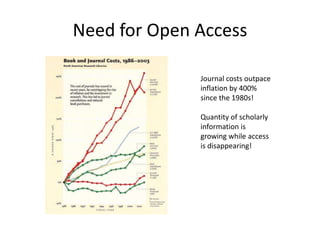
              Journal costs outpace
              inflation by 400%
              since the 1980s!

              Quantity of scholarly
              information is
              growing while access
              is disappearing!
Advantages to institution
•   Broader access to resources
•   Lower-cost in the long-run
•   Facilitates text and data mining
•   Increases author visibility and impact
•   Advances mission to share knowledge
OA and public funding
• Open Access publishing is now often required
  to receive public funding, except for classified
  military research, patentable discoveries, and
  research that generates royalties
Open Access Fund
• Pool of money set aside by an institution or
  other research-sponsoring entity specifically
  to defray or cover OA journal processing fees
• Cornell University, Dartmouth
  College, Harvard University, MIT, and UC
  Berkeley
Advantages for authors
• Wider audience and greater impact than
  subscription journals (Studies vary by
  discipline and journal, but 2011 studies
  showed an increase of citation between 130%-
  740%. Looking at the past several years, it
  seems safe to say that OA publishing easily
  doubles the number of citations in most
  cases.)
        http://opcit.eprints.org/oacitation-biblio.html
Advantages for journals/publishers
• Increased visibility may attracts:
  – Submissions
  – Advertisers
  – Readers
  – Citations
• May be combined with subscription strategies
Open Access Availability
• Estimated 4200 open access peer-reviewed
  journals
• Directory of Open Access Journals is a great
  resource
• It has been estimated that about 20% of
  scholarly papers are published OA http://opcit.eprints.org/oacitation-
  biblio.html
Open Access vs. Creative Commons
• Creative Commons is a standardized system
  for indicating that an author has granted
  permissive rights to a work
• OA and CC are not the same thing
• However, sufficiently permissive CC licenses
  may be compatible with OA
• Similar impetus
Author Permission
• Be aware that if you have already transferred
  copyright to a publisher, you must now seek
  permission for OA publication, even repository
  storage
Green OA
• However, many publishers provide blanket
  permission for Green OA, or placing any pre-
  publication draft in an OA repository
• This can include drafts that have been through
  the peer review process – anything up until
  you sign the contract on the final proof
• Project SHERPA is an online clearinghouse for
  publishing agreements – including Green OA
Resources
•   www.righttoresearch.org
•   www.doaj.org
•   http://www.sherpa.ac.uk/
•   Effect on Impact Factor bibliography
Citations
• Björk, B.-C., Welling, P., Laakso, M., Majlender, P., Hedlund, T., &
  Guðnason, G. (2010). Open Access to the Scientific Journal
  Literature: Situation 2009. PLoS ONE, 5(6), e11273.
  doi:10.1371/journal.pone.0011273
• Eyal Amiran. (2010). The Open Access Debate. symploke, 18(1-
  2), 251-260.
• Jacobs, N. (2006). Open access  key strategic, technical and
                                     :
  economic aspects. Oxford: Chandos.
• Laakso, M., Welling, P., Bukvova, H., Nyman, L., Björk, B.-C., &
  Hedlund, T. (2011). The Development of Open Access Journal
  Publishing from 1993 to 2009. PLoS ONE, 6(6), e20961.
  doi:10.1371/journal.pone.0020961
• Willinsky, J. (2006). The access principle  the case for open access
                                              :
  to research and scholarship. Cambridge Mass.: MIT Press.

Open access savvy skills 2011