Professor Julian Richards
Open Data in European Archaeology
• Context: The Open Agenda
• Past Reality – the development of data sharing
• The current state of play
– National data sharing infrastructures
– International e-infrastructures in archaeology
• Why should we share our data - Sticks
• Why should we share our data - ..and Carrots
Outline
http://archaeologydataservice.ac.uk
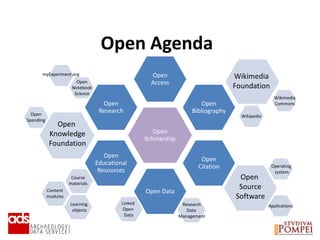
Open
Scholarship
Open
Access
Open
Bibliography
Open
Citation
Open Data
Open
Educational
Resources
Open
Research
Open
Knowledge
Foundation
Open
Source
Software
Open Agenda
Wikimedia
Foundation
Course
materials
Learning
objects
Content
modules
Linked
Open
Data
Research
Data
Management
Open
Notebook
Science
myExperiment.org
Open
Spending
Wikipedia
Wikimedia
Commons
Operating
system
Applications
Open Data
• Open data is the idea that certain data should
be freely available to everyone to use and
republish as they wish, without restrictions
from copyright, patents or other mechanisms
of control
(Wikipedia, 9 June 2013)
• Open data tradition and archaeology
The Open Data Movement
• Related to Open Access movement for
publications
• Data.gov & Data.gov.uk
• "A piece of data is open if anyone is free to
use, reuse, and redistribute it — subject only,
at most, to the requirement to attribute
and/or share-alike”
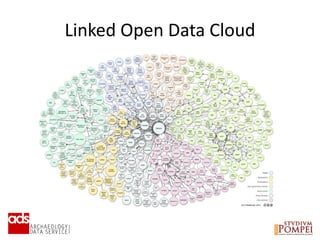
Linked Open Data Cloud
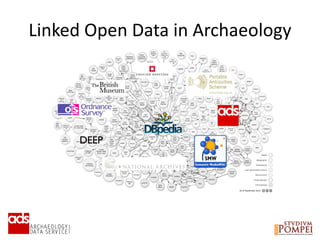
Linked Open Data in Archaeology
Open Data in Science
• The concept of open access to scientific data
was institutionally established in preparation for
the International Geophysical Year of 1957-8.
The International Council of Scientific Unions
established several World Data Centers to
minimize the risk of data loss and to maximize
data accessibility, further recommending in
1955 that data be made available in machine-
readable form.
• The Open-science-data movement long
predates the Internet
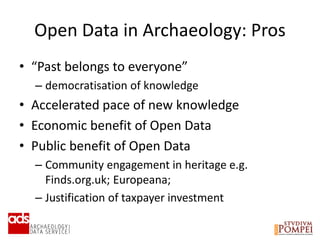
Open Data in Archaeology: Pros
• “Past belongs to everyone”
– democratisation of knowledge
• Accelerated pace of new knowledge
• Economic benefit of Open Data
• Public benefit of Open Data
– Community engagement in heritage e.g.
Finds.org.uk; Europeana;
– Justification of taxpayer investment
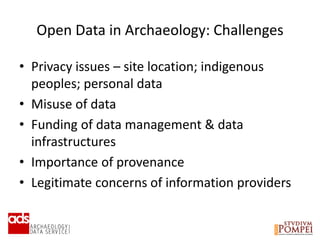
Open Data in Archaeology: Challenges
• Privacy issues – site location; indigenous
peoples; personal data
• Misuse of data
• Funding of data management & data
infrastructures
• Importance of provenance
• Legitimate concerns of information providers
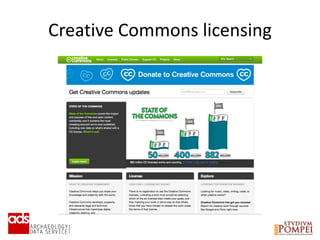
Creative Commons licensing
• Context: The Open Agenda
• Past Reality – the development of data sharing
• The current state of play
– National data sharing infrastructures
– International e-infrastructures in archaeology
• Why should we share our data - Sticks
• Why should we share our data - ..and Carrots
Outline
http://archaeologydataservice.ac.uk
The Reality
The prehistory of (non-)sharing
Rahtz, Sebastian 1988 `Reflections on an
Archaeological Information Exchange'
Archaeol Comput Newslett 16, 10-15
“The AIE in operation at Southampton University contains so far:
mailing list; distribution service for data and/or software; and an on-
line service. Problems include: the labour-intensive nature of the
mailing list; little use of the service by archaeologists as opposed to
UNIX-addicts....”
Harrison Eiteljorg, II 1994 ‘Archaeological Data
Archive Project’, CSA Newsletter VII(3)
Harrison Eiteljorg, II 2002 ‘The Archaeological
Data Archive Project Ceases Operation’, CSA
Newsletter XV (2)
“There appear to be two insurmountable problems with the
archives. One is the absence of any real possibility for
assembling a large enough body of material to be truly useful
within a reasonable time. This reflects primarily the
unwillingness of scholars to deposit materials in the archive......”
“The second is the inability of the Archaeological Data Archive to
become self-sufficient within the next decade or so.... Data depositors
may be willing to pay for deposit and long-term preservation, but there
has been no evidence of that for the near term.......
Archaeologists have too often treated their objects and their data as
privately owned......
Archaeology is hardly alone in finding it impossible to fund an archive
for digital data. Archaeologists will, however, be taken to task more
strongly than many scholars because their data cannot be recreated,
once lost.”
• “I need to tidy my data”
(“I worry that people will think my data is poor quality”)
• “I’ll do it when the research is finished / published”
(“I worry that people will steal my credit”)
• “It’s too expensive”
(“I forgot to budget for it”)
• “I haven’t got permission”
(“I can’t be bothered/ haven’t got the time”)
Common excuses....
http://archaeologydataservice.ac.uk
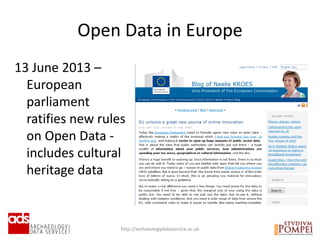
13 June 2013 –
European
parliament
ratifies new rules
on Open Data -
includes cultural
heritage data
Open Data in Europe
http://archaeologydataservice.ac.uk
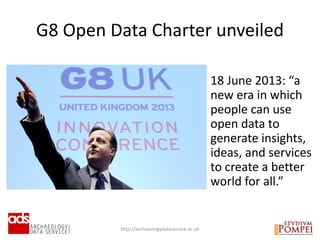
G8 Open Data Charter unveiled
http://archaeologydataservice.ac.uk
18 June 2013: “a
new era in which
people can use
open data to
generate insights,
ideas, and services
to create a better
world for all.”
http://archaeologydataservice.ac.uk
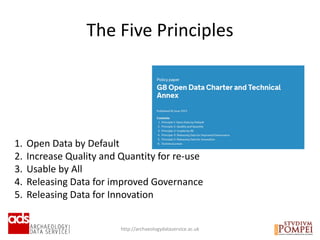
The Five Principles
1. Open Data by Default
2. Increase Quality and Quantity for re-use
3. Usable by All
4. Releasing Data for improved Governance
5. Releasing Data for Innovation
• Context: The Open Agenda
• Past Reality – the development of data sharing
• The current state of play
– National data sharing infrastructures
– International e-infrastructures in archaeology
• Why should we share our data - Sticks
• Why should we share our data - ..and Carrots
Outline
http://archaeologydataservice.ac.uk
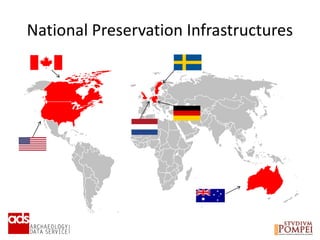
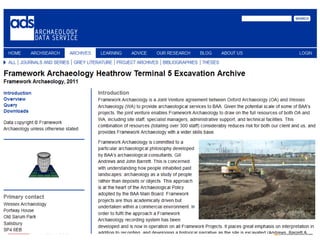
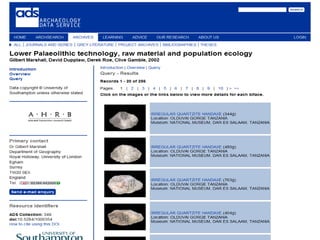
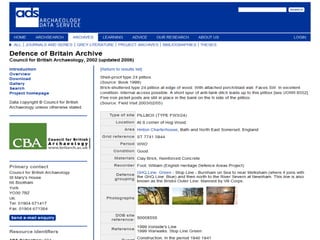
National Preservation Infrastructures
• UK: Archaeology Data Service
• Netherlands: eDNA
• Sweden: SNDS
• Germany: IANUS
• United States: tDAR
http://archaeologydataservice.ac.uk
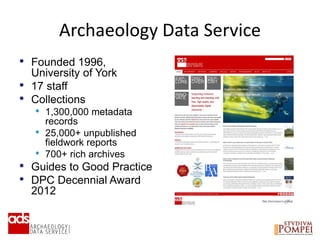
National Preservation Infrastructures
• Founded 1996,
University of York
• 17 staff
• Collections
• 1,300,000 metadata
records
• 25,000+ unpublished
fieldwork reports
• 700+ rich archives
• Guides to Good Practice
• DPC Decennial Award
2012
The Archaeology Data ServiceArchaeology Data Service
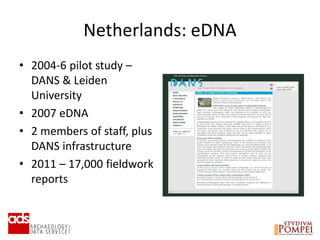
Netherlands: eDNA
• 2004-6 pilot study –
DANS & Leiden
University
• 2007 eDNA
• 2 members of staff, plus
DANS infrastructure
• 2011 – 17,000 fieldwork
reports
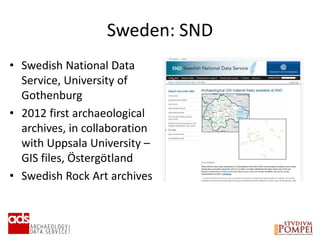
Sweden: SND
• Swedish National Data
Service, University of
Gothenburg
• 2012 first archaeological
archives, in collaboration
with Uppsala University –
GIS files, Östergötland
• Swedish Rock Art archives
Germany: IANUS
• 2012 – DAI scoping
project
• Initial staff of two
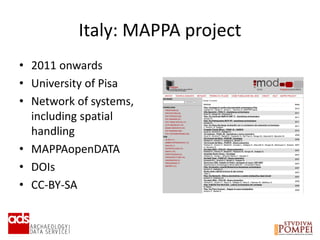
Italy: MAPPA project
• 2011 onwards
• University of Pisa
• Network of systems,
including spatial
handling
• MAPPAopenDATA
• DOIs
• CC-BY-SA
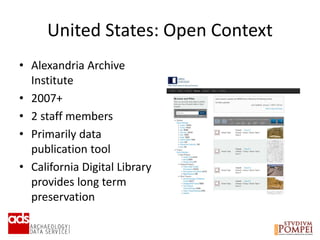
United States: Open Context
• Alexandria Archive
Institute
• 2007+
• 2 staff members
• Primarily data
publication tool
• California Digital Library
provides long term
preservation
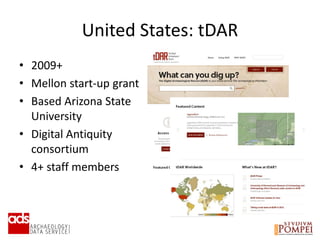
United States: tDAR
• 2009+
• Mellon start-up grant
• Based Arizona State
University
• Digital Antiquity
consortium
• 4+ staff members
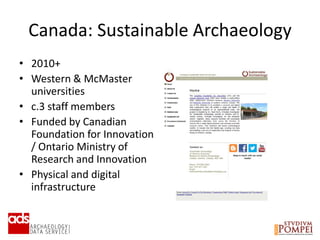
Canada: Sustainable Archaeology
• 2010+
• Western & McMaster
universities
• c.3 staff members
• Funded by Canadian
Foundation for Innovation
/ Ontario Ministry of
Research and Innovation
• Physical and digital
infrastructure
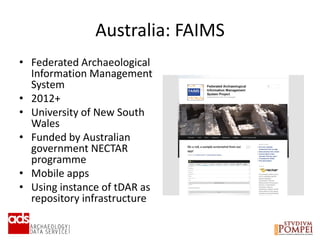
Australia: FAIMS
• Federated Archaeological
Information Management
System
• 2012+
• University of New South
Wales
• Funded by Australian
government NECTAR
programme
• Mobile apps
• Using instance of tDAR as
repository infrastructure
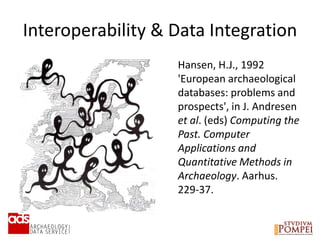
Interoperability & Data Integration
Hansen, H.J., 1992
'European archaeological
databases: problems and
prospects', in J. Andresen
et al. (eds) Computing the
Past. Computer
Applications and
Quantitative Methods in
Archaeology. Aarhus.
229-37.
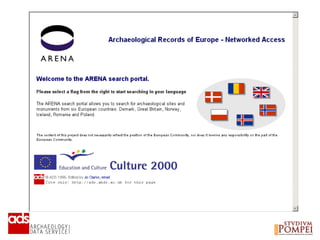
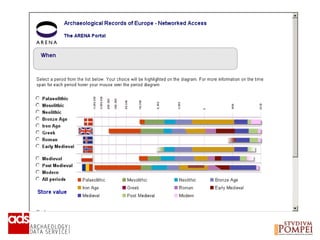
ARENA: Archaeological Records
of Europe: Networked Access.
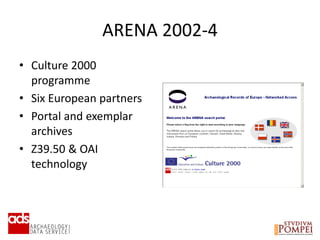
ARENA 2002-4
• Culture 2000
programme
• Six European partners
• Portal and exemplar
archives
• Z39.50 & OAI
technology
07/03/2015 http://archaeologydataservice.ac.uk
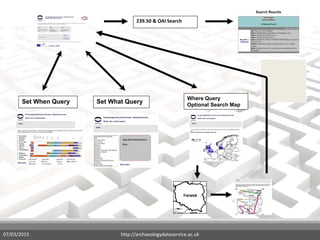
Z39.50 & OAI Search
Set When Query Set What Query
Where Query
Optional Search Map
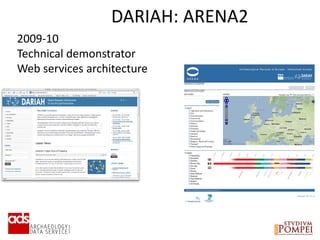
DARIAH: ARENA2
2009-10
Technical demonstrator
Web services architecture
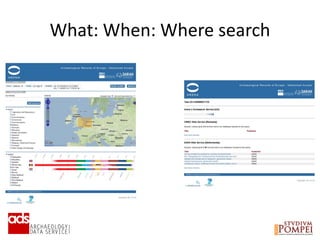
What: When: Where search
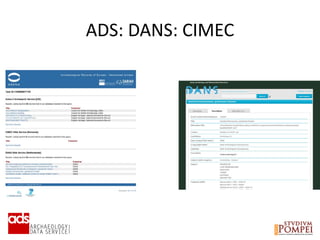
ADS: DANS: CIMEC
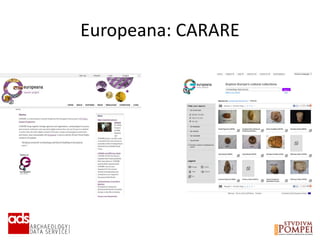
Europeana: CARARE
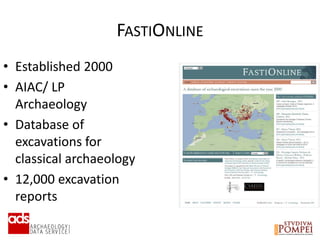
FASTIONLINE
• Established 2000
• AIAC/ LP
Archaeology
• Database of
excavations for
classical archaeology
• 12,000 excavation
reports
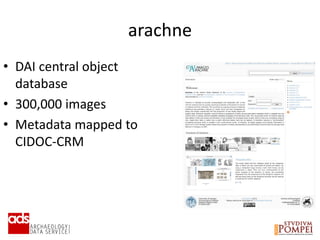
arachne
• DAI central object
database
• 300,000 images
• Metadata mapped to
CIDOC-CRM
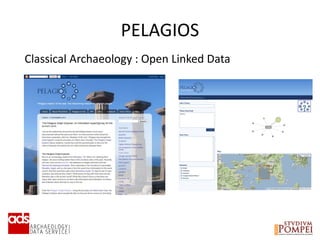
PELAGIOS
Classical Archaeology : Open Linked Data
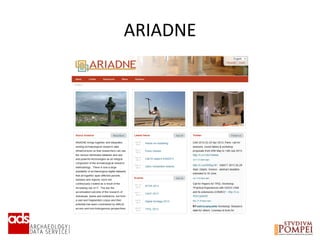
ARIADNE
Why ARIADNE
• Huge number of archaeological data
available in digital format
• Large number of non-communicating
archaeological datasets – the “information
silos”
• Increasing interest of the research
community for data sharing, both passive
(“access”) and active (“provide”)
• Social pressure for opening data vaults
What is ARIADNE
• ARIADNE is a Research Infrastructure project
aiming at the integration of archaeological
datasets in Europe
• Four years’ duration
• Starting 1st February 2013
• 23 partners from 17 countries
• Coordinated by PIN-U. of Florence (IT)
• Affiliated to DARIAH
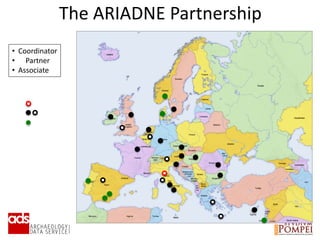
The ARIADNE Partnership
• Coordinator
• Partner
• Associate
Project Goals
• Shape the research community
• Share, access, use and re-use archaeological data
• Overcome fragmentation
• Foster/support interoperability
• Establish accepted standards and common protocols
• Enable resource discovery and faceted searches
• Explore new methods
• Create useful tools for searching and browsing
Connect, not assemble
Make data discoverable, accessible, understandable, usable
Progress in the first year
Joint Research
• Creation of the ACDM (ARIADNE Catalogue
Data Model) and of the Registry describing
archaeological digital resources
• Designing dataset integration
• Working on an extension of CIDOC-CRM
suitable for archaeological documentation
– Mapping metadata schemas to CIDOC-CRM
– Draft proposal for excavation data
Success stories
• Agreement with PACTOLS (multilingual French
thesaurus) for integration in the ARIADNE system
• Mapping the Italian documentation system on the
ARIADNE standard
• Progress into incorporating SITAR (archaeological
datasets on Rome)
• DAI implementing the novel ARIADNE extension for
new datasets
• ARIADNE inspiring new research projects in Austria
• and more…
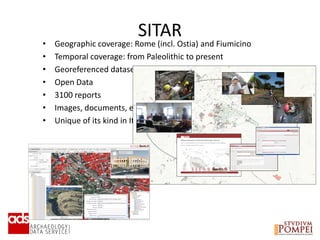
SITAR
• Geographic coverage: Rome (incl. Ostia) and Fiumicino
• Temporal coverage: from Paleolithic to present
• Georeferenced dataset
• Open Data
• 3100 reports
• Images, documents, etc.
• Unique of its kind in Italy
• Context: The Open Agenda
• Past Reality – the development of data sharing
• The current state of play
– National data sharing infrastructures
– International e-infrastructures in archaeology
• Why should we share our data - Sticks
• Why should we share our data - ..and Carrots
Outline
http://archaeologydataservice.ac.uk
Why should we share our data?
The Sticks
http://archaeologydataservice.ac.uk
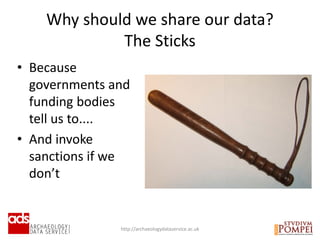
• Because
governments and
funding bodies
tell us to....
• And invoke
sanctions if we
don’t
• Research Councils
– EPSRC
• Published research papers should include a short
statement describing how and on what terms any
supporting research data may be accessed.
• Research organisations will ensure that EPSRC-funded
research data is securely preserved for a minimum of
10-years
Sticks in the UK
http://archaeologydataservice.ac.uk
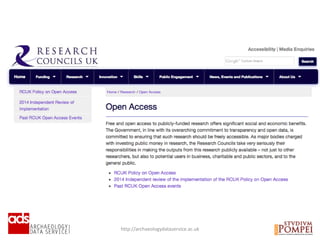
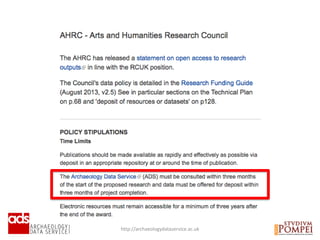
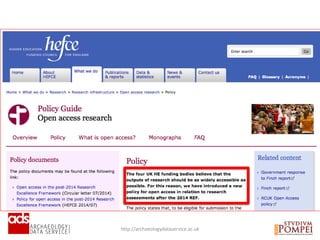
The policy states that, to be eligible for submission to
the post-2014 REF, authors’ final peer-reviewed
manuscripts must have been deposited in an
institutional or subject repository on acceptance for
publication. Deposited material should be
discoverable, and free to read and download, for
anyone with an internet connection.
The requirement applies only to journal articles and
conference proceedings with an International Standard
Serial Number.
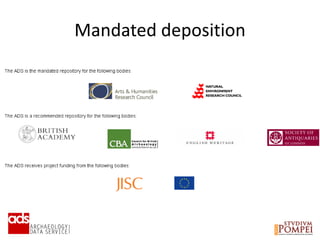
Mandated Deposition
Mandated deposition
http://archaeologydataservice.ac.uk
http://archaeologydataservice.ac.uk 62
http://archaeologydataservice.ac.uk
Open Data: Case Study - Archaeology Data Service
http://archaeologydataservice.ac.uk
• Context: The Open Agenda
• Past Reality – the development of data sharing
• The current state of play
– National data sharing infrastructures
– International e-infrastructures in archaeology
• Why should we share our data - Sticks
• Why should we share our data - ..and Carrots
Outline
http://archaeologydataservice.ac.uk
Why should we share our data?
The Carrots
http://archaeologydataservice.ac.uk
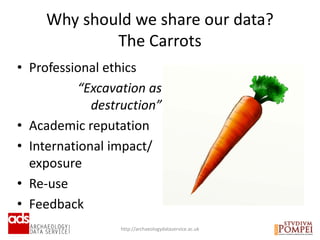
• Professional ethics
“Excavation as
destruction”
• Academic reputation
• International impact/
exposure
• Re-use
• Feedback
Why should we share our data?
The Carrots
http://archaeologydataservice.ac.uk
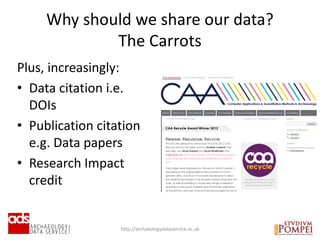
Plus, increasingly:
• Data citation i.e.
DOIs
• Publication citation
e.g. Data papers
• Research Impact
credit
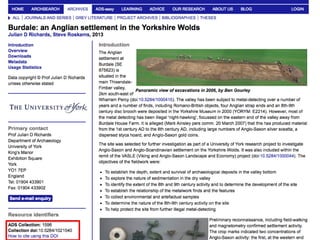
• Cool, H. E. M. & Bell, M. (2011) Excavations at
St Peter’s Church, Barton-upon-Humber [data-
set]. York: Archaeology Data Service
[distributor] <doi: 10.5284/1000389>
• NB http://dx.doi.org/10.5284/1000389
http://archaeologydataservice.ac.uk
Sample citation
http://archaeologydataservice.ac.uk
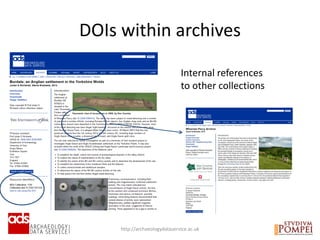
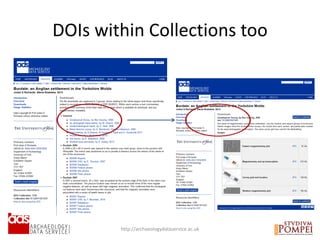
DOIs within archives
Internal references
to other collections
http://archaeologydataservice.ac.uk
DOIs within Collections too
http://archaeologydataservice.ac.uk
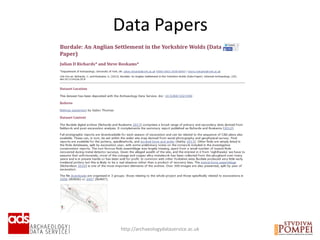
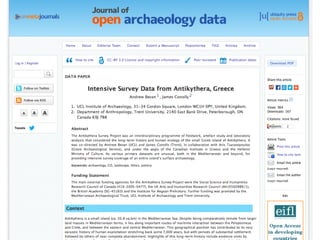
Data Papers
http://archaeologydataservice.ac.uk
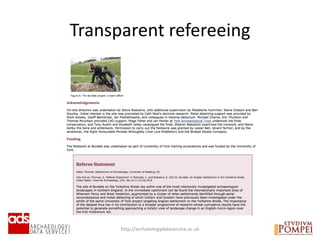
Transparent refereeing
http://archaeologydataservice.ac.uk
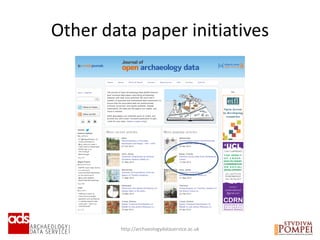
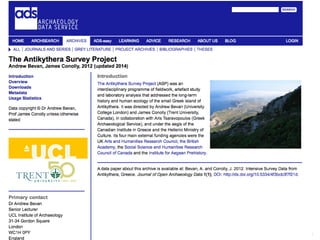
Other data paper initiatives
• Is there a difference?
• The archive tradition
• The archive as part of dissemination strategy
• Linking publication and archive
• Supporting and testing
• Supplementary data – needs to be archived
Open Access vs Open Data
http://archaeologydataservice.ac.uk
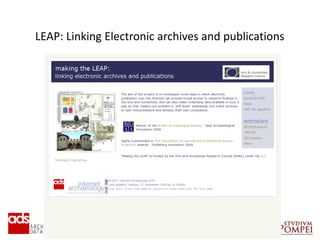
LEAP: Linking Electronic archives and publications
British Archaeological Awards 2008 Best Archaeological Innovation
http://archaeologydataservice.ac.uk
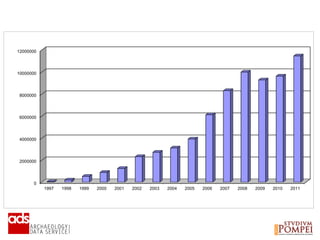
Year on year usage 1997-2011
0
2000000
4000000
6000000
8000000
10000000
12000000
1997 1998 1999 2000 2001 2002 2003 2004 2005 2006 2007 2008 2009 2010 2011
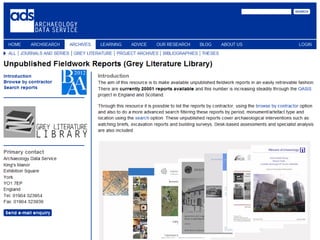
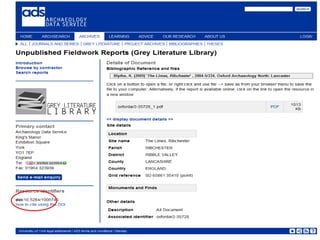
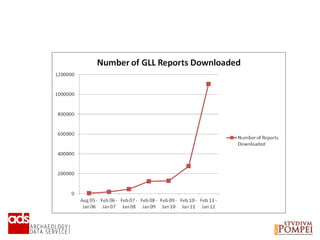
Grey Literature Library
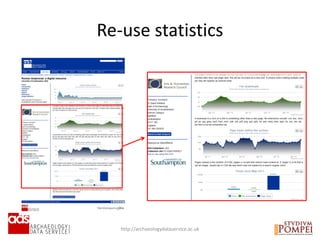
Re-use statistics
http://archaeologydataservice.ac.uk
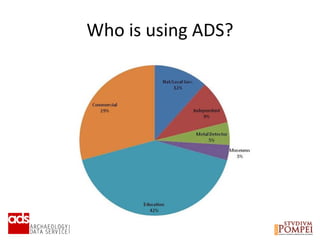
Who is using ADS?
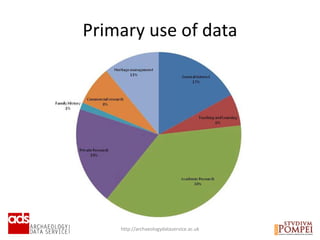
Primary use of data
http://archaeologydataservice.ac.uk
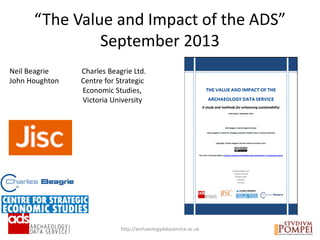
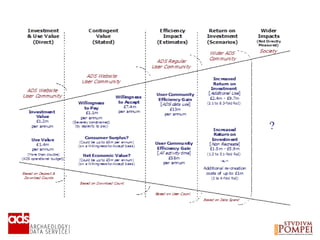
“The Value and Impact of the ADS”
September 2013
http://archaeologydataservice.ac.uk
Neil Beagrie Charles Beagrie Ltd.
John Houghton Centre for Strategic
Economic Studies,
Victoria University
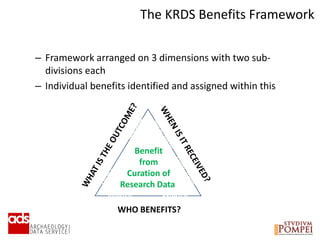
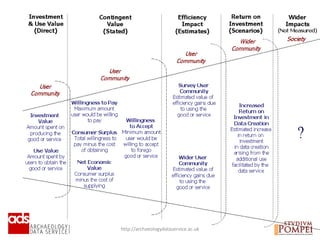
The KRDS Benefits Framework
– Framework arranged on 3 dimensions with two sub-
divisions each
– Individual benefits identified and assigned within this
Internal External
WHO BENEFITS?
Benefit
from
Curation of
Research Data
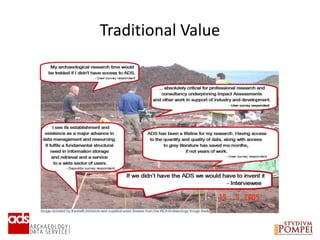
Traditional Value
http://archaeologydataservice.ac.uk
The Economic Impact of the ADS
07/03/2015
http://archaeologydataservice
.ac.uk
97
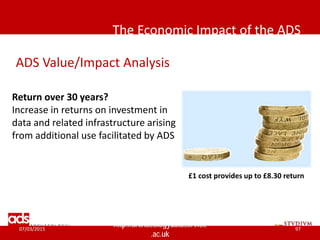
Return over 30 years?
Increase in returns on investment in
data and related infrastructure arising
from additional use facilitated by ADS
ADS Value/Impact Analysis
£1 cost provides up to £8.30 return
How to achieve integration
Data sharing requires:
•Suitability of someone else’s data
•Interoperability of datasets
•Trust in data collected by others
•Guarantee of data “provenance”
•Suitable licensing agreements
•Suitable repositories
Looking to the future
• 50% of all journals now require data to be
deposited in an archive
• Need a new metaphor for publication
• Blurring of publication and other forms of
dissemination
• Data management not for its own sake – no
preservation without re-use
Julian D. Richards -  Open Data in European Archaeology

Julian D. Richards - Open Data in European Archaeology

  • 1.
    Professor Julian Richards OpenData in European Archaeology
  • 2.
    • Context: TheOpen Agenda • Past Reality – the development of data sharing • The current state of play – National data sharing infrastructures – International e-infrastructures in archaeology • Why should we share our data - Sticks • Why should we share our data - ..and Carrots Outline http://archaeologydataservice.ac.uk
  • 3.
  • 4.
    Open Data • Opendata is the idea that certain data should be freely available to everyone to use and republish as they wish, without restrictions from copyright, patents or other mechanisms of control (Wikipedia, 9 June 2013) • Open data tradition and archaeology
  • 5.
    The Open DataMovement • Related to Open Access movement for publications • Data.gov & Data.gov.uk • "A piece of data is open if anyone is free to use, reuse, and redistribute it — subject only, at most, to the requirement to attribute and/or share-alike”
  • 6.
  • 7.
    Linked Open Datain Archaeology
  • 8.
    Open Data inScience • The concept of open access to scientific data was institutionally established in preparation for the International Geophysical Year of 1957-8. The International Council of Scientific Unions established several World Data Centers to minimize the risk of data loss and to maximize data accessibility, further recommending in 1955 that data be made available in machine- readable form. • The Open-science-data movement long predates the Internet
  • 9.
    Open Data inArchaeology: Pros • “Past belongs to everyone” – democratisation of knowledge • Accelerated pace of new knowledge • Economic benefit of Open Data • Public benefit of Open Data – Community engagement in heritage e.g. Finds.org.uk; Europeana; – Justification of taxpayer investment
  • 10.
    Open Data inArchaeology: Challenges • Privacy issues – site location; indigenous peoples; personal data • Misuse of data • Funding of data management & data infrastructures • Importance of provenance • Legitimate concerns of information providers
  • 11.
  • 12.
    • Context: TheOpen Agenda • Past Reality – the development of data sharing • The current state of play – National data sharing infrastructures – International e-infrastructures in archaeology • Why should we share our data - Sticks • Why should we share our data - ..and Carrots Outline http://archaeologydataservice.ac.uk
  • 13.
    The Reality The prehistoryof (non-)sharing Rahtz, Sebastian 1988 `Reflections on an Archaeological Information Exchange' Archaeol Comput Newslett 16, 10-15 “The AIE in operation at Southampton University contains so far: mailing list; distribution service for data and/or software; and an on- line service. Problems include: the labour-intensive nature of the mailing list; little use of the service by archaeologists as opposed to UNIX-addicts....”
  • 14.
    Harrison Eiteljorg, II1994 ‘Archaeological Data Archive Project’, CSA Newsletter VII(3) Harrison Eiteljorg, II 2002 ‘The Archaeological Data Archive Project Ceases Operation’, CSA Newsletter XV (2) “There appear to be two insurmountable problems with the archives. One is the absence of any real possibility for assembling a large enough body of material to be truly useful within a reasonable time. This reflects primarily the unwillingness of scholars to deposit materials in the archive......”
  • 15.
    “The second isthe inability of the Archaeological Data Archive to become self-sufficient within the next decade or so.... Data depositors may be willing to pay for deposit and long-term preservation, but there has been no evidence of that for the near term....... Archaeologists have too often treated their objects and their data as privately owned...... Archaeology is hardly alone in finding it impossible to fund an archive for digital data. Archaeologists will, however, be taken to task more strongly than many scholars because their data cannot be recreated, once lost.”
  • 16.
    • “I needto tidy my data” (“I worry that people will think my data is poor quality”) • “I’ll do it when the research is finished / published” (“I worry that people will steal my credit”) • “It’s too expensive” (“I forgot to budget for it”) • “I haven’t got permission” (“I can’t be bothered/ haven’t got the time”) Common excuses.... http://archaeologydataservice.ac.uk
  • 17.
    13 June 2013– European parliament ratifies new rules on Open Data - includes cultural heritage data Open Data in Europe http://archaeologydataservice.ac.uk
  • 18.
    G8 Open DataCharter unveiled http://archaeologydataservice.ac.uk 18 June 2013: “a new era in which people can use open data to generate insights, ideas, and services to create a better world for all.”
  • 19.
    http://archaeologydataservice.ac.uk The Five Principles 1.Open Data by Default 2. Increase Quality and Quantity for re-use 3. Usable by All 4. Releasing Data for improved Governance 5. Releasing Data for Innovation
  • 20.
    • Context: TheOpen Agenda • Past Reality – the development of data sharing • The current state of play – National data sharing infrastructures – International e-infrastructures in archaeology • Why should we share our data - Sticks • Why should we share our data - ..and Carrots Outline http://archaeologydataservice.ac.uk
  • 21.
  • 22.
    • UK: ArchaeologyData Service • Netherlands: eDNA • Sweden: SNDS • Germany: IANUS • United States: tDAR http://archaeologydataservice.ac.uk National Preservation Infrastructures
  • 23.
    • Founded 1996, Universityof York • 17 staff • Collections • 1,300,000 metadata records • 25,000+ unpublished fieldwork reports • 700+ rich archives • Guides to Good Practice • DPC Decennial Award 2012 The Archaeology Data ServiceArchaeology Data Service
  • 24.
    Netherlands: eDNA • 2004-6pilot study – DANS & Leiden University • 2007 eDNA • 2 members of staff, plus DANS infrastructure • 2011 – 17,000 fieldwork reports
  • 25.
    Sweden: SND • SwedishNational Data Service, University of Gothenburg • 2012 first archaeological archives, in collaboration with Uppsala University – GIS files, Östergötland • Swedish Rock Art archives
  • 26.
    Germany: IANUS • 2012– DAI scoping project • Initial staff of two
  • 27.
    Italy: MAPPA project •2011 onwards • University of Pisa • Network of systems, including spatial handling • MAPPAopenDATA • DOIs • CC-BY-SA
  • 28.
    United States: OpenContext • Alexandria Archive Institute • 2007+ • 2 staff members • Primarily data publication tool • California Digital Library provides long term preservation
  • 29.
    United States: tDAR •2009+ • Mellon start-up grant • Based Arizona State University • Digital Antiquity consortium • 4+ staff members
  • 30.
    Canada: Sustainable Archaeology •2010+ • Western & McMaster universities • c.3 staff members • Funded by Canadian Foundation for Innovation / Ontario Ministry of Research and Innovation • Physical and digital infrastructure
  • 31.
    Australia: FAIMS • FederatedArchaeological Information Management System • 2012+ • University of New South Wales • Funded by Australian government NECTAR programme • Mobile apps • Using instance of tDAR as repository infrastructure
  • 32.
    Interoperability & DataIntegration Hansen, H.J., 1992 'European archaeological databases: problems and prospects', in J. Andresen et al. (eds) Computing the Past. Computer Applications and Quantitative Methods in Archaeology. Aarhus. 229-37.
  • 33.
    ARENA: Archaeological Records ofEurope: Networked Access.
  • 35.
    ARENA 2002-4 • Culture2000 programme • Six European partners • Portal and exemplar archives • Z39.50 & OAI technology
  • 36.
    07/03/2015 http://archaeologydataservice.ac.uk Z39.50 &OAI Search Set When Query Set What Query Where Query Optional Search Map
  • 38.
  • 39.
  • 40.
  • 41.
  • 42.
    FASTIONLINE • Established 2000 •AIAC/ LP Archaeology • Database of excavations for classical archaeology • 12,000 excavation reports
  • 43.
    arachne • DAI centralobject database • 300,000 images • Metadata mapped to CIDOC-CRM
  • 44.
  • 45.
  • 46.
    Why ARIADNE • Hugenumber of archaeological data available in digital format • Large number of non-communicating archaeological datasets – the “information silos” • Increasing interest of the research community for data sharing, both passive (“access”) and active (“provide”) • Social pressure for opening data vaults
  • 47.
    What is ARIADNE •ARIADNE is a Research Infrastructure project aiming at the integration of archaeological datasets in Europe • Four years’ duration • Starting 1st February 2013 • 23 partners from 17 countries • Coordinated by PIN-U. of Florence (IT) • Affiliated to DARIAH
  • 48.
    The ARIADNE Partnership •Coordinator • Partner • Associate
  • 49.
    Project Goals • Shapethe research community • Share, access, use and re-use archaeological data • Overcome fragmentation • Foster/support interoperability • Establish accepted standards and common protocols • Enable resource discovery and faceted searches • Explore new methods • Create useful tools for searching and browsing Connect, not assemble Make data discoverable, accessible, understandable, usable
  • 50.
    Progress in thefirst year Joint Research • Creation of the ACDM (ARIADNE Catalogue Data Model) and of the Registry describing archaeological digital resources • Designing dataset integration • Working on an extension of CIDOC-CRM suitable for archaeological documentation – Mapping metadata schemas to CIDOC-CRM – Draft proposal for excavation data
  • 51.
    Success stories • Agreementwith PACTOLS (multilingual French thesaurus) for integration in the ARIADNE system • Mapping the Italian documentation system on the ARIADNE standard • Progress into incorporating SITAR (archaeological datasets on Rome) • DAI implementing the novel ARIADNE extension for new datasets • ARIADNE inspiring new research projects in Austria • and more…
  • 52.
    SITAR • Geographic coverage:Rome (incl. Ostia) and Fiumicino • Temporal coverage: from Paleolithic to present • Georeferenced dataset • Open Data • 3100 reports • Images, documents, etc. • Unique of its kind in Italy
  • 53.
    • Context: TheOpen Agenda • Past Reality – the development of data sharing • The current state of play – National data sharing infrastructures – International e-infrastructures in archaeology • Why should we share our data - Sticks • Why should we share our data - ..and Carrots Outline http://archaeologydataservice.ac.uk
  • 54.
    Why should weshare our data? The Sticks http://archaeologydataservice.ac.uk • Because governments and funding bodies tell us to.... • And invoke sanctions if we don’t
  • 55.
    • Research Councils –EPSRC • Published research papers should include a short statement describing how and on what terms any supporting research data may be accessed. • Research organisations will ensure that EPSRC-funded research data is securely preserved for a minimum of 10-years Sticks in the UK http://archaeologydataservice.ac.uk
  • 56.
  • 57.
  • 58.
  • 59.
    http://archaeologydataservice.ac.uk The policy statesthat, to be eligible for submission to the post-2014 REF, authors’ final peer-reviewed manuscripts must have been deposited in an institutional or subject repository on acceptance for publication. Deposited material should be discoverable, and free to read and download, for anyone with an internet connection. The requirement applies only to journal articles and conference proceedings with an International Standard Serial Number.
  • 60.
  • 61.
  • 62.
  • 63.
  • 68.
    • Context: TheOpen Agenda • Past Reality – the development of data sharing • The current state of play – National data sharing infrastructures – International e-infrastructures in archaeology • Why should we share our data - Sticks • Why should we share our data - ..and Carrots Outline http://archaeologydataservice.ac.uk
  • 69.
    Why should weshare our data? The Carrots http://archaeologydataservice.ac.uk • Professional ethics “Excavation as destruction” • Academic reputation • International impact/ exposure • Re-use • Feedback
  • 70.
    Why should weshare our data? The Carrots http://archaeologydataservice.ac.uk Plus, increasingly: • Data citation i.e. DOIs • Publication citation e.g. Data papers • Research Impact credit
  • 71.
    • Cool, H.E. M. & Bell, M. (2011) Excavations at St Peter’s Church, Barton-upon-Humber [data- set]. York: Archaeology Data Service [distributor] <doi: 10.5284/1000389> • NB http://dx.doi.org/10.5284/1000389 http://archaeologydataservice.ac.uk Sample citation
  • 73.
  • 74.
  • 75.
  • 76.
  • 77.
  • 78.
  • 81.
    • Is therea difference? • The archive tradition • The archive as part of dissemination strategy • Linking publication and archive • Supporting and testing • Supplementary data – needs to be archived Open Access vs Open Data http://archaeologydataservice.ac.uk
  • 82.
    LEAP: Linking Electronicarchives and publications
  • 83.
    British Archaeological Awards2008 Best Archaeological Innovation
  • 86.
  • 87.
    Year on yearusage 1997-2011 0 2000000 4000000 6000000 8000000 10000000 12000000 1997 1998 1999 2000 2001 2002 2003 2004 2005 2006 2007 2008 2009 2010 2011
  • 88.
  • 89.
  • 90.
  • 91.
    Primary use ofdata http://archaeologydataservice.ac.uk
  • 92.
    “The Value andImpact of the ADS” September 2013 http://archaeologydataservice.ac.uk Neil Beagrie Charles Beagrie Ltd. John Houghton Centre for Strategic Economic Studies, Victoria University
  • 93.
    The KRDS BenefitsFramework – Framework arranged on 3 dimensions with two sub- divisions each – Individual benefits identified and assigned within this Internal External WHO BENEFITS? Benefit from Curation of Research Data
  • 94.
  • 95.
  • 97.
    The Economic Impactof the ADS 07/03/2015 http://archaeologydataservice .ac.uk 97 Return over 30 years? Increase in returns on investment in data and related infrastructure arising from additional use facilitated by ADS ADS Value/Impact Analysis £1 cost provides up to £8.30 return
  • 98.
    How to achieveintegration Data sharing requires: •Suitability of someone else’s data •Interoperability of datasets •Trust in data collected by others •Guarantee of data “provenance” •Suitable licensing agreements •Suitable repositories
  • 99.
    Looking to thefuture • 50% of all journals now require data to be deposited in an archive • Need a new metaphor for publication • Blurring of publication and other forms of dissemination • Data management not for its own sake – no preservation without re-use