



Brett D. Currier, MSLS, JD
Director of Scholarly Communications
brett.currier@uta.edu
@brettdcurrier
2
3
KINDS OF QUESTIONS RECEIVED
We videotaped a guest lecturer who showed a youtube video in class. Can I
put that recording in blackboard?
Can I use a youtube video in my class?
I want to use this theory in my dissertation. How do I receive permission to
include it?
I’m creating a class that UT Arlington isn’t administering. What can I use?
My students are citing a Creative Commons Licensed image. How do we do
that?
4
5
LIBRARY SUPPORT
Brett D. Currier, Director of Scholarly Communications
Lydia Pyburn, Off-Campus Service Librarian
Heather Scalf, Director of Assessment & Nursing Liaison
Kaeli Vandertulip, Health Sciences Librarian
Kelly Visnak, Associate University Librarian of Scholarly Communications
Peace Ossom Williamson, Health Sciences Librarian
6
7
AGENDA
• Introduction to Copyright
• Learning how to identify Creative Commons Licensed materials for your
preferred objectives
• Break
• Learn how to identify Legitimate Open Educational Materials
• Learn how to create and release Open Access Resources
8
9
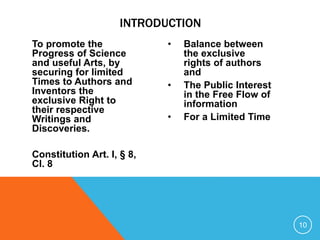
To promote the
Progress of Science
and useful Arts, by
securing for limited
Times to Authors and
Inventors the
exclusive Right to
their respective
Writings and
Discoveries.
Constitution Art. I, § 8,
Cl. 8
• Balance between
the exclusive
rights of authors
and
• The Public Interest
in the Free Flow of
information
• For a Limited Time
10
INTRODUCTION
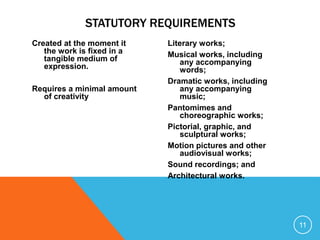
Created at the moment it
the work is fixed in a
tangible medium of
expression.
Requires a minimal amount
of creativity
Literary works;
Musical works, including
any accompanying
words;
Dramatic works, including
any accompanying
music;
Pantomimes and
choreographic works;
Pictorial, graphic, and
sculptural works;
Motion pictures and other
audiovisual works;
Sound recordings; and
Architectural works.
11
STATUTORY REQUIREMENTS
RIGHTS OF THE AUTHOR
• Make copies
• Distribute the work
• Publicly perform or display the work
• Prepare derivative works
• License any of the above to third parties
• Transfer the copyright to a third party
12
USE OF COPYRIGHTED MATERIALS
Linking to Content
Embedding Content in Blackboard
Archival Preservation
13
FAIR USE
1. Purpose and Character of the Use
2. Nature of the Copyrighted Work
3. Amount and Substantiality of the work
4. The Effect of the Use upon the Marketplace
14
GENERAL GUIDELINES
1 Chapter from a book
1 Article from a journal
When placed in Blackboard for students in your course
15
16
PUBLISHED BEFORE JAN. 1, 1923
Portal to Texas History
UT Arlington Libraries Digital Gallery
Library of Congress Prints & Photographs Online Catalog
Project Gutenberg
Archive.org
17
FEDERAL GOVERNMENT
National Institute of Health
National Library of Medicine
Centers for Disease Control and Prevention
18
19
TWO CATEGORIES
• Permissions that are given in advance
• Permissions that must be requested
20
PERMISSIONS THAT ARE GIVEN IN ADVANCE
• Creative Commons Licenses
• Anti-copyright Notices
• Woody Guthrie
• Other ways
21
PERMISSIONS THAT MUST BE REQUESTED
• Exclusive Licenses: Must be in writing
• Non-exclusive Licenses: Can be oral
• Better to be documented!
22
REQUESTING PERMISSIONS
• Copyright Clearance Center
• Other Clearing agencies
• Permissions Letters
23
COPYRIGHT CLEARANCE CENTER
Journal of Endocrinology
24
PERMISSIONS LETTERS
• UT Arlington Example Permission Letter Request
• Dr. Holliday in Architecture
25
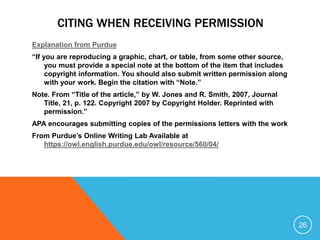
CITING WHEN RECEIVING PERMISSION
Explanation from Purdue
“If you are reproducing a graphic, chart, or table, from some other source,
you must provide a special note at the bottom of the item that includes
copyright information. You should also submit written permission along
with your work. Begin the citation with “Note.”
Note. From “Title of the article,” by W. Jones and R. Smith, 2007, Journal
Title, 21, p. 122. Copyright 2007 by Copyright Holder. Reprinted with
permission.”
APA encourages submitting copies of the permissions letters with the work
From Purdue’s Online Writing Lab Available at
https://owl.english.purdue.edu/owl/resource/560/04/
26
QUESTIONS?
27
28
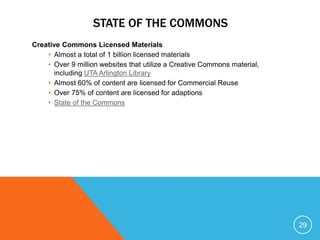
STATE OF THE COMMONS
Creative Commons Licensed Materials
• Almost a total of 1 billion licensed materials
• Over 9 million websites that utilize a Creative Commons material,
including UTA Arlington Library
• Almost 60% of content are licensed for Commercial Reuse
• Over 75% of content are licensed for adaptions
• State of the Commons
29
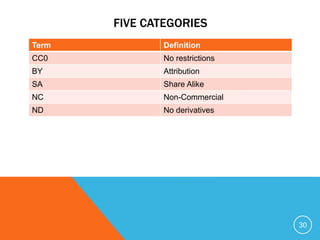
FIVE CATEGORIES
Term Definition
CC0 No restrictions
BY Attribution
SA Share Alike
NC Non-Commercial
ND No derivatives
30
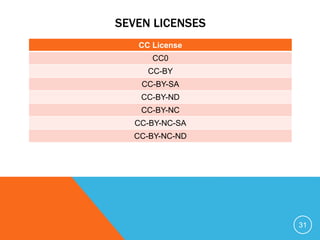
SEVEN LICENSES
CC License
CC0
CC-BY
CC-BY-SA
CC-BY-ND
CC-BY-NC
CC-BY-NC-SA
CC-BY-NC-ND
31
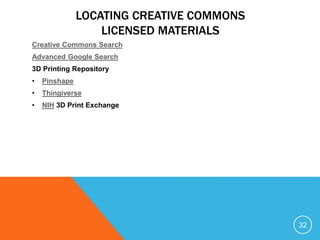
LOCATING CREATIVE COMMONS
LICENSED MATERIALS
Creative Commons Search
Advanced Google Search
3D Printing Repository
• Pinshape
• Thingiverse
• NIH 3D Print Exchange
32
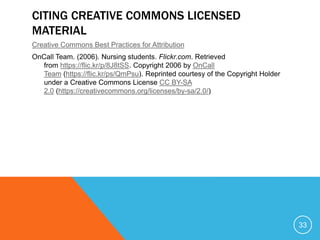
CITING CREATIVE COMMONS LICENSED
MATERIAL
Creative Commons Best Practices for Attribution
OnCall Team. (2006). Nursing students. Flickr.com. Retrieved
from https://flic.kr/p/8J8tSS. Copyright 2006 by OnCall
Team (https://flic.kr/ps/QmPsu). Reprinted courtesy of the Copyright Holder
under a Creative Commons License CC BY-SA
2.0 (https://creativecommons.org/licenses/by-sa/2.0/)
33
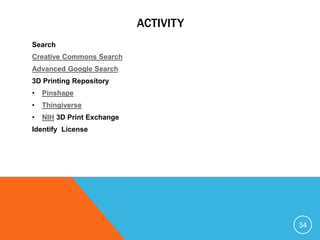
ACTIVITY
Search
Creative Commons Search
Advanced Google Search
3D Printing Repository
• Pinshape
• Thingiverse
• NIH 3D Print Exchange
Identify License
34
35
36
DEFINING OPEN EDUCATIONAL RESOURCES
“OER are teaching, learning, and research resources that reside in the
public domain or have been released under an intellectual property
license that permits their free use and re-purposing by others. Open
educational resources include full courses, course materials, modules,
textbooks, streaming videos, tests, software, and any other tools,
materials, or techniques used to support access to knowledge.”
William and Hewlett Foundation
37
KINDS OF OERS
• Open Textbooks
• Open Textbook Library
• Open Journal Articles
• Institutional Repositories
• Virginia Henderson Global Nursing E-Repository
• Powerpoints
• Slideshare
• Photographs
• Creative Commons search
• Google Search
• Achive.org
• Videos
• Clip Art
38
IDENTIFYING LEGITIMATE RESOURCES
• Peer Reviewed
• Beall’s List Criteria
• Open Access Scholarly Publishers Association (OASPA) Code of
Conduct
• Committee on Publication Ethics (COPE) Code of Conduct for Journal
Publishers
• International Association of Scientific, Technical & Medical Publishers
(STM) Code of Conduct
• Directory of Open Access Journals
• Principles of Transparency and Best Practice in Scholarly Publishing
• Ask a colleague
• Ask a librarian
• Instinct
39
DIRECTORY OF OPEN ACCESS JOURNALS
DOAJ Nursing
40
41
42
WHY?
• Broad dissemination of Research
• More readers
• More citations
• Social Justice
• Grant Compliance
43
DO YOU HAVE THE RIGHT?
University of Texas System Policy
UT System Intellectual Property Policy in Plain English
Contracts
44
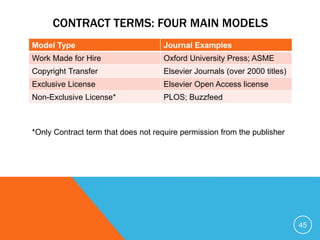
CONTRACT TERMS: FOUR MAIN MODELS
Model Type Journal Examples
Work Made for Hire Oxford University Press; ASME
Copyright Transfer Elsevier Journals (over 2000 titles)
Exclusive License Elsevier Open Access license
Non-Exclusive License* PLOS; Buzzfeed
45
*Only Contract term that does not require permission from the publisher
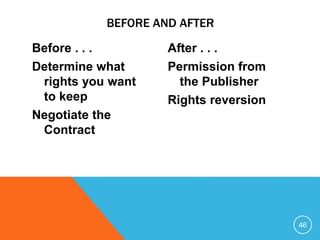
Before . . .
Determine what
rights you want
to keep
Negotiate the
Contract
After . . .
Permission from
the Publisher
Rights reversion
46
BEFORE AND AFTER
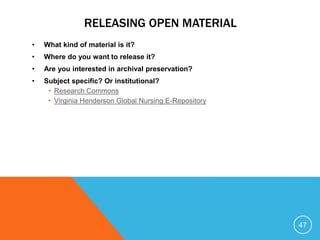
RELEASING OPEN MATERIAL
• What kind of material is it?
• Where do you want to release it?
• Are you interested in archival preservation?
• Subject specific? Or institutional?
• Research Commons
• Virginia Henderson Global Nursing E-Repository
47
APPLYING A CREATIVE COMMONS LICENSE
Selecting the license
48
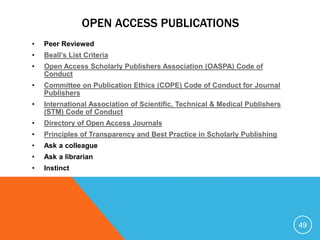
OPEN ACCESS PUBLICATIONS
• Peer Reviewed
• Beall’s List Criteria
• Open Access Scholarly Publishers Association (OASPA) Code of
Conduct
• Committee on Publication Ethics (COPE) Code of Conduct for Journal
Publishers
• International Association of Scientific, Technical & Medical Publishers
(STM) Code of Conduct
• Directory of Open Access Journals
• Principles of Transparency and Best Practice in Scholarly Publishing
• Ask a colleague
• Ask a librarian
• Instinct
49
UT ARLINGTON REPOSITORY
• Library
• Contact Faedra Wills wills@uta.edu
• Submission Walk Through
50
51
Brett D. Currier
817-272-5127
brett.currier@uta.edu
@bdcurrier

Copyright, Creative Commons, and Open Access Resources

  • 1.
    Brett D. Currier,MSLS, JD Director of Scholarly Communications brett.currier@uta.edu @brettdcurrier
  • 2.
  • 3.
  • 4.
    KINDS OF QUESTIONSRECEIVED We videotaped a guest lecturer who showed a youtube video in class. Can I put that recording in blackboard? Can I use a youtube video in my class? I want to use this theory in my dissertation. How do I receive permission to include it? I’m creating a class that UT Arlington isn’t administering. What can I use? My students are citing a Creative Commons Licensed image. How do we do that? 4
  • 5.
  • 6.
    LIBRARY SUPPORT Brett D.Currier, Director of Scholarly Communications Lydia Pyburn, Off-Campus Service Librarian Heather Scalf, Director of Assessment & Nursing Liaison Kaeli Vandertulip, Health Sciences Librarian Kelly Visnak, Associate University Librarian of Scholarly Communications Peace Ossom Williamson, Health Sciences Librarian 6
  • 7.
  • 8.
    AGENDA • Introduction toCopyright • Learning how to identify Creative Commons Licensed materials for your preferred objectives • Break • Learn how to identify Legitimate Open Educational Materials • Learn how to create and release Open Access Resources 8
  • 9.
  • 10.
    To promote the Progressof Science and useful Arts, by securing for limited Times to Authors and Inventors the exclusive Right to their respective Writings and Discoveries. Constitution Art. I, § 8, Cl. 8 • Balance between the exclusive rights of authors and • The Public Interest in the Free Flow of information • For a Limited Time 10 INTRODUCTION
  • 11.
    Created at themoment it the work is fixed in a tangible medium of expression. Requires a minimal amount of creativity Literary works; Musical works, including any accompanying words; Dramatic works, including any accompanying music; Pantomimes and choreographic works; Pictorial, graphic, and sculptural works; Motion pictures and other audiovisual works; Sound recordings; and Architectural works. 11 STATUTORY REQUIREMENTS
  • 12.
    RIGHTS OF THEAUTHOR • Make copies • Distribute the work • Publicly perform or display the work • Prepare derivative works • License any of the above to third parties • Transfer the copyright to a third party 12
  • 13.
    USE OF COPYRIGHTEDMATERIALS Linking to Content Embedding Content in Blackboard Archival Preservation 13
  • 14.
    FAIR USE 1. Purposeand Character of the Use 2. Nature of the Copyrighted Work 3. Amount and Substantiality of the work 4. The Effect of the Use upon the Marketplace 14
  • 15.
    GENERAL GUIDELINES 1 Chapterfrom a book 1 Article from a journal When placed in Blackboard for students in your course 15
  • 16.
  • 17.
    PUBLISHED BEFORE JAN.1, 1923 Portal to Texas History UT Arlington Libraries Digital Gallery Library of Congress Prints & Photographs Online Catalog Project Gutenberg Archive.org 17
  • 18.
    FEDERAL GOVERNMENT National Instituteof Health National Library of Medicine Centers for Disease Control and Prevention 18
  • 19.
  • 20.
    TWO CATEGORIES • Permissionsthat are given in advance • Permissions that must be requested 20
  • 21.
    PERMISSIONS THAT AREGIVEN IN ADVANCE • Creative Commons Licenses • Anti-copyright Notices • Woody Guthrie • Other ways 21
  • 22.
    PERMISSIONS THAT MUSTBE REQUESTED • Exclusive Licenses: Must be in writing • Non-exclusive Licenses: Can be oral • Better to be documented! 22
  • 23.
    REQUESTING PERMISSIONS • CopyrightClearance Center • Other Clearing agencies • Permissions Letters 23
  • 24.
  • 25.
    PERMISSIONS LETTERS • UTArlington Example Permission Letter Request • Dr. Holliday in Architecture 25
  • 26.
    CITING WHEN RECEIVINGPERMISSION Explanation from Purdue “If you are reproducing a graphic, chart, or table, from some other source, you must provide a special note at the bottom of the item that includes copyright information. You should also submit written permission along with your work. Begin the citation with “Note.” Note. From “Title of the article,” by W. Jones and R. Smith, 2007, Journal Title, 21, p. 122. Copyright 2007 by Copyright Holder. Reprinted with permission.” APA encourages submitting copies of the permissions letters with the work From Purdue’s Online Writing Lab Available at https://owl.english.purdue.edu/owl/resource/560/04/ 26
  • 27.
  • 28.
  • 29.
    STATE OF THECOMMONS Creative Commons Licensed Materials • Almost a total of 1 billion licensed materials • Over 9 million websites that utilize a Creative Commons material, including UTA Arlington Library • Almost 60% of content are licensed for Commercial Reuse • Over 75% of content are licensed for adaptions • State of the Commons 29
  • 30.
    FIVE CATEGORIES Term Definition CC0No restrictions BY Attribution SA Share Alike NC Non-Commercial ND No derivatives 30
  • 31.
  • 32.
    LOCATING CREATIVE COMMONS LICENSEDMATERIALS Creative Commons Search Advanced Google Search 3D Printing Repository • Pinshape • Thingiverse • NIH 3D Print Exchange 32
  • 33.
    CITING CREATIVE COMMONSLICENSED MATERIAL Creative Commons Best Practices for Attribution OnCall Team. (2006). Nursing students. Flickr.com. Retrieved from https://flic.kr/p/8J8tSS. Copyright 2006 by OnCall Team (https://flic.kr/ps/QmPsu). Reprinted courtesy of the Copyright Holder under a Creative Commons License CC BY-SA 2.0 (https://creativecommons.org/licenses/by-sa/2.0/) 33
  • 34.
    ACTIVITY Search Creative Commons Search AdvancedGoogle Search 3D Printing Repository • Pinshape • Thingiverse • NIH 3D Print Exchange Identify License 34
  • 35.
  • 36.
  • 37.
    DEFINING OPEN EDUCATIONALRESOURCES “OER are teaching, learning, and research resources that reside in the public domain or have been released under an intellectual property license that permits their free use and re-purposing by others. Open educational resources include full courses, course materials, modules, textbooks, streaming videos, tests, software, and any other tools, materials, or techniques used to support access to knowledge.” William and Hewlett Foundation 37
  • 38.
    KINDS OF OERS •Open Textbooks • Open Textbook Library • Open Journal Articles • Institutional Repositories • Virginia Henderson Global Nursing E-Repository • Powerpoints • Slideshare • Photographs • Creative Commons search • Google Search • Achive.org • Videos • Clip Art 38
  • 39.
    IDENTIFYING LEGITIMATE RESOURCES •Peer Reviewed • Beall’s List Criteria • Open Access Scholarly Publishers Association (OASPA) Code of Conduct • Committee on Publication Ethics (COPE) Code of Conduct for Journal Publishers • International Association of Scientific, Technical & Medical Publishers (STM) Code of Conduct • Directory of Open Access Journals • Principles of Transparency and Best Practice in Scholarly Publishing • Ask a colleague • Ask a librarian • Instinct 39
  • 40.
    DIRECTORY OF OPENACCESS JOURNALS DOAJ Nursing 40
  • 41.
  • 42.
  • 43.
    WHY? • Broad disseminationof Research • More readers • More citations • Social Justice • Grant Compliance 43
  • 44.
    DO YOU HAVETHE RIGHT? University of Texas System Policy UT System Intellectual Property Policy in Plain English Contracts 44
  • 45.
    CONTRACT TERMS: FOURMAIN MODELS Model Type Journal Examples Work Made for Hire Oxford University Press; ASME Copyright Transfer Elsevier Journals (over 2000 titles) Exclusive License Elsevier Open Access license Non-Exclusive License* PLOS; Buzzfeed 45 *Only Contract term that does not require permission from the publisher
  • 46.
    Before . .. Determine what rights you want to keep Negotiate the Contract After . . . Permission from the Publisher Rights reversion 46 BEFORE AND AFTER
  • 47.
    RELEASING OPEN MATERIAL •What kind of material is it? • Where do you want to release it? • Are you interested in archival preservation? • Subject specific? Or institutional? • Research Commons • Virginia Henderson Global Nursing E-Repository 47
  • 48.
    APPLYING A CREATIVECOMMONS LICENSE Selecting the license 48
  • 49.
    OPEN ACCESS PUBLICATIONS •Peer Reviewed • Beall’s List Criteria • Open Access Scholarly Publishers Association (OASPA) Code of Conduct • Committee on Publication Ethics (COPE) Code of Conduct for Journal Publishers • International Association of Scientific, Technical & Medical Publishers (STM) Code of Conduct • Directory of Open Access Journals • Principles of Transparency and Best Practice in Scholarly Publishing • Ask a colleague • Ask a librarian • Instinct 49
  • 50.
    UT ARLINGTON REPOSITORY •Library • Contact Faedra Wills wills@uta.edu • Submission Walk Through 50
  • 51.

Editor's Notes

  • #2 Brett Currier: Director of Scholarly Communications here in the library; JD/MSLS from UNC