Pulses suitability assessment for
sustainable productivity of
drylands of Morocco
Rachid Mrabet & Rachid Moussadek
INRA - Morocco
Marrakech, 19 April 2016
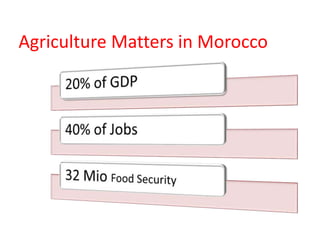
Agriculture MattersAgriculture Matters in Morocco
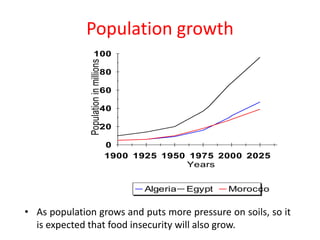
Population growth
• As population grows and puts more pressure on soils, so it
is expected that food insecurity will also grow.
0
20
40
60
80
100
Populationinmillions
1900 1925 1950 1975 2000 2025
Years
Algeria Egypt Morocco
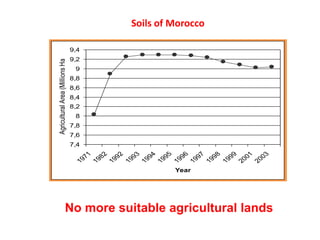
Soils of Morocco
7,4
7,6
7,8
8
8,2
8,4
8,6
8,8
9
9,2
9,4
1971
1982
1992
1993
1994
1995
1996
1997
1998
1999
2001
2003
Year
AgriculturalArea(MillionsHa)
No more suitable agricultural lands
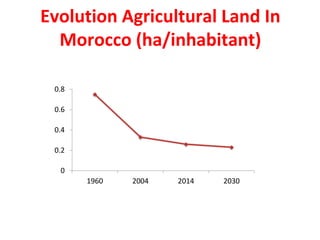
Evolution Agricultural Land In
Morocco (ha/inhabitant)
0
0.2
0.4
0.6
0.8
1960 2004 2014 2030
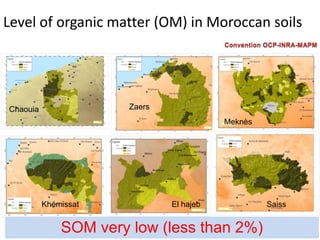
Level of organic matter (OM) in Moroccan soils
Chaouia Zaers
Khémissat El hajeb
Meknès
Saiss
Convention OCP-INRA-MAPM
SOM very low (less than 2%)
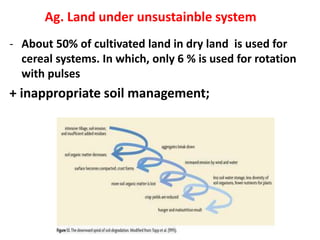
- About 50% of cultivated land in dry land is used for
cereal systems. In which, only 6 % is used for rotation
with pulses
+ inappropriate soil management;
Ag. Land under unsustainble system
New Paradigm
To Shift from unsustainble
intensive degraded cereal
cropping system to Climate
Resilient agriculture system
based on cereal-pulses rotation.
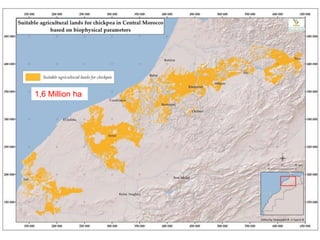
1,6 Million ha
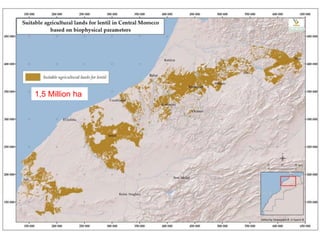
1,5 Million ha
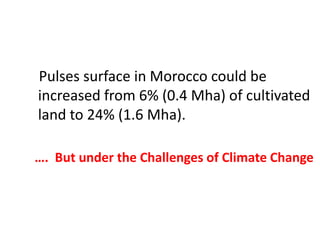
Pulses surface in Morocco could be
increased from 6% (0.4 Mha) of cultivated
land to 24% (1.6 Mha).
…. But under the Challenges of Climate Change
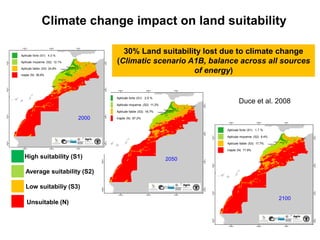
Aptitude forte (S1) 1.1 %
Aptitude moyenne (S2) 9.4%
Aptitude faible (S3) 17.7%
Inapte (N) 71.8%
Aptitude forte (S1) 2.9 %
Aptitude moyenne (S2) 11.2%
Aptitude faible (S3) 18.7%
Inapte (N) 67.2%
Aptitude forte (S1) 4.3 %
Aptitude moyenne (S2) 12.1%
Aptitude faible (S3) 24.8%
Inapte (N) 58.8%
2000
2050
2100
30% Land suitability lost due to climate change
(Climatic scenario A1B, balance across all sources
of energy)
Climate change impact on land suitability
Duce et al. 2008
High suitability (S1)
Average suitability (S2)
Low suitabiliy (S3)
Unsuitable (N)
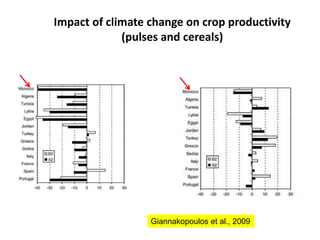
Impact of climate change on crop productivity
(pulses and cereals)
Giannakopoulos et al., 2009
Does Conservation Agri.
mitigate the negative effects
of land degradation and
climatic change on pulse-
cereal system vs Conventional
Agri.?
14
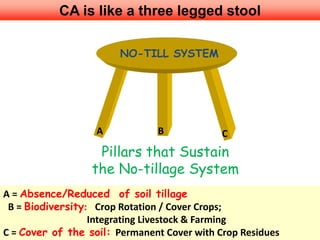
BA C
NO-TILL SYSTEM
A = Absence/Reduced of soil tillage
B = Biodiversity: Crop Rotation / Cover Crops;
Integrating Livestock & Farming
C = Cover of the soil: Permanent Cover with Crop Residues
CA is like a three legged stool
Pillars that Sustain
the No-tillage System
100
Dustbowl
1930 20001950
USSoilConservationService
conservationtillage
dustbowl
Siberia/USSR
Faulkner(US)–Fukuoka(Japan)
commercialno-till/US
firstno-tilldemonstrationinBrazil
Oldrieve/Zimbabwe
adoptionBrazil
plantiodiretonapalha
experimentsinChina,IndogangeticPlains
Newboost:Canada,Australia,Kazakhstan,
Russia,China,Finland...;Africa
Argentina,Paraguay;
1980 1990
Firstno-tillintheUS
IITAno-tillresearch
50
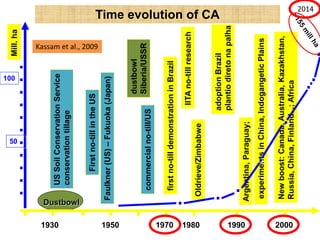
Mill.ha Time evolution of CA
1970
2014
Kassam et al., 2009
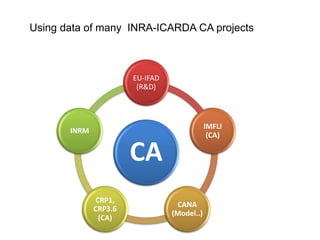
Using data of many INRA-ICARDA CA projects
CA
EU-IFAD
(R&D)
IMFLI
(CA)
CANA
(Model..)
CRP1,
CRP3.6
(CA)
INRM
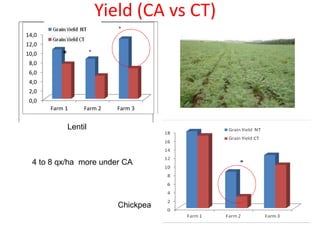
Fig 6: Effects of NT and CA on grain and straw yield of lentil at 3 sites in Zaer , (*) means significant
difference (t-student test)
0,0
2,0
4,0
6,0
8,0
10,0
12,0
14,0
Farm 1 Farm 2 Farm 3
Grain
Yield…
*
g 6: Effects of NT and CA on grain and straw yield of lentil at 3 sites in Zaer
Yield (CA vs CT)
Lentil
Chickpea
4 to 8 qx/ha more under CA
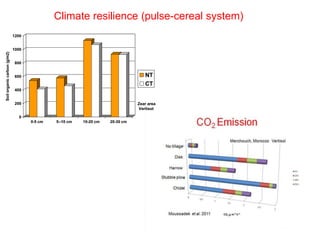
Climate resilience (pulse-cereal system)
0
200
400
600
800
1000
1200
Soilorganiccarbon(g/m2)
0-5 cm 5--10 cm 10-20 cm 20-30 cm
NT
CT
Soil organic Carbon
in NT vs CT
(after 5 years-INRM project)
Zear area
Vertisol
0
200
400
600
800
1000
1200
Soilorganiccarbon(g/m2)
0-5 cm 5--10 cm 10-20 cm 20-30 cm
NT
CT
Soil organic Carbon
in NT vs CT
(after 5 years-INRM project)
Zear area
Vertisol
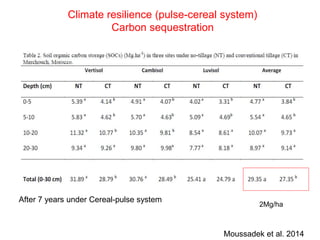
After 7 years under Cereal-pulse system
2Mg/ha
Climate resilience (pulse-cereal system)
Carbon sequestration
Moussadek et al. 2014
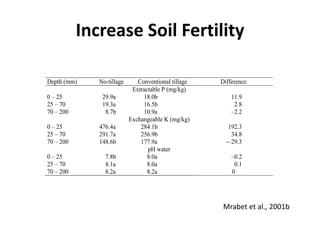
Increase Soil Fertility
Depth (mm) No-tillage Conventional tillage Difference
Extractable P (mg/kg)
0 – 25 29.9a 18.0b 11.9
25 – 70 19.3a 16.5b 2.8
70 – 200 8.7b 10.9a –2.2
Exchangeable K (mg/kg)
0 – 25 476.4a 284.1b 192.3
25 – 70 291.7a 256.9b 34.8
70 – 200 148.6b 177.9a -–29.3
pH water
0 – 25 7.8b 8.0a –0.2
25 – 70 8.1a 8.0a 0.1
70 – 200 8.2a 8.2a 0
1
Mrabet et al., 2001b
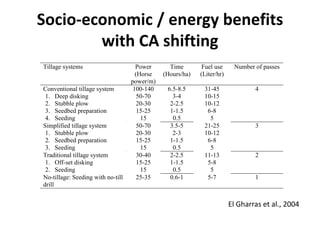
Socio-economic / energy benefits
with CA shifting
Tillage systems Power
(Horse
power/m)
Time
(Hours/ha)
Fuel use
(Liter/hr)
Number of passes
Conventional tillage system
1. Deep disking
2. Stubble plow
3. Seedbed preparation
4. Seeding
100-140
50-70
20-30
15-25
15
6.5-8.5
3-4
2-2.5
1-1.5
0.5
31-45
10-15
10-12
6-8
5
4
Simplified tillage system
1. Stubble plow
2. Seedbed preparation
3. Seeding
50-70
20-30
15-25
15
3.5-5
2-3
1-1.5
0.5
21-25
10-12
6-8
5
3
Traditional tillage system
1. Off-set disking
2. Seeding
30-40
15-25
15
2-2.5
1-1.5
0.5
11-13
5-8
5
2
No-tillage: Seeding with no-till
drill
25-35 0.6-1 5-7 1
1
El Gharras et al., 2004
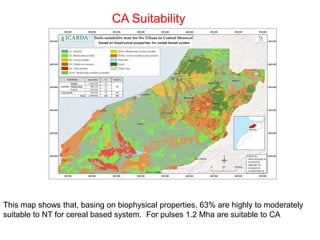
This map shows that, basing on biophysical properties, 63% are highly to moderately
suitable to NT for cereal based system. For pulses 1.2 Mha are suitable to CA
CA Suitability
Pulses-cereal system under CA: benefits to soil,
farmer and community
• cropping under CA is multi-functional within
landscapes and economies.
• It produces food and other goods for farm famillies
and markets, but it also contributes to a range of
public goods, such as carbon sequestration in soils
and land quality.
• Yield gap to be achieved using more technologies
under CA (IPM, improved varieties..)
• In contrast with Conventional Agriculture is a one-
dimensional issue: productivity (which lead to land
degardation )
• You cannot solve the problem
with the same kind of thinking
that created the problem!!!!
• Albert Einstein
Thank you

Pulses suitability assessment for sustainable productivity of drylands of Morocco

  • 1.
    Pulses suitability assessmentfor sustainable productivity of drylands of Morocco Rachid Mrabet & Rachid Moussadek INRA - Morocco Marrakech, 19 April 2016
  • 2.
  • 3.
    Population growth • Aspopulation grows and puts more pressure on soils, so it is expected that food insecurity will also grow. 0 20 40 60 80 100 Populationinmillions 1900 1925 1950 1975 2000 2025 Years Algeria Egypt Morocco
  • 4.
  • 5.
    Evolution Agricultural LandIn Morocco (ha/inhabitant) 0 0.2 0.4 0.6 0.8 1960 2004 2014 2030
  • 6.
    Level of organicmatter (OM) in Moroccan soils Chaouia Zaers Khémissat El hajeb Meknès Saiss Convention OCP-INRA-MAPM SOM very low (less than 2%)
  • 7.
    - About 50%of cultivated land in dry land is used for cereal systems. In which, only 6 % is used for rotation with pulses + inappropriate soil management; Ag. Land under unsustainble system
  • 8.
    New Paradigm To Shiftfrom unsustainble intensive degraded cereal cropping system to Climate Resilient agriculture system based on cereal-pulses rotation.
  • 9.
  • 10.
  • 11.
    Pulses surface inMorocco could be increased from 6% (0.4 Mha) of cultivated land to 24% (1.6 Mha). …. But under the Challenges of Climate Change
  • 12.
    Aptitude forte (S1)1.1 % Aptitude moyenne (S2) 9.4% Aptitude faible (S3) 17.7% Inapte (N) 71.8% Aptitude forte (S1) 2.9 % Aptitude moyenne (S2) 11.2% Aptitude faible (S3) 18.7% Inapte (N) 67.2% Aptitude forte (S1) 4.3 % Aptitude moyenne (S2) 12.1% Aptitude faible (S3) 24.8% Inapte (N) 58.8% 2000 2050 2100 30% Land suitability lost due to climate change (Climatic scenario A1B, balance across all sources of energy) Climate change impact on land suitability Duce et al. 2008 High suitability (S1) Average suitability (S2) Low suitabiliy (S3) Unsuitable (N)
  • 13.
    Impact of climatechange on crop productivity (pulses and cereals) Giannakopoulos et al., 2009
  • 14.
    Does Conservation Agri. mitigatethe negative effects of land degradation and climatic change on pulse- cereal system vs Conventional Agri.? 14
  • 15.
    BA C NO-TILL SYSTEM A= Absence/Reduced of soil tillage B = Biodiversity: Crop Rotation / Cover Crops; Integrating Livestock & Farming C = Cover of the soil: Permanent Cover with Crop Residues CA is like a three legged stool Pillars that Sustain the No-tillage System
  • 16.
  • 17.
    Using data ofmany INRA-ICARDA CA projects CA EU-IFAD (R&D) IMFLI (CA) CANA (Model..) CRP1, CRP3.6 (CA) INRM
  • 18.
    Fig 6: Effectsof NT and CA on grain and straw yield of lentil at 3 sites in Zaer , (*) means significant difference (t-student test) 0,0 2,0 4,0 6,0 8,0 10,0 12,0 14,0 Farm 1 Farm 2 Farm 3 Grain Yield… * g 6: Effects of NT and CA on grain and straw yield of lentil at 3 sites in Zaer Yield (CA vs CT) Lentil Chickpea 4 to 8 qx/ha more under CA
  • 19.
    Climate resilience (pulse-cerealsystem) 0 200 400 600 800 1000 1200 Soilorganiccarbon(g/m2) 0-5 cm 5--10 cm 10-20 cm 20-30 cm NT CT Soil organic Carbon in NT vs CT (after 5 years-INRM project) Zear area Vertisol 0 200 400 600 800 1000 1200 Soilorganiccarbon(g/m2) 0-5 cm 5--10 cm 10-20 cm 20-30 cm NT CT Soil organic Carbon in NT vs CT (after 5 years-INRM project) Zear area Vertisol
  • 20.
    After 7 yearsunder Cereal-pulse system 2Mg/ha Climate resilience (pulse-cereal system) Carbon sequestration Moussadek et al. 2014
  • 21.
    Increase Soil Fertility Depth(mm) No-tillage Conventional tillage Difference Extractable P (mg/kg) 0 – 25 29.9a 18.0b 11.9 25 – 70 19.3a 16.5b 2.8 70 – 200 8.7b 10.9a –2.2 Exchangeable K (mg/kg) 0 – 25 476.4a 284.1b 192.3 25 – 70 291.7a 256.9b 34.8 70 – 200 148.6b 177.9a -–29.3 pH water 0 – 25 7.8b 8.0a –0.2 25 – 70 8.1a 8.0a 0.1 70 – 200 8.2a 8.2a 0 1 Mrabet et al., 2001b
  • 22.
    Socio-economic / energybenefits with CA shifting Tillage systems Power (Horse power/m) Time (Hours/ha) Fuel use (Liter/hr) Number of passes Conventional tillage system 1. Deep disking 2. Stubble plow 3. Seedbed preparation 4. Seeding 100-140 50-70 20-30 15-25 15 6.5-8.5 3-4 2-2.5 1-1.5 0.5 31-45 10-15 10-12 6-8 5 4 Simplified tillage system 1. Stubble plow 2. Seedbed preparation 3. Seeding 50-70 20-30 15-25 15 3.5-5 2-3 1-1.5 0.5 21-25 10-12 6-8 5 3 Traditional tillage system 1. Off-set disking 2. Seeding 30-40 15-25 15 2-2.5 1-1.5 0.5 11-13 5-8 5 2 No-tillage: Seeding with no-till drill 25-35 0.6-1 5-7 1 1 El Gharras et al., 2004
  • 23.
    This map showsthat, basing on biophysical properties, 63% are highly to moderately suitable to NT for cereal based system. For pulses 1.2 Mha are suitable to CA CA Suitability
  • 24.
    Pulses-cereal system underCA: benefits to soil, farmer and community • cropping under CA is multi-functional within landscapes and economies. • It produces food and other goods for farm famillies and markets, but it also contributes to a range of public goods, such as carbon sequestration in soils and land quality. • Yield gap to be achieved using more technologies under CA (IPM, improved varieties..) • In contrast with Conventional Agriculture is a one- dimensional issue: productivity (which lead to land degardation )
  • 25.
    • You cannotsolve the problem with the same kind of thinking that created the problem!!!! • Albert Einstein Thank you