Name: Mukhtar Ahmad Faiz
Designation: 2nd year PhD scholar
Division: Agronomy
ICAR, India Agriculture Research Institute
Prospects and limitations of conservation
agriculture in semi-arid and arid ecologies of
South Asia
Mukhtar Ahmad Faiz
Ph.D. Student
Roll No. 11372
Division of Agronomy, IARI, New Delhi-110012
3
Content
• Introduction: Conservation agriculture
• Adoption of CA: International scenario
• Adoption in South Asia
• CA prospects
• CA Limitations
• Results and findings
• Conclusion
• Future thrust
4
Introduction
• Globally, total arable land area is 13.4 billion ha. In South Asia, it is
estimated to be 210 million ha (FAOSTAT, 2015). About 2.7% of the global
land area is degraded since last three decades (Bao et al., 2016).
• Rainfed agriculture covers ~80% of the world’s cultivated land and is
responsible for about 60% of crop production (UNESCO, 2017).
• India is also one of the world larger producer of agricultural crops where
67% (97 M ha) area is rainfed (Bana et al., 2013).
• Rainfed agriculture is characterized by low crop productivity due to many
constraints. Hence, the productivity is only 1/3rd of the irrigated area. On
the other hand, global population is increasing year by year.
5
Cont…
www.worldometers.info/world-population 6
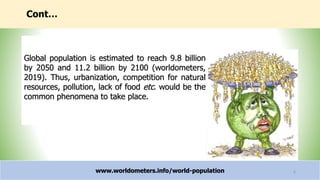
Global population is estimated to reach 9.8 billion
by 2050 and 11.2 billion by 2100 (worldometers,
2019). Thus, urbanization, competition for natural
resources, pollution, lack of food etc. would be the
common phenomena to take place.
Cont…
• agricultural intensification from intensive tillage-based production systems
generally had a negative effect on the quality of many of the essential
natural resources and the associated ecosystem services provided by
nature.
• This degradation caused crop yields and factor productivity to decline
and has forced farmers, scientists and development stakeholders to
search for an alternative paradigm that should be ecologically sustainable
as well as profitable.
• Another challenge that agriculture is 30% responsible for GHG emissions
of CO2, N2O and CH4 which directly affect climate change (IPCC, 2007).
7
• There appears to be no alternative to increase agricultural productivity and to
meet the global food, feed, fiber and bio-energy demand and to improve
hunger and poverty without degrading natural resources except
conservation agriculture.
8
Cont…
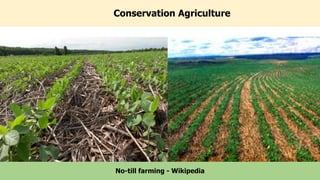
Conservation agriculture
• Definition: Conservation Agriculture (CA) is an approach, managing agro-ecosystems
for improved and sustained productivity, increased profits and food security
while preserving and enhancing the resource base and the environment (FAO, 2011).
• Concept: It was appeared in US because of land degradation and increased in oil
price. It is estimated that 91 million ha land was degraded (Utz et al., 1938).
• Principles: (Minimum soil disturbance, permanent soil cover and crop rotation).
• History: Edward H. F. (1886-1964) clearly indicated on disadvantages of CT so, he is
regarded as father of conservation tillage, book (Plowman’s Folly: a Second Look),
(Das et al., 2016).
9
Conservation Agriculture
10
No-till farming - Wikipedia
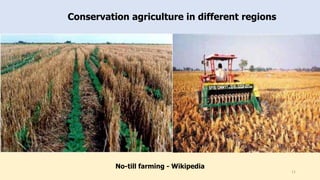
Conservation agriculture in different regions
No-till farming - Wikipedia
11
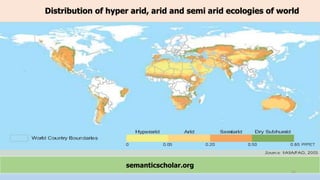
Distribution of hyper arid, arid and semi arid ecologies of world
semanticscholar.org
12
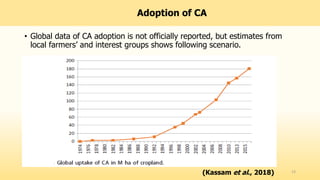
Adoption of CA
• Global data of CA adoption is not officially reported, but estimates from
local farmers’ and interest groups shows following scenario.
13
(Kassam et al., 2018)
• In many countries, CA is being mainstreamed in national agricultural
development programs by suitable policies and institutional support.
Consequently, the total area under CA worldwide has increased by 69.4%
since 2008 - 2015, from 106 m ha to 180 m ha.
• The adoption of CA globally has been growing mainly in North and South
America since 1990 , and more recently in Asia particularly (Kazakhstan,
China, India and Pakistan).
14
Cont…
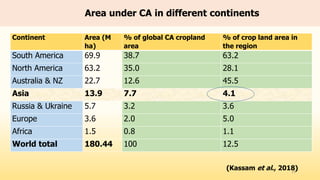
Area under CA in different continents
Continent Area (M
ha)
% of global CA cropland
area
% of crop land area in
the region
South America 69.9 38.7 63.2
North America 63.2 35.0 28.1
Australia & NZ 22.7 12.6 45.5
Asia 13.9 7.7 4.1
Russia & Ukraine 5.7 3.2 3.6
Europe 3.6 2.0 5.0
Africa 1.5 0.8 1.1
World total 180.44 100 12.5
(Kassam et al., 2018)
15
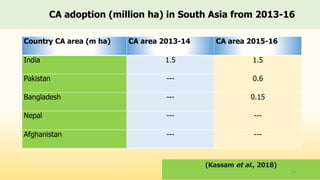
CA adoption (million ha) in South Asia from 2013-16
Country CA area (m ha) CA area 2013-14 CA area 2015-16
India 1.5 1.5
Pakistan --- 0.6
Bangladesh --- 0.15
Nepal --- ---
Afghanistan --- ---
(Kassam et al., 2018)
16
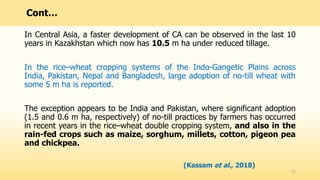
In Central Asia, a faster development of CA can be observed in the last 10
years in Kazakhstan which now has 10.5 m ha under reduced tillage.
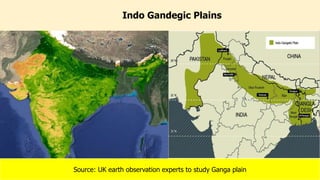
In the rice–wheat cropping systems of the Indo-Gangetic Plains across
India, Pakistan, Nepal and Bangladesh, large adoption of no-till wheat with
some 5 m ha is reported.
The exception appears to be India and Pakistan, where significant adoption
(1.5 and 0.6 m ha, respectively) of no-till practices by farmers has occurred
in recent years in the rice–wheat double cropping system, and also in the
rain-fed crops such as maize, sorghum, millets, cotton, pigeon pea
and chickpea.
17
Cont…
(Kassam et al., 2018)
Indo Gandegic Plains
18
Source: UK earth observation experts to study Ganga plain
Conservation Agriculture (CA) Prospects
• CA improves water quality due to reduced contamination levels from
agrochemicals and soil erosion (Laurent et al., 2011).
• It further helps to sequester carbon in soil at a rate ranging from about 0.2
to 1.0 t ha-1 year-1 depending on the agro-ecological location and
management practices (Corsi et al., 2012).
• Labor requirements are generally reduced by ~50%, which allows farmers
to save on time, fuel and machinery costs (Lindwall and Sonntag, 2011)
• Fuel savings ~65% is reported (Sorrenson and Montoya, 1991).
19
Cont…
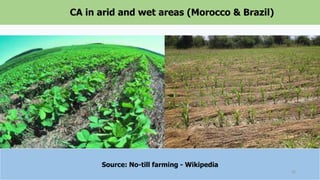
• It is practiced by farmers from extremely dry conditions with 250 mm a year
(Morocco), to heavy rainfall areas with 2,000 mm a year (Brazil) or 3,000 mm a
year (Chile) (Derpsch and Friedrich, 2009).
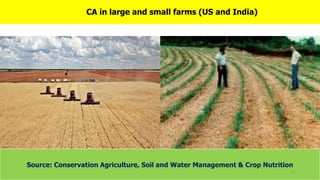
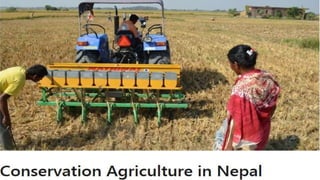
• It is practiced on all farm sizes from less than half a hectare (India, Nepal, China,
Zambia) to thousands of hectares (Argentina, Brazil, Kazakhstan).
• It is practiced on soils that vary from 90% sand (Australia) to 80% clay (Brazil)
(Derpsch and Friedrich, 2009).
• All crops can be grown adequately in CA, the authors’ knowledge there has not
yet been a crop that would not grow and produce under this system, including
root and tuber crops (Derpsch and Friedrich, 2009).
20
CA in large and small farms (US and India)
Source: Conservation Agriculture, Soil and Water Management & Crop Nutrition
21
CA in arid and wet areas (Morocco & Brazil)
Source: No-till farming - Wikipedia
22
Cont…
• Reduction in cost of production – Most studies showed that the cost of wheat
production is reduced by Rs. 2,000 to 3,000 ha-1 ($ 33 to 50) (Bahan and
Behera, 2014)
• Improvement of resource use efficiency through residue decomposition, soil
structural improvement, increased recycling and availability of plant nutrients
(Bahan and Behera, 2014)
• Saving in water– limited experimental results and farmers experience indicate
that considerable saving in water (up to 20% – 30%) achieved with zero-till
planting and particularly in laser leveled and bed planted crops (De Vita et al.,
2007).
• Yield increases as high as 200 – 500 kg ha-1 are found with no-till wheat
compared to conventional wheat under a rice-wheat system in the Indo
Gangetic plains (Hobbs and Gupta, 2004). 23
Cont…
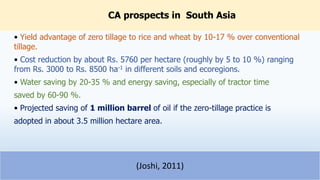
A major benefit of CA is the control of soil erosion due to maintenance of soil
cover, greater infiltration and reduced runoff (Roose and Barthes, 2001).
Approximately 97% of the soil erosion reduction from adoption of CA in the
US occurred prior to 1996.
24
Source: NRCS - USDA
CA prospects in South Asia
• Yield advantage of zero tillage to rice and wheat by 10-17 % over conventional
tillage.
• Cost reduction by about Rs. 5760 per hectare (roughly by 5 to 10 %) ranging
from Rs. 3000 to Rs. 8500 ha-1 in different soils and ecoregions.
• Water saving by 20-35 % and energy saving, especially of tractor time
saved by 60-90 %.
• Projected saving of 1 million barrel of oil if the zero-tillage practice is
adopted in about 3.5 million hectare area.
25
(Joshi, 2011)
Results and findings
1. The latest comprehensive meta-analysis of 5460 paired yield
observations from 610 studies suggests that CA in itself results in a
yield penalty of around 10% overall (Pittelkow et al., 2015).
2. No-till cannot increase the overall soil organic C stocks in most cases,
except for those with increased crop residue retention through growing
two crops each year.
26
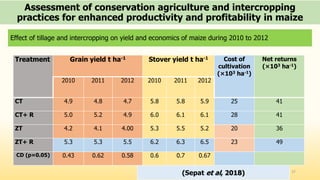
Assessment of conservation agriculture and intercropping
practices for enhanced productivity and profitability in maize
27
(Sepat et al, 2018)
Effect of tillage and intercropping on yield and economics of maize during 2010 to 2012
Treatment Grain yield t ha-1 Stover yield t ha-1 Cost of
cultivation
(×103 ha-1)
Net returns
(×103 ha-1)
2010 2011 2012 2010 2011 2012
CT 4.9 4.8 4.7 5.8 5.8 5.9 25 41
CT+ R 5.0 5.2 4.9 6.0 6.1 6.1 28 41
ZT 4.2 4.1 4.00 5.3 5.5 5.2 20 36
ZT+ R 5.3 5.3 5.5 6.2 6.3 6.5 23 49
CD (p=0.05) 0.43 0.62 0.58 0.6 0.7 0.67
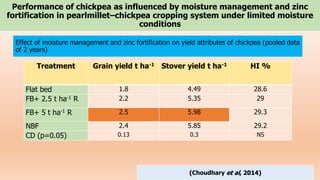
Performance of chickpea as influenced by moisture management and zinc
fortification in pearlmillet–chickpea cropping system under limited moisture
conditions
28
(Choudhary et al, 2014)
Effect of moisture management and zinc fortification on yield attributes of chickpea (pooled data
of 2 years)
Treatment Grain yield t ha-1 Stover yield t ha-1 HI %
Flat bed 1.8 4.49 28.6
FB+ 2.5 t ha-1 R 2.2 5.35 29
FB+ 5 t ha-1 R 2.5 5.98 29.3
NBF 2.4 5.85 29.2
CD (p=0.05) 0.13 0.3 NS
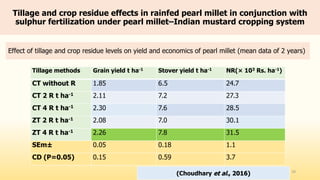
Tillage and crop residue effects in rainfed pearl millet in conjunction with
sulphur fertilization under pearl millet–Indian mustard cropping system
29
(Choudhary et al., 2016)
Tillage methods Grain yield t ha-1 Stover yield t ha-1 NR(× 103 Rs. ha-1)
CT without R 1.85 6.5 24.7
CT 2 R t ha-1 2.11 7.2 27.3
CT 4 R t ha-1 2.30 7.6 28.5
ZT 2 R t ha-1 2.08 7.0 30.1
ZT 4 R t ha-1 2.26 7.8 31.5
SEm± 0.05 0.18 1.1
CD (P=0.05) 0.15 0.59 3.7
Effect of tillage and crop residue levels on yield and economics of pearl millet (mean data of 2 years)
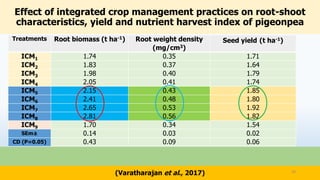
Effect of integrated crop management practices on root-shoot
characteristics, yield and nutrient harvest index of pigeonpea
(Varatharajan et al., 2017) 30
Treatments Root biomass (t ha-1) Root weight density
(mg/cm3)
Seed yield (t ha-1)
ICM1 1.74 0.35 1.71
ICM2 1.83 0.37 1.64
ICM3 1.98 0.40 1.79
ICM4 2.05 0.41 1.74
ICM5 2.15 0.43 1.85
ICM6 2.41 0.48 1.80
ICM7 2.65 0.53 1.92
ICM8 2.81 0.56 1.82
ICM9 1.70 0.34 1.54
SEm± 0.14 0.03 0.02
CD (P=0.05) 0.43 0.09 0.06
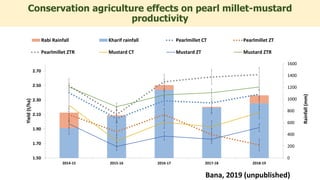
Conservation agriculture effects on pearl millet-mustard
productivity
0
200
400
600
800
1000
1200
1400
1600
1.50
1.70
1.90
2.10
2.30
2.50
2.70
2014-15 2015-16 2016-17 2017-18 2018-19
Rainfall
(mm)
Yield
(t/ha)
Rabi Rainfall Kharif rainfall Pearlmillet CT Pearlmillet ZT
Pearlmillet ZTR Mustard CT Mustard ZT Mustard ZTR
Bana, 2019 (unpublished)
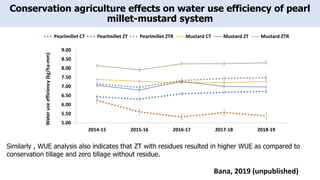
Conservation agriculture effects on water use efficiency of pearl
millet-mustard system
5.00
5.50
6.00
6.50
7.00
7.50
8.00
8.50
9.00
2014-15 2015-16 2016-17 2017-18 2018-19
Water
use
efficiency
(kg/ha-mm)
Pearlmillet CT Pearlmillet ZT Pearlmillet ZTR Mustard CT Mustard ZT Mustard ZTR
Bana, 2019 (unpublished)
Similarly , WUE analysis also indicates that ZT with residues resulted in higher WUE as compared to
conservation tillage and zero tillage without residue.
There were lesser effects of rainfall levels on WUE under ZTR as compared to ZT and CT.
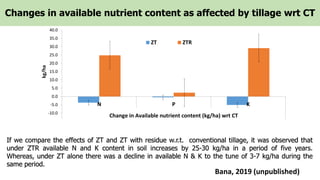
Changes in available nutrient content as affected by tillage wrt CT
-10.0
-5.0
0.0
5.0
10.0
15.0
20.0
25.0
30.0
35.0
40.0
N P K
Change in Available nutrient content (kg/ha) wrt CT
kg/ha ZT ZTR
Bana, 2019 (unpublished)
If we compare the effects of ZT and ZT with residue w.r.t. conventional tillage, it was observed that
under ZTR available N and K content in soil increases by 25-30 kg/ha in a period of five years.
Whereas, under ZT alone there was a decline in available N & K to the tune of 3-7 kg/ha during the
same period.
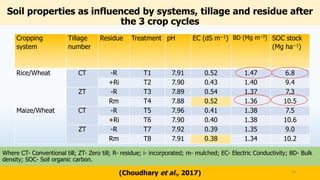
Where CT- Conventional till; ZT- Zero till; R- residue; i- incorporated; m- mulched; EC- Electric Conductivity; BD- Bulk
density; SOC- Soil organic carbon.
Cropping
system
Tillage
number
Residue Treatment pH EC (dS m−1) BD (Mg m−3) SOC stock
(Mg ha−1)
Rice/Wheat CT -R T1 7.91 0.52 1.47 6.8
+Ri T2 7.90 0.43 1.40 9.4
ZT -R T3 7.89 0.54 1.37 7.3
Rm T4 7.88 0.52 1.36 10.5
Maize/Wheat CT -R T5 7.96 0.41 1.38 7.5
+Ri T6 7.90 0.40 1.38 10.6
ZT -R T7 7.92 0.39 1.35 9.0
Rm T8 7.91 0.38 1.34 10.2
Soil properties as influenced by systems, tillage and residue after
the 3 crop cycles
(Choudhary et al., 2017) 34
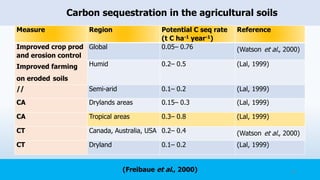
Carbon sequestration in the agricultural soils
Measure Region Potential C seq rate
(t C ha-1 year-1)
Reference
Improved crop prod
and erosion control
Global 0.05– 0.76 (Watson et al., 2000)
Improved farming
on eroded soils
Humid 0.2– 0.5 (Lal, 1999)
// Semi-arid 0.1– 0.2 (Lal, 1999)
CA Drylands areas 0.15– 0.3 (Lal, 1999)
CA Tropical areas 0.3– 0.8 (Lal, 1999)
CT Canada, Australia, USA 0.2– 0.4 (Watson et al., 2000)
CT Dryland 0.1– 0.2 (Lal, 1999)
(Freibaue et al., 2000) 35
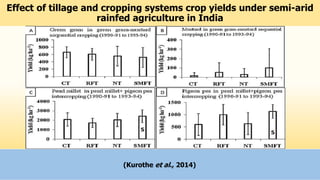
Effect of tillage and cropping systems crop yields under semi-arid
rainfed agriculture in India
36
(Kurothe et al., 2014)
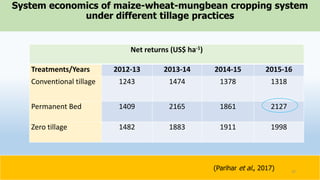
System economics of maize-wheat-mungbean cropping system
under different tillage practices
Net returns (US$ ha-1)
Treatments/Years 2012-13 2013-14 2014-15 2015-16
Conventional tillage 1243 1474 1378 1318
Permanent Bed 1409 2165 1861 2127
Zero tillage 1482 1883 1911 1998
(Parihar et al., 2017) 37
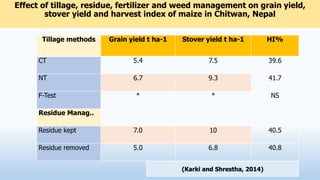
Effect of tillage, residue, fertilizer and weed management on grain yield,
stover yield and harvest index of maize in Chitwan, Nepal
38
Tillage methods Grain yield t ha-1 Stover yield t ha-1 HI%
CT 5.4 7.5 39.6
NT 6.7 9.3 41.7
F-Test * * NS
Residue Manag..
Residue kept 7.0 10 40.5
Residue removed 5.0 6.8 40.8
(Karki and Shrestha, 2014)
39
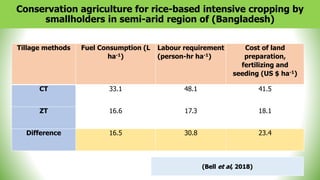
Conservation agriculture for rice-based intensive cropping by
smallholders in semi-arid region of (Bangladesh)
40
Tillage methods Fuel Consumption (L
ha-1)
Labour requirement
(person-hr ha-1)
Cost of land
preparation,
fertilizing and
seeding (US $ ha-1)
CT 33.1 48.1 41.5
ZT 16.6 17.3 18.1
Difference 16.5 30.8 23.4
(Bell et al, 2018)
41
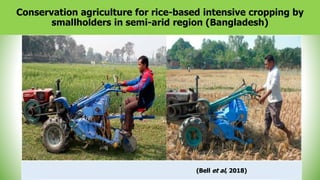
Conservation agriculture for rice-based intensive cropping by
smallholders in semi-arid region (Bangladesh)
(Bell et al, 2018)
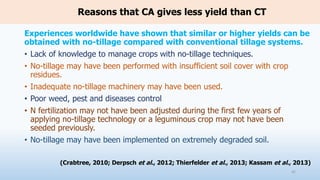
Reasons that CA gives less yield than CT
Experiences worldwide have shown that similar or higher yields can be
obtained with no-tillage compared with conventional tillage systems.
• Lack of knowledge to manage crops with no-tillage techniques.
• No-tillage may have been performed with insufficient soil cover with crop
residues.
• Inadequate no-tillage machinery may have been used.
• Poor weed, pest and diseases control
• N fertilization may not have been adjusted during the first few years of
applying no-tillage technology or a leguminous crop may not have been
seeded previously.
• No-tillage may have been implemented on extremely degraded soil.
(Crabtree, 2010; Derpsch et al., 2012; Thierfelder et al., 2013; Kassam et al., 2013)
42
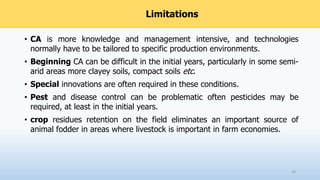
Limitations
• CA is more knowledge and management intensive, and technologies
normally have to be tailored to specific production environments.
• Beginning CA can be difficult in the initial years, particularly in some semi-
arid areas more clayey soils, compact soils etc.
• Special innovations are often required in these conditions.
• Pest and disease control can be problematic often pesticides may be
required, at least in the initial years.
• crop residues retention on the field eliminates an important source of
animal fodder in areas where livestock is important in farm economies.
43
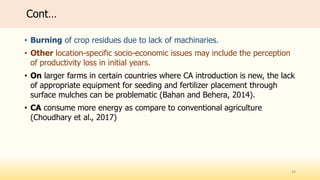
Cont…
• Burning of crop residues due to lack of machinaries.
• Other location-specific socio-economic issues may include the perception
of productivity loss in initial years.
• On larger farms in certain countries where CA introduction is new, the lack
of appropriate equipment for seeding and fertilizer placement through
surface mulches can be problematic (Bahan and Behera, 2014).
• CA consume more energy as compare to conventional agriculture
(Choudhary et al., 2017)
44
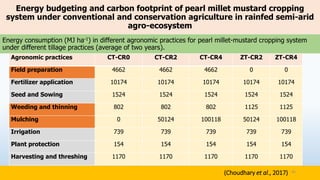
Energy consumption (MJ ha-1) in different agronomic practices for pearl millet-mustard cropping system
under different tillage practices (average of two years).
Energy budgeting and carbon footprint of pearl millet mustard cropping
system under conventional and conservation agriculture in rainfed semi-arid
agro-ecosystem
(Choudhary et al., 2017) 45
Agronomic practices CT-CR0 CT-CR2 CT-CR4 ZT-CR2 ZT-CR4
Field preparation 4662 4662 4662 0 0
Fertilizer application 10174 10174 10174 10174 10174
Seed and Sowing 1524 1524 1524 1524 1524
Weeding and thinning 802 802 802 1125 1125
Mulching 0 50124 100118 50124 100118
Irrigation 739 739 739 739 739
Plant protection 154 154 154 154 154
Harvesting and threshing 1170 1170 1170 1170 1170
Residue production
46
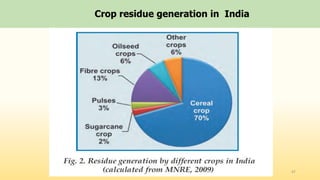
• The Ministry of New and Renewable Energy (MNRE, 2009) has estimated that
about ~501.76 m t of crop residues are generated every year in India. The
surplus residues i.e., total residues generated minus residues used for various
purposes, are estimated (~140.8 m t) and the residue which burnt in the
field is estimated (~91.3 m t).
• In China, where about 700 m t crop residues are generated annually, 31% of
crop residues are left in the field, 31% are used for animal feed, 19% are
used for bioenergy generation and 15% are used as fertilizer (Jiang et al.,
2012).
Crop residue generation in India
47
Conclusion
 80% of global area is under rainfed condition so the productivity is very less (1/3 of the
irrigated area).
 Agricultural intensification degraded soil fertility and reduced resource use efficiency.
 Even though, global support is for CA but still very less (12.5%) of the arable land
modified to CA.
 CA increases 10% yield as compare to CT and mitigate climate change by sequestering
CO2 0.05-0.76 t ha-1 year-1.
 It saves 60% labor requirement and 65% fuel consumption.
 it is difficult to adjust CA initially and required more skill, knowledge and budget.
48
Future thrust
• Conservation agriculture offers a new paradigm for agricultural
sustainability over the conventional one which mainly aimed at achieving
specific foodgrains production targets.
• Thus, a shift to CA systems has become a necessity in view of widespread
problems of production-vulnerabilities, resource degradation and climate
change.
• Conservation agriculture vitally integrates the concerns of sustained
productivity, resource conservation, and soil and environment quality
enhancement as the prime and fundamental goals for overall sustainable
development of the mankind.
49
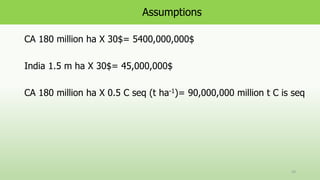
Assumptions
CA 180 million ha X 30$= 5400,000,000$
India 1.5 m ha X 30$= 45,000,000$
CA 180 million ha X 0.5 C seq (t ha-1)= 90,000,000 million t C is seq
50
51
52