Vocabularies, linking, and application programming

TOOLS FOR LLD
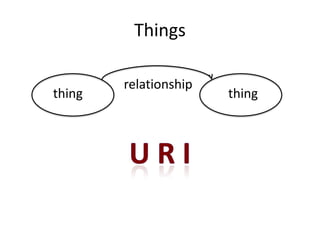
Things

        relationship
thing                  thing
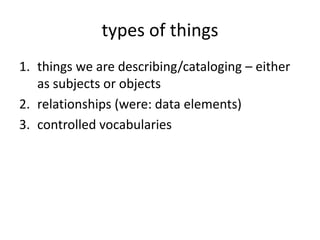
types of things
1. things we are describing/cataloging – either
   as subjects or objects
2. relationships (were: data elements)
3. controlled vocabularies
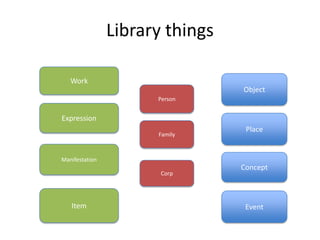
Library things

   Work
                                 Object
                      Person


Expression
                                  Place
                      Family


Manifestation
                                 Concept
                       Corp


   Item                           Event
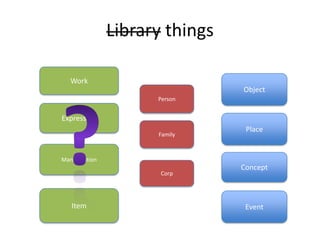
Library things

   Work
                                 Object
                      Person


Expression
                                  Place
                      Family


Manifestation
                                 Concept
                       Corp


   Item                           Event
GENERAL TERMS AND
VOCABULARIES
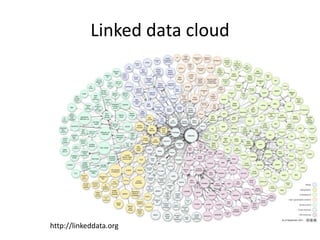
Linked data cloud


http://linkeddata.org
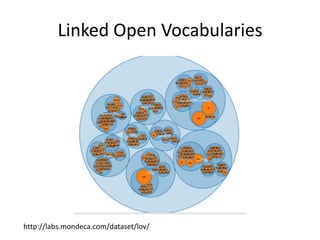
Linked Open Vocabularies


http://labs.mondeca.com/dataset/lov/
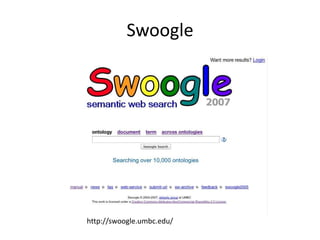
Swoogle


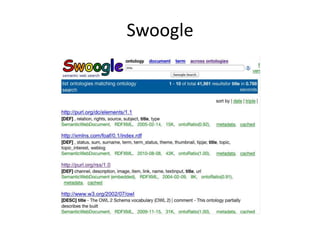
http://swoogle.umbc.edu/
Swoogle
IDENTIFYING COMMON THINGS
Identifying People
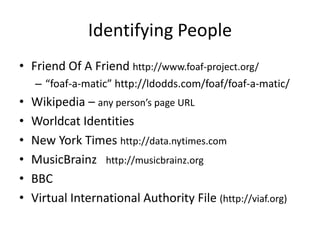
• Friend Of A Friend http://www.foaf-project.org/
    – “foaf-a-matic” http://ldodds.com/foaf/foaf-a-matic/
•   Wikipedia – any person’s page URL
•   Worldcat Identities
•   New York Times http://data.nytimes.com
•   MusicBrainz http://musicbrainz.org
•   BBC
•   Virtual International Authority File (http://viaf.org)
Identifying Places
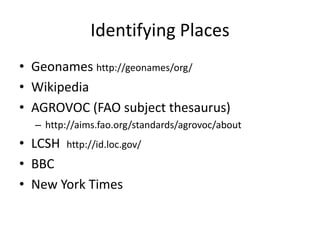
• Geonames http://geonames/org/
• Wikipedia
• AGROVOC (FAO subject thesaurus)
   – http://aims.fao.org/standards/agrovoc/about
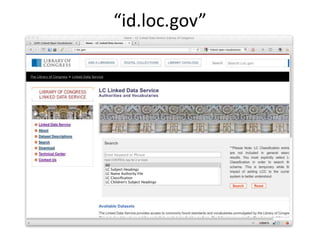
• LCSH http://id.loc.gov/
• BBC
• New York Times
Identifying Topics
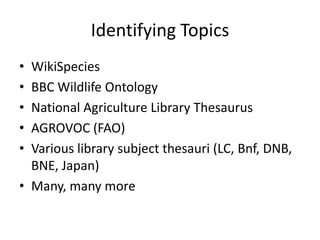
• WikiSpecies
• BBC Wildlife Ontology
• National Agriculture Library Thesaurus
• AGROVOC (FAO)
• Various library subject thesauri (LC, Bnf, DNB,
  BNE, Japan)
• Many, many more
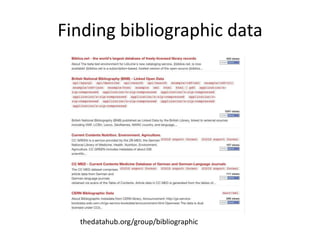
Finding bibliographic data


  thedatahub.org/group/bibliographic
“id.loc.gov”
programmers and application developers

DEVELOPMENT
Lists of tools
W3C Semantic Web tools
  – http://www.w3.org/2001/sw/wiki/Tools

  categories: APIs, converters, reasoners,
    programming environments, browser tools, social
    media, triple stores, validators, development
    environments
Lists of tools
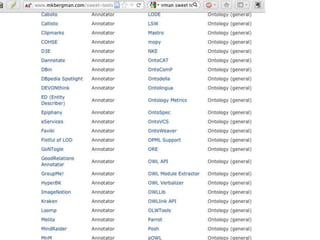
Sweet tools, by Mike Bergman
  http://www.mkbergman.com/sweet-tools

categories: agents, annotators, APIs, ontology
  creators, browser tools, application
  frameworks, converters…
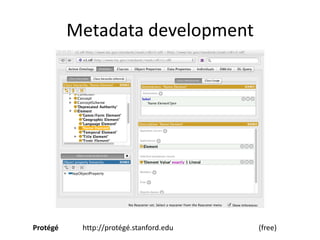
Metadata development


Protégé    http://protégé.stanford.edu   (free)
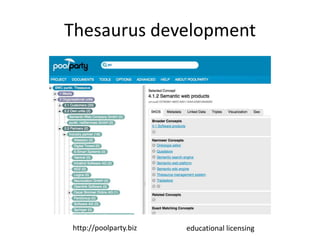
Thesaurus development


http://poolparty.biz   educational licensing
Programming
                  Apache Jena
              http://jena.apache.org

“Java framework for building Semantic Web
applications.”

•   Tutorial!
•   Getting started help!
•   Documentation!
Programming
                   Pellet
        http://clarkparsia.com/pellet/

“OWL2 Reasoner for Java”

•Users group listserv.
•Examples in download.
•Commercial support available.
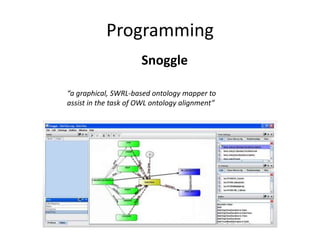
Programming
                      Snoggle

“a graphical, SWRL-based ontology mapper to
assist in the task of OWL ontology alignment”
Programming
        Virtuoso SPARQL query editor
         http://virtuoso.openlinksw.com


              SPARQL by Example
http://www.cambridgesemantics.com/2008/09/sparql-by-
                       example
                      tutorial!
Thank you!

… AND THAT’S JUST A TASTE
http://kcoyle.net/presentations/l
            inks.html
         kcoyle@kcoyle.net

Libraries and Linked Data: Looking to the Future (3)

Editor's Notes

  • #3 All things should have URI if possible. Note that in the parlance of the semantic web, even the relationships, formally, are things. This may be true, but I find that it is easier to think of things and relationships separately because we do think of them differently, even though they will both take the form of URIs.
  • #5 We have an idea of what the library “things” are.
  • #6 But we don’t want to create library things – we want to idenitify universal things that will link to and intereact with the same things when they occur in other metadata. The things in library data are, for the most part, not unique to libraries. People, places, events, topics, and even books and journals and pieces of music… there are many communities that are interested in these things, and a surprising number who are including them in metadata.One area of our modern concept of library resources that is still puzzling to the members of our community who are working on linked data is what to do about the division of resources into the FRBR concepts of Work, Expression, Manifestation and Item. The pre-FRBR bibliographic data in which these are pretty much blended into a single thing is closer to the rest of the world’s idea of resources to be defined by metadata. So there is a bit of a dilemma here, and I’m going to skip over this particular issue because it is more than a bit of a morass, and we could get stuck there for a while. Just know that there are good minds working on how we’ll connect FRBR-ized bibliographic data to non-FRBRized data both within libraries and on the web.
  • #23 other products as well. online demos.
  • #28 IMLS grant – modules to teach developers and programmers how to use the tools.