Personalized Museum Tour with Real-
Time Adaptation on a Mobile Device
with Multi-Point Touch Interface      Graduation Committee:
                                                Dr. L.M. Aroyo
                                                 Dr. A.J. Mooij
Master Thesis by Ivo Roes (0527673)    Prof. Dr. P.M.E. de Bra
Introduction

       • Current museum tours
           • Information on paper
           • Audio guides
           • Human tour guides

       • “One size fits all” mentality

       • Users want the best
         experience in the available
         time


/ Business Information Systems           July 2010   PAGE 1
Overview

       •   Context
       •   Related Work
       •   Problem Definition & Research Questions
       •   Requirements
       •   Design
       •   Adaptation Strategies
       •   Localization
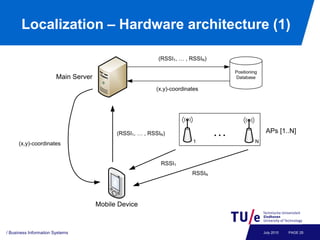
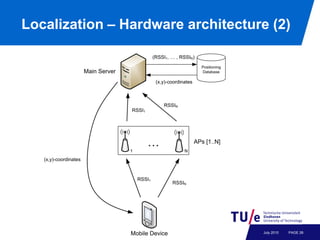
       •   Demo
       •   Conclusion & Further Research
       •   Questions

/ Business Information Systems                       July 2010   PAGE 2
Context – Project

       • CHIP project


       • CATCH program


/ Business Information Systems   July 2010   PAGE 3
Context – Existing Implementation


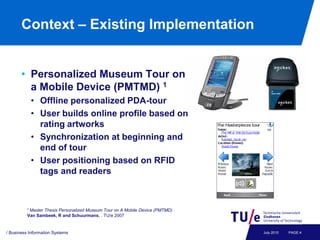
       • Personalized Museum Tour on
         a Mobile Device (PMTMD) 1
           • Offline personalized PDA-tour
           • User builds online profile based on
             rating artworks
           • Synchronization at beginning and
             end of tour
           • User positioning based on RFID
             tags and readers


          1 Master
                 Thesis Personalized Museum Tour on A Mobile Device (PMTMD)
          Van Sambeek, R and Schuurmans, . TU/e 2007


/ Business Information Systems                                                July 2010   PAGE 4
Related Work

       • GUIDE

       • Sotto Voce

       • AgentSalon

       • PEACH

       • HIPPIE

       • The Kubadji Project


/ Business Information Systems   July 2010   PAGE 5
Problem Definition

       • Existing Implementation (PMTMD)
           • Offline Tour
           • Hardware Platform
           • Static user positioning


/ Business Information Systems             July 2010   PAGE 6
Research Questions


       1. What user, collection and spatial aspects play a
          role in the real-time adaptation of a mobile museum
          tour?

       2. In what manner can the visitor be precisely
          positioned in real-time and how can this
          information be used in tour adaptation?


/ Business Information Systems                          July 2010   PAGE 7
Requirements

       •   Tour
       •   Adaptation
       •   Localization
       •   System
           • Platform independent implementation
           • Non-intrusiveness to the user
           • Non-intrusiveness to the environment


/ Business Information Systems                      July 2010   PAGE 8
Design – General Scenario


       • User creates online profile
       • User visits physical museum
       • User selects (personalized) tour
       • User configures the tour to his / her preferences
       • User starts tour
       • During tour user can view artwork description, concepts and related
         artworks.
       • The user can rate artworks / concepts
       • The user can add (similar) artworks
       • At any moment the user can view his location on the map


/ Business Information Systems                                       July 2010   PAGE 9
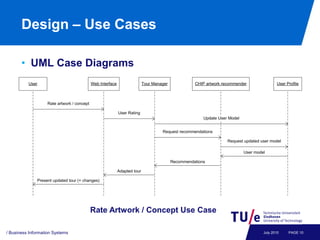
Design – Use Cases

       • UML Case Diagrams


                                 Rate Artwork / Concept Use Case

/ Business Information Systems                                     July 2010   PAGE 10
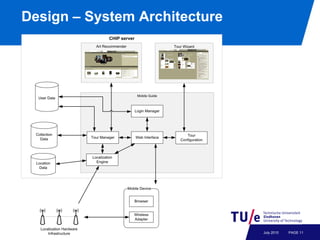
Design – System Architecture


                               July 2010   PAGE 11
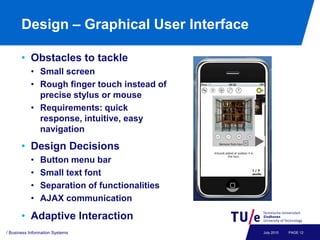
Design – Graphical User Interface

       • Obstacles to tackle
           • Small screen
           • Rough finger touch instead of
             precise stylus or mouse
           • Requirements: quick
             response, intuitive, easy
             navigation
       • Design Decisions
           •    Button menu bar
           •    Small text font
           •    Separation of functionalities
           •    AJAX communication

       • Adaptive Interaction
/ Business Information Systems                  July 2010   PAGE 12
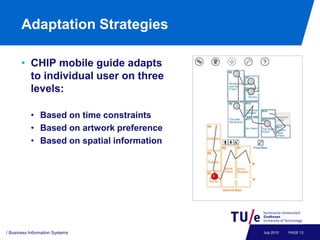
Adaptation Strategies

       • CHIP mobile guide adapts
         to individual user on three
         levels:

           • Based on time constraints
           • Based on artwork preference
           • Based on spatial information


/ Business Information Systems              July 2010   PAGE 13
Adaptation Strategies – time constraints (1)


       • Usually museum visitors wish to spend a certain
         amount of time in the museum

       • At tour configuration users can specify #artworks and
         #minutes

       • Each user has a different average time for viewing an
         artwork tv (continously updated)

       • CHIP mobile guide guards: #artworks x tv = #minutes


/ Business Information Systems                            July 2010   PAGE 14
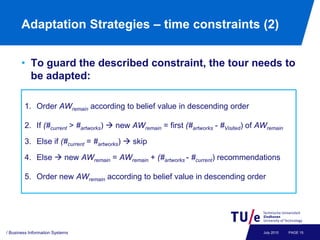
Adaptation Strategies – time constraints (2)


       • To guard the described constraint, the tour needs to
         be adapted:

        1. Order AWremain according to belief value in descending order

        2. If (#current > #artworks)  new AWremain = first (#artworks - #Visited) of AWremain

        3. Else if (#current = #artworks)  skip

        4. Else  new AWremain = AWremain + (#artworks - #current) recommendations

        5. Order new AWremain according to belief value in descending order


/ Business Information Systems                                                         July 2010   PAGE 15
Adaptation Strategies – artwork preference (1)

       • Rating of artworks and concepts on a
         5-star scale [-1.0, -0.5, 0.0, 0.5, 1.0]
       • A belief value is calculated for all
         artworks and concepts


       • Belief value of concepts is built up from
         child concepts
       • Belief value for artworks is built up
         from concepts

/ Business Information Systems                       July 2010   PAGE 16
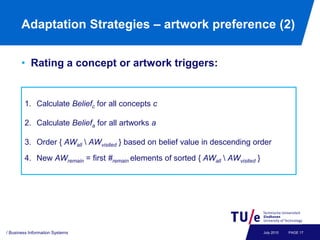
Adaptation Strategies – artwork preference (2)


       • Rating a concept or artwork triggers:


        1. Calculate Beliefc for all concepts c

        2. Calculate Beliefa for all artworks a

        3. Order { AWall  AWvisited } based on belief value in descending order

        4. New AWremain = first #remain elements of sorted { AWall  AWvisited }


/ Business Information Systems                                                     July 2010   PAGE 17
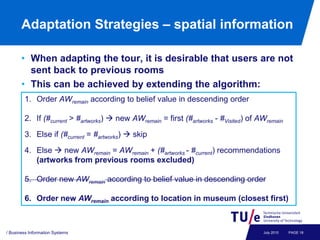
Adaptation Strategies – spatial information

       • When adapting the tour, it is desirable that users are not
         sent back to previous rooms
       • This can be achieved by extending the algorithm:
        1. Order AWremain according to belief value in descending order

        2. If (#current > #artworks)  new AWremain = first (#artworks - #Visited) of AWremain
        3. Else if (#current = #artworks)  skip

        4. Else  new AWremain = AWremain + (#artworks - #current) recommendations
           (artworks from previous rooms excluded)

        5. Order new AWremain according to belief value in descending order

        6. Order new AWremain according to location in museum (closest first)


/ Business Information Systems                                                         July 2010   PAGE 18
Adaptation Strategies – Validation (1)

       • Validation of the Artwork Recommender
           • Study 2 performed by CHIP team into relevant semantic
             relations
           • Test group rated artworks / concepts
           • After presentation of recommendations, users could
             rate the semantic relation used as a basis for the
             recommendation
           • Best performing semantic relations were based on
             creator and style of an artwork
           • Semantic relations based on geographic location
             performed the worst
          2 Semantic  Relations for Content-based Recommendations, Wang, Y et al.,
          In Proc. International Conference on Knowledge Capture (K-cap), 2009, Vol. September 2009


/ Business Information Systems                                                                        July 2010   PAGE 19
Adaptation Strategies – Validation (2)

       • Comparative Analysis with SpaceCHIP 3
           • SpaceCHIP extends the mobile guide by implementing a
             routing mechanism based on the SWI-Prolog Space package
           • Main goals: minimize walking distance and take themed rooms
             into account
           • Introduction of connectivity graph with nodes consisting of
             artworks, rooms, doors, hallways and stairs
           • Set transition weights of edges to experienced distance
             instead of actual distance
           • Using a nearest neighbor search a suboptimal shortest tour
             through the museum is calculated.
           • Calculation time is exponentially related to number of artworks
          3 Finding
                  Your Way through the Rijksmuseum with an Adaptive Mobile Museum Guide
          W.R. van Hage et al., Heraklion, Greece : 7th Extended Semantic Web Conference, 2010


/ Business Information Systems                                                                   July 2010   PAGE 20
Adaptation Strategies – Validation (3)

       • Both the CHIP mobile guide and SpaceCHIP aim at
         minimizing user walking distance and take themed
         rooms into account
       • The approach for reordering the tour differs slightly
           • CHIP mobile guide orders remaining tour based on the
             room where artworks are located
           • SpaceCHIP uses experienced distance instead of actual
             distance and therefore also takes into account
             unfavorable transitioning to a different floor
       • Further research is needed to determine which
         method results in better remaining tours


/ Business Information Systems                            July 2010   PAGE 21
Localization

       • In the exisiting implementation, localization was
         achieved using RFID scanners and tags

       • No real-time location information was available

       • In the CHIP mobile guide we set out to see what
         possibilities exist for real-time localization

       • Requirements that must hold: platform-independent
         implementation and non-intrusiveness.


/ Business Information Systems                         July 2010   PAGE 22
Localization – Software

       • From a literature study, a Radio Frequency
         Fingerprinting technique was chosen as a basis for
         localization.

       • Radio Frequency Fingerprinting
           • Based on Received Signal Strength Indicator (RSSI)
           • Calibration phase, measure RSSI values to all access
             points for predefined set of points in the space. Use
             average values to generate frequency radio map
           • Online phase, compare live measurement of RSSI
             values to all access points and compare to map


/ Business Information Systems                              July 2010   PAGE 23
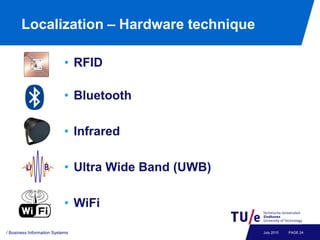
Localization – Hardware technique

                            • RFID

                            • Bluetooth

                            • Infrared

                            • Ultra Wide Band (UWB)

                            • WiFi

/ Business Information Systems                        July 2010   PAGE 24
Localization – Hardware architecture (1)


/ Business Information Systems            July 2010   PAGE 25
Localization – Hardware architecture (2)


                                   July 2010   PAGE 26
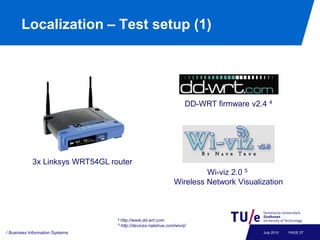
Localization – Test setup (1)


                                                                      DD-WRT firmware v2.4 4


            3x Linksys WRT54GL router
                                                                         Wi-viz 2.0 5
                                                                Wireless Network Visualization


                                 4 http://www.dd-wrt.com
                                 5   http://devices.natetrue.com/wiviz/
/ Business Information Systems                                                           July 2010   PAGE 27
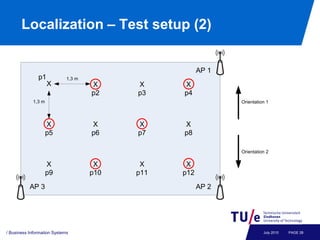
Localization – Test setup (2)


/ Business Information Systems         July 2010   PAGE 28
Localization – Test setup (3)

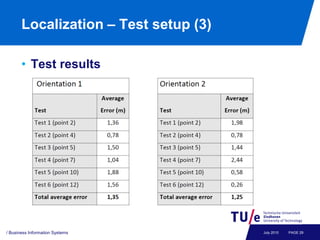
       • Test results


/ Business Information Systems         July 2010   PAGE 29
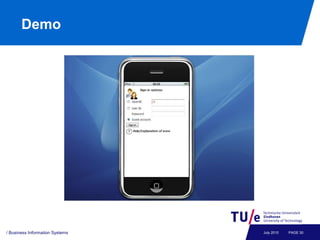
Demo


/ Business Information Systems   July 2010   PAGE 30
Conclusion

       • Focus on what aspects play a role in real-time
         adaptation of a museum tour and real-time
         localization of a visitor in the museum
       • Adaptation in the CHIP mobile guide takes place at
         three levels:
           • Based on time constraints
           • Based on artwork preference
           • Based on spatial information
       • Localization was implemented using a WiFi Radio
         Frequency Fingerprinting technique, resulting in an
         accuracy of up to 1,25 m


/ Business Information Systems                        July 2010   PAGE 31
Further Research

       • Graphical User Interface evaluation

       • Scalability of localization technique

       • Social aspects


/ Business Information Systems                   July 2010   PAGE 32
Questions?


/ Business Information Systems   July 2010   PAGE 33

CHIP Project: Personalized Museum Tour with Real-Time Adaptation on a Mobile Device with Multi-Point Touch Interface

  • 1.
    Personalized Museum Tourwith Real- Time Adaptation on a Mobile Device with Multi-Point Touch Interface Graduation Committee: Dr. L.M. Aroyo Dr. A.J. Mooij Master Thesis by Ivo Roes (0527673) Prof. Dr. P.M.E. de Bra
  • 2.
    Introduction • Current museum tours • Information on paper • Audio guides • Human tour guides • “One size fits all” mentality • Users want the best experience in the available time / Business Information Systems July 2010 PAGE 1
  • 3.
    Overview • Context • Related Work • Problem Definition & Research Questions • Requirements • Design • Adaptation Strategies • Localization • Demo • Conclusion & Further Research • Questions / Business Information Systems July 2010 PAGE 2
  • 4.
    Context – Project • CHIP project • CATCH program / Business Information Systems July 2010 PAGE 3
  • 5.
    Context – ExistingImplementation • Personalized Museum Tour on a Mobile Device (PMTMD) 1 • Offline personalized PDA-tour • User builds online profile based on rating artworks • Synchronization at beginning and end of tour • User positioning based on RFID tags and readers 1 Master Thesis Personalized Museum Tour on A Mobile Device (PMTMD) Van Sambeek, R and Schuurmans, . TU/e 2007 / Business Information Systems July 2010 PAGE 4
  • 6.
    Related Work • GUIDE • Sotto Voce • AgentSalon • PEACH • HIPPIE • The Kubadji Project / Business Information Systems July 2010 PAGE 5
  • 7.
    Problem Definition • Existing Implementation (PMTMD) • Offline Tour • Hardware Platform • Static user positioning / Business Information Systems July 2010 PAGE 6
  • 8.
    Research Questions 1. What user, collection and spatial aspects play a role in the real-time adaptation of a mobile museum tour? 2. In what manner can the visitor be precisely positioned in real-time and how can this information be used in tour adaptation? / Business Information Systems July 2010 PAGE 7
  • 9.
    Requirements • Tour • Adaptation • Localization • System • Platform independent implementation • Non-intrusiveness to the user • Non-intrusiveness to the environment / Business Information Systems July 2010 PAGE 8
  • 10.
    Design – GeneralScenario • User creates online profile • User visits physical museum • User selects (personalized) tour • User configures the tour to his / her preferences • User starts tour • During tour user can view artwork description, concepts and related artworks. • The user can rate artworks / concepts • The user can add (similar) artworks • At any moment the user can view his location on the map / Business Information Systems July 2010 PAGE 9
  • 11.
    Design – UseCases • UML Case Diagrams Rate Artwork / Concept Use Case / Business Information Systems July 2010 PAGE 10
  • 12.
    Design – SystemArchitecture July 2010 PAGE 11
  • 13.
    Design – GraphicalUser Interface • Obstacles to tackle • Small screen • Rough finger touch instead of precise stylus or mouse • Requirements: quick response, intuitive, easy navigation • Design Decisions • Button menu bar • Small text font • Separation of functionalities • AJAX communication • Adaptive Interaction / Business Information Systems July 2010 PAGE 12
  • 14.
    Adaptation Strategies • CHIP mobile guide adapts to individual user on three levels: • Based on time constraints • Based on artwork preference • Based on spatial information / Business Information Systems July 2010 PAGE 13
  • 15.
    Adaptation Strategies –time constraints (1) • Usually museum visitors wish to spend a certain amount of time in the museum • At tour configuration users can specify #artworks and #minutes • Each user has a different average time for viewing an artwork tv (continously updated) • CHIP mobile guide guards: #artworks x tv = #minutes / Business Information Systems July 2010 PAGE 14
  • 16.
    Adaptation Strategies –time constraints (2) • To guard the described constraint, the tour needs to be adapted: 1. Order AWremain according to belief value in descending order 2. If (#current > #artworks)  new AWremain = first (#artworks - #Visited) of AWremain 3. Else if (#current = #artworks)  skip 4. Else  new AWremain = AWremain + (#artworks - #current) recommendations 5. Order new AWremain according to belief value in descending order / Business Information Systems July 2010 PAGE 15
  • 17.
    Adaptation Strategies –artwork preference (1) • Rating of artworks and concepts on a 5-star scale [-1.0, -0.5, 0.0, 0.5, 1.0] • A belief value is calculated for all artworks and concepts • Belief value of concepts is built up from child concepts • Belief value for artworks is built up from concepts / Business Information Systems July 2010 PAGE 16
  • 18.
    Adaptation Strategies –artwork preference (2) • Rating a concept or artwork triggers: 1. Calculate Beliefc for all concepts c 2. Calculate Beliefa for all artworks a 3. Order { AWall AWvisited } based on belief value in descending order 4. New AWremain = first #remain elements of sorted { AWall AWvisited } / Business Information Systems July 2010 PAGE 17
  • 19.
    Adaptation Strategies –spatial information • When adapting the tour, it is desirable that users are not sent back to previous rooms • This can be achieved by extending the algorithm: 1. Order AWremain according to belief value in descending order 2. If (#current > #artworks)  new AWremain = first (#artworks - #Visited) of AWremain 3. Else if (#current = #artworks)  skip 4. Else  new AWremain = AWremain + (#artworks - #current) recommendations (artworks from previous rooms excluded) 5. Order new AWremain according to belief value in descending order 6. Order new AWremain according to location in museum (closest first) / Business Information Systems July 2010 PAGE 18
  • 20.
    Adaptation Strategies –Validation (1) • Validation of the Artwork Recommender • Study 2 performed by CHIP team into relevant semantic relations • Test group rated artworks / concepts • After presentation of recommendations, users could rate the semantic relation used as a basis for the recommendation • Best performing semantic relations were based on creator and style of an artwork • Semantic relations based on geographic location performed the worst 2 Semantic Relations for Content-based Recommendations, Wang, Y et al., In Proc. International Conference on Knowledge Capture (K-cap), 2009, Vol. September 2009 / Business Information Systems July 2010 PAGE 19
  • 21.
    Adaptation Strategies –Validation (2) • Comparative Analysis with SpaceCHIP 3 • SpaceCHIP extends the mobile guide by implementing a routing mechanism based on the SWI-Prolog Space package • Main goals: minimize walking distance and take themed rooms into account • Introduction of connectivity graph with nodes consisting of artworks, rooms, doors, hallways and stairs • Set transition weights of edges to experienced distance instead of actual distance • Using a nearest neighbor search a suboptimal shortest tour through the museum is calculated. • Calculation time is exponentially related to number of artworks 3 Finding Your Way through the Rijksmuseum with an Adaptive Mobile Museum Guide W.R. van Hage et al., Heraklion, Greece : 7th Extended Semantic Web Conference, 2010 / Business Information Systems July 2010 PAGE 20
  • 22.
    Adaptation Strategies –Validation (3) • Both the CHIP mobile guide and SpaceCHIP aim at minimizing user walking distance and take themed rooms into account • The approach for reordering the tour differs slightly • CHIP mobile guide orders remaining tour based on the room where artworks are located • SpaceCHIP uses experienced distance instead of actual distance and therefore also takes into account unfavorable transitioning to a different floor • Further research is needed to determine which method results in better remaining tours / Business Information Systems July 2010 PAGE 21
  • 23.
    Localization • In the exisiting implementation, localization was achieved using RFID scanners and tags • No real-time location information was available • In the CHIP mobile guide we set out to see what possibilities exist for real-time localization • Requirements that must hold: platform-independent implementation and non-intrusiveness. / Business Information Systems July 2010 PAGE 22
  • 24.
    Localization – Software • From a literature study, a Radio Frequency Fingerprinting technique was chosen as a basis for localization. • Radio Frequency Fingerprinting • Based on Received Signal Strength Indicator (RSSI) • Calibration phase, measure RSSI values to all access points for predefined set of points in the space. Use average values to generate frequency radio map • Online phase, compare live measurement of RSSI values to all access points and compare to map / Business Information Systems July 2010 PAGE 23
  • 25.
    Localization – Hardwaretechnique • RFID • Bluetooth • Infrared • Ultra Wide Band (UWB) • WiFi / Business Information Systems July 2010 PAGE 24
  • 26.
    Localization – Hardwarearchitecture (1) / Business Information Systems July 2010 PAGE 25
  • 27.
    Localization – Hardwarearchitecture (2) July 2010 PAGE 26
  • 28.
    Localization – Testsetup (1) DD-WRT firmware v2.4 4 3x Linksys WRT54GL router Wi-viz 2.0 5 Wireless Network Visualization 4 http://www.dd-wrt.com 5 http://devices.natetrue.com/wiviz/ / Business Information Systems July 2010 PAGE 27
  • 29.
    Localization – Testsetup (2) / Business Information Systems July 2010 PAGE 28
  • 30.
    Localization – Testsetup (3) • Test results / Business Information Systems July 2010 PAGE 29
  • 31.
    Demo / Business InformationSystems July 2010 PAGE 30
  • 32.
    Conclusion • Focus on what aspects play a role in real-time adaptation of a museum tour and real-time localization of a visitor in the museum • Adaptation in the CHIP mobile guide takes place at three levels: • Based on time constraints • Based on artwork preference • Based on spatial information • Localization was implemented using a WiFi Radio Frequency Fingerprinting technique, resulting in an accuracy of up to 1,25 m / Business Information Systems July 2010 PAGE 31
  • 33.
    Further Research • Graphical User Interface evaluation • Scalability of localization technique • Social aspects / Business Information Systems July 2010 PAGE 32
  • 34.
    Questions? / Business InformationSystems July 2010 PAGE 33