
Ontology Alignment

Course “Ontology Engineering”
Goals of the lecture
 Understand why ontology alignment is done
 Know what constructs can be used to express
  an alignment between two concepts
 Know what options there are to find mappings


                                             2
Agenda
 Why ontology alignment?
 Alignment relations
 Alignment techniques


                            3
Why is Ontology Alignment done?


                              4
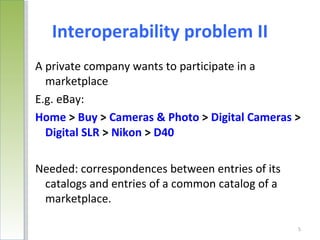
Interoperability problem II
A private company wants to participate in a
  marketplace
E.g. eBay:
Home > Buy > Cameras & Photo > Digital Cameras >
  Digital SLR > Nikon > D40

Needed: correspondences between entries of its
 catalogs and entries of a common catalog of a
 marketplace.

                                                 5
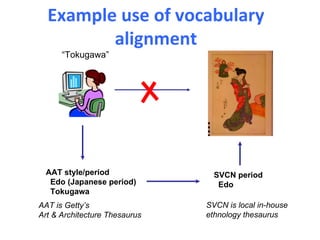
Example use of vocabulary
         alignment
      “Tokugawa”


 AAT style/period                SVCN period
  Edo (Japanese period)           Edo
  Tokugawa
AAT is Getty’s                 SVCN is local in-house
Art & Architecture Thesaurus   ethnology thesaurus
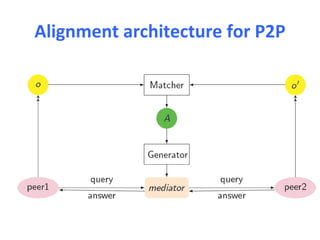
Alignment architecture for P2P
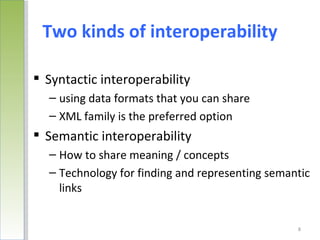
Two kinds of interoperability

 Syntactic interoperability
  – using data formats that you can share
  – XML family is the preferred option
 Semantic interoperability
  – How to share meaning / concepts
  – Technology for finding and representing semantic
    links


                                                 8
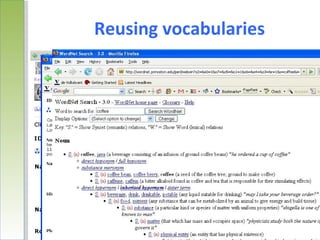
Reusing vocabularies


                       9
The myth of a unified vocabulary

   There will always be multiple ontologies
   Partly overlapping
   In multiple languages
   Each with their own perspective


                                               10
Links between ontologies

 “Ontology Alignment” / “Ontology Mapping”
  – use ontologies jointly by defining a limited set of
    links
  – Benefit from knowledge encoded in the other
    ontology
  – Enable access across applications/collections.
  – Partial by nature!


                                                     11
Why ontology alignment?
Summary:
 There is no single ontology of the world
 People work with different viewpoints and
  thus multiple conceptualizations
 But: these concepts often overlap
 Semantic relations between ontologies help
  integrating information sources
 Currently seen as a major issue in
  development of distributed (web) systems

                                           12
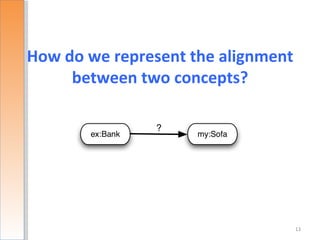
How do we represent the alignment
     between two concepts?


                                    13
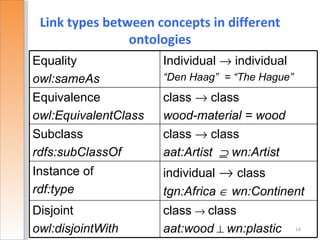
Link types between concepts in different
                ontologies
Equality              Individual → individual
owl:sameAs            “Den Haag” = “The Hague”
Equivalence           class → class
owl:EquivalentClass   wood-material = wood
Subclass              class → class
rdfs:subClassOf       aat:Artist ⊇ wn:Artist
Instance of           individual → class
rdf:type              tgn:Africa ∈ wn:Continent
Disjoint              class → class
owl:disjointWith      aat:wood ⊥ wn:plastic      14
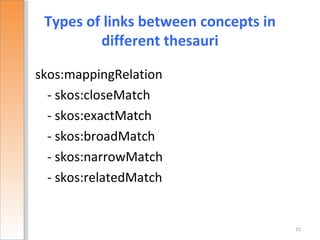
Types of links between concepts in
         different thesauri

skos:mappingRelation
  - skos:closeMatch
  - skos:exactMatch
  - skos:broadMatch
  - skos:narrowMatch
  - skos:relatedMatch


                                      15
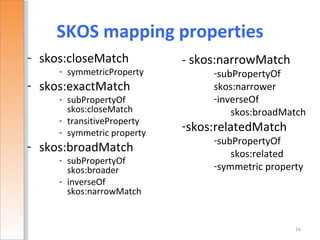
SKOS mapping properties
- skos:closeMatch           - skos:narrowMatch
     - symmetricProperty         -subPropertyOf
- skos:exactMatch                skos:narrower
     - subPropertyOf             -inverseOf
       skos:closeMatch               skos:broadMatch
     - transitiveProperty
     - symmetric property
                            -skos:relatedMatch
                                 -subPropertyOf
- skos:broadMatch                    skos:related
     - subPropertyOf
       skos:broader              -symmetric property
     - inverseOf
       skos:narrowMatch


                                                  16
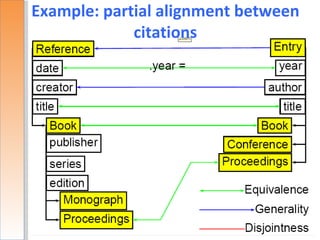
Example: partial alignment between
             citations


                                 17
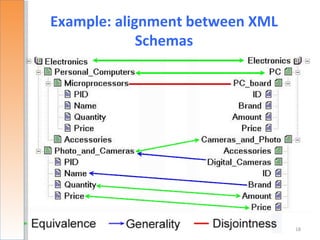
Example: alignment between XML
             Schemas


                                 18
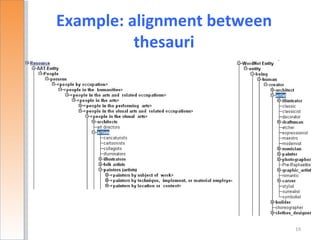
Example: alignment between
          thesauri


                             19
Types of links between properties in
         different ontologies
Links between properties:
 equivalentProperty
 subPropertyOf
 inverseOf

E.g.
 painterOf – creatorOf
 Trick: wn:hyponym subPropertyOf
  rdfs:subClassOf

                                        20
Types of links between concepts in
         different ontologies
 Domain-specific links
  – Van Gogh (ULAN) born-in Groot-Zundert
    (TGN)
  – Derain (ULAN) related-to Fauve (AAT))
  – Wandelkaart Pyreneeën RANDO.07 Haute-
    Ariège - Vicdessos (Pied à Terre) related to
    Pyrénées (TGN)
  – Part-of relations
                                              21
Alignment Techniques


                       22
Alignment tools
 Input: two ontologies, each consisting of a set
  of discrete entities
     •   HTML table headers
     •   XML elements
     •   Classes
     •   Properties
 Output: relationships holding between these
  entities (equivalence, subsumption, etc.) +
  confidence measure.
 Cardinality (e.g., 1:1, 1:m)

                                               23
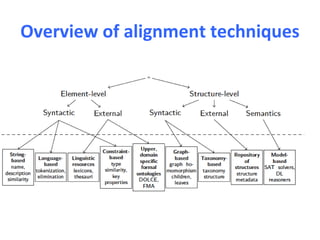
Alignment techniques
 Syntax: comparison of characters of the terms
   – Measures of syntactic distance
   – Language processing
      • E.g. Tokenization, single/plural,
 Relate to lexical resource
   – Relate terms to place in WordNet hierarchy
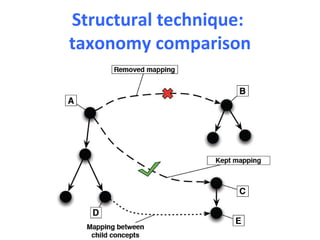
 Taxonomy comparison
   – Look for common parents/children in taxonomy
 Instance based mapping
   – Two classes are similar if their instances are similar.

                                                               24
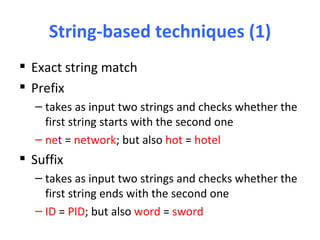
String-based techniques (1)
 Exact string match
 Prefix
  – takes as input two strings and checks whether the
    first string starts with the second one
  – net = network; but also hot = hotel
 Suffix
  – takes as input two strings and checks whether the
    first string ends with the second one
  – ID = PID; but also word = sword
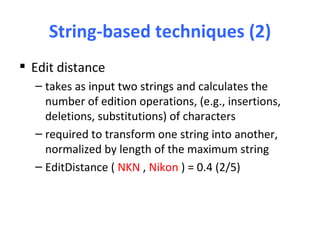
String-based techniques (2)
 Edit distance
  – takes as input two strings and calculates the
    number of edition operations, (e.g., insertions,
    deletions, substitutions) of characters
  – required to transform one string into another,
    normalized by length of the maximum string
  – EditDistance ( NKN , Nikon ) = 0.4 (2/5)
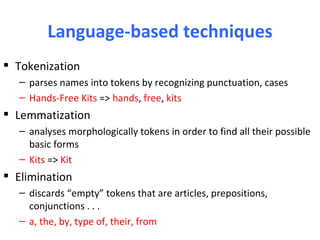
Language-based techniques
 Tokenization
   – parses names into tokens by recognizing punctuation, cases
   – Hands-Free Kits => hands, free, kits
 Lemmatization
   – analyses morphologically tokens in order to find all their possible
     basic forms
   – Kits => Kit
 Elimination
   – discards “empty” tokens that are articles, prepositions,
     conjunctions . . .
   – a, the, by, type of, their, from
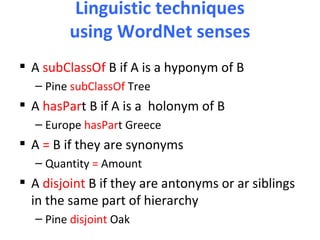
Linguistic techniques
         using WordNet senses
 A subClassOf B if A is a hyponym of B
  – Pine subClassOf Tree
 A hasPart B if A is a holonym of B
  – Europe hasPart Greece
 A = B if they are synonyms
  – Quantity = Amount
 A disjoint B if they are antonyms or ar siblings
  in the same part of hierarchy
  – Pine disjoint Oak
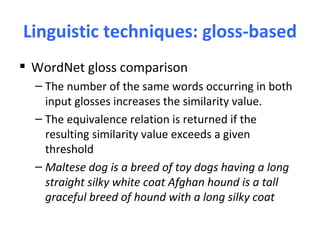
Linguistic techniques: gloss-based
 WordNet gloss comparison
  – The number of the same words occurring in both
    input glosses increases the similarity value.
  – The equivalence relation is returned if the
    resulting similarity value exceeds a given
    threshold
  – Maltese dog is a breed of toy dogs having a long
    straight silky white coat Afghan hound is a tall
    graceful breed of hound with a long silky coat
Structural technique:
taxonomy comparison
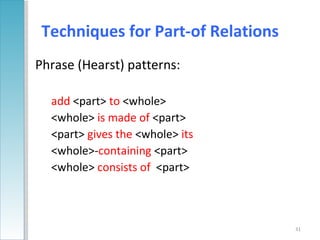
Techniques for Part-of Relations
Phrase (Hearst) patterns:

  add <part> to <whole>
  <whole> is made of <part>
  <part> gives the <whole> its
  <whole>-containing <part>
  <whole> consists of <part>


                                    31
Overview of alignment techniques
Alignment issues (1)
 Nature of the input
  – Underlying data models
  – Schema-level vs. Instance-level
  – Example: Link WordNet to Wikipedia
 Interpretation of the output
  – Approximate vs. exact
  – Graded vs. absolute confidence
 Performance varies
  > semi-automatic alignment.
                                         33
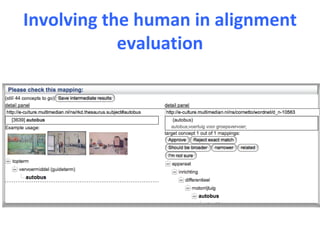
Involving the human in alignment
            evaluation
Evaluation of alignments
 Judging individual alignments
  – Precision
 Comparison to a reference alignment
  – Recall
  – Precision?
 Comparing the logical consequences of the
  models
 End-to-end evaluation
                                              35
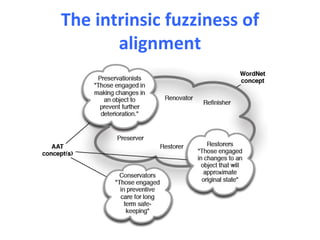
The intrinsic fuzziness of
       alignment
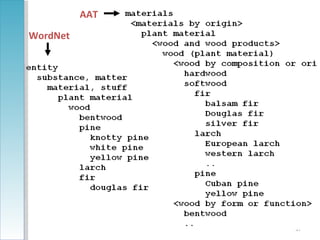
AAT
WordNet


                37
Literature / acknowledgment
 Some slides from this lecture are based on a
  tutorial of Pavel Shvaiko and Jerome Euzenat
http://dit.unitn.it/~accord/Presentations/ESWC'05

 Some slides are from Antoine Isaac (STICH)


                                               38

Ontology engineering: Ontology alignment

  • 1.
  • 2.
    Goals of thelecture  Understand why ontology alignment is done  Know what constructs can be used to express an alignment between two concepts  Know what options there are to find mappings 2
  • 3.
    Agenda  Why ontologyalignment?  Alignment relations  Alignment techniques 3
  • 4.
    Why is OntologyAlignment done? 4
  • 5.
    Interoperability problem II Aprivate company wants to participate in a marketplace E.g. eBay: Home > Buy > Cameras & Photo > Digital Cameras > Digital SLR > Nikon > D40 Needed: correspondences between entries of its catalogs and entries of a common catalog of a marketplace. 5
  • 6.
    Example use ofvocabulary alignment “Tokugawa” AAT style/period SVCN period Edo (Japanese period) Edo Tokugawa AAT is Getty’s SVCN is local in-house Art & Architecture Thesaurus ethnology thesaurus
  • 7.
  • 8.
    Two kinds ofinteroperability  Syntactic interoperability – using data formats that you can share – XML family is the preferred option  Semantic interoperability – How to share meaning / concepts – Technology for finding and representing semantic links 8
  • 9.
  • 10.
    The myth ofa unified vocabulary  There will always be multiple ontologies  Partly overlapping  In multiple languages  Each with their own perspective 10
  • 11.
    Links between ontologies “Ontology Alignment” / “Ontology Mapping” – use ontologies jointly by defining a limited set of links – Benefit from knowledge encoded in the other ontology – Enable access across applications/collections. – Partial by nature! 11
  • 12.
    Why ontology alignment? Summary: There is no single ontology of the world  People work with different viewpoints and thus multiple conceptualizations  But: these concepts often overlap  Semantic relations between ontologies help integrating information sources  Currently seen as a major issue in development of distributed (web) systems 12
  • 13.
    How do werepresent the alignment between two concepts? 13
  • 14.
    Link types betweenconcepts in different ontologies Equality Individual → individual owl:sameAs “Den Haag” = “The Hague” Equivalence class → class owl:EquivalentClass wood-material = wood Subclass class → class rdfs:subClassOf aat:Artist ⊇ wn:Artist Instance of individual → class rdf:type tgn:Africa ∈ wn:Continent Disjoint class → class owl:disjointWith aat:wood ⊥ wn:plastic 14
  • 15.
    Types of linksbetween concepts in different thesauri skos:mappingRelation - skos:closeMatch - skos:exactMatch - skos:broadMatch - skos:narrowMatch - skos:relatedMatch 15
  • 16.
    SKOS mapping properties -skos:closeMatch - skos:narrowMatch - symmetricProperty -subPropertyOf - skos:exactMatch skos:narrower - subPropertyOf -inverseOf skos:closeMatch skos:broadMatch - transitiveProperty - symmetric property -skos:relatedMatch -subPropertyOf - skos:broadMatch skos:related - subPropertyOf skos:broader -symmetric property - inverseOf skos:narrowMatch 16
  • 17.
    Example: partial alignmentbetween citations 17
  • 18.
  • 19.
  • 20.
    Types of linksbetween properties in different ontologies Links between properties:  equivalentProperty  subPropertyOf  inverseOf E.g.  painterOf – creatorOf  Trick: wn:hyponym subPropertyOf rdfs:subClassOf 20
  • 21.
    Types of linksbetween concepts in different ontologies  Domain-specific links – Van Gogh (ULAN) born-in Groot-Zundert (TGN) – Derain (ULAN) related-to Fauve (AAT)) – Wandelkaart Pyreneeën RANDO.07 Haute- Ariège - Vicdessos (Pied à Terre) related to Pyrénées (TGN) – Part-of relations 21
  • 22.
  • 23.
    Alignment tools  Input:two ontologies, each consisting of a set of discrete entities • HTML table headers • XML elements • Classes • Properties  Output: relationships holding between these entities (equivalence, subsumption, etc.) + confidence measure.  Cardinality (e.g., 1:1, 1:m) 23
  • 24.
    Alignment techniques  Syntax:comparison of characters of the terms – Measures of syntactic distance – Language processing • E.g. Tokenization, single/plural,  Relate to lexical resource – Relate terms to place in WordNet hierarchy  Taxonomy comparison – Look for common parents/children in taxonomy  Instance based mapping – Two classes are similar if their instances are similar. 24
  • 25.
    String-based techniques (1) Exact string match  Prefix – takes as input two strings and checks whether the first string starts with the second one – net = network; but also hot = hotel  Suffix – takes as input two strings and checks whether the first string ends with the second one – ID = PID; but also word = sword
  • 26.
    String-based techniques (2) Edit distance – takes as input two strings and calculates the number of edition operations, (e.g., insertions, deletions, substitutions) of characters – required to transform one string into another, normalized by length of the maximum string – EditDistance ( NKN , Nikon ) = 0.4 (2/5)
  • 27.
    Language-based techniques  Tokenization – parses names into tokens by recognizing punctuation, cases – Hands-Free Kits => hands, free, kits  Lemmatization – analyses morphologically tokens in order to find all their possible basic forms – Kits => Kit  Elimination – discards “empty” tokens that are articles, prepositions, conjunctions . . . – a, the, by, type of, their, from
  • 28.
    Linguistic techniques using WordNet senses  A subClassOf B if A is a hyponym of B – Pine subClassOf Tree  A hasPart B if A is a holonym of B – Europe hasPart Greece  A = B if they are synonyms – Quantity = Amount  A disjoint B if they are antonyms or ar siblings in the same part of hierarchy – Pine disjoint Oak
  • 29.
    Linguistic techniques: gloss-based WordNet gloss comparison – The number of the same words occurring in both input glosses increases the similarity value. – The equivalence relation is returned if the resulting similarity value exceeds a given threshold – Maltese dog is a breed of toy dogs having a long straight silky white coat Afghan hound is a tall graceful breed of hound with a long silky coat
  • 30.
  • 31.
    Techniques for Part-ofRelations Phrase (Hearst) patterns: add <part> to <whole> <whole> is made of <part> <part> gives the <whole> its <whole>-containing <part> <whole> consists of <part> 31
  • 32.
  • 33.
    Alignment issues (1) Nature of the input – Underlying data models – Schema-level vs. Instance-level – Example: Link WordNet to Wikipedia  Interpretation of the output – Approximate vs. exact – Graded vs. absolute confidence  Performance varies > semi-automatic alignment. 33
  • 34.
    Involving the humanin alignment evaluation
  • 35.
    Evaluation of alignments Judging individual alignments – Precision  Comparison to a reference alignment – Recall – Precision?  Comparing the logical consequences of the models  End-to-end evaluation 35
  • 36.
  • 37.
  • 38.
    Literature / acknowledgment Some slides from this lecture are based on a tutorial of Pavel Shvaiko and Jerome Euzenat http://dit.unitn.it/~accord/Presentations/ESWC'05  Some slides are from Antoine Isaac (STICH) 38

Editor's Notes

  • #3 And what the consequences are.
  • #4 All handed in in time except two, who have handed it in in the middle of the night, so we will overlook that because it is the first assignment. Two groups have submitted via email. Do not do that. SPAM. One group handed in more than one file: do not do that! Separate rdf file. Only two groups used restrictions. Not absolutely necessary.
  • #6 Breadcrumbs. Example could be: electronics, cameras, slrs, nikons: all cameras, digital or not.
  • #9 Conversion of vocabs into a shared vocab. Step 1 and 2 of your assignment. Lecture is about the second type
  • #10 As I said in previous lectures: there are so many ontologies out there. Why not link them all, once and for all, and then stick to it?
  • #11 Ontologies don’t solve the ‘problem’ that people have multiple views on the world. That there are multiple views, that people don’t agree. It gives us a tool to make our view explicit, to explain the meaning of our terms. So we have something clear to agree on. There is no uniform way to classify the world! You can’t just merge ontologies. Ontologies change.
  • #12 Broader public. It is surprising what you can do with just a few links Let op: geen VERANDERING maar TOEVOEGING
  • #15 Differences between sameAs and EquivalentClass? Strong assumption when you use sameAs or EquivalentClass. Examples: editorialnotes, restrictions, domain range. Subclasses if you know your own vocab + instances, but less about the other. Are all instances of the other also instances of my class? Don’t know? Subclass.
  • #16 For thesauri. Parallel with skos:semanticRelation. What are the characteristics of these properties? Think of symmetric, inverse, transitive properties, subproperties? C losematch: they can be used interchangeably in some information retrieval applications E xactmatch = transitiveprop, = subprop of closematch. skos:broadMatch is a sub-property of skos:broader, etc. SO: we can also use skos:semanticRelations for mapping. skos:narrowMatch is owl:inverseOf the property skos:broadMatch. skos:relatedMatch, skos:closeMatch and skos:exactMatch are each instances of owl:SymmetricProperty. Difference between skos:exactmatch en equivalentclass?
  • #17 Lelijk, maar: Uitwerking van vraag op vorige slide.
  • #19 One to many
  • #20 What is mapping here? aat:artist broader wn:artist.
  • #21 Much smaller field. Painter (role in ULAN?) is more specific than Creator (VRA) Trick: wordnet:hyponym subpropertyOf rdfs:subClassOf (visualization, treating as transitivity)
  • #22 E culture demo pop-art. K eith haring. Part of in many domains. TODO: example of domain specific match.
  • #24 Active field, automatically finding mappings
  • #25 1. Talk about prefix, suffix, edit distance, n-gram. 2. Tokenization (split into words without punctuation), lemmatization (reduce to its basic form) , stopping. 3. Or use the alignment to another thesaurus. 4. Bounded path matching These take two paths with links between classes defined by the hierarchical relations, compare terms and their positions along these paths, and identify similar terms 4. Super(sub)-concepts rules: If super-concepts are the same, the actual concepts are similar to each other 4. If two nodes from two schemas/ontologies are similar, their neighbors might also be somehow Similar Teken zonodig voorbeeld onto op bb.
  • #32 What could be a way to find part-of relations? Willems work Could also learn these patterns from know part-whole combinations. Also for subclassof, then they are called hearsh patterns.
  • #34 What is an instance, class? Example of different models of wn-dbpedia on the blackboard. W n: synsets have wordsenses, who have words, who have lexical forms. Hyponym, part of relation between synsets. WIKIPEDIA: things corresponding to a wikipedia page, who ha ve abstracts, titles, categories. Categories have subcategories, hierarchy. No direct hierarchy between pages.
  • #36 Comparing the logical consequences of the models: comparing full transitive closure of a mapping to full transitive closure of the reference alignment. Mappings to a concept that is too broad or too narrow are now still party good. End to end is similar to competency questions: what do I need to do with my app? Does it do it better with this mapping or this one?
  • #38 What are the mappings here? Plant material (wn) subclassof plant material (aat). Wood – exactmatch – wood(plant material) SAAI.
  • #39 END