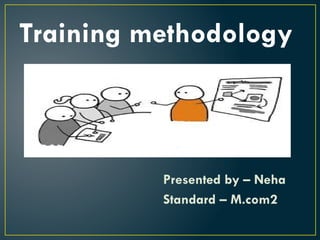
Training methodology
Presented by – Neha
Standard – M.com2
Training
• Training constitute a basic concept in human resource
development. It is concerned with developing a particular skill
to a desired standard by instruction and practice. Training is the
action of teaching a person about particular skill or type of
behavior. Training is a highly useful tool that can bring an
employee into a position where they can do their job correctly,
effectively and conscientiously.
According to Edwin Flippo, “Training is the act of
increasing the skill of an employee for doing a particular
job.”
Training Methodology
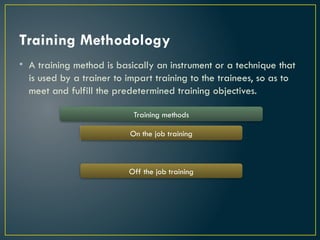
• A training method is basically an instrument or a technique that
is used by a trainer to impart training to the trainees, so as to
meet and fulfill the predetermined training objectives.
Training methods
On the job training
Off the job training
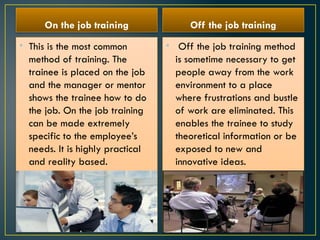
On the job training
• This is the most common
method of training. The
trainee is placed on the job
and the manager or mentor
shows the trainee how to do
the job. On the job training
can be made extremely
specific to the employee’s
needs. It is highly practical
and reality based.
Off the job training
• Off the job training method
is sometime necessary to get
people away from the work
environment to a place
where frustrations and bustle
of work are eliminated. This
enables the trainee to study
theoretical information or be
exposed to new and
innovative ideas.
Methods of On the job training:-
 Job rotation:-
job rotation involves moving an employee through a
series of jobs so he or she can get a good feel for the tasks that
are associated with different jobs. It is the management
technique wherein an employee is shifted from one job role to
the other.
 One to one instructions:-
It was used to be referred to as, ‘sitting
by Nellie’, the ‘Nellie’ approach was where a new entrant sat
alongside an existing skilled operator, and was told to watch
them actively. After a period of observation, they were given
their own machine and told to get on with the job.
Coaching/Mentoring:-
The trainee is placed under a particular supervisor who
functions as a coach/mentor in training the individual. The supervisor
provides feedback to the trainee on his performance and offers him
some suggestions for improvement. In coaching, the priority is to
improve performance that impacts present job and is short term
process where in mentoring, priority is to develop skills that are not
relevant for present job but also for the future and is a long term
process.
 Project management:-
In this process firstly, the learner should be
identified, along with this suitable projects should be identified
which the learner can manage. The projects should be discussed with
the learner and the methods should be finalized. The work should
be activated, the starting and finish dates should be finalized. The
learning achieved by this process should be discussed with the
project manager and future course of action should be decided.
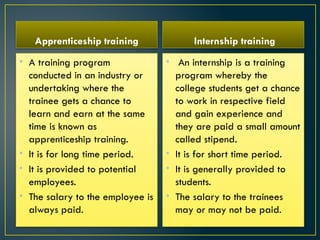
Apprenticeship training
• A training program
conducted in an industry or
undertaking where the
trainee gets a chance to
learn and earn at the same
time is known as
apprenticeship training.
• It is for long time period.
• It is provided to potential
employees.
• The salary to the employee is
always paid.
Internship training
• An internship is a training
program whereby the
college students get a chance
to work in respective field
and gain experience and
they are paid a small amount
called stipend.
• It is for short time period.
• It is generally provided to
students.
• The salary to the trainees
may or may not be paid.
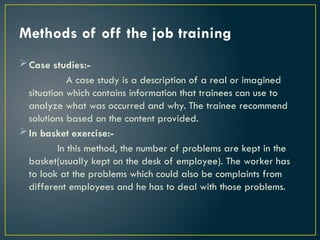
Methods of off the job training
Case studies:-
A case study is a description of a real or imagined
situation which contains information that trainees can use to
analyze what was occurred and why. The trainee recommend
solutions based on the content provided.
In basket exercise:-
In this method, the number of problems are kept in the
basket(usually kept on the desk of employee). The worker has
to look at the problems which could also be complaints from
different employees and he has to deal with those problems.
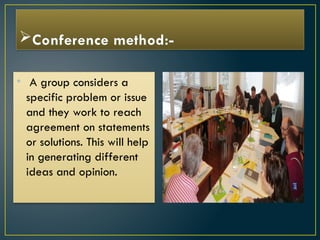
Conference method:-
• A group considers a
specific problem or issue
and they work to reach
agreement on statements
or solutions. This will help
in generating different
ideas and opinion.
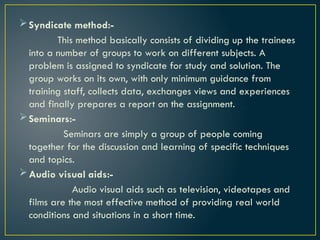
Syndicate method:-
This method basically consists of dividing up the trainees
into a number of groups to work on different subjects. A
problem is assigned to syndicate for study and solution. The
group works on its own, with only minimum guidance from
training staff, collects data, exchanges views and experiences
and finally prepares a report on the assignment.
Seminars:-
Seminars are simply a group of people coming
together for the discussion and learning of specific techniques
and topics.
Audio visual aids:-
Audio visual aids such as television, videotapes and
films are the most effective method of providing real world
conditions and situations in a short time.
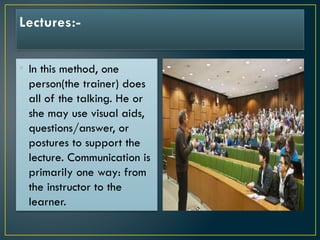
Lectures:-
• In this method, one
person(the trainer) does
all of the talking. He or
she may use visual aids,
questions/answer, or
postures to support the
lecture. Communication is
primarily one way: from
the instructor to the
learner.
Sensitivity training:-
Members are brought together in a free and open
environment in which participants discuss themselves and
interact. The discussion is directed by a behavior expert, who
creates the opportunity for participants to express their ideas,
beliefs and attitudes. The objective of this method is to provide
the participants with increased awareness of their own behavior
and of how others perceive them.
Role playing:-
The participants can be made to act in a particular
situation to get a real feel of the roles they are actually called
upon to play. Likely problems and alternative solutions are
presented for discussion.
Simulations:-
trainees participate in a reality based, interactive
activity where they imitate or copy actions required on the job.
Demonstration method:-
when a trainer has the audience actually
perform a task by showing and explaining how to do it, this is
called a demonstration. During a demonstration, the audience is
encouraged to ask questions and request assistance as they try
to do the task by themselves.
Panel discussion:-
A panel or a group of three or four experts in a
specific area of specialization may be invited to address a
group of trainees on a particular subject. The mutual
interactions of the panelists among themselves and with the
audience can lead to an effective understanding of the topic.
Conclusion
• In conclusion, we can say that training is an organized
procedure for increasing the knowledge and skill of people for
a specific purpose. Training improves the performance of
employees on present jobs and prepares them for taking up
new assignments in future. There are two methods of training;
on the job training and off the job training. Employer may
choose any one of these method for developing skill of
employees.
Thank you

Training methodology methods of training.pptx

  • 1.
    Training methodology Presented by– Neha Standard – M.com2
  • 2.
    Training • Training constitutea basic concept in human resource development. It is concerned with developing a particular skill to a desired standard by instruction and practice. Training is the action of teaching a person about particular skill or type of behavior. Training is a highly useful tool that can bring an employee into a position where they can do their job correctly, effectively and conscientiously. According to Edwin Flippo, “Training is the act of increasing the skill of an employee for doing a particular job.”
  • 3.
    Training Methodology • Atraining method is basically an instrument or a technique that is used by a trainer to impart training to the trainees, so as to meet and fulfill the predetermined training objectives. Training methods On the job training Off the job training
  • 4.
    On the jobtraining • This is the most common method of training. The trainee is placed on the job and the manager or mentor shows the trainee how to do the job. On the job training can be made extremely specific to the employee’s needs. It is highly practical and reality based. Off the job training • Off the job training method is sometime necessary to get people away from the work environment to a place where frustrations and bustle of work are eliminated. This enables the trainee to study theoretical information or be exposed to new and innovative ideas.
  • 5.
    Methods of Onthe job training:-  Job rotation:- job rotation involves moving an employee through a series of jobs so he or she can get a good feel for the tasks that are associated with different jobs. It is the management technique wherein an employee is shifted from one job role to the other.  One to one instructions:- It was used to be referred to as, ‘sitting by Nellie’, the ‘Nellie’ approach was where a new entrant sat alongside an existing skilled operator, and was told to watch them actively. After a period of observation, they were given their own machine and told to get on with the job.
  • 6.
    Coaching/Mentoring:- The trainee isplaced under a particular supervisor who functions as a coach/mentor in training the individual. The supervisor provides feedback to the trainee on his performance and offers him some suggestions for improvement. In coaching, the priority is to improve performance that impacts present job and is short term process where in mentoring, priority is to develop skills that are not relevant for present job but also for the future and is a long term process.  Project management:- In this process firstly, the learner should be identified, along with this suitable projects should be identified which the learner can manage. The projects should be discussed with the learner and the methods should be finalized. The work should be activated, the starting and finish dates should be finalized. The learning achieved by this process should be discussed with the project manager and future course of action should be decided.
  • 7.
    Apprenticeship training • Atraining program conducted in an industry or undertaking where the trainee gets a chance to learn and earn at the same time is known as apprenticeship training. • It is for long time period. • It is provided to potential employees. • The salary to the employee is always paid. Internship training • An internship is a training program whereby the college students get a chance to work in respective field and gain experience and they are paid a small amount called stipend. • It is for short time period. • It is generally provided to students. • The salary to the trainees may or may not be paid.
  • 8.
    Methods of offthe job training Case studies:- A case study is a description of a real or imagined situation which contains information that trainees can use to analyze what was occurred and why. The trainee recommend solutions based on the content provided. In basket exercise:- In this method, the number of problems are kept in the basket(usually kept on the desk of employee). The worker has to look at the problems which could also be complaints from different employees and he has to deal with those problems.
  • 9.
    Conference method:- • Agroup considers a specific problem or issue and they work to reach agreement on statements or solutions. This will help in generating different ideas and opinion.
  • 10.
    Syndicate method:- This methodbasically consists of dividing up the trainees into a number of groups to work on different subjects. A problem is assigned to syndicate for study and solution. The group works on its own, with only minimum guidance from training staff, collects data, exchanges views and experiences and finally prepares a report on the assignment. Seminars:- Seminars are simply a group of people coming together for the discussion and learning of specific techniques and topics. Audio visual aids:- Audio visual aids such as television, videotapes and films are the most effective method of providing real world conditions and situations in a short time.
  • 11.
    Lectures:- • In thismethod, one person(the trainer) does all of the talking. He or she may use visual aids, questions/answer, or postures to support the lecture. Communication is primarily one way: from the instructor to the learner.
  • 12.
    Sensitivity training:- Members arebrought together in a free and open environment in which participants discuss themselves and interact. The discussion is directed by a behavior expert, who creates the opportunity for participants to express their ideas, beliefs and attitudes. The objective of this method is to provide the participants with increased awareness of their own behavior and of how others perceive them. Role playing:- The participants can be made to act in a particular situation to get a real feel of the roles they are actually called upon to play. Likely problems and alternative solutions are presented for discussion. Simulations:- trainees participate in a reality based, interactive activity where they imitate or copy actions required on the job.
  • 13.
    Demonstration method:- when atrainer has the audience actually perform a task by showing and explaining how to do it, this is called a demonstration. During a demonstration, the audience is encouraged to ask questions and request assistance as they try to do the task by themselves. Panel discussion:- A panel or a group of three or four experts in a specific area of specialization may be invited to address a group of trainees on a particular subject. The mutual interactions of the panelists among themselves and with the audience can lead to an effective understanding of the topic.
  • 14.
    Conclusion • In conclusion,we can say that training is an organized procedure for increasing the knowledge and skill of people for a specific purpose. Training improves the performance of employees on present jobs and prepares them for taking up new assignments in future. There are two methods of training; on the job training and off the job training. Employer may choose any one of these method for developing skill of employees.
  • 15.