This research paper presents new tenth-order iterative methods for solving nonlinear equations that are derivative-free, developed from Steffensen's method and Kung and Traub's methods. The authors provide comparisons with existing methods, demonstrating the efficiency and potential practical utility of the proposed techniques. The paper also includes theoretical proofs on the convergence of these methods under specific conditions.
![Quest Journals
Journal of Research in Applied Mathematics
Volume 3 ~ Issue 4 (2017) pp: 13-18
ISSN(Online) : 2394-0743 ISSN (Print): 2394-0735
www.questjournals.org
*Corresponding Author:I.A. Al-Subaihi* 13 | Page
Research Paper
Tenth-Order Iterative Methods withoutDerivatives forSolving
Nonlinear Equations
Y.Y. Al-Husayni1
, I.A. Al-Subaihi2*
,
1,2
(Department Of Mathematics, Faculty Of Science, Taibah University, Saudi Arabia,)
Received 14 Jan, 2017; Accepted 07 Feb, 2017 © The author(s) 2014. Published with open access at
www.questjournals.org
ABSTRACT: In this paper, we construct new classes of derivative-free of tenth-order iterative methods for
solving nonlinear equations. The new methods of tenth-order convergence derived by combining of
theSteffensen's method, the Kung and Traub’s of optimal fourth-order and the Al-Subaihi's method. Several
examples to compare of other existing methods and the results of new iterative methods are given the
encouraging results and have definite practical utility.
Keywords: nonlinear equations, iterative methods, tenth-order, derivative-free, order of convergence.
I. INTRODUCTION
The nonlinear equation is one of the most and oldest problems in scientific and engineering
applications, so the researchers have beenlooking for optimization of solution for this problem.
For solving the nonlinear equation 𝑓(𝛾) = 0, where 𝑓: 𝐼 ⊆ ℝ → ℝbe a scalar function on an open interval𝐼,
and𝛾is a simple root of 𝑓(𝑥).The famous iterative method of optimal quadratic convergence to solve the
nonlinear equation is Newton’s method (NM).
𝑥 𝑛+1 = 𝑥 𝑛 −
𝑓 𝑥 𝑛
𝑓′ 𝑥 𝑛
. (1)
The optimal conjectureis2 𝑛
, where 𝑛 + 1 is the number of function evaluation [1].We can define the
efficiency index as 𝛿
1
𝛼, such that 𝛿 be the order of the method and 𝛼 is the total number of functions
evaluations per iteration [2,3]. The Newton's method have been modified by Steffensenby approximating𝑓′
𝑥 𝑛
by forward difference, to get the famous Steffensen's method (SM) [4]
𝑥 𝑛+1 = 𝑥 𝑛 −
𝑓(𝑥 𝑛 )2
𝑓(𝑥 𝑛 +𝑓(𝑥 𝑛 ))−𝑓(𝑥 𝑛 )
. (2)
Which has same optimal order of convergence asNewton's method (NM), the efficiency index of both
method (1) and (2) are EI = 2
1
2 ≈ 1.4142.
In this paper some iterative methods are constructedto develop new derivative-free iterative methods
usingtheSteffensen's method, the Kung-Traub [1] and the Al-Subaihi's method [5].
A three- point of eighth-order convergence is constructed by Kung-Traub(KTM) [1].
𝑦𝑛 = 𝑥 𝑛 −
𝑓(𝑥 𝑛 )2
𝑓 𝑤 𝑛 −𝑓 𝑥 𝑛
,
𝑧 𝑛 = 𝑦𝑛 −
𝑓 𝑥 𝑛 𝑓 𝑤 𝑛
𝑓 𝑦 𝑛 −𝑓 𝑥 𝑛
1
𝑓 𝑤 𝑛 ,𝑥 𝑛
−
1
𝑓 𝑤 𝑛 ,𝑦 𝑛
, (3)
𝑥 𝑛+1 = 𝑧 𝑛 −
𝑓 𝑦 𝑛 𝑓 𝑥 𝑛 𝑓 𝑤 𝑛
𝑓 𝑧 𝑛 −𝑓 𝑥 𝑛
1
𝑓 𝑧 𝑛 −𝑓 𝑤 𝑛
1
𝑓 𝑦 𝑛 ,𝑧 𝑛
−
1
𝑓 𝑤 𝑛 ,𝑦 𝑛
−
1
𝑓 𝑦 𝑛 −𝑓 𝑥 𝑛
1
𝑓 𝑤 𝑛 ,𝑦 𝑛
−
1
𝑓 𝑤 𝑛 ,𝑥 𝑛
,
(4)
where 𝑤𝑛 = 𝑥 𝑛 + 𝛽𝑓(𝑥 𝑛 ), 𝑛 ∈ ℕ𝑎𝑛𝑑𝛽 ∈ ℝ.
The conjecture of Kung and Traub’s for multipoint iterations, a without memory based which has
optimal convergence, and the efficiency index of eighth-order convergence (KTM), (4),
is8
1
4 ≈ 1.6818.Recently, families of Iterative methods with higher convergence orders for solving nonlinear
equations has been devolved by Al-Subaihi [5] as
𝑥 𝑛+1 = 𝑧 𝑛 −
𝑓 𝑧 𝑛
𝑓′ 𝑦 𝑛
− 𝑤(𝑡 𝑛 )
𝑓 𝑧 𝑛 −
𝑓 𝑧 𝑛
𝑓′ 𝑦 𝑛
𝑓′ 𝑦 𝑛
, (5)](https://image.slidesharecdn.com/c341318-170717094557/85/Tenth-Order-Iterative-Methods-withoutDerivatives-forSolving-Nonlinear-Equations-1-320.jpg)
![Quest Journals
Journal of Research in Applied Mathematics
Volume 3 ~ Issue 4 (2017) pp: 13-18
ISSN(Online) : 2394-0743 ISSN (Print): 2394-0735
www.questjournals.org
*Corresponding Author:I.A. Al-Subaihi* 13 | Page
Research Paper
Tenth-Order Iterative Methods withoutDerivatives forSolving
Nonlinear Equations
Y.Y. Al-Husayni1
, I.A. Al-Subaihi2*
,
1,2
(Department Of Mathematics, Faculty Of Science, Taibah University, Saudi Arabia,)
Received 14 Jan, 2017; Accepted 07 Feb, 2017 © The author(s) 2014. Published with open access at
www.questjournals.org
ABSTRACT: In this paper, we construct new classes of derivative-free of tenth-order iterative methods for
solving nonlinear equations. The new methods of tenth-order convergence derived by combining of
theSteffensen's method, the Kung and Traub’s of optimal fourth-order and the Al-Subaihi's method. Several
examples to compare of other existing methods and the results of new iterative methods are given the
encouraging results and have definite practical utility.
Keywords: nonlinear equations, iterative methods, tenth-order, derivative-free, order of convergence.
I. INTRODUCTION
The nonlinear equation is one of the most and oldest problems in scientific and engineering
applications, so the researchers have beenlooking for optimization of solution for this problem.
For solving the nonlinear equation 𝑓(𝛾) = 0, where 𝑓: 𝐼 ⊆ ℝ → ℝbe a scalar function on an open interval𝐼,
and𝛾is a simple root of 𝑓(𝑥).The famous iterative method of optimal quadratic convergence to solve the
nonlinear equation is Newton’s method (NM).
𝑥 𝑛+1 = 𝑥 𝑛 −
𝑓 𝑥 𝑛
𝑓′ 𝑥 𝑛
. (1)
The optimal conjectureis2 𝑛
, where 𝑛 + 1 is the number of function evaluation [1].We can define the
efficiency index as 𝛿
1
𝛼, such that 𝛿 be the order of the method and 𝛼 is the total number of functions
evaluations per iteration [2,3]. The Newton's method have been modified by Steffensenby approximating𝑓′
𝑥 𝑛
by forward difference, to get the famous Steffensen's method (SM) [4]
𝑥 𝑛+1 = 𝑥 𝑛 −
𝑓(𝑥 𝑛 )2
𝑓(𝑥 𝑛 +𝑓(𝑥 𝑛 ))−𝑓(𝑥 𝑛 )
. (2)
Which has same optimal order of convergence asNewton's method (NM), the efficiency index of both
method (1) and (2) are EI = 2
1
2 ≈ 1.4142.
In this paper some iterative methods are constructedto develop new derivative-free iterative methods
usingtheSteffensen's method, the Kung-Traub [1] and the Al-Subaihi's method [5].
A three- point of eighth-order convergence is constructed by Kung-Traub(KTM) [1].
𝑦𝑛 = 𝑥 𝑛 −
𝑓(𝑥 𝑛 )2
𝑓 𝑤 𝑛 −𝑓 𝑥 𝑛
,
𝑧 𝑛 = 𝑦𝑛 −
𝑓 𝑥 𝑛 𝑓 𝑤 𝑛
𝑓 𝑦 𝑛 −𝑓 𝑥 𝑛
1
𝑓 𝑤 𝑛 ,𝑥 𝑛
−
1
𝑓 𝑤 𝑛 ,𝑦 𝑛
, (3)
𝑥 𝑛+1 = 𝑧 𝑛 −
𝑓 𝑦 𝑛 𝑓 𝑥 𝑛 𝑓 𝑤 𝑛
𝑓 𝑧 𝑛 −𝑓 𝑥 𝑛
1
𝑓 𝑧 𝑛 −𝑓 𝑤 𝑛
1
𝑓 𝑦 𝑛 ,𝑧 𝑛
−
1
𝑓 𝑤 𝑛 ,𝑦 𝑛
−
1
𝑓 𝑦 𝑛 −𝑓 𝑥 𝑛
1
𝑓 𝑤 𝑛 ,𝑦 𝑛
−
1
𝑓 𝑤 𝑛 ,𝑥 𝑛
,
(4)
where 𝑤𝑛 = 𝑥 𝑛 + 𝛽𝑓(𝑥 𝑛 ), 𝑛 ∈ ℕ𝑎𝑛𝑑𝛽 ∈ ℝ.
The conjecture of Kung and Traub’s for multipoint iterations, a without memory based which has
optimal convergence, and the efficiency index of eighth-order convergence (KTM), (4),
is8
1
4 ≈ 1.6818.Recently, families of Iterative methods with higher convergence orders for solving nonlinear
equations has been devolved by Al-Subaihi [5] as
𝑥 𝑛+1 = 𝑧 𝑛 −
𝑓 𝑧 𝑛
𝑓′ 𝑦 𝑛
− 𝑤(𝑡 𝑛 )
𝑓 𝑧 𝑛 −
𝑓 𝑧 𝑛
𝑓′ 𝑦 𝑛
𝑓′ 𝑦 𝑛
, (5)](https://image.slidesharecdn.com/c341318-170717094557/75/Tenth-Order-Iterative-Methods-withoutDerivatives-forSolving-Nonlinear-Equations-1-2048.jpg)
![Tenth-Order Iterative Methods without Derivatives for Solving Nonlinear Equations
*Corresponding Author:I.A. Al-Subaihi* 14 | Page
where𝑦𝑛 is iterative method of order 𝑝, 𝑧 𝑛 is iterative method of order 𝑞, (𝑞 > 𝑝 ), and
𝑡 𝑛 =
𝑓 𝑧 𝑛 −
𝑓 𝑧 𝑛
𝑓′ 𝑦 𝑛
𝑓 𝑧 𝑛
, where 𝑤 𝑡 𝑛 is a weight function satisfying the conditions of 𝑤 0 = 1, 𝑤′
0 =
1𝑎𝑛𝑑 𝑤′′
(0) < ∞. The families, (5),of order 2𝑞 + 𝑝.
II. DESCREPTION OF THE METHODS
In this section a new iterative families of higher-order with derivative-free are described. The
construction depend on the Steffensen's, (2), theKung and Traub’s, (4), and the Al-Subaihi's methods, (5).
Approximation of 𝑓′
(𝑥 𝑛 ) by
𝑓′
𝑥 𝑛 ≈
𝑓(𝑥 𝑛 +𝑓 𝑥 𝑛 )−𝑓 𝑥 𝑛
𝑓 𝑥 𝑛
, (6)
and substituting in Newton's method (NM), (1), gives Steffensen's method (SM), (2), which is convergence
quadratically and derivative-free.
Let 𝐺𝑛 = 𝑥 𝑛 + 𝑓(𝑥 𝑛 )3
[6]. UsingtheSteffensen's method of order two and the second step of the Kung and
Traub’s method of order fourth, (3), and substituting them in Al-Subaihi's method, (5), we have:
𝑦𝑛 = 𝑥 𝑛 −
𝑓 𝑥 𝑛
𝑓 𝐺 𝑛 ,𝑥 𝑛
,
𝑧 𝑛 = 𝑦𝑛 −
𝑓 𝑥 𝑛 𝑓 𝐺 𝑛
𝑓 𝑦 𝑛 −𝑓 𝑥 𝑛
1
𝑓 𝐺 𝑛 ,𝑥 𝑛
−
1
𝑓 𝐺 𝑛 ,𝑦 𝑛
,
𝑥 𝑛+1 = 𝑧 𝑛 −
𝑓 𝑧 𝑛
𝑓′ 𝑦 𝑛
− 𝑤 𝑡 𝑛
𝑓 𝑧 𝑛 −
𝑓 𝑧 𝑛
𝑓′ 𝑦 𝑛
𝑓′ 𝑦 𝑛
. (7)
Using the approximation (see for example [7])
𝑓′
𝑦𝑛 = 2𝑓 𝑦𝑛 , 𝑥 𝑛 − 𝑓 𝐺𝑛 , 𝑥 𝑛 , (8)
where:
𝑓 𝐺𝑛 , 𝑥 𝑛 =
𝑓 𝐺 𝑛 −𝑓 𝑥 𝑛
𝐺 𝑛 −𝑥 𝑛
, (9)
𝑓 𝐺𝑛 , 𝑦𝑛 =
𝑓 𝐺 𝑛 −𝑓 𝑦 𝑛
𝐺 𝑛 −𝑦 𝑛
, (10)
𝑓 𝑦𝑛 , 𝑥 𝑛 =
𝑓 𝑦 𝑛 −𝑓 𝑥 𝑛
𝑦 𝑛 −𝑥 𝑛
. (11)
Substitute (8) into equation (7), to obtain a new class of methods (YSM)
𝑦𝑛 = 𝑥 𝑛 −
𝑓 𝑥 𝑛
𝑓 𝐺 𝑛 ,𝑥 𝑛
, (12)
𝑧 𝑛 = 𝑦𝑛 −
𝑓 𝑥 𝑛 𝑓 𝐺 𝑛
𝑓 𝑦 𝑛 −𝑓 𝑥 𝑛
1
𝑓 𝐺 𝑛 ,𝑥 𝑛
−
1
𝑓 𝐺 𝑛 ,𝑦 𝑛
, (13)
𝑥 𝑛+1 = 𝑧 𝑛 −
𝑓 𝑧 𝑛
2𝑓 𝑦 𝑛 ,𝑥 𝑛 −𝑓 𝐺 𝑛 ,𝑥 𝑛
− 𝑤 𝑡 𝑛
𝑓 𝑧 𝑛 −
𝑓 𝑧 𝑛
2𝑓 𝑦 𝑛 ,𝑥 𝑛 −𝑓 𝐺 𝑛 ,𝑥 𝑛
2𝑓 𝑦 𝑛 ,𝑥 𝑛 −𝑓 𝐺 𝑛 ,𝑥 𝑛
, (14)
the new iterative method (14) is of order tenth with derivative free, and five functions evaluations, so the
efficiency index (EI) = 10
1
5 ≈ 1.5849.
Theorem1: suppose that 𝑓: 𝐼 ⊆ ℝ → ℝ in an open interval 𝐼 with simple root 𝛾∈𝐼. If 𝑥0be a sufficiently close to
𝛾then the methods (12)41ــ has tenth-order of convergence, if 𝑡 𝑛 =
𝑓 𝑧 𝑛 −
𝑓 𝑧 𝑛
2𝑓 𝑦 𝑛 ,𝑥 𝑛 −𝑓 𝐺 𝑛 ,𝑥 𝑛
𝑓 𝑧 𝑛
, and 𝑤 𝑡 𝑛 is a
function satisfying the conditions of 𝑤 0 = 1, 𝑤′
0 = 1𝑎𝑛𝑑 𝑤′′
(0) < ∞.
𝑒 𝑛+1 = (24𝑘2
8
− 44𝑘2
6
k3 + 30𝑘2
4
𝑘3
2
− 9𝑘2
2
𝑘3
3
+ 𝑘3
4
)k2en
10
+ O en
11
Proof: let 𝑒 𝑛 = 𝑥 𝑛 − 𝛾, and 𝑘 𝑛 =
𝑓 𝑛 (𝛾)
𝑛!𝑓′(𝛾)
By Taylor expansion of𝑓(𝑥 𝑛 )
𝑓(𝑥 𝑛 ) = 𝑓′
𝛾 𝑘 𝑛 + 𝑘2 𝑒 𝑛
2
+ 𝑘3 𝑒 𝑛
3
+ 𝑘4 𝑒 𝑛
4
+ 𝑘5 𝑒 𝑛
5
+ ⋯ + 𝑘8 𝑒 𝑛
8
+ 𝑘9 𝑒 𝑛
9
+ 𝑘10 𝑒 𝑛
10
+ O en
11
(15)
Dividing (9) by (15)
𝑓 𝑥 𝑛
𝑓 𝐺𝑛 , 𝑥 𝑛
= 𝑒 𝑛 − k2en
2
+ −2k3 + 2k2
2
en
3
+ −𝑓′
𝛾 3
k2 − 3k4 + 7k2k3 − 4k2
3
en
4
+ (−4𝑘5
−3𝑓′
𝛾 3
k3 + ⋯ + 10𝑘2 𝑘4 + 6𝑘3
2
)en
5
+ ⋯ + (396𝑓′
𝛾 3
k2
2
k3k4 + 24𝑓′
𝛾 6
k2
3
k3
−13𝑓′
𝛾 6
𝑘2
2
k4 − 11𝑓′
𝛾 6
𝑘2 𝑘3
2
+ ⋯ − 28𝑓′
𝛾 3
k8 − 166𝑓′
𝛾 3
k2k3k5 − 9k10)en
10
+O en
11
(16)
Computing (12) by using (16), we have](https://image.slidesharecdn.com/c341318-170717094557/85/Tenth-Order-Iterative-Methods-withoutDerivatives-forSolving-Nonlinear-Equations-2-320.jpg)
![Tenth-Order Iterative Methods without Derivatives for Solving Nonlinear Equations
*Corresponding Author:I.A. Al-Subaihi* 15 | Page
𝑦𝑛 = 𝛾 + k2en
2
+ 2k3 − 2k2
2
en
3
+ 𝑓′
𝛾 3
k2 + 3k4 − 7k2k3 + 4k2
3
+ (3𝑓′
𝛾 3
k3 − 8𝑘2
4
+20𝑘2
2
k3 − ⋯ − 6𝑘3
2
+ 4𝑘5)en
5
+ ⋯ + (−396𝑓′
𝛾 3
𝑘2
2
k3k4 − 24𝑓′
𝛾 6
k2
3
k3 + ⋯
+166𝑓′
𝛾 3
k2k3 𝑘5 + 9k10)en
10
+ O en
11
(17)
Use Taylor expansion of 𝑦𝑛 about 𝛾 and simplifying, we obtain
𝑓 𝑦𝑛 = 𝑓′
𝛾 [k2en
2
+ 2k3 − 2k2
2
en
3
+ 𝑓′
𝛾 3
k2 + 3k4 − 7k2k3 + 5k2
3
en
4
+ (3𝑓′
𝛾 3
k3 − 12𝑘2
4
+24𝑘2
2
k3 − ⋯ − 6𝑘3
2
+ 4𝑘5)en
5
+ ⋯ + (−614𝑓′
𝛾 3
𝑘2
2
k3k4 + 230𝑓′
𝛾 3
k2k3k5 + ⋯
−45k4k7 − 49k5k6)en
10
+ O en
11
] (18)
And
𝑓 𝑥 𝑛 𝑓 𝐺𝑛
𝑓 𝑦𝑛 − 𝑓 𝑥 𝑛
= 𝑓′
𝛾 [−𝑒 𝑛 − 2k2en
2
+ −𝑓′
𝛾 3
− 3k3+k2
2
en
3
+ (−7𝑓′
𝛾 3
k2 − 4k4 + 3k2k3
−k2
3
)en
4
+ ⋯ + (−155𝑘2
2
k3k4 − 86𝑓′
𝛾 3
k2k3k5 + ⋯ + 9k4k7 + 9k5k6)en
10
+O en
11
](19)
Substituting (17), (19), (9) and (10) into (13), we obtain
𝑧 𝑛 = 𝛾 + 2𝑘2
3
− k2k3 en
4
+ −10𝑘2
4
+ ⋯ − 2k2k4 − 2𝑘3
2
en
5
+ ⋯ + (−947𝑓′
𝛾 3
𝑘2
2
k3k4
−72𝑓′
𝛾 6
𝑘2
3
k3 + 46𝑓′
𝛾 6
𝑘2
2
k4 + ⋯ + 178𝑓′
𝛾 3
k2 𝑘4
2
+ 98𝑓′
𝛾 3
𝑘2
2
k6
+326𝑓′
𝛾 3
k2k3k5)en
10
+ O en
11
(20)
Use Taylor expansion of (𝑧 𝑛 ), we get
𝑓 𝑧 𝑛 = 𝑓′
𝛾 [ 2𝑘2
3
− k2k3 en
4
+ −10𝑘2
4
+ ⋯ − 2k2k4 − 2𝑘3
2
en
5
+ ⋯ + (−947𝑘2
2
k3k4
+3264𝑓′
𝛾 3
k2k3k5 + 46𝑓′
𝛾 6
𝑘2
2
k4 − ⋯ − 19k3k8 − 27k4k7 − 31k5k6)en
10
+ O en
11
]
(21)
Expand 2𝑓 𝑦𝑛 , 𝑥 𝑛 − 𝑓 𝐺𝑛 , 𝑥 𝑛 to get
2𝑓 𝑥 𝑛 , 𝑦𝑛 − 𝑓 𝑥 𝑛 , 𝐺𝑛 = 𝑓′
𝛾 [1 + 2𝑘2
2
− k3 en
2
+ −𝑓′
𝛾 3
k2 − 4𝑘2
3
+ ⋯ − 2k4 en
3
+ ⋯
+(2𝑓′
𝛾 9
𝑘2
4
+ 472k2k3k4k5 + 213𝑘2
2
k3k5 − ⋯ − 176𝑘2
4
k5
+128𝑘2
2
𝑘3
3
)en
10
+ O en
11
] (22)
Then we computing 𝑧 𝑛 −
𝑓 𝑧 𝑛
2𝑓 𝑥 𝑛 ,𝑦 𝑛 −𝑓 𝑥 𝑛 ,𝐺 𝑛
, we have
𝑧 𝑛 −
𝑓 𝑧 𝑛
2𝑓 𝑥 𝑛 , 𝑦𝑛 − 𝑓 𝑥 𝑛 , 𝐺𝑛
= 𝛾 + 4𝑘2
5
− 4𝑘2
3
k3 + 𝑘3
2
k2 en
6
+ (4k2k3k4 − 28𝑘2
6
+ 54𝑘2
4
k3
− ⋯ + 𝑓′
𝛾 3
𝑘2
2
k3 − 2𝑓′
𝛾 3
𝑘2
4
)en
7
+ ⋯ + (−399𝑓′
𝛾 3
𝑘2
2
k3k4
−44𝑓′
𝛾 6
𝑘2
3
k3 + 5𝑓′
𝛾 3
𝑘2
2
k4 + ⋯ + 28𝑓′
𝛾 3
k2 𝑘4
2
+4𝑓′
𝛾 3
𝑘2
2
k6 + 44𝑓′
𝛾 3
k2k3k5)en
10
+ O en
11
(23)
Then by Taylor expansion, we have
𝑓 𝑧 𝑛 −
𝑓 𝑧 𝑛
2𝑓 𝑥 𝑛 , 𝑦𝑛 − 𝑓 𝑥 𝑛 , 𝐺𝑛
= 𝑓′
𝛾 [ 4𝑘2
5
− 4𝑘2
3
k3 + 𝑘3
2
k2 en
6
+ (4k2k3k4 − 28𝑘2
6
+ 54𝑘2
4
k3
−8𝑘2
3
k4 − 24𝑘2
2
𝑘3
2
+ ⋯ − 2𝑓′
𝛾 3
𝑘2
4
)en
7
+ ⋯
+(−399𝑓′
𝛾 3
𝑘2
2
k3k4 + 44𝑓′
𝛾 3
k2k3k5 + ⋯ − 159𝑘3
3
k4
+9k2 𝑘5
2
+ 21𝑘3
2
k6)en
10
+ O en
11
] (24)
Substituting (23), (24), (22) and 𝑤(𝑡 𝑛 ) is weight function into (14), we get
𝑥 𝑛+1 = 𝛾 + (24𝑘2
8
− 44𝑘2
6
k3 + 30𝑘2
4
𝑘3
2
− 9𝑘2
2
𝑘3
3
+ 𝑘3
4
)k2en
10
+ O en
11
Finally, we have
𝑒 𝑛+1 = (24𝑘2
8
− 44𝑘2
6
k3 + 30𝑘2
4
𝑘3
2
− 9𝑘2
2
𝑘3
3
+ 𝑘3
4
)k2en
10
+ O en
11
.∎
And we take some special method of (14), by multiple uses of weight function 𝑤 𝑡 𝑛 which satisfies
the conditions at Theorem1 as
Method1: choosing
𝑤 𝑡 𝑛 = (1 + 𝑡 𝑛 + 𝜃𝑡 𝑛
2
), 𝜃 ∈ ℝ
A new families of methods can be written as
𝑥 𝑛+1 = 𝑧 𝑛 −
𝑓 𝑧 𝑛
2𝑓 𝑦 𝑛 ,𝑥 𝑛 −𝑓 𝐺 𝑛 ,𝑥 𝑛
− (1 + 𝑡 𝑛 + 𝜃𝑡 𝑛
2
)
𝑓 𝑧 𝑛 −
𝑓 𝑧 𝑛
2𝑓 𝑦 𝑛 ,𝑥 𝑛 −𝑓 𝐺 𝑛 ,𝑥 𝑛
2𝑓 𝑦 𝑛 ,𝑥 𝑛 −𝑓 𝐺 𝑛 ,𝑥 𝑛
. (25)
Method2: the function
𝑤 𝑡 𝑛 =
1
(1−𝑡 𝑛 +𝜃 𝑡 𝑛
2)
, 𝜃 ∈ ℝ
Gives another group characterized by the iterative function](https://image.slidesharecdn.com/c341318-170717094557/85/Tenth-Order-Iterative-Methods-withoutDerivatives-forSolving-Nonlinear-Equations-3-320.jpg)
![Tenth-Order Iterative Methods without Derivatives for Solving Nonlinear Equations
*Corresponding Author:I.A. Al-Subaihi* 16 | Page
𝑥 𝑛+1 = 𝑧 𝑛 −
𝑓 𝑧 𝑛
2𝑓 𝑦 𝑛 ,𝑥 𝑛 −𝑓 𝐺 𝑛 ,𝑥 𝑛
− (
1
(1−𝑡 𝑛 +𝜃𝑡 𝑛
2)
)
𝑓 𝑧 𝑛 −
𝑓 𝑧 𝑛
2𝑓 𝑦 𝑛 ,𝑥 𝑛 −𝑓 𝐺 𝑛 ,𝑥 𝑛
2𝑓 𝑦 𝑛 ,𝑥 𝑛 −𝑓 𝐺 𝑛 ,𝑥 𝑛
. (26)
Method3: the choice
𝑤 𝑡 𝑛 = (1 +
𝑡 𝑛
1+𝜃 𝑡 𝑛
), 𝜃 ∈ ℝ
A new family of methods can be obtained as
𝑥 𝑛+1 = 𝑧 𝑛 −
𝑓 𝑧 𝑛
2𝑓 𝑦 𝑛 ,𝑥 𝑛 −𝑓 𝐺 𝑛 ,𝑥 𝑛
− (1 +
𝑡 𝑛
1+𝜃 𝑡 𝑛
)
𝑓 𝑧 𝑛 −
𝑓 𝑧 𝑛
2𝑓 𝑦 𝑛 ,𝑥 𝑛 −𝑓 𝐺 𝑛 ,𝑥 𝑛
2𝑓 𝑦 𝑛 ,𝑥 𝑛 −𝑓 𝐺 𝑛 ,𝑥 𝑛
. (27)
Method4: let 𝑤 𝑡 𝑛 = (1 + 𝑡 𝑛 ), then the new method will become
𝑥 𝑛+1 = 𝑧 𝑛 −
𝑓 𝑧 𝑛
2𝑓 𝑦 𝑛 ,𝑥 𝑛 −𝑓 𝐺 𝑛 ,𝑥 𝑛
− (1 + 𝑡 𝑛 )
𝑓 𝑧 𝑛 −
𝑓 𝑧 𝑛
2𝑓 𝑦 𝑛 ,𝑥 𝑛 −𝑓 𝐺 𝑛 ,𝑥 𝑛
2𝑓 𝑦 𝑛 ,𝑥 𝑛 −𝑓 𝐺 𝑛 ,𝑥 𝑛
. (28)
The weighted functions (25-28) have been used to give the methods (YSM1 – YSM4), respectively.
III. NUMERICAL RESULT
The present tenth-order method given by (YSM), (14), to compare different methods to solve the
nonlinear-equation to verify the effectiveness of the tenth-order methods with derivative-free.
We compare the new families (YSM1 – YSM4) with the Steffensen’s method (SM), (2),thefourth –order
method with derivative-free of Kung and Traub (KTM), (3),andninth-order without derivative of Malik's, Al-
Fahid's and Fayyaz'smethods(FM), [8]
𝑦𝑛 = 𝑥 𝑛 −
𝜅𝑓(𝑥 𝑛 )2
𝑓 𝑥 𝑛 −𝑓 𝜂 𝑛
,
𝑧 𝑛 = 𝑦𝑛 − 𝐻1(𝑡1)
𝜅𝑓 (𝑦 𝑛 )2
𝑓 𝑦 𝑛 −𝑓 𝜍 𝑛
,
𝑥 𝑛+1 = 𝑧 𝑛 − 𝐻2(𝑡1, 𝑡2, 𝑡3, 𝑡4)
𝜅𝑓 𝑦 𝑛 𝑓 𝑧 𝑛
𝑓 𝑦 𝑛 −𝑓 𝜍 𝑛
, (29)
where𝜅 are real parameters,𝜂 𝑛 = 𝑥 𝑛 − 𝜅𝑓 𝑥 𝑛 , 𝜍 𝑛 = 𝑦𝑛 − 𝜅𝑓 𝑦𝑛 ,𝑡1 =
𝑓 𝑦 𝑛 𝑓 𝜍 𝑛
𝑓 𝑥 𝑛 −𝑓 𝜂 𝑛
,
𝑡2 =
𝑓 𝑦 𝑛 𝑓 𝑦 𝑛
𝑓 𝑥 𝑛 −𝑓 𝜂 𝑛
, 𝑡3 =
𝑓 𝑧 𝑛
𝑓 𝜍 𝑛
, 𝑡4 =
𝑓 𝑧 𝑛
𝑓 𝑦 𝑛
, and𝐻1, 𝐻2 satisfying the condition
𝐻1 0 = 1,
𝜕𝐻1
𝜕𝑡1
0 = 1,𝐻2 0,0,0,0 = 1,
𝜕𝐻2
𝜕𝑡1
0,0,0,0 = 1,
𝜕𝐻2
𝜕𝑡2
0,0,0,0 = 1,
𝜕𝐻2
𝜕𝑡3
0,0,0,0 = 1 and
𝜕𝐻2
𝜕𝑡4
0,0,0,0 = 1, ( Let 𝐻1 =
1
1−𝑡1
and 𝐻2 =
1
1−𝑡1−𝑡2−𝑡3−𝑡4
).
The efficiency index of (FM), (30), is 9
1
5 ≈ 1.5518, and the eighth –order (KTM1), (4), and the tenth-order
with derivative of Hafiz's method (HM), [9]
𝑦𝑛 = 𝑥 𝑛 −
𝑓(𝑥 𝑛 )
𝑓′(𝑥 𝑛 )
,
𝑧 𝑛 = 𝑦𝑛 −
2𝑓(𝑦 𝑛 )𝑓′(𝑦 𝑛 )
2[𝑓′ 𝑦 𝑛 ]2−𝑓(𝑦 𝑛 )𝑃 𝑓
,
𝑥 𝑛+1 = 𝑧 𝑛 −
𝑓 𝑧 𝑛
𝑓 𝑧 𝑛 ,𝑦 𝑛 + 𝑧 𝑛 −𝑦 𝑛 𝑓 𝑧 𝑛 ,𝑦 𝑛 ,𝑦 𝑛
, (30)
where 𝑃𝑓 =
2
𝑦 𝑛 −𝑥 𝑛
2𝑓′
𝑦𝑛 + 𝑓′
𝑥 𝑛 − 3𝑓 𝑦𝑛 , 𝑥 𝑛 .
The efficiency index of (HM), (29), is 10
1
5 ≈ 1.5849, which the same as the new families (YSM), (14),
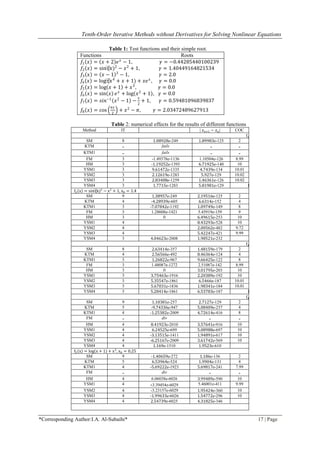
The MATLAB program is used for all the computations using 2000 digit, Table 2 present are the
number of iterations to approximate the zero (IT) and containing the value of 𝑓(𝑥 𝑛 ) 𝑎𝑛𝑑 𝑥 𝑛+1 − 𝑥 𝑛 . The
convergence order 𝛿 of a new iterative methods is over by the equation lim 𝑛→∞
𝑒 𝑛 +1
𝑒 𝑛
𝛿 = 𝑐 ≠ 0, then values of the
computational order of convergence (COC) may be approximated as 𝑐𝑜𝑐 ≈
ln (𝑥 𝑛+1−γ) (𝑥 𝑛 −γ)
𝑙𝑛 (𝑥 𝑛 −γ) (𝑥 𝑛−1−γ)
, (see for
example [10])
The following criteria
𝑥 𝑛+1 − 𝑥 𝑛 ≤ 10−100
,
is used to stop the iteration process in all examples.
The following test functions are used to complain methods, with a simple roots in:](https://image.slidesharecdn.com/c341318-170717094557/85/Tenth-Order-Iterative-Methods-withoutDerivatives-forSolving-Nonlinear-Equations-4-320.jpg)
![Tenth-Order Iterative Methods without Derivatives for Solving Nonlinear Equations
*Corresponding Author:I.A. Al-Subaihi* 18 | Page
COC| 𝑥n+1 − 𝑥n|𝑓(𝑥 𝑛 )ITMethod
𝑓6 𝑥 = sin 𝑥 𝑒 𝑥
+ log 𝑥2
+ 1 , 𝑥0 = 0.5
21.45276e-1448.44207e-28810SM
41.85292e-1171.80742e-4665KTM
7.993.70115e-2193.90546e-17454KTM1
106.32121e-649-1.02076e-38884HM
--div-FM
106.61204e-460-8.62745e-37284YSM1
101.16503e-4241.40673e-37924YSM2
9.991.15041e-4096.64559e-39434YSM3
102.75612e-4271.50312e-37674YSM4
f7 x = sin−1
x2
− 1 −
x
2
+ 1, x0 = 1
--div-SM
43.01354e-225-2.40779e-9005KTM
89.45464e-398-2.69748e-20084KTM1
9.232.78079e-115-2.18467e-10423FM
105.97482e-692-2.69748e-20084HM
101.83776e-6698.02466e-6844YSM1
101.06178e-603-3.35584e-15974YSM2
101.13456e-55104YSM3
102.58104e-5961.06964e-17034YSM4
f8 x = cos
πx
2
+ x2
− π, x0 = 2
21.30323e-1281.95409e-2558SM
46.10311e-1031.81305e-4094KTM
--fails-KTM1
8.983.37864e-1049.59404e-9303FM
106.36702e-1878.13807e-18663HM
10.059.27035e-1566.05924e-15523YSM1
10.116.67285e-1436.85374e-14233YSM2
10.138.22618e-1409.2786e-13923YSM3
10.116.52908e-1435.51227e-14233YSM4
IV. CONCLUSION
In this paper, we have presented a new families of tenth-order derivative-free methods for solving
nonlinear equations. New scheme of methods containing three steps and five functions, one of them is weighted
function.Although the new families are not optimal methods, but it is efficiency index is better than the
Steffensen’smethod,Malik's, Al-Fahid's and Fayyaz's methods and equal to the efficiency index of tenth-order of
Hafiz's method and no derivative need. Finally, Table2 comparing the other methods using a lot of numerical
examples to explain the convergence of the new methods.
REFERENCES
[1]. H. Kung and J. Traub, Optimal order of one-point and multipoint iteration, Journal of the ACM (JACM), 21(4), 1974, 643-651.
[2]. J. Traub, Iterative methods for the solution of equations, American Mathematical Soc, 1982.
[3]. W.Gautschi, Numerical Analysis, An Introduction,Birkhauser, Barton, Mass, USA, 1997.
[4]. J. F. Steffensen, Remark on iteration, Scandinavian Actuarial Journal. 16, 1933, 64-72.
[5]. I. Al-Subaihi, Families of Iterative Methods with Higher Convergence Orders for Solving Nonlinear Equations, Journal of
Progressive Research in Mathematics, 7(4), 2016, 1129-1141.
[6]. M.Sharifi, S.Karimi, F.Khaksar, M.Arab and S.Shateyi, On a new iterative scheme without memory with optimal eighth order, The
Scientific World Journal, 2014, 1-6.
[7]. M. Hafiz, M. Bahgat, Solving nonlinear equations using Two-step optimal methods, Annual Review of Chaos Theory, Bifu. Dyn.
Sys 3, 2013, 1-11.
[8]. M.Ullah, A.AL-fahid and F.Ahmad, Ninth-order Three-point Derivative-Free Family of Iterative Methods for Nonlinear Equations,
2013, 1-6.
[9]. M. Hafiz, An Efficient Three-Step Tenth–Order Method Without Second Order Derivative, Palestine Journal of Mathematics, 3(2),
2014, 198-203.
[10]. D. Basu, From third to fourth order variant of Newton’s method for simple roots, Applied Mathematics and Computation, 202(2),
2008, 886-892.](https://image.slidesharecdn.com/c341318-170717094557/85/Tenth-Order-Iterative-Methods-withoutDerivatives-forSolving-Nonlinear-Equations-6-320.jpg)


