FUNDAMENTALS
Properties of Integers
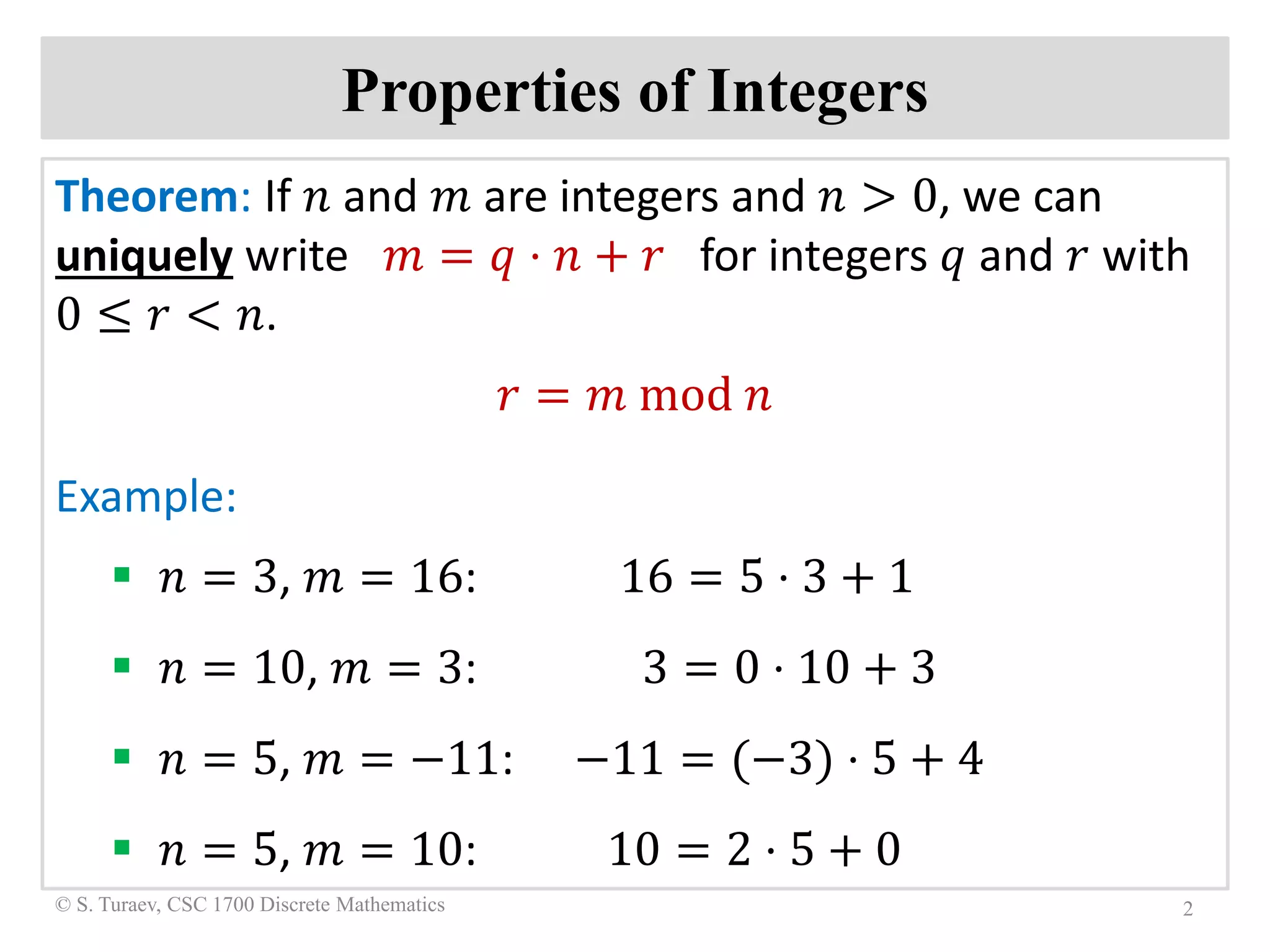
Theorem: If 𝑛𝑛 and 𝑚𝑚 are integers and 𝑛𝑛 > 0, we can
uniquely write 𝑚𝑚 = 𝑞𝑞 ⋅ 𝑛𝑛 + 𝑟𝑟 for integers 𝑞𝑞 and 𝑟𝑟 with
0 ≤ 𝑟𝑟 < 𝑛𝑛.
𝑟𝑟 = 𝑚𝑚 mod 𝑛𝑛
Example:
 𝑛𝑛 = 3, 𝑚𝑚 = 16: 16 = 5 ⋅ 3 + 1
 𝑛𝑛 = 10, 𝑚𝑚 = 3: 3 = 0 ⋅ 10 + 3
 𝑛𝑛 = 5, 𝑚𝑚 = −11: −11 = (−3) ⋅ 5 + 4
 𝑛𝑛 = 5, 𝑚𝑚 = 10: 10 = 2 ⋅ 5 + 0
2© S. Turaev, CSC 1700 Discrete Mathematics
Properties of Integers
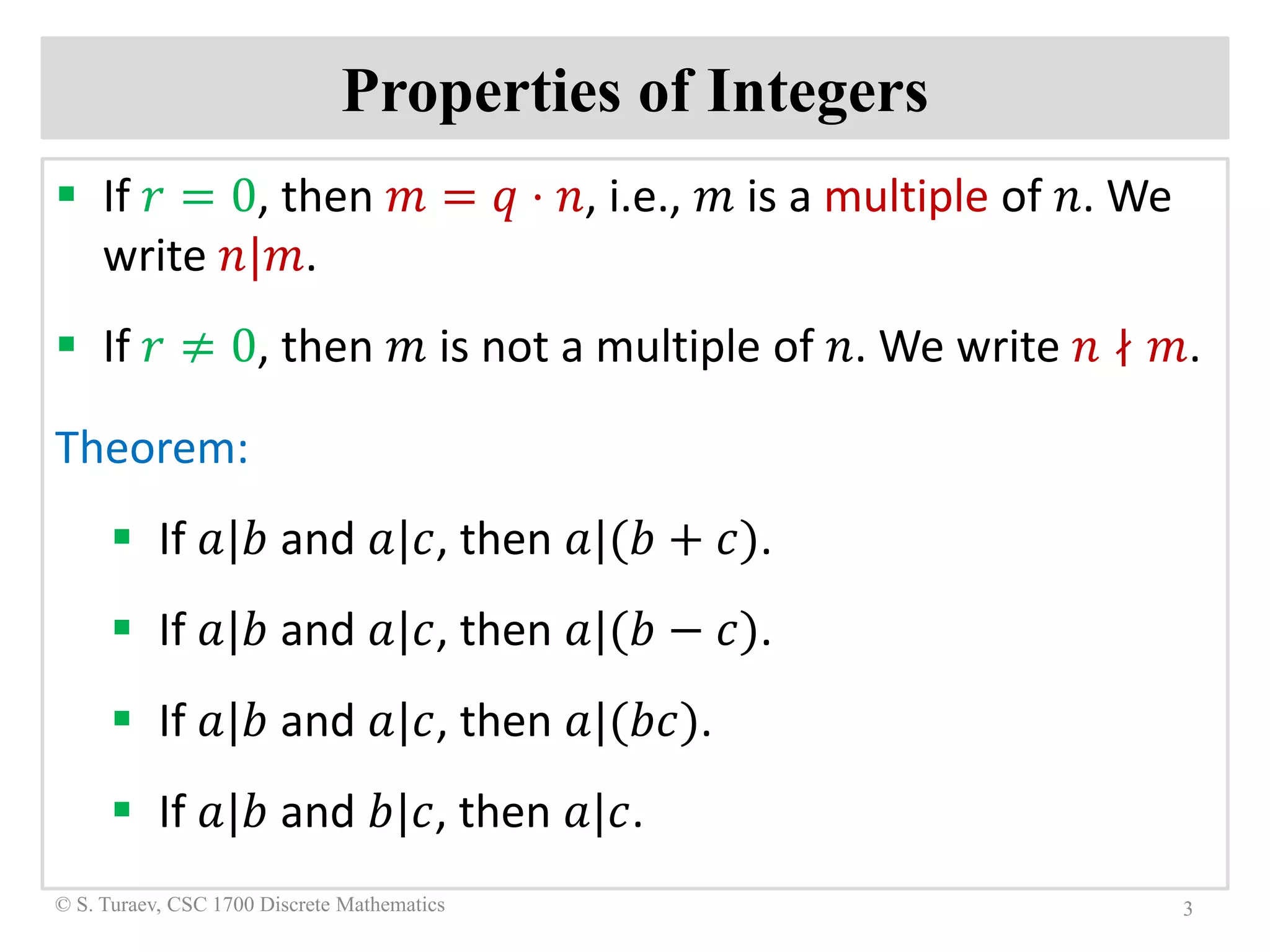
 If 𝑟𝑟 = 0, then 𝑚𝑚 = 𝑞𝑞 ⋅ 𝑛𝑛, i.e., 𝑚𝑚 is a multiple of 𝑛𝑛. We
write 𝑛𝑛|𝑚𝑚.
 If 𝑟𝑟 ≠ 0, then 𝑚𝑚 is not a multiple of 𝑛𝑛. We write 𝑛𝑛 ∤ 𝑚𝑚.
Theorem:
 If 𝑎𝑎|𝑏𝑏 and 𝑎𝑎|𝑐𝑐, then 𝑎𝑎|(𝑏𝑏 + 𝑐𝑐).
 If 𝑎𝑎|𝑏𝑏 and 𝑎𝑎|𝑐𝑐, then 𝑎𝑎|(𝑏𝑏 − 𝑐𝑐).
 If 𝑎𝑎|𝑏𝑏 and 𝑎𝑎|𝑐𝑐, then 𝑎𝑎|(𝑏𝑏𝑏𝑏).
 If 𝑎𝑎|𝑏𝑏 and 𝑏𝑏|𝑐𝑐, then 𝑎𝑎|𝑐𝑐.
3© S. Turaev, CSC 1700 Discrete Mathematics
Prime Numbers
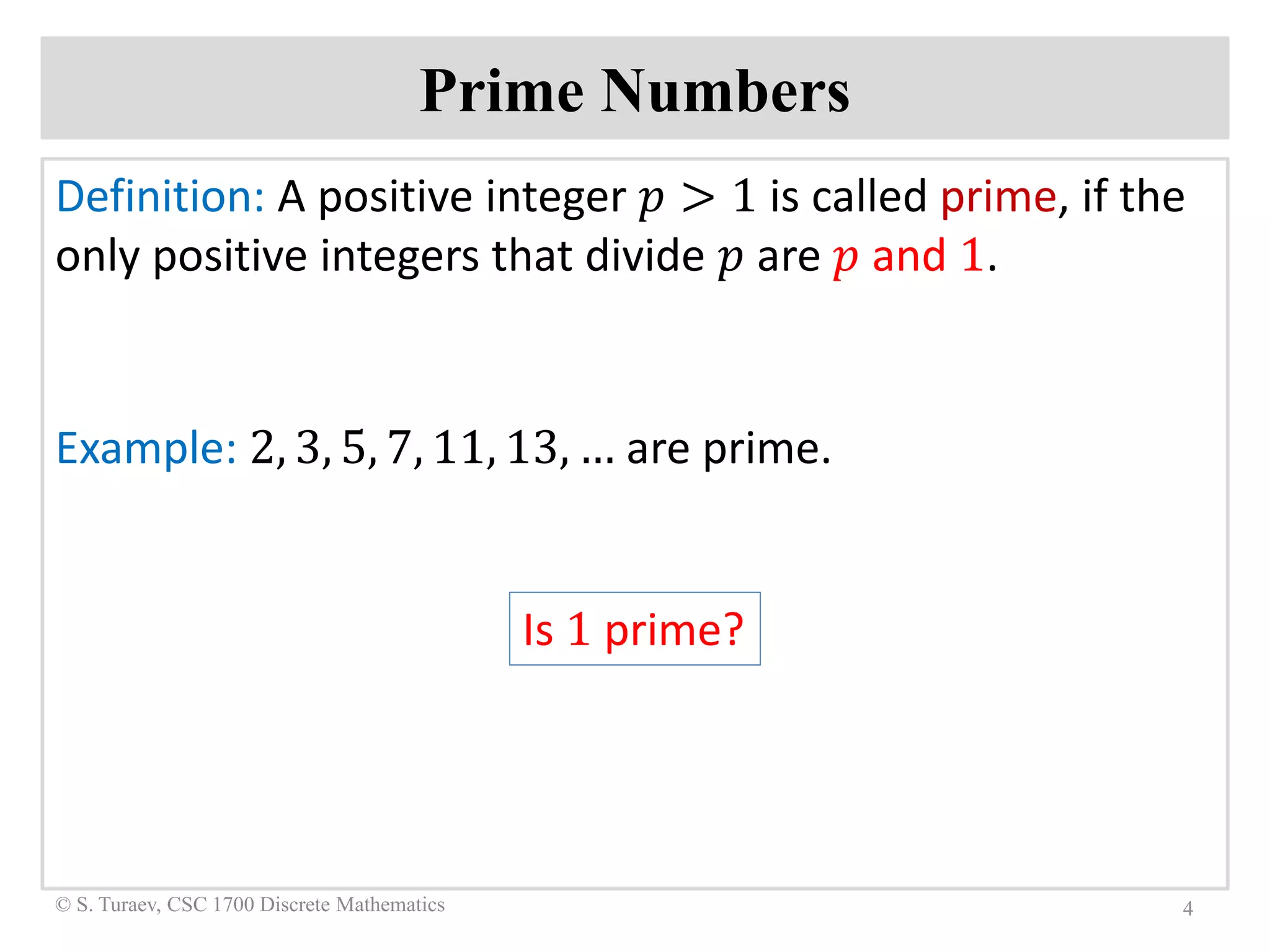
Definition: A positive integer 𝑝𝑝 > 1 is called prime, if the
only positive integers that divide 𝑝𝑝 are 𝑝𝑝 and 1.
Example: 2, 3, 5, 7, 11, 13, … are prime.
4© S. Turaev, CSC 1700 Discrete Mathematics
Is 1 prime?
Prime Numbers
Algorithm for determining if an integer 𝑛𝑛 > 1 is prime:
Step 1: Check if 𝑛𝑛 is 2. if so, 𝑛𝑛 is prime. If not, proceed to
Step 2: Check if 2|𝑛𝑛. if so, 𝑛𝑛 isn’t prime. If not, proceed to
Step 3: Compute the largest integer 𝑘𝑘 ≤ 𝑛𝑛; proceed to
Step 4: Check if 𝑑𝑑|𝑛𝑛 where 𝑑𝑑 is any odd number in (1, 𝑘𝑘].
If 𝑑𝑑|𝑛𝑛, then 𝑛𝑛 isn’t prime; otherwise it is prime.
5© S. Turaev, CSC 1700 Discrete Mathematics
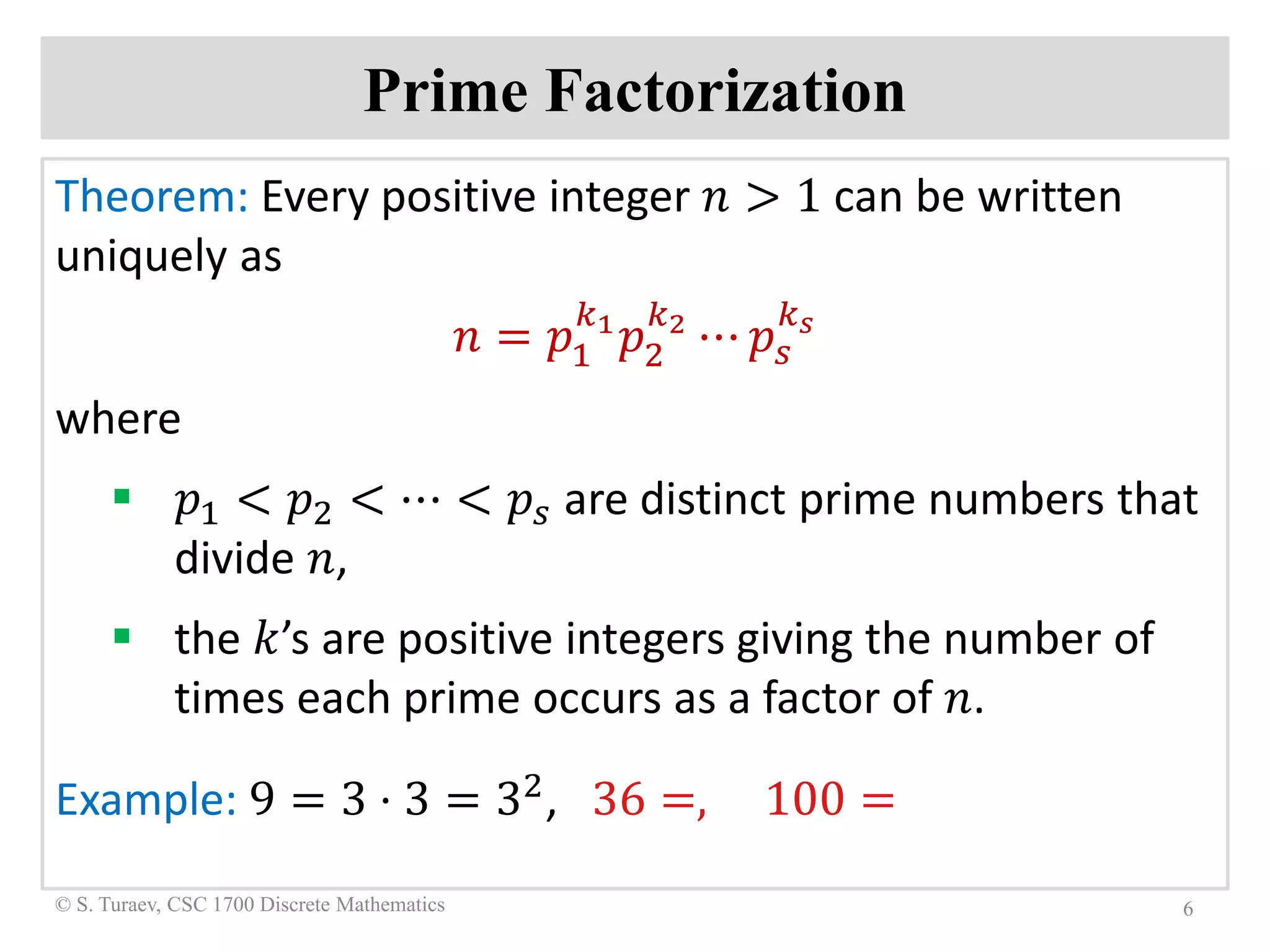
Prime Factorization
Theorem: Every positive integer 𝑛𝑛 > 1 can be written
uniquely as
𝑛𝑛 = 𝑝𝑝1
𝑘𝑘1
𝑝𝑝2
𝑘𝑘2
⋯ 𝑝𝑝𝑠𝑠
𝑘𝑘𝑠𝑠
where
 𝑝𝑝1 < 𝑝𝑝2 < ⋯ < 𝑝𝑝𝑠𝑠 are distinct prime numbers that
divide 𝑛𝑛,
 the 𝑘𝑘’s are positive integers giving the number of
times each prime occurs as a factor of 𝑛𝑛.
Example: 9 = 3 ⋅ 3 = 32, 36 =, 100 =
6© S. Turaev, CSC 1700 Discrete Mathematics
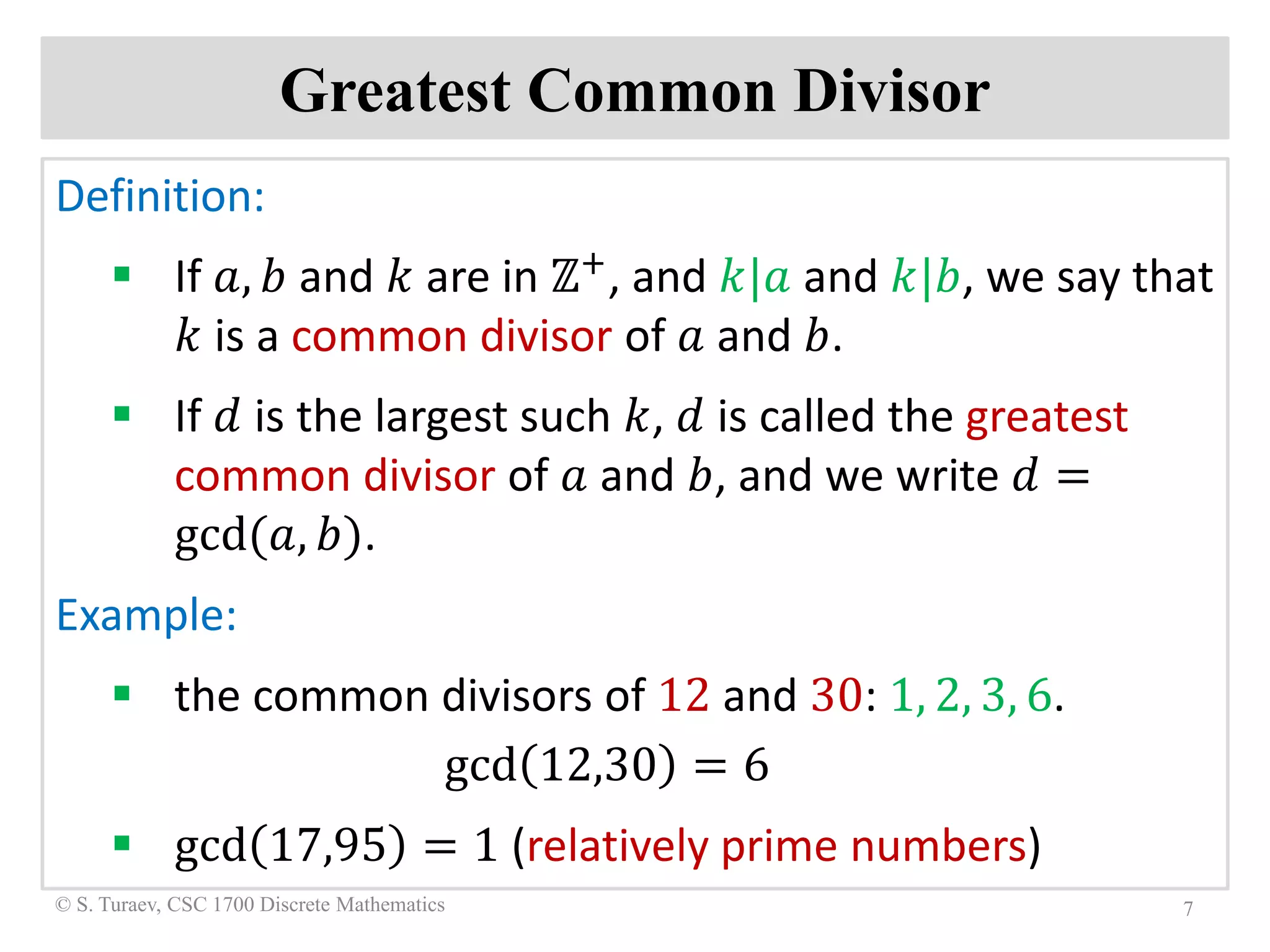
Greatest Common Divisor
Definition:
 If 𝑎𝑎, 𝑏𝑏 and 𝑘𝑘 are in ℤ+, and 𝑘𝑘|𝑎𝑎 and 𝑘𝑘|𝑏𝑏, we say that
𝑘𝑘 is a common divisor of 𝑎𝑎 and 𝑏𝑏.
 If 𝑑𝑑 is the largest such 𝑘𝑘, 𝑑𝑑 is called the greatest
common divisor of 𝑎𝑎 and 𝑏𝑏, and we write 𝑑𝑑 =
gcd(𝑎𝑎, 𝑏𝑏).
Example:
 the common divisors of 12 and 30: 1, 2, 3, 6.
gcd 12,30 = 6
 gcd 17,95 = 1 (relatively prime numbers)
7© S. Turaev, CSC 1700 Discrete Mathematics
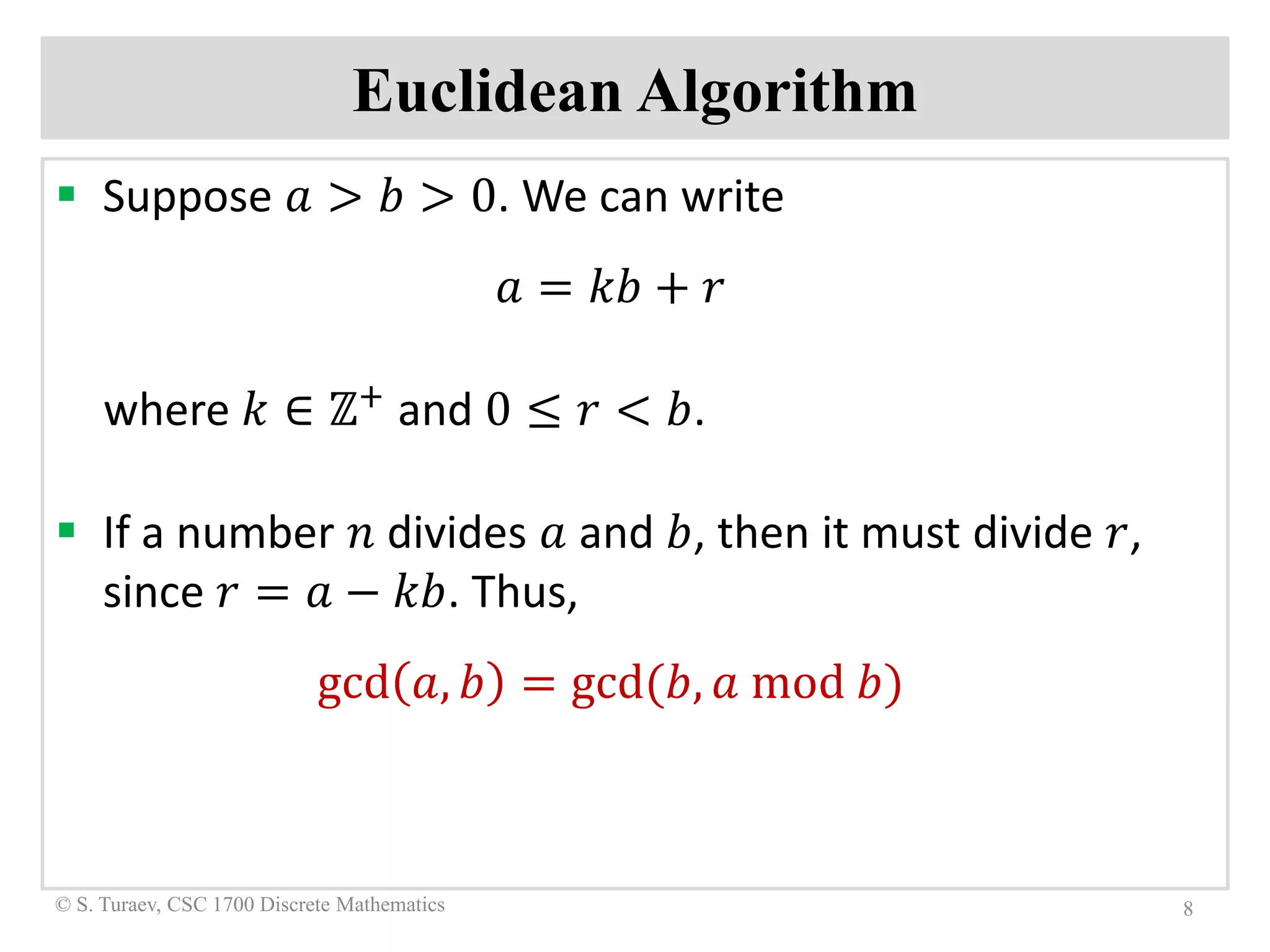
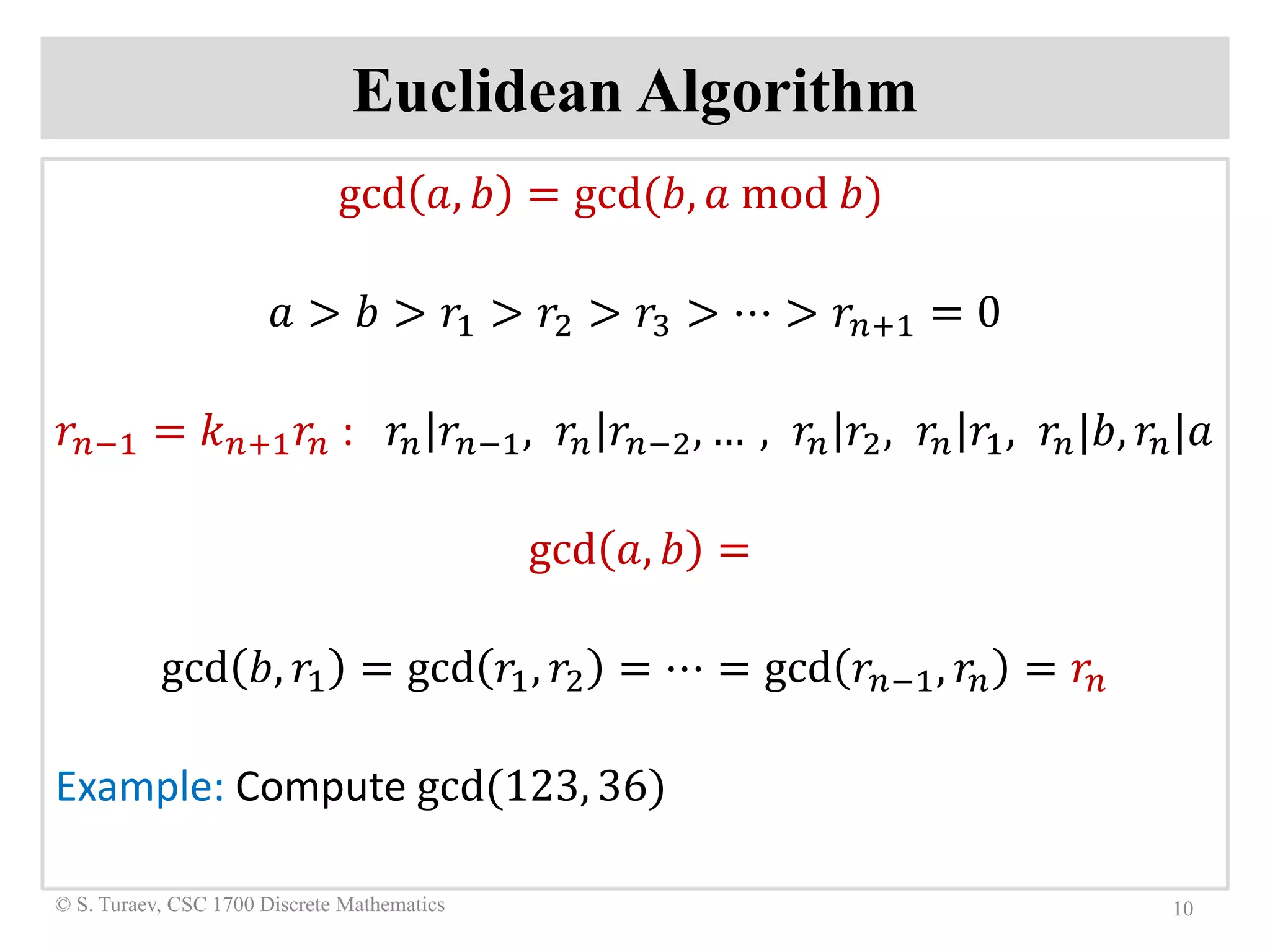
Euclidean Algorithm
 Suppose 𝑎𝑎 > 𝑏𝑏 > 0. We can write
𝑎𝑎 = 𝑘𝑘𝑘𝑘 + 𝑟𝑟
where 𝑘𝑘 ∈ ℤ+
and 0 ≤ 𝑟𝑟 < 𝑏𝑏.
 If a number 𝑛𝑛 divides 𝑎𝑎 and 𝑏𝑏, then it must divide 𝑟𝑟,
since 𝑟𝑟 = 𝑎𝑎 − 𝑘𝑘𝑘𝑘. Thus,
gcd 𝑎𝑎, 𝑏𝑏 = gcd(𝑏𝑏, 𝑎𝑎 mod 𝑏𝑏)
8© S. Turaev, CSC 1700 Discrete Mathematics
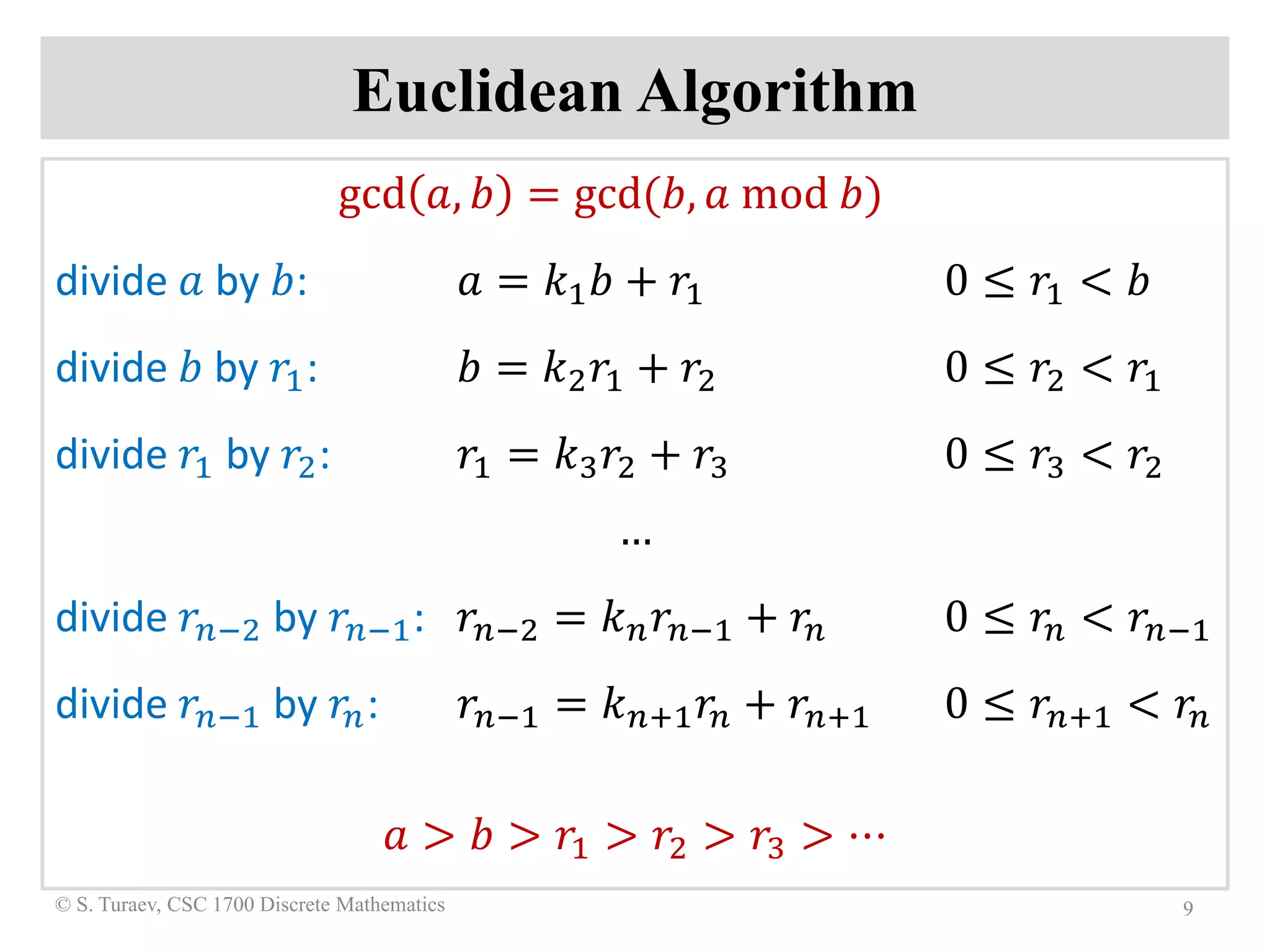
Euclidean Algorithm
gcd 𝑎𝑎, 𝑏𝑏 = gcd(𝑏𝑏, 𝑎𝑎 mod 𝑏𝑏)
divide 𝑎𝑎 by 𝑏𝑏: 𝑎𝑎 = 𝑘𝑘1 𝑏𝑏 + 𝑟𝑟1 0 ≤ 𝑟𝑟1 < 𝑏𝑏
divide 𝑏𝑏 by 𝑟𝑟1: 𝑏𝑏 = 𝑘𝑘2 𝑟𝑟1 + 𝑟𝑟2 0 ≤ 𝑟𝑟2 < 𝑟𝑟1
divide 𝑟𝑟1 by 𝑟𝑟2: 𝑟𝑟1 = 𝑘𝑘3 𝑟𝑟2 + 𝑟𝑟3 0 ≤ 𝑟𝑟3 < 𝑟𝑟2
…
divide 𝑟𝑟𝑛𝑛−2 by 𝑟𝑟𝑛𝑛−1: 𝑟𝑟𝑛𝑛−2 = 𝑘𝑘𝑛𝑛 𝑟𝑟𝑛𝑛−1 + 𝑟𝑟𝑛𝑛 0 ≤ 𝑟𝑟𝑛𝑛 < 𝑟𝑟𝑛𝑛−1
divide 𝑟𝑟𝑛𝑛−1 by 𝑟𝑟𝑛𝑛: 𝑟𝑟𝑛𝑛−1 = 𝑘𝑘𝑛𝑛+1 𝑟𝑟𝑛𝑛 + 𝑟𝑟𝑛𝑛+1 0 ≤ 𝑟𝑟𝑛𝑛+1 < 𝑟𝑟𝑛𝑛
𝑎𝑎 > 𝑏𝑏 > 𝑟𝑟1 > 𝑟𝑟2 > 𝑟𝑟3 > ⋯
9© S. Turaev, CSC 1700 Discrete Mathematics
Euclidean Algorithm
gcd 𝑎𝑎, 𝑏𝑏 = gcd(𝑏𝑏, 𝑎𝑎 mod 𝑏𝑏)
𝑎𝑎 > 𝑏𝑏 > 𝑟𝑟1 > 𝑟𝑟2 > 𝑟𝑟3 > ⋯ > 𝑟𝑟𝑛𝑛+1 = 0
𝑟𝑟𝑛𝑛−1 = 𝑘𝑘𝑛𝑛+1 𝑟𝑟𝑛𝑛 : 𝑟𝑟𝑛𝑛 𝑟𝑟𝑛𝑛−1, 𝑟𝑟𝑛𝑛 𝑟𝑟𝑛𝑛−2, … , 𝑟𝑟𝑛𝑛 𝑟𝑟2, 𝑟𝑟𝑛𝑛 𝑟𝑟1, 𝑟𝑟𝑛𝑛|𝑏𝑏, 𝑟𝑟𝑛𝑛|𝑎𝑎
gcd 𝑎𝑎, 𝑏𝑏 =
gcd 𝑏𝑏, 𝑟𝑟1 = gcd 𝑟𝑟1, 𝑟𝑟2 = ⋯ = gcd 𝑟𝑟𝑛𝑛−1, 𝑟𝑟𝑛𝑛 = 𝑟𝑟𝑛𝑛
Example: Compute gcd(123, 36)
10© S. Turaev, CSC 1700 Discrete Mathematics
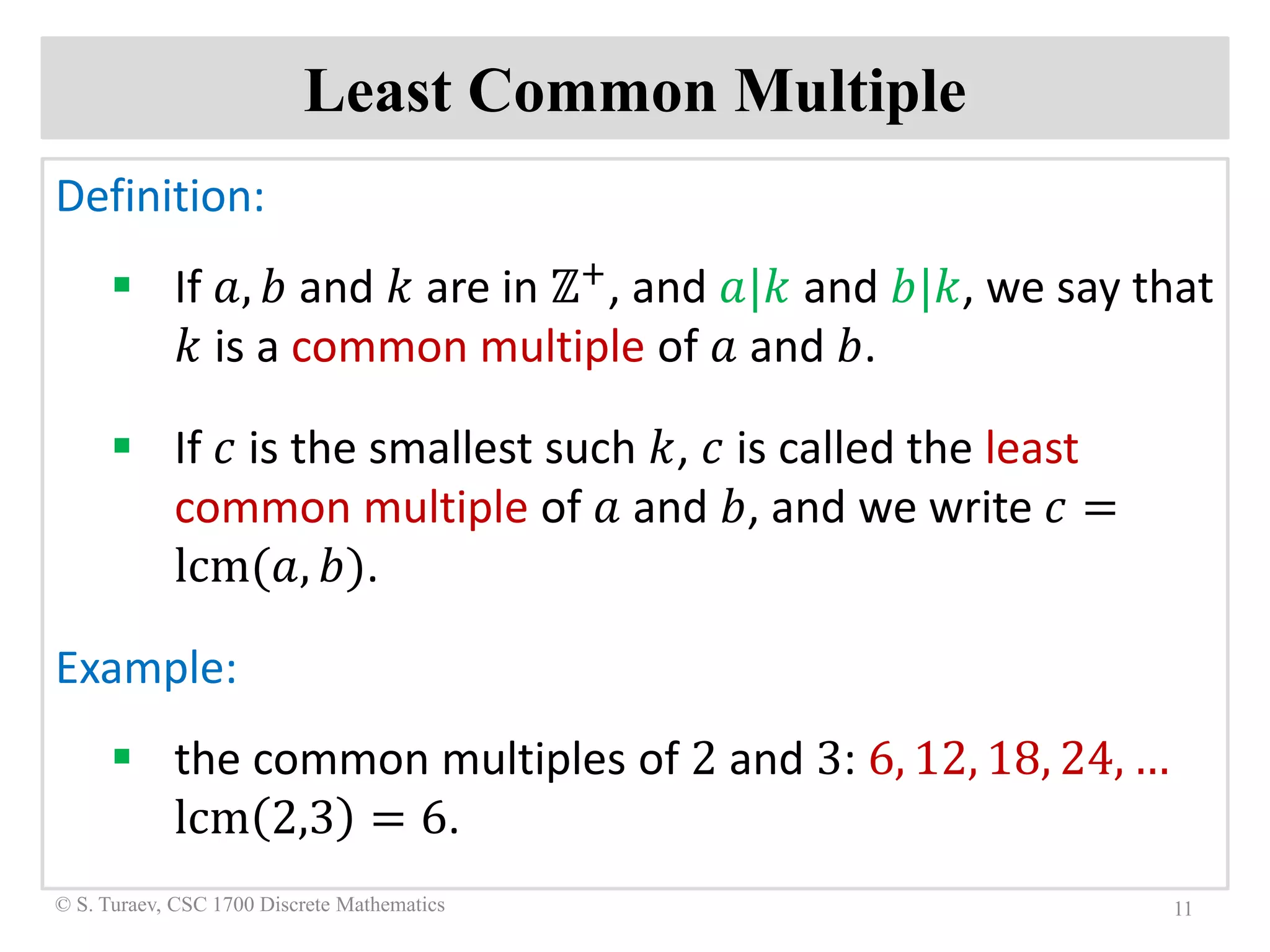
Least Common Multiple
Definition:
 If 𝑎𝑎, 𝑏𝑏 and 𝑘𝑘 are in ℤ+, and 𝑎𝑎|𝑘𝑘 and 𝑏𝑏|𝑘𝑘, we say that
𝑘𝑘 is a common multiple of 𝑎𝑎 and 𝑏𝑏.
 If 𝑐𝑐 is the smallest such 𝑘𝑘, 𝑐𝑐 is called the least
common multiple of 𝑎𝑎 and 𝑏𝑏, and we write 𝑐𝑐 =
lcm(𝑎𝑎, 𝑏𝑏).
Example:
 the common multiples of 2 and 3: 6, 12, 18, 24, …
lcm 2,3 = 6.
11© S. Turaev, CSC 1700 Discrete Mathematics
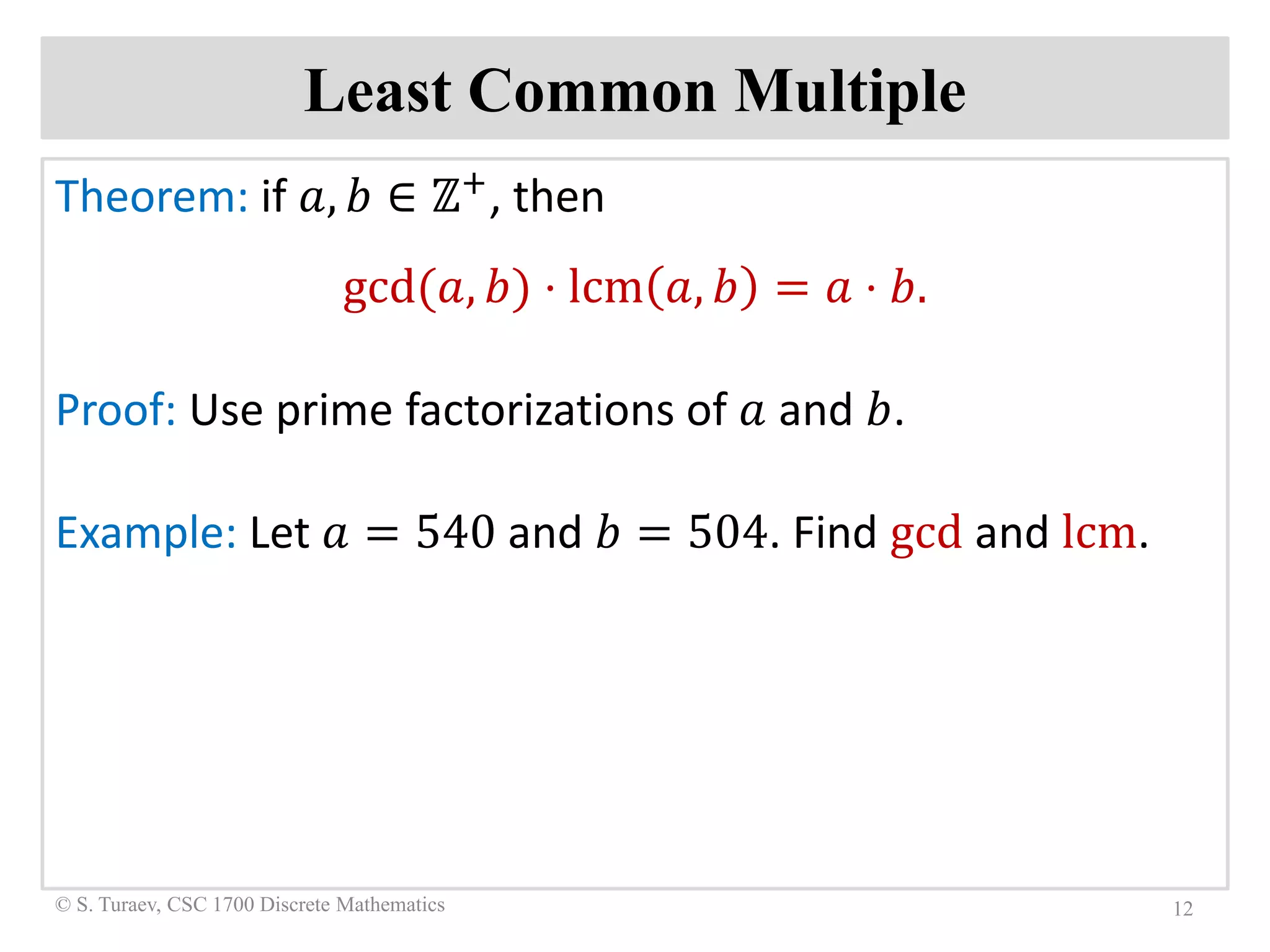
Least Common Multiple
Theorem: if 𝑎𝑎, 𝑏𝑏 ∈ ℤ+, then
gcd(𝑎𝑎, 𝑏𝑏) ⋅ lcm 𝑎𝑎, 𝑏𝑏 = 𝑎𝑎 ⋅ 𝑏𝑏.
Proof: Use prime factorizations of 𝑎𝑎 and 𝑏𝑏.
Example: Let 𝑎𝑎 = 540 and 𝑏𝑏 = 504. Find gcd and lcm.
12© S. Turaev, CSC 1700 Discrete Mathematics
Exercises
• Write 𝑚𝑚 as 𝑞𝑞𝑞𝑞 + 𝑟𝑟, with 0 ≤ 𝑟𝑟 < 𝑛𝑛:
1. 𝑚𝑚 = 20, 𝑛𝑛 = 3
2. 𝑚𝑚 = 64, 𝑛𝑛 = 37
3. 𝑚𝑚 = 3, 𝑛𝑛 = 12
• Write each integer as a product of powers of primes:
828, 1666, 1781
• Find the gcd(𝑎𝑎, 𝑏𝑏) and lcm(𝑎𝑎, 𝑏𝑏):
1. 𝑎𝑎 = 60, 𝑏𝑏 = 100
2. 𝑎𝑎 = 77, 𝑏𝑏 = 128
13© S. Turaev, CSC 1700 Discrete Mathematics
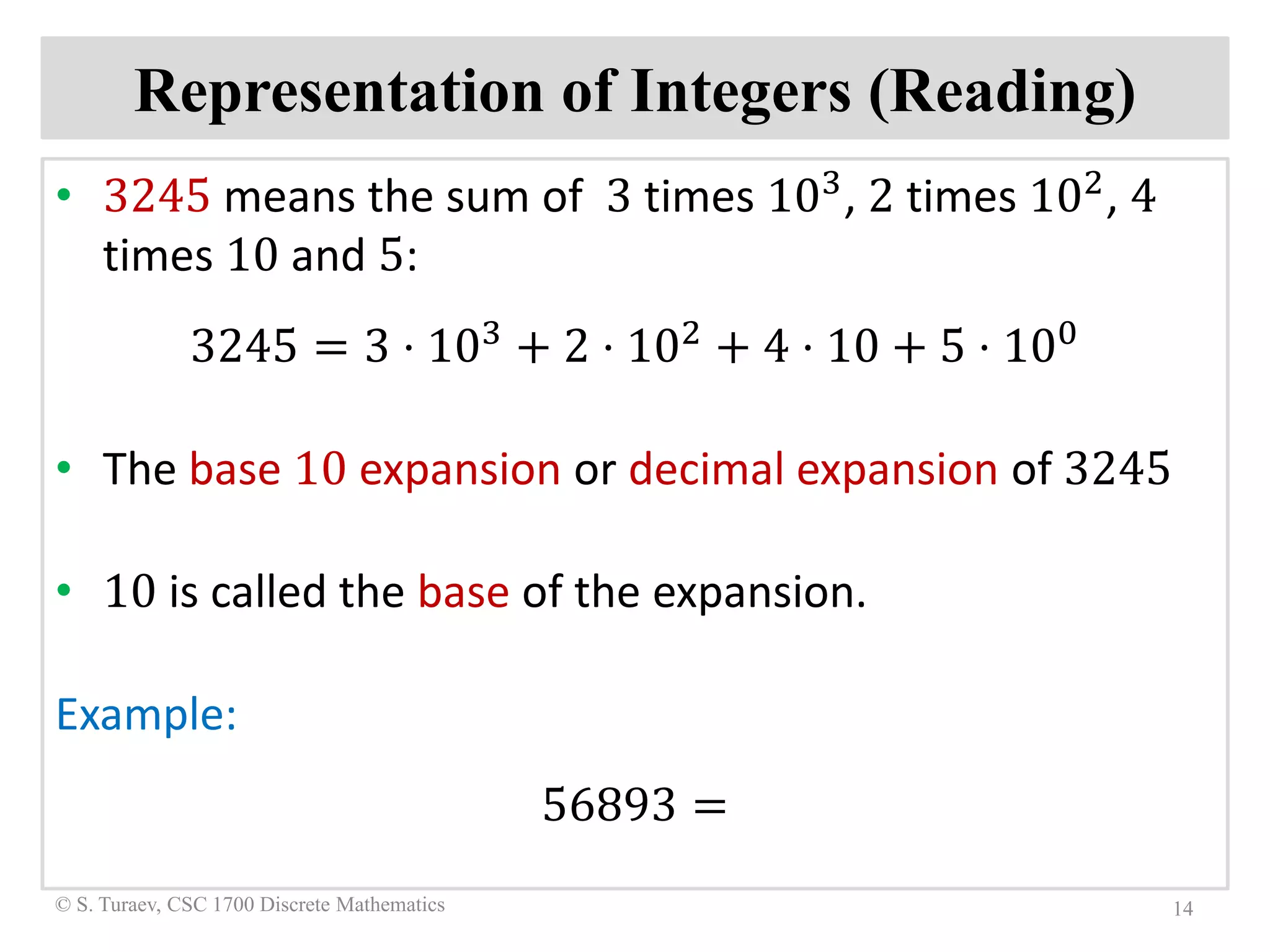
Representation of Integers (Reading)
• 3245 means the sum of 3 times 103, 2 times 102, 4
times 10 and 5:
3245 = 3 ⋅ 103 + 2 ⋅ 102 + 4 ⋅ 10 + 5 ⋅ 100
• The base 10 expansion or decimal expansion of 3245
• 10 is called the base of the expansion.
Example:
56893 =
14© S. Turaev, CSC 1700 Discrete Mathematics
Representation of Integers (Reading)
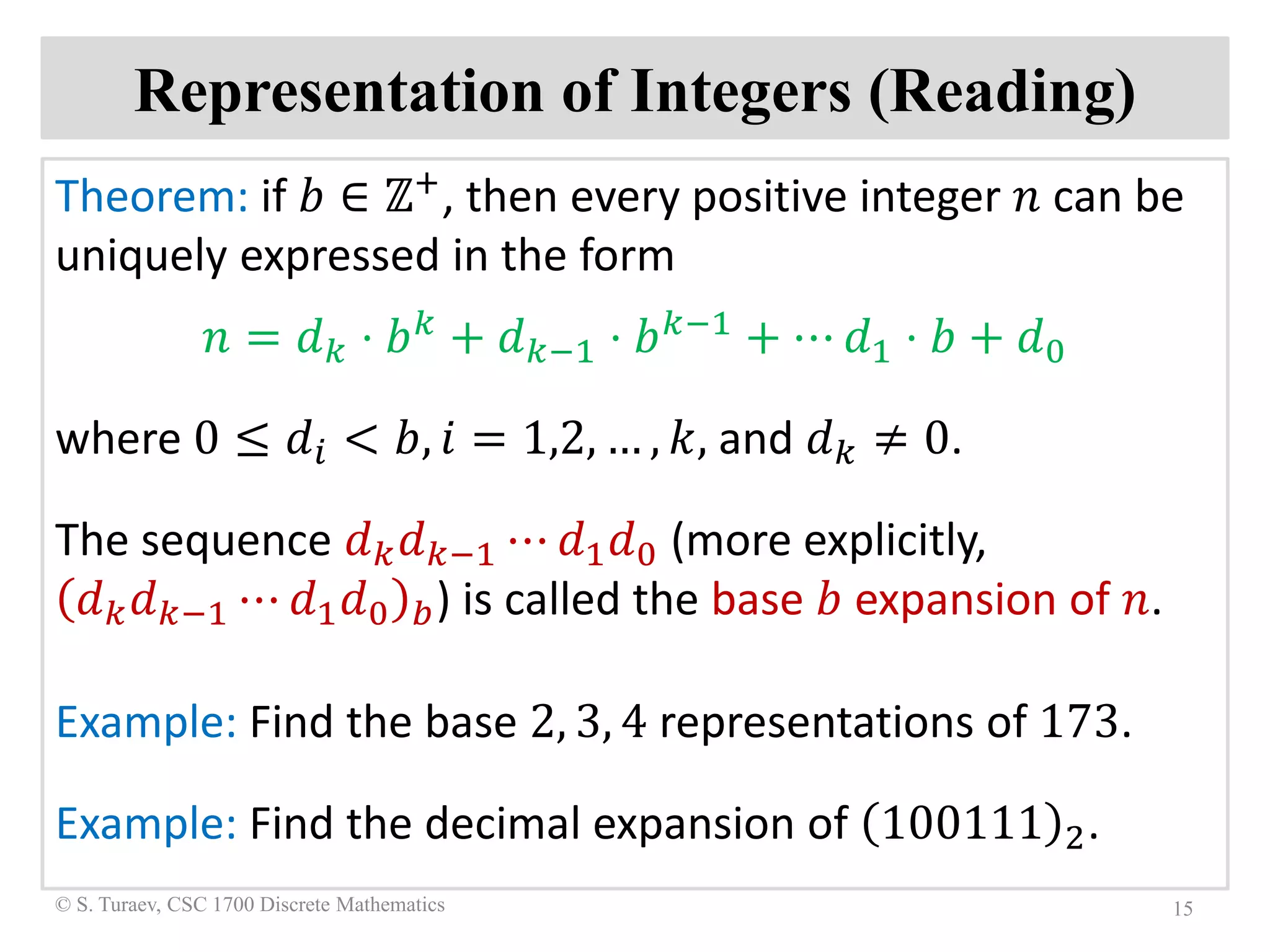
Theorem: if 𝑏𝑏 ∈ ℤ+, then every positive integer 𝑛𝑛 can be
uniquely expressed in the form
𝑛𝑛 = 𝑑𝑑𝑘𝑘 ⋅ 𝑏𝑏𝑘𝑘 + 𝑑𝑑𝑘𝑘−1 ⋅ 𝑏𝑏𝑘𝑘−1 + ⋯ 𝑑𝑑1 ⋅ 𝑏𝑏 + 𝑑𝑑0
where 0 ≤ 𝑑𝑑𝑖𝑖 < 𝑏𝑏, 𝑖𝑖 = 1,2, … , 𝑘𝑘, and 𝑑𝑑𝑘𝑘 ≠ 0.
The sequence 𝑑𝑑𝑘𝑘 𝑑𝑑𝑘𝑘−1 ⋯ 𝑑𝑑1 𝑑𝑑0 (more explicitly,
𝑑𝑑𝑘𝑘 𝑑𝑑𝑘𝑘−1 ⋯ 𝑑𝑑1 𝑑𝑑0 𝑏𝑏) is called the base 𝑏𝑏 expansion of 𝑛𝑛.
Example: Find the base 2, 3, 4 representations of 173.
Example: Find the decimal expansion of 100111 2.
15© S. Turaev, CSC 1700 Discrete Mathematics
Matrices
Definition: A matrix is a rectangular array of numbers in
𝑚𝑚 horizontal rows and 𝑛𝑛 vertical columns:
𝐀𝐀 =
𝑎𝑎11 𝑎𝑎12
𝑎𝑎21 𝑎𝑎22
⋯
𝑎𝑎1𝑛𝑛
𝑎𝑎2𝑛𝑛
⋮ ⋮
𝑎𝑎 𝑚𝑚1 𝑎𝑎 𝑚𝑚𝑚 ⋯ 𝑎𝑎 𝑚𝑚𝑚𝑚
Definition: The 𝑖𝑖th row of 𝐀𝐀 is [𝑎𝑎𝑖𝑖 𝑖 𝑎𝑎𝑖𝑖 𝑖 ⋯ 𝑎𝑎𝑖𝑖 𝑖𝑖], 1 ≤ 𝑖𝑖 ≤ 𝑚𝑚,
and the 𝑗𝑗th column of 𝐀𝐀 is
𝑎𝑎1𝑗𝑗
𝑎𝑎2𝑗𝑗
⋮
𝑎𝑎𝑛𝑛𝑛𝑛
, 1 ≤ 𝑗𝑗 ≤ 𝑛𝑛.
16© S. Turaev, CSC 1700 Discrete Mathematics
Matrices
Definition: We say that 𝐀𝐀 is 𝑚𝑚 by 𝑛𝑛, written 𝑚𝑚 × 𝑛𝑛. If
𝑚𝑚 = 𝑛𝑛, we say 𝐀𝐀 is a square matrix of order 𝑛𝑛. The
elements 𝑎𝑎11, 𝑎𝑎22, … , 𝑎𝑎𝑛𝑛𝑛𝑛 form main diagonal of 𝐀𝐀.
Definition: We refer to the element 𝑎𝑎𝑖𝑖𝑖𝑖 in the 𝑖𝑖th row and
𝑗𝑗th column of 𝐀𝐀 as the (𝑖𝑖, 𝑗𝑗) entry of 𝐀𝐀. We denote the
matrix 𝐀𝐀 by [𝑎𝑎𝑖𝑖𝑖𝑖], for short.
Example:
𝐀𝐀 =
2 3 5
0 −1 2
, 𝐁𝐁 =
2 6
3 6
, 𝐂𝐂 = 1 0 0 , 𝐃𝐃 =
1
1
1
17© S. Turaev, CSC 1700 Discrete Mathematics
Matrices
Definition: A square matrix 𝐀𝐀 = [𝑎𝑎𝑖𝑖𝑖𝑖] is called a diagonal
matrix if 𝑎𝑎𝑖𝑖𝑖𝑖 = 0 for all 𝑖𝑖 ≠ 𝑗𝑗.
Example:
𝐅𝐅 =
2 0
0 6
, 𝐆𝐆 =
1 0 0
0 3 0
0 0 −3
, 𝐇𝐇 =
0 0 0
0 3 0
0 0 0
Definition: A 𝑚𝑚 × 𝑛𝑛 matrix 𝐀𝐀 = [𝑎𝑎𝑖𝑖𝑖𝑖] is called zero matrix,
denoted by 𝟎𝟎, if 𝑎𝑎𝑖𝑖𝑖𝑖 = 0 for all 1 ≤ 𝑖𝑖 ≤ 𝑚𝑚, 1 ≤ 𝑗𝑗 ≤ 𝑛𝑛.
18© S. Turaev, CSC 1700 Discrete Mathematics
Matrices
Definition: Two 𝑚𝑚 × 𝑛𝑛 matrices 𝐀𝐀 = [𝑎𝑎𝑖𝑖𝑖𝑖] and 𝐁𝐁 = [𝑏𝑏𝑖𝑖𝑖𝑖]
are said to be equal if 𝑎𝑎𝑖𝑖𝑖𝑖 = 𝑏𝑏𝑖𝑖𝑖𝑖 for all 𝑖𝑖 and 𝑗𝑗.
Definition: If 𝐀𝐀 = [𝑎𝑎𝑖𝑖𝑖𝑖] and 𝐁𝐁 = [𝑏𝑏𝑖𝑖𝑖𝑖] are 𝑚𝑚 × 𝑛𝑛 matrices,
then the sum of 𝐀𝐀 and 𝐁𝐁, denoted by 𝐀𝐀 + 𝐁𝐁, is the matrix
𝐂𝐂 = [𝑐𝑐𝑖𝑖𝑖𝑖] defined by 𝑐𝑐𝑖𝑖𝑖𝑖 = 𝑎𝑎𝑖𝑖𝑖𝑖 + 𝑏𝑏𝑖𝑖𝑖𝑖 for all 1 ≤ 𝑖𝑖 ≤ 𝑚𝑚,
1 ≤ 𝑗𝑗 ≤ 𝑛𝑛.
Example: Find 𝐀𝐀+ 𝐁𝐁 if
𝐀𝐀 =
1 0 −8
3 3 0
−2 9 −3
, 𝐁𝐁 =
4 5 3
0 −3 2
5 0 −2
19© S. Turaev, CSC 1700 Discrete Mathematics
Matrices
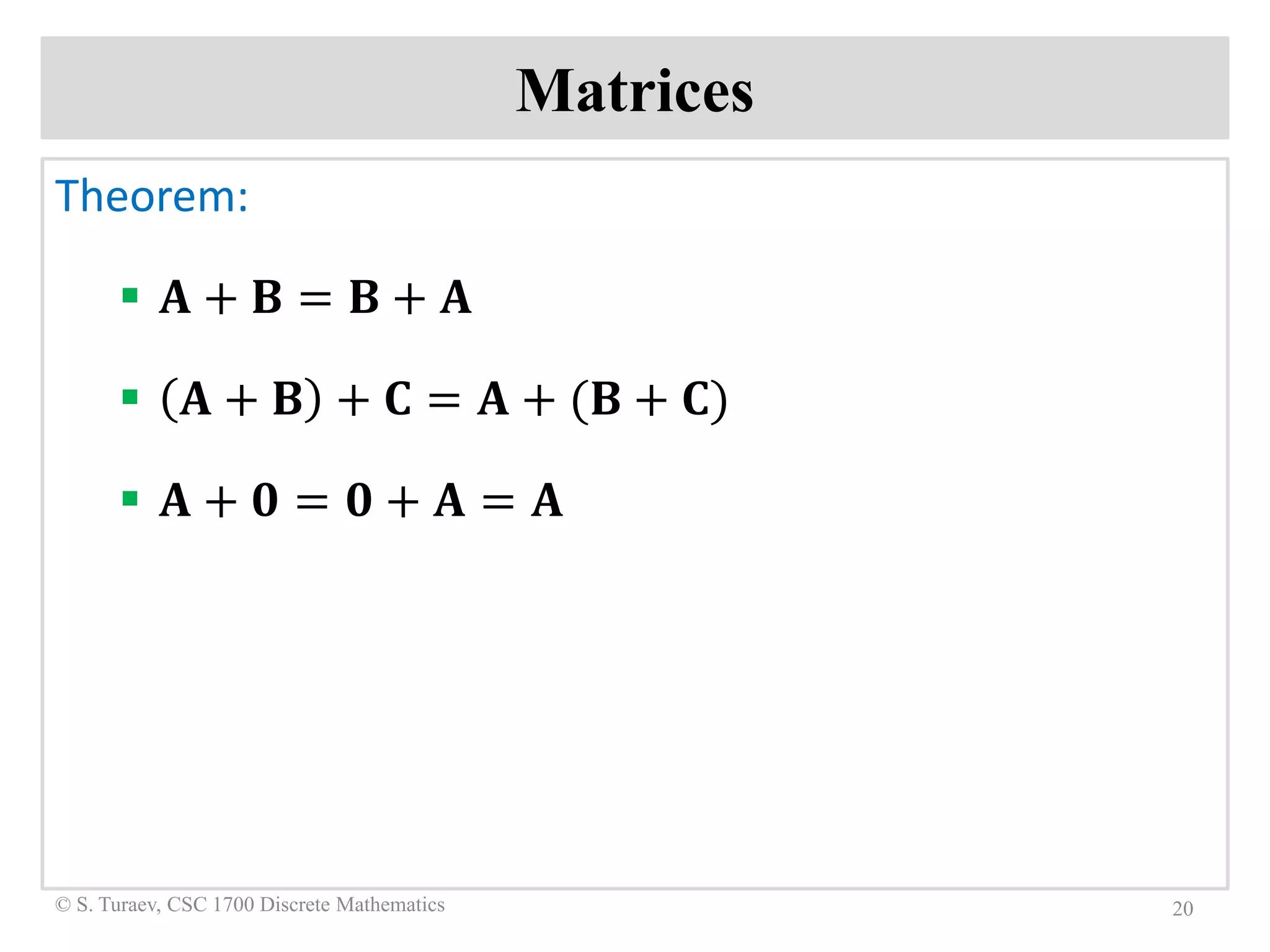
Theorem:
 𝐀𝐀 + 𝐁𝐁 = 𝐁𝐁 + 𝐀𝐀
 𝐀𝐀 + 𝐁𝐁 + 𝐂𝐂 = 𝐀𝐀 + (𝐁𝐁 + 𝐂𝐂)
 𝐀𝐀 + 𝟎𝟎 = 𝟎𝟎 + 𝐀𝐀 = 𝐀𝐀
20© S. Turaev, CSC 1700 Discrete Mathematics
Matrices
Definition: If 𝐀𝐀 = [𝑎𝑎𝑖𝑖𝑖𝑖] is 𝑚𝑚 × 𝑝𝑝 matrix and 𝐁𝐁 = [𝑏𝑏𝑖𝑖𝑖𝑖] are
𝑝𝑝 × 𝑛𝑛 matrix, then the product of 𝐀𝐀 and 𝐁𝐁, denotes by
𝐀𝐀𝐀𝐀 is the 𝑚𝑚 × 𝑛𝑛 matrix 𝐂𝐂 = [𝑐𝑐𝑖𝑖𝑖𝑖] defined by
𝑐𝑐𝑖𝑖𝑖𝑖 = 𝑎𝑎𝑖𝑖 𝑖 𝑏𝑏1𝑗𝑗 + 𝑎𝑎𝑖𝑖2 𝑏𝑏2𝑗𝑗 + ⋯ 𝑎𝑎𝑖𝑖 𝑝𝑝 𝑏𝑏𝑝𝑝𝑗𝑗
for all 1 ≤ 𝑖𝑖 ≤ 𝑚𝑚, 1 ≤ 𝑗𝑗 ≤ 𝑛𝑛.
Example: Find 𝐀𝐀𝐁𝐁 if
𝐀𝐀 =
1 0 −8
3 3 0
−2 9 −3
, 𝐁𝐁 =
4 5 3
0 −3 2
5 0 −2
21© S. Turaev, CSC 1700 Discrete Mathematics
Matrices
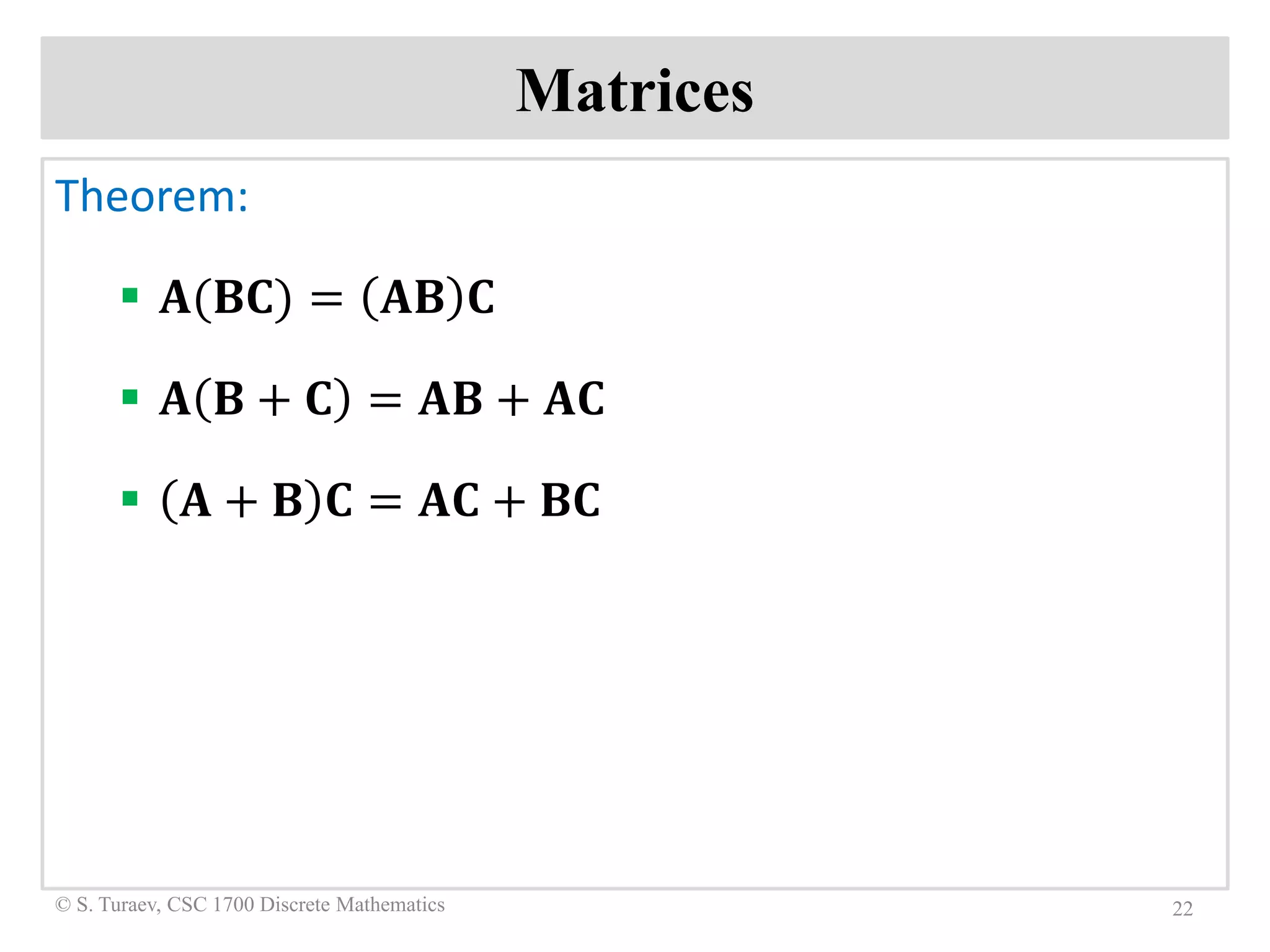
Theorem:
 𝐀𝐀(𝐁𝐁𝐁𝐁) = 𝐀𝐀𝐀𝐀 𝐂𝐂
 𝐀𝐀 𝐁𝐁 + 𝐂𝐂 = 𝐀𝐀𝐀𝐀 + 𝐀𝐀𝐀𝐀
 𝐀𝐀 + 𝐁𝐁 𝐂𝐂 = 𝐀𝐀𝐀𝐀 + 𝐁𝐁𝐁𝐁
22© S. Turaev, CSC 1700 Discrete Mathematics
Matrices
Definition: A 𝑛𝑛 × 𝑛𝑛 diagonal matrix:
𝐈𝐈𝑛𝑛 =
1 0
0 1
⋯
0
0
⋮ ⋮
0 0 ⋯ 1
is called the identity matrix of order 𝑛𝑛.
Theorem: For any 𝑛𝑛 × 𝑛𝑛 matrix 𝐀𝐀 and positive integer 𝑝𝑝,
 𝐈𝐈𝑛𝑛 𝐀𝐀 = 𝐀𝐀𝐈𝐈𝑛𝑛 = 𝐀𝐀
 𝐀𝐀𝑝𝑝
= 𝐀𝐀 ⋅ 𝐀𝐀 ⋅ ⋯ ⋅ 𝐀𝐀
𝑝𝑝
, 𝐀𝐀0
= 𝐈𝐈𝑛𝑛.
23© S. Turaev, CSC 1700 Discrete Mathematics
Matrices
Definition: If 𝐀𝐀 = [𝑎𝑎𝑖𝑖𝑖𝑖] is 𝑚𝑚 × 𝑛𝑛 matrix, then the 𝑛𝑛 × 𝑚𝑚
matrix 𝐀𝐀𝑇𝑇 = [𝑎𝑎𝑖𝑖𝑖𝑖
𝑇𝑇
], where 𝑎𝑎𝑖𝑖𝑖𝑖
𝑇𝑇
= 𝑎𝑎𝑗𝑗𝑗𝑗, for all 1 ≤ 𝑖𝑖 ≤ 𝑚𝑚,
1 ≤ 𝑗𝑗 ≤ 𝑛𝑛, is called the transpose of 𝐀𝐀.
Example: Find 𝐀𝐀𝑇𝑇 and 𝐁𝐁𝑇𝑇 if
𝐀𝐀 =
1 0 −8
3 3 0
−2 9 −3
, 𝐁𝐁 =
2 −3 5
6 1 3
24© S. Turaev, CSC 1700 Discrete Mathematics
Matrices
Theorem:
 𝐀𝐀𝑇𝑇 𝑇𝑇
= 𝐀𝐀
 𝐀𝐀 + 𝐁𝐁 𝑇𝑇 = 𝐀𝐀𝑇𝑇 + 𝐁𝐁𝑇𝑇
 𝐀𝐀𝐁𝐁 𝑇𝑇 = 𝐁𝐁𝑇𝑇 𝐀𝐀𝑇𝑇
Definition: A matrix 𝐀𝐀 = [𝑎𝑎𝑖𝑖𝑖𝑖] is called symmetric if
𝑨𝑨𝑇𝑇=𝐀𝐀.
Definition: if 𝐀𝐀 and 𝐁𝐁 are 𝑛𝑛 × 𝑛𝑛 matrices, we say 𝐁𝐁 is the
inverse of 𝐀𝐀 if 𝐀𝐀𝐁𝐁 = 𝐈𝐈𝑛𝑛.
25© S. Turaev, CSC 1700 Discrete Mathematics
Boolean Matrix Operations
Definition: A Boolean matrix is 𝑚𝑚 × 𝑛𝑛 matrix whose
entries are either zero or one.
Definition: Let 𝐀𝐀 = [𝑎𝑎𝑖𝑖𝑖𝑖] and 𝐁𝐁 = [𝑏𝑏𝑖𝑖𝑖𝑖] be 𝑚𝑚 × 𝑛𝑛 Boolean
matrices. We define 𝐀𝐀 ∨ 𝐁𝐁 = 𝐂𝐂 = [𝑐𝑐𝑖𝑖𝑖𝑖], the join of 𝐀𝐀 and
𝐁𝐁, by
𝑐𝑐𝑖𝑖𝑖𝑖 = 1 if 𝑎𝑎𝑖𝑖𝑖𝑖 = 1 or 𝑏𝑏𝑖𝑖𝑖𝑖 = 1, 𝑐𝑐𝑖𝑖𝑖𝑖 = 0 if 𝑎𝑎𝑖𝑖𝑖𝑖 = 𝑏𝑏𝑖𝑖𝑖𝑖 = 0,
and the meet of 𝐀𝐀 and 𝐁𝐁, by
𝑐𝑐𝑖𝑖𝑖𝑖 = 1 if 𝑎𝑎𝑖𝑖𝑖𝑖 = 𝑏𝑏𝑖𝑖𝑖𝑖 = 1, 𝑐𝑐𝑖𝑖𝑖𝑖 = 0 if 𝑎𝑎𝑖𝑖𝑖𝑖 = 0 or 𝑏𝑏𝑖𝑖𝑖𝑖 = 0.
26© S. Turaev, CSC 1700 Discrete Mathematics
Boolean Matrix Operations
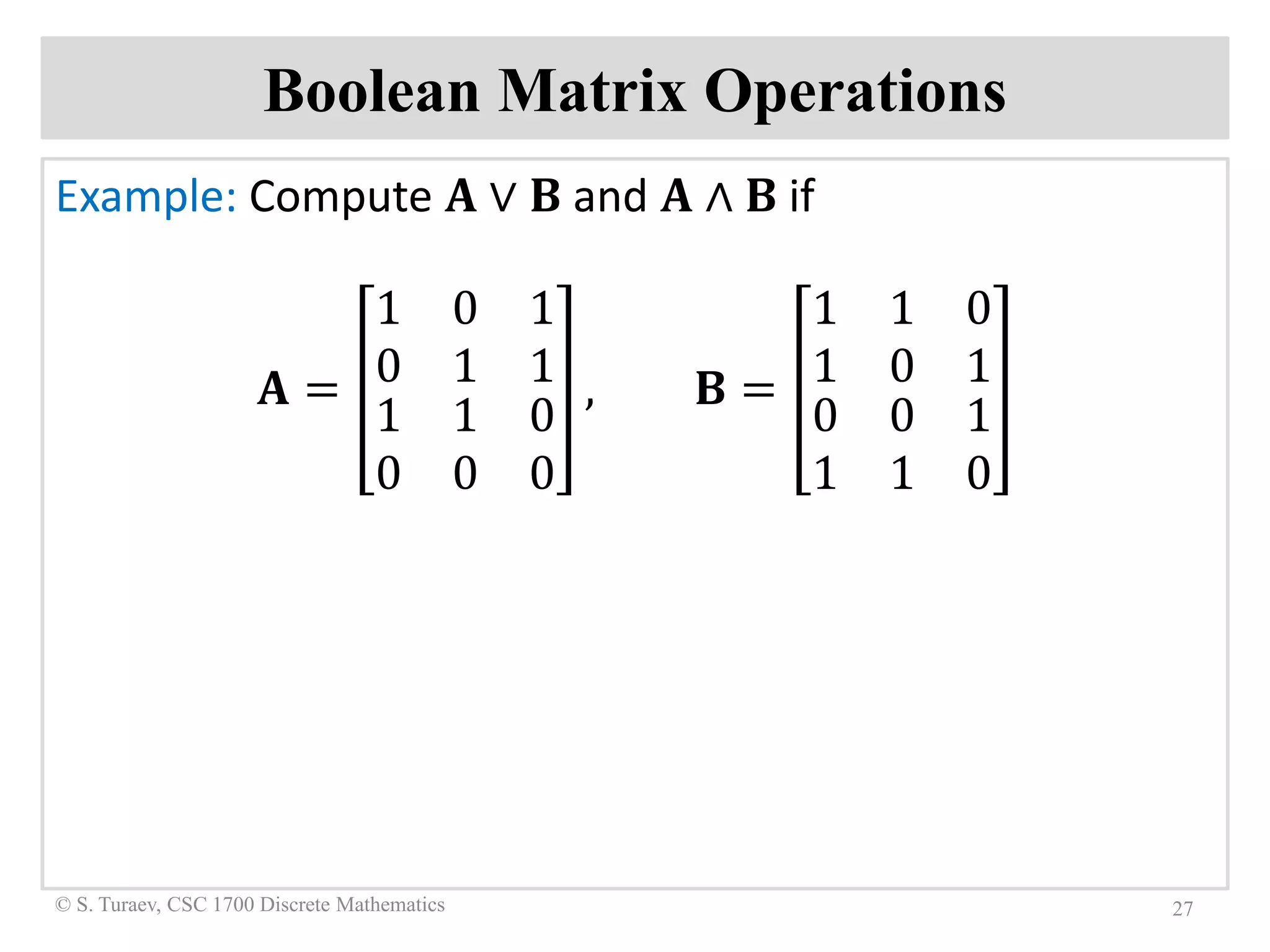
Example: Compute 𝐀𝐀 ∨ 𝐁𝐁 and 𝐀𝐀 ∧ 𝐁𝐁 if
𝐀𝐀 =
1 0 1
0 1 1
1 1 0
0 0 0
, 𝐁𝐁 =
1 1 0
1 0 1
0 0 1
1 1 0
27© S. Turaev, CSC 1700 Discrete Mathematics
Boolean Matrix Operations
Definition: Let 𝐀𝐀 = [𝑎𝑎𝑖𝑖𝑖𝑖] be an 𝑚𝑚 × 𝑝𝑝 Boolean matrix and
𝐁𝐁 = [𝑏𝑏𝑖𝑖𝑖𝑖] be a 𝑝𝑝 × 𝑛𝑛 Boolean matrix. The Boolean
product of 𝐀𝐀 and 𝐁𝐁, denoted by 𝐀𝐀 ⊙ 𝐁𝐁, is the 𝑚𝑚 × 𝑛𝑛
matrix 𝐂𝐂 = [𝑐𝑐𝑖𝑖𝑖𝑖] defined by
 𝑐𝑐𝑖𝑖𝑖𝑖 = 1 if 𝑎𝑎𝑖𝑖𝑖𝑖 = 1 and 𝑏𝑏𝑖𝑖𝑖𝑖 = 1, for some 1 ≤ 𝑘𝑘 ≤ 𝑝𝑝,
 𝑐𝑐𝑖𝑖𝑖𝑖 = 0 otherwise.
28© S. Turaev, CSC 1700 Discrete Mathematics
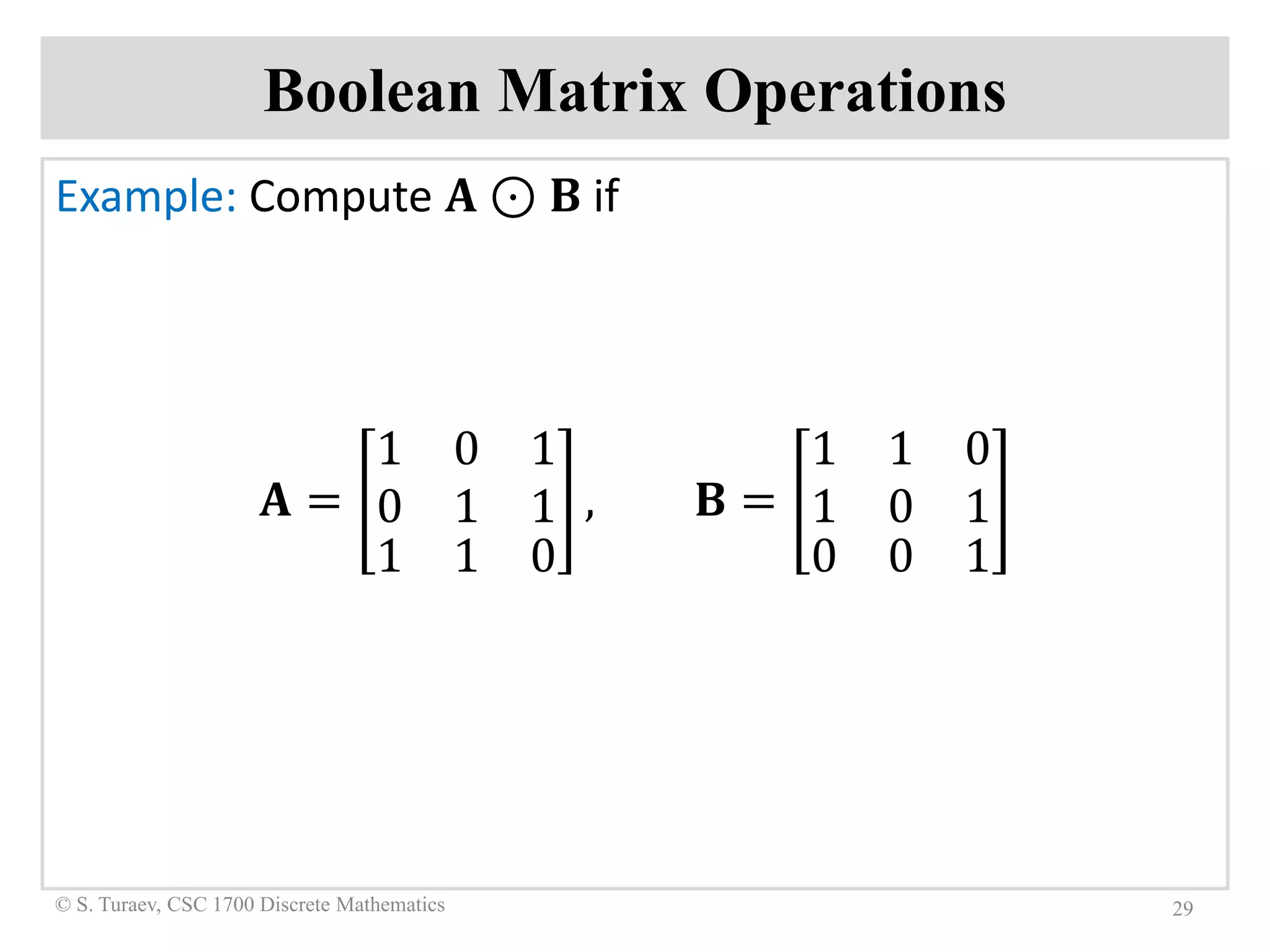
Boolean Matrix Operations
Example: Compute 𝐀𝐀 ⊙ 𝐁𝐁 if
𝐀𝐀 =
1 0 1
0 1 1
1 1 0
, 𝐁𝐁 =
1 1 0
1 0 1
0 0 1
29© S. Turaev, CSC 1700 Discrete Mathematics
Boolean Matrix Operations
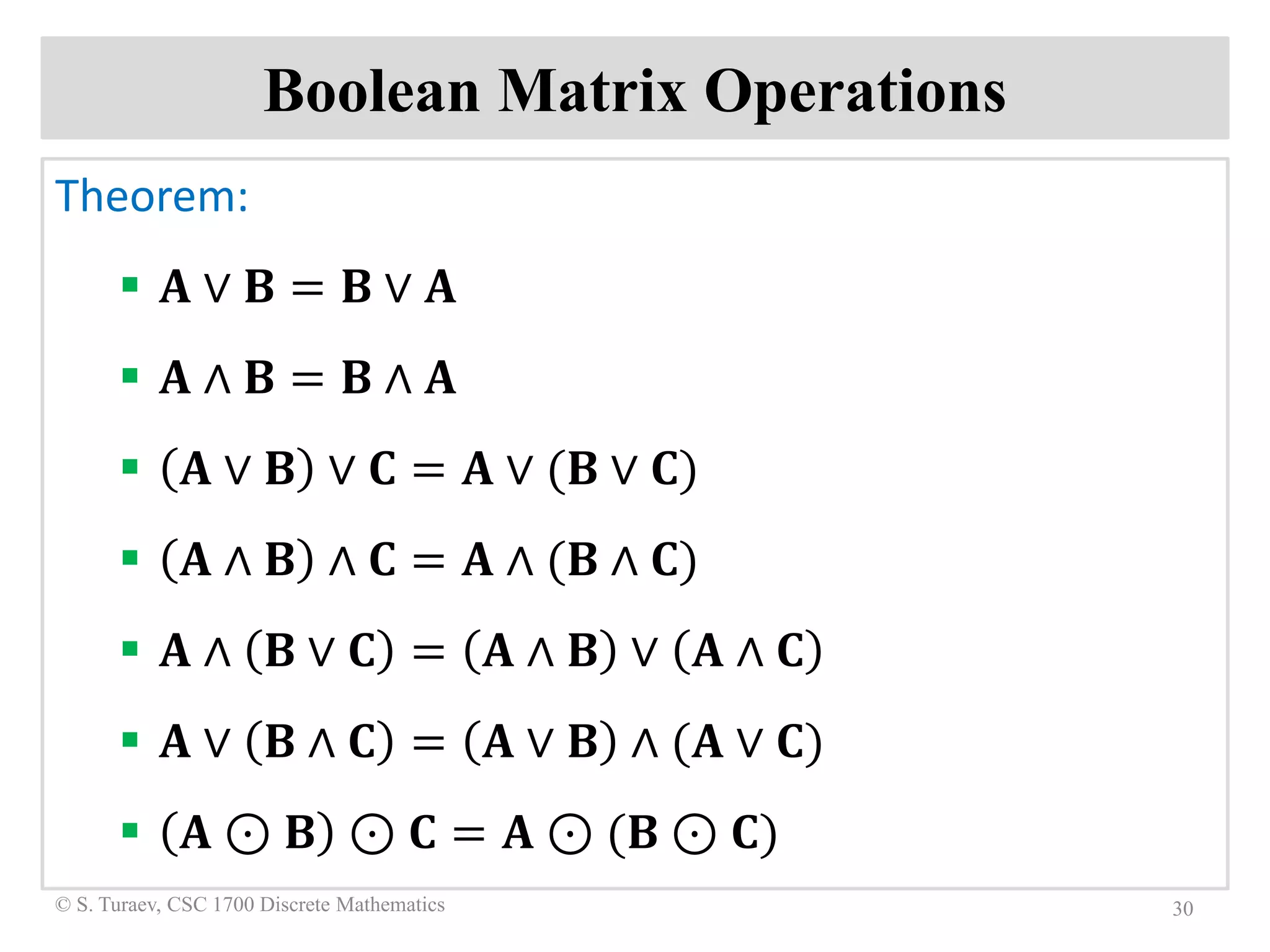
Theorem:
 𝐀𝐀 ∨ 𝐁𝐁 = 𝐁𝐁 ∨ 𝐀𝐀
 𝐀𝐀 ∧ 𝐁𝐁 = 𝐁𝐁 ∧ 𝐀𝐀
 𝐀𝐀 ∨ 𝐁𝐁 ∨ 𝐂𝐂 = 𝐀𝐀 ∨ (𝐁𝐁 ∨ 𝐂𝐂)
 𝐀𝐀 ∧ 𝐁𝐁 ∧ 𝐂𝐂 = 𝐀𝐀 ∧ (𝐁𝐁 ∧ 𝐂𝐂)
 𝐀𝐀 ∧ 𝐁𝐁 ∨ 𝐂𝐂 = 𝐀𝐀 ∧ 𝐁𝐁 ∨ 𝐀𝐀 ∧ 𝐂𝐂
 𝐀𝐀 ∨ 𝐁𝐁 ∧ 𝐂𝐂 = 𝐀𝐀 ∨ 𝐁𝐁 ∧ (𝐀𝐀 ∨ 𝐂𝐂)
 𝐀𝐀 ⊙ 𝐁𝐁 ⊙ 𝐂𝐂 = 𝐀𝐀 ⊙ (𝐁𝐁 ⊙ 𝐂𝐂)
30© S. Turaev, CSC 1700 Discrete Mathematics

Integers and matrices (slides)

  • 1.
  • 2.
    Properties of Integers Theorem:If 𝑛𝑛 and 𝑚𝑚 are integers and 𝑛𝑛 > 0, we can uniquely write 𝑚𝑚 = 𝑞𝑞 ⋅ 𝑛𝑛 + 𝑟𝑟 for integers 𝑞𝑞 and 𝑟𝑟 with 0 ≤ 𝑟𝑟 < 𝑛𝑛. 𝑟𝑟 = 𝑚𝑚 mod 𝑛𝑛 Example:  𝑛𝑛 = 3, 𝑚𝑚 = 16: 16 = 5 ⋅ 3 + 1  𝑛𝑛 = 10, 𝑚𝑚 = 3: 3 = 0 ⋅ 10 + 3  𝑛𝑛 = 5, 𝑚𝑚 = −11: −11 = (−3) ⋅ 5 + 4  𝑛𝑛 = 5, 𝑚𝑚 = 10: 10 = 2 ⋅ 5 + 0 2© S. Turaev, CSC 1700 Discrete Mathematics
  • 3.
    Properties of Integers If 𝑟𝑟 = 0, then 𝑚𝑚 = 𝑞𝑞 ⋅ 𝑛𝑛, i.e., 𝑚𝑚 is a multiple of 𝑛𝑛. We write 𝑛𝑛|𝑚𝑚.  If 𝑟𝑟 ≠ 0, then 𝑚𝑚 is not a multiple of 𝑛𝑛. We write 𝑛𝑛 ∤ 𝑚𝑚. Theorem:  If 𝑎𝑎|𝑏𝑏 and 𝑎𝑎|𝑐𝑐, then 𝑎𝑎|(𝑏𝑏 + 𝑐𝑐).  If 𝑎𝑎|𝑏𝑏 and 𝑎𝑎|𝑐𝑐, then 𝑎𝑎|(𝑏𝑏 − 𝑐𝑐).  If 𝑎𝑎|𝑏𝑏 and 𝑎𝑎|𝑐𝑐, then 𝑎𝑎|(𝑏𝑏𝑏𝑏).  If 𝑎𝑎|𝑏𝑏 and 𝑏𝑏|𝑐𝑐, then 𝑎𝑎|𝑐𝑐. 3© S. Turaev, CSC 1700 Discrete Mathematics
  • 4.
    Prime Numbers Definition: Apositive integer 𝑝𝑝 > 1 is called prime, if the only positive integers that divide 𝑝𝑝 are 𝑝𝑝 and 1. Example: 2, 3, 5, 7, 11, 13, … are prime. 4© S. Turaev, CSC 1700 Discrete Mathematics Is 1 prime?
  • 5.
    Prime Numbers Algorithm fordetermining if an integer 𝑛𝑛 > 1 is prime: Step 1: Check if 𝑛𝑛 is 2. if so, 𝑛𝑛 is prime. If not, proceed to Step 2: Check if 2|𝑛𝑛. if so, 𝑛𝑛 isn’t prime. If not, proceed to Step 3: Compute the largest integer 𝑘𝑘 ≤ 𝑛𝑛; proceed to Step 4: Check if 𝑑𝑑|𝑛𝑛 where 𝑑𝑑 is any odd number in (1, 𝑘𝑘]. If 𝑑𝑑|𝑛𝑛, then 𝑛𝑛 isn’t prime; otherwise it is prime. 5© S. Turaev, CSC 1700 Discrete Mathematics
  • 6.
    Prime Factorization Theorem: Everypositive integer 𝑛𝑛 > 1 can be written uniquely as 𝑛𝑛 = 𝑝𝑝1 𝑘𝑘1 𝑝𝑝2 𝑘𝑘2 ⋯ 𝑝𝑝𝑠𝑠 𝑘𝑘𝑠𝑠 where  𝑝𝑝1 < 𝑝𝑝2 < ⋯ < 𝑝𝑝𝑠𝑠 are distinct prime numbers that divide 𝑛𝑛,  the 𝑘𝑘’s are positive integers giving the number of times each prime occurs as a factor of 𝑛𝑛. Example: 9 = 3 ⋅ 3 = 32, 36 =, 100 = 6© S. Turaev, CSC 1700 Discrete Mathematics
  • 7.
    Greatest Common Divisor Definition: If 𝑎𝑎, 𝑏𝑏 and 𝑘𝑘 are in ℤ+, and 𝑘𝑘|𝑎𝑎 and 𝑘𝑘|𝑏𝑏, we say that 𝑘𝑘 is a common divisor of 𝑎𝑎 and 𝑏𝑏.  If 𝑑𝑑 is the largest such 𝑘𝑘, 𝑑𝑑 is called the greatest common divisor of 𝑎𝑎 and 𝑏𝑏, and we write 𝑑𝑑 = gcd(𝑎𝑎, 𝑏𝑏). Example:  the common divisors of 12 and 30: 1, 2, 3, 6. gcd 12,30 = 6  gcd 17,95 = 1 (relatively prime numbers) 7© S. Turaev, CSC 1700 Discrete Mathematics
  • 8.
    Euclidean Algorithm  Suppose𝑎𝑎 > 𝑏𝑏 > 0. We can write 𝑎𝑎 = 𝑘𝑘𝑘𝑘 + 𝑟𝑟 where 𝑘𝑘 ∈ ℤ+ and 0 ≤ 𝑟𝑟 < 𝑏𝑏.  If a number 𝑛𝑛 divides 𝑎𝑎 and 𝑏𝑏, then it must divide 𝑟𝑟, since 𝑟𝑟 = 𝑎𝑎 − 𝑘𝑘𝑘𝑘. Thus, gcd 𝑎𝑎, 𝑏𝑏 = gcd(𝑏𝑏, 𝑎𝑎 mod 𝑏𝑏) 8© S. Turaev, CSC 1700 Discrete Mathematics
  • 9.
    Euclidean Algorithm gcd 𝑎𝑎,𝑏𝑏 = gcd(𝑏𝑏, 𝑎𝑎 mod 𝑏𝑏) divide 𝑎𝑎 by 𝑏𝑏: 𝑎𝑎 = 𝑘𝑘1 𝑏𝑏 + 𝑟𝑟1 0 ≤ 𝑟𝑟1 < 𝑏𝑏 divide 𝑏𝑏 by 𝑟𝑟1: 𝑏𝑏 = 𝑘𝑘2 𝑟𝑟1 + 𝑟𝑟2 0 ≤ 𝑟𝑟2 < 𝑟𝑟1 divide 𝑟𝑟1 by 𝑟𝑟2: 𝑟𝑟1 = 𝑘𝑘3 𝑟𝑟2 + 𝑟𝑟3 0 ≤ 𝑟𝑟3 < 𝑟𝑟2 … divide 𝑟𝑟𝑛𝑛−2 by 𝑟𝑟𝑛𝑛−1: 𝑟𝑟𝑛𝑛−2 = 𝑘𝑘𝑛𝑛 𝑟𝑟𝑛𝑛−1 + 𝑟𝑟𝑛𝑛 0 ≤ 𝑟𝑟𝑛𝑛 < 𝑟𝑟𝑛𝑛−1 divide 𝑟𝑟𝑛𝑛−1 by 𝑟𝑟𝑛𝑛: 𝑟𝑟𝑛𝑛−1 = 𝑘𝑘𝑛𝑛+1 𝑟𝑟𝑛𝑛 + 𝑟𝑟𝑛𝑛+1 0 ≤ 𝑟𝑟𝑛𝑛+1 < 𝑟𝑟𝑛𝑛 𝑎𝑎 > 𝑏𝑏 > 𝑟𝑟1 > 𝑟𝑟2 > 𝑟𝑟3 > ⋯ 9© S. Turaev, CSC 1700 Discrete Mathematics
  • 10.
    Euclidean Algorithm gcd 𝑎𝑎,𝑏𝑏 = gcd(𝑏𝑏, 𝑎𝑎 mod 𝑏𝑏) 𝑎𝑎 > 𝑏𝑏 > 𝑟𝑟1 > 𝑟𝑟2 > 𝑟𝑟3 > ⋯ > 𝑟𝑟𝑛𝑛+1 = 0 𝑟𝑟𝑛𝑛−1 = 𝑘𝑘𝑛𝑛+1 𝑟𝑟𝑛𝑛 : 𝑟𝑟𝑛𝑛 𝑟𝑟𝑛𝑛−1, 𝑟𝑟𝑛𝑛 𝑟𝑟𝑛𝑛−2, … , 𝑟𝑟𝑛𝑛 𝑟𝑟2, 𝑟𝑟𝑛𝑛 𝑟𝑟1, 𝑟𝑟𝑛𝑛|𝑏𝑏, 𝑟𝑟𝑛𝑛|𝑎𝑎 gcd 𝑎𝑎, 𝑏𝑏 = gcd 𝑏𝑏, 𝑟𝑟1 = gcd 𝑟𝑟1, 𝑟𝑟2 = ⋯ = gcd 𝑟𝑟𝑛𝑛−1, 𝑟𝑟𝑛𝑛 = 𝑟𝑟𝑛𝑛 Example: Compute gcd(123, 36) 10© S. Turaev, CSC 1700 Discrete Mathematics
  • 11.
    Least Common Multiple Definition: If 𝑎𝑎, 𝑏𝑏 and 𝑘𝑘 are in ℤ+, and 𝑎𝑎|𝑘𝑘 and 𝑏𝑏|𝑘𝑘, we say that 𝑘𝑘 is a common multiple of 𝑎𝑎 and 𝑏𝑏.  If 𝑐𝑐 is the smallest such 𝑘𝑘, 𝑐𝑐 is called the least common multiple of 𝑎𝑎 and 𝑏𝑏, and we write 𝑐𝑐 = lcm(𝑎𝑎, 𝑏𝑏). Example:  the common multiples of 2 and 3: 6, 12, 18, 24, … lcm 2,3 = 6. 11© S. Turaev, CSC 1700 Discrete Mathematics
  • 12.
    Least Common Multiple Theorem:if 𝑎𝑎, 𝑏𝑏 ∈ ℤ+, then gcd(𝑎𝑎, 𝑏𝑏) ⋅ lcm 𝑎𝑎, 𝑏𝑏 = 𝑎𝑎 ⋅ 𝑏𝑏. Proof: Use prime factorizations of 𝑎𝑎 and 𝑏𝑏. Example: Let 𝑎𝑎 = 540 and 𝑏𝑏 = 504. Find gcd and lcm. 12© S. Turaev, CSC 1700 Discrete Mathematics
  • 13.
    Exercises • Write 𝑚𝑚as 𝑞𝑞𝑞𝑞 + 𝑟𝑟, with 0 ≤ 𝑟𝑟 < 𝑛𝑛: 1. 𝑚𝑚 = 20, 𝑛𝑛 = 3 2. 𝑚𝑚 = 64, 𝑛𝑛 = 37 3. 𝑚𝑚 = 3, 𝑛𝑛 = 12 • Write each integer as a product of powers of primes: 828, 1666, 1781 • Find the gcd(𝑎𝑎, 𝑏𝑏) and lcm(𝑎𝑎, 𝑏𝑏): 1. 𝑎𝑎 = 60, 𝑏𝑏 = 100 2. 𝑎𝑎 = 77, 𝑏𝑏 = 128 13© S. Turaev, CSC 1700 Discrete Mathematics
  • 14.
    Representation of Integers(Reading) • 3245 means the sum of 3 times 103, 2 times 102, 4 times 10 and 5: 3245 = 3 ⋅ 103 + 2 ⋅ 102 + 4 ⋅ 10 + 5 ⋅ 100 • The base 10 expansion or decimal expansion of 3245 • 10 is called the base of the expansion. Example: 56893 = 14© S. Turaev, CSC 1700 Discrete Mathematics
  • 15.
    Representation of Integers(Reading) Theorem: if 𝑏𝑏 ∈ ℤ+, then every positive integer 𝑛𝑛 can be uniquely expressed in the form 𝑛𝑛 = 𝑑𝑑𝑘𝑘 ⋅ 𝑏𝑏𝑘𝑘 + 𝑑𝑑𝑘𝑘−1 ⋅ 𝑏𝑏𝑘𝑘−1 + ⋯ 𝑑𝑑1 ⋅ 𝑏𝑏 + 𝑑𝑑0 where 0 ≤ 𝑑𝑑𝑖𝑖 < 𝑏𝑏, 𝑖𝑖 = 1,2, … , 𝑘𝑘, and 𝑑𝑑𝑘𝑘 ≠ 0. The sequence 𝑑𝑑𝑘𝑘 𝑑𝑑𝑘𝑘−1 ⋯ 𝑑𝑑1 𝑑𝑑0 (more explicitly, 𝑑𝑑𝑘𝑘 𝑑𝑑𝑘𝑘−1 ⋯ 𝑑𝑑1 𝑑𝑑0 𝑏𝑏) is called the base 𝑏𝑏 expansion of 𝑛𝑛. Example: Find the base 2, 3, 4 representations of 173. Example: Find the decimal expansion of 100111 2. 15© S. Turaev, CSC 1700 Discrete Mathematics
  • 16.
    Matrices Definition: A matrixis a rectangular array of numbers in 𝑚𝑚 horizontal rows and 𝑛𝑛 vertical columns: 𝐀𝐀 = 𝑎𝑎11 𝑎𝑎12 𝑎𝑎21 𝑎𝑎22 ⋯ 𝑎𝑎1𝑛𝑛 𝑎𝑎2𝑛𝑛 ⋮ ⋮ 𝑎𝑎 𝑚𝑚1 𝑎𝑎 𝑚𝑚𝑚 ⋯ 𝑎𝑎 𝑚𝑚𝑚𝑚 Definition: The 𝑖𝑖th row of 𝐀𝐀 is [𝑎𝑎𝑖𝑖 𝑖 𝑎𝑎𝑖𝑖 𝑖 ⋯ 𝑎𝑎𝑖𝑖 𝑖𝑖], 1 ≤ 𝑖𝑖 ≤ 𝑚𝑚, and the 𝑗𝑗th column of 𝐀𝐀 is 𝑎𝑎1𝑗𝑗 𝑎𝑎2𝑗𝑗 ⋮ 𝑎𝑎𝑛𝑛𝑛𝑛 , 1 ≤ 𝑗𝑗 ≤ 𝑛𝑛. 16© S. Turaev, CSC 1700 Discrete Mathematics
  • 17.
    Matrices Definition: We saythat 𝐀𝐀 is 𝑚𝑚 by 𝑛𝑛, written 𝑚𝑚 × 𝑛𝑛. If 𝑚𝑚 = 𝑛𝑛, we say 𝐀𝐀 is a square matrix of order 𝑛𝑛. The elements 𝑎𝑎11, 𝑎𝑎22, … , 𝑎𝑎𝑛𝑛𝑛𝑛 form main diagonal of 𝐀𝐀. Definition: We refer to the element 𝑎𝑎𝑖𝑖𝑖𝑖 in the 𝑖𝑖th row and 𝑗𝑗th column of 𝐀𝐀 as the (𝑖𝑖, 𝑗𝑗) entry of 𝐀𝐀. We denote the matrix 𝐀𝐀 by [𝑎𝑎𝑖𝑖𝑖𝑖], for short. Example: 𝐀𝐀 = 2 3 5 0 −1 2 , 𝐁𝐁 = 2 6 3 6 , 𝐂𝐂 = 1 0 0 , 𝐃𝐃 = 1 1 1 17© S. Turaev, CSC 1700 Discrete Mathematics
  • 18.
    Matrices Definition: A squarematrix 𝐀𝐀 = [𝑎𝑎𝑖𝑖𝑖𝑖] is called a diagonal matrix if 𝑎𝑎𝑖𝑖𝑖𝑖 = 0 for all 𝑖𝑖 ≠ 𝑗𝑗. Example: 𝐅𝐅 = 2 0 0 6 , 𝐆𝐆 = 1 0 0 0 3 0 0 0 −3 , 𝐇𝐇 = 0 0 0 0 3 0 0 0 0 Definition: A 𝑚𝑚 × 𝑛𝑛 matrix 𝐀𝐀 = [𝑎𝑎𝑖𝑖𝑖𝑖] is called zero matrix, denoted by 𝟎𝟎, if 𝑎𝑎𝑖𝑖𝑖𝑖 = 0 for all 1 ≤ 𝑖𝑖 ≤ 𝑚𝑚, 1 ≤ 𝑗𝑗 ≤ 𝑛𝑛. 18© S. Turaev, CSC 1700 Discrete Mathematics
  • 19.
    Matrices Definition: Two 𝑚𝑚× 𝑛𝑛 matrices 𝐀𝐀 = [𝑎𝑎𝑖𝑖𝑖𝑖] and 𝐁𝐁 = [𝑏𝑏𝑖𝑖𝑖𝑖] are said to be equal if 𝑎𝑎𝑖𝑖𝑖𝑖 = 𝑏𝑏𝑖𝑖𝑖𝑖 for all 𝑖𝑖 and 𝑗𝑗. Definition: If 𝐀𝐀 = [𝑎𝑎𝑖𝑖𝑖𝑖] and 𝐁𝐁 = [𝑏𝑏𝑖𝑖𝑖𝑖] are 𝑚𝑚 × 𝑛𝑛 matrices, then the sum of 𝐀𝐀 and 𝐁𝐁, denoted by 𝐀𝐀 + 𝐁𝐁, is the matrix 𝐂𝐂 = [𝑐𝑐𝑖𝑖𝑖𝑖] defined by 𝑐𝑐𝑖𝑖𝑖𝑖 = 𝑎𝑎𝑖𝑖𝑖𝑖 + 𝑏𝑏𝑖𝑖𝑖𝑖 for all 1 ≤ 𝑖𝑖 ≤ 𝑚𝑚, 1 ≤ 𝑗𝑗 ≤ 𝑛𝑛. Example: Find 𝐀𝐀+ 𝐁𝐁 if 𝐀𝐀 = 1 0 −8 3 3 0 −2 9 −3 , 𝐁𝐁 = 4 5 3 0 −3 2 5 0 −2 19© S. Turaev, CSC 1700 Discrete Mathematics
  • 20.
    Matrices Theorem:  𝐀𝐀 +𝐁𝐁 = 𝐁𝐁 + 𝐀𝐀  𝐀𝐀 + 𝐁𝐁 + 𝐂𝐂 = 𝐀𝐀 + (𝐁𝐁 + 𝐂𝐂)  𝐀𝐀 + 𝟎𝟎 = 𝟎𝟎 + 𝐀𝐀 = 𝐀𝐀 20© S. Turaev, CSC 1700 Discrete Mathematics
  • 21.
    Matrices Definition: If 𝐀𝐀= [𝑎𝑎𝑖𝑖𝑖𝑖] is 𝑚𝑚 × 𝑝𝑝 matrix and 𝐁𝐁 = [𝑏𝑏𝑖𝑖𝑖𝑖] are 𝑝𝑝 × 𝑛𝑛 matrix, then the product of 𝐀𝐀 and 𝐁𝐁, denotes by 𝐀𝐀𝐀𝐀 is the 𝑚𝑚 × 𝑛𝑛 matrix 𝐂𝐂 = [𝑐𝑐𝑖𝑖𝑖𝑖] defined by 𝑐𝑐𝑖𝑖𝑖𝑖 = 𝑎𝑎𝑖𝑖 𝑖 𝑏𝑏1𝑗𝑗 + 𝑎𝑎𝑖𝑖2 𝑏𝑏2𝑗𝑗 + ⋯ 𝑎𝑎𝑖𝑖 𝑝𝑝 𝑏𝑏𝑝𝑝𝑗𝑗 for all 1 ≤ 𝑖𝑖 ≤ 𝑚𝑚, 1 ≤ 𝑗𝑗 ≤ 𝑛𝑛. Example: Find 𝐀𝐀𝐁𝐁 if 𝐀𝐀 = 1 0 −8 3 3 0 −2 9 −3 , 𝐁𝐁 = 4 5 3 0 −3 2 5 0 −2 21© S. Turaev, CSC 1700 Discrete Mathematics
  • 22.
    Matrices Theorem:  𝐀𝐀(𝐁𝐁𝐁𝐁) =𝐀𝐀𝐀𝐀 𝐂𝐂  𝐀𝐀 𝐁𝐁 + 𝐂𝐂 = 𝐀𝐀𝐀𝐀 + 𝐀𝐀𝐀𝐀  𝐀𝐀 + 𝐁𝐁 𝐂𝐂 = 𝐀𝐀𝐀𝐀 + 𝐁𝐁𝐁𝐁 22© S. Turaev, CSC 1700 Discrete Mathematics
  • 23.
    Matrices Definition: A 𝑛𝑛× 𝑛𝑛 diagonal matrix: 𝐈𝐈𝑛𝑛 = 1 0 0 1 ⋯ 0 0 ⋮ ⋮ 0 0 ⋯ 1 is called the identity matrix of order 𝑛𝑛. Theorem: For any 𝑛𝑛 × 𝑛𝑛 matrix 𝐀𝐀 and positive integer 𝑝𝑝,  𝐈𝐈𝑛𝑛 𝐀𝐀 = 𝐀𝐀𝐈𝐈𝑛𝑛 = 𝐀𝐀  𝐀𝐀𝑝𝑝 = 𝐀𝐀 ⋅ 𝐀𝐀 ⋅ ⋯ ⋅ 𝐀𝐀 𝑝𝑝 , 𝐀𝐀0 = 𝐈𝐈𝑛𝑛. 23© S. Turaev, CSC 1700 Discrete Mathematics
  • 24.
    Matrices Definition: If 𝐀𝐀= [𝑎𝑎𝑖𝑖𝑖𝑖] is 𝑚𝑚 × 𝑛𝑛 matrix, then the 𝑛𝑛 × 𝑚𝑚 matrix 𝐀𝐀𝑇𝑇 = [𝑎𝑎𝑖𝑖𝑖𝑖 𝑇𝑇 ], where 𝑎𝑎𝑖𝑖𝑖𝑖 𝑇𝑇 = 𝑎𝑎𝑗𝑗𝑗𝑗, for all 1 ≤ 𝑖𝑖 ≤ 𝑚𝑚, 1 ≤ 𝑗𝑗 ≤ 𝑛𝑛, is called the transpose of 𝐀𝐀. Example: Find 𝐀𝐀𝑇𝑇 and 𝐁𝐁𝑇𝑇 if 𝐀𝐀 = 1 0 −8 3 3 0 −2 9 −3 , 𝐁𝐁 = 2 −3 5 6 1 3 24© S. Turaev, CSC 1700 Discrete Mathematics
  • 25.
    Matrices Theorem:  𝐀𝐀𝑇𝑇 𝑇𝑇 =𝐀𝐀  𝐀𝐀 + 𝐁𝐁 𝑇𝑇 = 𝐀𝐀𝑇𝑇 + 𝐁𝐁𝑇𝑇  𝐀𝐀𝐁𝐁 𝑇𝑇 = 𝐁𝐁𝑇𝑇 𝐀𝐀𝑇𝑇 Definition: A matrix 𝐀𝐀 = [𝑎𝑎𝑖𝑖𝑖𝑖] is called symmetric if 𝑨𝑨𝑇𝑇=𝐀𝐀. Definition: if 𝐀𝐀 and 𝐁𝐁 are 𝑛𝑛 × 𝑛𝑛 matrices, we say 𝐁𝐁 is the inverse of 𝐀𝐀 if 𝐀𝐀𝐁𝐁 = 𝐈𝐈𝑛𝑛. 25© S. Turaev, CSC 1700 Discrete Mathematics
  • 26.
    Boolean Matrix Operations Definition:A Boolean matrix is 𝑚𝑚 × 𝑛𝑛 matrix whose entries are either zero or one. Definition: Let 𝐀𝐀 = [𝑎𝑎𝑖𝑖𝑖𝑖] and 𝐁𝐁 = [𝑏𝑏𝑖𝑖𝑖𝑖] be 𝑚𝑚 × 𝑛𝑛 Boolean matrices. We define 𝐀𝐀 ∨ 𝐁𝐁 = 𝐂𝐂 = [𝑐𝑐𝑖𝑖𝑖𝑖], the join of 𝐀𝐀 and 𝐁𝐁, by 𝑐𝑐𝑖𝑖𝑖𝑖 = 1 if 𝑎𝑎𝑖𝑖𝑖𝑖 = 1 or 𝑏𝑏𝑖𝑖𝑖𝑖 = 1, 𝑐𝑐𝑖𝑖𝑖𝑖 = 0 if 𝑎𝑎𝑖𝑖𝑖𝑖 = 𝑏𝑏𝑖𝑖𝑖𝑖 = 0, and the meet of 𝐀𝐀 and 𝐁𝐁, by 𝑐𝑐𝑖𝑖𝑖𝑖 = 1 if 𝑎𝑎𝑖𝑖𝑖𝑖 = 𝑏𝑏𝑖𝑖𝑖𝑖 = 1, 𝑐𝑐𝑖𝑖𝑖𝑖 = 0 if 𝑎𝑎𝑖𝑖𝑖𝑖 = 0 or 𝑏𝑏𝑖𝑖𝑖𝑖 = 0. 26© S. Turaev, CSC 1700 Discrete Mathematics
  • 27.
    Boolean Matrix Operations Example:Compute 𝐀𝐀 ∨ 𝐁𝐁 and 𝐀𝐀 ∧ 𝐁𝐁 if 𝐀𝐀 = 1 0 1 0 1 1 1 1 0 0 0 0 , 𝐁𝐁 = 1 1 0 1 0 1 0 0 1 1 1 0 27© S. Turaev, CSC 1700 Discrete Mathematics
  • 28.
    Boolean Matrix Operations Definition:Let 𝐀𝐀 = [𝑎𝑎𝑖𝑖𝑖𝑖] be an 𝑚𝑚 × 𝑝𝑝 Boolean matrix and 𝐁𝐁 = [𝑏𝑏𝑖𝑖𝑖𝑖] be a 𝑝𝑝 × 𝑛𝑛 Boolean matrix. The Boolean product of 𝐀𝐀 and 𝐁𝐁, denoted by 𝐀𝐀 ⊙ 𝐁𝐁, is the 𝑚𝑚 × 𝑛𝑛 matrix 𝐂𝐂 = [𝑐𝑐𝑖𝑖𝑖𝑖] defined by  𝑐𝑐𝑖𝑖𝑖𝑖 = 1 if 𝑎𝑎𝑖𝑖𝑖𝑖 = 1 and 𝑏𝑏𝑖𝑖𝑖𝑖 = 1, for some 1 ≤ 𝑘𝑘 ≤ 𝑝𝑝,  𝑐𝑐𝑖𝑖𝑖𝑖 = 0 otherwise. 28© S. Turaev, CSC 1700 Discrete Mathematics
  • 29.
    Boolean Matrix Operations Example:Compute 𝐀𝐀 ⊙ 𝐁𝐁 if 𝐀𝐀 = 1 0 1 0 1 1 1 1 0 , 𝐁𝐁 = 1 1 0 1 0 1 0 0 1 29© S. Turaev, CSC 1700 Discrete Mathematics
  • 30.
    Boolean Matrix Operations Theorem: 𝐀𝐀 ∨ 𝐁𝐁 = 𝐁𝐁 ∨ 𝐀𝐀  𝐀𝐀 ∧ 𝐁𝐁 = 𝐁𝐁 ∧ 𝐀𝐀  𝐀𝐀 ∨ 𝐁𝐁 ∨ 𝐂𝐂 = 𝐀𝐀 ∨ (𝐁𝐁 ∨ 𝐂𝐂)  𝐀𝐀 ∧ 𝐁𝐁 ∧ 𝐂𝐂 = 𝐀𝐀 ∧ (𝐁𝐁 ∧ 𝐂𝐂)  𝐀𝐀 ∧ 𝐁𝐁 ∨ 𝐂𝐂 = 𝐀𝐀 ∧ 𝐁𝐁 ∨ 𝐀𝐀 ∧ 𝐂𝐂  𝐀𝐀 ∨ 𝐁𝐁 ∧ 𝐂𝐂 = 𝐀𝐀 ∨ 𝐁𝐁 ∧ (𝐀𝐀 ∨ 𝐂𝐂)  𝐀𝐀 ⊙ 𝐁𝐁 ⊙ 𝐂𝐂 = 𝐀𝐀 ⊙ (𝐁𝐁 ⊙ 𝐂𝐂) 30© S. Turaev, CSC 1700 Discrete Mathematics