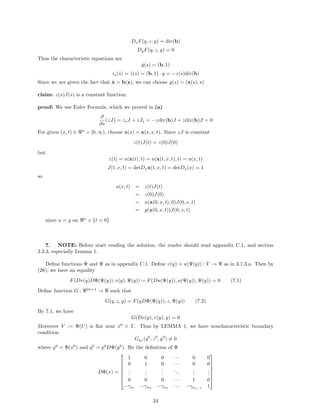
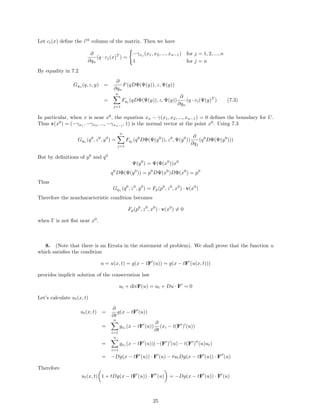
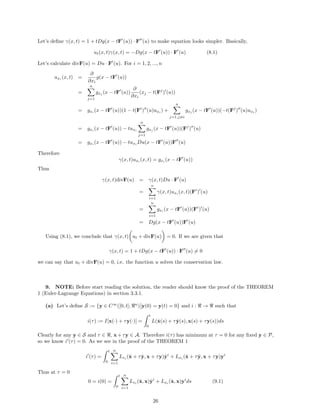
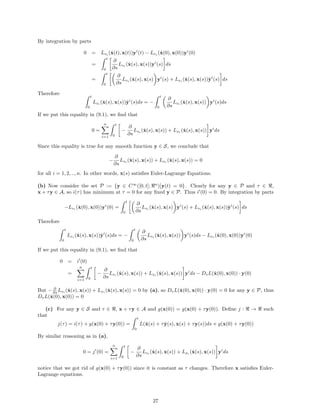
Evans PDE Solutions for Ch2 and Ch3
Osman Akar
July 2016
This document is written for the book ”Partial Differential Equations” by Lawrence C. Evans (Second
Edition). The document prepared under UCLA 2016 Pure REU Program.
SOLUTIONS OF CHAPTER 2
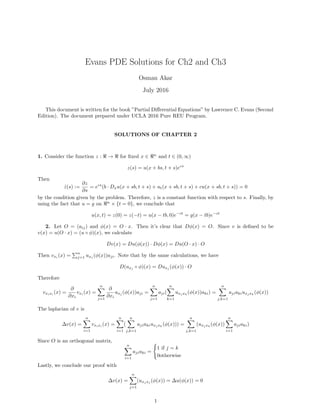
1. Consider the function z : < → < for fixed x ∈ <n
and t ∈ (0, ∞)
z(s) = u(x + bs, t + s)ecs
Then
ż(s) :=
∂z
∂s
= ecs
(b · Dxu(x + sb, t + s) + ut(x + sb, t + s) + cu(x + sb, t + s)) = 0
by the condition given by the problem. Therefore, z is a constant function with respect to s. Finally, by
using the fact that u = g on <n
× {t = 0}, we conclude that
u(x, t) = z(0) = z(−t) = u(x − tb, 0)e−ct
= g(x − tb)e−ct
2. Let O = (aij) and φ(x) = O · x. Then it’s clear that Dφ(x) = O. Since v is defined to be
v(x) = u(O · x) = (u ◦ φ)(x), we calculate
Dv(x) = Du(φ(x)) · Dφ(x) = Du(O · x) · O
Then vxi
(x) =
Pn
j=1 uxj
(φ(x))aji. Note that by the same calculations, we have
D(uxj ◦ φ)(x) = Duxj (φ(x)) · O
Therefore
vxixi
(x) =
∂
∂xi
vxi
(x) =
n
X
j=1
∂
∂xi
uxj
(φ(x))aji =
n
X
j=1
aji(
n
X
k=1
uxj xk
(φ(x))aki) =
n
X
j,k=1
ajiakiuxj xk
(φ(x))
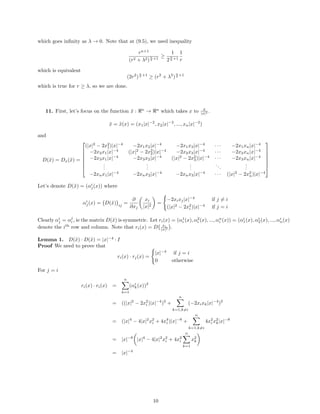
The laplacian of v is
∆v(x) =
n
X
i=1
vxixi
(x) =
n
X
i=1
(
n
X
j,k=1
ajiakiuxj xk
(φ(x))) =
n
X
j,k=1
(uxj xk
(φ(x))
n
X
i=1
ajiaki)
Since O is an orthogonal matrix,
n
X
i=1
ajiaki =
(
1 if j = k
0otherwise
Lastly, we conclude our proof with
∆v(x) =
n
X
j=1
(uxj xj
(φ(x)) = ∆u(φ(x)) = 0
1
since u is harmonic.
3. We’ll modify the mean value property for harmonic functions. It is assumed that the reader know
the proof of the mean value property(Check Evans PDE 2.2.2, Mean Value Formulas). As in the proof
in the book, define
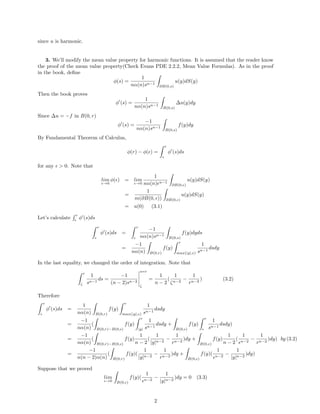
φ(s) =
1
nα(n)sn−1
Z
∂B(0,s)
u(y)dS(y)
Then the book proves
φ0
(s) =
1
nα(n)sn−1
Z
B(0,s)
∆u(y)dy
Since ∆u = −f in B(0, r)
φ0
(s) =
−1
nα(n)sn−1
Z
B(0,s)
f(y)dy
By Fundamental Theorem of Calculus,
φ(r) − φ() =
Z r

φ0
(s)ds
for any   0. Note that
lim
→0
φ() = lim
→0
1
nα(n)n−1
Z
∂B(0,)
u(y)dS(y)
=
1
m(∂B(0, ))
Z
∂B(0,)
u(y)dS(y)
= u(0) (3.1)
Let’s calculate
R r

φ0
(s)ds
Z r

φ0
(s)ds =
Z r

−1
nα(n)sn−1
Z
B(0,s)
f(y)dyds
=
−1
nα(n)
Z
B(0,r)
f(y)
Z r
max(|y|,)
1
sn−1
dsdy
In the last equality, we changed the order of integration. Note that
Z r
ζ
1
sn−1
ds =
−1
(n − 2)sn−2
s=r
ζ
=
1
n − 2
(
1
ζn−2
−
1
rn−2
) (3.2)
Therefore
Z r

φ0
(s)ds =
1
nα(n)
Z
B(0,r)
f(y)
Z r
max(|y|,)
1
sn−1
dsdy
=
−1
nα(n)
(
Z
B(0,r)−B(0,)
f(y)
Z r
|y|
1
sn−1
dsdy +
Z
B(0,)
f(y)
Z r

1
sn−1
dsdy)
=
−1
nα(n)
(
Z
B(0,r)−B(0,)
f(y)
1
n − 2
(
1
|y|n−2
−
1
rn−2
)dy +
Z
B(0,)
f(y)
1
n − 2
(
1
n−2
−
1
rn−2
)dy) by (3.2)
=
−1
n(n − 2)α(n)
(
Z
B(0,r)
f(y)(
1
|y|n−2
−
1
rn−2
)dy +
Z
B(0,)
f(y)(
1
n−2
−
1
|y|n−2
)dy)
Suppose that we proved
lim
→0
Z
B(0,)
f(y)(
1
n−2
−
1
|y|n−2
)dy = 0 (3.3)
2
Then
φ(r) − u(0) = lim
→0
φ(r) − φ() by (3.1)
= lim
→0
Z r

φ0
(s)ds
= lim
→0
−1
n(n − 2)α(n)
(
Z
B(0,r)
f(y)(
1
|y|n−2
−
1
rn−2
)dy +
Z
B(0,)
f(y)(
1
n−2
−
1
|y|n−2
)dy)
=
−1
n(n − 2)α(n)
Z
B(0,r)
f(y)(
1
|y|n−2
−
1
rn−2
)dy
Therefore
u(0) = φ(r) +
1
n(n − 2)α(n)
Z
B(0,r)
f(y)(
1
|y|n−2
−
1
rn−2
)dy
=
1
nα(n)rn−1
Z
∂B(0,r)
u(y)dS(y) +
1
n(n − 2)α(n)
Z
B(0,r)
f(y)(
1
|y|n−2
−
1
rn−2
)dy
But u = g on ∂B(0, r), so the equality holds. So we only need to prove (3.3)
lim
→0
Z
B(0,)
f(y)(
1
n−2
−
1
|y|n−2
)dy = lim
→0
1
n−2
Z
B(0,)
f(y)dy − lim
→0
Z
B(0,)
f(y)
|y|n−2
But
lim
→0
1
n−2
Z
B(0,)
f(y)dy = lim
→0
nα(n)2 1
m(B(0, ))
Z
B(0,)
f(y)dy
= lim
→0
nα(n)2
f(0)
= 0
and
lim
→0
Z
B(0,)
f(y)
|y|n−2
= lim
→0
Z 
0
Z
∂B(0,t)
f(y)
|y|n−2
dS(y)dt
= lim
→0
Z 
0
1
tn−2
Z
∂B(0,t)
f(y)dS(y)dt
= lim
→0
Z 
0
nα(n)t
1
m(∂B(0, t))
Z
∂B(0,t)
f(y)dS(y)dt
= lim
→0
Z 
0
nα(n)tf(0)dt
= lim
→0
nα(n)f(0)
2
2
= 0
Therefore
lim
→0
Z
B(0,)
f(y)(
1
n−2
−
1
|y|n−2
)dy = 0
so we are done.
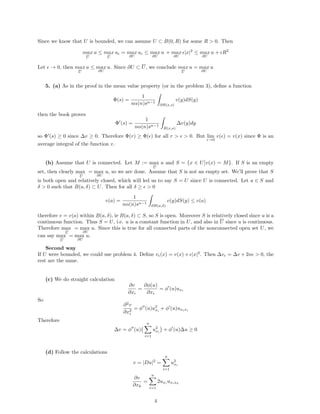
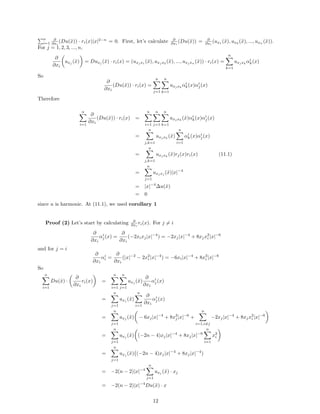
4. First note that U and ∂U is compact, since U is bounded and open. So max u = sup u on
both U and ∂U. Define u := u + |x|2
for each   0. Then for x ∈ U, ∂u
∂xi
= uxi
+ 2xi, so
∆u = ∆u + 2n = 2n  0 since u is harmonic and   0. But tr(Hess(u)) = ∆u(x)  0,
so Hess(u)(x) is cannot be negative definite matrix. Therefore, x cannot be local maximum of the
function u, so u cannot attain its max within U. Therefore, we conclude that
max
U
u = max
∂U
u
3
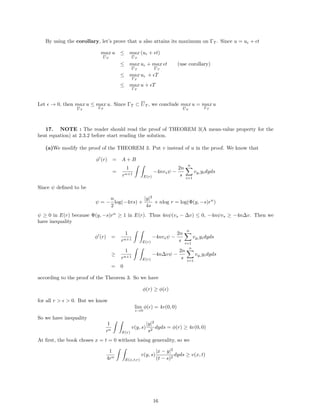
Since we know that U is bounded, we can assume U ⊂ B(0, R) for some R  0. Then
max
U
u ≤ max
U
u = max
∂U
u ≤ max
∂U
u + max
∂U
|x|2
≤ max
∂U
u + R2
Let  → 0, then max
U
u ≤ max
∂U
u. Since ∂U ⊂ U, we conclude max
U
u = max
∂U
u
5. (a) As in the proof in the mean value property (or in the problem 3), define a function
Φ(s) =
1
nα(n)sn−1
Z
∂B(x,s)
v(y)dS(y)
then the book proves
Φ0
(s) =
1
nα(n)sn−1
Z
B(x,s)
∆v(y)dy
so Φ0
(s) ≥ 0 since ∆v ≥ 0. Therefore Φ(r) ≥ Φ() for all r    0. But lim
→0
v() = v(x) since Φ is an
average integral of the function v.
(b) Assume that U is connected. Let M := max
U
u and S = {x ∈ U
v(x) = M}. If S is an empty
set, then clearly max
U
= max
∂U
u, so we are done. Assume that S is not an empty set. We’ll prove that S
is both open and relatively closed, which will led us to say S = U since U is connected. Let a ∈ S and
δ  0 such that B(a, δ) ⊂ U. Then for all δ ≥   0
v(a) =
1
nα(n)sn−1
Z
∂B(a,δ)
v(y)dS(y) ≤ v(a)
therefore v = v(a) within B(a, δ), ie B(a, δ) ⊂ S, so S is open. Moreover S is relatively closed since u is a
continuous function. Thus S = U, i.e. u is a constant function in U, and also in U since u is continuous.
Therefore max
U
= max
∂U
u. Since this is true for all connected parts of the nonconnected open set U, we
can say max
U
= max
∂U
u.
Second way
If U were bounded, we could use problem 4. Define v(x) = v(x) + |x|2
. Then ∆v = ∆v + 2n  0, the
rest are the same.
(c) We do straight calculation
∂v
∂xi
=
∂φ(u)
∂xi
= φ0
(u)uxi
So
∂2
v
∂x2
i
= φ00
(u)u2
xi
+ φ0
(u)uxixi
Therefore
∆v = φ00
(u)
n
X
i=1
u2
xi

+ φ0
(u)∆u ≥ 0
(d) Follow the calculations
v = |Du|2
=
n
X
i=1
u2
xi
∂v
∂xk
=
n
X
i=1
2uxi
uxixk
4
∂2
v
∂x2
k
= 2
n
X
i=1
u2
xixk
+ uxixkxk
∆v = 2
n
X
i,k=1
u2
xixk
+
n
X
i=1
∆uxi
≥
n
X
i=1
∆uxi
Since u is harmonic, uxi is harmonic for all i = 1, 2, ..., n. Thus ∆v ≥
Pn
i=1 ∆uxi = 0
6. Since U is bounded, we can assume that U ⊂ B(0, R) for some fixed R  0. Choose C such that
C  max(1, R2
2n ). Let’s define λ := max
U
|f| (??? can we, can f be extended continuously over U) Since
∆(u + λ|x|2
2n ) = ∆u + n2λ
2n ≥ 0 u + λ|x|2
2n is subharmonic. By the problem 5
max
U
(u + λ
|x|2
2n
) = max
∂U
(u + λ
|x|2
2n
)
≤ max
∂U
|u| + λ
R2
2n
≤ max
∂U
|g| +
R2
2n
max
U
|f|
≤ C(max
∂U
|g| + max
U
|f|)
7. We are assuming that u is harmonic in an open set U satisfying B(0, r) ⊂ U ⊆ n
. Let’s write
the Poisson’s formula x ∈ B(0, r),
u(x) =
r2
− |x|2
nα(n)
Z
∂B(0,r)
u(y)
|x − y|n
dy
Note that by the triangle inequality
r + |x| = |y| + |x| ≥ |x − y| ≥ ||y| − |x|| = r − |x|
for y ∈ ∂B(0, r). Moreover, Z
∂B(0,r)
u(y)dy = nα(n)rn−1
u(0)
by the mean value property of the harmonic functions. Then
rn−2 r − |x|
(r + |x|)n−1
u(0) =
r2
− |x|2
nα(n)
Z
∂B(0,r)
u(y)
(r + |x|)n
dy ≤
r2
− |x|2
nα(n)
Z
∂B(0,r)
u(y)
|x − y|n
dy = u(x)
Similarly
rn−2 r + |x|
(r − |x|)n−1
u(0) =
r2
− |x|2
nα(n)
Z
∂B(0,r)
u(y)
(r − |x|)n
dy ≥
r2
− |x|2
nα(n)
Z
∂B(0,r)
u(y)
|x − y|n
dy = u(x)
8. (i) We’ll prove the Theorem 15 in the chapter 2.2. Take u = 1 in B(0, r) and consequently g = 1
on ∂B(0, r), then by theorem 12 (Representation Formula using Green’s function), for any x ∈ B(0, r)
1 = u(x) =
Z
∂B(0,r)
g(y)K(x, y)dS(y) =
Z
∂B(0,r)
K(x, y)dS(y) (8.1)
Let’s back to the problem. First, we shall show that uxi
exist and it equals to
R
∂B(0,r)
g(y)Kxi
(x, y)dS(y).
It’s enough to show that
lim
h→0
u(x + hei) − u(x)
h
=
Z
∂B(0,r)
g(y)Kxi (x, y)dS(y)
5
Let’s denote
v(x, h) :=
u(x + hei) − u(x)
h
=
Z
∂B(0,r)
g(y)
K(x + hei, y) − K(x, y)
h

dS(y)
By Mean Value Theorem, K(x + hei, y) − K(x, y) = hKxi (x + γ(h), y) for some 0  γ(h)  h. Therefore
v(x, h) =
Z
∂B(0,r)
g(y)Kxi
(x + γ(h), y)dS(y)
v(x, h) −
Z
∂B(0,r)
g(y)Kxi
(x, y)dS(y) =
Z
∂B(0,r)
g(y) Kxi
(x + γ(h), y) − Kxi
(x, y)

dS(y)
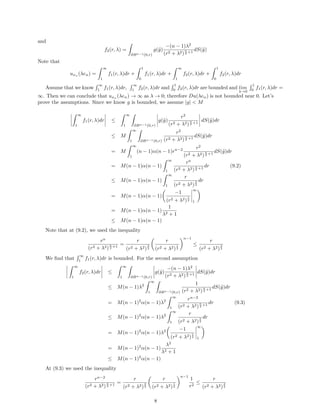
Let µ := dist(x, ∂B(0, r)) = inf {|x − y|
y ∈ ∂B(0, r)} and consider the continuous function Kxi
(x, y)
on the compact set U(0, r − µ
2 ) × ∂B(0, r). Thus Kxi (x, y) is uniformly continuous. Also, since g is
continuous in the compact set ∂B(0, r), g is also bounded. Assume |g|  M. Choose   0. Since
Kxi
(x, y) is uniformly continuous, there exist δ  0 such that |(x1, y1) − (x2, y2)|2n  δ implies
|Kxi
(x1, y1) − Kxi
(x2, y2)|   Thus, for h  min {µ, δ},
v(x, h) −
Z
∂B(0,r)
g(y)Kxi (x, y)dS(y)
=
Z
∂B(0,r)
g(y) Kxi (x + γ(h), y) − Kxi (x, y)

dS(y)
≤
Z
∂B(0,r)
|g(y)|
Kxi (x + γ(h), y) − Kxi (x, y)
dS(y)
≤
Z
∂B(0,r)
|g(y)|
Kxi (x + γ(h), y) − Kxi (x, y)
dS(y)
≤
Z
∂B(0,r)
|g(y)|dS(y)
≤ Mnα(n)rn−1
which goes 0 as  goes 0. Therefore lim
h→0
u(x+hei)−u(x)
h exist and it equals to
R
∂B(0,r)
g(y)Kxi
(x, y)dS(y)
In the same way, we can prove for all α = (α1, α2, ..., αn),
Dα
u(x) =
Z
∂B(0,r)
g(y)Dα
K(x, y)dS(y)
since K is smooth, so is u, i.e u ∈ C∞
(B(0, r))
(ii) By (i), we can say ∆u =
R
∂B(0,r)
g(y)∆xK(x, y)dS(y). But ∆xK(x, y) = 0 within B(0, r) (I
may add calculation) so ∆u = 0
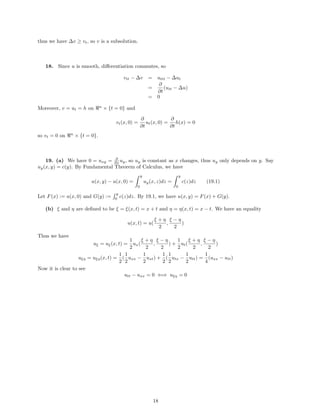
(iii) We’ll follow the similar path as in the proof of the theorem 14. Let   0, since g is continuous,
choose δ  0 such that |y−x0
|  δ implies |g(y)−g(x0
)|  . Moreover, since g is defined in the compact
set ∂B(0, r), it is bounded, assume |g|  M. By (8.1),
|u(x) − g(x0
)| =
Z
∂B(0,r)
g(y)K(x, y)dS(y) −
Z
∂B(0,r)
g(x0
)K(x, y)dS(y)

evans_pde_solutions_ch2_ch3.pdf

  • 1.
    Evans PDE Solutionsfor Ch2 and Ch3 Osman Akar July 2016 This document is written for the book ”Partial Differential Equations” by Lawrence C. Evans (Second Edition). The document prepared under UCLA 2016 Pure REU Program. SOLUTIONS OF CHAPTER 2 1. Consider the function z : < → < for fixed x ∈ <n and t ∈ (0, ∞) z(s) = u(x + bs, t + s)ecs Then ż(s) := ∂z ∂s = ecs (b · Dxu(x + sb, t + s) + ut(x + sb, t + s) + cu(x + sb, t + s)) = 0 by the condition given by the problem. Therefore, z is a constant function with respect to s. Finally, by using the fact that u = g on <n × {t = 0}, we conclude that u(x, t) = z(0) = z(−t) = u(x − tb, 0)e−ct = g(x − tb)e−ct 2. Let O = (aij) and φ(x) = O · x. Then it’s clear that Dφ(x) = O. Since v is defined to be v(x) = u(O · x) = (u ◦ φ)(x), we calculate Dv(x) = Du(φ(x)) · Dφ(x) = Du(O · x) · O Then vxi (x) = Pn j=1 uxj (φ(x))aji. Note that by the same calculations, we have D(uxj ◦ φ)(x) = Duxj (φ(x)) · O Therefore vxixi (x) = ∂ ∂xi vxi (x) = n X j=1 ∂ ∂xi uxj (φ(x))aji = n X j=1 aji( n X k=1 uxj xk (φ(x))aki) = n X j,k=1 ajiakiuxj xk (φ(x)) The laplacian of v is ∆v(x) = n X i=1 vxixi (x) = n X i=1 ( n X j,k=1 ajiakiuxj xk (φ(x))) = n X j,k=1 (uxj xk (φ(x)) n X i=1 ajiaki) Since O is an orthogonal matrix, n X i=1 ajiaki = ( 1 if j = k 0otherwise Lastly, we conclude our proof with ∆v(x) = n X j=1 (uxj xj (φ(x)) = ∆u(φ(x)) = 0 1
  • 2.
    since u isharmonic. 3. We’ll modify the mean value property for harmonic functions. It is assumed that the reader know the proof of the mean value property(Check Evans PDE 2.2.2, Mean Value Formulas). As in the proof in the book, define φ(s) = 1 nα(n)sn−1 Z ∂B(0,s) u(y)dS(y) Then the book proves φ0 (s) = 1 nα(n)sn−1 Z B(0,s) ∆u(y)dy Since ∆u = −f in B(0, r) φ0 (s) = −1 nα(n)sn−1 Z B(0,s) f(y)dy By Fundamental Theorem of Calculus, φ(r) − φ() = Z r φ0 (s)ds for any 0. Note that lim →0 φ() = lim →0 1 nα(n)n−1 Z ∂B(0,) u(y)dS(y) = 1 m(∂B(0, )) Z ∂B(0,) u(y)dS(y) = u(0) (3.1) Let’s calculate R r φ0 (s)ds Z r φ0 (s)ds = Z r −1 nα(n)sn−1 Z B(0,s) f(y)dyds = −1 nα(n) Z B(0,r) f(y) Z r max(|y|,) 1 sn−1 dsdy In the last equality, we changed the order of integration. Note that Z r ζ 1 sn−1 ds = −1 (n − 2)sn−2
  • 7.
    s=r ζ = 1 n − 2 ( 1 ζn−2 − 1 rn−2 )(3.2) Therefore Z r φ0 (s)ds = 1 nα(n) Z B(0,r) f(y) Z r max(|y|,) 1 sn−1 dsdy = −1 nα(n) ( Z B(0,r)−B(0,) f(y) Z r |y| 1 sn−1 dsdy + Z B(0,) f(y) Z r 1 sn−1 dsdy) = −1 nα(n) ( Z B(0,r)−B(0,) f(y) 1 n − 2 ( 1 |y|n−2 − 1 rn−2 )dy + Z B(0,) f(y) 1 n − 2 ( 1 n−2 − 1 rn−2 )dy) by (3.2) = −1 n(n − 2)α(n) ( Z B(0,r) f(y)( 1 |y|n−2 − 1 rn−2 )dy + Z B(0,) f(y)( 1 n−2 − 1 |y|n−2 )dy) Suppose that we proved lim →0 Z B(0,) f(y)( 1 n−2 − 1 |y|n−2 )dy = 0 (3.3) 2
  • 8.
    Then φ(r) − u(0)= lim →0 φ(r) − φ() by (3.1) = lim →0 Z r φ0 (s)ds = lim →0 −1 n(n − 2)α(n) ( Z B(0,r) f(y)( 1 |y|n−2 − 1 rn−2 )dy + Z B(0,) f(y)( 1 n−2 − 1 |y|n−2 )dy) = −1 n(n − 2)α(n) Z B(0,r) f(y)( 1 |y|n−2 − 1 rn−2 )dy Therefore u(0) = φ(r) + 1 n(n − 2)α(n) Z B(0,r) f(y)( 1 |y|n−2 − 1 rn−2 )dy = 1 nα(n)rn−1 Z ∂B(0,r) u(y)dS(y) + 1 n(n − 2)α(n) Z B(0,r) f(y)( 1 |y|n−2 − 1 rn−2 )dy But u = g on ∂B(0, r), so the equality holds. So we only need to prove (3.3) lim →0 Z B(0,) f(y)( 1 n−2 − 1 |y|n−2 )dy = lim →0 1 n−2 Z B(0,) f(y)dy − lim →0 Z B(0,) f(y) |y|n−2 But lim →0 1 n−2 Z B(0,) f(y)dy = lim →0 nα(n)2 1 m(B(0, )) Z B(0,) f(y)dy = lim →0 nα(n)2 f(0) = 0 and lim →0 Z B(0,) f(y) |y|n−2 = lim →0 Z 0 Z ∂B(0,t) f(y) |y|n−2 dS(y)dt = lim →0 Z 0 1 tn−2 Z ∂B(0,t) f(y)dS(y)dt = lim →0 Z 0 nα(n)t 1 m(∂B(0, t)) Z ∂B(0,t) f(y)dS(y)dt = lim →0 Z 0 nα(n)tf(0)dt = lim →0 nα(n)f(0) 2 2 = 0 Therefore lim →0 Z B(0,) f(y)( 1 n−2 − 1 |y|n−2 )dy = 0 so we are done. 4. First note that U and ∂U is compact, since U is bounded and open. So max u = sup u on both U and ∂U. Define u := u + |x|2 for each 0. Then for x ∈ U, ∂u ∂xi = uxi + 2xi, so ∆u = ∆u + 2n = 2n 0 since u is harmonic and 0. But tr(Hess(u)) = ∆u(x) 0, so Hess(u)(x) is cannot be negative definite matrix. Therefore, x cannot be local maximum of the function u, so u cannot attain its max within U. Therefore, we conclude that max U u = max ∂U u 3
  • 9.
    Since we knowthat U is bounded, we can assume U ⊂ B(0, R) for some R 0. Then max U u ≤ max U u = max ∂U u ≤ max ∂U u + max ∂U |x|2 ≤ max ∂U u + R2 Let → 0, then max U u ≤ max ∂U u. Since ∂U ⊂ U, we conclude max U u = max ∂U u 5. (a) As in the proof in the mean value property (or in the problem 3), define a function Φ(s) = 1 nα(n)sn−1 Z ∂B(x,s) v(y)dS(y) then the book proves Φ0 (s) = 1 nα(n)sn−1 Z B(x,s) ∆v(y)dy so Φ0 (s) ≥ 0 since ∆v ≥ 0. Therefore Φ(r) ≥ Φ() for all r 0. But lim →0 v() = v(x) since Φ is an average integral of the function v. (b) Assume that U is connected. Let M := max U u and S = {x ∈ U
  • 11.
    v(x) = M}.If S is an empty set, then clearly max U = max ∂U u, so we are done. Assume that S is not an empty set. We’ll prove that S is both open and relatively closed, which will led us to say S = U since U is connected. Let a ∈ S and δ 0 such that B(a, δ) ⊂ U. Then for all δ ≥ 0 v(a) = 1 nα(n)sn−1 Z ∂B(a,δ) v(y)dS(y) ≤ v(a) therefore v = v(a) within B(a, δ), ie B(a, δ) ⊂ S, so S is open. Moreover S is relatively closed since u is a continuous function. Thus S = U, i.e. u is a constant function in U, and also in U since u is continuous. Therefore max U = max ∂U u. Since this is true for all connected parts of the nonconnected open set U, we can say max U = max ∂U u. Second way If U were bounded, we could use problem 4. Define v(x) = v(x) + |x|2 . Then ∆v = ∆v + 2n 0, the rest are the same. (c) We do straight calculation ∂v ∂xi = ∂φ(u) ∂xi = φ0 (u)uxi So ∂2 v ∂x2 i = φ00 (u)u2 xi + φ0 (u)uxixi Therefore ∆v = φ00 (u) n X i=1 u2 xi + φ0 (u)∆u ≥ 0 (d) Follow the calculations v = |Du|2 = n X i=1 u2 xi ∂v ∂xk = n X i=1 2uxi uxixk 4
  • 12.
    ∂2 v ∂x2 k = 2 n X i=1 u2 xixk + uxixkxk ∆v= 2 n X i,k=1 u2 xixk + n X i=1 ∆uxi ≥ n X i=1 ∆uxi Since u is harmonic, uxi is harmonic for all i = 1, 2, ..., n. Thus ∆v ≥ Pn i=1 ∆uxi = 0 6. Since U is bounded, we can assume that U ⊂ B(0, R) for some fixed R 0. Choose C such that C max(1, R2 2n ). Let’s define λ := max U |f| (??? can we, can f be extended continuously over U) Since ∆(u + λ|x|2 2n ) = ∆u + n2λ 2n ≥ 0 u + λ|x|2 2n is subharmonic. By the problem 5 max U (u + λ |x|2 2n ) = max ∂U (u + λ |x|2 2n ) ≤ max ∂U |u| + λ R2 2n ≤ max ∂U |g| + R2 2n max U |f| ≤ C(max ∂U |g| + max U |f|) 7. We are assuming that u is harmonic in an open set U satisfying B(0, r) ⊂ U ⊆ n . Let’s write the Poisson’s formula x ∈ B(0, r), u(x) = r2 − |x|2 nα(n) Z ∂B(0,r) u(y) |x − y|n dy Note that by the triangle inequality r + |x| = |y| + |x| ≥ |x − y| ≥ ||y| − |x|| = r − |x| for y ∈ ∂B(0, r). Moreover, Z ∂B(0,r) u(y)dy = nα(n)rn−1 u(0) by the mean value property of the harmonic functions. Then rn−2 r − |x| (r + |x|)n−1 u(0) = r2 − |x|2 nα(n) Z ∂B(0,r) u(y) (r + |x|)n dy ≤ r2 − |x|2 nα(n) Z ∂B(0,r) u(y) |x − y|n dy = u(x) Similarly rn−2 r + |x| (r − |x|)n−1 u(0) = r2 − |x|2 nα(n) Z ∂B(0,r) u(y) (r − |x|)n dy ≥ r2 − |x|2 nα(n) Z ∂B(0,r) u(y) |x − y|n dy = u(x) 8. (i) We’ll prove the Theorem 15 in the chapter 2.2. Take u = 1 in B(0, r) and consequently g = 1 on ∂B(0, r), then by theorem 12 (Representation Formula using Green’s function), for any x ∈ B(0, r) 1 = u(x) = Z ∂B(0,r) g(y)K(x, y)dS(y) = Z ∂B(0,r) K(x, y)dS(y) (8.1) Let’s back to the problem. First, we shall show that uxi exist and it equals to R ∂B(0,r) g(y)Kxi (x, y)dS(y). It’s enough to show that lim h→0 u(x + hei) − u(x) h = Z ∂B(0,r) g(y)Kxi (x, y)dS(y) 5
  • 13.
    Let’s denote v(x, h):= u(x + hei) − u(x) h = Z ∂B(0,r) g(y) K(x + hei, y) − K(x, y) h dS(y) By Mean Value Theorem, K(x + hei, y) − K(x, y) = hKxi (x + γ(h), y) for some 0 γ(h) h. Therefore v(x, h) = Z ∂B(0,r) g(y)Kxi (x + γ(h), y)dS(y) v(x, h) − Z ∂B(0,r) g(y)Kxi (x, y)dS(y) = Z ∂B(0,r) g(y) Kxi (x + γ(h), y) − Kxi (x, y) dS(y) Let µ := dist(x, ∂B(0, r)) = inf {|x − y|
  • 15.
    y ∈ ∂B(0,r)} and consider the continuous function Kxi (x, y) on the compact set U(0, r − µ 2 ) × ∂B(0, r). Thus Kxi (x, y) is uniformly continuous. Also, since g is continuous in the compact set ∂B(0, r), g is also bounded. Assume |g| M. Choose 0. Since Kxi (x, y) is uniformly continuous, there exist δ 0 such that |(x1, y1) − (x2, y2)|2n δ implies |Kxi (x1, y1) − Kxi (x2, y2)| Thus, for h min {µ, δ},
  • 17.
  • 19.
  • 21.
    Z ∂B(0,r) g(y) Kxi (x+ γ(h), y) − Kxi (x, y) dS(y)
  • 23.
  • 25.
    Kxi (x +γ(h), y) − Kxi (x, y)
  • 27.
  • 29.
    Kxi (x +γ(h), y) − Kxi (x, y)
  • 31.
    dS(y) ≤ Z ∂B(0,r) |g(y)|dS(y) ≤ Mnα(n)rn−1 which goes0 as goes 0. Therefore lim h→0 u(x+hei)−u(x) h exist and it equals to R ∂B(0,r) g(y)Kxi (x, y)dS(y) In the same way, we can prove for all α = (α1, α2, ..., αn), Dα u(x) = Z ∂B(0,r) g(y)Dα K(x, y)dS(y) since K is smooth, so is u, i.e u ∈ C∞ (B(0, r)) (ii) By (i), we can say ∆u = R ∂B(0,r) g(y)∆xK(x, y)dS(y). But ∆xK(x, y) = 0 within B(0, r) (I may add calculation) so ∆u = 0 (iii) We’ll follow the similar path as in the proof of the theorem 14. Let 0, since g is continuous, choose δ 0 such that |y−x0 | δ implies |g(y)−g(x0 )| . Moreover, since g is defined in the compact set ∂B(0, r), it is bounded, assume |g| M. By (8.1), |u(x) − g(x0 )| =
  • 33.