P R E S E N T E D B Y :
G R O U P 9
R A J N I V A S H I S T ( P G F B 1 3 3 8 )
S A L O N I M I S H R A ( P G F B 1 3 4 3 )
S H A H B A A Z A H M E D ( P G F B 1 3 4 5 )
S H R A V A N K U M A R ( P G F B 1 3 4 7 )
S U N D R A M S I N H A ( P G F B 1 3 5 2 )
S W A T I S H A R M A ( P G F B 1 3 5 3 )
Operations at Big
Bazaar
OBJECTIVE OF THE STUDY
 The objective of the study is to analyse how the stock
moves from vendor to customer in a organised retail
format.
 It also includes understanding of the ware house
management of Big Bazaar.
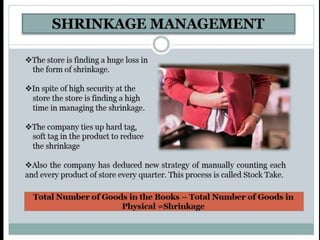
 The study also includes Shrinkage Management.
SUPPLY CHAIN MANGEMENT AT BIG
BAZAAR
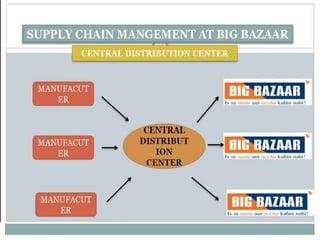
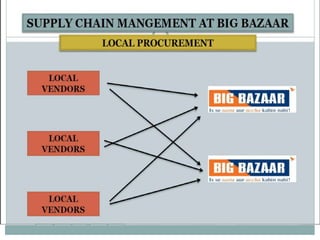
 Procurement in Big Bazaar happens from Central
Distribution Center and Local Vendors.
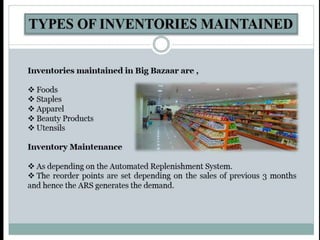
 The Stock in the store is managed by Automated
Replenishment System (ARS).
 The CDC are located in such a strategically positioned so
that it can easily cater to the nearby Big Bazaar.
 For the Stores of Eastern Zone, the CDC is located at
Barasat.
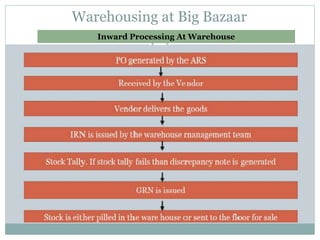
Warehousing at Big Bazaar
Inward Processing At Warehouse
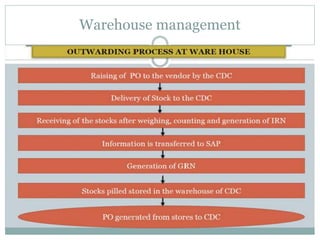
Warehouse management
Damage and defective stock management
 Damage goods management
 Defective goods management
INVENTORY MANAGEMENT
 Stock of goods which is held for the purpose of future
production or sales.
 Forms-
Raw Materials
Partly finished goods
Finished goods
Spare parts etc.
 Objective-
Minimize the total (actual or expected) cost or to maximize
(actual or expected) profit.
 Variables :
The Controlled variables
The uncontrolled variables
Need of Inventory Management:
 Meet variation in Production Demand
 Cater to Cyclical and Seasonal Demand
 Take advantage of Price Increase and Quantity Discounts
 To decrease the setup and shortage costs.
 To meet demand on time to earn goodwill.
 For smooth running of the business.
MANAGEMENT OF STOCKS ON THE
FLOOR
 The stocks entered into the floor can only come out with a
customer unless damage or defective.
 The stock management on the floor depends on the foot
fall of customers.
 The stock management on the floor are analyzed by the
department manager.
 The concerned DM request for the replenishment when
the sales are high.
 The request are received by the warehouse team and
accordingly replenishment happens.
ADVANTAGE
• The economics of production with the large run sizes.
• The smooth and efficient running of the business.
• The economics in transportation.
• The advantage of price discounts by bulk purchasing.
• Faster and adequate service to the customers and,
• Profit from speculation in the market where price are
expected to rise.
DISADVANTAGES
• Ware house rent.
• Interest on invested capital.
• Physical handling.
• Accounting.
• Classification and Categories of Inventory
Models:
Findings
 Care of Visual merchandising for high sales.
 Product on offer to catch customer’s attention &
purchase.
 Importance of frontline staff
 Use of IT tools like Bar coding, ERP systems, CRM,
Advanced planning and scheduling systems.
Thank You!

Operations at Big Bazaar

  • 1.
    P R ES E N T E D B Y : G R O U P 9 R A J N I V A S H I S T ( P G F B 1 3 3 8 ) S A L O N I M I S H R A ( P G F B 1 3 4 3 ) S H A H B A A Z A H M E D ( P G F B 1 3 4 5 ) S H R A V A N K U M A R ( P G F B 1 3 4 7 ) S U N D R A M S I N H A ( P G F B 1 3 5 2 ) S W A T I S H A R M A ( P G F B 1 3 5 3 ) Operations at Big Bazaar
  • 2.
    OBJECTIVE OF THESTUDY  The objective of the study is to analyse how the stock moves from vendor to customer in a organised retail format.  It also includes understanding of the ware house management of Big Bazaar.  The study also includes Shrinkage Management.
  • 4.
    SUPPLY CHAIN MANGEMENTAT BIG BAZAAR  Procurement in Big Bazaar happens from Central Distribution Center and Local Vendors.  The Stock in the store is managed by Automated Replenishment System (ARS).  The CDC are located in such a strategically positioned so that it can easily cater to the nearby Big Bazaar.  For the Stores of Eastern Zone, the CDC is located at Barasat.
  • 7.
    Warehousing at BigBazaar Inward Processing At Warehouse
  • 8.
  • 10.
    Damage and defectivestock management  Damage goods management  Defective goods management
  • 12.
    INVENTORY MANAGEMENT  Stockof goods which is held for the purpose of future production or sales.  Forms- Raw Materials Partly finished goods Finished goods Spare parts etc.  Objective- Minimize the total (actual or expected) cost or to maximize (actual or expected) profit.  Variables : The Controlled variables The uncontrolled variables
  • 14.
    Need of InventoryManagement:  Meet variation in Production Demand  Cater to Cyclical and Seasonal Demand  Take advantage of Price Increase and Quantity Discounts  To decrease the setup and shortage costs.  To meet demand on time to earn goodwill.  For smooth running of the business.
  • 15.
    MANAGEMENT OF STOCKSON THE FLOOR  The stocks entered into the floor can only come out with a customer unless damage or defective.  The stock management on the floor depends on the foot fall of customers.  The stock management on the floor are analyzed by the department manager.  The concerned DM request for the replenishment when the sales are high.  The request are received by the warehouse team and accordingly replenishment happens.
  • 16.
    ADVANTAGE • The economicsof production with the large run sizes. • The smooth and efficient running of the business. • The economics in transportation. • The advantage of price discounts by bulk purchasing. • Faster and adequate service to the customers and, • Profit from speculation in the market where price are expected to rise.
  • 17.
    DISADVANTAGES • Ware houserent. • Interest on invested capital. • Physical handling. • Accounting. • Classification and Categories of Inventory Models:
  • 18.
    Findings  Care ofVisual merchandising for high sales.  Product on offer to catch customer’s attention & purchase.  Importance of frontline staff  Use of IT tools like Bar coding, ERP systems, CRM, Advanced planning and scheduling systems.
  • 19.