Presented by :
- Ahmed saeed
- Esraa esaa
OLYMPIC
CITY
- Nada elsayed
- Nourhan gamal
- Yousef rashad
The Olympic
Games
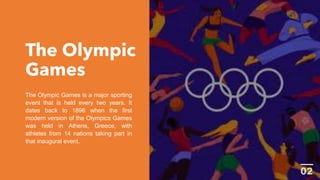
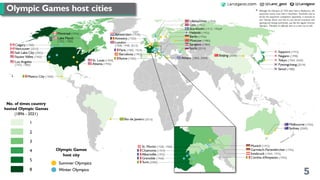
The Olympic Games is a major sporting
event that is held every two years. It
dates back to 1896 when the first
modern version of the Olympics Games
was held in Athens, Greece, with
athletes from 14 nations taking part in
that inaugural event.
Olympic
games Summer Olympic
games
Winter Olympic
games
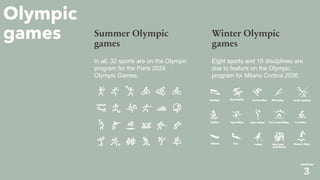
In all, 32 sports are on the Olympic
program for the Paris 2024
Olympic Games.
Eight sports and 15 disciplines are
due to feature on the Olympic
program for Milano Cortina 2026.
The host city
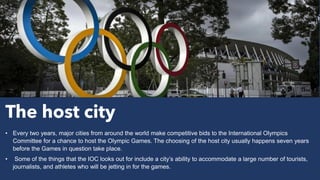
• Every two years, major cities from around the world make competitive bids to the International Olympics
Committee for a chance to host the Olympic Games. The choosing of the host city usually happens seven years
before the Games in question take place.
• Some of the things that the IOC looks out for include a city’s ability to accommodate a large number of tourists,
journalists, and athletes who will be jetting in for the games.
Case studies
Los angeles Olympic
city
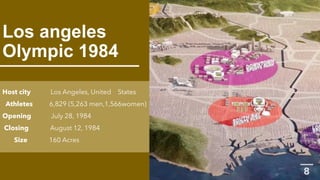
Los angeles
Olympic 1984
Host city Los Angeles, United States
Athletes 6,829 (5,263 men,1,566women)
Opening July 28, 1984
Closing August 12, 1984
Size 160 Acres
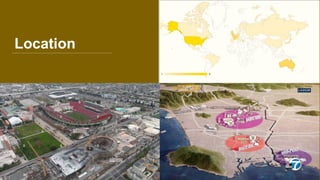
Location
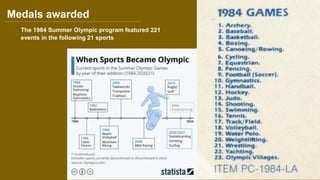
The 1984 Summer Olympic program featured 221
events in the following 21 sports
Medals awarded
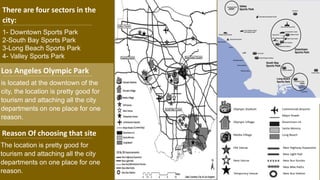
Los Angeles Olympic Park
is located at the downtown of the
city, the location is pretty good for
tourism and attaching all the city
departments on one place for one
reason.
Reason Of choosing that site
The location is pretty good for
tourism and attaching all the city
departments on one place for one
reason.
There are four sectors in the
city:
1- Downtown Sports Park
2-South Bay Sports Park
3-Long Beach Sports Park
4- Valley Sports Park
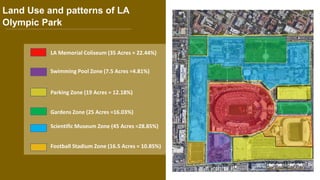
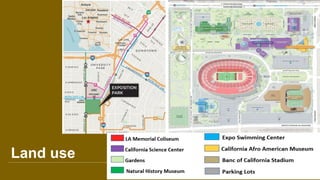
Land Use and patterns of LA
Olympic Park
LA Memorial Coliseum (35 Acres = 22.44%)
Swimming Pool Zone (7.5 Acres =4.81%)
Parking Zone (19 Acres = 12.18%)
Gardens Zone (25 Acres =16.03%)
Scientific Museum Zone (45 Acres =28.85%)
Football Stadium Zone (16.5 Acres = 10.85%)
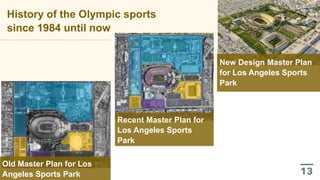
Old Master Plan for Los
Angeles Sports Park
Recent Master Plan for
Los Angeles Sports
Park
New Design Master Plan
for Los Angeles Sports
Park
History of the Olympic sports
since 1984 until now
Land use
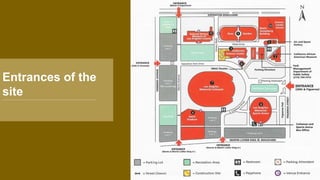
Entrances of the
site
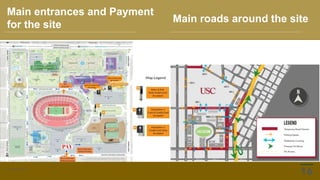
Main entrances and Payment
for the site
Main roads around the site
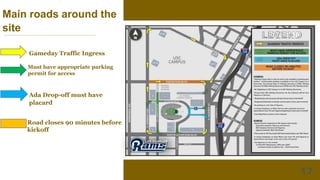
Gameday Traffic Ingress
Must have appropriate parking
permit for access
Road closes 90 minutes before
kickoff
Ada Drop-off must have
placard
Main roads around the
site
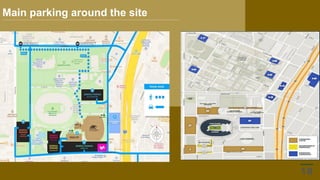
Main parking around the site
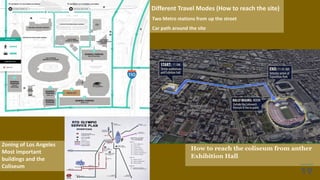
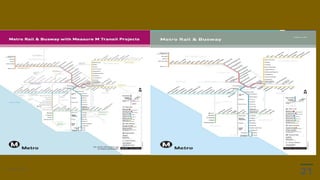
Different Travel Modes (How to reach the site)
Two Metro stations from up the street
Car path around the site
How to reach the coliseum from anther
Exhibition Hall
Zoning of Los Angeles
Most important
buildings and the
Coliseum
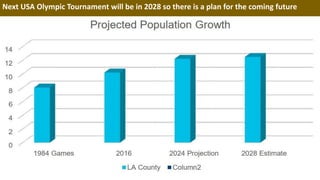
Next USA Olympic Tournament will be in 2028 so there is a plan for the coming future
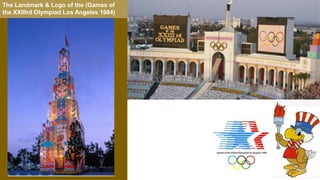
The Landmark & Logo of the (Games of
the XXlllrd Olympiad Los Angeles 1984)
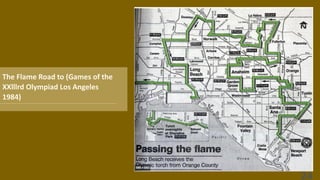
The Flame Road to (Games of the
XXlllrd Olympiad Los Angeles
1984)
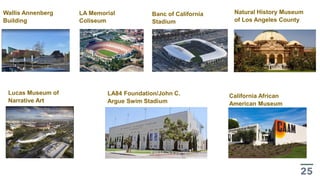
Wallis Annenberg
Building
LA Memorial
Coliseum
Banc of California
Stadium
Lucas Museum of
Narrative Art
LA84 Foundation/John C.
Argue Swim Stadium
Natural History Museum
of Los Angeles County
California African
American Museum
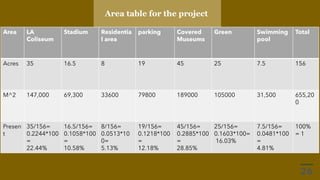
Area LA
Coliseum
Stadium Residentia
l area
parking Covered
Museums
Green Swimming
pool
Total
Acres 35 16.5 8 19 45 25 7.5 156
M^2 147,000 69,300 33600 79800 189000 105000 31,500 655,20
0
Presen
t
35/156=
0.2244*100
=
22.44%
16.5/156=
0.1058*100
=
10.58%
8/156=
0.0513*10
0=
5.13%
19/156=
0.1218*100
=
12.18%
45/156=
0.2885*100
=
28.85%
25/156=
0.1603*100=
16.03%
7.5/156=
0.0481*100
=
4.81%
100%
= 1
Area table for the project
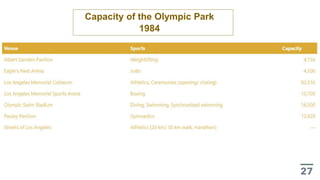
Capacity of the Olympic Park
1984
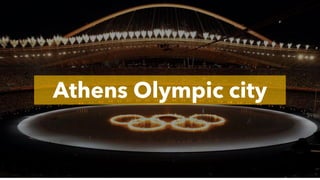
Athens Olympic city
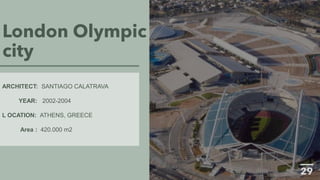
London Olympic
city
ARCHITECT: SANTIAGO CALATRAVA
YEAR: 2002-2004
L OCATION: ATHENS, GREECE
Area : 420.000 m2
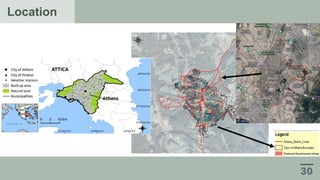
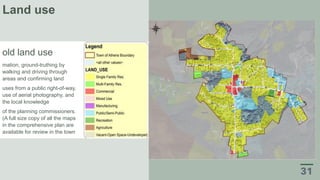
Location
mation, ground-truthing by
walking and driving through
areas and confirming land
uses from a public right-of-way,
use of aerial photography, and
the local knowledge
of the planning commissioners.
(A full size copy of all the maps
in the comprehensive plan are
available for review in the town
Land use
old land use
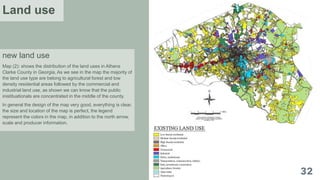
new land use
Map (2): shows the distribution of the land uses in Athens
Clarke County in Georgia, As we see in the map the majority of
the land use type are belong to agricultural forest and low
density residential areas followed by the commercial and
industrial land use, as shown we can know that the public
inistituationals are concentrated in the middle of the county.
In general the design of the map very good, everything is clear,
the size and location of the map is perfect, the legend
represent the colors in the map, in addition to the north arrow,
scale and producer information.
Land use
3
1
2
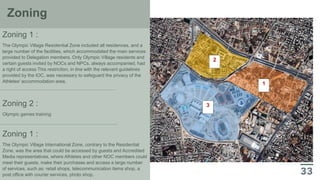
Zoning
Zoning 1 :
The Olympic Village Residential Zone included all residences, and a
large number of the facilities, which accommodated the main services
provided to Delegation members. Only Olympic Village residents and
certain guests invited by NOCs and NPCs, always accompanied, had
a right of access This restriction, in line with the relevant guidelines
provided by the IOC, was necessary to safeguard the privacy of the
Athletes' accommodation area.
Zoning 2 :
Olympic games training
Zoning 1 :
The Olympic Village International Zone, contrary to the Residential
Zone, was the area that could be accessed by guests and Accredited
Media representatives, where Athletes and other NOC members could
meet their guests, make their purchases and access a large number
of services, such as: retail shops, telecommunication items shop, a
post office with courier services, photo shop,
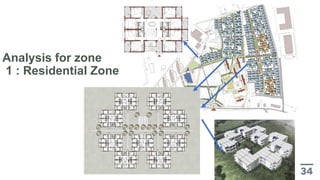
Analysis for zone
1 : Residential Zone
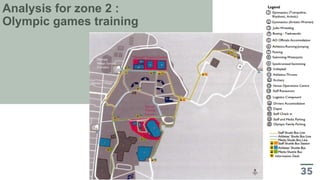
Analysis for zone 2 :
Olympic games training
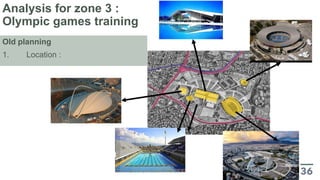
Analysis for zone 3 :
Olympic games training
Old planning
1. Location :
Old planning
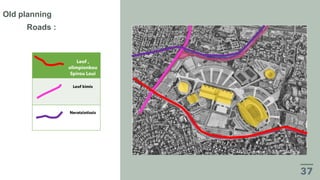
Roads :
Leof ,
olimpionkou
Spirou Loui
Leof kimis
Neratziotissis
Old planning
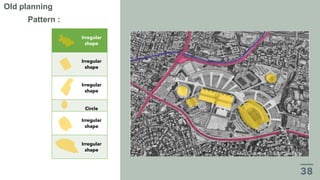
Pattern :
Irregular
shape
Irregular
shape
Irregular
shape
Circle
Irregular
shape
Irregular
shape
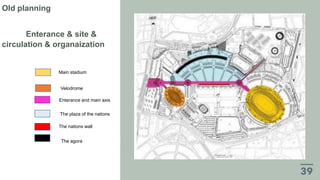
Old planning
Enterance & site &
circulation & organaization
Main stadium
The plaza of the nations
Enterance and main axis
The nations wall
The agora
Velodrome
Old planning
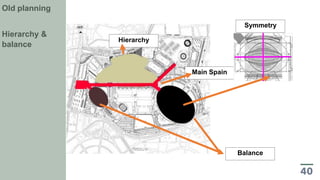
Hierarchy &
balance
Balance
Main Spain
Hierarchy
Symmetry
Old planning
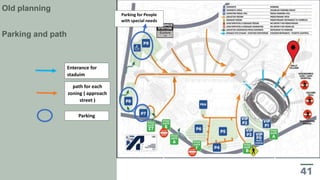
Parking and path
Parking for People
with special needs
Enterance for
staduim
path for each
zoning ( approach
street )
Parking
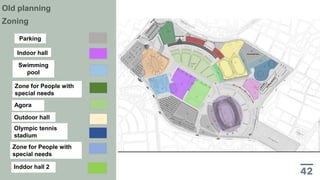
Old planning
Zoning
Parking
Indoor hall
Swimming
pool
Zone for People with
special needs
Agora
Outdoor hall
Olympic tennis
stadium
Zone for People with
special needs
Inddor hall 2
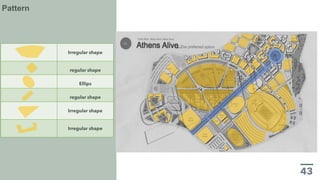
Pattern
Irregular shape
regular shape
Ellips
regular shape
Irregular shape
Irregular shape
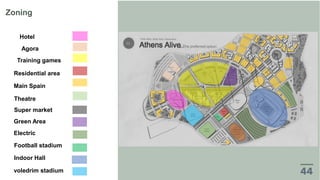
Zoning
Hotel
Agora
Training games
Residential area
Main Spain
Theatre
Super market
Electric
Football stadium
Green Area
Indoor Hall
voledrim stadium
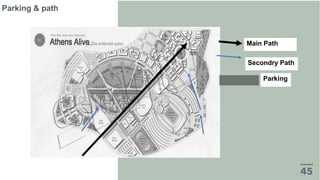
Parking & path
Main Path
Secondry Path
Parking
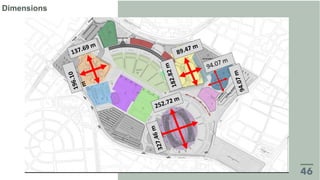
Dimensions
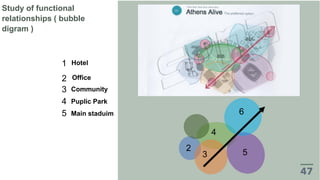
Study of functional
relationships ( bubble
digram )
1
2
3
4
5
6
2
3
4
5
Hotel
Office
Community
Puplic Park
Main staduim
London Olympic city
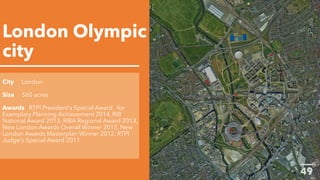
London Olympic
city
City London
Size 560 acres
Awards RTPI President's Special Award for
Exemplary Planning Achievement 2014, RIB
National Award 2013, RIBA Regional Award 2013,
New London Awards Overall Winner 2012, New
London Awards Masterplan Winner 2012, RTPI
Judge's Special Award 2011
Abstract
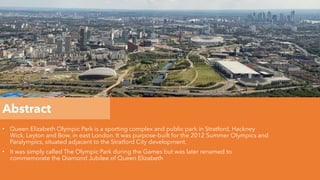
• Queen Elizabeth Olympic Park is a sporting complex and public park in Stratford, Hackney
Wick, Leyton and Bow, in east London. It was purpose-built for the 2012 Summer Olympics and
Paralympics, situated adjacent to the Stratford City development.
• It was simply called The Olympic Park during the Games but was later renamed to
commemorate the Diamond Jubilee of Queen Elizabeth
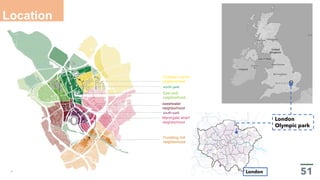
Location
London
Olympic park
London
Chobham manor
neighborhood
East wick
neighborhood
sweetwater
neighborhood
Marshgate wharf
neighborhood
Pundding mill
neighborhood
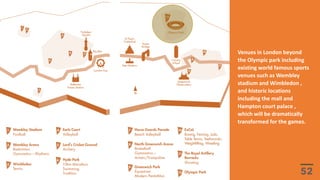
Venues in London beyond
the Olympic park including
existing world famous sports
venues such as Wembley
stadium and Wimbledon ,
and historic locations
including the mall and
Hampton court palace ,
which will be dramatically
transformed for the games.
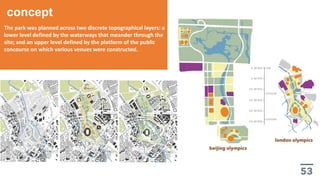
The park was planned across two discrete topographical layers: a
lower level defined by the waterways that meander through the
site; and an upper level defined by the platform of the public
concourse on which various venues were constructed.
concept
beijing olympics
london olympics
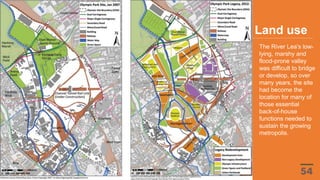
The River Lea's low-
lying, marshy and
flood-prone valley
was difficult to bridge
or develop, so over
many years, the site
had become the
location for many of
those essential
back-of-house
functions needed to
sustain the growing
metropolis.
Land use
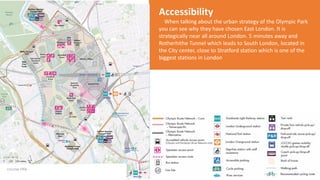
Accessibility
When talking about the urban strategy of the Olympic Park
you can see why they have chosen East London. It is
strategically near all around London. 5 minutes away and
Rotherhithe Tunnel which leads to South London, located in
the City center, close to Stratford station which is one of the
biggest stations in London
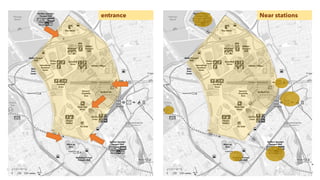
Near stations
entrance
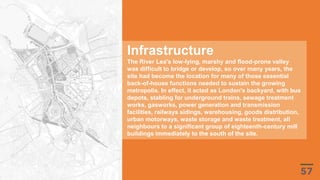
Infrastructure
The River Lea's low-lying, marshy and flood-prone valley
was difficult to bridge or develop, so over many years, the
site had become the location for many of those essential
back-of-house functions needed to sustain the growing
metropolis. In effect, it acted as London's backyard, with bus
depots, stabling for underground trains, sewage treatment
works, gasworks, power generation and transmission
facilities, railways sidings, warehousing, goods distribution,
urban motorways, waste storage and waste treatment, all
neighbours to a significant group of eighteenth-century mill
buildings immediately to the south of the site.
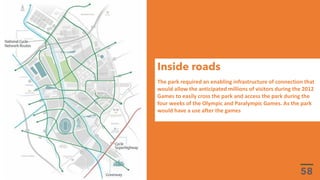
The park required an enabling infrastructure of connection that
would allow the anticipated millions of visitors during the 2012
Games to easily cross the park and access the park during the
four weeks of the Olympic and Paralympic Games. As the park
would have a use after the games
Inside roads
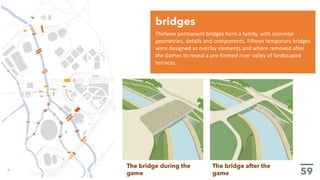
Thirteen permanent bridges form a family, with common
geometries, details and components. Fifteen temporary bridges
were designed as overlay elements and where removed after
the Games to reveal a pre-formed river valley of landscaped
terraces.
bridges
The bridge during the
game
The bridge after the
game
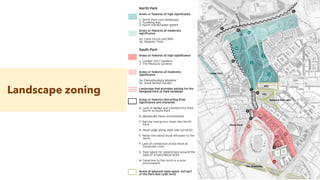
Landscape zoning
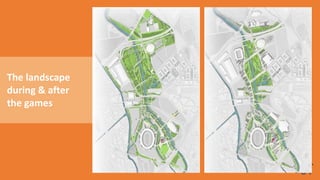
The landscape
during & after
the games
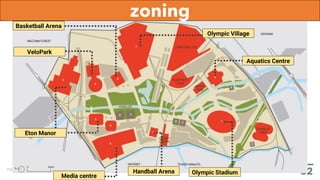
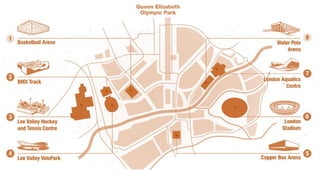
Olympic Stadium
Eton Manor
VeloPark
Handball Arena
Aquatics Centre
Basketball Arena
Olympic Village
Media centre
zoning
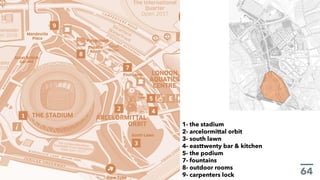
1- the stadium
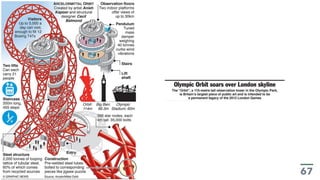
2- arcelormittal orbit
3- south lawn
4- easttwenty bar & kitchen
5- the podium
7- fountains
8- outdoor rooms
9- carpenters lock
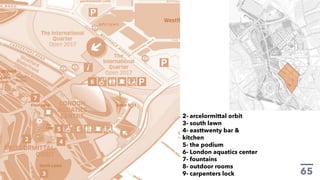
2- arcelormittal orbit
3- south lawn
4- easttwenty bar &
kitchen
5- the podium
6- London aquatics center
7- fountains
8- outdoor rooms
9- carpenters lock
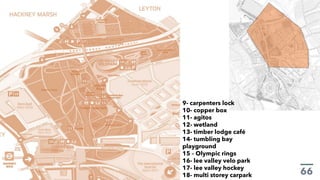
9- carpenters lock
10- copper box
11- agitos
12- wetland
13- timber lodge café
14- tumbling bay
playground
15 – Olympic rings
16- lee valley velo park
17- lee valley hockey
18- multi storey carpark
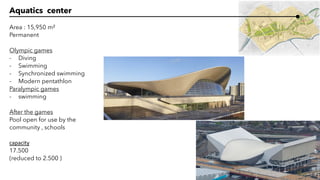
Aquatics center
Area : 15,950 m²
Permanent
Olympic games
- Diving
- Swimming
- Synchronized swimming
- Modern pentathlon
Paralympic games
- swimming
After the games
Pool open for use by the
community , schools
capacity
17.500
(reduced to 2.500 )
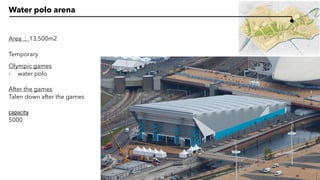
Water polo arena
Area : 13,500m2
Temporary
Olympic games
- water polo
After the games
Talen down after the games
capacity
5000
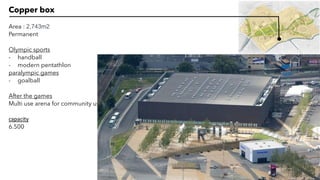
Copper box
Area : 2,743m2
Permanent
Olympic sports
- handball
- modern pentathlon
paralympic games
- goalball
After the games
Multi use arena for community use
capacity
6.500
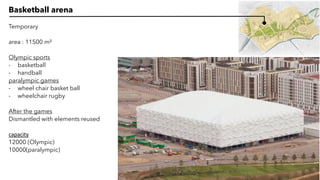
Basketball arena
Temporary
area : 11500 m²
Olympic sports
- basketball
- handball
paralympic games
- wheel chair basket ball
- wheelchair rugby
After the games
Dismantled with elements reused
capacity
12000 (Olympic)
10000(paralympic)
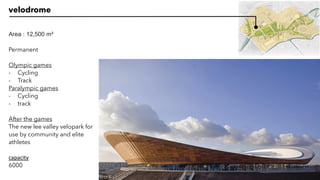
velodrome
Area : 12,500 m²
Permanent
Olympic games
- Cycling
- Track
Paralympic games
- Cycling
- track
After the games
The new lee valley velopark for
use by community and elite
athletes
capacity
6000
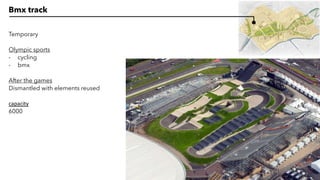
Bmx track
Temporary
Olympic sports
- cycling
- bmx
After the games
Dismantled with elements reused
capacity
6000
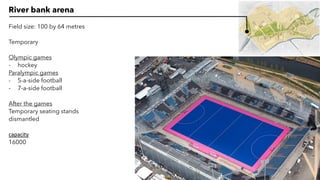
River bank arena
Field size: 100 by 64 metres
Temporary
Olympic games
- hockey
Paralympic games
- 5-a-side football
- 7-a-side football
After the games
Temporary seating stands
dismantled
capacity
16000
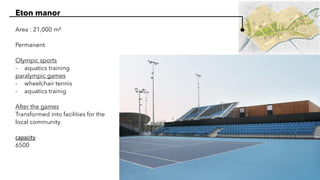
Eton manor
Area : 21,000 m²
Permanent
Olympic sports
- aquatics training
paralympic games
- wheelchair tennis
- aquatics trainig
After the games
Transformed into facilities for the
local community
capacity
6500
Social economics Environmental
• Athletes village
became the east
village
• 2.800 new homes
• Expansion of more
neighbours in the
future
• New startford tube
station and other
infrastructure
improvements
• Queen eleizebeth
Olympic park
• New school built in the
area
• 9 b investment to east
london
• Stadiums used
recycled materials
• Aquastics centrer for
community use
• All venues sold of
• 300m media center has
become an it storge
facility
• Restoration of the river
lea
• Improved water quality
• Unemployment feel
during the olympics
• Estimated 10bn of
extra income into the
uk economy
• Wasteland cleaned up
• Improved biodiversity
• New green spaces for
wildlife
Social economics Environmental
• The people who
lived in this area are
moved to another
place
• 8.77bn of tax payer’s
money for the
Olympics
• Olympic stadium
cost 760m including
renovations in 2016
• Material came from
overseas
• Increase of
unemployments
after the competion
has done
• Businesses had to
be moved
• Games produced
3.3 m ton of co2
advantages disadvantages
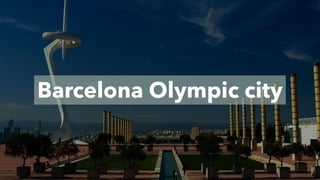
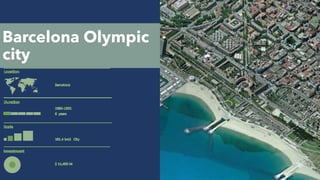
Barcelona Olympic city
Barcelona Olympic
city
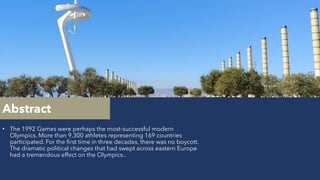
Abstract
• The 1992 Games were perhaps the most-successful modern
Olympics. More than 9,300 athletes representing 169 countries
participated. For the first time in three decades, there was no boycott.
The dramatic political changes that had swept across eastern Europe
had a tremendous effect on the Olympics..
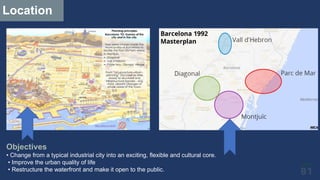
Location
Objectives
• Change from a typical industrial city into an exciting, flexible and cultural core.
• Improve the urban quality of life
• Restructure the waterfront and make it open to the public.
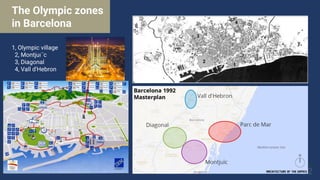
The Olympic zones
in Barcelona
1, Olympic village
2, Montjuı¨c
3, Diagonal
4, Vall d'Hebron
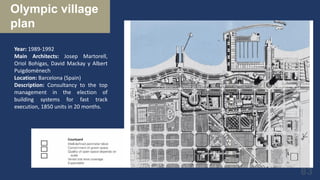
Olympic village
plan
Year: 1989-1992
Main Architects: Josep Martorell,
Oriol Bohigas, David Mackay y Albert
Puigdomènech
Location: Barcelona (Spain)
Description: Consultancy to the top
management in the election of
building systems for fast track
execution, 1850 units in 20 months.
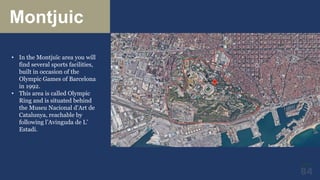
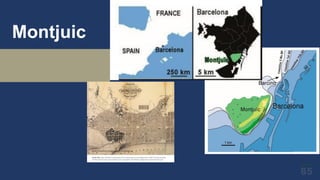
Montjuic
• In the Montjuïc area you will
find several sports facilities,
built in occasion of the
Olympic Games of Barcelona
in 1992.
• This area is called Olympic
Ring and is situated behind
the Museu Nacional d’Art de
Catalunya, reachable by
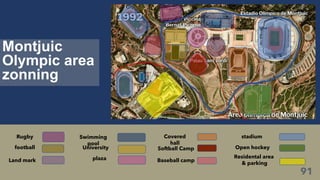
following l’Avinguda de L’
Estadi.
Montjuic
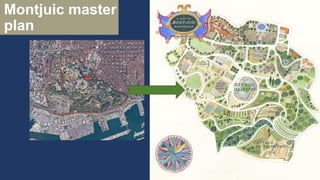
Montjuic master
plan
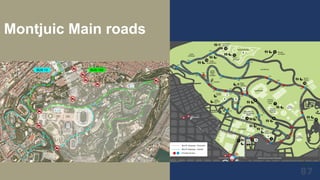
Montjuic Main roads
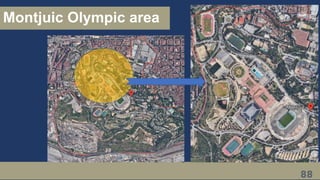
Montjuic Olympic area
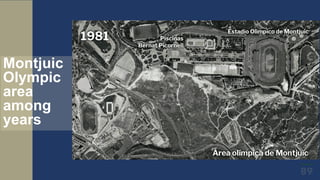
Montjuic
Olympic
area
among
years
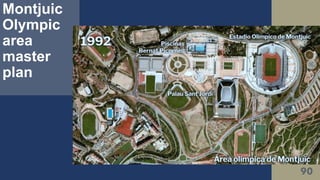
Montjuic
Olympic
area
master
plan
stadium
Open hockey
Covered
hall
Softball Camp
Swimming
pool
University
Rugby
football
plaza Baseball camp
Residental area
& parking
Land mark
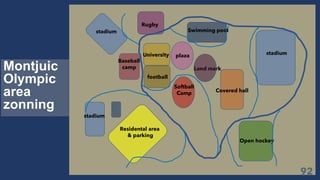
Montjuic
Olympic area
zonning
stadium
Open hockey
Covered hall
Softball
Camp
Swimming pool
University
Rugby
football
plaza
Baseball
camp
Residental area
& parking
stadium
stadium
Land mark
Montjuic
Olympic
area
zonning
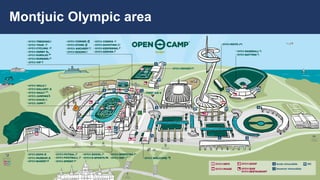
Montjuic Olympic area
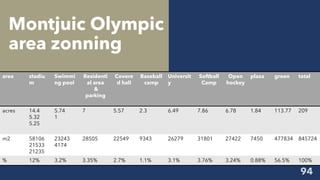
Montjuic Olympic
area zonning
area stadiu
m
Swimmi
ng pool
Residenti
al area
&
parking
Covere
d hall
Baseball
camp
Universit
y
Softball
Camp
Open
hockey
plaza green total
acres 14.4
5.32
5.25
5.74
1
7 5.57 2.3 6.49 7.86 6.78 1.84 113.77 209
m2 58106
21533
21235
23243
4174
28505 22549 9343 26279 31801 27422 7450 477834 845724
% 12% 3.2% 3.35% 2.7% 1.1% 3.1% 3.76% 3.24% 0.88% 56.5% 100%
area stadiu
m
Swimmi
ng pool
Residenti
al area
&
parking
Covere
d hall
Baseball
camp
Universit
y
Softball
Camp
Open
hockey
plaza green total
acres 14.4
5.32
5.25
5.74
1
7 5.57 2.3 6.49 7.86 6.78 1.84 113.77 209
m2 58106
21533
21235
23243
4174
28505 22549 9343 26279 31801 27422 7450 477834 845724
% 12% 3.2% 3.35% 2.7% 1.1% 3.1% 3.76% 3.24% 0.88% 56.5% 100%
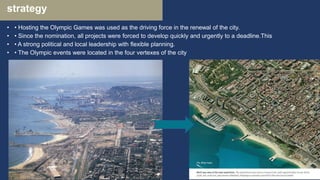
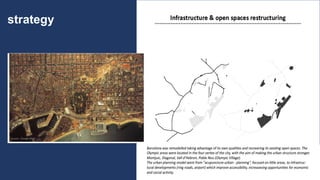
strategy
• • Hosting the Olympic Games was used as the driving force in the renewal of the city.
• • Since the nomination, all projects were forced to develop quickly and urgently to a deadline.This
• • A strong political and local leadership with flexible planning.
• • The Olympic events were located in the four vertexes of the city
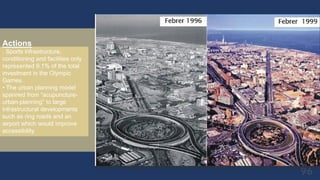
Actions
. Sports infrastructure,
conditioning and facilities only
represented 9.1% of the total
investment in the Olympic
Games.
• The urban planning model
spanned from “acupuncture-
urban-planning” to large
infrastructural developments
such as ring roads and an
airport which would improve
accessibility.
strategy
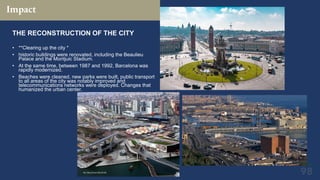
Impact
THE RECONSTRUCTION OF THE CITY
• **Clearing up the city *
• historic buildings were renovated, including the Beaulieu
Palace and the Montjuic Stadium.
• At the same time, between 1987 and 1992, Barcelona was
rapidly modernized.
• Beaches were cleaned, new parks were built, public transport
to all areas of the city was notably improved and
telecommunications networks were deployed. Changes that
humanized the urban center.

Olympic city - قرية اولمبيه (olympic park ) case study

  • 1.
    Presented by : -Ahmed saeed - Esraa esaa OLYMPIC CITY - Nada elsayed - Nourhan gamal - Yousef rashad
  • 2.
    The Olympic Games The OlympicGames is a major sporting event that is held every two years. It dates back to 1896 when the first modern version of the Olympics Games was held in Athens, Greece, with athletes from 14 nations taking part in that inaugural event.
  • 3.
    Olympic games Summer Olympic games WinterOlympic games In all, 32 sports are on the Olympic program for the Paris 2024 Olympic Games. Eight sports and 15 disciplines are due to feature on the Olympic program for Milano Cortina 2026.
  • 4.
    The host city •Every two years, major cities from around the world make competitive bids to the International Olympics Committee for a chance to host the Olympic Games. The choosing of the host city usually happens seven years before the Games in question take place. • Some of the things that the IOC looks out for include a city’s ability to accommodate a large number of tourists, journalists, and athletes who will be jetting in for the games.
  • 6.
  • 7.
  • 8.
    Los angeles Olympic 1984 Hostcity Los Angeles, United States Athletes 6,829 (5,263 men,1,566women) Opening July 28, 1984 Closing August 12, 1984 Size 160 Acres
  • 9.
  • 10.
    The 1984 SummerOlympic program featured 221 events in the following 21 sports Medals awarded
  • 11.
    Los Angeles OlympicPark is located at the downtown of the city, the location is pretty good for tourism and attaching all the city departments on one place for one reason. Reason Of choosing that site The location is pretty good for tourism and attaching all the city departments on one place for one reason. There are four sectors in the city: 1- Downtown Sports Park 2-South Bay Sports Park 3-Long Beach Sports Park 4- Valley Sports Park
  • 12.
    Land Use andpatterns of LA Olympic Park LA Memorial Coliseum (35 Acres = 22.44%) Swimming Pool Zone (7.5 Acres =4.81%) Parking Zone (19 Acres = 12.18%) Gardens Zone (25 Acres =16.03%) Scientific Museum Zone (45 Acres =28.85%) Football Stadium Zone (16.5 Acres = 10.85%)
  • 13.
    Old Master Planfor Los Angeles Sports Park Recent Master Plan for Los Angeles Sports Park New Design Master Plan for Los Angeles Sports Park History of the Olympic sports since 1984 until now
  • 14.
  • 15.
  • 16.
    Main entrances andPayment for the site Main roads around the site
  • 17.
    Gameday Traffic Ingress Musthave appropriate parking permit for access Road closes 90 minutes before kickoff Ada Drop-off must have placard Main roads around the site
  • 18.
  • 19.
    Different Travel Modes(How to reach the site) Two Metro stations from up the street Car path around the site How to reach the coliseum from anther Exhibition Hall Zoning of Los Angeles Most important buildings and the Coliseum
  • 22.
    Next USA OlympicTournament will be in 2028 so there is a plan for the coming future
  • 23.
    The Landmark &Logo of the (Games of the XXlllrd Olympiad Los Angeles 1984)
  • 24.
    The Flame Roadto (Games of the XXlllrd Olympiad Los Angeles 1984)
  • 25.
    Wallis Annenberg Building LA Memorial Coliseum Bancof California Stadium Lucas Museum of Narrative Art LA84 Foundation/John C. Argue Swim Stadium Natural History Museum of Los Angeles County California African American Museum
  • 26.
    Area LA Coliseum Stadium Residentia larea parking Covered Museums Green Swimming pool Total Acres 35 16.5 8 19 45 25 7.5 156 M^2 147,000 69,300 33600 79800 189000 105000 31,500 655,20 0 Presen t 35/156= 0.2244*100 = 22.44% 16.5/156= 0.1058*100 = 10.58% 8/156= 0.0513*10 0= 5.13% 19/156= 0.1218*100 = 12.18% 45/156= 0.2885*100 = 28.85% 25/156= 0.1603*100= 16.03% 7.5/156= 0.0481*100 = 4.81% 100% = 1 Area table for the project
  • 27.
    Capacity of theOlympic Park 1984
  • 28.
  • 29.
    London Olympic city ARCHITECT: SANTIAGOCALATRAVA YEAR: 2002-2004 L OCATION: ATHENS, GREECE Area : 420.000 m2
  • 30.
  • 31.
    mation, ground-truthing by walkingand driving through areas and confirming land uses from a public right-of-way, use of aerial photography, and the local knowledge of the planning commissioners. (A full size copy of all the maps in the comprehensive plan are available for review in the town Land use old land use
  • 32.
    new land use Map(2): shows the distribution of the land uses in Athens Clarke County in Georgia, As we see in the map the majority of the land use type are belong to agricultural forest and low density residential areas followed by the commercial and industrial land use, as shown we can know that the public inistituationals are concentrated in the middle of the county. In general the design of the map very good, everything is clear, the size and location of the map is perfect, the legend represent the colors in the map, in addition to the north arrow, scale and producer information. Land use
  • 33.
    3 1 2 Zoning Zoning 1 : TheOlympic Village Residential Zone included all residences, and a large number of the facilities, which accommodated the main services provided to Delegation members. Only Olympic Village residents and certain guests invited by NOCs and NPCs, always accompanied, had a right of access This restriction, in line with the relevant guidelines provided by the IOC, was necessary to safeguard the privacy of the Athletes' accommodation area. Zoning 2 : Olympic games training Zoning 1 : The Olympic Village International Zone, contrary to the Residential Zone, was the area that could be accessed by guests and Accredited Media representatives, where Athletes and other NOC members could meet their guests, make their purchases and access a large number of services, such as: retail shops, telecommunication items shop, a post office with courier services, photo shop,
  • 34.
    Analysis for zone 1: Residential Zone
  • 35.
    Analysis for zone2 : Olympic games training
  • 36.
    Analysis for zone3 : Olympic games training Old planning 1. Location :
  • 37.
    Old planning Roads : Leof, olimpionkou Spirou Loui Leof kimis Neratziotissis
  • 38.
  • 39.
    Old planning Enterance &site & circulation & organaization Main stadium The plaza of the nations Enterance and main axis The nations wall The agora Velodrome
  • 40.
  • 41.
    Old planning Parking andpath Parking for People with special needs Enterance for staduim path for each zoning ( approach street ) Parking
  • 42.
    Old planning Zoning Parking Indoor hall Swimming pool Zonefor People with special needs Agora Outdoor hall Olympic tennis stadium Zone for People with special needs Inddor hall 2
  • 43.
    Pattern Irregular shape regular shape Ellips regularshape Irregular shape Irregular shape
  • 44.
    Zoning Hotel Agora Training games Residential area MainSpain Theatre Super market Electric Football stadium Green Area Indoor Hall voledrim stadium
  • 45.
    Parking & path MainPath Secondry Path Parking
  • 46.
  • 47.
    Study of functional relationships( bubble digram ) 1 2 3 4 5 6 2 3 4 5 Hotel Office Community Puplic Park Main staduim
  • 48.
  • 49.
    London Olympic city City London Size560 acres Awards RTPI President's Special Award for Exemplary Planning Achievement 2014, RIB National Award 2013, RIBA Regional Award 2013, New London Awards Overall Winner 2012, New London Awards Masterplan Winner 2012, RTPI Judge's Special Award 2011
  • 50.
    Abstract • Queen ElizabethOlympic Park is a sporting complex and public park in Stratford, Hackney Wick, Leyton and Bow, in east London. It was purpose-built for the 2012 Summer Olympics and Paralympics, situated adjacent to the Stratford City development. • It was simply called The Olympic Park during the Games but was later renamed to commemorate the Diamond Jubilee of Queen Elizabeth
  • 51.
    Location London Olympic park London Chobham manor neighborhood Eastwick neighborhood sweetwater neighborhood Marshgate wharf neighborhood Pundding mill neighborhood
  • 52.
    Venues in Londonbeyond the Olympic park including existing world famous sports venues such as Wembley stadium and Wimbledon , and historic locations including the mall and Hampton court palace , which will be dramatically transformed for the games.
  • 53.
    The park wasplanned across two discrete topographical layers: a lower level defined by the waterways that meander through the site; and an upper level defined by the platform of the public concourse on which various venues were constructed. concept beijing olympics london olympics
  • 54.
    The River Lea'slow- lying, marshy and flood-prone valley was difficult to bridge or develop, so over many years, the site had become the location for many of those essential back-of-house functions needed to sustain the growing metropolis. Land use
  • 55.
    Accessibility When talking aboutthe urban strategy of the Olympic Park you can see why they have chosen East London. It is strategically near all around London. 5 minutes away and Rotherhithe Tunnel which leads to South London, located in the City center, close to Stratford station which is one of the biggest stations in London
  • 56.
  • 57.
    Infrastructure The River Lea'slow-lying, marshy and flood-prone valley was difficult to bridge or develop, so over many years, the site had become the location for many of those essential back-of-house functions needed to sustain the growing metropolis. In effect, it acted as London's backyard, with bus depots, stabling for underground trains, sewage treatment works, gasworks, power generation and transmission facilities, railways sidings, warehousing, goods distribution, urban motorways, waste storage and waste treatment, all neighbours to a significant group of eighteenth-century mill buildings immediately to the south of the site.
  • 58.
    The park requiredan enabling infrastructure of connection that would allow the anticipated millions of visitors during the 2012 Games to easily cross the park and access the park during the four weeks of the Olympic and Paralympic Games. As the park would have a use after the games Inside roads
  • 59.
    Thirteen permanent bridgesform a family, with common geometries, details and components. Fifteen temporary bridges were designed as overlay elements and where removed after the Games to reveal a pre-formed river valley of landscaped terraces. bridges The bridge during the game The bridge after the game
  • 60.
  • 61.
    The landscape during &after the games
  • 62.
    Olympic Stadium Eton Manor VeloPark HandballArena Aquatics Centre Basketball Arena Olympic Village Media centre zoning
  • 64.
    1- the stadium 2-arcelormittal orbit 3- south lawn 4- easttwenty bar & kitchen 5- the podium 7- fountains 8- outdoor rooms 9- carpenters lock
  • 65.
    2- arcelormittal orbit 3-south lawn 4- easttwenty bar & kitchen 5- the podium 6- London aquatics center 7- fountains 8- outdoor rooms 9- carpenters lock
  • 66.
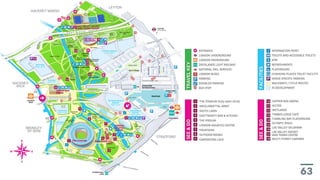
    9- carpenters lock 10-copper box 11- agitos 12- wetland 13- timber lodge café 14- tumbling bay playground 15 – Olympic rings 16- lee valley velo park 17- lee valley hockey 18- multi storey carpark
  • 69.
    Aquatics center Area :15,950 m² Permanent Olympic games - Diving - Swimming - Synchronized swimming - Modern pentathlon Paralympic games - swimming After the games Pool open for use by the community , schools capacity 17.500 (reduced to 2.500 )
  • 70.
    Water polo arena Area: 13,500m2 Temporary Olympic games - water polo After the games Talen down after the games capacity 5000
  • 71.
    Copper box Area :2,743m2 Permanent Olympic sports - handball - modern pentathlon paralympic games - goalball After the games Multi use arena for community use capacity 6.500
  • 72.
    Basketball arena Temporary area :11500 m² Olympic sports - basketball - handball paralympic games - wheel chair basket ball - wheelchair rugby After the games Dismantled with elements reused capacity 12000 (Olympic) 10000(paralympic)
  • 73.
    velodrome Area : 12,500m² Permanent Olympic games - Cycling - Track Paralympic games - Cycling - track After the games The new lee valley velopark for use by community and elite athletes capacity 6000
  • 74.
    Bmx track Temporary Olympic sports -cycling - bmx After the games Dismantled with elements reused capacity 6000
  • 75.
    River bank arena Fieldsize: 100 by 64 metres Temporary Olympic games - hockey Paralympic games - 5-a-side football - 7-a-side football After the games Temporary seating stands dismantled capacity 16000
  • 76.
    Eton manor Area :21,000 m² Permanent Olympic sports - aquatics training paralympic games - wheelchair tennis - aquatics trainig After the games Transformed into facilities for the local community capacity 6500
  • 77.
    Social economics Environmental •Athletes village became the east village • 2.800 new homes • Expansion of more neighbours in the future • New startford tube station and other infrastructure improvements • Queen eleizebeth Olympic park • New school built in the area • 9 b investment to east london • Stadiums used recycled materials • Aquastics centrer for community use • All venues sold of • 300m media center has become an it storge facility • Restoration of the river lea • Improved water quality • Unemployment feel during the olympics • Estimated 10bn of extra income into the uk economy • Wasteland cleaned up • Improved biodiversity • New green spaces for wildlife Social economics Environmental • The people who lived in this area are moved to another place • 8.77bn of tax payer’s money for the Olympics • Olympic stadium cost 760m including renovations in 2016 • Material came from overseas • Increase of unemployments after the competion has done • Businesses had to be moved • Games produced 3.3 m ton of co2 advantages disadvantages
  • 78.
  • 79.
  • 80.
    Abstract • The 1992Games were perhaps the most-successful modern Olympics. More than 9,300 athletes representing 169 countries participated. For the first time in three decades, there was no boycott. The dramatic political changes that had swept across eastern Europe had a tremendous effect on the Olympics..
  • 81.
    Location Objectives • Change froma typical industrial city into an exciting, flexible and cultural core. • Improve the urban quality of life • Restructure the waterfront and make it open to the public.
  • 82.
    The Olympic zones inBarcelona 1, Olympic village 2, Montjuı¨c 3, Diagonal 4, Vall d'Hebron
  • 83.
    Olympic village plan Year: 1989-1992 MainArchitects: Josep Martorell, Oriol Bohigas, David Mackay y Albert Puigdomènech Location: Barcelona (Spain) Description: Consultancy to the top management in the election of building systems for fast track execution, 1850 units in 20 months.
  • 84.
    Montjuic • In theMontjuïc area you will find several sports facilities, built in occasion of the Olympic Games of Barcelona in 1992. • This area is called Olympic Ring and is situated behind the Museu Nacional d’Art de Catalunya, reachable by following l’Avinguda de L’ Estadi.
  • 85.
  • 86.
  • 87.
  • 88.
  • 89.
  • 90.
  • 91.
    stadium Open hockey Covered hall Softball Camp Swimming pool University Rugby football plazaBaseball camp Residental area & parking Land mark Montjuic Olympic area zonning
  • 92.
    stadium Open hockey Covered hall Softball Camp Swimmingpool University Rugby football plaza Baseball camp Residental area & parking stadium stadium Land mark Montjuic Olympic area zonning
  • 93.
  • 94.
    Montjuic Olympic area zonning areastadiu m Swimmi ng pool Residenti al area & parking Covere d hall Baseball camp Universit y Softball Camp Open hockey plaza green total acres 14.4 5.32 5.25 5.74 1 7 5.57 2.3 6.49 7.86 6.78 1.84 113.77 209 m2 58106 21533 21235 23243 4174 28505 22549 9343 26279 31801 27422 7450 477834 845724 % 12% 3.2% 3.35% 2.7% 1.1% 3.1% 3.76% 3.24% 0.88% 56.5% 100% area stadiu m Swimmi ng pool Residenti al area & parking Covere d hall Baseball camp Universit y Softball Camp Open hockey plaza green total acres 14.4 5.32 5.25 5.74 1 7 5.57 2.3 6.49 7.86 6.78 1.84 113.77 209 m2 58106 21533 21235 23243 4174 28505 22549 9343 26279 31801 27422 7450 477834 845724 % 12% 3.2% 3.35% 2.7% 1.1% 3.1% 3.76% 3.24% 0.88% 56.5% 100%
  • 95.
    strategy • • Hostingthe Olympic Games was used as the driving force in the renewal of the city. • • Since the nomination, all projects were forced to develop quickly and urgently to a deadline.This • • A strong political and local leadership with flexible planning. • • The Olympic events were located in the four vertexes of the city
  • 96.
    Actions . Sports infrastructure, conditioningand facilities only represented 9.1% of the total investment in the Olympic Games. • The urban planning model spanned from “acupuncture- urban-planning” to large infrastructural developments such as ring roads and an airport which would improve accessibility.
  • 97.
  • 98.
    Impact THE RECONSTRUCTION OFTHE CITY • **Clearing up the city * • historic buildings were renovated, including the Beaulieu Palace and the Montjuic Stadium. • At the same time, between 1987 and 1992, Barcelona was rapidly modernized. • Beaches were cleaned, new parks were built, public transport to all areas of the city was notably improved and telecommunications networks were deployed. Changes that humanized the urban center.