BUSINESS CYCLES
The  business cycle  is the upward and downward movement of economic activity or real GDP that occurs around the growth trend. Since the late 1940s, :Downturns and panics have generally been less severe. The duration of business cycles has increased. The average length of expansions has increased while the average length of contractions has decreased.
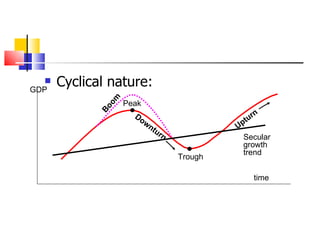
The Phases of the Business Cycle A  peak  is the top of the business cycle. A  trough  is the bottom of the business cycle. A  boom  is a very high peak. A  downturn  is when economic activity starts to fall from a peak. A  upturn  is when economic activity starts to rise from a trough.
The Phases of the Business Cycle Hence the four main phases are: Recession Depression Recovery  Boom Recession occurs faster while recovery is a slower process.
Cyclical nature: GDP time Boom Secular growth trend Downturn Upturn Trough Peak
RECESSION: Consumer demand falls Investment already undertaken appears unprofitable New investment is unlikely Production and employment fall General price level likely to fall DEPRESSION: In the absence of any stimulus, to aggregate demand, depression sets in.
RECOVERY: Business confidence returns Production, sales and profits increase Employment increases Price levels start increasing New technology is adopted BOOM: Output levels increase to go beyond the trend to a boom.
Full utilization of capacity High investment expenditure High profits High business expectations New investment is profitable
Limits to the Business Cycles: Ceilings: When full employment level of output is reached, total volume of output is restricted to limited availability of labour. Floors: At its worst level, business confidence is so low that there is no investment at all.
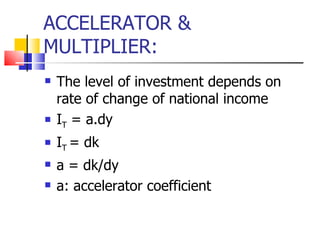
ACCELERATOR & MULTIPLIER: The level of investment depends on rate of change of national income I T  = a.dy I T  = dk a = dk/dy a: accelerator coefficient
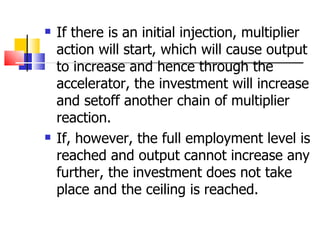
If there is an initial injection, multiplier action will start, which will cause output to increase and hence through the accelerator, the investment will increase and setoff another chain of multiplier reaction. If, however, the full employment level is reached and output cannot increase any further, the investment does not take place and the ceiling is reached.
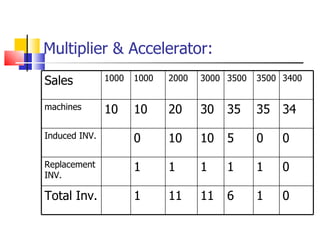
Multiplier & Accelerator: Sales 1000 1000 2000 3000 3500 3500 3400 machines 10 10 20 30 35 35 34 Induced INV. 0 10 10 5 0 0 Replacement INV. 1 1 1 1 1 0 Total Inv. 1 11 11 6 1 0
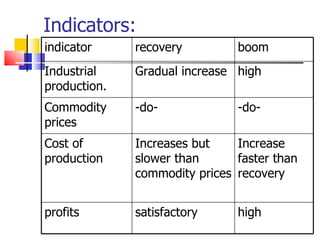
Indicators: indicator recovery boom Industrial production. Gradual increase high Commodity prices -do- -do- Cost of production Increases but slower than commodity prices Increase faster than recovery profits satisfactory high
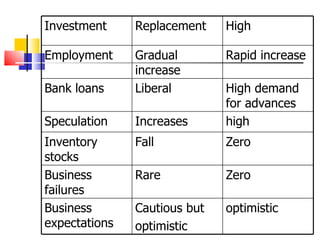
Investment Replacement High Employment Gradual increase Rapid increase Bank loans Liberal High demand for advances Speculation Increases high Inventory stocks Fall Zero Business failures Rare Zero Business expectations Cautious but  optimistic optimistic
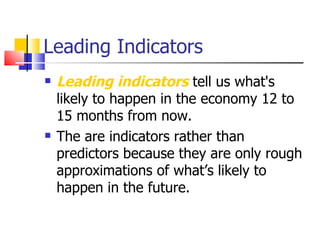
Leading Indicators Leading indicators  tell us what's likely to happen in the economy 12 to 15 months from now. The are indicators rather than predictors because they are only rough approximations of what’s likely to happen in the future.
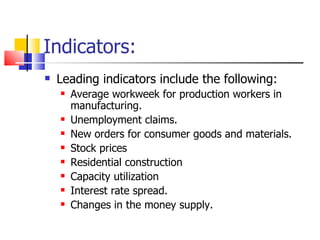
Indicators: Leading indicators include the following: Average workweek for production workers in manufacturing. Unemployment claims. New orders for consumer goods and materials. Stock prices Residential construction Capacity utilization Interest rate spread. Changes in the money supply.
 
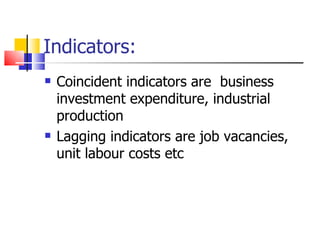
Indicators: Coincident indicators are  business investment expenditure, industrial production Lagging indicators are job vacancies, unit labour costs etc
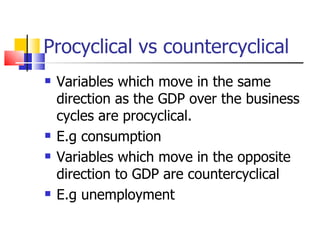
Procyclical vs countercyclical Variables which move in the same direction as the GDP over the business cycles are procyclical. E.g consumption Variables which move in the opposite direction to GDP are countercyclical E.g unemployment
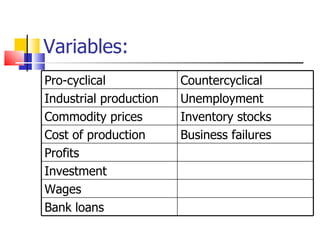
Variables: Pro-cyclical Countercyclical Industrial production Unemployment Commodity prices Inventory stocks Cost of production Business failures Profits Investment Wages Bank loans

Business+cycles

  • 1.
  • 2.
    The businesscycle is the upward and downward movement of economic activity or real GDP that occurs around the growth trend. Since the late 1940s, :Downturns and panics have generally been less severe. The duration of business cycles has increased. The average length of expansions has increased while the average length of contractions has decreased.
  • 3.
    The Phases ofthe Business Cycle A peak is the top of the business cycle. A trough is the bottom of the business cycle. A boom is a very high peak. A downturn is when economic activity starts to fall from a peak. A upturn is when economic activity starts to rise from a trough.
  • 4.
    The Phases ofthe Business Cycle Hence the four main phases are: Recession Depression Recovery Boom Recession occurs faster while recovery is a slower process.
  • 5.
    Cyclical nature: GDPtime Boom Secular growth trend Downturn Upturn Trough Peak
  • 6.
    RECESSION: Consumer demandfalls Investment already undertaken appears unprofitable New investment is unlikely Production and employment fall General price level likely to fall DEPRESSION: In the absence of any stimulus, to aggregate demand, depression sets in.
  • 7.
    RECOVERY: Business confidencereturns Production, sales and profits increase Employment increases Price levels start increasing New technology is adopted BOOM: Output levels increase to go beyond the trend to a boom.
  • 8.
    Full utilization ofcapacity High investment expenditure High profits High business expectations New investment is profitable
  • 9.
    Limits to theBusiness Cycles: Ceilings: When full employment level of output is reached, total volume of output is restricted to limited availability of labour. Floors: At its worst level, business confidence is so low that there is no investment at all.
  • 10.
    ACCELERATOR & MULTIPLIER:The level of investment depends on rate of change of national income I T = a.dy I T = dk a = dk/dy a: accelerator coefficient
  • 11.
    If there isan initial injection, multiplier action will start, which will cause output to increase and hence through the accelerator, the investment will increase and setoff another chain of multiplier reaction. If, however, the full employment level is reached and output cannot increase any further, the investment does not take place and the ceiling is reached.
  • 12.
    Multiplier & Accelerator:Sales 1000 1000 2000 3000 3500 3500 3400 machines 10 10 20 30 35 35 34 Induced INV. 0 10 10 5 0 0 Replacement INV. 1 1 1 1 1 0 Total Inv. 1 11 11 6 1 0
  • 13.
    Indicators: indicator recoveryboom Industrial production. Gradual increase high Commodity prices -do- -do- Cost of production Increases but slower than commodity prices Increase faster than recovery profits satisfactory high
  • 14.
    Investment Replacement HighEmployment Gradual increase Rapid increase Bank loans Liberal High demand for advances Speculation Increases high Inventory stocks Fall Zero Business failures Rare Zero Business expectations Cautious but optimistic optimistic
  • 15.
    Leading Indicators Leadingindicators tell us what's likely to happen in the economy 12 to 15 months from now. The are indicators rather than predictors because they are only rough approximations of what’s likely to happen in the future.
  • 16.
    Indicators: Leading indicatorsinclude the following: Average workweek for production workers in manufacturing. Unemployment claims. New orders for consumer goods and materials. Stock prices Residential construction Capacity utilization Interest rate spread. Changes in the money supply.
  • 17.
  • 18.
    Indicators: Coincident indicatorsare business investment expenditure, industrial production Lagging indicators are job vacancies, unit labour costs etc
  • 19.
    Procyclical vs countercyclicalVariables which move in the same direction as the GDP over the business cycles are procyclical. E.g consumption Variables which move in the opposite direction to GDP are countercyclical E.g unemployment
  • 20.
    Variables: Pro-cyclical CountercyclicalIndustrial production Unemployment Commodity prices Inventory stocks Cost of production Business failures Profits Investment Wages Bank loans