5/27/2010


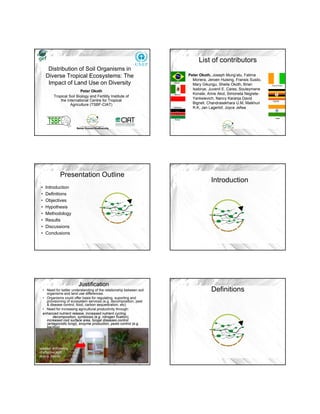
                                                                                       List of contributors
      Distribution of Soil Organisms in
     Diverse Tropical Ecosystems: The                                            Peter Okoth, Joseph Mung’atu, Fatima
                                                                                   Moriera, Jeroen Huising, Fransis Susilo,
      Impact of Land Use on Diversity                                Brazil
                                                                                   Mary Gikungu, Sheila Okoth, Brian          Cote d’Ivoire

                                                                                   Isabirye, Juvenil E. Cares, Souleymane
                          Peter Okoth
                                                                     Mexico        Konate, Anne Akol, Si
                                                                                   K     t A     Ak l Simoneta N
                                                                                                               t Negrete-
                                                                                                                       t
          Tropical Soil Biology and Fertility Institute of
                                                                                   Yankelevich, Nancy Karanja David
              the International Centre for Tropical                                                                            Uganda

                    Agriculture (TSBF-CIAT)                                        Bignell, Chandrasekhara U.M, Maikhuri
                                                                     Indonesia     R.K, Jan Lagerlof, Joyce Jefwa

                                                                                                                                  India
                                                                      Kenya


               Presentation Outline
                                                                                              Introduction
 •   Introduction
 •   Definitions
 •   Objectives
 •   Hypothesis
 •   Methodology
 •   Results
 •   Discussions
 •   Conclusions                 Macro and meso-fauna


                         Justification
  • Need for better understanding of the relationship between soil
    organisms and land use differences.
                                                                                              Definitions
  • Organisms could offer basis for regulating, suporting and
    provisioning of ecosystem services (e.g. decomposition, pest
    & disease control, food, carbon sequestration, etc)
  • Need for increasing agricultural productivity through:
  enhanced nutrient release, increased nutrient cycling,
        decomposition, symbiosis (e.g. nitrogen fixation),
    increased root surface area, fungal diseases control
                                ,    g
    (antagonistic fungi), enzyme production, pests control (e.g.
    bacillus)


Isolation and testing
of effective AMF
strains, Mexico


                                                                                                                                              1
5/27/2010


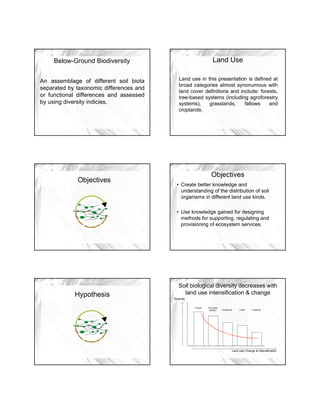
     Below-Ground Biodiversity                                     Land Use

An assemblage of different soil biota        Land use in this presentation is defined at
                                             broad categories almost synonumous with
separated by taxonomic differences and
                                             land cover definitions and include: forests
                                                                                  forests,
or functional differences and assessed       tree-based systems (including agroforestry
by using diversity indicies.                 systems),    grasslands,     fallows     and
                                             croplands.


                                                                  Objectives
             Objectives
                                           • Create better knowledge and
                                             understanding of the distribution of soil
                                             organisms in different land use kinds.

                                           • Use knowledge gained for designing
                                             methods for supporting, regulating and
                                             provisioning of ecosystem services.


                                            Soil biological diversity decreases with
            Hypothesis                        land use intensification & change
                                         Diversity


                                                     Forests   Tree based
                                                                systems     Grasslands    Fallow   Croplands


                                                                                     Land Use Change & Intensification


                                                                                                                            2
5/27/2010


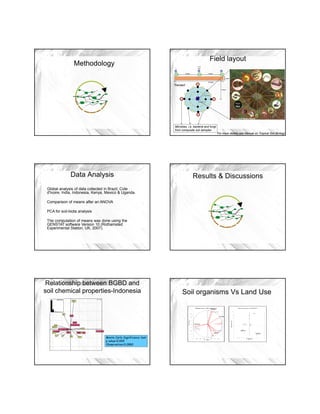
                                                                                                                                             Field layout
                                 Methodology                                                                         13 cm


                                                                                                         6 metres                      6 metres


                                                                                                                                                            2 metres


                                                                                                                                       20 metres

                                                                                              Transect
                                                                                                                                                      8 metres


                                                                                                                                  6 metres


                                                                                                                       3 metres


                                                                                                                                                                       Macro and meso-fauna


                                                                                              Microbes, i.e, bacteria and fungi
                                                                                              from composite soil samples
                                                                                                                                                   For more details-see Manual on Tropical Soil Biology


                           Data Analysis                                                                            Results & Discussions
 Global analysis of data collected in Brazil, Cote
 d'Ivoire, India, Indonesia, Kenya, Mexico & Uganda.

 Comparison of means after an ANOVA

 PCA for soil-biota analysis

 The computation of means was done using the
 GENSTAT software Version 10 (Rothamsted
 Experimental Station, UK, 2007).


Relationship between BGBD and
soil chemical properties-Indonesia                                                                 Soil organisms Vs Land Use
           Eigenvalues                              d = 0.5
                             P205


                     pH
                           PPF


                                 AMF
      Mg                   Collembolla
    Bsat
                                              OM
            Earthworms
     Beetles                                       Termites
    Sca              Ant               Nematode
                                          N
       Ca           K      Na           CEC
                                                              Monte Carlo Significance test
                                                              p value=0.009
                                                              Observation=0.2882


                                                                                                                                                                                                          3
5/27/2010


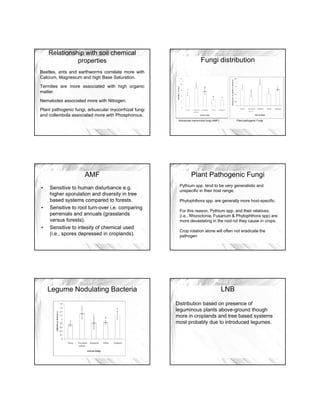
    Relationship with soil chemical
              properties                                                  Fungi distribution
Beetles, ants and earthworms correlate more with
Calcium, Magnesium and high Base Saturation.
Termites are more associated with high organic
matter.
matter
Nematodes associated more with Nitrogen.
Plant pathogenic fungi, arbuscular mycorrhizal fungi
and collembola associated more with Phosphorous.
                                                        Arbuscular mycorrhizal fungi (AMF)         Plant pathogenic Fungi


                      AMF                                         Plant Pathogenic Fungi
                                                        Pythium spp. tend to be very generalistic and
•   Sensitive to human disturbance e.g.
                                                        unspecific in their host range.
    higher sporulation and diversity in tree
    based systems compared to forests.                  Phytophthora spp. are generally more host-specific.
•   Sensitive to root turn-over i.e. comparing
                      turn over i e
                                                        For this reason, Pythium spp. and their relatives,
    perrenials and annuals (grasslands                  (i.e., Rhizoctonia, Fusarium & Phytophthora spp) are
    versus forests).                                    more devastating in the root rot they cause in crops.
•   Sensitive to intesity of chemical used
                                                        Crop rotation alone will often not eradicate the
    (i.e., spores depressed in croplands).              pathogen


    Legume Nodulating Bacteria                                                               LNB
                                                       Distribution based on presence of
                                                       leguminous plants above-ground though
                                                       more in croplands and tree based systems
                                                       most probably due to introduced legumes
                                                                                       legumes.


                                                                                                                                   4
5/27/2010


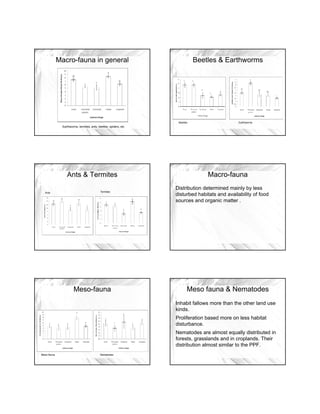
             Macro-fauna in general                                           Beetles & Earthworms


                                                                    Beetles                     Earthworms
               Earthworms, termites, ants, beetles, spiders, etc


                  Ants & Termites                                                 Macro-fauna
                                                                   Distribution determined mainly by less
  Ants                                      Termites
                                                                   disturbed habitats and availability of food
                                                                   sources and organic matter .


                       Meso-fauna                                         Meso fauna & Nematodes
                                                                   Inhabit fallows more than the other land use
                                                                   kinds.
                                                                   Proliferation based more on less habitat
                                                                   disturbance.
                                                                   Nematodes are almost equally distributed in
                                                                   forests, grasslands and in croplands. Their
                                                                   distribution almost similar to the PPF.
Meso-fauna                                  Nematodes


                                                                                                                         5
5/27/2010


  Conclusions                         Message
                  Soil biota in general change with land use kinds.
                  The direction of change is however not in any one
                  direction. Tree based systems seems to favour the
                  highest diversity.
                  The b o a see s to a g themselves with nutrients,
                     e biota seems o align e se es              u e s,
                  land use, food chains, their individual functions and
                  habitats.
                  The trends show that soil biota can be used to
                  further understand their niches including
                  opportunities in ecosystems services.


Acknowledgement                       Thanking
                       • Global Environment Facility (GEF) for the
                         financial support.
                       • UNEP for implementation support.
                       • Diversitas for the conference organization.
                       • SIDA for the sponsoring this particular
                         presentation.
                       • CIAT Director General and TSBF Director for
                         making the work possible in good environment.
                       • Countries and partners in: Brazil, Cote d’Ivoire,
                         India, Indonesia, Kenya, Mexico and Uganda


                                                                                    6

PK06:Distribution of Soil Organisms in Diverse Tropical Ecosystems: The Impact of Land Use on Diversity

  • 1.
    5/27/2010 List of contributors Distribution of Soil Organisms in Diverse Tropical Ecosystems: The Peter Okoth, Joseph Mung’atu, Fatima Moriera, Jeroen Huising, Fransis Susilo, Impact of Land Use on Diversity Brazil Mary Gikungu, Sheila Okoth, Brian Cote d’Ivoire Isabirye, Juvenil E. Cares, Souleymane Peter Okoth Mexico Konate, Anne Akol, Si K t A Ak l Simoneta N t Negrete- t Tropical Soil Biology and Fertility Institute of Yankelevich, Nancy Karanja David the International Centre for Tropical Uganda Agriculture (TSBF-CIAT) Bignell, Chandrasekhara U.M, Maikhuri Indonesia R.K, Jan Lagerlof, Joyce Jefwa India Kenya Presentation Outline Introduction • Introduction • Definitions • Objectives • Hypothesis • Methodology • Results • Discussions • Conclusions Macro and meso-fauna Justification • Need for better understanding of the relationship between soil organisms and land use differences. Definitions • Organisms could offer basis for regulating, suporting and provisioning of ecosystem services (e.g. decomposition, pest & disease control, food, carbon sequestration, etc) • Need for increasing agricultural productivity through: enhanced nutrient release, increased nutrient cycling, decomposition, symbiosis (e.g. nitrogen fixation), increased root surface area, fungal diseases control , g (antagonistic fungi), enzyme production, pests control (e.g. bacillus) Isolation and testing of effective AMF strains, Mexico 1
  • 2.
    5/27/2010 Below-Ground Biodiversity Land Use An assemblage of different soil biota Land use in this presentation is defined at broad categories almost synonumous with separated by taxonomic differences and land cover definitions and include: forests forests, or functional differences and assessed tree-based systems (including agroforestry by using diversity indicies. systems), grasslands, fallows and croplands. Objectives Objectives • Create better knowledge and understanding of the distribution of soil organisms in different land use kinds. • Use knowledge gained for designing methods for supporting, regulating and provisioning of ecosystem services. Soil biological diversity decreases with Hypothesis land use intensification & change Diversity Forests Tree based systems Grasslands Fallow Croplands Land Use Change & Intensification 2
  • 3.
    5/27/2010 Field layout Methodology 13 cm 6 metres 6 metres 2 metres 20 metres Transect 8 metres 6 metres 3 metres Macro and meso-fauna Microbes, i.e, bacteria and fungi from composite soil samples For more details-see Manual on Tropical Soil Biology Data Analysis Results & Discussions Global analysis of data collected in Brazil, Cote d'Ivoire, India, Indonesia, Kenya, Mexico & Uganda. Comparison of means after an ANOVA PCA for soil-biota analysis The computation of means was done using the GENSTAT software Version 10 (Rothamsted Experimental Station, UK, 2007). Relationship between BGBD and soil chemical properties-Indonesia Soil organisms Vs Land Use Eigenvalues d = 0.5 P205 pH PPF AMF Mg Collembolla Bsat OM Earthworms Beetles Termites Sca Ant Nematode N Ca K Na CEC Monte Carlo Significance test p value=0.009 Observation=0.2882 3
  • 4.
    5/27/2010 Relationship with soil chemical properties Fungi distribution Beetles, ants and earthworms correlate more with Calcium, Magnesium and high Base Saturation. Termites are more associated with high organic matter. matter Nematodes associated more with Nitrogen. Plant pathogenic fungi, arbuscular mycorrhizal fungi and collembola associated more with Phosphorous. Arbuscular mycorrhizal fungi (AMF) Plant pathogenic Fungi AMF Plant Pathogenic Fungi Pythium spp. tend to be very generalistic and • Sensitive to human disturbance e.g. unspecific in their host range. higher sporulation and diversity in tree based systems compared to forests. Phytophthora spp. are generally more host-specific. • Sensitive to root turn-over i.e. comparing turn over i e For this reason, Pythium spp. and their relatives, perrenials and annuals (grasslands (i.e., Rhizoctonia, Fusarium & Phytophthora spp) are versus forests). more devastating in the root rot they cause in crops. • Sensitive to intesity of chemical used Crop rotation alone will often not eradicate the (i.e., spores depressed in croplands). pathogen Legume Nodulating Bacteria LNB Distribution based on presence of leguminous plants above-ground though more in croplands and tree based systems most probably due to introduced legumes legumes. 4
  • 5.
    5/27/2010 Macro-fauna in general Beetles & Earthworms Beetles Earthworms Earthworms, termites, ants, beetles, spiders, etc Ants & Termites Macro-fauna Distribution determined mainly by less Ants Termites disturbed habitats and availability of food sources and organic matter . Meso-fauna Meso fauna & Nematodes Inhabit fallows more than the other land use kinds. Proliferation based more on less habitat disturbance. Nematodes are almost equally distributed in forests, grasslands and in croplands. Their distribution almost similar to the PPF. Meso-fauna Nematodes 5
  • 6.
    5/27/2010 Conclusions Message Soil biota in general change with land use kinds. The direction of change is however not in any one direction. Tree based systems seems to favour the highest diversity. The b o a see s to a g themselves with nutrients, e biota seems o align e se es u e s, land use, food chains, their individual functions and habitats. The trends show that soil biota can be used to further understand their niches including opportunities in ecosystems services. Acknowledgement Thanking • Global Environment Facility (GEF) for the financial support. • UNEP for implementation support. • Diversitas for the conference organization. • SIDA for the sponsoring this particular presentation. • CIAT Director General and TSBF Director for making the work possible in good environment. • Countries and partners in: Brazil, Cote d’Ivoire, India, Indonesia, Kenya, Mexico and Uganda 6