
5/27/2010


                                                                                1. Premises for our Project

  ASB and CSM-BGBD: towards a                                                   2. Why fauna?
   universal sampling protocol for
   soil biotas in the humid tropics                                             3.
                                                                                3 Evolution of sampling methods

                                                                                4. (Evolution of sampling design)
                        David Bignell
               Queen Mary, University of London, UK                             5. Conclusions
                                 and
         Universiti Malaysia Sabah, Kota Kinabalu, Malaysia


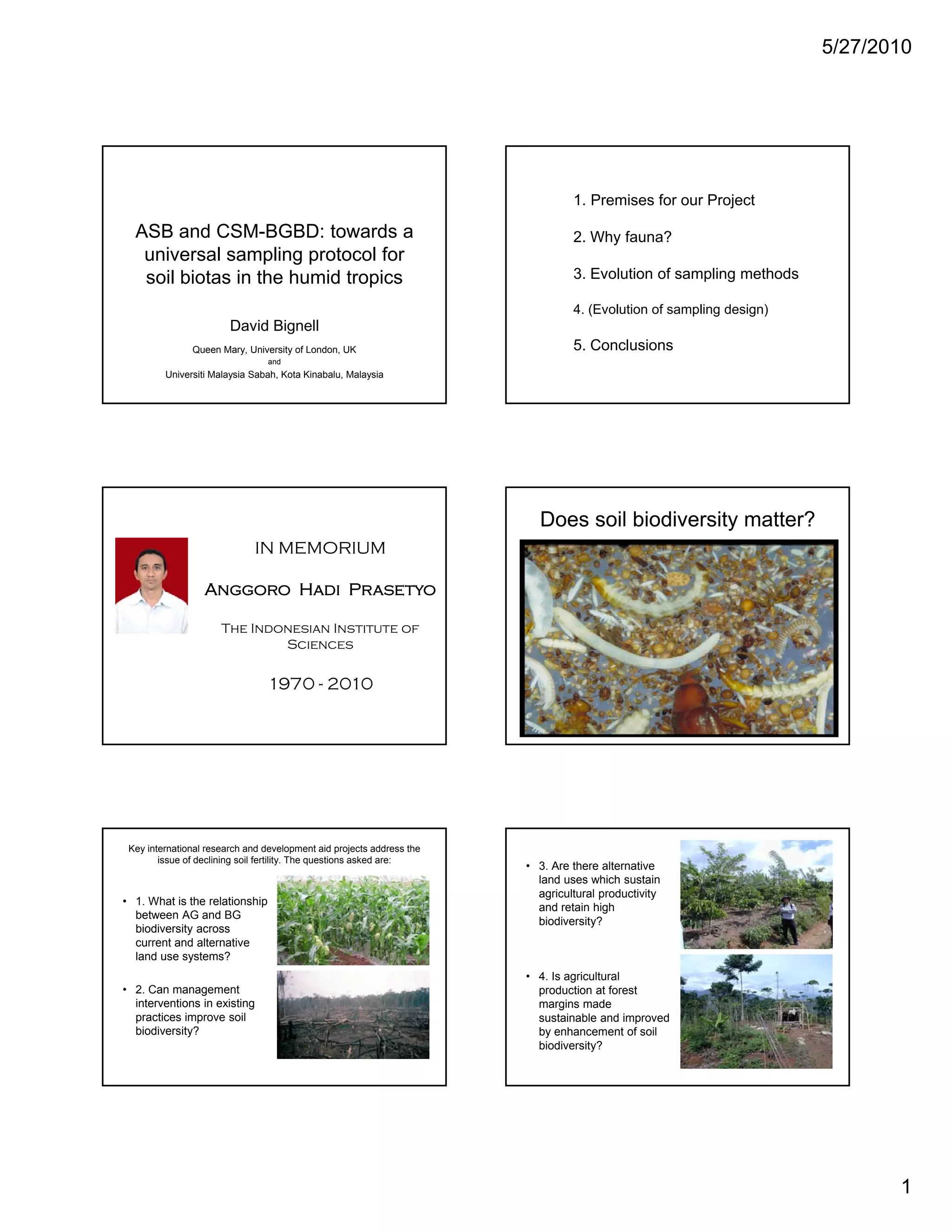
                                                                         Does soil biodiversity matter?
                             IN MEMORIUM

                  Anggoro Hadi Prasetyo

                      The Indonesian Institute of
                              Sciences


                                1970 - 2010


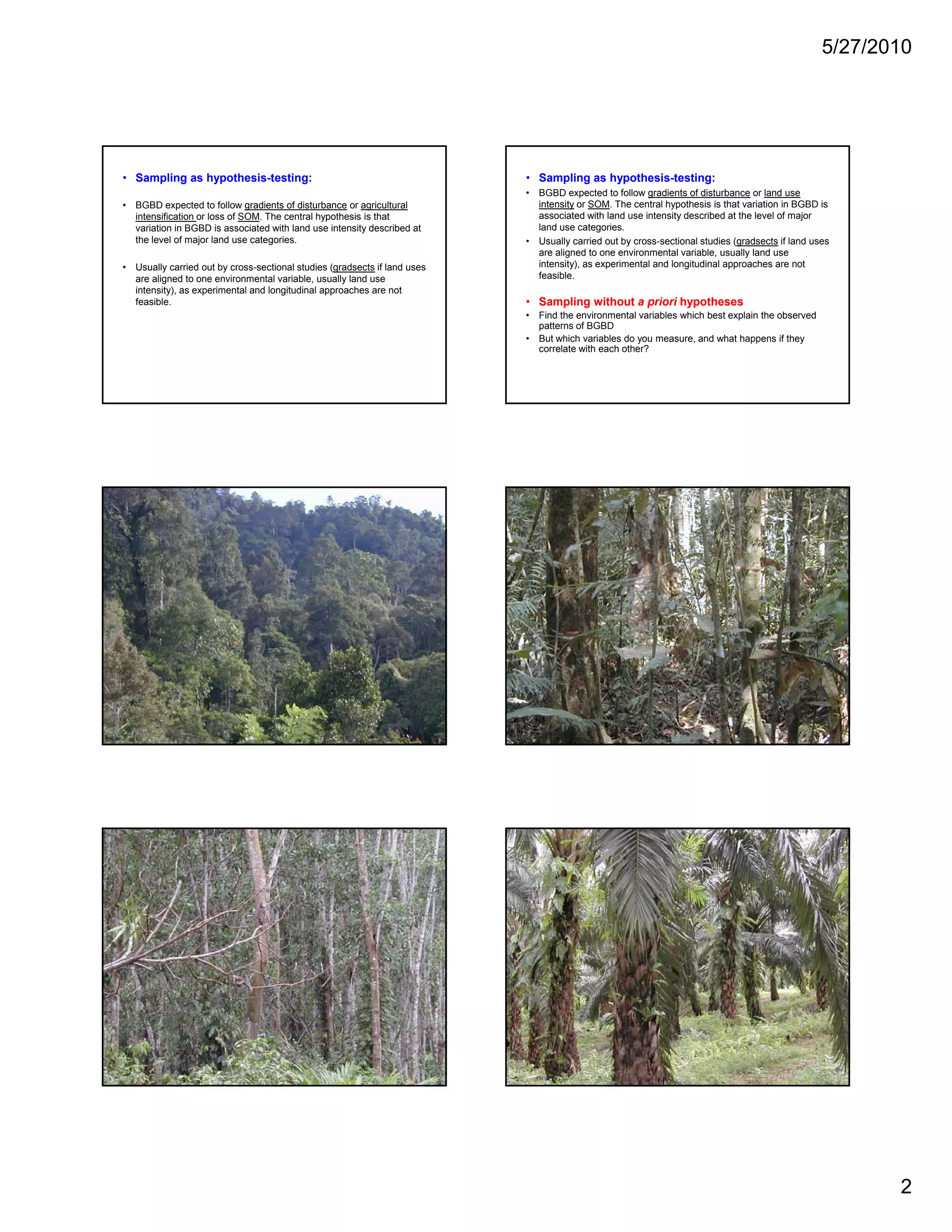
 Key international research and development aid projects address the
        issue of declining soil fertility. The questions asked are:
                                                                       • 3. Are there alternative
                                                                         land uses which sustain
                                                                         agricultural productivity
• 1. What is the relationship
                                                                         and retain high
  between AG and BG
                                                                         biodiversity?
  biodiversity across
  current and alternative
  land use systems?
                                                                       • 4. Is agricultural
• 2. Can management                                                      production at forest
  interventions in existing                                              margins made
  practices improve soil                                                 sustainable and improved
  biodiversity?                                                          by enhancement of soil
                                                                         biodiversity?


                                                                                                                           1
5/27/2010


• Sampling as hypothesis-testing:                                          • Sampling as hypothesis-testing:
                                                                           • BGBD expected to follow gradients of disturbance or land use
• BGBD expected to follow gradients of disturbance or agricultural           intensity or SOM. The central hypothesis is that variation in BGBD is
  intensification or loss of SOM. The central hypothesis is that             associated with land use intensity described at the level of major
  variation in BGBD is associated with land use intensity described at       land use categories.
  the level of major land use categories.                                  • Usually carried out by cross-sectional studies (gradsects if land uses
                                                                             are aligned to one environmental variable, usually land use
• Usually carried out by cross-sectional studies (gradsects if land uses     intensity), as experimental and longitudinal approaches are not
  are aligned to one environmental variable, usually land use                feasible.
                                                                             feasible
  intensity), as experimental and longitudinal approaches are not
  feasible.                                                                • Sampling without a priori hypotheses
                                                                           • Find the environmental variables which best explain the observed
                                                                             patterns of BGBD
                                                                           • But which variables do you measure, and what happens if they
                                                                             correlate with each other?


                                                                                                                                                        2
5/27/2010


  What is the future of tropical landscapes?
• Some primary and secondary forests gazetted as reserves, but
  mainly at higher altitudes, including montane forests.
  Biodiversity retention up to 100%

• Plantation landscapes: rubber, oil palm, pulpwood, hardwood.
  Biodiversity retention variable 10% - 50%

• Segregated landscapes: intact larger or smaller forest
  fragments separated by crop or plantation monocultures,
  mixtures or rotations. Notable edge effects. Biodiversity
  retention up to 60%

• Integrated landscapes: multistrata mixed treecrops or
  agroforests. Biodiversity retention 40%

• Uniformly simplified or degraded landscapes: nutrient depleted
  sites dominated by invasive weeds, with severe soil erosion.
  Biodiversity retention 10% or less


                                                                     3
5/27/2010


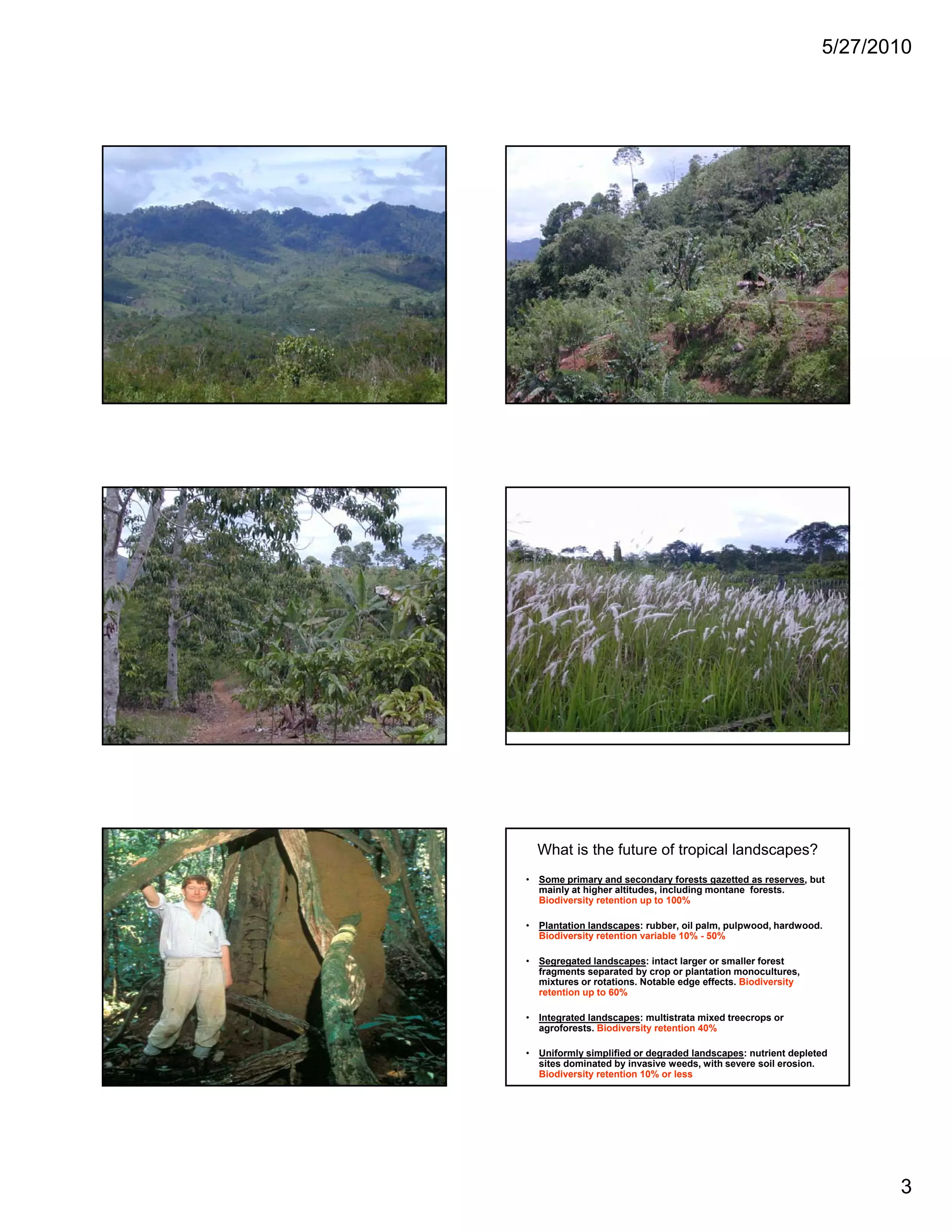
Ecosystem function conservation is a more practical approach than biodiversity                                               Ecosystem function conservation is a more practical approach than biodiversity
conservation per se; for example the following 10 functional groups are required:                                            conservation per se; for example the following 10 functional groups are required:

•   1. Primary producers (higher and lower             •   6. Predators (many macrofauna and                                 •   1. Primary producers (higher and lower             •   6. Predators (many macrofauna and
    plants): photosynthetic organisms                      mesofauna): animals which regulate                                    plants): photosynthetic organisms                      mesofauna): animals which regulate
    assimilating carbon dioxide from the air,              herbivores, ecosystem engineers, litter                               assimilating carbon dioxide from the air,              herbivores, ecosystem engineers, litter
    penetrating the soil with rooting systems and          transformers, decomposers and                                         penetrating the soil with rooting systems and          transformers, decomposers and
    translocating organic compounds                        microregulators through predation.                                    translocating organic compounds                        microregulators through predation.
    synthesized above ground.                          •   7. Microregulators (e.g. microfauna such                              synthesized above ground.                          •   7. Microregulators (e.g. microfauna such
•   2. Herbivores: animals consuming and                   as nematodes): animals which regulate                             •   2. Herbivores: animals consuming and                   as nematodes): animals which regulate
    partly digesting living plant tissues, including       nutrient cycles through grazing and other                             partly digesting living plant tissues, including       nutrient cycles through grazing and other
    leaf miners and rollers, stem borers and sap           interactions with the decomposer                                      leaf miners and rollers, stem borers and sap           interactions with the decomposer
    suckers.                                               microorganisms.                                                       suckers.                                               microorganisms.
•   3. Ecosystem engineers (e.g. macrofauna            •   8. Microsymbionts (e.g. mycorrhizal fungi,                        •   3. Ecosystem engineers (e.g. macrofauna            •   8. Microsymbionts (e.g. mycorrhizal fungi,
    such as termites, earthworms):organisms                rhizobia): microorganisms associated with                             such as termites, earthworms):organisms                rhizobia): microorganisms associated with
    which have major physical impact on soil               roots that enhance nutrient uptake                                    which have major physical impact on soil               roots that enhance nutrient uptake
    through soil t
    th     h il transport ,building of aggregate
                           t b ildi    f          t    •   9. Soil-borne pests and diseases (e.g.                                through soil t
                                                                                                                                 th     h il transport, b ildi of aggregate
                                                                                                                                                        t building f           t    •   9. Soil-borne pests and diseases (e.g.
    structures and formation of pores – as well            fungal pathogens, invertebrate                                        structures and formation of pores – as well            fungal pathogens, invertebrate
    as influencing nutrient cycling. Can include           pests):biological control species (e.g.                               as influencing nutrient cycling. Can include           pests):biological control species (e.g.
    predators (e.g. many ants).                            predators, parasitoids and hyper parasites of                         predators (e.g. many ants).                            predators, parasitoids and hyper parasites of
•   4. Litter transformers (many macrofauna                pests and diseases) can also be included.                         •   4. Litter transformers (many macrofauna                pests and diseases) can also be included.
    and mesofauna, but some microfauna):               •   10. Prokaryotic transformers: Archaea and                             and mesofauna, but some microfauna):               •   10. Prokaryotic transformers: Archaea and
    invertebrates feeding on microbially-                  Bacteria performing specific transformations                          invertebrates feeding on microbially-                  Bacteria performing specific transformations
    conditioned organic detritus and shredding             of carbon (e.g.methanotrophy) or nutrient                             conditioned organic detritus and shredding             of carbon (e.g.methanotrophy) or nutrient
    this material (comminution) and making it              elements such as N, S or P (e.g. nitrification,                       this material (comminution) and making it              elements such as N, S or P (e.g. nitrification,
    more accessible to decomposers, or                     nitrogen fixation).                                                   more accessible to decomposers, or                     nitrogen fixation).
    promoting microbial growth in pelletized                                                                                     promoting microbial growth in pelletized
    faeces. This activity can be performed at          •   Source: Swift, M.J., Bignell, D.E., Moreira, F.M.S., Huising,
                                                                                                                                 faeces. This activity can be performed at          •   Source: Swift, M.J., Bignell, D.E., Moreira, F.M.S., Huising,
    several spatial scales.                                E.J. 2008. The inventory of soil biological diversity: concepts       several spatial scales.                                E.J. 2008. The inventory of soil biological diversity: concepts
•   5. Decomposers (e.g. cellulose degrading               and general guidelines. In: A Handbook of Tropical Soil           •   5. Decomposers (e.g. cellulose degrading               and general guidelines. In: A Handbook of Tropical Soil
                                                           Biology: Sampling and Characterization of Below-ground                                                                       Biology: Sampling and Characterization of Below-ground
    fungi or bacteria): microorganisms                     Biodiversity (eds. F.M.S. Moreira, E.J. Huising and D.E.              fungi or bacteria): microorganisms                     Biodiversity (eds. F.M.S. Moreira, E.J. Huising and D.E.
    possessing the polymer degrading enzymes               Bignell), pp 1-16. Earthscan, London.                                 possessing the polymer degrading enzymes               Bignell), pp 1-16. Earthscan, London.
    that are responsible for most of the energy                                                                                  that are responsible for most of the energy
    flow in the decomposer food web.                                                                                             flow in the decomposer food web.


                                                                                                                                                 Where are we now?
                                                                                                                             • 1989                  “TSBF” : Tropical Soil Biology and Fertility
                                                                                                                                                     (Anderson and Ingram)

                                                                                                                             • 2001                  ASB: Alternatives to Slash-and-Burn
                                                                                                                                                     (
                                                                                                                                                     (Swift and Bignell)
                                                                                                                                                                  g    )

                                                                                                                             • 2008                  CSM-BGBD: Conservation and Sustainable
                                                                                                                                                    Management of Below-ground Biodiversity
                                                                                                                                                    (Moreira, Huising and Bignell)


                                                                                                                                                                                                                                                           4
5/27/2010


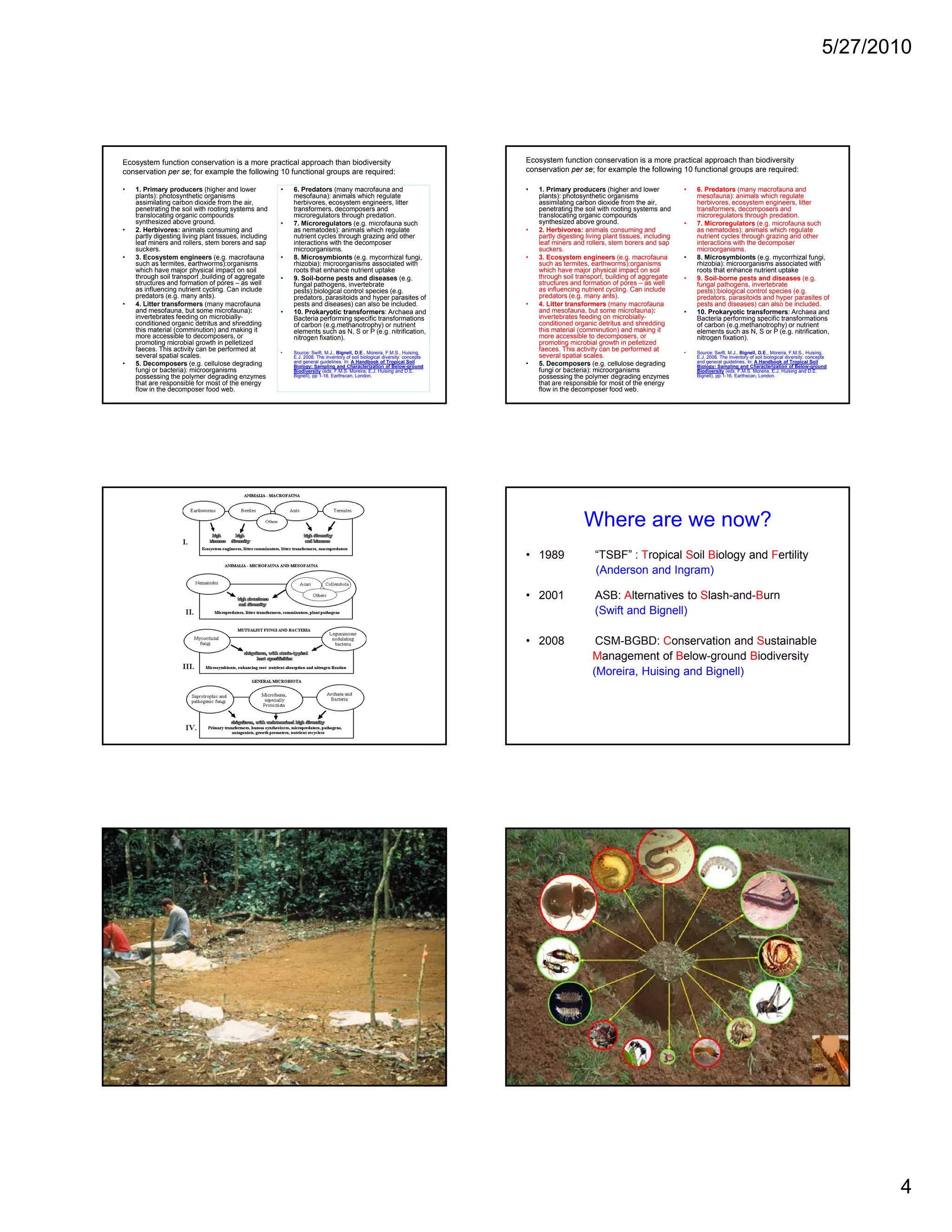
                                                                                                                                         The “TSBF” transect (1989)


                                                                                                                                            25 cm                                                                                   5 metres
                                                                                                                                                                                                    5, 8 or 10
                                                                                                                                                        25                                          monoliths as
                                                                                                                                                        cm                                          resources
                                                                                                                                                                                                    permitit
                                                                                                                                          20 or 30 cm
                                                                                                                                            depth


                                                                                                                                        40 metres                                     Other cores (pattern not specified) for:

                                                                                                                                                                                      Mycorrhizal roots
                                                                                                                                                                                      Rhizosphere bacteria
                                                                                                                                                                                      Viable rhizobia
                                                                                                                                            Macrofauna                                Soil physics/chemistry


    The Swift and Bignell ASB transect (2001)
                                                                                                                                             60
                                                          20 small cores
Prior litter removal, then                                per 8 x 5 m
5-8 soil monoliths, each                                  section for
25 x 25 x 30 (depth) cm                                   microsymbionts                                                                     50                                                                                 2500      40
                                                                                                       Soil physical
                                                                         Examine plant                 sampling
                                                                         roots for nodules             from walls of
                                                                         and mycorrhiza                monolith pit
                                                          40 m                                                                               40                                                                                 2000
                                                                                                                                                                                                                                          30
                                                                                                                       Monolith soil
   5m                                                                                                                  sorted for
                                                                                                                       for macrofauna
                                                                             TRANSECT 1
                                                                                                                                             30                                                                                 1500

           Line of 10 (or more) pitfall traps, each                                                                                                                                                                                       20
           ca.15 cm diameter
                                                           10 soil samples from plant                                                        20                                                                                 1000
                                                           rhizosphere, 0-30 cm, bulked to
                                                           ca. 1 litre for nematode extraction

             1       2       3       4       5        6      7       8         9     10      11        etc.             19      20                                                                                                        10
                                                                                                                                             10                                                                                 500
             Qualitative termite transect, 100 x 2 m, in 20 sections of 5 x 2 m each


                                         40 m
                                                                                                                                                                                                                                0
                                                                                                                                                    Pristine   Logged      Tree         Rubber      Jungle   Alang-   Cassava
   5m
                                                                                                                                                     forest     forest   plantation    plantation   rubber   alang     field
                                                                                                                        19      20
                                                                             TRANSECT 2
                                                                                                                                                                                 Land-use system
                                                                                                  Termite transect can turn up to 90o
                                                                                                  to accommodate topography or
                                                                                                  bend around living trees.


CSM-BGBD monolith, ring and transect (2008)                                                                                              CSM-BGBD enhanced monolith and transect (2008)


                                                                                                                                                                                                                                                      5
5/27/2010


CSM-BGBD sampling points allocated by a GPS grid
                                                                                           Sampling                                                 Sampling scheme
                                                                                           parameter
                                                                                                                   “TSBF” transect           Swift & Bignell    CSM-BGBD       CSM-BGBD
                                                                                                                       (1989)                    (2001)            basic     alternate (2008)
                                                                                                                                                                  (2008)

                                                                                           Selection of plots     Not specified             Subjective         From GPS      From GPS
                                                                                                                                                               window grid   window grid

                                                                                           Plots per land use     Not specified             3                  20            20
                                                                                           recommended

                                                                                           Sampling events        Not specified             620 (1860)         51 (1020)     71 (1420)
                                                                                           per plot (per
                                                                                           land use in
                                                                                           bracket)
                                                                                           Samples for            Not specified             106 (318)          22 (440)      42 (840)
                                                                                           analysis per plot
                                                                                           (per land use in
                                                                                           bracket)

                                                                                           Time required          One day                   Two days           One day       Two days
                                                                                           per plot,
                                                                                           assuming 6-10
                                                                                           staff available*
                                                                                                  * includes on-site sorting time for monoliths


         Sampling parameter         Transect based (few         Grid based (many
                                   plots, higher effort per   plots, lower effort per                                              Conclusions
                                             plot)                     plot)


        Ease of positioning        Higher                     Lower                     • 1. Selection of sampling points should be grid-
        samples, access to sites
        and field logistics                                                               based. This provides for:
        Overall field time         Shorter                    Longer
                                                                                          – the best representation of land uses
        Representation of the      Less good, normally        Better, normally
        land use distribution      more subjective;           derived from remote         – the best statistical descriptions of data
                                   concentrates               sensing; spreads
                                   sampling, but rare         sampling, but rare
                                   land uses can be           land uses may be
                                   chosen                     missed
        Autocorrelation            High                       Low
                                                                                        • 2. Plot sampling schemes can combine
        Stratification             Possible                   Possible                    monoliths, transects and soil cores. This
        Sensitivity to
        aggregated species
                                   Low                        High (better than
                                                              random sampling)
                                                                                          provides for:
        Precision of               Higher                     Lower                       – co-location of sampling for macrofauna, mesofauna,
        biodiversity sampling
        Replication                Pseudoreplication          Genuine replication
                                                                                            microfauna, microsymbionts and other microbiota
        Redundant points           Few, if any                Some                        – the highest resolution of below-ground biodiversity
        Estimations of             Problematic (or high       Possible (or lower
        abundance and              variance)                  variance)
        biomass


                                                                                                                                                                                                       6
5/27/2010


       7

OP03:Towards a universal sampling protocol for macro and meso-fauna in the humid tropics

  • 1.
    5/27/2010 1. Premises for our Project ASB and CSM-BGBD: towards a 2. Why fauna? universal sampling protocol for soil biotas in the humid tropics 3. 3 Evolution of sampling methods 4. (Evolution of sampling design) David Bignell Queen Mary, University of London, UK 5. Conclusions and Universiti Malaysia Sabah, Kota Kinabalu, Malaysia Does soil biodiversity matter? IN MEMORIUM Anggoro Hadi Prasetyo The Indonesian Institute of Sciences 1970 - 2010 Key international research and development aid projects address the issue of declining soil fertility. The questions asked are: • 3. Are there alternative land uses which sustain agricultural productivity • 1. What is the relationship and retain high between AG and BG biodiversity? biodiversity across current and alternative land use systems? • 4. Is agricultural • 2. Can management production at forest interventions in existing margins made practices improve soil sustainable and improved biodiversity? by enhancement of soil biodiversity? 1
  • 2.
    5/27/2010 • Sampling ashypothesis-testing: • Sampling as hypothesis-testing: • BGBD expected to follow gradients of disturbance or land use • BGBD expected to follow gradients of disturbance or agricultural intensity or SOM. The central hypothesis is that variation in BGBD is intensification or loss of SOM. The central hypothesis is that associated with land use intensity described at the level of major variation in BGBD is associated with land use intensity described at land use categories. the level of major land use categories. • Usually carried out by cross-sectional studies (gradsects if land uses are aligned to one environmental variable, usually land use • Usually carried out by cross-sectional studies (gradsects if land uses intensity), as experimental and longitudinal approaches are not are aligned to one environmental variable, usually land use feasible. feasible intensity), as experimental and longitudinal approaches are not feasible. • Sampling without a priori hypotheses • Find the environmental variables which best explain the observed patterns of BGBD • But which variables do you measure, and what happens if they correlate with each other? 2
  • 3.
    5/27/2010 Whatis the future of tropical landscapes? • Some primary and secondary forests gazetted as reserves, but mainly at higher altitudes, including montane forests. Biodiversity retention up to 100% • Plantation landscapes: rubber, oil palm, pulpwood, hardwood. Biodiversity retention variable 10% - 50% • Segregated landscapes: intact larger or smaller forest fragments separated by crop or plantation monocultures, mixtures or rotations. Notable edge effects. Biodiversity retention up to 60% • Integrated landscapes: multistrata mixed treecrops or agroforests. Biodiversity retention 40% • Uniformly simplified or degraded landscapes: nutrient depleted sites dominated by invasive weeds, with severe soil erosion. Biodiversity retention 10% or less 3
  • 4.
    5/27/2010 Ecosystem function conservationis a more practical approach than biodiversity Ecosystem function conservation is a more practical approach than biodiversity conservation per se; for example the following 10 functional groups are required: conservation per se; for example the following 10 functional groups are required: • 1. Primary producers (higher and lower • 6. Predators (many macrofauna and • 1. Primary producers (higher and lower • 6. Predators (many macrofauna and plants): photosynthetic organisms mesofauna): animals which regulate plants): photosynthetic organisms mesofauna): animals which regulate assimilating carbon dioxide from the air, herbivores, ecosystem engineers, litter assimilating carbon dioxide from the air, herbivores, ecosystem engineers, litter penetrating the soil with rooting systems and transformers, decomposers and penetrating the soil with rooting systems and transformers, decomposers and translocating organic compounds microregulators through predation. translocating organic compounds microregulators through predation. synthesized above ground. • 7. Microregulators (e.g. microfauna such synthesized above ground. • 7. Microregulators (e.g. microfauna such • 2. Herbivores: animals consuming and as nematodes): animals which regulate • 2. Herbivores: animals consuming and as nematodes): animals which regulate partly digesting living plant tissues, including nutrient cycles through grazing and other partly digesting living plant tissues, including nutrient cycles through grazing and other leaf miners and rollers, stem borers and sap interactions with the decomposer leaf miners and rollers, stem borers and sap interactions with the decomposer suckers. microorganisms. suckers. microorganisms. • 3. Ecosystem engineers (e.g. macrofauna • 8. Microsymbionts (e.g. mycorrhizal fungi, • 3. Ecosystem engineers (e.g. macrofauna • 8. Microsymbionts (e.g. mycorrhizal fungi, such as termites, earthworms):organisms rhizobia): microorganisms associated with such as termites, earthworms):organisms rhizobia): microorganisms associated with which have major physical impact on soil roots that enhance nutrient uptake which have major physical impact on soil roots that enhance nutrient uptake through soil t th h il transport ,building of aggregate t b ildi f t • 9. Soil-borne pests and diseases (e.g. through soil t th h il transport, b ildi of aggregate t building f t • 9. Soil-borne pests and diseases (e.g. structures and formation of pores – as well fungal pathogens, invertebrate structures and formation of pores – as well fungal pathogens, invertebrate as influencing nutrient cycling. Can include pests):biological control species (e.g. as influencing nutrient cycling. Can include pests):biological control species (e.g. predators (e.g. many ants). predators, parasitoids and hyper parasites of predators (e.g. many ants). predators, parasitoids and hyper parasites of • 4. Litter transformers (many macrofauna pests and diseases) can also be included. • 4. Litter transformers (many macrofauna pests and diseases) can also be included. and mesofauna, but some microfauna): • 10. Prokaryotic transformers: Archaea and and mesofauna, but some microfauna): • 10. Prokaryotic transformers: Archaea and invertebrates feeding on microbially- Bacteria performing specific transformations invertebrates feeding on microbially- Bacteria performing specific transformations conditioned organic detritus and shredding of carbon (e.g.methanotrophy) or nutrient conditioned organic detritus and shredding of carbon (e.g.methanotrophy) or nutrient this material (comminution) and making it elements such as N, S or P (e.g. nitrification, this material (comminution) and making it elements such as N, S or P (e.g. nitrification, more accessible to decomposers, or nitrogen fixation). more accessible to decomposers, or nitrogen fixation). promoting microbial growth in pelletized promoting microbial growth in pelletized faeces. This activity can be performed at • Source: Swift, M.J., Bignell, D.E., Moreira, F.M.S., Huising, faeces. This activity can be performed at • Source: Swift, M.J., Bignell, D.E., Moreira, F.M.S., Huising, several spatial scales. E.J. 2008. The inventory of soil biological diversity: concepts several spatial scales. E.J. 2008. The inventory of soil biological diversity: concepts • 5. Decomposers (e.g. cellulose degrading and general guidelines. In: A Handbook of Tropical Soil • 5. Decomposers (e.g. cellulose degrading and general guidelines. In: A Handbook of Tropical Soil Biology: Sampling and Characterization of Below-ground Biology: Sampling and Characterization of Below-ground fungi or bacteria): microorganisms Biodiversity (eds. F.M.S. Moreira, E.J. Huising and D.E. fungi or bacteria): microorganisms Biodiversity (eds. F.M.S. Moreira, E.J. Huising and D.E. possessing the polymer degrading enzymes Bignell), pp 1-16. Earthscan, London. possessing the polymer degrading enzymes Bignell), pp 1-16. Earthscan, London. that are responsible for most of the energy that are responsible for most of the energy flow in the decomposer food web. flow in the decomposer food web. Where are we now? • 1989 “TSBF” : Tropical Soil Biology and Fertility (Anderson and Ingram) • 2001 ASB: Alternatives to Slash-and-Burn ( (Swift and Bignell) g ) • 2008 CSM-BGBD: Conservation and Sustainable Management of Below-ground Biodiversity (Moreira, Huising and Bignell) 4
  • 5.
    5/27/2010 The “TSBF” transect (1989) 25 cm 5 metres 5, 8 or 10 25 monoliths as cm resources permitit 20 or 30 cm depth 40 metres Other cores (pattern not specified) for: Mycorrhizal roots Rhizosphere bacteria Viable rhizobia Macrofauna Soil physics/chemistry The Swift and Bignell ASB transect (2001) 60 20 small cores Prior litter removal, then per 8 x 5 m 5-8 soil monoliths, each section for 25 x 25 x 30 (depth) cm microsymbionts 50 2500 40 Soil physical Examine plant sampling roots for nodules from walls of and mycorrhiza monolith pit 40 m 40 2000 30 Monolith soil 5m sorted for for macrofauna TRANSECT 1 30 1500 Line of 10 (or more) pitfall traps, each 20 ca.15 cm diameter 10 soil samples from plant 20 1000 rhizosphere, 0-30 cm, bulked to ca. 1 litre for nematode extraction 1 2 3 4 5 6 7 8 9 10 11 etc. 19 20 10 10 500 Qualitative termite transect, 100 x 2 m, in 20 sections of 5 x 2 m each 40 m 0 Pristine Logged Tree Rubber Jungle Alang- Cassava 5m forest forest plantation plantation rubber alang field 19 20 TRANSECT 2 Land-use system Termite transect can turn up to 90o to accommodate topography or bend around living trees. CSM-BGBD monolith, ring and transect (2008) CSM-BGBD enhanced monolith and transect (2008) 5
  • 6.
    5/27/2010 CSM-BGBD sampling pointsallocated by a GPS grid Sampling Sampling scheme parameter “TSBF” transect Swift & Bignell CSM-BGBD CSM-BGBD (1989) (2001) basic alternate (2008) (2008) Selection of plots Not specified Subjective From GPS From GPS window grid window grid Plots per land use Not specified 3 20 20 recommended Sampling events Not specified 620 (1860) 51 (1020) 71 (1420) per plot (per land use in bracket) Samples for Not specified 106 (318) 22 (440) 42 (840) analysis per plot (per land use in bracket) Time required One day Two days One day Two days per plot, assuming 6-10 staff available* * includes on-site sorting time for monoliths Sampling parameter Transect based (few Grid based (many plots, higher effort per plots, lower effort per Conclusions plot) plot) Ease of positioning Higher Lower • 1. Selection of sampling points should be grid- samples, access to sites and field logistics based. This provides for: Overall field time Shorter Longer – the best representation of land uses Representation of the Less good, normally Better, normally land use distribution more subjective; derived from remote – the best statistical descriptions of data concentrates sensing; spreads sampling, but rare sampling, but rare land uses can be land uses may be chosen missed Autocorrelation High Low • 2. Plot sampling schemes can combine Stratification Possible Possible monoliths, transects and soil cores. This Sensitivity to aggregated species Low High (better than random sampling) provides for: Precision of Higher Lower – co-location of sampling for macrofauna, mesofauna, biodiversity sampling Replication Pseudoreplication Genuine replication microfauna, microsymbionts and other microbiota Redundant points Few, if any Some – the highest resolution of below-ground biodiversity Estimations of Problematic (or high Possible (or lower abundance and variance) variance) biomass 6
  • 7.