CHART SHIP ORGANIZATION By  Dr. Oladokun Sulaiman Olanrewaju
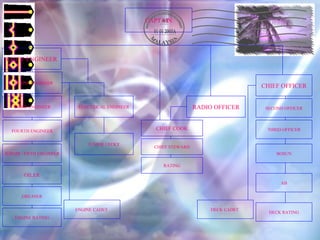
CAPTAIN RADIO OFFICER ENGINE CADET  DECK CADET  ELECTRICAL ENGINEER JUNIOR LECKY CHIEF ENGINEER SECONF ENGINEER THIRD ENGINEER FOURTH ENGINEER JUNOIR / FIFTH ENGINEER OILER GREASER ENGINE RATING CHIEF OFFICER SECOND OFFICER THRID OFFICER BOSUN AB DECK RATING CHIEF COOK RATING CHIEF STEWARD
WHO MARINE ENGINEER (CLOSELY RELATED  TO  MECHANICAL ENGINEERING )
Operate and maintain the propulsion and electrical with knowledge (and hands on experience) with   electrical ,  electronic ,  pneumatic ,  hydraulic   and even   nuclear technology .  generation systems onboard ships They also design and build these complicated systems   The merchant and military fleets of the world would not move without them
Marine Engineering staff also deal with the "Hotel" facilities onboard, notably the   sewage ,  lighting,   air conditioning   and water systems.  They deal with bulk fuel transfers, and require training in   firefighting   and first aid, as well as in dealing with the ship's boats and other nautical tasks- especially with cargo loading/discharging gear and   safety systems .
The original term engineer on a ship meant the people who dealt with the engines ("The black hand gang"), as opposed to the Consulting Engineer concept. Marine Engineers are generally much more hands on, and often get dirty, sweaty and hot doing their jobs. Care and thought is required, however, especially with heavy machinery in a seaway, and in managing  the rest of the engine-room crew.
MARINE ENGINEER REQUIREMENTS
1 Be familiar with the piping system onboard and see that all piping are in good order and condition
Colour code Fuel oil  - Red Lubrication oil - Yellow Fresh water - Blue Sea water / Ballast - Green Compressed air  - Gray Steam - Silver Bilge - Black
2 Account for and replenish spares and stores suitably
3 Store and bunker reasonable amount of fuel
4 Made suggestions for modifications of machineries and running methods for better efficiency in operations and maintenances
5 To learn the skill of trouble shooting accurately, saving time and spares
6 To improvise and adapt in repairs onboard, given insufficient spaces available
7 Display good discipline and obedience
RESPOSIBILITY on ENGINE  Chief Engineer   - Directly responsible to the master  for  the satisfactory operation of  all machinery and equipment.  - Apart from assuming all  responsibility his role is mainly  that of consultant and advisor.  - It is not usual for Chief Engineer  to keep a watch
Second Engineer - The one who responsible for the  practical upkeep of machinery  and the manning of engine room - He is in effect an executive officer and directly report to Chief  Engineer - Second Engineer may keep a  watch
Third and Fourth Engineer - They are usually senior watch- keeper or engineers in charge of  a watch. - Each may have particular areas of  responsibility, such as generator,  purifier or boiler etc…
Junior or Fifth Engineer - Classified as a junior officers. - They will make up as additional  watch-keepers, day workers on  maintenance work or possibly act  as Refrigeration Engineer.
Electrical Engineers - Normally on large ships or  company practice dictates. - No carried out watch-keeper duty - Responsibility more on electrical  equipments and assisting Chief or  Second Engineer as required
Engine Rating - Oiler are usually senior ratings  who attend the boiler while the  ship is in port. - The greaser or firemen are  usually employed on watches to  assist the engineers in charge. - Job scopes normally assisting in  the maintenance and upkeep of  the machinery space
Watchkeeping System The system of watches adopted on board ship is usually a four hour period working with eight hours rest for the members of each watch.  The three watches in any 12 hour period are usually 12 – 4, 4 – 8 and 8 – 12. The word ‘watch’ is taken as meaning the time period and also the personnel at work during that period Cont-
The watchkeeping arrangement and the make up of the watch will be decided by Chief Engineer. Factor to be account in the matter will include the type of ship, machineries and degree of automation, the qualifications and experiences of the members of the watch, any special conditions such as weather, ship location, international and local regulations , etc The engineer officer in charge of the watch is the Chief Engineer’s representative and is responsible for the safe and efficient operation and upkeep of all machinery affecting the safety of the ship

6 ship org chart

  • 1.
    CHART SHIP ORGANIZATIONBy Dr. Oladokun Sulaiman Olanrewaju
  • 2.
    CAPTAIN RADIO OFFICERENGINE CADET DECK CADET ELECTRICAL ENGINEER JUNIOR LECKY CHIEF ENGINEER SECONF ENGINEER THIRD ENGINEER FOURTH ENGINEER JUNOIR / FIFTH ENGINEER OILER GREASER ENGINE RATING CHIEF OFFICER SECOND OFFICER THRID OFFICER BOSUN AB DECK RATING CHIEF COOK RATING CHIEF STEWARD
  • 3.
    WHO MARINE ENGINEER(CLOSELY RELATED TO MECHANICAL ENGINEERING )
  • 4.
    Operate and maintainthe propulsion and electrical with knowledge (and hands on experience) with electrical , electronic , pneumatic , hydraulic and even nuclear technology . generation systems onboard ships They also design and build these complicated systems The merchant and military fleets of the world would not move without them
  • 5.
    Marine Engineering staffalso deal with the "Hotel" facilities onboard, notably the sewage , lighting, air conditioning and water systems. They deal with bulk fuel transfers, and require training in firefighting and first aid, as well as in dealing with the ship's boats and other nautical tasks- especially with cargo loading/discharging gear and safety systems .
  • 6.
    The original termengineer on a ship meant the people who dealt with the engines ("The black hand gang"), as opposed to the Consulting Engineer concept. Marine Engineers are generally much more hands on, and often get dirty, sweaty and hot doing their jobs. Care and thought is required, however, especially with heavy machinery in a seaway, and in managing the rest of the engine-room crew.
  • 7.
  • 8.
    1 Be familiarwith the piping system onboard and see that all piping are in good order and condition
  • 9.
    Colour code Fueloil - Red Lubrication oil - Yellow Fresh water - Blue Sea water / Ballast - Green Compressed air - Gray Steam - Silver Bilge - Black
  • 10.
    2 Account forand replenish spares and stores suitably
  • 11.
    3 Store andbunker reasonable amount of fuel
  • 12.
    4 Made suggestionsfor modifications of machineries and running methods for better efficiency in operations and maintenances
  • 13.
    5 To learnthe skill of trouble shooting accurately, saving time and spares
  • 14.
    6 To improviseand adapt in repairs onboard, given insufficient spaces available
  • 15.
    7 Display gooddiscipline and obedience
  • 16.
    RESPOSIBILITY on ENGINE Chief Engineer - Directly responsible to the master for the satisfactory operation of all machinery and equipment. - Apart from assuming all responsibility his role is mainly that of consultant and advisor. - It is not usual for Chief Engineer to keep a watch
  • 17.
    Second Engineer -The one who responsible for the practical upkeep of machinery and the manning of engine room - He is in effect an executive officer and directly report to Chief Engineer - Second Engineer may keep a watch
  • 18.
    Third and FourthEngineer - They are usually senior watch- keeper or engineers in charge of a watch. - Each may have particular areas of responsibility, such as generator, purifier or boiler etc…
  • 19.
    Junior or FifthEngineer - Classified as a junior officers. - They will make up as additional watch-keepers, day workers on maintenance work or possibly act as Refrigeration Engineer.
  • 20.
    Electrical Engineers -Normally on large ships or company practice dictates. - No carried out watch-keeper duty - Responsibility more on electrical equipments and assisting Chief or Second Engineer as required
  • 21.
    Engine Rating -Oiler are usually senior ratings who attend the boiler while the ship is in port. - The greaser or firemen are usually employed on watches to assist the engineers in charge. - Job scopes normally assisting in the maintenance and upkeep of the machinery space
  • 22.
    Watchkeeping System Thesystem of watches adopted on board ship is usually a four hour period working with eight hours rest for the members of each watch. The three watches in any 12 hour period are usually 12 – 4, 4 – 8 and 8 – 12. The word ‘watch’ is taken as meaning the time period and also the personnel at work during that period Cont-
  • 23.
    The watchkeeping arrangementand the make up of the watch will be decided by Chief Engineer. Factor to be account in the matter will include the type of ship, machineries and degree of automation, the qualifications and experiences of the members of the watch, any special conditions such as weather, ship location, international and local regulations , etc The engineer officer in charge of the watch is the Chief Engineer’s representative and is responsible for the safe and efficient operation and upkeep of all machinery affecting the safety of the ship