Downloaded 208 times
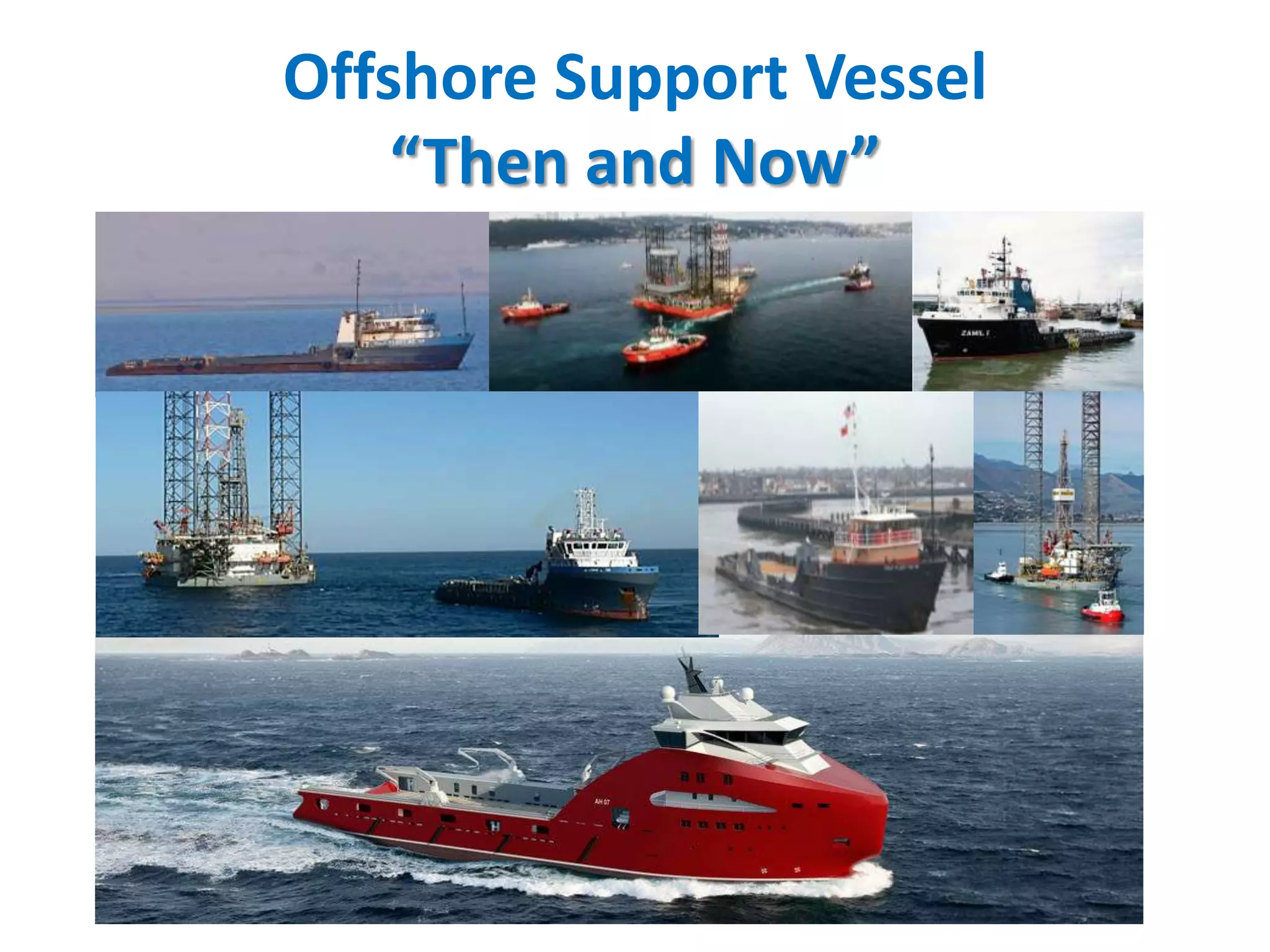
![Offshore Support Vessel “Then & Now”
The origin of offshore support vessels may be traced to the Gulf of Mexico –
where oil exploration first moved offshore in the 1950s. Then, surplus World War
II vessels, wooden fishing boats, and shrimp trawlers were used to supply
offshore rigs with cement, mud, spare parts, crews, fuel and food.
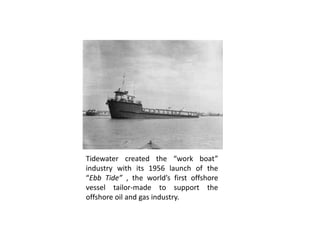
In 1955, Alden and John Laborde [17] developed the first purpose-built vessel to
supply offshore rigs and platforms, featuring a bow wheelhouse and a long flat
afterdeck that became the standard for offshore support vessels. This pioneering
design – bearing close resemblance to a pickup truck – withstood the test of time
and has become a generic ship type of its own right.
As a ship type it has since been given a variety of names: offshore support vessel
is perhaps the more all-encompassing one; others are offshore supply
vessels, anchor handling and supply vessel, anchor handling towing and supply
vessels, or other combinations, depending largely on the functions the vessel is
designed and equipped to perform.](https://image.slidesharecdn.com/offshoresupportvessel-thenandnow-140314061406-phpapp02/85/Then-and-Now-Offshore-Support-Vessel-2-320.jpg)
![Typical OSVs Then and Now
In the past, the sizes of OSVs are traditionally in the range of 40m to around 70m.
The types of cargos carried on board were typically
pipes, casings, stores, chains, machineries and equipment for offshore rigs, etc.
In general, the conventional design of offshore supply vessels satisfied with the
definition in IMO Resolution A469(XII) [10].
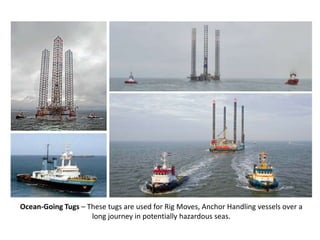
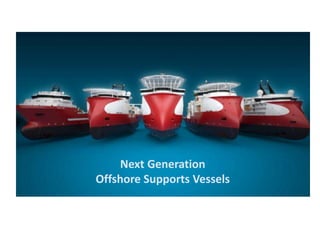
In contrast, new generation OSVs are required to provide support for deepwater
drilling operations and deliver more cargoes at greater distance from shore and
faster.
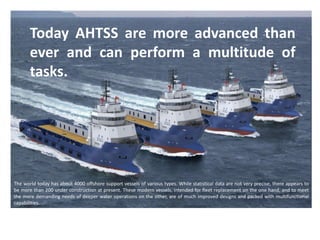
They are larger in size as compared to their predecessors in order to provide bigger
cargo deck areas, and to optimize the under deck spaces for accommodating
increase number of bulk tanks for liquid mud, brine and cement.
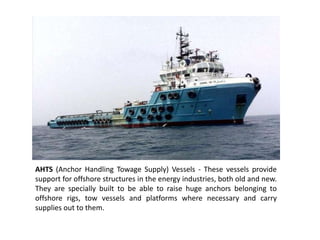
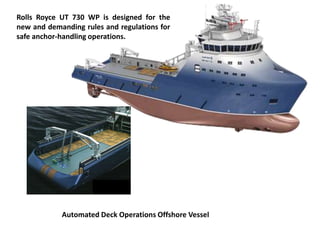
Due to higher specification for towing and anchor handling, new generation OSVs
are now equipped with sophisticated anchor handling equipment, and thrusters for
dynamic positioning capabilities.](https://image.slidesharecdn.com/offshoresupportvessel-thenandnow-140314061406-phpapp02/85/Then-and-Now-Offshore-Support-Vessel-11-320.jpg)

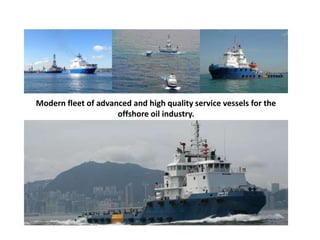
The document traces the evolution of offshore support vessels (OSVs) from their origins in the 1950s Gulf of Mexico, where WWII surplus vessels were repurposed for oil exploration, to the development of specialized designs like the 1955 Alden and John Laborde vessel. Modern OSVs are highly advanced, larger, and equipped with multifunctional capabilities to support deep-water operations, reflecting the industry's growing demands. Currently, there are approximately 4,000 OSVs globally, with over 200 more under construction, emphasizing the shift to sophisticated and automated designs for safety and efficiency.


