NEW
TRENDS OF
WHAT IS OFFICE??
An office is a space where an
organization’s employees perform
administrative work in order to support and
realize objects and goals of
the organization .The main purpose of an
office environment is to support its
occupants in performing their jobs. Work
spaces in an office are typically used for
conventional office activities such as
reading, writing and computer work.
TRENDS FOR
OFFICE DESIGNING:
There is no doubt that COVID-19 has dramatically changed
the way we view office design .Throughout the pandemic,
many companies had to find innovative ways to ensure that
safety in the workplace remains a top priority, while still
maintaining corporate culture, securing high levels of
productivity and efficiency, and promoting a much-needed
sense of employee well-being .It has certainly been a
challenge for many offices to adapt to the numerous changes
over the past two years, so it comes as no surprise that top
office design trends have also shifted with the times. Here are
some suggestions for implementing them in your space.
1. Creating dynamic office
layouts
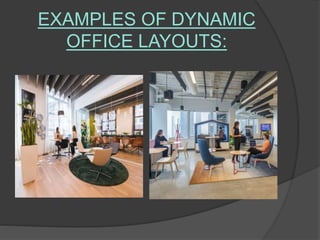
 It’s official: cubicle farms and rigid partitions
are out. Modern design elements are
beginning to feature more dynamic spaces
that can be easily adapted to fit the needs
of an ever-changing workforce.
 Since many people have spent at least part
of the last two years in social isolation, the
best way to foster more collaboration and
teamwork amongst your employees is to
ensure that your space is versatile enough
to accommodate a variety of interactions
with colleagues
EXAMPLES OF DYNAMIC
OFFICE LAYOUTS:
2. Add pods to your office
space
 As many businesses adopted an open concept office design,
flexible workspaces and “pod” style layouts became more
popular. In the times of social distancing, they proved to be
especially useful, but even in post-pandemic office
environments, they are perfect for adding an element of privacy
to open spaces.
 When employees are in the office, they often seek out safe and
confidential places to work in. As remote workers return to the
office and the number of employees in the workforce continues
to fluctuate, employees may find themselves without a sense of
belonging in their office. This is where pods come in.
 Many of these pods feature small private spaces with enough
room to work alone or with a small group, as well as soft seating
and outlets for laptop charging. Some pods are even
soundproof so that employees may hold meetings and talk to
one another in a convenient, secure manner.
Examples of Add
pods to your office
space
3.Incorporate more flexible furniture:
 If pods are unsuitable for your office space,
consider adding furniture that can easily adjust to
the needs of your workplace.
 Rather than large tables and fixed chairs, opt for
smaller tables and chairs with wheels that can be
pushed together during times of collaboration, and
then pulled apart later for independent work.
 This workplace design is incredibly popular in
small office spaces in the post-pandemic era, as
most employees are more conscious about health
and safety in their office environments.
 This flexible office design not only allows your
workforce to feel safe and comfortable in their
offices but also to modify their space for ideal
levels of productivity.
Examples of Incorporate more
flexible furniture:
4. Viewing commercial spaces as a
home away from home
 Especially after spending the last two years in and out of
home offices (which may or may not have felt like an
office at all!), it is essential for the success of your
business to create a pleasant office design for
employees and clients alike.
 Basically, you want everyone to feel as though they are
in their own home. There are many ways to go about this
and every workplace is different. But the key is to find a
balance between comfort and rationale that works
perfectly with your brand.
Examples of Viewing
commercial spaces as a home
away from home
5. Create more natural
light
 Exposure to daylight has been scientifically proven to
increase our well-being and mood. It also brightens
rooms and makes the office feel bigger and more
spacious. So it goes without saying that adding more
natural light to your building can benefit your office
environments tremendously.
 Sometimes, it’s as simple as moving furniture away
from windows to allow for more sunshine to
illuminate the space. However, in commercial spaces
with fewer opportunities to embrace the daylight, you
can create the illusion of natural light with well-
placed mirrors or a warm colour scheme.
 No matter what works best for your office space,
adding more natural light is key to a more
comfortable, homey office environment that will
surely boost productivity and morale in your office.
Examples of Create
more natural light:
6. Combine old and new
design elements
 Trends are like the weather; they come and they go.
So no matter if your organization is a brand new
start-up or a company with an established reputation,
you may consider creating a fascinating mix of past
and present by incorporating modern and vintage
design trends.
 One trend that is coming back in style is the wooden
office fixtures of the 1960s. Other modern “old” styles
include brass, industrial-style metal, and stone. Even
if it’s impractical to redesign the entire office from
wall to wall, complementing your interior design with
some wooden coffee tables or brass art pieces can
spark interest in your clients and creativity in your
employees for years to come.
Examples of Combine
old and new design
elements
7. Using technology to create
safer office environments
 Investing in automated light switches and taps in
your new office space was already a key feature of
modern office design before the pandemic, but now
this technology has become essential for health and
safety.
 Wherever possible, make sure you are limiting the
number of surfaces that your employees and
customers need to touch to interact with your space.
 Voice recognition technology and mobile apps is a
useful tool for reducing the amount of physical
contact in the office. However, one popular
alternative is voice recognition. Imagine: planning
meetings and making task lists could be as simple as
asking Alexa to do it for you.
Examples of Using
technology to create safer
office environments
8.Biophilic office design
 Many offices are starting using plants more generously
because of their positive effects on employee well-being.
 “The Global Impact of Biophilic Design in the Workplace”,
a 2021 study from Human Spaces, found that workers in
offices with natural elements, such as greenery and
sunlight achieve;
- 6% more productivity
- 15% more creativity
- 15% higher levels of well-being
 Sometimes rooms lack windows or good illumination, so
introducing greenery can add an element of nature and
bring the outdoors inside. One way to do this in your
space is to learn about and prioritize biophilic design
elements.
Examples of Biophilic
office design
FINAL THOUGHTS
The pandemic has definitely shifted our
perspective on office design trends over
the last two years. In these times of
change, the spaces that we work in every
day should work for us, too. Whether you
have decided to do a complete overhaul of
your work environment or make only a few
minor adjustments, keeping these design
trends in mind will enhance your workplace
and maintain the happiness and
healthiness of your workforce.
THANK
YOU

OFFICE DESIGN.pptx

  • 1.
  • 2.
    WHAT IS OFFICE?? Anoffice is a space where an organization’s employees perform administrative work in order to support and realize objects and goals of the organization .The main purpose of an office environment is to support its occupants in performing their jobs. Work spaces in an office are typically used for conventional office activities such as reading, writing and computer work.
  • 3.
    TRENDS FOR OFFICE DESIGNING: Thereis no doubt that COVID-19 has dramatically changed the way we view office design .Throughout the pandemic, many companies had to find innovative ways to ensure that safety in the workplace remains a top priority, while still maintaining corporate culture, securing high levels of productivity and efficiency, and promoting a much-needed sense of employee well-being .It has certainly been a challenge for many offices to adapt to the numerous changes over the past two years, so it comes as no surprise that top office design trends have also shifted with the times. Here are some suggestions for implementing them in your space.
  • 4.
    1. Creating dynamicoffice layouts  It’s official: cubicle farms and rigid partitions are out. Modern design elements are beginning to feature more dynamic spaces that can be easily adapted to fit the needs of an ever-changing workforce.  Since many people have spent at least part of the last two years in social isolation, the best way to foster more collaboration and teamwork amongst your employees is to ensure that your space is versatile enough to accommodate a variety of interactions with colleagues
  • 5.
  • 6.
    2. Add podsto your office space  As many businesses adopted an open concept office design, flexible workspaces and “pod” style layouts became more popular. In the times of social distancing, they proved to be especially useful, but even in post-pandemic office environments, they are perfect for adding an element of privacy to open spaces.  When employees are in the office, they often seek out safe and confidential places to work in. As remote workers return to the office and the number of employees in the workforce continues to fluctuate, employees may find themselves without a sense of belonging in their office. This is where pods come in.  Many of these pods feature small private spaces with enough room to work alone or with a small group, as well as soft seating and outlets for laptop charging. Some pods are even soundproof so that employees may hold meetings and talk to one another in a convenient, secure manner.
  • 7.
    Examples of Add podsto your office space
  • 8.
    3.Incorporate more flexiblefurniture:  If pods are unsuitable for your office space, consider adding furniture that can easily adjust to the needs of your workplace.  Rather than large tables and fixed chairs, opt for smaller tables and chairs with wheels that can be pushed together during times of collaboration, and then pulled apart later for independent work.  This workplace design is incredibly popular in small office spaces in the post-pandemic era, as most employees are more conscious about health and safety in their office environments.  This flexible office design not only allows your workforce to feel safe and comfortable in their offices but also to modify their space for ideal levels of productivity.
  • 9.
    Examples of Incorporatemore flexible furniture:
  • 10.
    4. Viewing commercialspaces as a home away from home  Especially after spending the last two years in and out of home offices (which may or may not have felt like an office at all!), it is essential for the success of your business to create a pleasant office design for employees and clients alike.  Basically, you want everyone to feel as though they are in their own home. There are many ways to go about this and every workplace is different. But the key is to find a balance between comfort and rationale that works perfectly with your brand.
  • 11.
    Examples of Viewing commercialspaces as a home away from home
  • 12.
    5. Create morenatural light  Exposure to daylight has been scientifically proven to increase our well-being and mood. It also brightens rooms and makes the office feel bigger and more spacious. So it goes without saying that adding more natural light to your building can benefit your office environments tremendously.  Sometimes, it’s as simple as moving furniture away from windows to allow for more sunshine to illuminate the space. However, in commercial spaces with fewer opportunities to embrace the daylight, you can create the illusion of natural light with well- placed mirrors or a warm colour scheme.  No matter what works best for your office space, adding more natural light is key to a more comfortable, homey office environment that will surely boost productivity and morale in your office.
  • 13.
  • 14.
    6. Combine oldand new design elements  Trends are like the weather; they come and they go. So no matter if your organization is a brand new start-up or a company with an established reputation, you may consider creating a fascinating mix of past and present by incorporating modern and vintage design trends.  One trend that is coming back in style is the wooden office fixtures of the 1960s. Other modern “old” styles include brass, industrial-style metal, and stone. Even if it’s impractical to redesign the entire office from wall to wall, complementing your interior design with some wooden coffee tables or brass art pieces can spark interest in your clients and creativity in your employees for years to come.
  • 15.
    Examples of Combine oldand new design elements
  • 16.
    7. Using technologyto create safer office environments  Investing in automated light switches and taps in your new office space was already a key feature of modern office design before the pandemic, but now this technology has become essential for health and safety.  Wherever possible, make sure you are limiting the number of surfaces that your employees and customers need to touch to interact with your space.  Voice recognition technology and mobile apps is a useful tool for reducing the amount of physical contact in the office. However, one popular alternative is voice recognition. Imagine: planning meetings and making task lists could be as simple as asking Alexa to do it for you.
  • 17.
    Examples of Using technologyto create safer office environments
  • 18.
    8.Biophilic office design Many offices are starting using plants more generously because of their positive effects on employee well-being.  “The Global Impact of Biophilic Design in the Workplace”, a 2021 study from Human Spaces, found that workers in offices with natural elements, such as greenery and sunlight achieve; - 6% more productivity - 15% more creativity - 15% higher levels of well-being  Sometimes rooms lack windows or good illumination, so introducing greenery can add an element of nature and bring the outdoors inside. One way to do this in your space is to learn about and prioritize biophilic design elements.
  • 19.
  • 20.
    FINAL THOUGHTS The pandemichas definitely shifted our perspective on office design trends over the last two years. In these times of change, the spaces that we work in every day should work for us, too. Whether you have decided to do a complete overhaul of your work environment or make only a few minor adjustments, keeping these design trends in mind will enhance your workplace and maintain the happiness and healthiness of your workforce.
  • 21.