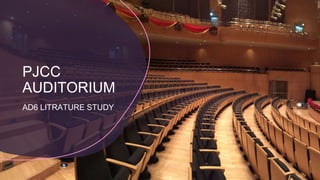
PJCC
AUDITORIUM
AD6 LITRATURE STUDY
Table of Content
SITE
INTRODUCTION
TECHNICAL
DRAWINGS AND
ZONING
LITERATURE
REVIEW
EXISTING
SOUND
SOURCES
SOUND PATH MATERIALITY
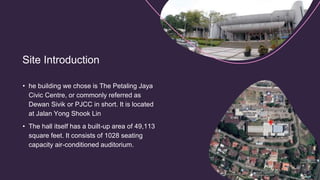
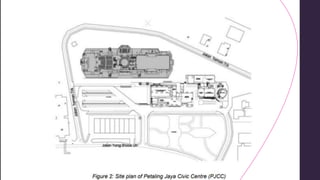
• he building we chose is The Petaling Jaya
Civic Centre, or commonly referred as
Dewan Sivik or PJCC in short. It is located
at Jalan Yong Shook Lin
• The hall itself has a built-up area of 49,113
square feet. It consists of 1028 seating
capacity air-conditioned auditorium.
Site Introduction
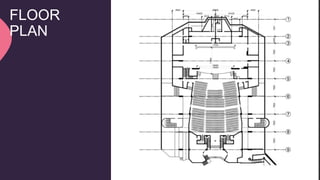
FLOOR
PLAN
Zoning
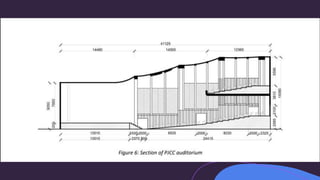
e categorised the auditorium seatings into 3 zones: Zone 1 where the front section of the
seats is located, Zone 2 where the back section of the seats under the balcony is
located, Zone 3 where the seats are located on the balcony. Different zones have
different acoustical properties affecting them due to distances and form of the auditorium.
These will be further addressed in the later part of the report
Existing Sound Sources
• External Noise
• The occurrence of rain, thunderstorm and road traffic (Jalan Taman 7/6, Jalan Yong
Shook Lin) might cause unwanted noise which will disrupt the acoustical quality of
the auditorium due to the loud sound it produced.
• Internal Noise
• Most of the internal noises produced in the auditorium are high frequency noises
such as the slamming of entrance doors, human chatters and electrical appliances.
These noises can affect the overall acoustical quality as it is easily noticed compared
to the low frequency noises (air-conditioning units).
Location of Sound Sources
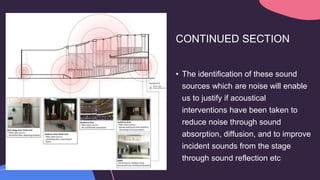
• The identification of these sound
sources which are noise will enable
us to justify if acoustical
interventions have been taken to
reduce noise through sound
absorption, diffusion, and to improve
incident sounds from the stage
through sound reflection etc
CONTINUED SECTION
• Due to the nature of a large auditorium, sound
reinforcement system is used to accommodate the large
volume where sound is better heard across the audience,
especially in areas which have sound shadows. PJCC
auditorium uses a centrally locate system, which is
common among many other auditoriums, with a single
cluster of loudspeakers over a sound source. This system
gives maximum realism as the amplified sound comes from
the same direction as original sound. Additional sound
speakers are located at the side walls of the auditorium for
sound to be directed to zones located at the further end of
the auditorium.
Sound Reinforcement
System
Sound Path
• When designing an enclosed space such as an auditorium, the
architect will need to provide the best conditions for the production and
the reception of desirable sound and to exclude unwanted sound
(noise) by paying attention to the control of sound in that space. Control
of sound are usually influenced by the form and the materiality used in
the space. The most difficult aspect of hall design is the ambiguity of
the goal itself, where different usage, based on function, of the
auditorium have different acoustical requirements.
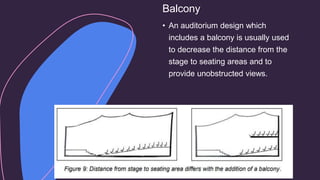
• An auditorium design which
includes a balcony is usually used
to decrease the distance from the
stage to seating areas and to
provide unobstructed views.
Balcony
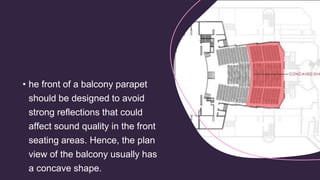
• he front of a balcony parapet
should be designed to avoid
strong reflections that could
affect sound quality in the front
seating areas. Hence, the plan
view of the balcony usually has
a concave shape.
Wall
• Walls in front of an auditorium are usually flat, to produce strong early reflections that
are integrated with the direct sound to enhance it before reaching the audience. The
depth of the front stage is used to achieve proper blend of sounds from various
instruments and voices before distributing to the audience.
• On the other hand, walls around an auditorium are encouraged to be splayed or tilted
to avoid parallelism. This will avoid flutter echoes from taking place. Angles can also
be advantageously used to direct reflected sound to the audience seating area, and
to provide diffusion. Any surface 20 that introduces undesirable angle should be
covered with absorptive material to reduce acoustical defects.
• A raked (sloped) floor is desirable
especially for large halls designed
either for music or speech. A raked
floor improves sight lines and allows
listener to receive more direct sound
than would be available on a flat
floor.
Floors
• Ceiling height is usually determined by the overall room
volume that is required. A ceiling that is too high in a room
may create undesirable late reflections.
• To avoid potential flutter echo, the ceiling should not be
parallel to the floor. Instead, it should be geometrically
designed to direct sound to the rear of the hall or to diffuse
it throughout the hall.
• Concave surfaces such as barreled ceilings and domes
should be avoided to prevent sound concentration which is
an unwanted acoustical defect.
Ceiling
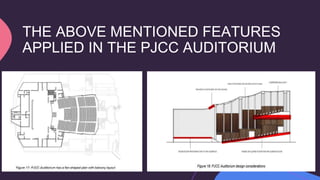
THE ABOVE MENTIONED FEATURES
APPLIED IN THE PJCC AUDITORIUM
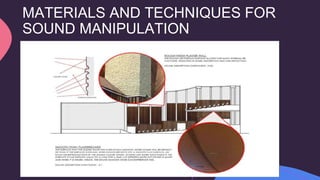
MATERIALS AND TECHNIQUES FOR
SOUND MANIPULATION
SOUND REFLECTION
SECTION
PLA
N
Sound reflection occurs when sound is bounced off a
surface. This usually occurs on flat, rigid surfaces like
concrete or brick walls. Sound waves that are unable
to penetrate very far into the surface causes the wave
to ricochet back against its direction.
SOUND REFLECTION IN PJCC
• The stage located at the front has flat surfaces. This is to produce strong early
reflections that are integrated with the direct sound and enhance it.
• On the contrary, strong late reflections and reverberation at the walls of the
audience level are not appreciated. In other words, the stage area and front of
the hall are generally made reflective while absorption of sound is placed in the
seating area and rea of the hall.
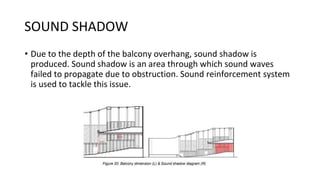
SOUND SHADOW
• Due to the depth of the balcony overhang, sound shadow is
produced. Sound shadow is an area through which sound waves
failed to propagate due to obstruction. Sound reinforcement system
is used to tackle this issue.
SOUND DIFFUSION
• Sound diffusion is important in room acoustics because constant
strong reflection of sound waves will create undesirable sound effect.
Sound diffusion helps break the wave pattern into several other
directions which depletes its energy faster. When a sound wave hits
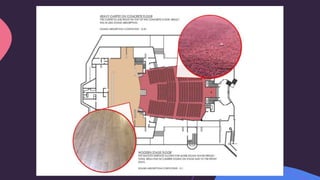
an irregular surface such as the carpet, the vibration breaks up and
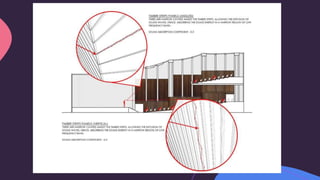
divides the energy of the wave into smaller paths. In PJCC
auditorium, timber strip panels and carpet help diffuse sound better,
reducing strong reflection from constantly bouncing off within the
space.
SOUND ABSORPTION
• Sound Absorption When a sound wave hits a surface, the kinetic
energy it contains is converted into small amount of heat energy
which dissipates, causing it to decay faster. How well a material
absorbs sound depends on several factors, such as material density
and how porous it is. Carpets and timber strip panels offer a small
sound absorption especially though its porous nature (carpet) or
cavities designed (timber strip panels) where sound dissipates within
this tiny space.
TIME DELAY Time delay is calculated to see
how direct sound is reinforced
through sound reflection. If time
delay is relatively short, reflected
sound beneficially reinforces
sound. However, if time delay is
long, reflected sound will result in
echoes.
From the time delay obtained
based on sound reflection in
addition to the incident sound, we
can deduce that it has both the
qualities of a music hall and a
speech hall, which ultimately
result in a good multi-purpose
auditorium, since it
accommodates both types of
activities
TIME DELAY
MATERIALITY
Acoustical absorption created inside
the room limits reverberation
therefore reducing overall sound
energy. The amount of sound energy
absorbed depends on type of
material, weight and pleating width.
The term used to define a material
sound absorption is its coefficient of
absorption.
ABSORPTION COEFFICIENT
It can be concluded that timber is
widely used as an acoustical
feature in our featured
auditorium and has a fairly good
sound absorption coefficient
value. Timber acoustic
performance is fairly good as its
network of small interlocking
wood cells converts sound energy
into heat energy by frictional
resistance within these cells and
by vibrations within their sub-
structure.
REVERBERATION TIME
• PJCC auditorium has a reverberation
time (RT) of 1.25s which is within
the recommended range of 1.00s –
1.25s for a medium sized multi-
purpose auditorium. This overall
shows that the acoustical properties
of the auditorium have been
achieved successfully and it
functions well. The auditorium
design (form & volume) and the
choice of materiality for sound
absorption, diffusion and reflection
has ultimately affect the overall
result of the reverberation time. In
order to further lower the RT, some
interventions could be made.
CONCLUSION
• Through this project, we learned that a successful design of auditoriums depends
a lot on its acoustic design which includes the auditorium layout and the types
absorption materials used. Acoustic plays the role of preserving and enhancing
the desired sound and to eliminate noise and undesired sound.
• After visiting and doing research on our chosen building, we learned about
material absorption coefficient and how to identify existing acoustic and sound
sources.
• Through those information, we then learned to calculate and analyze the data
we collected from site. Thus, enabling us to learn about acoustic ray bouncing
diagrams, sound pressure level, sound reduction index and reverberation time
SPECIFICS STANDARDS GIVEN
NO. OF SEATS /
ROW
10 - 16 10 - 15
PER PERSON
VOLUME IN AUDI
6 – 8M³ 5
VISSUAL ANGLE 30 - 110degree -
SIZE OF STAGE 2*7m -17m*17m 16.4*11.3m
HEIGHT OF
PROSCENIUM
4.3m-10.6m 7.5m
DISTANCE UPTO
THE LAST ROW OF
SEATING FROM
STAGE
24-32m max 25.2m
PER PERSON AREA
IN CONGREGATION
SPACE
0.5sqm -
NO. OF URINALS
AND WASHBASIN
PER PERSON
1 FOR EVERY 50 -
PER PERSON AREA
IN GREEN ROOM /
1.5sqm -

PJCC AUDITORIUM COM.pptx

  • 1.
  • 2.
    Table of Content SITE INTRODUCTION TECHNICAL DRAWINGSAND ZONING LITERATURE REVIEW EXISTING SOUND SOURCES SOUND PATH MATERIALITY
  • 3.
    • he buildingwe chose is The Petaling Jaya Civic Centre, or commonly referred as Dewan Sivik or PJCC in short. It is located at Jalan Yong Shook Lin • The hall itself has a built-up area of 49,113 square feet. It consists of 1028 seating capacity air-conditioned auditorium. Site Introduction
  • 5.
  • 7.
    Zoning e categorised theauditorium seatings into 3 zones: Zone 1 where the front section of the seats is located, Zone 2 where the back section of the seats under the balcony is located, Zone 3 where the seats are located on the balcony. Different zones have different acoustical properties affecting them due to distances and form of the auditorium. These will be further addressed in the later part of the report
  • 8.
    Existing Sound Sources •External Noise • The occurrence of rain, thunderstorm and road traffic (Jalan Taman 7/6, Jalan Yong Shook Lin) might cause unwanted noise which will disrupt the acoustical quality of the auditorium due to the loud sound it produced. • Internal Noise • Most of the internal noises produced in the auditorium are high frequency noises such as the slamming of entrance doors, human chatters and electrical appliances. These noises can affect the overall acoustical quality as it is easily noticed compared to the low frequency noises (air-conditioning units).
  • 9.
  • 10.
    • The identificationof these sound sources which are noise will enable us to justify if acoustical interventions have been taken to reduce noise through sound absorption, diffusion, and to improve incident sounds from the stage through sound reflection etc CONTINUED SECTION
  • 11.
    • Due tothe nature of a large auditorium, sound reinforcement system is used to accommodate the large volume where sound is better heard across the audience, especially in areas which have sound shadows. PJCC auditorium uses a centrally locate system, which is common among many other auditoriums, with a single cluster of loudspeakers over a sound source. This system gives maximum realism as the amplified sound comes from the same direction as original sound. Additional sound speakers are located at the side walls of the auditorium for sound to be directed to zones located at the further end of the auditorium. Sound Reinforcement System
  • 13.
    Sound Path • Whendesigning an enclosed space such as an auditorium, the architect will need to provide the best conditions for the production and the reception of desirable sound and to exclude unwanted sound (noise) by paying attention to the control of sound in that space. Control of sound are usually influenced by the form and the materiality used in the space. The most difficult aspect of hall design is the ambiguity of the goal itself, where different usage, based on function, of the auditorium have different acoustical requirements.
  • 14.
    • An auditoriumdesign which includes a balcony is usually used to decrease the distance from the stage to seating areas and to provide unobstructed views. Balcony
  • 15.
    • he frontof a balcony parapet should be designed to avoid strong reflections that could affect sound quality in the front seating areas. Hence, the plan view of the balcony usually has a concave shape.
  • 16.
    Wall • Walls infront of an auditorium are usually flat, to produce strong early reflections that are integrated with the direct sound to enhance it before reaching the audience. The depth of the front stage is used to achieve proper blend of sounds from various instruments and voices before distributing to the audience. • On the other hand, walls around an auditorium are encouraged to be splayed or tilted to avoid parallelism. This will avoid flutter echoes from taking place. Angles can also be advantageously used to direct reflected sound to the audience seating area, and to provide diffusion. Any surface 20 that introduces undesirable angle should be covered with absorptive material to reduce acoustical defects.
  • 18.
    • A raked(sloped) floor is desirable especially for large halls designed either for music or speech. A raked floor improves sight lines and allows listener to receive more direct sound than would be available on a flat floor. Floors
  • 19.
    • Ceiling heightis usually determined by the overall room volume that is required. A ceiling that is too high in a room may create undesirable late reflections. • To avoid potential flutter echo, the ceiling should not be parallel to the floor. Instead, it should be geometrically designed to direct sound to the rear of the hall or to diffuse it throughout the hall. • Concave surfaces such as barreled ceilings and domes should be avoided to prevent sound concentration which is an unwanted acoustical defect. Ceiling
  • 20.
    THE ABOVE MENTIONEDFEATURES APPLIED IN THE PJCC AUDITORIUM
  • 21.
    MATERIALS AND TECHNIQUESFOR SOUND MANIPULATION
  • 25.
    SOUND REFLECTION SECTION PLA N Sound reflectionoccurs when sound is bounced off a surface. This usually occurs on flat, rigid surfaces like concrete or brick walls. Sound waves that are unable to penetrate very far into the surface causes the wave to ricochet back against its direction.
  • 26.
    SOUND REFLECTION INPJCC • The stage located at the front has flat surfaces. This is to produce strong early reflections that are integrated with the direct sound and enhance it. • On the contrary, strong late reflections and reverberation at the walls of the audience level are not appreciated. In other words, the stage area and front of the hall are generally made reflective while absorption of sound is placed in the seating area and rea of the hall.
  • 27.
    SOUND SHADOW • Dueto the depth of the balcony overhang, sound shadow is produced. Sound shadow is an area through which sound waves failed to propagate due to obstruction. Sound reinforcement system is used to tackle this issue.
  • 28.
    SOUND DIFFUSION • Sounddiffusion is important in room acoustics because constant strong reflection of sound waves will create undesirable sound effect. Sound diffusion helps break the wave pattern into several other directions which depletes its energy faster. When a sound wave hits an irregular surface such as the carpet, the vibration breaks up and divides the energy of the wave into smaller paths. In PJCC auditorium, timber strip panels and carpet help diffuse sound better, reducing strong reflection from constantly bouncing off within the space.
  • 29.
    SOUND ABSORPTION • SoundAbsorption When a sound wave hits a surface, the kinetic energy it contains is converted into small amount of heat energy which dissipates, causing it to decay faster. How well a material absorbs sound depends on several factors, such as material density and how porous it is. Carpets and timber strip panels offer a small sound absorption especially though its porous nature (carpet) or cavities designed (timber strip panels) where sound dissipates within this tiny space.
  • 30.
    TIME DELAY Timedelay is calculated to see how direct sound is reinforced through sound reflection. If time delay is relatively short, reflected sound beneficially reinforces sound. However, if time delay is long, reflected sound will result in echoes. From the time delay obtained based on sound reflection in addition to the incident sound, we can deduce that it has both the qualities of a music hall and a speech hall, which ultimately result in a good multi-purpose auditorium, since it accommodates both types of activities
  • 31.
  • 32.
    MATERIALITY Acoustical absorption createdinside the room limits reverberation therefore reducing overall sound energy. The amount of sound energy absorbed depends on type of material, weight and pleating width. The term used to define a material sound absorption is its coefficient of absorption.
  • 33.
  • 34.
    ABSORPTION COEFFICIENT It canbe concluded that timber is widely used as an acoustical feature in our featured auditorium and has a fairly good sound absorption coefficient value. Timber acoustic performance is fairly good as its network of small interlocking wood cells converts sound energy into heat energy by frictional resistance within these cells and by vibrations within their sub- structure.
  • 35.
    REVERBERATION TIME • PJCCauditorium has a reverberation time (RT) of 1.25s which is within the recommended range of 1.00s – 1.25s for a medium sized multi- purpose auditorium. This overall shows that the acoustical properties of the auditorium have been achieved successfully and it functions well. The auditorium design (form & volume) and the choice of materiality for sound absorption, diffusion and reflection has ultimately affect the overall result of the reverberation time. In order to further lower the RT, some interventions could be made.
  • 36.
    CONCLUSION • Through thisproject, we learned that a successful design of auditoriums depends a lot on its acoustic design which includes the auditorium layout and the types absorption materials used. Acoustic plays the role of preserving and enhancing the desired sound and to eliminate noise and undesired sound. • After visiting and doing research on our chosen building, we learned about material absorption coefficient and how to identify existing acoustic and sound sources. • Through those information, we then learned to calculate and analyze the data we collected from site. Thus, enabling us to learn about acoustic ray bouncing diagrams, sound pressure level, sound reduction index and reverberation time
  • 37.
    SPECIFICS STANDARDS GIVEN NO.OF SEATS / ROW 10 - 16 10 - 15 PER PERSON VOLUME IN AUDI 6 – 8M³ 5 VISSUAL ANGLE 30 - 110degree - SIZE OF STAGE 2*7m -17m*17m 16.4*11.3m HEIGHT OF PROSCENIUM 4.3m-10.6m 7.5m DISTANCE UPTO THE LAST ROW OF SEATING FROM STAGE 24-32m max 25.2m PER PERSON AREA IN CONGREGATION SPACE 0.5sqm - NO. OF URINALS AND WASHBASIN PER PERSON 1 FOR EVERY 50 - PER PERSON AREA IN GREEN ROOM / 1.5sqm -