
DESIGN STUDIO 3
TERM: JUN 2013
LECTURER: SANDRA DRASKOVIC
OFFICE DESIGN PRINCIPLES THAT WORK
1. Open Plans
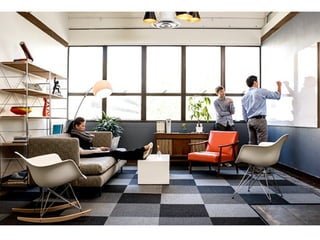
Humans are social animals and want to be able to
interact with each other. Studies have shown that
an open plan improves the mood of employees. So
modern offices are often designed to encourage
collaboration, as modern employers understand
that employees being able to interact while they
work is beneficial to long-term productivity.
Let employees carve out their own space.
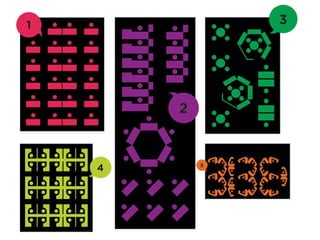
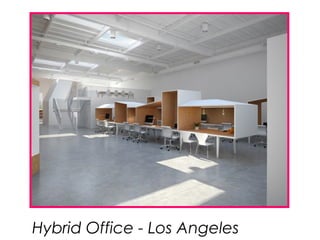
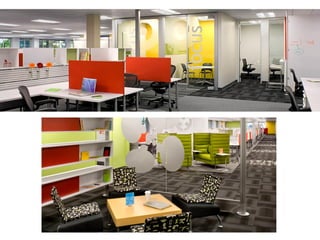
Hybrid Office - Los Angeles
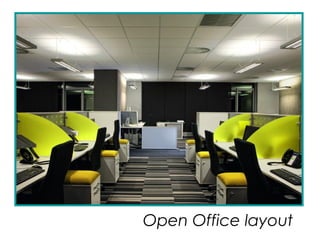
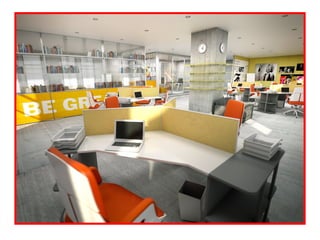
Open Office layout
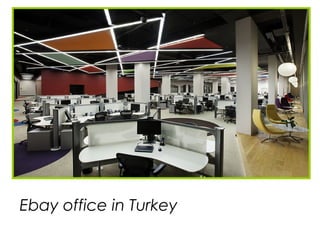
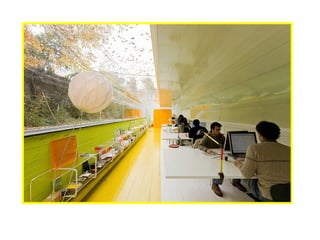
Ebay office in Turkey
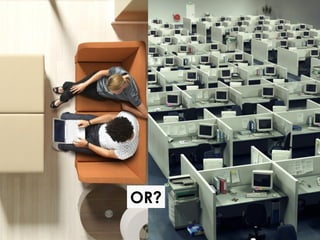
OR?
So in the last several years, the
move away from cubicle
structures and toward more
open floor plans, where
collaboration is as simple as
looking across the desk to see
your co-worker sitting five feet
away, became incredibly
popular.
A space that's full of collaborative
space but has zero quiet space is just
as unsuccessful as a space that's full
of offices and has no collaborative
space. It's about finding a balance,
and what that balance is for each
company. That ratio depends on the
type of work that companies do."
BALANCE
COLLABORATION
2. Hot Desking
Having employees who aren’t chained to their
desks translates to reduced office costs and
increased networking opportunities. Open spaces
have also become more valuable as technological
advances now allow workers to work from almost
anywhere.
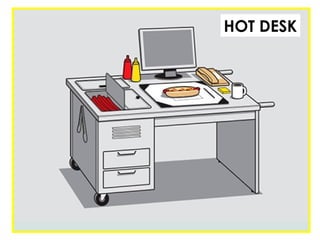
Hot desking is a work space sharing model in which
employees outnumber desks. In some such
environments, each work station has its own
computer and the worker logs into a virtual
desktop.
2. Hot Desking
The hot desk – a workstation not assigned to an
individual – is quite a common feature in office
space design already, but it is set to assume even
more importance in 2012. Many top performing
organizations utilize hot desking to break down the
formality of office space. Hot desking
encourages employees to interact with other
employees they might not otherwise have come
across.
Hot desks are to be found in a range of
environments often including traditional
workstations, meeting rooms, breakout areas and
chill out zones.
2. Hot Desking - rethink
technology – GENERATION Y
Internet
Mobile phone
Laptop
Mobility (not connected to place)
Flexibility (work anywhere)
Sharing (small space requirements)
File storage (immediate and long term
files)
HOT DESK
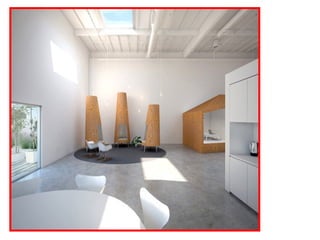
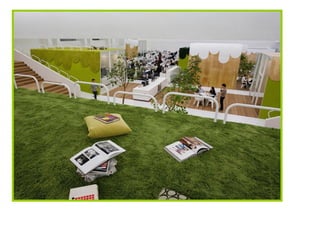
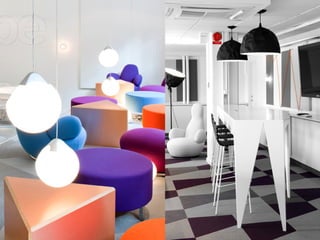
3. Common Spaces
Designing informal areas for ad-hoc meetings and
collaboration on larger projects create a
community feel to the workplace. Working
collectively on tough problems can vastly improve
productivity. Activity rooms, break and rest spaces,
variety in their design and flexibility of use is the key
to keeping up motivation at work.
Improve creativity, concentration,
socialization, efficiency through “ break”
spaces design
PLAY, INTERACTION & FUNCTIONALITY
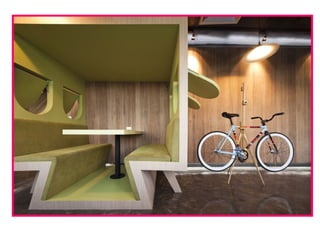
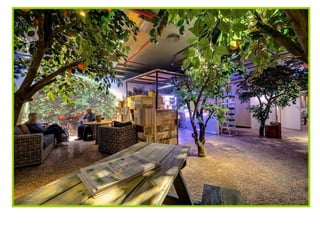
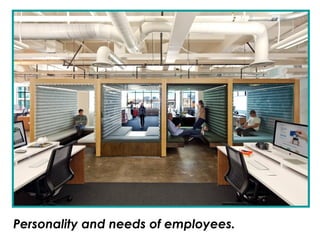
Personality and needs of employees.
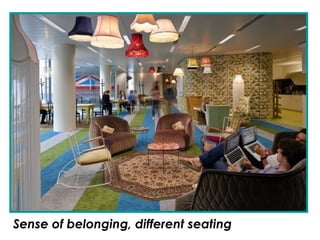
Sense of belonging, different seating
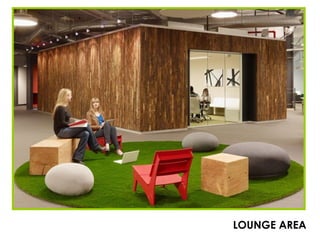
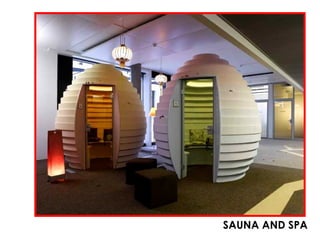
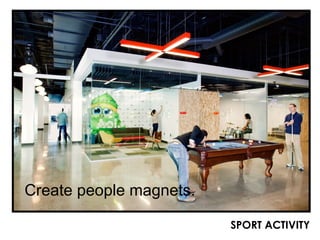
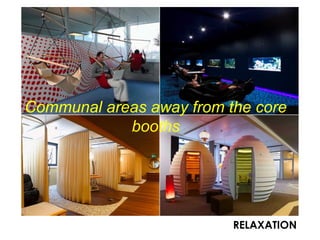
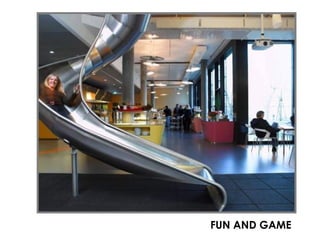
4. Functional Buildings
Large corporate office buildings are now
increasingly equipped with cafes, restaurants,
libraries, bars, and gyms. Google is probably the
best at this, the theory being that a happy
employee at work is more likely to stay at the office
longer. Idea generation is the name of the game,
so many employers don’t mind whether a great
idea comes from an employee at the office gym or
a worker as his desk.
So long as the ideas keep coming, both
parties will be happy!
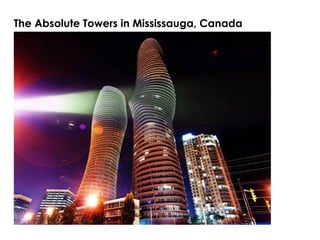
The Absolute Towers in Mississauga, Canada
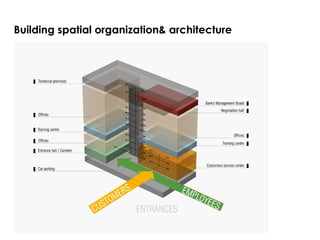
Building spatial organization& architecture
LOUNGE AREA
SAUNA AND SPA
SPORT ACTIVITY
Create people magnets.
RELAXATION
Communal areas away from the core
booths
FUN AND GAME
5. Sustainable
Increasingly, green is the new black in office design
projects, more businesses want to design their
space in a sustainable and environmentally friendly
manner. It’s not just employers; environmentalism is
often a key issue for many employees, too.
Numerous issues are discussed here: How to
choose the most sustainable materials for finishes,
such as flooring, and also how to select finishes,
based on their impact on indoor air quality (IAQ).
Support the work of individuals
Workspaces that support the job.
Standard cubes make layout easier, but they may
also give space that is more or less than is actually
needed. Flexibility, adoptability and enough space.
Proximity. 
Where the things and people associated with the job
are not to hand, it makes work harder and reduces
efficiency.
•Adequate storage at desk.
•Nearby services (printers, coffee, stationery, etc.)
•Teams near other teams with similar interests,
customers
•Connect both functional specialists and
operational teams.
Support the work of groups
Groups also need good workplace design.
They must be able to easily work together.
They must also feel like a group, exchange and
collaborate.
1. Create community.
2. Link communities.
3. Design collaboratively.
Create a motivating environment
To give of their best, people in the workplace must
be well motivated. And the design of the
workplace can make a big difference.
Light and comfortable.
Natural light as a shared resource: not just a
management perk.
Color that alleviates boredom and creates
interest.
Comfortable and ergonomic furniture.
Social spaces.
Shared space should be perceived as beneficial
and useful by the majority.
The ‘buzz’ of an active office is a positive social
signal, indicating the presence of co-workers
and providing cues to encourage active work.
Clear signage so even visitors can find things.
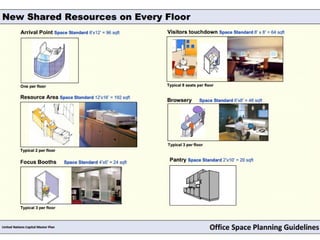
Shared areas
Create people magnets. People often need to be
encouraged to talk together.
Quiet areas away from the core. The opposite effect of
‘towards the core’ is where people seek quiet and
isolation.
Booths, with panels between seater tables (possibly with
benches) are both space-efficient and provide a
balance of privacy and openness for informal meetings.
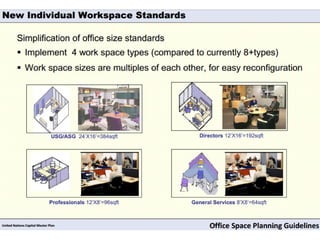
Propose shared space. Increasing space shared across
the site reduces the need for individual and team
space, but requires that people be prepared to share.
No white elephants. Soft-seating areas, and play areas
although inviting can be shunned when people are
concerned at appearing to be not working or where
they are too far away.
Reflect company values
Does your office reflect the
culture of your organisation?
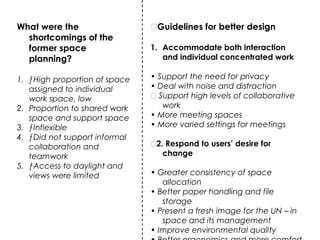
What were the
shortcomings of the
former space
planning?
1. ƒHigh proportion of space
assigned to individual
work space, low
2. Proportion to shared work
space and support space
3. ƒInflexible
4. ƒDid not support informal
collaboration and
teamwork
5. ƒAccess to daylight and
views were limited
ƒGuidelines for better design
1. Accommodate both interaction
and individual concentrated work
• Support the need for privacy
• Deal with noise and distraction
ƒ Support high levels of collaborative
work
• More meeting spaces
• More varied settings for meetings
ƒ2. Respond to users’ desire for
change
• Greater consistency of space
allocation
• Better paper handling and file
storage
• Present a fresh image for the UN – in
space and its management
• Improve environmental quality
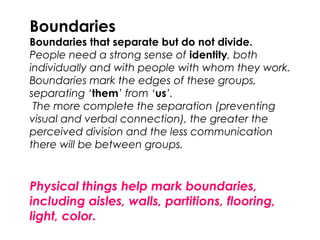
Boundaries
Boundaries that separate but do not divide.
People need a strong sense of identity, both
individually and with people with whom they work.
Boundaries mark the edges of these groups,
separating ‘them’ from ‘us’.
The more complete the separation (preventing
visual and verbal connection), the greater the
perceived division and the less communication
there will be between groups.
Physical things help mark boundaries,
including aisles, walls, partitions, flooring,
light, color.
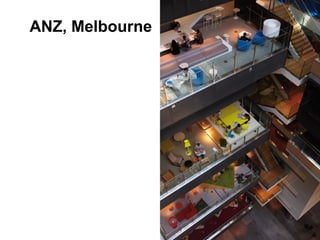
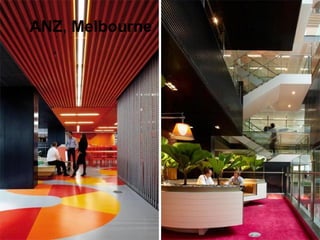
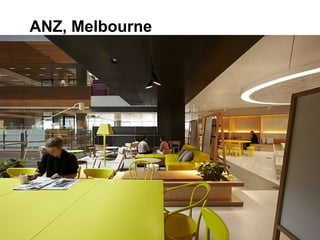
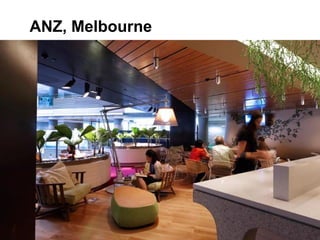
Collaboration is new work model
As a small company there is always a buzz,
an energy between employees. When
company grows, move into large, more
traditional office spaces. Employees end up
getting private offices with windows and
view. And the energy get lost.
Maturity of company = traditional plan?
Collaboration and interaction are the key
words in contemporary office planning
toward efficiency!
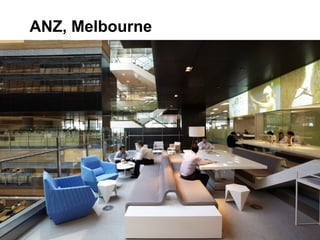
ANZ, Melbourne
ANZ, Melbourne
ANZ, Melbourne
ANZ, Melbourne
ANZ, Melbourne
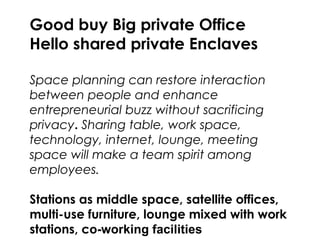
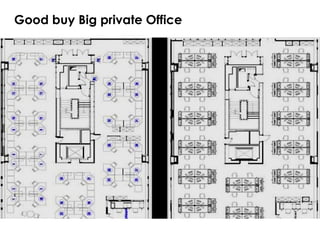
Good buy Big private Office
Hello shared private Enclaves
Space planning can restore interaction
between people and enhance
entrepreneurial buzz without sacrificing
privacy. Sharing table, work space,
technology, internet, lounge, meeting
space will make a team spirit among
employees.
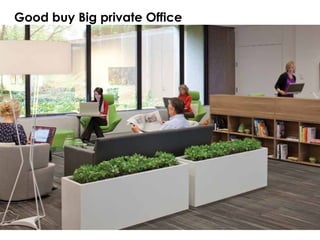
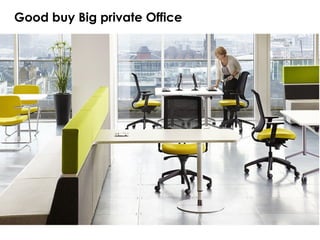
Stations as middle space, satellite offices,
multi-use furniture, lounge mixed with work
stations, co-working facilities 
Good buy Big private Office
Managed noise
•Build a noise gradient: a greater noise may be
expected at the core, with quieter areas at the
periphery.
•Match the people to the bustle. People have different
noise needs. Some need calm and quiet whilst others
feel lonely and left out if they are not sited near the
centers of action.
•Manage the natural noise points. There are points
where noise naturally occurs and where people should
not be put at desks if they have a significant need for
quiet.
•By coffee machines and other intended break areas.
•Next to meeting areas.
•Next to people with louder tendencies.
•At junctions where people pause before going their separate
ways.
Walkways and places between
1. Promenade. Many people like to take occasional breaks
from their desks and go for a stroll to think and refresh. This
kind of area is sometimes called ‘Main Street’.
2. Excuses to pause. When people are out walking they may
meet others but they often need an excuse to pause and
maybe have a common topic to talk about.
Ways of doing this include:
Notice boards (especially if they are well-laid out and up to
date).
White-boards where they can doodle.
3. Space to stop. Where people stop, others need to pass by, so
ensure these areas are wide enough.
4. Connecting shared areas. A walkway that connects breakout
and other shared areas encourages groups to visit one
another.
5. Anchors at the ends. Just as shopping Malls have major stores
at either end to ensure people walk the full length, office
walkways can have major points of attraction at either end.
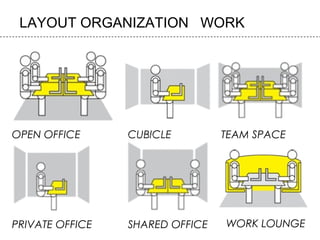
LAYOUT ORGANIZATION   WORK
OPEN OFFICE CUBICLE TEAM SPACE
PRIVATE OFFICE SHARED OFFICE WORK LOUNGE
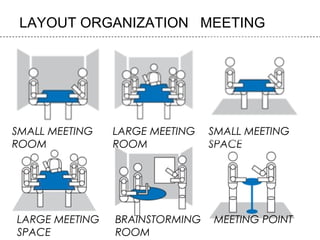
LAYOUT ORGANIZATION   MEETING
SMALL MEETING
ROOM
LARGE MEETING
ROOM
SMALL MEETING
SPACE
LARGE MEETING
SPACE
BRAINSTORMING
ROOM
MEETING POINT
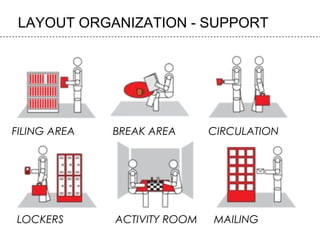
LAYOUT ORGANIZATION - SUPPORT
FILING AREA BREAK AREA CIRCULATION
LOCKERS ACTIVITY ROOM MAILING
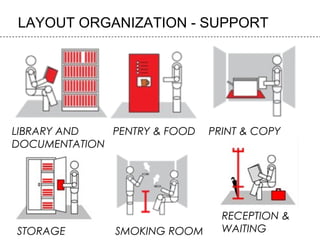
LAYOUT ORGANIZATION - SUPPORT
LIBRARY AND
DOCUMENTATION
PENTRY & FOOD PRINT & COPY
STORAGE SMOKING ROOM
RECEPTION &
WAITING

Raffles Institute_Office principles that work_Design Studio 3

  • 1.
    DESIGN STUDIO 3 TERM:JUN 2013 LECTURER: SANDRA DRASKOVIC OFFICE DESIGN PRINCIPLES THAT WORK
  • 3.
    1. Open Plans Humansare social animals and want to be able to interact with each other. Studies have shown that an open plan improves the mood of employees. So modern offices are often designed to encourage collaboration, as modern employers understand that employees being able to interact while they work is beneficial to long-term productivity. Let employees carve out their own space.
  • 4.
    Hybrid Office -Los Angeles
  • 5.
  • 6.
  • 7.
  • 8.
    So in thelast several years, the move away from cubicle structures and toward more open floor plans, where collaboration is as simple as looking across the desk to see your co-worker sitting five feet away, became incredibly popular. A space that's full of collaborative space but has zero quiet space is just as unsuccessful as a space that's full of offices and has no collaborative space. It's about finding a balance, and what that balance is for each company. That ratio depends on the type of work that companies do." BALANCE COLLABORATION
  • 13.
    2. Hot Desking Havingemployees who aren’t chained to their desks translates to reduced office costs and increased networking opportunities. Open spaces have also become more valuable as technological advances now allow workers to work from almost anywhere. Hot desking is a work space sharing model in which employees outnumber desks. In some such environments, each work station has its own computer and the worker logs into a virtual desktop.
  • 14.
    2. Hot Desking Thehot desk – a workstation not assigned to an individual – is quite a common feature in office space design already, but it is set to assume even more importance in 2012. Many top performing organizations utilize hot desking to break down the formality of office space. Hot desking encourages employees to interact with other employees they might not otherwise have come across. Hot desks are to be found in a range of environments often including traditional workstations, meeting rooms, breakout areas and chill out zones.
  • 15.
    2. Hot Desking- rethink technology – GENERATION Y Internet Mobile phone Laptop Mobility (not connected to place) Flexibility (work anywhere) Sharing (small space requirements) File storage (immediate and long term files)
  • 16.
  • 17.
    3. Common Spaces Designing informalareas for ad-hoc meetings and collaboration on larger projects create a community feel to the workplace. Working collectively on tough problems can vastly improve productivity. Activity rooms, break and rest spaces, variety in their design and flexibility of use is the key to keeping up motivation at work. Improve creativity, concentration, socialization, efficiency through “ break” spaces design PLAY, INTERACTION & FUNCTIONALITY
  • 22.
    Personality and needsof employees.
  • 23.
    Sense of belonging,different seating
  • 25.
    4. Functional Buildings Large corporateoffice buildings are now increasingly equipped with cafes, restaurants, libraries, bars, and gyms. Google is probably the best at this, the theory being that a happy employee at work is more likely to stay at the office longer. Idea generation is the name of the game, so many employers don’t mind whether a great idea comes from an employee at the office gym or a worker as his desk. So long as the ideas keep coming, both parties will be happy!
  • 26.
    The Absolute Towersin Mississauga, Canada
  • 27.
  • 28.
  • 29.
  • 30.
  • 31.
    RELAXATION Communal areas awayfrom the core booths
  • 32.
  • 33.
    5. Sustainable Increasingly, green isthe new black in office design projects, more businesses want to design their space in a sustainable and environmentally friendly manner. It’s not just employers; environmentalism is often a key issue for many employees, too. Numerous issues are discussed here: How to choose the most sustainable materials for finishes, such as flooring, and also how to select finishes, based on their impact on indoor air quality (IAQ).
  • 34.
    Support the workof individuals Workspaces that support the job. Standard cubes make layout easier, but they may also give space that is more or less than is actually needed. Flexibility, adoptability and enough space. Proximity.  Where the things and people associated with the job are not to hand, it makes work harder and reduces efficiency. •Adequate storage at desk. •Nearby services (printers, coffee, stationery, etc.) •Teams near other teams with similar interests, customers •Connect both functional specialists and operational teams.
  • 35.
    Support the workof groups Groups also need good workplace design. They must be able to easily work together. They must also feel like a group, exchange and collaborate. 1. Create community. 2. Link communities. 3. Design collaboratively.
  • 36.
    Create a motivatingenvironment To give of their best, people in the workplace must be well motivated. And the design of the workplace can make a big difference. Light and comfortable. Natural light as a shared resource: not just a management perk. Color that alleviates boredom and creates interest. Comfortable and ergonomic furniture. Social spaces. Shared space should be perceived as beneficial and useful by the majority. The ‘buzz’ of an active office is a positive social signal, indicating the presence of co-workers and providing cues to encourage active work. Clear signage so even visitors can find things.
  • 37.
    Shared areas Create peoplemagnets. People often need to be encouraged to talk together. Quiet areas away from the core. The opposite effect of ‘towards the core’ is where people seek quiet and isolation. Booths, with panels between seater tables (possibly with benches) are both space-efficient and provide a balance of privacy and openness for informal meetings. Propose shared space. Increasing space shared across the site reduces the need for individual and team space, but requires that people be prepared to share. No white elephants. Soft-seating areas, and play areas although inviting can be shunned when people are concerned at appearing to be not working or where they are too far away.
  • 38.
    Reflect company values Doesyour office reflect the culture of your organisation?
  • 40.
    What were the shortcomingsof the former space planning? 1. ƒHigh proportion of space assigned to individual work space, low 2. Proportion to shared work space and support space 3. ƒInflexible 4. ƒDid not support informal collaboration and teamwork 5. ƒAccess to daylight and views were limited ƒGuidelines for better design 1. Accommodate both interaction and individual concentrated work • Support the need for privacy • Deal with noise and distraction ƒ Support high levels of collaborative work • More meeting spaces • More varied settings for meetings ƒ2. Respond to users’ desire for change • Greater consistency of space allocation • Better paper handling and file storage • Present a fresh image for the UN – in space and its management • Improve environmental quality
  • 43.
    Boundaries Boundaries that separatebut do not divide. People need a strong sense of identity, both individually and with people with whom they work. Boundaries mark the edges of these groups, separating ‘them’ from ‘us’. The more complete the separation (preventing visual and verbal connection), the greater the perceived division and the less communication there will be between groups. Physical things help mark boundaries, including aisles, walls, partitions, flooring, light, color.
  • 50.
    Collaboration is newwork model As a small company there is always a buzz, an energy between employees. When company grows, move into large, more traditional office spaces. Employees end up getting private offices with windows and view. And the energy get lost. Maturity of company = traditional plan? Collaboration and interaction are the key words in contemporary office planning toward efficiency!
  • 51.
  • 52.
  • 53.
  • 54.
  • 55.
  • 56.
    Good buy Bigprivate Office Hello shared private Enclaves Space planning can restore interaction between people and enhance entrepreneurial buzz without sacrificing privacy. Sharing table, work space, technology, internet, lounge, meeting space will make a team spirit among employees. Stations as middle space, satellite offices, multi-use furniture, lounge mixed with work stations, co-working facilities 
  • 58.
    Good buy Bigprivate Office
  • 59.
    Good buy Bigprivate Office
  • 60.
    Good buy Bigprivate Office
  • 61.
    Managed noise •Build anoise gradient: a greater noise may be expected at the core, with quieter areas at the periphery. •Match the people to the bustle. People have different noise needs. Some need calm and quiet whilst others feel lonely and left out if they are not sited near the centers of action. •Manage the natural noise points. There are points where noise naturally occurs and where people should not be put at desks if they have a significant need for quiet. •By coffee machines and other intended break areas. •Next to meeting areas. •Next to people with louder tendencies. •At junctions where people pause before going their separate ways.
  • 62.
    Walkways and placesbetween 1. Promenade. Many people like to take occasional breaks from their desks and go for a stroll to think and refresh. This kind of area is sometimes called ‘Main Street’. 2. Excuses to pause. When people are out walking they may meet others but they often need an excuse to pause and maybe have a common topic to talk about. Ways of doing this include: Notice boards (especially if they are well-laid out and up to date). White-boards where they can doodle. 3. Space to stop. Where people stop, others need to pass by, so ensure these areas are wide enough. 4. Connecting shared areas. A walkway that connects breakout and other shared areas encourages groups to visit one another. 5. Anchors at the ends. Just as shopping Malls have major stores at either end to ensure people walk the full length, office walkways can have major points of attraction at either end.
  • 63.
    LAYOUT ORGANIZATION   WORK OPEN OFFICE CUBICLETEAM SPACE PRIVATE OFFICE SHARED OFFICE WORK LOUNGE
  • 64.
    LAYOUT ORGANIZATION   MEETING SMALL MEETING ROOM LARGE MEETING ROOM SMALLMEETING SPACE LARGE MEETING SPACE BRAINSTORMING ROOM MEETING POINT
  • 65.
    LAYOUT ORGANIZATION - SUPPORT FILING AREA BREAKAREA CIRCULATION LOCKERS ACTIVITY ROOM MAILING
  • 66.
    LAYOUT ORGANIZATION - SUPPORT LIBRARY AND DOCUMENTATION PENTRY &FOOD PRINT & COPY STORAGE SMOKING ROOM RECEPTION & WAITING