ORGANIC
ELECTRONICS
BY- JAGRATA DAS(18), MADHUSHREE
GHOSH(20), MRINMOYEE RANA(21),
KAUSHIK JHA(19)
OF B.TECH(IT), 3RD YEAR, 6TH SEMESTER
CONTENTS:
• Introduction
• Organic Electronics
• Conductive Organic Materials
• Organic vs. Inorganic
• Advantages and Disadvantages
• OVPD
• Schematic Diagram
• OLED and its Applications
• OLED vs. LCD
• OFET and its Applications
• OSC and its Applications
• Features
• Future Uses and Purposes
• Conclusion
INTRODUCTION
• Organic electronics is a branch of
electronics.
• It deals with conductive polymers and
conductive small molecules.
• Most polymer electronics are laminar
electronics.
• Conductive polymers are lighter, more
flexible, and less expensive.
• This makes them a desirable alternative
in many applications.
• They are not well structured.
CONDUCTIVE ORGANIC
MATERIALS
• Conductive Organic Materials can be grouped into two
main classes:
Conductive Polymers and Conductive Small
Molecules.
Conductive small molecules are usually used in the
construction of organic semiconductors, which exhibit
degrees of electrical conductivity between those of
insulators and metals.
ORGANIC VS. INORGANIC
ELECTRONICS
ORGANIC
• It is amorphous is
structure.
• It’s processor can maintain
low temperature.
• It has high flexibility.
• It’s stability is currently an
issue.
INORGANIC
• It is single crystalline in
structure.
• It’s processor becomes
heated pretty quickly.
• It has very low flexibility.
• It is very stable.
ADVANTAGES AND
DISADVANTAGES
Advantages:
• Technology is compatible with Large area processes (low cost)
• Low temperature processing (low cost)
• Molecules and polymers can be tailored for specific electronic or optical
properties
• Compatible with inorganic semiconductors
Disadvantages:
• Low carrier mobility
• Electronic and optical stability of the materials
• Processing is incompatible with classical processing in semiconductor
industry.
APPLICATIONS OF ORGANIC
ELECTRONICS
• Organic Vapor Phase Deposition (OVPD)
• Organic Light Emitting Diode (OLED)
• Organic Field Effect Transistor(OFET)
• Organic Solar Cell (OSC)
SCHEMATIC DIAGRAM
Organic
Electronics
OFET
OSC
OLED
OVPD
OVPD
• OVPD was invented by Professor Steve Forrest at
Princeton University has potential to overcome the
limitation of VTE
• The arrangement of evaporation and condensation is
decoupled
• Evaporation of the organic material occurs in individual
and decoupled quartz pipes.
• A precise amount of carrier gas is added into each
quartz pipe by MFC to pick up organic molecules.
• Then it’s transported into hot wall deposition chamber
• They (ex: host and dopant) mix and evaporate.
• They diffuse through the boundary layer on to the
cooled substrate
OLED(ORGANIC LIGHT
EMITTING DIODE)
OLED is a flat light emitting technology, made by placing a
series of organic thin films between two conductors. when
electrical current is applied, a bright light is emitted.
OLEDs can be used to make displays and lighting.
Because OLEDs emit light they do not require a backlight
and so are thinner and more efficient than LCD
displays(which do require a white backlight).
• First developed in early 1950’s.
• Multiple organic layer sandwiched between two electrodes
marked as cathode and transparent anode.
• Principle: Electroluminescence(It is a characteristic of a
material, typically semiconductor which enables it to emit
light and response to an electrical current or strong
electrical field).
• Doesn’t require any backlight, self emitting.
OLED VS. LCD
OLED
 Greater view angle
 High contrast
 Faster response time
 Do not require
backlighting
LCD
 Limited view angle
 Low contrast
 Slow response
 Require backlighting
APPLICATIONS
Television
Cell phone
Computer Screens
Wrist watch
Foldable smart phones
Automobiles
OLED Lenses
Data Glasses
OFET(ORGANIC FIELD-EFFECT
TRANSISTOR)
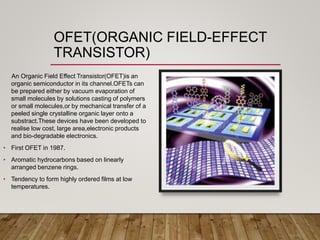
An Organic Field Effect Transistor(OFET)is an
organic semiconductor in its channel.OFETs can
be prepared either by vacuum evaporation of
small molecules by solutions casting of polymers
or small molecules,or by mechanical transfer of a
peeled single crystalline organic layer onto a
substract.These devices have been developed to
realise low cost, large area,electronic products
and bio-degradable electronics.
• First OFET in 1987.
• Aromatic hydrocarbons based on linearly
arranged benzene rings.
• Tendency to form highly ordered films at low
temperatures.
APPLICATIONS
 OFET sensors
 Bio Sensors
 Gas Sensors
 Chemical Sensors
 Electronic Skin
 Electronic paper
 E-books
 Displays embedded in smart cards
 Status displays
 Organic Radio Frequency Identification(ORFID)
 Wireless technology uses radio wave to scan or identify the product
 Switching speed upto 13.56MHz
OSC(ORGANIC SOLAR CELL)
An Organic Solar Cell or plastic
solar cell is a type of photovoltaic
that deals with conductive organic
polymers or small organic
molecules, for light absorption and
charge transport to produce
electricity from sunlight by the
photovoltaic effect . Most organic
photovoltaic cells are polymers
solar cells.
 Conductive organic polymers and
organic molecule.
 Photovoltaic effect.
 Rollable organic solar cell.
APPLICATIONS
• Organic solar car
• In satellites
• Calculators
• Wearable organic solar cell
APPLICATION
OF ORGANIC
ELECTRONICS
• OUR DAILY ACTIVITIES
NOWADAYS MAINLY SUPPORTED
BY MACHINE AND ELECTRONIC
DEVICE BASED ON SILICON
TECHNOLOGY.
• SMALL SIZE AND VERY LOW
PRICE.
• TRIED TO UTILIZING ORGANIC
THIN FILMS.
USING ORGANIC TRANSISTOR
FLEXIBLE DISPLAY
• It play important role in the interaction
between human beings and information.
• Organic material are used in display
mechanism
• Their control system consist of inorganic
transistor on glass substrates(silicon
TFT).
• More flexibility
• Displays can be breaked,rolled up or
folded.
ACTIVE MATRIX ORGANIC LIGHT
EMITTING DIODE(AMOLED)
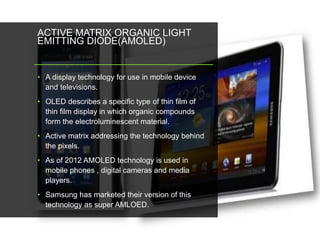
• A display technology for use in mobile device
and televisions.
• OLED describes a specific type of thin film of
thin film display in which organic compounds
form the electroluminescent material.
• Active matrix addressing the technology behind
the pixels.
• As of 2012 AMOLED technology is used in
mobile phones , digital cameras and media
players.
• Samsung has marketed their version of this
technology as super AMLOED.
FUTURE OF
ORGANIC
ELECTRONICS
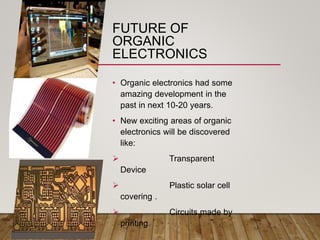
• Organic electronics had some
amazing development in the
past in next 10-20 years.
• New exciting areas of organic
electronics will be discovered
like:
 Transparent
Device
 Plastic solar cell
covering .
 Circuits made by
printing.
TRANSPARENT DEVICES
• Steps involved during processing
selection,design,simulation,fabrication,intregation,cha
racterization and optimization.
• Essentials Parts to make a transparent device:-
1)Transparent Thin Film Resistors(TTFR
•
2)Transparent Thin Film Inductors(TTFI)
3)Transparent Thin Film Transistors(TTFT)
4)Transparent Thin Film Capacitor To build a
transparent device many process is involved like
degenerate doping ,Burstien-Moss(BM) shift.
FUTURE OF ORGANIC
ELECTRONICS
PLASTIC SOLAR CELL
• Plastic solar cell that can turn the suns power into electrical
energy even on a cloudy day.
• The new material uses nanotechnology and absorbs the
infrared part of suns energy.
• It uses 1st generation solar cells which absorbs energy
efficiently.
• Solar energy given to earth 10000 times than what we consume
and if we use 1% of it we can overcome our power.
• Combined with the flexibility of organic molecules organic solar
cell are potentially cost effective.
APPLICATION OF
PLASTIC SOLAR
CELL
• Super Thin Disposable solar
panel poster which could offer
the rural dwellers a cheap and
an alternative source power.
• A hydrogen powered car
painted with the film could
potentially convert energy into
electricity.
• Personal mobile phone charger
• Small home electronics and
mobile electronics attachment.
• Power generation
APPLICATION OF PRINTED
CIRCUIT
• Automotive Industry
• Medical Industry
• Defence
• Lighting and emergency lighting
• Signs
• Scientific Instrumentation
• Broadcasting
• Marine Instrumentation
• Building protection
• Agriculture
FUTURE OF ORGANIC
ELECTRONICS
SMART TEXTILE
• Integrated
electronics device
into textile like
clothing
• Made possible
because of low
fabrication
temperature
• Has many potential
uses including
monitoring heart rate
and other vital signs
controlling
embedded
device(mp3 player).
FUTURE OF ORGANIC
ELECTRONICS
SKIN CANCER TREATMENT
• Team of
researchers in
Scotland has
demonstrated that
the change in
photodynamic
therapy is used to
treat skin cancer.
• It can be also
used in a
cosmetic industry
for anti aging and
acne treatment.
FUTURE WITH ORGANIC
ELECTRONICS
LAB ON A CHIPS
• A device that incorporate multiple function
in a single chip.
• Organic is replacing some si fabrication
method.
 Lower cost
 Easier to manufacture
 More flexible
CONCLUSION
• Add on feature on organic electronics
increased its demand than inorganic
electronics.
• With the consistent refinement of organic
electronics numerous application possibilities
for everyday use will arise.
• For example one could think illuminated
wallpapers for room lighting or as a variant
with imprinted TV
• There are hardly any limits to the imagination.

ORGANIC ELECTRONICS

  • 1.
    ORGANIC ELECTRONICS BY- JAGRATA DAS(18),MADHUSHREE GHOSH(20), MRINMOYEE RANA(21), KAUSHIK JHA(19) OF B.TECH(IT), 3RD YEAR, 6TH SEMESTER
  • 2.
    CONTENTS: • Introduction • OrganicElectronics • Conductive Organic Materials • Organic vs. Inorganic • Advantages and Disadvantages • OVPD • Schematic Diagram • OLED and its Applications • OLED vs. LCD • OFET and its Applications • OSC and its Applications • Features • Future Uses and Purposes • Conclusion
  • 3.
    INTRODUCTION • Organic electronicsis a branch of electronics. • It deals with conductive polymers and conductive small molecules. • Most polymer electronics are laminar electronics. • Conductive polymers are lighter, more flexible, and less expensive. • This makes them a desirable alternative in many applications. • They are not well structured.
  • 4.
    CONDUCTIVE ORGANIC MATERIALS • ConductiveOrganic Materials can be grouped into two main classes: Conductive Polymers and Conductive Small Molecules. Conductive small molecules are usually used in the construction of organic semiconductors, which exhibit degrees of electrical conductivity between those of insulators and metals.
  • 5.
    ORGANIC VS. INORGANIC ELECTRONICS ORGANIC •It is amorphous is structure. • It’s processor can maintain low temperature. • It has high flexibility. • It’s stability is currently an issue. INORGANIC • It is single crystalline in structure. • It’s processor becomes heated pretty quickly. • It has very low flexibility. • It is very stable.
  • 6.
    ADVANTAGES AND DISADVANTAGES Advantages: • Technologyis compatible with Large area processes (low cost) • Low temperature processing (low cost) • Molecules and polymers can be tailored for specific electronic or optical properties • Compatible with inorganic semiconductors Disadvantages: • Low carrier mobility • Electronic and optical stability of the materials • Processing is incompatible with classical processing in semiconductor industry.
  • 7.
    APPLICATIONS OF ORGANIC ELECTRONICS •Organic Vapor Phase Deposition (OVPD) • Organic Light Emitting Diode (OLED) • Organic Field Effect Transistor(OFET) • Organic Solar Cell (OSC)
  • 8.
  • 9.
    OVPD • OVPD wasinvented by Professor Steve Forrest at Princeton University has potential to overcome the limitation of VTE • The arrangement of evaporation and condensation is decoupled • Evaporation of the organic material occurs in individual and decoupled quartz pipes. • A precise amount of carrier gas is added into each quartz pipe by MFC to pick up organic molecules. • Then it’s transported into hot wall deposition chamber • They (ex: host and dopant) mix and evaporate. • They diffuse through the boundary layer on to the cooled substrate
  • 10.
    OLED(ORGANIC LIGHT EMITTING DIODE) OLEDis a flat light emitting technology, made by placing a series of organic thin films between two conductors. when electrical current is applied, a bright light is emitted. OLEDs can be used to make displays and lighting. Because OLEDs emit light they do not require a backlight and so are thinner and more efficient than LCD displays(which do require a white backlight). • First developed in early 1950’s. • Multiple organic layer sandwiched between two electrodes marked as cathode and transparent anode. • Principle: Electroluminescence(It is a characteristic of a material, typically semiconductor which enables it to emit light and response to an electrical current or strong electrical field). • Doesn’t require any backlight, self emitting.
  • 11.
    OLED VS. LCD OLED Greater view angle  High contrast  Faster response time  Do not require backlighting LCD  Limited view angle  Low contrast  Slow response  Require backlighting
  • 12.
    APPLICATIONS Television Cell phone Computer Screens Wristwatch Foldable smart phones Automobiles OLED Lenses Data Glasses
  • 13.
    OFET(ORGANIC FIELD-EFFECT TRANSISTOR) An OrganicField Effect Transistor(OFET)is an organic semiconductor in its channel.OFETs can be prepared either by vacuum evaporation of small molecules by solutions casting of polymers or small molecules,or by mechanical transfer of a peeled single crystalline organic layer onto a substract.These devices have been developed to realise low cost, large area,electronic products and bio-degradable electronics. • First OFET in 1987. • Aromatic hydrocarbons based on linearly arranged benzene rings. • Tendency to form highly ordered films at low temperatures.
  • 14.
    APPLICATIONS  OFET sensors Bio Sensors  Gas Sensors  Chemical Sensors  Electronic Skin  Electronic paper  E-books  Displays embedded in smart cards  Status displays  Organic Radio Frequency Identification(ORFID)  Wireless technology uses radio wave to scan or identify the product  Switching speed upto 13.56MHz
  • 15.
    OSC(ORGANIC SOLAR CELL) AnOrganic Solar Cell or plastic solar cell is a type of photovoltaic that deals with conductive organic polymers or small organic molecules, for light absorption and charge transport to produce electricity from sunlight by the photovoltaic effect . Most organic photovoltaic cells are polymers solar cells.  Conductive organic polymers and organic molecule.  Photovoltaic effect.  Rollable organic solar cell.
  • 16.
    APPLICATIONS • Organic solarcar • In satellites • Calculators • Wearable organic solar cell
  • 17.
    APPLICATION OF ORGANIC ELECTRONICS • OURDAILY ACTIVITIES NOWADAYS MAINLY SUPPORTED BY MACHINE AND ELECTRONIC DEVICE BASED ON SILICON TECHNOLOGY. • SMALL SIZE AND VERY LOW PRICE. • TRIED TO UTILIZING ORGANIC THIN FILMS.
  • 18.
    USING ORGANIC TRANSISTOR FLEXIBLEDISPLAY • It play important role in the interaction between human beings and information. • Organic material are used in display mechanism • Their control system consist of inorganic transistor on glass substrates(silicon TFT). • More flexibility • Displays can be breaked,rolled up or folded.
  • 19.
    ACTIVE MATRIX ORGANICLIGHT EMITTING DIODE(AMOLED) • A display technology for use in mobile device and televisions. • OLED describes a specific type of thin film of thin film display in which organic compounds form the electroluminescent material. • Active matrix addressing the technology behind the pixels. • As of 2012 AMOLED technology is used in mobile phones , digital cameras and media players. • Samsung has marketed their version of this technology as super AMLOED.
  • 20.
    FUTURE OF ORGANIC ELECTRONICS • Organicelectronics had some amazing development in the past in next 10-20 years. • New exciting areas of organic electronics will be discovered like:  Transparent Device  Plastic solar cell covering .  Circuits made by printing.
  • 21.
    TRANSPARENT DEVICES • Stepsinvolved during processing selection,design,simulation,fabrication,intregation,cha racterization and optimization. • Essentials Parts to make a transparent device:- 1)Transparent Thin Film Resistors(TTFR • 2)Transparent Thin Film Inductors(TTFI) 3)Transparent Thin Film Transistors(TTFT) 4)Transparent Thin Film Capacitor To build a transparent device many process is involved like degenerate doping ,Burstien-Moss(BM) shift.
  • 22.
    FUTURE OF ORGANIC ELECTRONICS PLASTICSOLAR CELL • Plastic solar cell that can turn the suns power into electrical energy even on a cloudy day. • The new material uses nanotechnology and absorbs the infrared part of suns energy. • It uses 1st generation solar cells which absorbs energy efficiently. • Solar energy given to earth 10000 times than what we consume and if we use 1% of it we can overcome our power. • Combined with the flexibility of organic molecules organic solar cell are potentially cost effective.
  • 23.
    APPLICATION OF PLASTIC SOLAR CELL •Super Thin Disposable solar panel poster which could offer the rural dwellers a cheap and an alternative source power. • A hydrogen powered car painted with the film could potentially convert energy into electricity. • Personal mobile phone charger • Small home electronics and mobile electronics attachment. • Power generation
  • 24.
    APPLICATION OF PRINTED CIRCUIT •Automotive Industry • Medical Industry • Defence • Lighting and emergency lighting • Signs • Scientific Instrumentation • Broadcasting • Marine Instrumentation • Building protection • Agriculture
  • 25.
    FUTURE OF ORGANIC ELECTRONICS SMARTTEXTILE • Integrated electronics device into textile like clothing • Made possible because of low fabrication temperature • Has many potential uses including monitoring heart rate and other vital signs controlling embedded device(mp3 player).
  • 26.
    FUTURE OF ORGANIC ELECTRONICS SKINCANCER TREATMENT • Team of researchers in Scotland has demonstrated that the change in photodynamic therapy is used to treat skin cancer. • It can be also used in a cosmetic industry for anti aging and acne treatment.
  • 27.
    FUTURE WITH ORGANIC ELECTRONICS LABON A CHIPS • A device that incorporate multiple function in a single chip. • Organic is replacing some si fabrication method.  Lower cost  Easier to manufacture  More flexible
  • 28.
    CONCLUSION • Add onfeature on organic electronics increased its demand than inorganic electronics. • With the consistent refinement of organic electronics numerous application possibilities for everyday use will arise. • For example one could think illuminated wallpapers for room lighting or as a variant with imprinted TV • There are hardly any limits to the imagination.