Animal Ethics
Committee
BY PRASHANT SHIVGUNDE
UNIVERSITY RESEARCH DEPARTMENT,
MUHS, NASHIK
Content
• Animals: a key to medical research
• Current Uses of Laboratory animals
• Should Laboratory animals be used for Research?
• Ethics
• Milestones in animal welfare
• Milestones- Indian scenario
• Indian Act forAnimal Welfare
• Institutional Animal Ethics Committee
1/16/2018PPS, MUHS, Nashik 2
Animals: A Key to Medical Research
• Provide new measures for the health and welfare of humans
• Solutions to many questions only because of animal research
• Use of monkeys in polio research.
• Anti-hypertensives due to research on cats.
• Successful kidney/organ transplants due to research in dogs and rodents.
PPS, MUHS, Nashik 1/16/2018 3
Current Uses of Laboratory animals
• •Biomedical Research
• •Regulatory Requirements
• •Quality Control Measures
• •Training
• •Demonstrations
PPS, MUHS, Nashik 1/16/2018 4
PPS, MUHS, Nashik 1/16/2018 5
PPS, MUHS, Nashik 1/16/2018 6
Animals in
medical
research
Acquisition
of new
knowledge
Fundamental
research
Study of
Genetic
Disorder
Development of
new diagnostic
diseases
Teaching
exercises
Testing
New
treatment
for disease
Preparatio
ns of
natural
products
Safety
testing
Ethics
• Wide spectrum of views on this subject-
• ranging from those concerned with animal 'rights' to those who view animals
only as a resource to be exploited.
• These viewpoints have contributed to the development of ethical
principles of animal use
PPS, MUHS, Nashik 1/16/2018 7
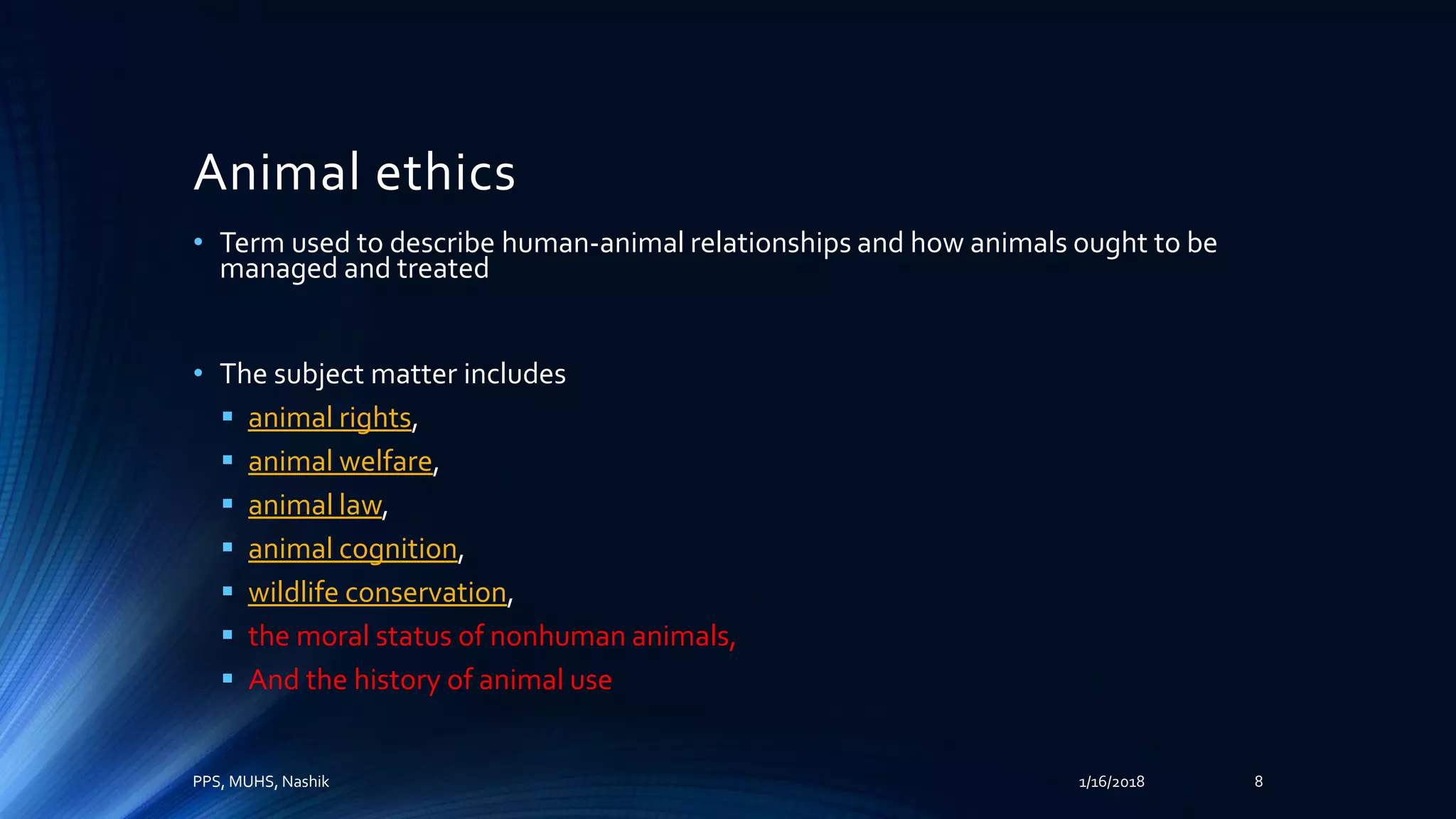
Animal ethics
• Term used to describe human-animal relationships and how animals ought to be
managed and treated
• The subject matter includes
 animal rights,
 animal welfare,
 animal law,
 animal cognition,
 wildlife conservation,
 the moral status of nonhuman animals,
 And the history of animal use
PPS, MUHS, Nashik 1/16/2018 8
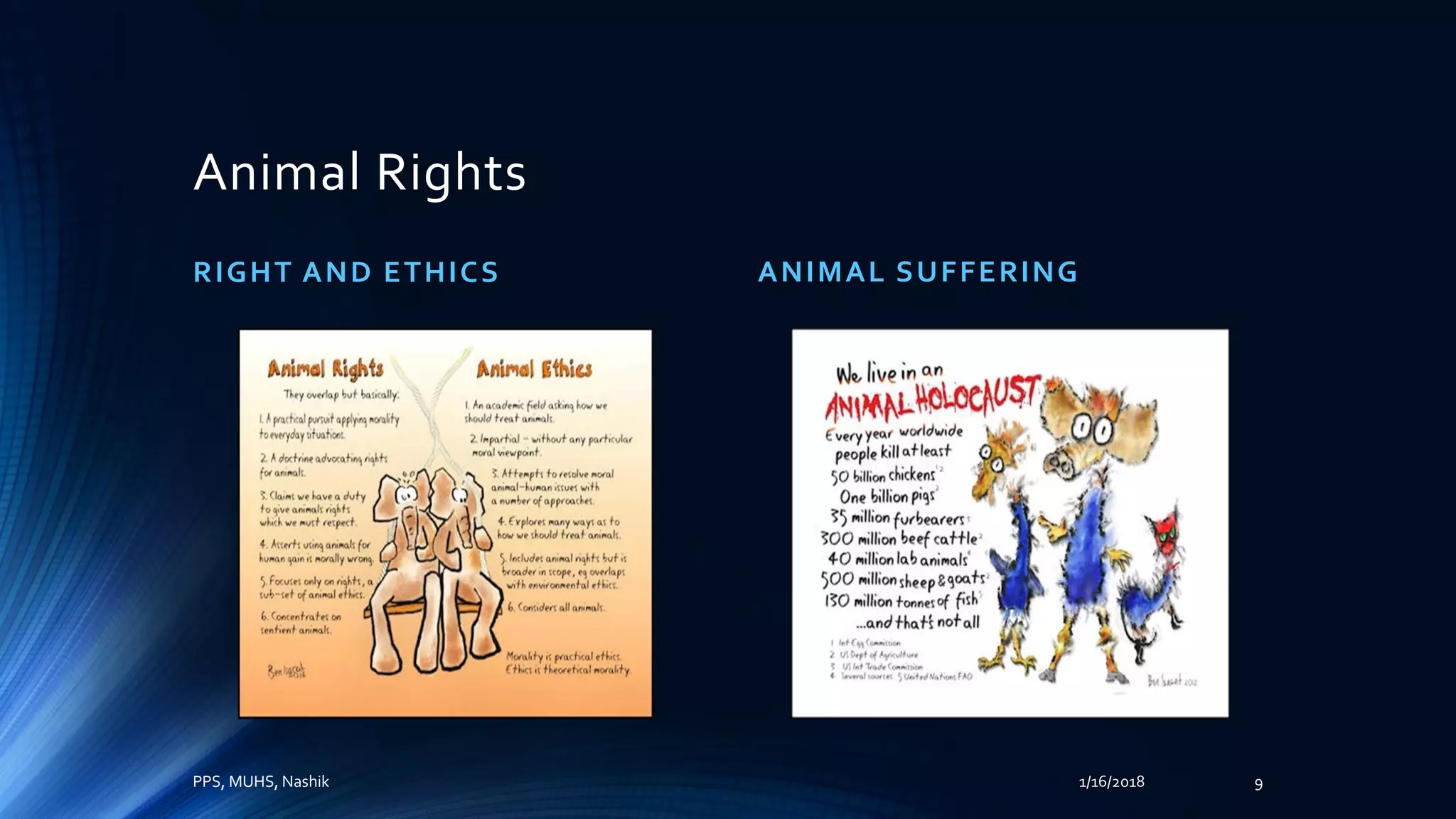
Animal Rights
RIGHT AND ETHICS ANIMAL SUFFERING
PPS, MUHS, Nashik 1/16/2018 9
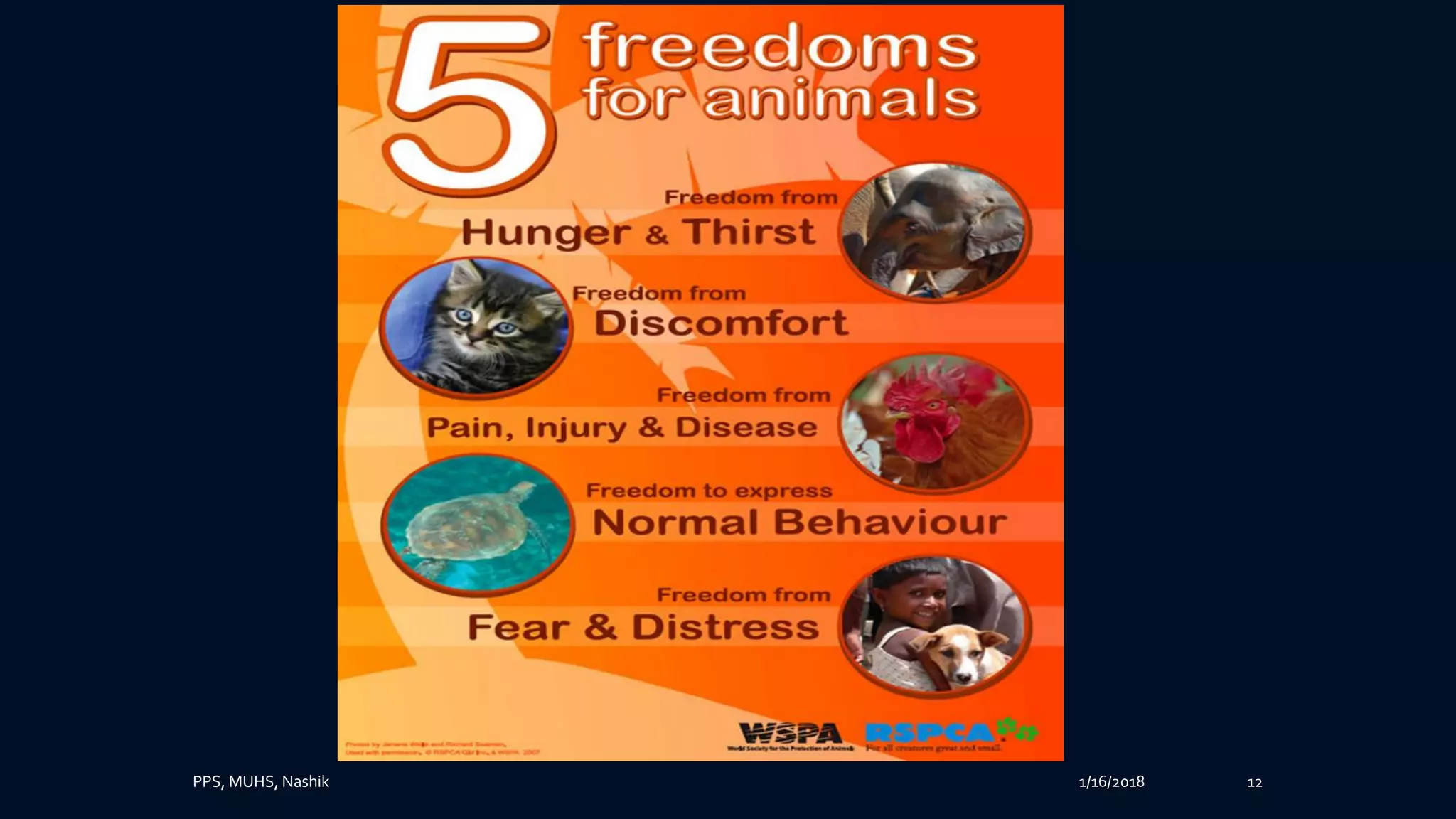
Five Freedoms (Brambell's five freedoms)
• The five freedoms were originally developed from a UK
Government report on livestock husbandry in 1965 (Prof.Roger
Brambell) then by FarmAnimalWelfare Council (FAWC) In July 1979
PPS, MUHS, Nashik 1/16/2018 10
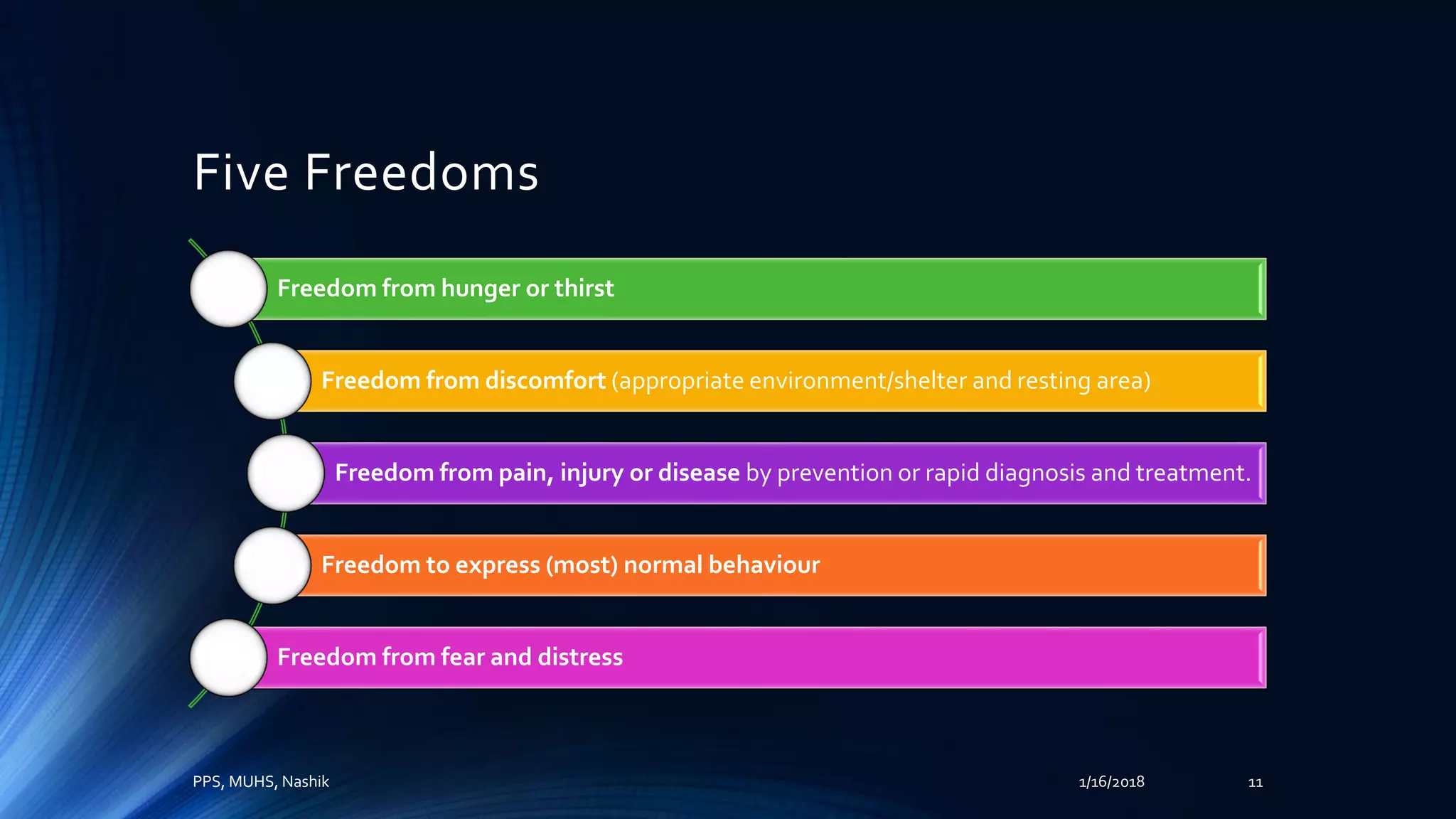
Five Freedoms
Freedom from hunger or thirst
Freedom from discomfort (appropriate environment/shelter and resting area)
Freedom from pain, injury or disease by prevention or rapid diagnosis and treatment.
Freedom to express (most) normal behaviour
Freedom from fear and distress
PPS, MUHS, Nashik 1/16/2018 11
PPS, MUHS, Nashik 1/16/2018 12
Should Laboratory animals be used
for Research?
• Using animals for biomedical research
“Evokes strong emotions”
3 viewpoints are observed
The scientist’s viewpoint
The animal activist’s viewpoint
The philosopher’s viewpoint
PPS, MUHS, Nashik 1/16/2018 13
The Scientist’s Viewpoint
• Animals are not the only bio-system in use
• If not animals then experiments in humans under uncontrolled
conditions
• Animal research vital to medical progress
• In vitro alternatives provide supplementary information and work
only as adjuncts
• Certain life processes cannot be investigated without involving whole
animal systems.
PPS, MUHS, Nashik 1/16/2018 14
The Animal Activist’s Viewpoint
• Animals are exposed to too much suffering.
• Better alternatives than animal research.
• Superior human life does not confer the right to exploit inferior
order’s life.
PPS, MUHS, Nashik 1/16/2018 15
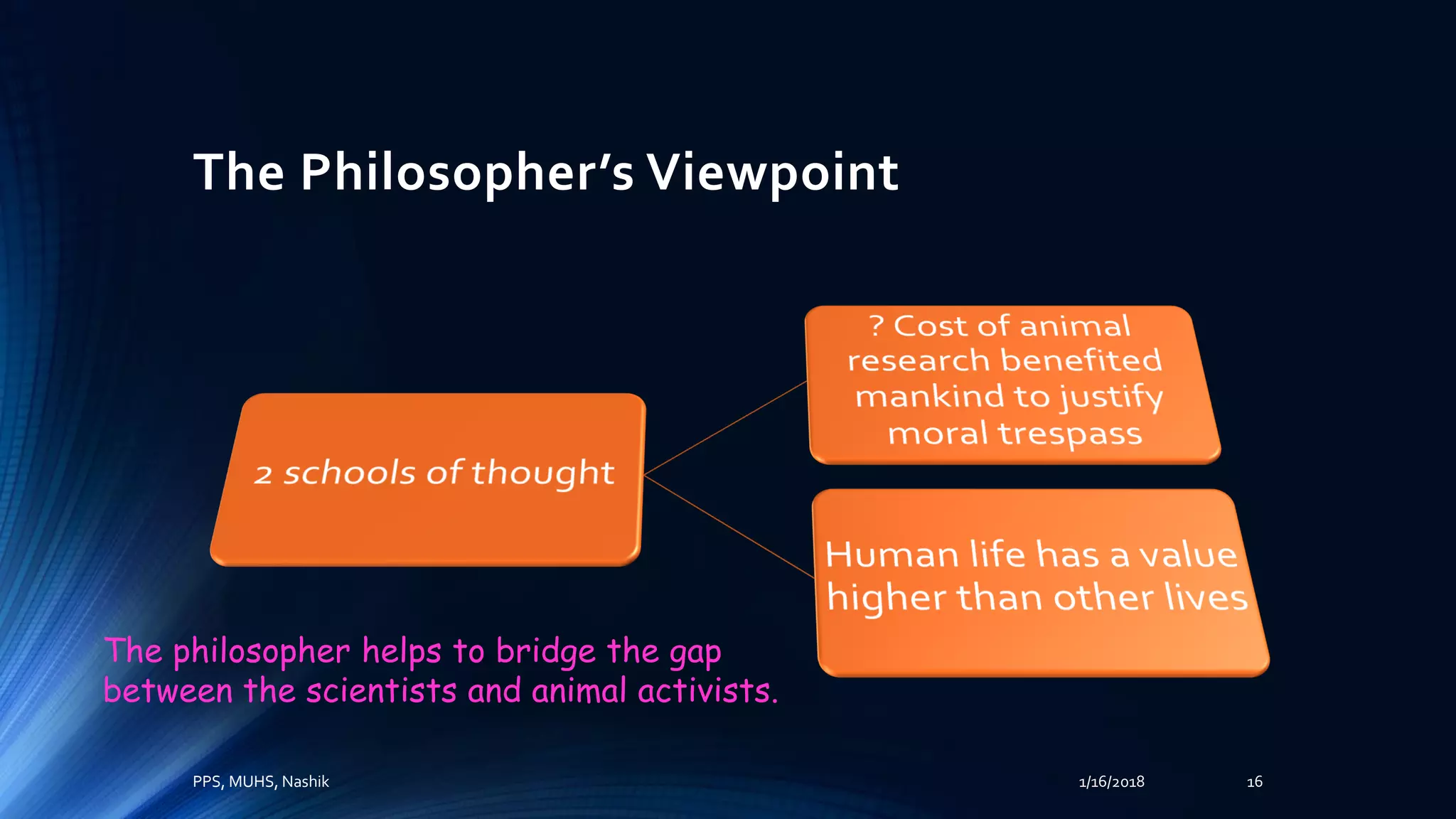
The Philosopher’s Viewpoint
PPS, MUHS, Nashik 1/16/2018 16
The philosopher helps to bridge the gap
between the scientists and animal activists.
PPS, MUHS, Nashik 1/16/2018 17
The three differing viewpoints
appear valid and reasonable when
seen separately
Is a reconciliation possible ?
Yes !
If a common goal of a
common good has to be achieved.
Steps Towards Using Fewer Animals
The 3 R’s and Biomedical Research
• In 1926, Charles Humes, founded "UFAW” (Universities Federation for
AnimalWelfare) to change the attitude of people to animals.
In 1959, he commissionedWilliam Russell and Rex Burch, to write,
“The Principles Of Humane ExperimentalTechnique”
PPS, MUHS, Nashik 1/16/2018 18
Steps Towards Using Fewer Animals
• The Principles Of Humane ExperimentalTechnique
• Scientific excellence and humane use of laboratory animals are
inextricably linked
Concept of "Three R’s "
Reduction
Refinement
Replacement
PPS, MUHS, Nashik 1/16/2018 19
Steps Towards Using Fewer Animals
Reduction
• More data from a given number of animals
• Collaborating with colleagues
• Minimum necessary animals
Refinement
• Methods to minimise pain/suffering
• Alteration in frequency and volume of dose
• Enhancement of animal well-being
PPS, MUHS, Nashik 1/16/2018 20
Steps Towards Using Fewer Animals
Replacement
• Methods that use organisms with limited sentience, microorganisms, invertebrates
• Improved information exchange
• Mathematics and computer models
PPS, MUHS, Nashik 1/16/2018 21
Milestones in animal welfare
• 1641- First Legislation forbidding cruelty to animals passed in the
Court of Massachusetts
• 1820 - First anti-cruelty law was passed in England
• 1824 and 1865 - SPCA in England and USA
• 1871 - “The British Association for the Advancement of Science”
published guidelines for animal experimentation
• 1883 - American Antivivisection society came into existence
PPS, MUHS, Nashik 1/16/2018 22
Milestones- Indian scenario
• 1890 - Act preventing cruelty to animals implemented
• Later replaced by “THE PREVENTION OF CRUELTYTO ANIMALS
ACT, 1960”.
PPS, MUHS, Nashik 1/16/2018 23
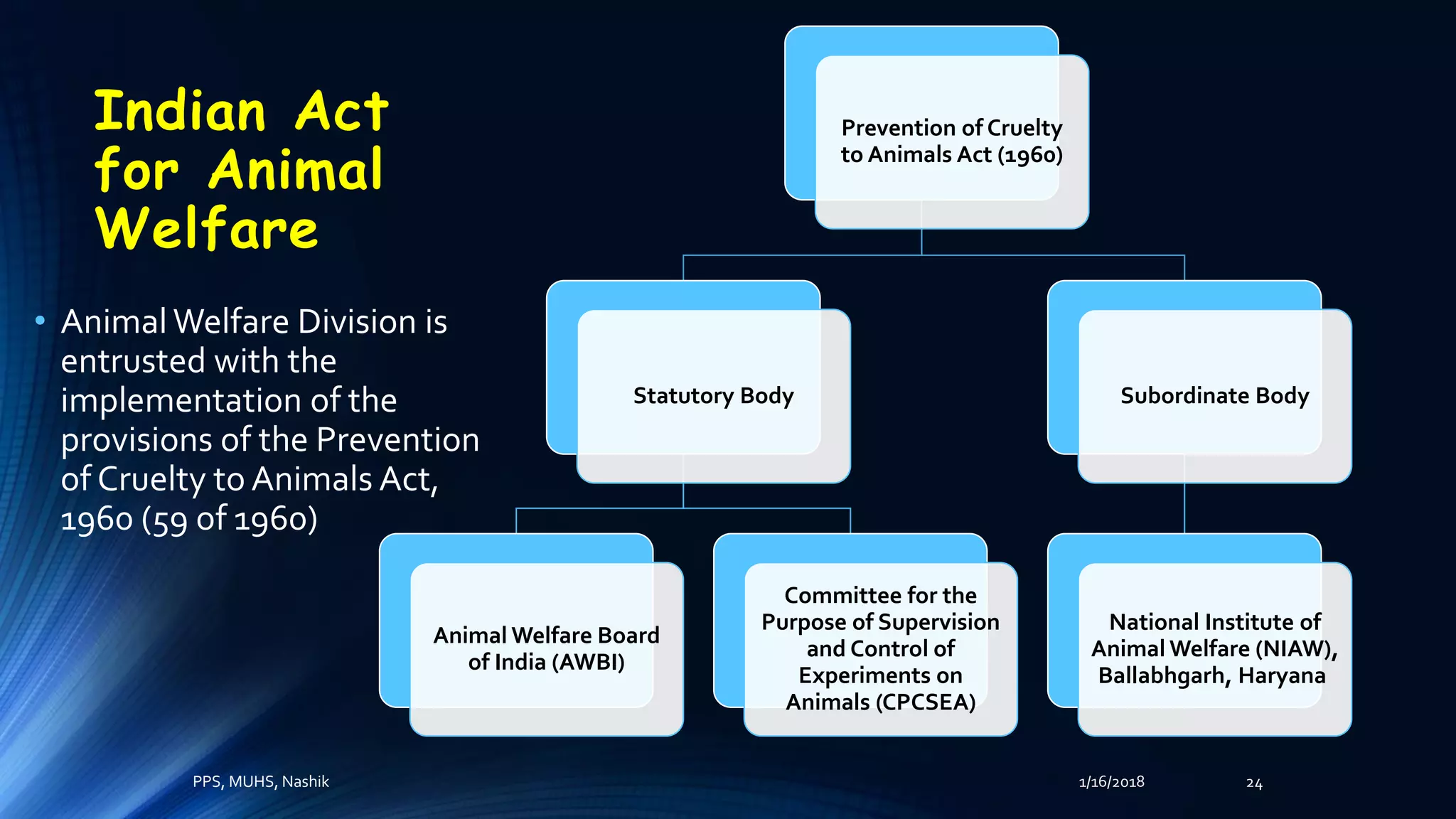
Indian Act
for Animal
Welfare
• AnimalWelfare Division is
entrusted with the
implementation of the
provisions of the Prevention
of Cruelty to Animals Act,
1960 (59 of 1960)
Prevention of Cruelty
to Animals Act (1960)
Statutory Body
Animal Welfare Board
of India (AWBI)
Committee for the
Purpose of Supervision
and Control of
Experiments on
Animals (CPCSEA)
Subordinate Body
National Institute of
Animal Welfare (NIAW),
Ballabhgarh, Haryana
1/16/2018PPS, MUHS, Nashik 24
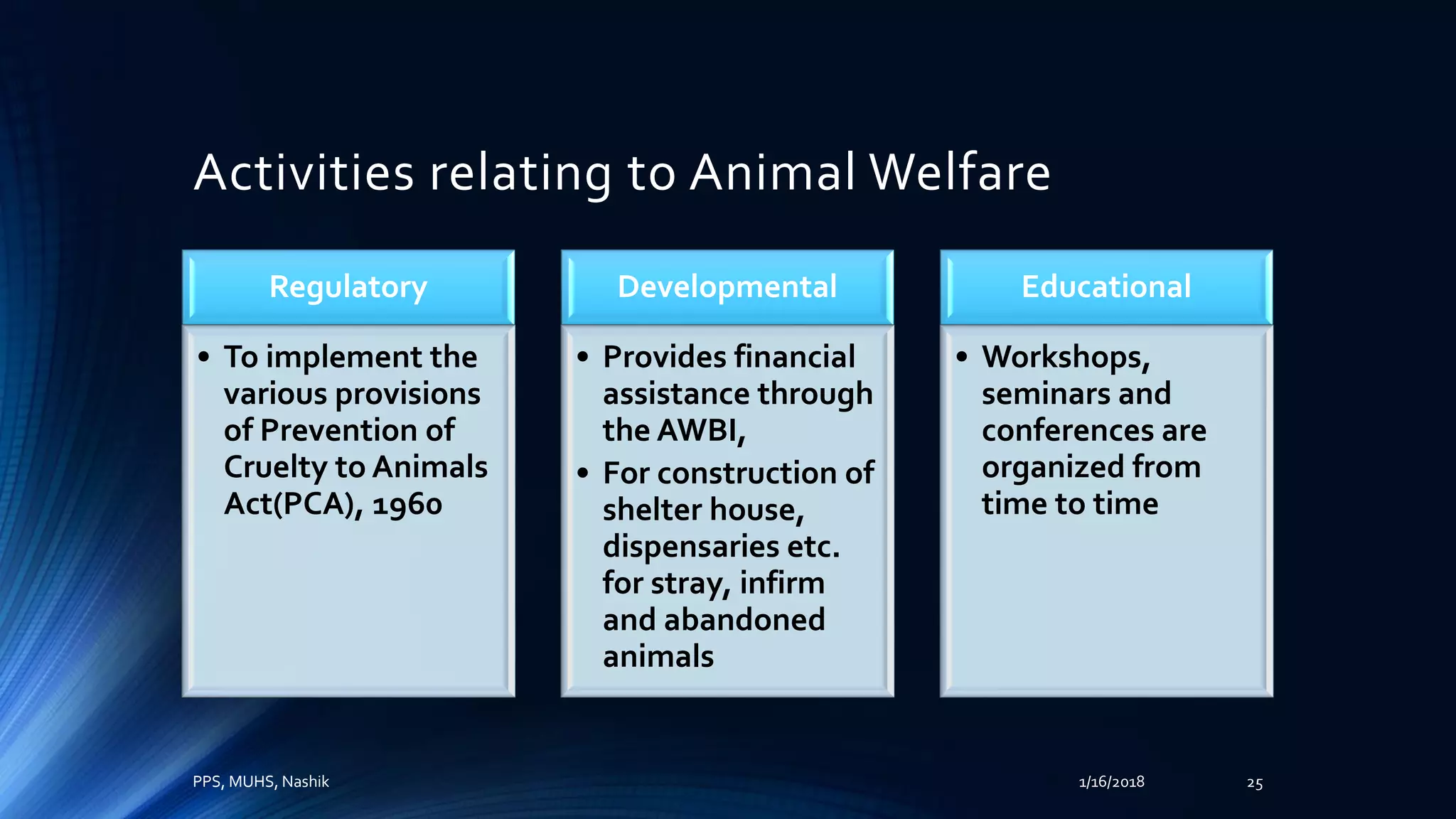
Activities relating to Animal Welfare
Regulatory
• To implement the
various provisions
of Prevention of
Cruelty to Animals
Act(PCA), 1960
Developmental
• Provides financial
assistance through
the AWBI,
• For construction of
shelter house,
dispensaries etc.
for stray, infirm
and abandoned
animals
Educational
• Workshops,
seminars and
conferences are
organized from
time to time
1/16/2018PPS, MUHS, Nashik 25
Indian historical developments
Prevention of Cruelty
to Animals (PCA) Act
1960 as amended in
1982
• To prevent infliction of
unnecessary pain or
suffering on animals
Central Government
has constituted
(CPCSEA)
• Duty to ensure that animals
are not subjected to
unnecessary pain or
suffering before, during or
after the performance of
experiments on them
Breeding of and
Experiments on
Animals (Control and
Supervision) Rules,
1998
• Amended during 2001 and
2006, to regulate the
experimentation on
animals
1/16/2018PPS, MUHS, Nashik 26
Functions of CPCSEA
PPS, MUHS, Nashik 1/16/2018 27
Registration of establishments
Selection and appointment of nominees in the IAEC
Approval of Animal House Facilities
Permission for conducting experiments
Recommendation for import of animals
Action against establishments in case of violation
Institutional Animal Ethics
Committee
1/16/2018PPS, MUHS, Nashik 28
Objectives behind designing
• Utilization of competent staff for animal experiment
• Performance with care and humanity
• Anesthesia
• Euthanasia in case of recovery would involve serious suffering
• To avoid animal experiment wherever possible
PPS, MUHS, Nashik 1/16/2018 29
Objectives behind designing
• To avoid experiments on large animals incase small lab animals can
be utilized
• To avoid experiments, merely for the purpose of acquiring manual
skill
• Proper look after both before and after experiments
• To Maintain suitable animal experimentation records
PPS, MUHS, Nashik 1/16/2018 30
IAEC
“Body comprising of a group of persons recognized and
registered by the Committee for the purpose of control and
supervision of experiments on animals performed in an
establishment which is constituted and operated in
accordance with procedures specified for the purpose by the
Committee”
• As defined in “Breeding of and Experiments onAnimals
(Control and Supervision) Rules, 1998”
PPS, MUHS, Nashik 1/16/2018 31
Functions
of IAEC
To achieve designed objectives
To review and approve research proposals involving small animal
experimentation before the start of the study.
For experimentation on large animals, the case is required to be
forwarded to CPCSEA in prescribed manner with recommendation of
IAEC.
To monitor the research throughout and after completion of study
ToVisit to animal house and laboratory
To ensure compliance with all regulatory requirements, applicable rules,
guidelines and laws.
PPS, MUHS, Nashik 1/16/2018 32
Composition of IAEC
Scientist in charge of animals
facility
A biological scientist
2 scientists from different
biological disciplines
A veterinarian involved in the
care of animal
A scientist from, outside the
institute
A non scientific socially aware
member
A nominee of CPCSEA
PPS, MUHS, Nashik 1/16/2018 33
PPS, MUHS, Nashik 1/16/2018 34
Constituting IAEC
AUTHORITY
• CPCSEA
• On receipt of five (5) names
against serial numbers 1-4 from
the institute
DURATION
• 3 years’
• Reconstituted at the time of
renewal of registration
• Changes
• with the approval of CPCSEA
PPS, MUHS, Nashik 1/16/2018 35
Decision Making
• Quorum- Minimum of 6 members
• All decisions should be taken
• In meetings
• Not by circulation
• Presence of CPCSEA nominee is a must.
• Link nominee can attend (main nominee conveys his unavailability)
• Socially aware member’s presence is compulsory in cases referred to
CPCSEA and at least in one meeting in a calendar year
PPS, MUHS, Nashik 1/16/2018 36
Conduct of Business
• Chairperson role
• In absence of chairperson
• Member Secretary role
• Participation by Investigators / experts in IAEC
• Application Procedures
• Review procedure
PPS, MUHS, Nashik 1/16/2018 37
Conduct of Business
• Decision-making
• Communicating the decision
• Follow up procedures
PPS, MUHS, Nashik 1/16/2018 38
Record keeping and Archiving
• CurriculumVitae (CV) of all members of IAEC including training
programs in animal ethics attended.
• Copy of all study protocols with enclosed documents, progress
reports.
• Minutes of all meetings duly signed by the Chairperson and the
members.
• Copy of all existing relevant national and international guidelines on
animal ethics and laws along with amendments.
• Copy of all correspondence with members, researchers and other
regulatory bodies.
PPS, MUHS, Nashik 1/16/2018 39
Record keeping and Archiving
• Final report of the approved projects.
• Record of Breeding of animals, supply etc.
• Record of import of animals with species, source, quantity, usage etc.
• Record of all Contract research
• Record of rehabilitation of large animals if done
• All documents should be archived for period as prescribed in the SOP
of the IAEC.
PPS, MUHS, Nashik 1/16/2018 40
Reporting to CPCSEA
• After IAEC meeting, within 15 days
• Inspection report of animal house with photographs by IAEC
members is required to be sent once in a calendar year.
PPS, MUHS, Nashik 1/16/2018 41
Project proposal
• Study rationale
• Number of animals
• Methodology - details of procedures
• Species ( Procurement & transportation)
• Trained personnel and veterinary care
• Anaesthesia
• Euthanasia
PPS, MUHS, Nashik 1/16/2018 42
Review of Project proposal
• Is the animal study justified?
• Is replacement, reduction or refinement possible ?
• Is pain or suffering involved ?
• Will survival surgery be done?
• How will euthanasia be carried out?
• Where will the animals be housed ?
• What food will be given ?
• How will dead animals be disposed of ?
PPS, MUHS, Nashik 1/16/2018 43
Controlling Pain
Environmental / behavioural strategies taken to relieve pain & distress
• Decreasing noise
• Gentle handling
• Separation
• Familiar environment
PPS, MUHS, Nashik 1/16/2018 44
Anaesthesia/ Analgesia
Use of anaesthetic or analgesic is based upon
Species and the age of the animal
The type and degree of pain
The effects of particular agents on specific organ systems
Length of the operative procedure
The safety of an agent for an animal
PPS, MUHS, Nashik 1/16/2018 45
EUTHANASIA
Act of killing animals by inducing rapid unconsciousness and death
without pain or distress.
At the end of the study procedure
Relieve severe pain or distress
• Barbiturates & inhalant anaesthetics are preferable to physical
methods
PPS, MUHS, Nashik 1/16/2018 46
EUTHANASIA
Procedure
• Painless + Rapid
• Reliable and non-reversible
• Should cause minimum psychological stress
• Carried out in a separate room as animals recognise sound and smell
• Skilled personnel
• Trained Personnel should confirm death
PPS, MUHS, Nashik 1/16/2018 47
PPS, MUHS, Nashik 1/16/2018 48

Animal ethics committee in INDIA

  • 1.
    Animal Ethics Committee BY PRASHANTSHIVGUNDE UNIVERSITY RESEARCH DEPARTMENT, MUHS, NASHIK
  • 2.
    Content • Animals: akey to medical research • Current Uses of Laboratory animals • Should Laboratory animals be used for Research? • Ethics • Milestones in animal welfare • Milestones- Indian scenario • Indian Act forAnimal Welfare • Institutional Animal Ethics Committee 1/16/2018PPS, MUHS, Nashik 2
  • 3.
    Animals: A Keyto Medical Research • Provide new measures for the health and welfare of humans • Solutions to many questions only because of animal research • Use of monkeys in polio research. • Anti-hypertensives due to research on cats. • Successful kidney/organ transplants due to research in dogs and rodents. PPS, MUHS, Nashik 1/16/2018 3
  • 4.
    Current Uses ofLaboratory animals • •Biomedical Research • •Regulatory Requirements • •Quality Control Measures • •Training • •Demonstrations PPS, MUHS, Nashik 1/16/2018 4
  • 5.
    PPS, MUHS, Nashik1/16/2018 5
  • 6.
    PPS, MUHS, Nashik1/16/2018 6 Animals in medical research Acquisition of new knowledge Fundamental research Study of Genetic Disorder Development of new diagnostic diseases Teaching exercises Testing New treatment for disease Preparatio ns of natural products Safety testing
  • 7.
    Ethics • Wide spectrumof views on this subject- • ranging from those concerned with animal 'rights' to those who view animals only as a resource to be exploited. • These viewpoints have contributed to the development of ethical principles of animal use PPS, MUHS, Nashik 1/16/2018 7
  • 8.
    Animal ethics • Termused to describe human-animal relationships and how animals ought to be managed and treated • The subject matter includes  animal rights,  animal welfare,  animal law,  animal cognition,  wildlife conservation,  the moral status of nonhuman animals,  And the history of animal use PPS, MUHS, Nashik 1/16/2018 8
  • 9.
    Animal Rights RIGHT ANDETHICS ANIMAL SUFFERING PPS, MUHS, Nashik 1/16/2018 9
  • 10.
    Five Freedoms (Brambell'sfive freedoms) • The five freedoms were originally developed from a UK Government report on livestock husbandry in 1965 (Prof.Roger Brambell) then by FarmAnimalWelfare Council (FAWC) In July 1979 PPS, MUHS, Nashik 1/16/2018 10
  • 11.
    Five Freedoms Freedom fromhunger or thirst Freedom from discomfort (appropriate environment/shelter and resting area) Freedom from pain, injury or disease by prevention or rapid diagnosis and treatment. Freedom to express (most) normal behaviour Freedom from fear and distress PPS, MUHS, Nashik 1/16/2018 11
  • 12.
    PPS, MUHS, Nashik1/16/2018 12
  • 13.
    Should Laboratory animalsbe used for Research? • Using animals for biomedical research “Evokes strong emotions” 3 viewpoints are observed The scientist’s viewpoint The animal activist’s viewpoint The philosopher’s viewpoint PPS, MUHS, Nashik 1/16/2018 13
  • 14.
    The Scientist’s Viewpoint •Animals are not the only bio-system in use • If not animals then experiments in humans under uncontrolled conditions • Animal research vital to medical progress • In vitro alternatives provide supplementary information and work only as adjuncts • Certain life processes cannot be investigated without involving whole animal systems. PPS, MUHS, Nashik 1/16/2018 14
  • 15.
    The Animal Activist’sViewpoint • Animals are exposed to too much suffering. • Better alternatives than animal research. • Superior human life does not confer the right to exploit inferior order’s life. PPS, MUHS, Nashik 1/16/2018 15
  • 16.
    The Philosopher’s Viewpoint PPS,MUHS, Nashik 1/16/2018 16 The philosopher helps to bridge the gap between the scientists and animal activists.
  • 17.
    PPS, MUHS, Nashik1/16/2018 17 The three differing viewpoints appear valid and reasonable when seen separately Is a reconciliation possible ? Yes ! If a common goal of a common good has to be achieved.
  • 18.
    Steps Towards UsingFewer Animals The 3 R’s and Biomedical Research • In 1926, Charles Humes, founded "UFAW” (Universities Federation for AnimalWelfare) to change the attitude of people to animals. In 1959, he commissionedWilliam Russell and Rex Burch, to write, “The Principles Of Humane ExperimentalTechnique” PPS, MUHS, Nashik 1/16/2018 18
  • 19.
    Steps Towards UsingFewer Animals • The Principles Of Humane ExperimentalTechnique • Scientific excellence and humane use of laboratory animals are inextricably linked Concept of "Three R’s " Reduction Refinement Replacement PPS, MUHS, Nashik 1/16/2018 19
  • 20.
    Steps Towards UsingFewer Animals Reduction • More data from a given number of animals • Collaborating with colleagues • Minimum necessary animals Refinement • Methods to minimise pain/suffering • Alteration in frequency and volume of dose • Enhancement of animal well-being PPS, MUHS, Nashik 1/16/2018 20
  • 21.
    Steps Towards UsingFewer Animals Replacement • Methods that use organisms with limited sentience, microorganisms, invertebrates • Improved information exchange • Mathematics and computer models PPS, MUHS, Nashik 1/16/2018 21
  • 22.
    Milestones in animalwelfare • 1641- First Legislation forbidding cruelty to animals passed in the Court of Massachusetts • 1820 - First anti-cruelty law was passed in England • 1824 and 1865 - SPCA in England and USA • 1871 - “The British Association for the Advancement of Science” published guidelines for animal experimentation • 1883 - American Antivivisection society came into existence PPS, MUHS, Nashik 1/16/2018 22
  • 23.
    Milestones- Indian scenario •1890 - Act preventing cruelty to animals implemented • Later replaced by “THE PREVENTION OF CRUELTYTO ANIMALS ACT, 1960”. PPS, MUHS, Nashik 1/16/2018 23
  • 24.
    Indian Act for Animal Welfare •AnimalWelfare Division is entrusted with the implementation of the provisions of the Prevention of Cruelty to Animals Act, 1960 (59 of 1960) Prevention of Cruelty to Animals Act (1960) Statutory Body Animal Welfare Board of India (AWBI) Committee for the Purpose of Supervision and Control of Experiments on Animals (CPCSEA) Subordinate Body National Institute of Animal Welfare (NIAW), Ballabhgarh, Haryana 1/16/2018PPS, MUHS, Nashik 24
  • 25.
    Activities relating toAnimal Welfare Regulatory • To implement the various provisions of Prevention of Cruelty to Animals Act(PCA), 1960 Developmental • Provides financial assistance through the AWBI, • For construction of shelter house, dispensaries etc. for stray, infirm and abandoned animals Educational • Workshops, seminars and conferences are organized from time to time 1/16/2018PPS, MUHS, Nashik 25
  • 26.
    Indian historical developments Preventionof Cruelty to Animals (PCA) Act 1960 as amended in 1982 • To prevent infliction of unnecessary pain or suffering on animals Central Government has constituted (CPCSEA) • Duty to ensure that animals are not subjected to unnecessary pain or suffering before, during or after the performance of experiments on them Breeding of and Experiments on Animals (Control and Supervision) Rules, 1998 • Amended during 2001 and 2006, to regulate the experimentation on animals 1/16/2018PPS, MUHS, Nashik 26
  • 27.
    Functions of CPCSEA PPS,MUHS, Nashik 1/16/2018 27 Registration of establishments Selection and appointment of nominees in the IAEC Approval of Animal House Facilities Permission for conducting experiments Recommendation for import of animals Action against establishments in case of violation
  • 28.
  • 29.
    Objectives behind designing •Utilization of competent staff for animal experiment • Performance with care and humanity • Anesthesia • Euthanasia in case of recovery would involve serious suffering • To avoid animal experiment wherever possible PPS, MUHS, Nashik 1/16/2018 29
  • 30.
    Objectives behind designing •To avoid experiments on large animals incase small lab animals can be utilized • To avoid experiments, merely for the purpose of acquiring manual skill • Proper look after both before and after experiments • To Maintain suitable animal experimentation records PPS, MUHS, Nashik 1/16/2018 30
  • 31.
    IAEC “Body comprising ofa group of persons recognized and registered by the Committee for the purpose of control and supervision of experiments on animals performed in an establishment which is constituted and operated in accordance with procedures specified for the purpose by the Committee” • As defined in “Breeding of and Experiments onAnimals (Control and Supervision) Rules, 1998” PPS, MUHS, Nashik 1/16/2018 31
  • 32.
    Functions of IAEC To achievedesigned objectives To review and approve research proposals involving small animal experimentation before the start of the study. For experimentation on large animals, the case is required to be forwarded to CPCSEA in prescribed manner with recommendation of IAEC. To monitor the research throughout and after completion of study ToVisit to animal house and laboratory To ensure compliance with all regulatory requirements, applicable rules, guidelines and laws. PPS, MUHS, Nashik 1/16/2018 32
  • 33.
    Composition of IAEC Scientistin charge of animals facility A biological scientist 2 scientists from different biological disciplines A veterinarian involved in the care of animal A scientist from, outside the institute A non scientific socially aware member A nominee of CPCSEA PPS, MUHS, Nashik 1/16/2018 33
  • 34.
    PPS, MUHS, Nashik1/16/2018 34
  • 35.
    Constituting IAEC AUTHORITY • CPCSEA •On receipt of five (5) names against serial numbers 1-4 from the institute DURATION • 3 years’ • Reconstituted at the time of renewal of registration • Changes • with the approval of CPCSEA PPS, MUHS, Nashik 1/16/2018 35
  • 36.
    Decision Making • Quorum-Minimum of 6 members • All decisions should be taken • In meetings • Not by circulation • Presence of CPCSEA nominee is a must. • Link nominee can attend (main nominee conveys his unavailability) • Socially aware member’s presence is compulsory in cases referred to CPCSEA and at least in one meeting in a calendar year PPS, MUHS, Nashik 1/16/2018 36
  • 37.
    Conduct of Business •Chairperson role • In absence of chairperson • Member Secretary role • Participation by Investigators / experts in IAEC • Application Procedures • Review procedure PPS, MUHS, Nashik 1/16/2018 37
  • 38.
    Conduct of Business •Decision-making • Communicating the decision • Follow up procedures PPS, MUHS, Nashik 1/16/2018 38
  • 39.
    Record keeping andArchiving • CurriculumVitae (CV) of all members of IAEC including training programs in animal ethics attended. • Copy of all study protocols with enclosed documents, progress reports. • Minutes of all meetings duly signed by the Chairperson and the members. • Copy of all existing relevant national and international guidelines on animal ethics and laws along with amendments. • Copy of all correspondence with members, researchers and other regulatory bodies. PPS, MUHS, Nashik 1/16/2018 39
  • 40.
    Record keeping andArchiving • Final report of the approved projects. • Record of Breeding of animals, supply etc. • Record of import of animals with species, source, quantity, usage etc. • Record of all Contract research • Record of rehabilitation of large animals if done • All documents should be archived for period as prescribed in the SOP of the IAEC. PPS, MUHS, Nashik 1/16/2018 40
  • 41.
    Reporting to CPCSEA •After IAEC meeting, within 15 days • Inspection report of animal house with photographs by IAEC members is required to be sent once in a calendar year. PPS, MUHS, Nashik 1/16/2018 41
  • 42.
    Project proposal • Studyrationale • Number of animals • Methodology - details of procedures • Species ( Procurement & transportation) • Trained personnel and veterinary care • Anaesthesia • Euthanasia PPS, MUHS, Nashik 1/16/2018 42
  • 43.
    Review of Projectproposal • Is the animal study justified? • Is replacement, reduction or refinement possible ? • Is pain or suffering involved ? • Will survival surgery be done? • How will euthanasia be carried out? • Where will the animals be housed ? • What food will be given ? • How will dead animals be disposed of ? PPS, MUHS, Nashik 1/16/2018 43
  • 44.
    Controlling Pain Environmental /behavioural strategies taken to relieve pain & distress • Decreasing noise • Gentle handling • Separation • Familiar environment PPS, MUHS, Nashik 1/16/2018 44
  • 45.
    Anaesthesia/ Analgesia Use ofanaesthetic or analgesic is based upon Species and the age of the animal The type and degree of pain The effects of particular agents on specific organ systems Length of the operative procedure The safety of an agent for an animal PPS, MUHS, Nashik 1/16/2018 45
  • 46.
    EUTHANASIA Act of killinganimals by inducing rapid unconsciousness and death without pain or distress. At the end of the study procedure Relieve severe pain or distress • Barbiturates & inhalant anaesthetics are preferable to physical methods PPS, MUHS, Nashik 1/16/2018 46
  • 47.
    EUTHANASIA Procedure • Painless +Rapid • Reliable and non-reversible • Should cause minimum psychological stress • Carried out in a separate room as animals recognise sound and smell • Skilled personnel • Trained Personnel should confirm death PPS, MUHS, Nashik 1/16/2018 47
  • 48.
    PPS, MUHS, Nashik1/16/2018 48