Body Dysmorphic Disorder, Hypochondriasis, Hoarding, and other OCD Spectrum Disorders; Comparing and Contrasting Treatments with OCD Fugen Neziroglu Ph.D., ABBP, ABPP    Bio-Behavioral Institute   Great Neck, NY www.biobehavioralinstitute.com
Obsessive Compulsive Spectrum Disorders We identify disorders on the OC spectrum because: They all share in common obsessions and/or compulsions They have similar symptomatology, treatment response, and family history
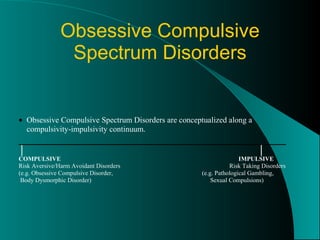
Obsessive Compulsive Spectrum Disorders
Obsessive-compulsive Spectrum Disorders Obsessive-compulsive disorder Hoarding Body-dysmorphic disorder Hypochondriasis Eating disorders Trichotillomania Tourette’s syndrome Self-mutilation
Body Dysmorphic Disorder A. Preoccupation with an imagined defect in appearance. If a slight physical anomaly is present, the person’s concern is markedly excessive. B. The preoccupation causes clinically significant distress or impairment in functioning. C.The preoccupation is not better accounted for by another mental disorder (e.g., dissatisfaction with body shape and size in anorexia nervosa).
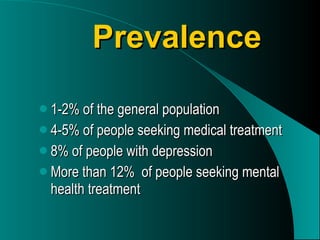
Prevalence 1-2% of the general population 4-5% of people seeking medical treatment 8% of people with depression More than 12%  of people seeking mental health treatment
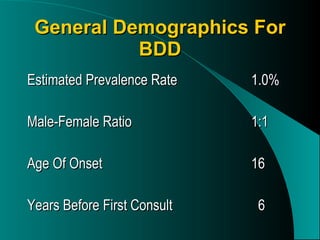
General Demographics For BDD Estimated Prevalence Rate 1.0% Male-Female Ratio 1:1 Age Of Onset 16 Years Before First Consult   6
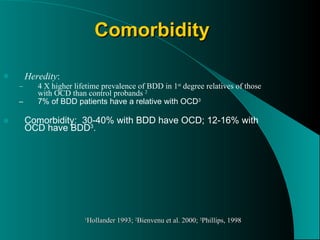
Comorbidity Heredity : 4 X higher lifetime prevalence of BDD in 1 st  degree relatives of those with OCD than control probands  2 7% of BDD patients have a relative with OCD 3 Comorbidity:  30-40% with BDD have OCD; 12-16% with OCD have BDD 3 . 1 Hollander 1993;  2 Bienvenu et al. 2000;  3 Phillips, 1998
Adolescent Feelings Of  Ugliness vs. BDD Between the ages of 12-17, many adolescents  feel ugly. Longevity  and  Severity  distinguish normal adolescent concerns from BDD.
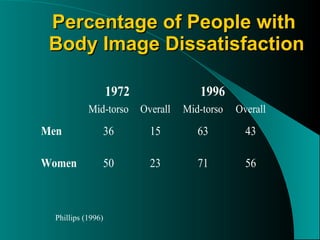
Percentage of People with  Body Image Dissatisfaction Phillips (1996)
Normal Concerns vs. BDD Time consumption    1 hour Produces distress Interferes with functioning
Risk Factors for BDD Abuse History Teasing Past History of Dermatological Problems Shyness Depression Anxiety Perfectionism Stressors in General
Is BDD a Problem of: Perception Somatosensory Disturbance Global/Idealized Values Faulty Beliefs Information Processing Biases Neurobiological Defect
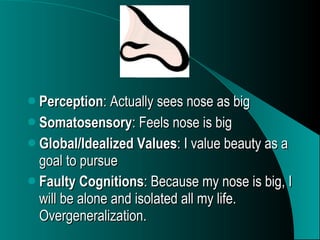
Perception : Actually sees nose as big Somatosensory : Feels nose is big Global/Idealized Values : I value beauty as a goal to pursue Faulty Cognitions : Because my nose is big, I will be alone and isolated all my life. Overgeneralization.
Information Processing Biases : Looking in the mirror and focusing immediately on the nose. Selective attention to details, rather than the whole. Neurobiological Defect : Serotonin alteration; orbito-frontal cortex, temporal, occipital and parietal lobe involvement; genetically or ethologically transmitted.
How Do All These Aspects Interrelate? Based on genetically and/or ethologically transmitted need for symmetry or aestheticism, maladaptive beliefs and values are learned which influences information processing and perception.
Beliefs About Appearance   Identify and question the meaning of the defectiveness (not the defect), i.e., the assumptions about defectiveness and values (the importance of appearance)
Focus on assumptions and values Collect information that is inconsistent with beliefs which patient normally ignores or distorts in an alternative data log Beliefs About Appearance (Cont.)
Faulty Beliefs - Cognitive Distortion I need to be perfect I need to be noticed If I  feel  that my body part is unattractive, it means that it  looks  unattractive If my body part is not beautiful, then it must be ugly If I looked better, my whole life would be better Happiness comes from looking good
Faulty Beliefs - Cognitive Distortion The only way to  feel  better is to  look  better I must be happy with what I see in the mirror Looking good protects you from being treated badly I cannot be comfortable unless I look good Physical perfection is a realistic and attainable goal If my appearance is defective then I am inadequate and worthless.
Safety or Avoidance Behaviors in BDD Mirror gazing or avoiding Excessive grooming Ritualized or excessive makeup application Excessive usage of skin or hair products Hair removal Hair cutting Reassurance seeking Camouflaging Skin picking Repeated checking of body part
Comparing self with others or old photos Grooming, combing, smoothening, straightening, plucking or cutting hair Skin cleaning, picking, peeling, bleaching Facial exercises Safety or Avoidance  Behaviors in BDD (Cont.)
Avoidance Behaviors in BDD Social and public situations with varying degrees of safety behaviors Clothes or hair to hide “defect” Certain posture Padding Cold Coke cans!
Skin Picking and Hair Cutting Self-monitoring (frequency chart)  Self-monitoring of triggers Habit reversal  Challenge irrational beliefs regarding effectiveness and necessity of behavior Delay response and alternative activities  (e.g., not alone) Difficult to treat due to short-term satisfaction  Identify secondary functions of behavior (stress reducer, escape, emotion regulation)
Compulsive Skin Picking   Repetitive skin picking and cleaning, especially face Aim to remove moles, freckles, blemish, scabs Fingernails, tweezers, pins, sharp implements Lead to bleeding, bruises, infections and/or permanent disfigurement Short-term tension reduction and satisfaction Followed by disgust, anger, depression OC spectrum — BDD, OCD, trichotillomania
Safety Behaviors in BDD Do it yourself surgery  Cosmetic or dermatological interventions
BDD vs. OCD Similarities  Symptoms Response to Cognitive Behavioral Therapy Response to Pharmacotherapy Dissimilarities BDD has higher OVI, more depressed, less anxious, total self identification, more personality disorders.
Example of Differentiating BDD From OCD Symptom Clusters Neuropsychological Testing Neuroimaging  Function of Compulsions/Safety Behaviors Presence or absence of delusions, overvalued ideation Perceptual/Somatosensory Components
OVI in OCD Examined whether OVI predicts medication treatment response Results illustrated that OVI predicted the outcome for obsessions, but not compulsions. As patients scored higher on OVIS there was less improvement following treatment. Neziroglu, F., Yaryura-Tobias, J., Pinto, A., & McKay, D. (2004). Psychiatry Research, 125 (1).
OVI in BDD High overvalued ideas need to be addressed prior to exposure. The higher the OVI the poorer the prognosis.
OVI in BDD vs. OCD Subjects with BDD had significantly lower levels of insight than subjects with OCD Suggests differences in insight is not attributable to symptom severity Eisen, Phillips, Coles, & Rasmussen (2003) Phillips, Pinto, Menard, Eisen, Mancebo, Rasmussen (2007)
Quality of Life Quality of life measures impact of a disorder across area of everyday functioning Self esteem Goals Play Love  Friendship Community Health Money Learning Helping Children  Relatives Home  Neighborhood Creativity Work
Quality of Life in OCD Lower overall Quality of Life than general population Mental health and psychological well being most impaired in subjects with OCD Lower Quality of Life than Schizophrenia patients  Koran, Thienemann, & Davenport (1996) Stengler-Wenzke , Kroll, Matschinger , & Angermeyer (2006)
Quality of Life in BDD BDD patients have poor Quality of Life across all psychosocial functioning and mental health domains. BDD Patients demonstrate poorer quality of mental health life as compared to: US general population Patients with Major Depression or Dysthymia Patients with chronic medical conditions . Functioning and quality of life for BDD patients are low regardless of treatment Phillips , Menard, Fay, & Paagano (2005)
Quality of Life BDD vs. OCD (cont) OCD & BDD had very poor psychosocial functioning and Quality of Life Comorbid OCD/BDD patients showed greater impairment than OCD patients but not BDD patients. BDD severity may account for lower quality of life in the comorbid group. Didie, Mancebo, Rasmussen, Phillips, Walters, Menard, & Eisen (2004)
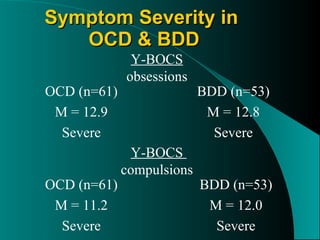
Symptom Severity in  OCD & BDD Y-BOCS   obsessions  Y-BOCS  compulsions  OCD (n=61) M = 12.9 Severe BDD (n=53) M = 12.8 Severe OCD (n=61) M = 11.2 Severe BDD (n=53) M = 12.0 Severe
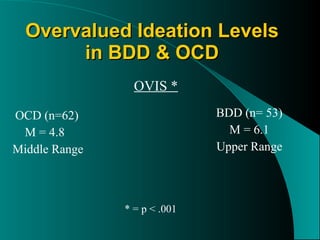
Overvalued Ideation Levels in BDD & OCD OCD (n=62) M = 4.8 Middle Range BDD (n= 53) M = 6.1 Upper Range OVIS * * = p < .001
Quality of Life in BDD & OCD OCD (n=32) M = 35.7 Low Level  BDD (n= 23) M = 24.1 Very Low Level QOLI * * = p < .05
BDD: Severity of Disorder Suicide attempt rate: 29% Suicide ideation rate: 80% Hospitalization: 36-58% Homebound: 32-40% Full-time employment/student: 42% Phillips KA et al. (2006), Compr Psychiatry 47(2):77-87
Frequency and Percentage of  Abuse in BDD and OCD Abuse Type BDD (N=50) OCD (N=50) Any Abuse 19 (38%) 7 (14%) Sexual 11 (22%) 3 (6%) Physical 7 (14%) 4 (8%) Emotional 14 (28%) 1 (2%) Neziroglu F, Khemlani-Patel, S & Yaryura-Tobias. (2006). Body Image 3: 189-193
Appropriate Treatments for BDD Exposure and response prevention Cognitive therapy Psychopharmacological treatment Support groups Family intervention
Inappropriate Treatment for BDD Dermatological procedures Surgical and non-surgical procedures Psychodynamic therapy
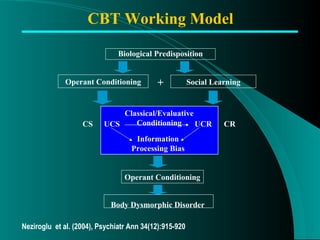
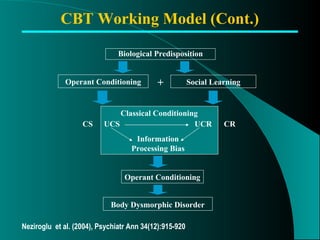
CBT Working Model Operant Conditioning Biological Predisposition Operant Conditioning Social Learning + CS UCS CR UCR Information Processing Bias Classical/Evaluative Conditioning Body Dysmorphic Disorder Neziroglu  et al. (2004), Psychiatr Ann 34(12):915-920
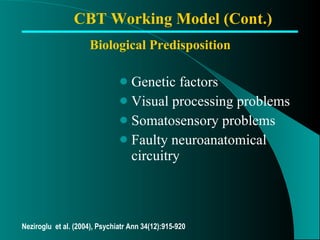
Genetic factors Visual processing problems Somatosensory problems Faulty neuroanatomical circuitry Biological Predisposition CBT Working Model (Cont.) Neziroglu  et al. (2004), Psychiatr Ann 34(12):915-920
Person is positively and/or intermittently reinforced for: Overall appearance ▪   Poise Particular body part ▪   Weight Height ▪   Body shape Cuteness Biological Predisposition Operant Conditioning CBT Working Model (Cont.) Neziroglu  et al. (2004), Psychiatr Ann 34(12):915-920
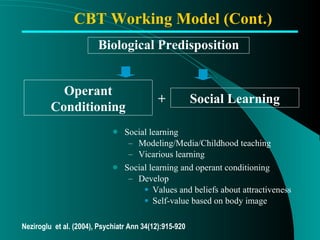
Social learning Modeling/Media/Childhood teaching  Vicarious learning Social learning and operant conditioning Develop Values and beliefs about attractiveness Self-value based on body image + Biological Predisposition Operant Conditioning CBT Working Model (Cont.) Social Learning Neziroglu  et al. (2004), Psychiatr Ann 34(12):915-920
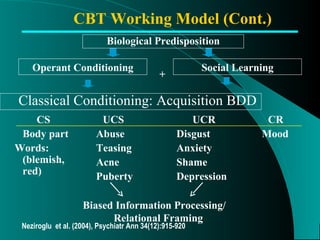
Classical Conditioning: Acquisition BDD CS Body part Words: (blemish, red)  + Biological Predisposition Operant Conditioning CBT Working Model (Cont.) Social Learning UCS Abuse Teasing Acne Puberty UCR Disgust Anxiety Shame  Depression CR Mood Biased Information Processing/ Relational Framing Neziroglu  et al. (2004), Psychiatr Ann 34(12):915-920
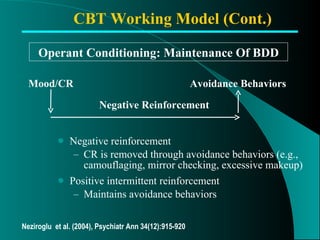
Negative reinforcement CR is removed through avoidance behaviors (e.g., camouflaging, mirror checking, excessive makeup) Positive intermittent reinforcement Maintains avoidance behaviors Operant Conditioning: Maintenance Of BDD Mood/CR Avoidance Behaviors Negative Reinforcement CBT Working Model (Cont.) Neziroglu  et al. (2004), Psychiatr Ann 34(12):915-920
CBT Working Model (Cont.) Operant Conditioning Biological Predisposition Operant Conditioning Social Learning + Body Dysmorphic Disorder Neziroglu  et al. (2004), Psychiatr Ann 34(12):915-920 CS UCS CR UCR Information Processing Bias Classical Conditioning
Cognitive Therapy: Initial Strategies Address readiness for change Motivational interviewing to engage patients reluctant to continue treatment Stress the degree of dysfunction and suffering Target depression and/or suicidal ideation
Engagement   Explaining diagnosis — emphasize “preoccupation with the way you feel about appearance”  Similar problems in disorders with OVI where goals not shared by clinician  Motivational interviewing (focus on handicap linked to the demand about how their appearance must be or their idealized value about appearance) OVI = overvalued ideation
Engagement (Cont.) Avoid giving reassurance about appearance as patient often told “look alright”  Validate experience and help understand what the problem is  Two hypotheses either “problem unattractive” or you have a “problem with the way you feel about your appearance”
Early Goals Functioning — activity scheduling and social withdrawal/avoidance which maintains depressed mood  Decrease compulsive behaviors, such as mirror gazing and checking with hands  Skin picking
Cognitive Therapy:  Targeting BDD Symptoms Target cognitive distortions Beck or Ellis modalities work well Hypothesis testing/collaborative empiricism Take patient’s photograph and collect ratings of attractiveness Interview strangers regarding relevant distorted beliefs of patient
Cognitive Therapy: Targeting  Values on Appearance Targeting value of appearance may be an important treatment component in relapse prevention Methods to target values and attitudes Psychoeducation Pie chart of important values
Pie Chart of Values Artistic  Achievement  30% Attractiveness  20% Family  15% Friendship 15% Money  10% Education  10% Neziroglu F, Khemlani-Patel S
CBT for BDD in Social Situations Exposure/behavioral experiments  Minimal or no makeup or exaggerate “defect” No changes in posture Not using hand or hair Not stand by window Refocus attention away from self
4 Ways To Challenge Beliefs for BDD What is the evidence that supports or contradicts this belief? Are there any other ways to interpret this situation? Realistically, what is the worst thing that could happen in this situation and how would it honestly affect my life? Even if the negative belief is warranted, what can I realistically do to help remedy the situation? Geremia, G & Neziroglu F (2001), Clinical Psych and Psychotherapy 8: 243-251
 
HYPOCHONDRIASIS PREOCCUPATION WITH FEARS OF HAVING, OR THE IDEA THAT ONE HAS, A SERIOUS DISEASE BASED ON MISINTERPRETATION OF BODILY SYMPTOMS THE PREOCCUPATION PERSISTS DESPITE APPROPRIATE MEDICAL EVALUATION AND REASSURANCE. THEIR BELIEF IS NOT OF DELUSIONAL INTENSITY NOR DUE TO CONCERN ABOUT APPEARANCE. SPECIFY IF: WITH POOR INSIGHT
Historical Conceptualization Of Hypochondria In 1621, Robert Burton wrote  “ The Anatomy of Melancholy”.  He described “hypochondriacal melancholy” as including physical ailments (e.g. ears ringing, belching, vertigo.) and fear of disease
Hypochondria Second Century A.D., Galen of Pergamon used the term  HYPOCHONDRIA  to describe broad range of digestive disorders and melancholia
Cost of HC Per Year At least 20 billion dollars per year is spent on hypochondriacal patients, and may be as much as 100 billion dollars
Phenomenology of HC HC are more concerned with the authenticity, meaning or etiological significance of their symptoms than with the unpleasant sensation or pain
HC Demographics Male: Female Ratio 1:1 Average Age 36-57 Duration of Symptoms 6 months-25 years Symptoms occur more often in single, women, less educated, less income, non-whites, hispanics, older, urban residence
Common HC Symptoms Parts of the Body Affected 1) Head and Neck Complaints: Tumors Aneurysms Strokes Burning Sensation Chronic Headaches Muscle Spasms Numbness in Face
Common HC Symptoms Parts of the Body Affected (con’t) 2)  Abdomen Complaints: Prostate Cancer Hernias Irritable Bowel Syndrome Liver Cancer Ulcers Chest Complaints: Heart Attacks Chronic Asthma
Differential Diagnosis of HC Somatization Disorder Delusional Disorder (monosymptomatic Hypochondriacal Disorder) Panic Disorder Generalized Anxiety Disorder Depression Obsessive Compulsive Disorder (Somatic Obsessions) Illness Phobia
Reported Dissimilarities Between OCD & HC Patient with Hypochondriasis: See their fears as realistic Possess pervasive ideas of illness as part of their personality Are public about their concerns Experience genuine somatic discomfort Barsky (1992)
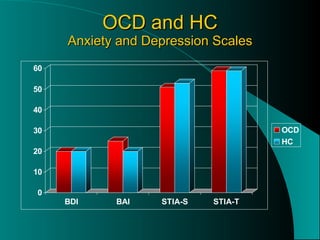
OCD and HC Anxiety and Depression Scales
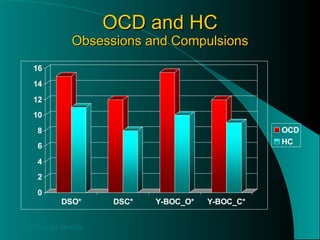
OCD and HC Obsessions and Compulsions DS-Disorder Specific
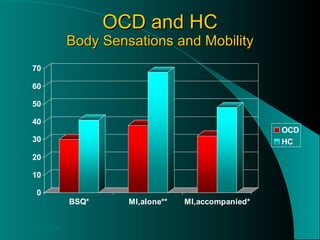
OCD and HC Body Sensations and Mobility p<.05;**p<.01
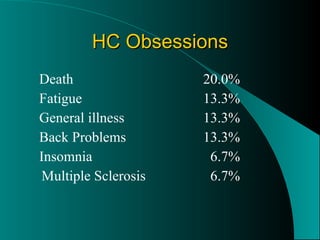
HC Obsessions Death 20.0% Fatigue 13.3% General illness 13.3% Back Problems 13.3% Insomnia   6.7% Multiple Sclerosis   6.7%
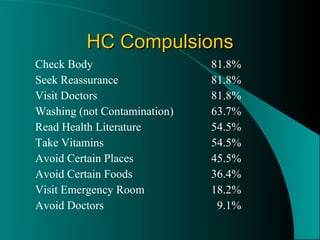
HC Compulsions Check Body 81.8% Seek Reassurance 81.8% Visit Doctors 81.8% Washing (not Contamination) 63.7% Read Health Literature 54.5% Take Vitamins 54.5% Avoid Certain Places 45.5% Avoid Certain Foods 36.4% Visit Emergency Room 18.2% Avoid Doctors   9.1%
Treatment Modalities For HC 1) Psychodynamic Interventions 2) Reassurance Therapy 3) Cognitive-Behavior Therapy 4) Pharmacotherapy
Kellner’s Reassurance Intervention Physical Examination Client Centered Techniques Explanatory Therapy (psychoeducation) Use of Suggestion Biofeedback
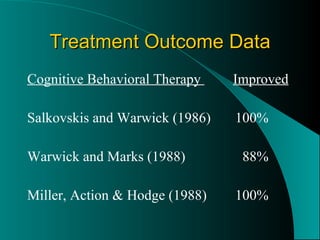
Treatment Outcome Data Cognitive Behavioral Therapy  Improved Salkovskis and Warwick (1986) 100% Warwick and Marks (1988)   88% Miller, Action & Hodge (1988) 100%
Cognitive Behavioral Model of Hypochondriasis Review Previous Experience Formulation of Dysfunctional Assumptions A Critical Incident  Activation of Assumptions  Negative Thoughts and Imagery Hypochondriacal Development
General Cognitive Therapy for Hypochondriasis Hypochondriacs overestimate the probability of a symptom indicating the existence of an illness and underestimate their ability to cope with it.
COGNITIVE THERAPY FOCUS PREVENT NEUTRALIZATION INCREASE EXPOSURE TO OBSESSIONS MODIFY “RESPONSIBILITY” ATTITUDE MODIFY APPRAISAL OF OBSESSIONS INCREASE EXPOSURE TO RESPONSIBILTY  BY EXPOSURE IN VIVO AND STOP REASSURANCE SEEKING
COGNITIVE RESTRUCTURING A.= ANTECEDENT EVENT B. = BELIEFS C. = CONSEQUENCES 1.  EMOTIONAL 2.  BEHAVIORAL D. =DISPUTE E. = EFFECT OF DISPUTING
Ellis’ ABC Paradigm in the Treatment of OCD Applied to HC A =  Obsession itself or any activating event B =  1.  If I do not call the doctor about my  headache I have behaved irresponsibly 2.  It is awful to feel anxious. 3.  I must have guarantees. C =  Anxiety Active Avoidance
Cognitive Theories Under high cost conditions obsessives make the same threat appraisal as normals. Under low cost conditions obsessionals overestimate the probability of the occurance of the disastrous consequence. Carr (1974)
Cognitive Theories Primary Appraisal Process  whereby the individual overestimates probability and the cost of the occurrence of unfavorable events. Secondary Appraisal Process  whereby individual underestimates his/her abilities to cope with the threat. MC Fall and Wollersheim (1979)
Common HC Belief Distortions If I have something wrong with me, I will not be a desirable person. Bodily symptoms are a sign of serious illness because every symptom has an identifiable physical cause. I am irresponsible if I don’t go to the doctor immediately.
Common HC Belief Distortions (Cont.) I can’t stand the pain I can’t stand being ill. Any symptom means that I’m ill, or am going to be ill. If I’m ill, I will definitely suffer greatly (and I can not stand the suffering). If I’m ill, I will die. I have an incurable illness. If I’m ill, I can’t be happy. Symptoms are indicative of severe illnesses.
Common HC Belief Distortions (Cont.) If I’m ill, there’s no need to fight because my life is over. I want certainty that I am not ill. Every physical symptom is indicative of a serious medical condition. I have a disease, but the doctors have not been able to diagnose it yet. If I pay close attention to my bodily symptoms I can prevent being sick.
Common HC Belief Distortions (Cont.) All symptoms are a sign of danger. I will not be able to cope with a major illness. I must know immediately if there is something wrong with me. I can not tolerate anxiety. I must be hypervigilant to all bodily symptoms, in order to prevent an illness.
Four Ways To Challenge Beliefs (Hypochondriasis) 1) What is the evidence that supports or contradicts this belief? 2) Are there any other ways to interpret the physical symptoms or my belief? 3) Ultimately if I am correct in my interpretation, realistically to what extent can I control the outcome? 4) Why is it that others don’t preoccupy themselves with the same physical symptoms, and what enables them to cope with negative outcomes?
Conclusions  (CT for HC) Cognitive Therapy is effective for HC. Cognitive Therapy decreases overvalued ideas, depression, anxiety, frequency and severity of obsessive thoughts. Exposure and Responsive Prevention (ERP) reduces compulsions. ERP does not decrease overvalued ideas, obsessions, nor depression. Best to combine cognitive therapy with ERP. Cognitive Therapy effective even for severe cases.
General Conclusions about ERP vs. CT With Cognitive Therapy Attrition rate lower Compliance better Motivation greater  Acceptance of therapy better
Hoarding Hoarding is the acquisition of, and failure to discard, large numbers of items that appear to have little or no value (Frost & Gross, 1993)
Hoarding: Additional Criteria Clutter prevents usage of functional space Significant distress or impairment Frost & Hartl (1996)
Disorders with Hoarding Behavior OCD OCPD Depression Dementia Psychosis (eg.SZ; delusional dis.) Eating Disorders
Prevalence 20-30% of OCD patients 26.3 per 100,000 as reported by health departments Frost, Steketee, Greene (2003)
Possible Etiology of Hoarding Informational-Processing Deficits: i.e. decision making, organizing, memory  Emotional attachment to possessions Cognitive distortions; ie. I will never be able to get the info anywhere else Neurobiological
Co-morbidity in Compulsive Hoarding   Social Phobia: generalized and specific  (Samuels et al, 2002; Steketee et al., 2000) Major Depression  (Frost et al., 2000; Lochner et al., 2005; Samuels et al, 2002; Seedat & Stein, 2002) OC  spectrum conditions: trichotillomania, Tourette’s syndrome, nail biting, skin picking (Samuels et al, 2002; Seedat & Stein, 2002) GAD  (Lochner et al, 2005) ADHD  (Hartl et al., 2003) Dementia  (Hwang et al., 1998)
Model of Hoarding
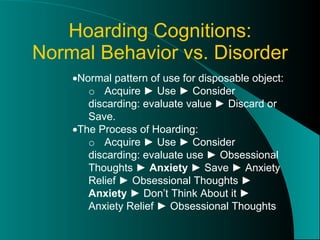
Hoarding Cognitions: Normal Behavior vs. Disorder  Normal pattern of use for disposable object: o Acquire ► Use ► Consider discarding: evaluate value ► Discard or Save.  The Process of Hoarding: o Acquire ► Use ► Consider discarding: evaluate use ► Obsessional Thoughts ►  Anxiety  ► Save ► Anxiety Relief ► Obsessional Thoughts ►  Anxiety  ► Don’t Think About it ► Anxiety Relief ► Obsessional Thoughts
Obsessional Thoughts in Hoarding  Emotional Comfort  Loss  Identity  Value  Responsibility/Waste  Memory  Control
Obsessional Thoughts in Hoarding  Emotional attachment (comfort, distress, loss, identity) o  “Without this possession, I will be vulnerable” o  “If I didn’t know where this was, I would feel  anxious” o  “Throwing this away means losing a part of my  life” o  “I might never be able to find this again”  Responsibility o  “I am responsible for finding a use for this  possession” o  I am responsible for saving this for someone  who might need it” o  I am ashamed when I don’t have something  when I need it”
Obsessional Thoughts in Hoarding  Memory o “Saving this means I don’t have to rely on  my memory o  “If I don’t leave this in sight, I’ll forget it” o  “I must remember something about this” · Control o  “No one has the right to touch my  possessions” o  “I like to maintain sole control over my  things”
Differences between Hoarding and OCD Hoarders report less distress Hoarders are less depressed Hoarders usually have less insight: higher OVI They are harder to engage in treatment Hoarding more likely to cause family friction  Hoarding more harmful to self Neziroglu, Peterson & Weissman   (2006)
Hoarding vs. OCD: Obsessions Thoughts triggered by objects and efforts to discard (e.g., “I might need this; I don’t want to lose an opportunity; I can’t waste this.”) Not always distressing (e.g., “This is beautiful/ sentimental. I’ll keep it.”) Impulses to acquire Images of using item in future, but rarely distressing
Hoarding vs. OCD:  Rituals and avoidance behaviors Doubting, checking, reassurance seeking are common before discarding and reflect negative emotions like anxiety and guilt Efforts to control distress result in avoidance of discarding (saving) objects Acquiring behaviors appear to be motivated by impulsive urges and are commonly accompanied by positive feelings
Hoarding vs. OCD:  Insight, distress & interference Insight can be very poor, ambivalence about treatment is common Distress not always present, even in severe cases Interference with functioning is typical
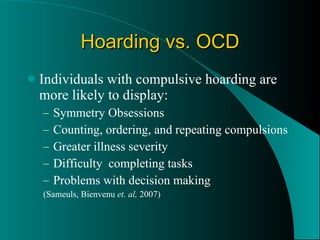
Hoarding vs. OCD Individuals with compulsive hoarding are more likely to display: Symmetry Obsessions Counting, ordering, and repeating compulsions Greater illness severity Difficulty  completing tasks Problems with decision making (Sameuls, Bienvenu  et. al,  2007)
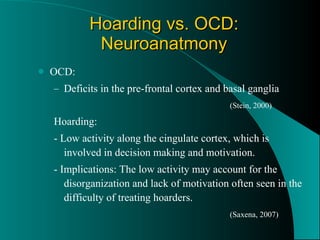
Hoarding vs. OCD: Neuroanatmony OCD: Deficits in the pre-frontal cortex and basal ganglia (Stein, 2000) Hoarding: - Low activity along the cingulate cortex, which is involved in decision making and motivation.  - Implications: The low activity may account for the disorganization and lack of motivation often seen in the difficulty of treating hoarders. (Saxena, 2007)
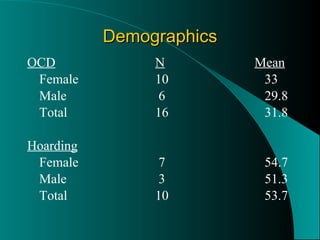
Demographics OCD N   Mean Female 10   33 Male  6   29.8 Total 16   31.8 Hoarding Female  7   54.7 Male  3   51.3 Total 10   53.7
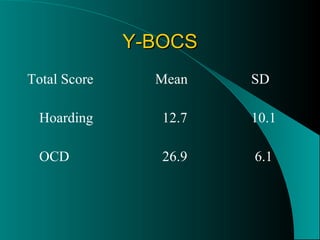
Y-BOCS Total Score Mean SD Hoarding   12.7 10.1 OCD   26.9  6.1
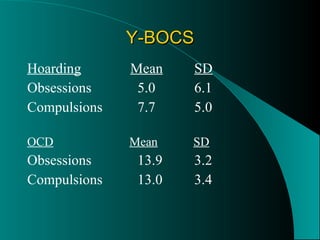
Y-BOCS Hoarding   Mean   SD Obsessions   5.0   6.1 Compulsions   7.7   5.0 OCD   Mean   SD Obsessions   13.9   3.2 Compulsions   13.0   3.4
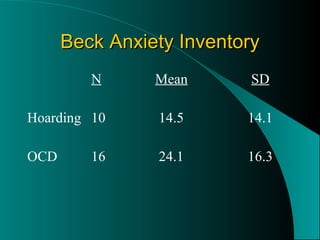
Beck Anxiety Inventory N Mean SD Hoarding 10  14.5   14.1 OCD 16  24.1   16.3
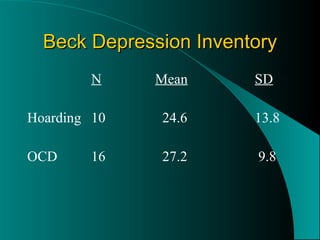
Beck Depression Inventory N Mean   SD Hoarding 10   24.6  13.8 OCD  16   27.2   9.8
Overvalued Ideas Scale N Mean   SD Hoarding  10   6.7   1.3 OCD 16   4.6   1.3
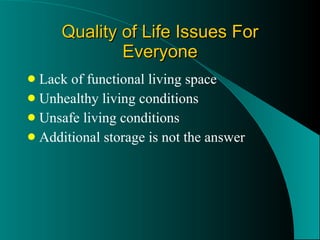
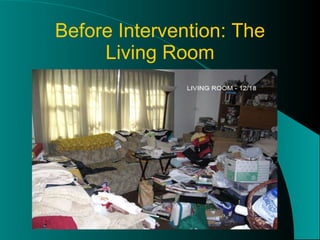
Quality of Life Issues For Everyone Lack of functional living space Unhealthy living conditions Unsafe living conditions Additional storage is not the answer
Lack of Functional Living Space Furniture not being used as furniture Little, if any place to gather as a family Financial strain from ordering meals out Social isolation
Unhealthy Living Conditions Headaches Respiratory problems Allergies Fatigue/lethargy Insomnia or sleep problems
Unsafe Living Conditions Structural damage to homes Weight of possessions Possible water damage Fire hazards Highly flammable situations Blocked passage ways
Unsafe Conditions (Cont.) Rodent infestation Insect infestation Stairways filled with clutter Fire hazard, dangerous with children Can lead to legal involvement
Additional Storage Is Not the Answer Does  not  fix the problem Leads to increased financial pressure Leads to increased family tension Eventually ends up as more cluttered, nonfunctional space
Effects of Hoarding on Families Living in clutter is living in chaos Financial problems High levels of resentment and anger toward hoarder Separation, divorce, kids moving out, etc.
Getting Help Family members have the right to live without clutter Families may seek treatment first Hoarders can be resistant to treatment on their own May not think it is such a big deal
Treatment Steps for Family Members Psycho-education on hoarding Learn how to communicate more effectively with hoarder Validate, validate, validate Learn about the intervention technique Goal is to bring the hoarder in for treatment
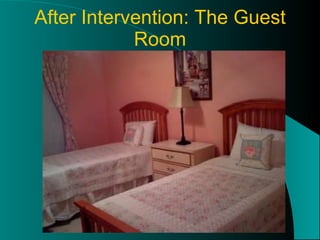
Applying the Intervention Technique Family members bring hoarder into a session One by one, each member talks about how the hoarding has affected them Issues are brought out in loving and supportive tones with validation Hoarder then agrees to give treatment a chance for a specific time period
Before Intervention: The Kitchen
After Intervention: The Kitchen
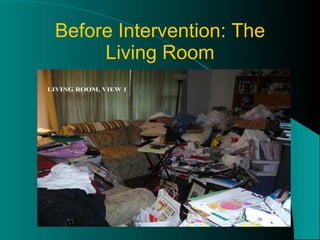
Before Intervention: The Living Room
After Intervention: The Living Room
Before Intervention: The Guest Room
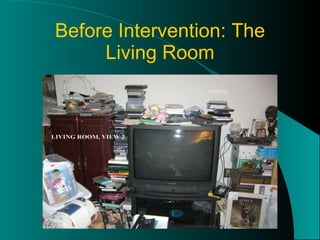
Before Intervention: The Living Room
After Intervention: The Guest Room

OCD Spectrum Disorders

  • 1.
    Body Dysmorphic Disorder,Hypochondriasis, Hoarding, and other OCD Spectrum Disorders; Comparing and Contrasting Treatments with OCD Fugen Neziroglu Ph.D., ABBP, ABPP Bio-Behavioral Institute Great Neck, NY www.biobehavioralinstitute.com
  • 2.
    Obsessive Compulsive SpectrumDisorders We identify disorders on the OC spectrum because: They all share in common obsessions and/or compulsions They have similar symptomatology, treatment response, and family history
  • 3.
  • 4.
    Obsessive-compulsive Spectrum DisordersObsessive-compulsive disorder Hoarding Body-dysmorphic disorder Hypochondriasis Eating disorders Trichotillomania Tourette’s syndrome Self-mutilation
  • 5.
    Body Dysmorphic DisorderA. Preoccupation with an imagined defect in appearance. If a slight physical anomaly is present, the person’s concern is markedly excessive. B. The preoccupation causes clinically significant distress or impairment in functioning. C.The preoccupation is not better accounted for by another mental disorder (e.g., dissatisfaction with body shape and size in anorexia nervosa).
  • 6.
    Prevalence 1-2% ofthe general population 4-5% of people seeking medical treatment 8% of people with depression More than 12% of people seeking mental health treatment
  • 7.
    General Demographics ForBDD Estimated Prevalence Rate 1.0% Male-Female Ratio 1:1 Age Of Onset 16 Years Before First Consult 6
  • 8.
    Comorbidity Heredity :4 X higher lifetime prevalence of BDD in 1 st degree relatives of those with OCD than control probands 2 7% of BDD patients have a relative with OCD 3 Comorbidity: 30-40% with BDD have OCD; 12-16% with OCD have BDD 3 . 1 Hollander 1993; 2 Bienvenu et al. 2000; 3 Phillips, 1998
  • 9.
    Adolescent Feelings Of Ugliness vs. BDD Between the ages of 12-17, many adolescents feel ugly. Longevity and Severity distinguish normal adolescent concerns from BDD.
  • 10.
    Percentage of Peoplewith Body Image Dissatisfaction Phillips (1996)
  • 11.
    Normal Concerns vs.BDD Time consumption  1 hour Produces distress Interferes with functioning
  • 12.
    Risk Factors forBDD Abuse History Teasing Past History of Dermatological Problems Shyness Depression Anxiety Perfectionism Stressors in General
  • 13.
    Is BDD aProblem of: Perception Somatosensory Disturbance Global/Idealized Values Faulty Beliefs Information Processing Biases Neurobiological Defect
  • 14.
    Perception : Actuallysees nose as big Somatosensory : Feels nose is big Global/Idealized Values : I value beauty as a goal to pursue Faulty Cognitions : Because my nose is big, I will be alone and isolated all my life. Overgeneralization.
  • 15.
    Information Processing Biases: Looking in the mirror and focusing immediately on the nose. Selective attention to details, rather than the whole. Neurobiological Defect : Serotonin alteration; orbito-frontal cortex, temporal, occipital and parietal lobe involvement; genetically or ethologically transmitted.
  • 16.
    How Do AllThese Aspects Interrelate? Based on genetically and/or ethologically transmitted need for symmetry or aestheticism, maladaptive beliefs and values are learned which influences information processing and perception.
  • 17.
    Beliefs About Appearance Identify and question the meaning of the defectiveness (not the defect), i.e., the assumptions about defectiveness and values (the importance of appearance)
  • 18.
    Focus on assumptionsand values Collect information that is inconsistent with beliefs which patient normally ignores or distorts in an alternative data log Beliefs About Appearance (Cont.)
  • 19.
    Faulty Beliefs -Cognitive Distortion I need to be perfect I need to be noticed If I feel that my body part is unattractive, it means that it looks unattractive If my body part is not beautiful, then it must be ugly If I looked better, my whole life would be better Happiness comes from looking good
  • 20.
    Faulty Beliefs -Cognitive Distortion The only way to feel better is to look better I must be happy with what I see in the mirror Looking good protects you from being treated badly I cannot be comfortable unless I look good Physical perfection is a realistic and attainable goal If my appearance is defective then I am inadequate and worthless.
  • 21.
    Safety or AvoidanceBehaviors in BDD Mirror gazing or avoiding Excessive grooming Ritualized or excessive makeup application Excessive usage of skin or hair products Hair removal Hair cutting Reassurance seeking Camouflaging Skin picking Repeated checking of body part
  • 22.
    Comparing self withothers or old photos Grooming, combing, smoothening, straightening, plucking or cutting hair Skin cleaning, picking, peeling, bleaching Facial exercises Safety or Avoidance Behaviors in BDD (Cont.)
  • 23.
    Avoidance Behaviors inBDD Social and public situations with varying degrees of safety behaviors Clothes or hair to hide “defect” Certain posture Padding Cold Coke cans!
  • 24.
    Skin Picking andHair Cutting Self-monitoring (frequency chart) Self-monitoring of triggers Habit reversal Challenge irrational beliefs regarding effectiveness and necessity of behavior Delay response and alternative activities (e.g., not alone) Difficult to treat due to short-term satisfaction Identify secondary functions of behavior (stress reducer, escape, emotion regulation)
  • 25.
    Compulsive Skin Picking Repetitive skin picking and cleaning, especially face Aim to remove moles, freckles, blemish, scabs Fingernails, tweezers, pins, sharp implements Lead to bleeding, bruises, infections and/or permanent disfigurement Short-term tension reduction and satisfaction Followed by disgust, anger, depression OC spectrum — BDD, OCD, trichotillomania
  • 26.
    Safety Behaviors inBDD Do it yourself surgery Cosmetic or dermatological interventions
  • 27.
    BDD vs. OCDSimilarities Symptoms Response to Cognitive Behavioral Therapy Response to Pharmacotherapy Dissimilarities BDD has higher OVI, more depressed, less anxious, total self identification, more personality disorders.
  • 28.
    Example of DifferentiatingBDD From OCD Symptom Clusters Neuropsychological Testing Neuroimaging Function of Compulsions/Safety Behaviors Presence or absence of delusions, overvalued ideation Perceptual/Somatosensory Components
  • 29.
    OVI in OCDExamined whether OVI predicts medication treatment response Results illustrated that OVI predicted the outcome for obsessions, but not compulsions. As patients scored higher on OVIS there was less improvement following treatment. Neziroglu, F., Yaryura-Tobias, J., Pinto, A., & McKay, D. (2004). Psychiatry Research, 125 (1).
  • 30.
    OVI in BDDHigh overvalued ideas need to be addressed prior to exposure. The higher the OVI the poorer the prognosis.
  • 31.
    OVI in BDDvs. OCD Subjects with BDD had significantly lower levels of insight than subjects with OCD Suggests differences in insight is not attributable to symptom severity Eisen, Phillips, Coles, & Rasmussen (2003) Phillips, Pinto, Menard, Eisen, Mancebo, Rasmussen (2007)
  • 32.
    Quality of LifeQuality of life measures impact of a disorder across area of everyday functioning Self esteem Goals Play Love Friendship Community Health Money Learning Helping Children Relatives Home Neighborhood Creativity Work
  • 33.
    Quality of Lifein OCD Lower overall Quality of Life than general population Mental health and psychological well being most impaired in subjects with OCD Lower Quality of Life than Schizophrenia patients Koran, Thienemann, & Davenport (1996) Stengler-Wenzke , Kroll, Matschinger , & Angermeyer (2006)
  • 34.
    Quality of Lifein BDD BDD patients have poor Quality of Life across all psychosocial functioning and mental health domains. BDD Patients demonstrate poorer quality of mental health life as compared to: US general population Patients with Major Depression or Dysthymia Patients with chronic medical conditions . Functioning and quality of life for BDD patients are low regardless of treatment Phillips , Menard, Fay, & Paagano (2005)
  • 35.
    Quality of LifeBDD vs. OCD (cont) OCD & BDD had very poor psychosocial functioning and Quality of Life Comorbid OCD/BDD patients showed greater impairment than OCD patients but not BDD patients. BDD severity may account for lower quality of life in the comorbid group. Didie, Mancebo, Rasmussen, Phillips, Walters, Menard, & Eisen (2004)
  • 36.
    Symptom Severity in OCD & BDD Y-BOCS obsessions Y-BOCS compulsions OCD (n=61) M = 12.9 Severe BDD (n=53) M = 12.8 Severe OCD (n=61) M = 11.2 Severe BDD (n=53) M = 12.0 Severe
  • 37.
    Overvalued Ideation Levelsin BDD & OCD OCD (n=62) M = 4.8 Middle Range BDD (n= 53) M = 6.1 Upper Range OVIS * * = p < .001
  • 38.
    Quality of Lifein BDD & OCD OCD (n=32) M = 35.7 Low Level BDD (n= 23) M = 24.1 Very Low Level QOLI * * = p < .05
  • 39.
    BDD: Severity ofDisorder Suicide attempt rate: 29% Suicide ideation rate: 80% Hospitalization: 36-58% Homebound: 32-40% Full-time employment/student: 42% Phillips KA et al. (2006), Compr Psychiatry 47(2):77-87
  • 40.
    Frequency and Percentageof Abuse in BDD and OCD Abuse Type BDD (N=50) OCD (N=50) Any Abuse 19 (38%) 7 (14%) Sexual 11 (22%) 3 (6%) Physical 7 (14%) 4 (8%) Emotional 14 (28%) 1 (2%) Neziroglu F, Khemlani-Patel, S & Yaryura-Tobias. (2006). Body Image 3: 189-193
  • 41.
    Appropriate Treatments forBDD Exposure and response prevention Cognitive therapy Psychopharmacological treatment Support groups Family intervention
  • 42.
    Inappropriate Treatment forBDD Dermatological procedures Surgical and non-surgical procedures Psychodynamic therapy
  • 43.
    CBT Working ModelOperant Conditioning Biological Predisposition Operant Conditioning Social Learning + CS UCS CR UCR Information Processing Bias Classical/Evaluative Conditioning Body Dysmorphic Disorder Neziroglu et al. (2004), Psychiatr Ann 34(12):915-920
  • 44.
    Genetic factors Visualprocessing problems Somatosensory problems Faulty neuroanatomical circuitry Biological Predisposition CBT Working Model (Cont.) Neziroglu et al. (2004), Psychiatr Ann 34(12):915-920
  • 45.
    Person is positivelyand/or intermittently reinforced for: Overall appearance ▪ Poise Particular body part ▪ Weight Height ▪ Body shape Cuteness Biological Predisposition Operant Conditioning CBT Working Model (Cont.) Neziroglu et al. (2004), Psychiatr Ann 34(12):915-920
  • 46.
    Social learning Modeling/Media/Childhoodteaching Vicarious learning Social learning and operant conditioning Develop Values and beliefs about attractiveness Self-value based on body image + Biological Predisposition Operant Conditioning CBT Working Model (Cont.) Social Learning Neziroglu et al. (2004), Psychiatr Ann 34(12):915-920
  • 47.
    Classical Conditioning: AcquisitionBDD CS Body part Words: (blemish, red) + Biological Predisposition Operant Conditioning CBT Working Model (Cont.) Social Learning UCS Abuse Teasing Acne Puberty UCR Disgust Anxiety Shame Depression CR Mood Biased Information Processing/ Relational Framing Neziroglu et al. (2004), Psychiatr Ann 34(12):915-920
  • 48.
    Negative reinforcement CRis removed through avoidance behaviors (e.g., camouflaging, mirror checking, excessive makeup) Positive intermittent reinforcement Maintains avoidance behaviors Operant Conditioning: Maintenance Of BDD Mood/CR Avoidance Behaviors Negative Reinforcement CBT Working Model (Cont.) Neziroglu et al. (2004), Psychiatr Ann 34(12):915-920
  • 49.
    Negative reinforcement CRis removed through avoidance behaviors (e.g., camouflaging, mirror checking, excessive makeup) Positive intermittent reinforcement Maintains avoidance behaviors Operant Conditioning: Maintenance Of BDD Mood/CR Avoidance Behaviors Negative Reinforcement CBT Working Model (Cont.) Neziroglu et al. (2004), Psychiatr Ann 34(12):915-920
  • 50.
    CBT Working Model(Cont.) Operant Conditioning Biological Predisposition Operant Conditioning Social Learning + Body Dysmorphic Disorder Neziroglu et al. (2004), Psychiatr Ann 34(12):915-920 CS UCS CR UCR Information Processing Bias Classical Conditioning
  • 51.
    Cognitive Therapy: InitialStrategies Address readiness for change Motivational interviewing to engage patients reluctant to continue treatment Stress the degree of dysfunction and suffering Target depression and/or suicidal ideation
  • 52.
    Engagement Explaining diagnosis — emphasize “preoccupation with the way you feel about appearance” Similar problems in disorders with OVI where goals not shared by clinician Motivational interviewing (focus on handicap linked to the demand about how their appearance must be or their idealized value about appearance) OVI = overvalued ideation
  • 53.
    Engagement (Cont.) Avoidgiving reassurance about appearance as patient often told “look alright” Validate experience and help understand what the problem is Two hypotheses either “problem unattractive” or you have a “problem with the way you feel about your appearance”
  • 54.
    Early Goals Functioning— activity scheduling and social withdrawal/avoidance which maintains depressed mood Decrease compulsive behaviors, such as mirror gazing and checking with hands Skin picking
  • 55.
    Cognitive Therapy: Targeting BDD Symptoms Target cognitive distortions Beck or Ellis modalities work well Hypothesis testing/collaborative empiricism Take patient’s photograph and collect ratings of attractiveness Interview strangers regarding relevant distorted beliefs of patient
  • 56.
    Cognitive Therapy: Targeting Values on Appearance Targeting value of appearance may be an important treatment component in relapse prevention Methods to target values and attitudes Psychoeducation Pie chart of important values
  • 57.
    Pie Chart ofValues Artistic Achievement 30% Attractiveness 20% Family 15% Friendship 15% Money 10% Education 10% Neziroglu F, Khemlani-Patel S
  • 58.
    CBT for BDDin Social Situations Exposure/behavioral experiments Minimal or no makeup or exaggerate “defect” No changes in posture Not using hand or hair Not stand by window Refocus attention away from self
  • 59.
    4 Ways ToChallenge Beliefs for BDD What is the evidence that supports or contradicts this belief? Are there any other ways to interpret this situation? Realistically, what is the worst thing that could happen in this situation and how would it honestly affect my life? Even if the negative belief is warranted, what can I realistically do to help remedy the situation? Geremia, G & Neziroglu F (2001), Clinical Psych and Psychotherapy 8: 243-251
  • 60.
  • 61.
    HYPOCHONDRIASIS PREOCCUPATION WITHFEARS OF HAVING, OR THE IDEA THAT ONE HAS, A SERIOUS DISEASE BASED ON MISINTERPRETATION OF BODILY SYMPTOMS THE PREOCCUPATION PERSISTS DESPITE APPROPRIATE MEDICAL EVALUATION AND REASSURANCE. THEIR BELIEF IS NOT OF DELUSIONAL INTENSITY NOR DUE TO CONCERN ABOUT APPEARANCE. SPECIFY IF: WITH POOR INSIGHT
  • 62.
    Historical Conceptualization OfHypochondria In 1621, Robert Burton wrote “ The Anatomy of Melancholy”. He described “hypochondriacal melancholy” as including physical ailments (e.g. ears ringing, belching, vertigo.) and fear of disease
  • 63.
    Hypochondria Second CenturyA.D., Galen of Pergamon used the term HYPOCHONDRIA to describe broad range of digestive disorders and melancholia
  • 64.
    Cost of HCPer Year At least 20 billion dollars per year is spent on hypochondriacal patients, and may be as much as 100 billion dollars
  • 65.
    Phenomenology of HCHC are more concerned with the authenticity, meaning or etiological significance of their symptoms than with the unpleasant sensation or pain
  • 66.
    HC Demographics Male:Female Ratio 1:1 Average Age 36-57 Duration of Symptoms 6 months-25 years Symptoms occur more often in single, women, less educated, less income, non-whites, hispanics, older, urban residence
  • 67.
    Common HC SymptomsParts of the Body Affected 1) Head and Neck Complaints: Tumors Aneurysms Strokes Burning Sensation Chronic Headaches Muscle Spasms Numbness in Face
  • 68.
    Common HC SymptomsParts of the Body Affected (con’t) 2) Abdomen Complaints: Prostate Cancer Hernias Irritable Bowel Syndrome Liver Cancer Ulcers Chest Complaints: Heart Attacks Chronic Asthma
  • 69.
    Differential Diagnosis ofHC Somatization Disorder Delusional Disorder (monosymptomatic Hypochondriacal Disorder) Panic Disorder Generalized Anxiety Disorder Depression Obsessive Compulsive Disorder (Somatic Obsessions) Illness Phobia
  • 70.
    Reported Dissimilarities BetweenOCD & HC Patient with Hypochondriasis: See their fears as realistic Possess pervasive ideas of illness as part of their personality Are public about their concerns Experience genuine somatic discomfort Barsky (1992)
  • 71.
    OCD and HCAnxiety and Depression Scales
  • 72.
    OCD and HCObsessions and Compulsions DS-Disorder Specific
  • 73.
    OCD and HCBody Sensations and Mobility p<.05;**p<.01
  • 74.
    HC Obsessions Death20.0% Fatigue 13.3% General illness 13.3% Back Problems 13.3% Insomnia 6.7% Multiple Sclerosis 6.7%
  • 75.
    HC Compulsions CheckBody 81.8% Seek Reassurance 81.8% Visit Doctors 81.8% Washing (not Contamination) 63.7% Read Health Literature 54.5% Take Vitamins 54.5% Avoid Certain Places 45.5% Avoid Certain Foods 36.4% Visit Emergency Room 18.2% Avoid Doctors 9.1%
  • 76.
    Treatment Modalities ForHC 1) Psychodynamic Interventions 2) Reassurance Therapy 3) Cognitive-Behavior Therapy 4) Pharmacotherapy
  • 77.
    Kellner’s Reassurance InterventionPhysical Examination Client Centered Techniques Explanatory Therapy (psychoeducation) Use of Suggestion Biofeedback
  • 78.
    Treatment Outcome DataCognitive Behavioral Therapy Improved Salkovskis and Warwick (1986) 100% Warwick and Marks (1988) 88% Miller, Action & Hodge (1988) 100%
  • 79.
    Cognitive Behavioral Modelof Hypochondriasis Review Previous Experience Formulation of Dysfunctional Assumptions A Critical Incident Activation of Assumptions Negative Thoughts and Imagery Hypochondriacal Development
  • 80.
    General Cognitive Therapyfor Hypochondriasis Hypochondriacs overestimate the probability of a symptom indicating the existence of an illness and underestimate their ability to cope with it.
  • 81.
    COGNITIVE THERAPY FOCUSPREVENT NEUTRALIZATION INCREASE EXPOSURE TO OBSESSIONS MODIFY “RESPONSIBILITY” ATTITUDE MODIFY APPRAISAL OF OBSESSIONS INCREASE EXPOSURE TO RESPONSIBILTY BY EXPOSURE IN VIVO AND STOP REASSURANCE SEEKING
  • 82.
    COGNITIVE RESTRUCTURING A.=ANTECEDENT EVENT B. = BELIEFS C. = CONSEQUENCES 1. EMOTIONAL 2. BEHAVIORAL D. =DISPUTE E. = EFFECT OF DISPUTING
  • 83.
    Ellis’ ABC Paradigmin the Treatment of OCD Applied to HC A = Obsession itself or any activating event B = 1. If I do not call the doctor about my headache I have behaved irresponsibly 2. It is awful to feel anxious. 3. I must have guarantees. C = Anxiety Active Avoidance
  • 84.
    Cognitive Theories Underhigh cost conditions obsessives make the same threat appraisal as normals. Under low cost conditions obsessionals overestimate the probability of the occurance of the disastrous consequence. Carr (1974)
  • 85.
    Cognitive Theories PrimaryAppraisal Process whereby the individual overestimates probability and the cost of the occurrence of unfavorable events. Secondary Appraisal Process whereby individual underestimates his/her abilities to cope with the threat. MC Fall and Wollersheim (1979)
  • 86.
    Common HC BeliefDistortions If I have something wrong with me, I will not be a desirable person. Bodily symptoms are a sign of serious illness because every symptom has an identifiable physical cause. I am irresponsible if I don’t go to the doctor immediately.
  • 87.
    Common HC BeliefDistortions (Cont.) I can’t stand the pain I can’t stand being ill. Any symptom means that I’m ill, or am going to be ill. If I’m ill, I will definitely suffer greatly (and I can not stand the suffering). If I’m ill, I will die. I have an incurable illness. If I’m ill, I can’t be happy. Symptoms are indicative of severe illnesses.
  • 88.
    Common HC BeliefDistortions (Cont.) If I’m ill, there’s no need to fight because my life is over. I want certainty that I am not ill. Every physical symptom is indicative of a serious medical condition. I have a disease, but the doctors have not been able to diagnose it yet. If I pay close attention to my bodily symptoms I can prevent being sick.
  • 89.
    Common HC BeliefDistortions (Cont.) All symptoms are a sign of danger. I will not be able to cope with a major illness. I must know immediately if there is something wrong with me. I can not tolerate anxiety. I must be hypervigilant to all bodily symptoms, in order to prevent an illness.
  • 90.
    Four Ways ToChallenge Beliefs (Hypochondriasis) 1) What is the evidence that supports or contradicts this belief? 2) Are there any other ways to interpret the physical symptoms or my belief? 3) Ultimately if I am correct in my interpretation, realistically to what extent can I control the outcome? 4) Why is it that others don’t preoccupy themselves with the same physical symptoms, and what enables them to cope with negative outcomes?
  • 91.
    Conclusions (CTfor HC) Cognitive Therapy is effective for HC. Cognitive Therapy decreases overvalued ideas, depression, anxiety, frequency and severity of obsessive thoughts. Exposure and Responsive Prevention (ERP) reduces compulsions. ERP does not decrease overvalued ideas, obsessions, nor depression. Best to combine cognitive therapy with ERP. Cognitive Therapy effective even for severe cases.
  • 92.
    General Conclusions aboutERP vs. CT With Cognitive Therapy Attrition rate lower Compliance better Motivation greater Acceptance of therapy better
  • 93.
    Hoarding Hoarding isthe acquisition of, and failure to discard, large numbers of items that appear to have little or no value (Frost & Gross, 1993)
  • 94.
    Hoarding: Additional CriteriaClutter prevents usage of functional space Significant distress or impairment Frost & Hartl (1996)
  • 95.
    Disorders with HoardingBehavior OCD OCPD Depression Dementia Psychosis (eg.SZ; delusional dis.) Eating Disorders
  • 96.
    Prevalence 20-30% ofOCD patients 26.3 per 100,000 as reported by health departments Frost, Steketee, Greene (2003)
  • 97.
    Possible Etiology ofHoarding Informational-Processing Deficits: i.e. decision making, organizing, memory Emotional attachment to possessions Cognitive distortions; ie. I will never be able to get the info anywhere else Neurobiological
  • 98.
    Co-morbidity in CompulsiveHoarding Social Phobia: generalized and specific (Samuels et al, 2002; Steketee et al., 2000) Major Depression (Frost et al., 2000; Lochner et al., 2005; Samuels et al, 2002; Seedat & Stein, 2002) OC spectrum conditions: trichotillomania, Tourette’s syndrome, nail biting, skin picking (Samuels et al, 2002; Seedat & Stein, 2002) GAD (Lochner et al, 2005) ADHD (Hartl et al., 2003) Dementia (Hwang et al., 1998)
  • 99.
  • 100.
    Hoarding Cognitions: NormalBehavior vs. Disorder  Normal pattern of use for disposable object: o Acquire ► Use ► Consider discarding: evaluate value ► Discard or Save.  The Process of Hoarding: o Acquire ► Use ► Consider discarding: evaluate use ► Obsessional Thoughts ► Anxiety ► Save ► Anxiety Relief ► Obsessional Thoughts ► Anxiety ► Don’t Think About it ► Anxiety Relief ► Obsessional Thoughts
  • 101.
    Obsessional Thoughts inHoarding  Emotional Comfort  Loss  Identity  Value  Responsibility/Waste  Memory  Control
  • 102.
    Obsessional Thoughts inHoarding  Emotional attachment (comfort, distress, loss, identity) o “Without this possession, I will be vulnerable” o “If I didn’t know where this was, I would feel anxious” o “Throwing this away means losing a part of my life” o “I might never be able to find this again”  Responsibility o “I am responsible for finding a use for this possession” o I am responsible for saving this for someone who might need it” o I am ashamed when I don’t have something when I need it”
  • 103.
    Obsessional Thoughts inHoarding  Memory o “Saving this means I don’t have to rely on my memory o “If I don’t leave this in sight, I’ll forget it” o “I must remember something about this” · Control o “No one has the right to touch my possessions” o “I like to maintain sole control over my things”
  • 104.
    Differences between Hoardingand OCD Hoarders report less distress Hoarders are less depressed Hoarders usually have less insight: higher OVI They are harder to engage in treatment Hoarding more likely to cause family friction Hoarding more harmful to self Neziroglu, Peterson & Weissman (2006)
  • 105.
    Hoarding vs. OCD:Obsessions Thoughts triggered by objects and efforts to discard (e.g., “I might need this; I don’t want to lose an opportunity; I can’t waste this.”) Not always distressing (e.g., “This is beautiful/ sentimental. I’ll keep it.”) Impulses to acquire Images of using item in future, but rarely distressing
  • 106.
    Hoarding vs. OCD: Rituals and avoidance behaviors Doubting, checking, reassurance seeking are common before discarding and reflect negative emotions like anxiety and guilt Efforts to control distress result in avoidance of discarding (saving) objects Acquiring behaviors appear to be motivated by impulsive urges and are commonly accompanied by positive feelings
  • 107.
    Hoarding vs. OCD: Insight, distress & interference Insight can be very poor, ambivalence about treatment is common Distress not always present, even in severe cases Interference with functioning is typical
  • 108.
    Hoarding vs. OCDIndividuals with compulsive hoarding are more likely to display: Symmetry Obsessions Counting, ordering, and repeating compulsions Greater illness severity Difficulty completing tasks Problems with decision making (Sameuls, Bienvenu et. al, 2007)
  • 109.
    Hoarding vs. OCD:Neuroanatmony OCD: Deficits in the pre-frontal cortex and basal ganglia (Stein, 2000) Hoarding: - Low activity along the cingulate cortex, which is involved in decision making and motivation. - Implications: The low activity may account for the disorganization and lack of motivation often seen in the difficulty of treating hoarders. (Saxena, 2007)
  • 110.
    Demographics OCD N Mean Female 10 33 Male 6 29.8 Total 16 31.8 Hoarding Female 7 54.7 Male 3 51.3 Total 10 53.7
  • 111.
    Y-BOCS Total ScoreMean SD Hoarding 12.7 10.1 OCD 26.9 6.1
  • 112.
    Y-BOCS Hoarding Mean SD Obsessions 5.0 6.1 Compulsions 7.7 5.0 OCD Mean SD Obsessions 13.9 3.2 Compulsions 13.0 3.4
  • 113.
    Beck Anxiety InventoryN Mean SD Hoarding 10 14.5 14.1 OCD 16 24.1 16.3
  • 114.
    Beck Depression InventoryN Mean SD Hoarding 10 24.6 13.8 OCD 16 27.2 9.8
  • 115.
    Overvalued Ideas ScaleN Mean SD Hoarding 10 6.7 1.3 OCD 16 4.6 1.3
  • 116.
    Quality of LifeIssues For Everyone Lack of functional living space Unhealthy living conditions Unsafe living conditions Additional storage is not the answer
  • 117.
    Lack of FunctionalLiving Space Furniture not being used as furniture Little, if any place to gather as a family Financial strain from ordering meals out Social isolation
  • 118.
    Unhealthy Living ConditionsHeadaches Respiratory problems Allergies Fatigue/lethargy Insomnia or sleep problems
  • 119.
    Unsafe Living ConditionsStructural damage to homes Weight of possessions Possible water damage Fire hazards Highly flammable situations Blocked passage ways
  • 120.
    Unsafe Conditions (Cont.)Rodent infestation Insect infestation Stairways filled with clutter Fire hazard, dangerous with children Can lead to legal involvement
  • 121.
    Additional Storage IsNot the Answer Does not fix the problem Leads to increased financial pressure Leads to increased family tension Eventually ends up as more cluttered, nonfunctional space
  • 122.
    Effects of Hoardingon Families Living in clutter is living in chaos Financial problems High levels of resentment and anger toward hoarder Separation, divorce, kids moving out, etc.
  • 123.
    Getting Help Familymembers have the right to live without clutter Families may seek treatment first Hoarders can be resistant to treatment on their own May not think it is such a big deal
  • 124.
    Treatment Steps forFamily Members Psycho-education on hoarding Learn how to communicate more effectively with hoarder Validate, validate, validate Learn about the intervention technique Goal is to bring the hoarder in for treatment
  • 125.
    Applying the InterventionTechnique Family members bring hoarder into a session One by one, each member talks about how the hoarding has affected them Issues are brought out in loving and supportive tones with validation Hoarder then agrees to give treatment a chance for a specific time period
  • 126.
  • 127.
  • 128.
  • 129.
  • 130.
  • 131.
  • 132.
  • 133.
  • 134.
  • 135.
  • 136.

Editor's Notes

  • #9 Hollander D (1993): Introduction. In: Hollander E, editor. Obsessive-Compulsive Related Disorders . Washington, DC: American Psychiatric Press, 1-16 Hollander E, Neville D, Frenkel M, et al: Body dysmorphic disorder: diagnostic issues and related disorders. Psychosomatics 33: 156-165, 1992 Bienvenu OJ, Samuels JF, Riddle MA , et al. The relationship of obsessive-compulsive disorder to possible spectrum disorders: results from a family study. Biol Psychiatry. 2000 Aug 15;48(4):287-93 Implications: many of same strategies, both for primary treatments and augmentation
  • #48 Classical Conditioning:Acquisition of BDD CS UCS UCR Body part abuse disgust teasing anxiety acne shame puberty depression
  • #53 Be aware of the agenda / goals of patient have they been sent by cosmetic surgeon or relative shut them up. Make the diagnosis - don’t say imagined defect- we try to give an alternative explanation for their symptoms with the CBT model. We emphasise the the role of selective attention and impossible ideals If depressed start on SSRI??