Obsessive-Compulsive Disorder
(OCD)
by-Gulilat Sisay
moderator : Dr. Solomon Dabi
Outlines
• Definitions
• Epidimiology
• Comorbidity
• Etiology
• Diagnosis
• Clinical features
• Differential diagnosis
• Course and prognosis
• Treatment
Definition
An obsession
• is a recurrent and intrusive thought, feeling, idea, or
sensation.
• In contrast to an obsession, which is a mental event,
a compulsion is a behavior.
A compulsion
• is a conscious, standardized, recurrent behavior,
such as counting, checking, or avoiding.
OCD cont…
• OCD is one of the more disabling and potentially
chronic anxiety disorders.
• A patient with OCD may have an obsession, a
compulsion, or both
• A patient with OCD realizes the irrationality of the
obsession and experiences both the obsession and
the compulsion as ego-dystonic (i.e., unwanted
behaviour
Epidemiology
• lifetime prevalence in the general population estimated
at 2 to 3 %.
• Among adults, men and women are equally likely to be
affected.
• Among adolescents, boys are more commonly affected
than girls
• The mean age of onset is about 20 years
• Single persons are more frequently affected with OCD
than are married persons
• OCD occurs less often among blacks than among whites
Comorbidity
• The lifetime prevalence for
major depressive disorder-- 67%
social phobia -- 25 %.
• Other common comorbid include alcohol use
disorders, GAD, specific phobia, panic disorder,
eating disorders, and personality disorders.
• Tourette's disorder in 5 to 7%
• 20 to 30% of patients with OCD have a history of tics.
Etiology
Biological Factors
Neurotransmitters
• Serotonergic System-Data show that
serotonergic drugs are more effective than
drugs that affect other neurotransmitter
systems, but whether serotonin is involved in
the cause of OCD is not clear
• Noradrenergic System-Currently, less evidence
exists for dysfunction in the noradrenergic
system in OCD
Cont....
• Neuroimmunology
• Some interest exists in a positive link between
streptococcal infection and OCD.
• GABHS infection can cause rheumatic fever,
and approximately 10 to 30 percent of the
patients develop Sydenham's chorea and
show obsessive-compulsive symptoms.
Cont....
Brain-Imaging Studies
•Neuroimaging in patients with OCD has
produced converging data implicating altered
function in the neurocircuitry between
orbitofrontal cortex, caudate, and thalamus
Genetics- OCD has a significant genetic
component
• Behavioral Factors-According to learning
theorists, obsessions are conditioned stimuli
• Psychosocial Factors
 Personality Factors-Only about 15 to 35 percent
of patients with OCD have had premorbid
obsessional traits.
Psychodynamic Factors- may be of great help in
understanding problems with treatment
compliance, interpersonal difficulties, and
personality problems accompanying the Axis I
disorder
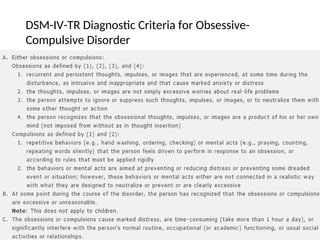
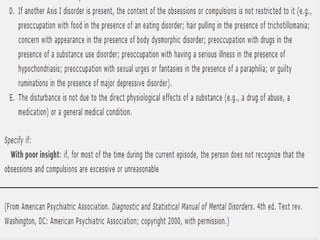
DSM-IV-TR Diagnostic Criteria for Obsessive-
Compulsive Disorder
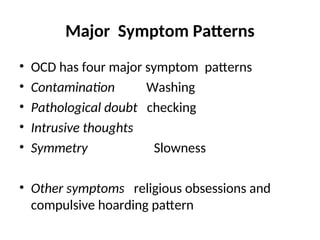
Major Symptom Patterns
• OCD has four major symptom patterns
• Contamination Washing
• Pathological doubt checking
• Intrusive thoughts
• Symmetry Slowness
• Other symptoms religious obsessions and
compulsive hoarding pattern
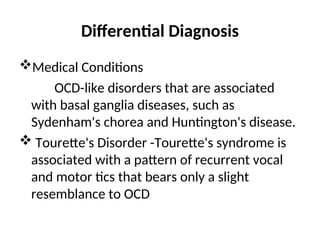
Differential Diagnosis
Medical Conditions
OCD-like disorders that are associated
with basal ganglia diseases, such as
Sydenham's chorea and Huntington's disease.
 Tourette's Disorder -Tourette's syndrome is
associated with a pattern of recurrent vocal
and motor tics that bears only a slight
resemblance to OCD
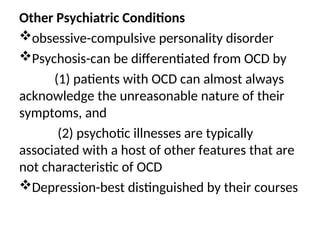
Other Psychiatric Conditions
obsessive-compulsive personality disorder
Psychosis-can be differentiated from OCD by
(1) patients with OCD can almost always
acknowledge the unreasonable nature of their
symptoms, and
(2) psychotic illnesses are typically
associated with a host of other features that are
not characteristic of OCD
Depression-best distinguished by their courses
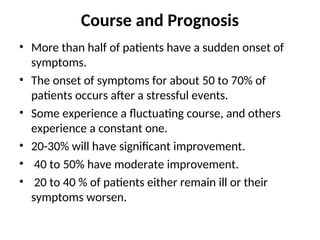
Course and Prognosis
• More than half of patients have a sudden onset of
symptoms.
• The onset of symptoms for about 50 to 70% of
patients occurs after a stressful events.
• Some experience a fluctuating course, and others
experience a constant one.
• 20-30% will have significant improvement.
• 40 to 50% have moderate improvement.
• 20 to 40 % of patients either remain ill or their
symptoms worsen.
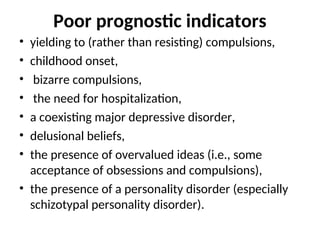
Poor prognostic indicators
• yielding to (rather than resisting) compulsions,
• childhood onset,
• bizarre compulsions,
• the need for hospitalization,
• a coexisting major depressive disorder,
• delusional beliefs,
• the presence of overvalued ideas (i.e., some
acceptance of obsessions and compulsions),
• the presence of a personality disorder (especially
schizotypal personality disorder).
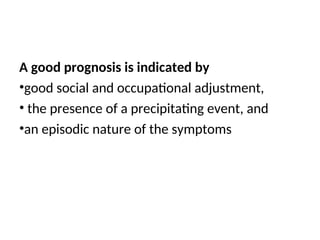
A good prognosis is indicated by
•good social and occupational adjustment,
• the presence of a precipitating event, and
•an episodic nature of the symptoms
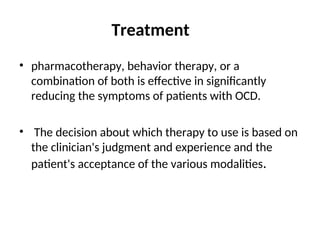
Treatment
• pharmacotherapy, behavior therapy, or a
combination of both is effective in significantly
reducing the symptoms of patients with OCD.
• The decision about which therapy to use is based on
the clinician's judgment and experience and the
patient's acceptance of the various modalities.
Pharmacotherapy
SSRIs
• first-line treatment
• Higher dose is used usually
• lead to improvement in 40 to 60 %
Clomipramine(TCAs)
• has been the first-line therapy for many years.
• associated with frequent anticholinergic side effects,
postural hypotension, somnolence, and weight gain.
• If treatment with clomipramine or an SSRI is
unsuccessful, many therapists augment the
first drug by the addition of valproate , lithium
, or carbamazepine
• venlafaxine, pindolol , and the monoamine
oxidase inhibitors (MAOIs), especially
phenelzine can also be tried
Behavior Therapy
• Longer lasting
• The principal behavioral approaches in OCD are
exposure and response prevention.
Psychotherapy
• insight-oriented psychotherapy
For extreme cases that are treatment resistant
and chronically debilitating, electroconvulsive
therapy (ECT) and psychosurgery are
considerations
References
•THANK
YOU
VERY
MUCH!!
•AN
Y
Q
U
ESTIO
N
S???

4. obsessive-compulsive -disorder assignment

  • 1.
  • 2.
    Outlines • Definitions • Epidimiology •Comorbidity • Etiology • Diagnosis • Clinical features • Differential diagnosis • Course and prognosis • Treatment
  • 3.
    Definition An obsession • isa recurrent and intrusive thought, feeling, idea, or sensation. • In contrast to an obsession, which is a mental event, a compulsion is a behavior. A compulsion • is a conscious, standardized, recurrent behavior, such as counting, checking, or avoiding.
  • 4.
    OCD cont… • OCDis one of the more disabling and potentially chronic anxiety disorders. • A patient with OCD may have an obsession, a compulsion, or both • A patient with OCD realizes the irrationality of the obsession and experiences both the obsession and the compulsion as ego-dystonic (i.e., unwanted behaviour
  • 5.
    Epidemiology • lifetime prevalencein the general population estimated at 2 to 3 %. • Among adults, men and women are equally likely to be affected. • Among adolescents, boys are more commonly affected than girls • The mean age of onset is about 20 years • Single persons are more frequently affected with OCD than are married persons • OCD occurs less often among blacks than among whites
  • 6.
    Comorbidity • The lifetimeprevalence for major depressive disorder-- 67% social phobia -- 25 %. • Other common comorbid include alcohol use disorders, GAD, specific phobia, panic disorder, eating disorders, and personality disorders. • Tourette's disorder in 5 to 7% • 20 to 30% of patients with OCD have a history of tics.
  • 7.
    Etiology Biological Factors Neurotransmitters • SerotonergicSystem-Data show that serotonergic drugs are more effective than drugs that affect other neurotransmitter systems, but whether serotonin is involved in the cause of OCD is not clear • Noradrenergic System-Currently, less evidence exists for dysfunction in the noradrenergic system in OCD
  • 8.
    Cont.... • Neuroimmunology • Someinterest exists in a positive link between streptococcal infection and OCD. • GABHS infection can cause rheumatic fever, and approximately 10 to 30 percent of the patients develop Sydenham's chorea and show obsessive-compulsive symptoms.
  • 9.
    Cont.... Brain-Imaging Studies •Neuroimaging inpatients with OCD has produced converging data implicating altered function in the neurocircuitry between orbitofrontal cortex, caudate, and thalamus Genetics- OCD has a significant genetic component
  • 10.
    • Behavioral Factors-Accordingto learning theorists, obsessions are conditioned stimuli • Psychosocial Factors  Personality Factors-Only about 15 to 35 percent of patients with OCD have had premorbid obsessional traits. Psychodynamic Factors- may be of great help in understanding problems with treatment compliance, interpersonal difficulties, and personality problems accompanying the Axis I disorder
  • 11.
    DSM-IV-TR Diagnostic Criteriafor Obsessive- Compulsive Disorder
  • 13.
    Major Symptom Patterns •OCD has four major symptom patterns • Contamination Washing • Pathological doubt checking • Intrusive thoughts • Symmetry Slowness • Other symptoms religious obsessions and compulsive hoarding pattern
  • 14.
    Differential Diagnosis Medical Conditions OCD-likedisorders that are associated with basal ganglia diseases, such as Sydenham's chorea and Huntington's disease.  Tourette's Disorder -Tourette's syndrome is associated with a pattern of recurrent vocal and motor tics that bears only a slight resemblance to OCD
  • 15.
    Other Psychiatric Conditions obsessive-compulsivepersonality disorder Psychosis-can be differentiated from OCD by (1) patients with OCD can almost always acknowledge the unreasonable nature of their symptoms, and (2) psychotic illnesses are typically associated with a host of other features that are not characteristic of OCD Depression-best distinguished by their courses
  • 16.
    Course and Prognosis •More than half of patients have a sudden onset of symptoms. • The onset of symptoms for about 50 to 70% of patients occurs after a stressful events. • Some experience a fluctuating course, and others experience a constant one. • 20-30% will have significant improvement. • 40 to 50% have moderate improvement. • 20 to 40 % of patients either remain ill or their symptoms worsen.
  • 17.
    Poor prognostic indicators •yielding to (rather than resisting) compulsions, • childhood onset, • bizarre compulsions, • the need for hospitalization, • a coexisting major depressive disorder, • delusional beliefs, • the presence of overvalued ideas (i.e., some acceptance of obsessions and compulsions), • the presence of a personality disorder (especially schizotypal personality disorder).
  • 18.
    A good prognosisis indicated by •good social and occupational adjustment, • the presence of a precipitating event, and •an episodic nature of the symptoms
  • 19.
    Treatment • pharmacotherapy, behaviortherapy, or a combination of both is effective in significantly reducing the symptoms of patients with OCD. • The decision about which therapy to use is based on the clinician's judgment and experience and the patient's acceptance of the various modalities.
  • 20.
    Pharmacotherapy SSRIs • first-line treatment •Higher dose is used usually • lead to improvement in 40 to 60 % Clomipramine(TCAs) • has been the first-line therapy for many years. • associated with frequent anticholinergic side effects, postural hypotension, somnolence, and weight gain.
  • 21.
    • If treatmentwith clomipramine or an SSRI is unsuccessful, many therapists augment the first drug by the addition of valproate , lithium , or carbamazepine • venlafaxine, pindolol , and the monoamine oxidase inhibitors (MAOIs), especially phenelzine can also be tried
  • 22.
    Behavior Therapy • Longerlasting • The principal behavioral approaches in OCD are exposure and response prevention. Psychotherapy • insight-oriented psychotherapy For extreme cases that are treatment resistant and chronically debilitating, electroconvulsive therapy (ECT) and psychosurgery are considerations
  • 23.
  • 24.
  • 25.

Editor's Notes

  • #4 Although the compulsive act may be carried out in an attempt to reduce the anxiety associated with the obsession, it does not always succeed in doing so. The completion of the compulsive act may not affect the anxiety, and it may even increase the anxiety. Anxiety is also increased when a person resists carrying out a compulsion.
  • #6 OCD exhibits a superficial resemblance to obsessive-compulsive personality disorder, which is associated with an obsessive concern for details, perfectionism, and other similar personality traits.
  • #7 Serotonergic System The many clinical drug trials that have been conducted support the hypothesis that dysregulation of serotonin is involved in the symptom formation of obsessions and compulsions in the disorder. Data show that serotonergic drugs are more effective than drugs that affect other neurotransmitter systems, but whether serotonin is involved in the cause of OCD is not clear. Clinical studies have assayed cerebrospinal fluid (CSF) concentrations of serotonin metabolites (e.g., 5-hydroxyindoleacetic acid [5-HIAA]) and affinities and numbers of platelet-binding sites of tritiated imipramine (Tofranil), which binds to serotonin reuptake sites, and have reported variable findings of these measures in patients with OCD. In one study, the CSF concentration of 5-HIAA decreased after treatment with clomipramine (Anafranil), focusing attention on the serotonergic system. Noradrenergic System Currently, less evidence exists for dysfunction in the noradrenergic system in OCD. Anecdotal reports show some improvement in OCD symptoms with use of oral clonidine (Catapres), a drug that lowers the amount of norepinephrine released from the presynaptic nerve terminals.
  • #9 Some studies also demonstrate increased rates of a variety of conditions among relatives of OCD probands, including generalized anxiety disorder, tic disorders, body dysmorphic disorder, hypochondriasis, eating disorders, and habits such as nail-biting.
  • #14 OCD-like disorders that are associated with basal ganglia diseases, such as Sydenham's chorea and Huntington's disease. Tourette's syndrome is associated with a pattern of recurrent vocal and motor tics that bears only a slight resemblance to OCD