Occupational Therapy Case Presentation (Geriatrics)Prepared by: 	Teoh Jou Yin (A 118729)		Occupational Therapy Programme		Faculty of Allied Health Sciences		National University of MalaysiaOccupational Therapy: Helping people live lives THEIR way.~ British Association of Occupational Therapy
Cerebral Vascular Accident (Stroke / CVA)A stroke is a sudden onset of neurologic deficit due to disruption of vascular function. This may be caused by partial or total blockage of blood vessels to the brain by a hemorrhage, or blood clot, of the brain.There are three groups who are at a high risk for stroke. People with transient or mild neurologic events, those with a cardiac disease that predisposes to embolism, and asymptomatic people with a carotid bruit (indicating a blockage) comprise this group. Those who have experienced TIAs (transient ischemic attacks) also have a high risk for stroke. TIAs are indications of cerebrovascular disease and are a warning that a CVA could occur at any time.(Source: Encyclopedia of the aging and the elderly.)
What is Occupational Therapy’s role?To FACILITATE / ENABLE / EMPOWER clients to engage and participate in life processes and activities that are important and of value to them, i.e. to do the things in life that they want to do and need to do.(Teoh et al. 2010)How to do that?
CONCEPTUAL MODELOF PRACTICEConceptual models of practice describe phenomena of interest like “occupation” or “occupational performance”, guide treatment approaches by easily allowing therapists to focus on the right problem areas, and help to predict outcomes in clinical interventions.(Iwama 2010)
The Kawa ModelThe essence of the Kawa Model (Iwama 2006) is basically to enable occupational therapists everywhere to “just ask the client how they want to live their lives so that it is more meaningful to them, and look together with them at what we can do to achieve that.”The Kawa Model can be used as a conceptual model of practice, frame of reference, assessment tool and modality. (Iwama 2010)It can be used with any population since it is based on the client's own perceptions of what is important to them, and the only possible contraindication is an occupational therapist unskilled in the therapeutic use of self.DISCUSS THE KAWA MODEL ON FACEBOOK!http://facebook.com/KawaModel
OCCUPATIONAL THERAPYPERFORMANCE FRAMEWORKA summary of interrelated constructs that represent and guide occupational therapy practice and articulate occupational therapy’s contribution to promoting health and participation through engagement in occupation.(AOTA 2008)
EVALUATIONSUBJECTIVE EVALUATIONSTEP 1: FIND OUT WHAT THE CLIENTS WANT AND NEED.
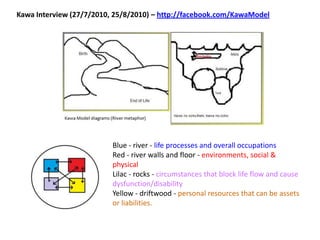
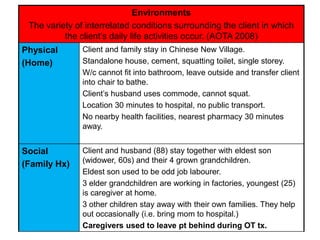
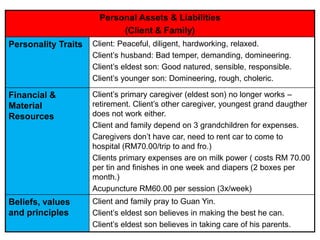
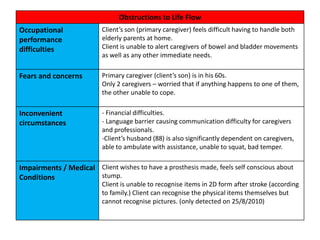
Kawa Interview (27/7/2010, 25/8/2010) – http://facebook.com/KawaModelBlue - river - life processes and overall occupationsRed - river walls and floor - environments, social & physicalLilac - rocks - circumstances that block life flow and cause dysfunction/disabilityYellow - driftwood - personal resources that can be assets or liabilities.
EVALUATIONOBJECTIVE EVALUATIONSTEP 2: VERIFYING THE DETAILS.
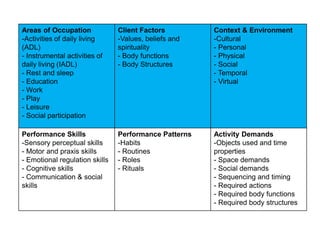
AREAS OF OCCUPATIONCategories articulating “the many types of occupations in which clients might engage” (AOTA 2008)Activities of daily living (ADL), Instrumental activities of daily living (IADL), Rest and sleep, Education, Work, Play, Leisure, Social participation
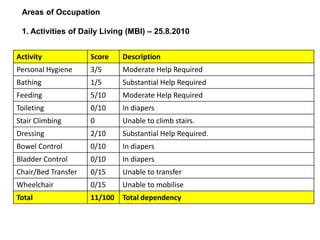
Areas of Occupation1. Activities of Daily Living (MBI) – 25.8.2010
INTERPRETATIONIdentifying and prioritising AIMS.STEP 3: IDENTIFYING AND PRIORITISING AIMS.
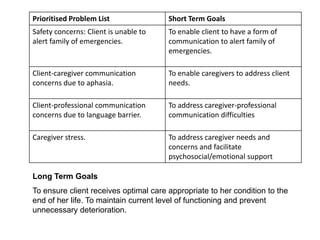
Long Term GoalsTo ensure client receives optimal care appropriate to her condition to the end of her life. To maintain current level of functioning and prevent unnecessary deterioration.
INTERVENTIONSTEP 4: OCCUPATIONAL THERAPY TREATMENT PLANNING
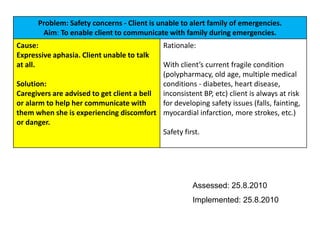
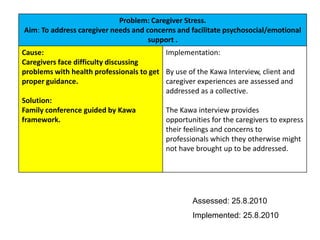
Assessed: 25.8.2010Implemented: 25.8.2010
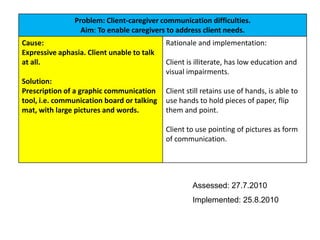
Assessed: 27.7.2010Implemented: 25.8.2010
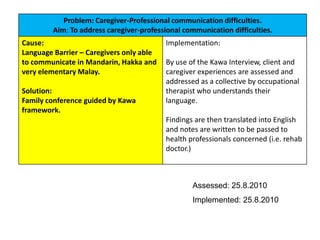
Assessed: 25.8.2010Implemented: 25.8.2010
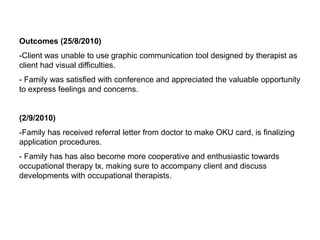
Outcomes (25/8/2010)Client was unable to use graphic communication tool designed by therapist as client had visual difficulties.
 Family was satisfied with conference and appreciated the valuable opportunity to express feelings and concerns.(2/9/2010)Family has received referral letter from doctor to make OKU card, is finalizing application procedures.
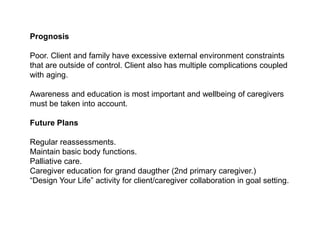
 Family has has also become more cooperative and enthusiastic towards occupational therapy tx, making sure to accompany client and discuss developments with occupational therapists.PrognosisPoor. Client and family have excessive external environment constraints that are outside of control. Client also has multiple complications coupled with aging.Awareness and education is most important and wellbeing of caregivers must be taken into account.Future PlansRegular reassessments.Maintain basic body functions.Palliative care.Caregiver education for grand daugther (2nd primary caregiver.)“Design Your Life” activity for client/caregiver collaboration in goal setting.
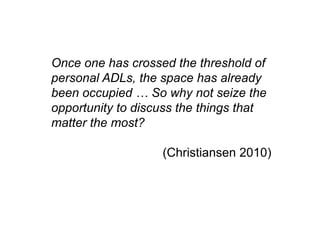
Once one has crossed the threshold of personal ADLs, the space has already been occupied … So why not seize the opportunity to discuss the things that matter the most?(Christiansen 2010)

Occupational Therapy (Geriatric) Kawa Model Case

  • 1.
    Occupational Therapy CasePresentation (Geriatrics)Prepared by: Teoh Jou Yin (A 118729) Occupational Therapy Programme Faculty of Allied Health Sciences National University of MalaysiaOccupational Therapy: Helping people live lives THEIR way.~ British Association of Occupational Therapy
  • 3.
    Cerebral Vascular Accident(Stroke / CVA)A stroke is a sudden onset of neurologic deficit due to disruption of vascular function. This may be caused by partial or total blockage of blood vessels to the brain by a hemorrhage, or blood clot, of the brain.There are three groups who are at a high risk for stroke. People with transient or mild neurologic events, those with a cardiac disease that predisposes to embolism, and asymptomatic people with a carotid bruit (indicating a blockage) comprise this group. Those who have experienced TIAs (transient ischemic attacks) also have a high risk for stroke. TIAs are indications of cerebrovascular disease and are a warning that a CVA could occur at any time.(Source: Encyclopedia of the aging and the elderly.)
  • 4.
    What is OccupationalTherapy’s role?To FACILITATE / ENABLE / EMPOWER clients to engage and participate in life processes and activities that are important and of value to them, i.e. to do the things in life that they want to do and need to do.(Teoh et al. 2010)How to do that?
  • 5.
    CONCEPTUAL MODELOF PRACTICEConceptualmodels of practice describe phenomena of interest like “occupation” or “occupational performance”, guide treatment approaches by easily allowing therapists to focus on the right problem areas, and help to predict outcomes in clinical interventions.(Iwama 2010)
  • 6.
    The Kawa ModelTheessence of the Kawa Model (Iwama 2006) is basically to enable occupational therapists everywhere to “just ask the client how they want to live their lives so that it is more meaningful to them, and look together with them at what we can do to achieve that.”The Kawa Model can be used as a conceptual model of practice, frame of reference, assessment tool and modality. (Iwama 2010)It can be used with any population since it is based on the client's own perceptions of what is important to them, and the only possible contraindication is an occupational therapist unskilled in the therapeutic use of self.DISCUSS THE KAWA MODEL ON FACEBOOK!http://facebook.com/KawaModel
  • 7.
    OCCUPATIONAL THERAPYPERFORMANCE FRAMEWORKAsummary of interrelated constructs that represent and guide occupational therapy practice and articulate occupational therapy’s contribution to promoting health and participation through engagement in occupation.(AOTA 2008)
  • 9.
    EVALUATIONSUBJECTIVE EVALUATIONSTEP 1:FIND OUT WHAT THE CLIENTS WANT AND NEED.
  • 10.
    Kawa Interview (27/7/2010,25/8/2010) – http://facebook.com/KawaModelBlue - river - life processes and overall occupationsRed - river walls and floor - environments, social & physicalLilac - rocks - circumstances that block life flow and cause dysfunction/disabilityYellow - driftwood - personal resources that can be assets or liabilities.
  • 17.
  • 18.
    AREAS OF OCCUPATIONCategoriesarticulating “the many types of occupations in which clients might engage” (AOTA 2008)Activities of daily living (ADL), Instrumental activities of daily living (IADL), Rest and sleep, Education, Work, Play, Leisure, Social participation
  • 19.
    Areas of Occupation1.Activities of Daily Living (MBI) – 25.8.2010
  • 20.
    INTERPRETATIONIdentifying and prioritisingAIMS.STEP 3: IDENTIFYING AND PRIORITISING AIMS.
  • 21.
    Long Term GoalsToensure client receives optimal care appropriate to her condition to the end of her life. To maintain current level of functioning and prevent unnecessary deterioration.
  • 22.
    INTERVENTIONSTEP 4: OCCUPATIONALTHERAPY TREATMENT PLANNING
  • 23.
  • 24.
  • 25.
  • 26.
  • 27.
    Outcomes (25/8/2010)Client wasunable to use graphic communication tool designed by therapist as client had visual difficulties.
  • 28.
    Family wassatisfied with conference and appreciated the valuable opportunity to express feelings and concerns.(2/9/2010)Family has received referral letter from doctor to make OKU card, is finalizing application procedures.
  • 29.
    Family hashas also become more cooperative and enthusiastic towards occupational therapy tx, making sure to accompany client and discuss developments with occupational therapists.PrognosisPoor. Client and family have excessive external environment constraints that are outside of control. Client also has multiple complications coupled with aging.Awareness and education is most important and wellbeing of caregivers must be taken into account.Future PlansRegular reassessments.Maintain basic body functions.Palliative care.Caregiver education for grand daugther (2nd primary caregiver.)“Design Your Life” activity for client/caregiver collaboration in goal setting.
  • 30.
    Once one hascrossed the threshold of personal ADLs, the space has already been occupied … So why not seize the opportunity to discuss the things that matter the most?(Christiansen 2010)