Occupational Therapy for Special Needs Children
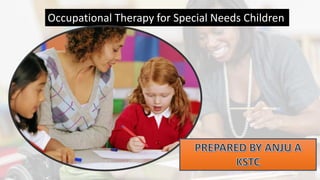
• Occupational therapy (OT) may sound like it involves finding a job or developing work
skills, but it actually deals with strengthening fine motor skills.
• These include tasks like writing, cutting, shoe-tying, and using utensils.
• OT is commonly used in special education programs for children.
• For adults recovering from an accident or stroke, OT may indeed include work-related
skills. For children, whose "occupation" is school and play, it will focus more sharply
on developmental milestones and skills required for playground and academic
activities.
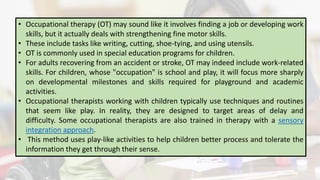
• Occupational therapists working with children typically use techniques and routines
that seem like play. In reality, they are designed to target areas of delay and
difficulty. Some occupational therapists are also trained in therapy with a sensory
integration approach.
• This method uses play-like activities to help children better process and tolerate the
information they get through their sense.
OT and Special Education
• As a parent, you may want to pursue private occupational therapy for
your child. It's also a common service offered to children in early
intervention and special education.
• Individualized Education Plans (IEPs) or Individualized Family Services
Plans (IFSPs) will outline the amount of time your child will spend in
occupational therapy and where it will be delivered. Your child's
occupational therapist should be part of your IEP team and present at
any meetings in which that document is discussed and planned.
Understanding an IEP for Your Child
Individualized Education Plan
• IEP stands for Individualized Education Program or Individualized
Education Plan.
• You may also hear it called some permutation of those, like
"Individualized Educational Plan" or "Individual Education Program."
• They all mean the same thing – a legally binding document that spells
out exactly what special education services your child will receive and
why.
• The plan will include your child's classification, placement, services
such as a one-on-one aide and therapies, academic and behavioural
goals, a behaviour plan if needed, percentage of time in regular
education, and progress reports from teachers and therapists.
• The IEP is planned at an IEP meeting.
• The individualized part of IEP means that the plan has to be tailored
specifically to your child's special needs -- not to the needs of the
teacher, or the school, or the district.
• Goals, modifications, accommodations, personnel, and placement
should all be selected, enforced, and maintained with the particular
needs of your child in mind.
• "We don't do that," for example, is not an individualized response.
• If your school has never had a child like yours (and since your child is
an individual, they haven't), and now they do, and a service is
appropriate to his or her needs, then they do do that now.
Who attends an IEP meeting?
• The IEP meeting is attended by members of the Child Study Team,
which usually includes a social worker, a psychologist, a learning
specialist, and your child's teachers and therapists. Parents are always
to be included in IEP meetings.
• You have a right to be notified in advance and to change the date if
necessary. Although IEP meetings are rarely pleasant, do not be
tempted to skip them. You are the expert on your child and are
therefore the most essential member of the team.
What happens at an IEP meeting?
• Sometimes an open and honest exchange of information, sometimes
a lot of game-playing and intimidation, sometimes wailing and
gnashing of teeth.
• IEP meetings can be some of the most emotionally difficult
experiences parents of children with special needs can endure, and
given the way most specialists interact with their patients' parents,
that's really saying something.
• Early in your child's special education experience, IEP meetings will
focus on arranging for testing, giving a classification, and assessing
needs.
• These are hard mostly because you will hear how very far your child is
from the "norm," and begin to realize how his or her educational
experience will differ from the one you had or your other children
had.
• You may feel that the professionals at the table are only looking at
your child as a disability – or, equally difficult, you may feel that they
are not giving enough attention to the depth of your child's problem
and the intensity of his or her needs.
Where do IEP meetings take place?
• Generally, IEP meetings will take place at the school where your Child
Study Team is based.
• This may or may not be your child’s school, depending on the size of
your district and where your child is placed.
Sensory Integration Therapy and Autism
• Many people with autism are also hypersensitive or under-sensitive
to light, noise, and touch.
• They may be unable to stand the sound of a dishwasher, or, on the
other extreme, need to flap and even injure themselves to be fully
aware of their bodies.
• These sensory differences are sometimes called "sensory processing
disorder" or "sensory processing dysfunction," and they may be
treatable with sensory integration therapy.
• Sensory processing dysfunction is the ability to take in information
through our senses (touch, movement, smell, taste, vision, and
hearing), organize and interpret that information, and make a
meaningful response.
• For most people, this process is automatic.
• People who have a Sensory Processing Disorder (SPD), however, don’t
experience these interactions in the same way.
• SPD affects the way their brains interpret the information that comes
in and how they respond with emotional, motor, and other reactions.
• For example, some children with autism feel as if they're being
constantly bombarded with sensory information.
• Sensory integration therapy is essentially a form of occupational
therapy, and it is generally offered by specially trained
occupational therapists.
• It involves specific sensory activities to help a child appropriately
respond to light, sound, touch, smells, and other input.
• Intervention may include swinging, brushing, playing in a ball pit
and a whole gamut of other activities.
• The outcome of these activities may be better focus, improved
behavior, and even lowered anxiety.
How Parents Can Get Involved
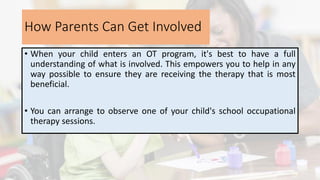
• When your child enters an OT program, it's best to have a full
understanding of what is involved. This empowers you to help in any
way possible to ensure they are receiving the therapy that is most
beneficial.
• You can arrange to observe one of your child's school occupational
therapy sessions.
• Ask questions and make sure the goals of the IEP are being addressed, sessions
are being accommodated consistently, and the therapy space is conducive to
good work.
• A school OT can be very helpful in addressing problems in the classroom. They
can also recommend things like writing utensils, seating solutions to keep your
child from fidgeting, or weighted items to help calm and focus.
• Keep up good friendly communication with the occupational therapist.
• You may also be able to ask about any problems you need advice on at home.
• Additionally, you can find out if there's any work you could do with your child
to further the OT goals.
• The exercises often look like games to kids and may be a good way to sneak
some substance into your playtime.
Occupational Therapy for Special Needs Children

Occupational Therapy for Special Needs Children

  • 1.
    Occupational Therapy forSpecial Needs Children
  • 2.
    • Occupational therapy(OT) may sound like it involves finding a job or developing work skills, but it actually deals with strengthening fine motor skills. • These include tasks like writing, cutting, shoe-tying, and using utensils. • OT is commonly used in special education programs for children. • For adults recovering from an accident or stroke, OT may indeed include work-related skills. For children, whose "occupation" is school and play, it will focus more sharply on developmental milestones and skills required for playground and academic activities. • Occupational therapists working with children typically use techniques and routines that seem like play. In reality, they are designed to target areas of delay and difficulty. Some occupational therapists are also trained in therapy with a sensory integration approach. • This method uses play-like activities to help children better process and tolerate the information they get through their sense.
  • 3.
    OT and SpecialEducation • As a parent, you may want to pursue private occupational therapy for your child. It's also a common service offered to children in early intervention and special education. • Individualized Education Plans (IEPs) or Individualized Family Services Plans (IFSPs) will outline the amount of time your child will spend in occupational therapy and where it will be delivered. Your child's occupational therapist should be part of your IEP team and present at any meetings in which that document is discussed and planned.
  • 4.
    Understanding an IEPfor Your Child Individualized Education Plan • IEP stands for Individualized Education Program or Individualized Education Plan. • You may also hear it called some permutation of those, like "Individualized Educational Plan" or "Individual Education Program." • They all mean the same thing – a legally binding document that spells out exactly what special education services your child will receive and why. • The plan will include your child's classification, placement, services such as a one-on-one aide and therapies, academic and behavioural goals, a behaviour plan if needed, percentage of time in regular education, and progress reports from teachers and therapists.
  • 5.
    • The IEPis planned at an IEP meeting. • The individualized part of IEP means that the plan has to be tailored specifically to your child's special needs -- not to the needs of the teacher, or the school, or the district. • Goals, modifications, accommodations, personnel, and placement should all be selected, enforced, and maintained with the particular needs of your child in mind. • "We don't do that," for example, is not an individualized response. • If your school has never had a child like yours (and since your child is an individual, they haven't), and now they do, and a service is appropriate to his or her needs, then they do do that now.
  • 6.
    Who attends anIEP meeting? • The IEP meeting is attended by members of the Child Study Team, which usually includes a social worker, a psychologist, a learning specialist, and your child's teachers and therapists. Parents are always to be included in IEP meetings. • You have a right to be notified in advance and to change the date if necessary. Although IEP meetings are rarely pleasant, do not be tempted to skip them. You are the expert on your child and are therefore the most essential member of the team.
  • 7.
    What happens atan IEP meeting? • Sometimes an open and honest exchange of information, sometimes a lot of game-playing and intimidation, sometimes wailing and gnashing of teeth. • IEP meetings can be some of the most emotionally difficult experiences parents of children with special needs can endure, and given the way most specialists interact with their patients' parents, that's really saying something.
  • 8.
    • Early inyour child's special education experience, IEP meetings will focus on arranging for testing, giving a classification, and assessing needs. • These are hard mostly because you will hear how very far your child is from the "norm," and begin to realize how his or her educational experience will differ from the one you had or your other children had. • You may feel that the professionals at the table are only looking at your child as a disability – or, equally difficult, you may feel that they are not giving enough attention to the depth of your child's problem and the intensity of his or her needs.
  • 9.
    Where do IEPmeetings take place? • Generally, IEP meetings will take place at the school where your Child Study Team is based. • This may or may not be your child’s school, depending on the size of your district and where your child is placed.
  • 10.
    Sensory Integration Therapyand Autism • Many people with autism are also hypersensitive or under-sensitive to light, noise, and touch. • They may be unable to stand the sound of a dishwasher, or, on the other extreme, need to flap and even injure themselves to be fully aware of their bodies. • These sensory differences are sometimes called "sensory processing disorder" or "sensory processing dysfunction," and they may be treatable with sensory integration therapy.
  • 11.
    • Sensory processingdysfunction is the ability to take in information through our senses (touch, movement, smell, taste, vision, and hearing), organize and interpret that information, and make a meaningful response. • For most people, this process is automatic. • People who have a Sensory Processing Disorder (SPD), however, don’t experience these interactions in the same way. • SPD affects the way their brains interpret the information that comes in and how they respond with emotional, motor, and other reactions. • For example, some children with autism feel as if they're being constantly bombarded with sensory information.
  • 12.
    • Sensory integrationtherapy is essentially a form of occupational therapy, and it is generally offered by specially trained occupational therapists. • It involves specific sensory activities to help a child appropriately respond to light, sound, touch, smells, and other input. • Intervention may include swinging, brushing, playing in a ball pit and a whole gamut of other activities. • The outcome of these activities may be better focus, improved behavior, and even lowered anxiety.
  • 13.
    How Parents CanGet Involved • When your child enters an OT program, it's best to have a full understanding of what is involved. This empowers you to help in any way possible to ensure they are receiving the therapy that is most beneficial. • You can arrange to observe one of your child's school occupational therapy sessions.
  • 14.
    • Ask questionsand make sure the goals of the IEP are being addressed, sessions are being accommodated consistently, and the therapy space is conducive to good work. • A school OT can be very helpful in addressing problems in the classroom. They can also recommend things like writing utensils, seating solutions to keep your child from fidgeting, or weighted items to help calm and focus. • Keep up good friendly communication with the occupational therapist. • You may also be able to ask about any problems you need advice on at home. • Additionally, you can find out if there's any work you could do with your child to further the OT goals. • The exercises often look like games to kids and may be a good way to sneak some substance into your playtime.