June 30th 2012
          EDU 627
Lourdes Maria Pena
1) Pathology that interrupts physical or
   mental processes,
2) Impairment that limits a person’s ability to
   function and that may result in,
3) Functional limitation relative to the ability
   to perform or engage in life task and,
4)  disability to perform socially expected
   activities.
- Nagi (1969)
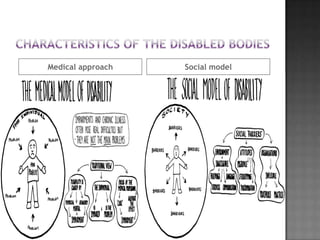
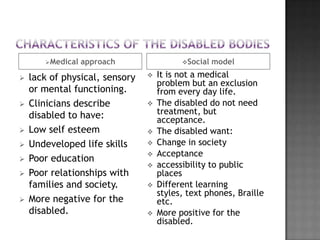
Medical approach   Social model
Medical   approach                Social   model

   lack of physical, sensory      It is not a medical
                                    problem but an exclusion
    or mental functioning.          from every day life.
   Clinicians describe            The disabled do not need
    disabled to have:               treatment, but
                                    acceptance.
   Low self esteem                The disabled want:
   Undeveloped life skills        Change in society
                                   Acceptance
   Poor education
                                   accessibility to public
   Poor relationships with         places
    families and society.          Different learning
                                    styles, text phones, Braille
   More negative for the           etc.
    disabled.                      More positive for the
                                    disabled.
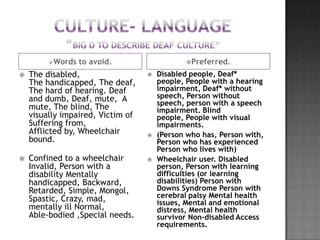
Words   to avoid.                   Preferred.

   The disabled,                     Disabled people, Deaf*
    The handicapped, The deaf,         people, People with a hearing
    The hard of hearing. Deaf          impairment, Deaf* without
    and dumb, Deaf, mute, A            speech, Person without
                                       speech, person with a speech
    mute, The blind, The               impairment. Blind
    visually impaired, Victim of       people, People with visual
    Suffering from,                    impairments.
    Afflicted by, Wheelchair          (Person who has, Person with,
    bound.                             Person who has experienced
                                       Person who lives with)
   Confined to a wheelchair          Wheelchair user. Disabled
    Invalid, Person with a             person, Person with learning
    disability Mentally                difficulties (or learning
    handicapped, Backward,             disabilities) Person with
    Retarded, Simple, Mongol,          Downs Syndrome Person with
    Spastic, Crazy, mad,               cerebral palsy Mental health
                                       issues, Mental and emotional
    mentally ill Normal,               distress, Mental health
    Able-bodied ,Special needs.        survivor Non-disabled Access
                                       requirements.
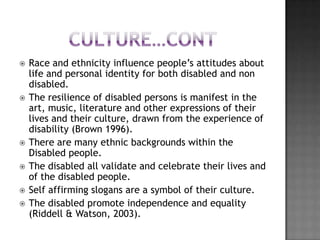
   Race and ethnicity influence people’s attitudes about
    life and personal identity for both disabled and non
    disabled.
   The resilience of disabled persons is manifest in the
    art, music, literature and other expressions of their
    lives and their culture, drawn from the experience of
    disability (Brown 1996).
   There are many ethnic backgrounds within the
    Disabled people.
   The disabled all validate and celebrate their lives and
    of the disabled people.
   Self affirming slogans are a symbol of their culture.
   The disabled promote independence and equality
    (Riddell & Watson, 2003).
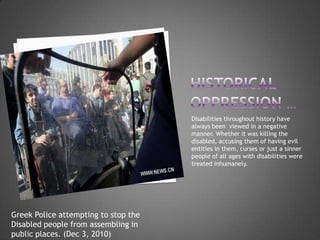
Disabilities throughout history have
                                      always been viewed in a negative
                                      manner. Whether it was killing the
                                      disabled, accusing them of having evil
                                      entities in them, curses or just a sinner
                                      people of all ages with disabilities were
                                      treated inhumanely.


Greek Police attempting to stop the
Disabled people from assembling in
public places. (Dec 3, 2010)
 Disabilities throughout history have always been
  seen in a negative manner:
 Neolithic tribes- believed disabilities were
  caused by evil spirits, they performed skull
  surgeries to release the supernatural entities.
 Greeks- believed the disabled were inhuman
 Romans- abandoned disabled babies to die.
 Persians- wanted a perfect world without the
  disabled.
 The Disabled were banned from even practicing
  their faith in Temples in Ancient Hebrew times.
 Blindness was seen as a punishment for sin.
 1924 under BUCK vs. Bell the supreme court
  passed forced sterilization of Disabled people.
 In1912 a French noble prize winner in
  medicine created the “Humane Disposal” or
  euthanasia of Disabled people.
 The Holocaust is well known for the
  extermination of the Jews but little for the
  “perfection plan” of Hitler's large
  extermination of the disabled.
 Between 75,000 -200,000 Disabled Germans
  were killed.
o The Elizabethan poor Law defined the Disabled as
“worthy poor” in contrast to the lazy, unmotivated
“unworthy poor. ”
oDisabled war veterans were seen as Hero’s and accepted
by society because their disability was brought forth by a
good deed being society service.
o1960s CIVIL RIGHTS MOVEMENT gave rise to many rights
based on race, sex, religion sexual orientation, and
national origin, but it wasn’t until much later the Disabled
with helped.
o1973 Rehabilitation Act prohibited the discrimination of
the disabled in federal agencies and organizations and
those places with federal contracts.
o1990 THE ADA- Americans Disabilities Act. Arouse from 3
major Civil Rights Movement Laws passed to finally protect
the Disabled people of hate crimes and discriminatory
remarks anywhere.
   54 million people have a disability. They represent 19
    percent of the civilian non-institutionalized population
   By age :
   5 percent of children 5 to 17 have disabilities.
   10 percent of people 18 to 64 have disabilities.
   38 percent of adults 65 and older have disabilities.
   Persons with disabilities are more likely to be victims of
    violence or rape, according to a 2004 British study, and
    less likely to obtain police intervention, legal protection or
    preventive care.
   59%of people 21 to 64 with difficulty hearing were
    employed. The corresponding percentage for those with
    difficulty seeing was 41 percent.
   6% of disabled workers 16 and older who used public
    transportation to commute to work. In addition, 69
    percent of people with a disability drove alone, 13 percent
    carpooled, 4 percent walked and 3 percent used a taxicab,
    motorcycle, bicycle or other means.
   On average, 19 % of less educated people have disabilities.
   19 %of children with disabilities in developing countries do
    not attend school, says UNESCO
   Students with disabilities have a higher risk of depression
    than the nondisabled.
    Research indicates that violence against student children
    with disabilities occurs at annual rates at least 1.7 times
    greater than for their peers without disabilities.
   A 2004 United States survey found that only 35 per cent of
    working-age persons with disabilities are in fact working,
    compared to 78 per cent of those without disabilities.
   One third of the employers surveyed said that persons with
    disabilities cannot effectively perform the required job
    tasks. The second most common reason given for not hiring persons
    with disabilities was the fear of costly special facilities.
   More than 50 million—which is about 1 in 5—Americans report having
    some level of disability.
   The U.S. Census 2000 counted 49.7 million people with some type of
    long-lasting condition or disability
    impairment or condition does not define individuals, their health, or
    their talents and abilities.
   DISABLED PEOPLE:
   Experience difficulties or delays in getting the health care they need.
    have not had an annual dental visit.
    have not had a mammogram in past 2 years.
   have not had a Pap test within the past 3 years.
    have not engage in fitness activities.
    are more likely to Use tobacco.
   Are more likely to be overweight or obese.
    are more likely to Have high blood pressure.
   Experience symptoms of psychological distress.
   Receive less social-emotional support.
   Have lower employment rates.
 http://www.va.gov/     Older Disabled
  opa/feature/vanews      veterans struggle
  /vanews.asx             with respect. These
 The link provided       are people that
  above shows how         have served our
  veterans age 55 or      country.
  older come together    Door to door
  Disabled or not and     transportation with
  partake in              accessible ramps
  communal                are being put to use
  exercise, games, wo     more now.
  rk and conference’s    (watch video)
  to help get them
  active.
   Teachers lack the             Immobility- education
    correct training for           providers are not
    specific Disabled              physically accessible.
    students                       They cost the school
   Young students and             enormous amounts and
    adults require much            the funds are not
    needed medical                 available.
    attention throughout          Bullying- Many Disabled
    the day that school            people have
    have yet to have a staff       inappropriate
    for these necessities.         behaviors, which can be
   Schools lack appropriate       allowed for in class but
    equipment necessary            which may create
    for students with              difficulties or
    hearing and vision aids        embarrassment for the
                                   student in public.
   Some students have a
    disability ignored by         STARING- by non-
    parent and struggle            Disabled people causes
    academically until             low self esteem and
    school personal                insecurities.
    addresses situation.
   First I believe it is important for the school and
    teachers to be aware of their students current health
    and of any Disabilities.
   This can affect the health and well-being of people
    with disabilities of any ages.
   How to Improve the conditions of daily life in the
    class rooms:
       Encouraging communities to be accessible so all can live
        in, move through, and interact with their environment.
       Encouraging community living. And nonjudgmental
        stares.
       Removing barriers in the environment.
       Teachers should reinforce policy and make sure others
        are respectful. Also promote equality and an
        environment that is tolerant and understanding of
        differences and disabilities. Through this reinforcement
        the Main focus should be always be education.
  Class age- college         Construct the survey-
   students.                   pass it out to each
  In small groups –           other in the class
   conduct possible            room, then to peers
   survey questions            on campus.
   about Disabled             Purpose- the purpose
   peopled.                    of the survey is raise
>These questions should        awareness of what
   vary and not only           people may “think”
   pertain to the stereo       they know. Realize
   typical physical            what is false, what
   disabilities but            the stereotypes are
   everything across the       and to educate!
   spectrum.
  the small groups should come together in class
  and cross analyze their results and those of their
  peers on campus.
 The next task should be to prepare a day of
  awareness on campus. Searching for guest
  speakers to talk about how they have lived with
  their disability, and find resources for those who
  are living with a disability and are not treating
  themselves because of fear of exclusion by
  society.
 This day of awareness could be combined with
  our campus Rally Around Diversity Day. So it is
  reinforcing diversity, respect and acceptance for
  all people, not only pertaining to Race or
  Ethnicity but also people with Disabilities.
 Veterans Crisis Line- 1-800-273-8255
  www.veteranscrisisline.net
 center for universal design
 Removing Barriers to Health Clubs and Fitness
  Facilities
 conferences for the blind
 MCDHH
 local Massachusetts Social Security
  Administration (SSA) field office.
 Disability Rights
 Healthy People for the Disabled and Non-
  Disabled
 medical   model picture
 social model picture
 disabilityinfo.org
 Mass Rehab Commission MRC
 http://www.socialsecurity-
  disability.org/social-security-disability-
  resources/worcester - helps disabled around
  Worcester, Ma.
   Brown,S.E. (1996). Deviants, invalids, and
    anthropologist: Cross-Cultural perspectives on
    conditions of disabilities in one academic discipline.
    Disability and Rehabilitation, 18(5), 273-275
   Centers for Disease Control and Prevention
    (CDC), National Center for Health Statistics. DATA
    2010 [Internet database]. Hyattsville, MD: CDC; 2010
    [cited 2010 Sep 30]. Available
    from: http://wonder.cdc.gov/data2010/focus.htm
   Disability Rights Commission: Disability
    Discrimination Act - Best Practice Trainers Resource
    Pack 2002.
   http://ddsg.org.uk/taxi/medical-model.html
   http://ddsg.org.uk/taxi/social-model.html
   Lum, D. ( 2011). Culturally competent practice. (4th
    ed.). Belmont, California: Cengage. DOI:
    www.cengage.com
   Nagi,S.Z. (1969). Disability and Rehabilitation.
    Columbus,OH: Ohio state University Press.
 Riddell,S.,& Watson,N.(Eds.). (2003).
  Disability, culture and identity.Londo: pearson
 Ridley,C.R., Baker,D.M.,& Hill,C.L.(2001).Critical
  issues concerning culture compentence. The
  Counciling psychologist, 29(6), 8822-832
 US Department of Health and Human Services.
  Healthy people 2010 (conference ed, in 2 vols).
  Washington, DC: US Department of Health and
  Human Services; 2000. Available at
  http://www.healthypeople.gov.
 World Health Organization (WHO), Commission
  on Determinants of Health. Closing the gap in a
  generation: Health equity through action on the
  determinants of health. Final report.
  Geneva, Switzerland: WHO; 2008

People with disabilities powere point.

  • 1.
    June 30th 2012 EDU 627 Lourdes Maria Pena
  • 2.
    1) Pathology thatinterrupts physical or mental processes, 2) Impairment that limits a person’s ability to function and that may result in, 3) Functional limitation relative to the ability to perform or engage in life task and, 4) disability to perform socially expected activities. - Nagi (1969)
  • 4.
    Medical approach Social model
  • 5.
    Medical approach Social model  lack of physical, sensory  It is not a medical problem but an exclusion or mental functioning. from every day life.  Clinicians describe  The disabled do not need disabled to have: treatment, but acceptance.  Low self esteem  The disabled want:  Undeveloped life skills  Change in society  Acceptance  Poor education  accessibility to public  Poor relationships with places families and society.  Different learning styles, text phones, Braille  More negative for the etc. disabled.  More positive for the disabled.
  • 6.
    Words to avoid. Preferred.  The disabled,  Disabled people, Deaf* The handicapped, The deaf, people, People with a hearing The hard of hearing. Deaf impairment, Deaf* without and dumb, Deaf, mute, A speech, Person without speech, person with a speech mute, The blind, The impairment. Blind visually impaired, Victim of people, People with visual Suffering from, impairments. Afflicted by, Wheelchair  (Person who has, Person with, bound. Person who has experienced Person who lives with)  Confined to a wheelchair  Wheelchair user. Disabled Invalid, Person with a person, Person with learning disability Mentally difficulties (or learning handicapped, Backward, disabilities) Person with Retarded, Simple, Mongol, Downs Syndrome Person with Spastic, Crazy, mad, cerebral palsy Mental health issues, Mental and emotional mentally ill Normal, distress, Mental health Able-bodied ,Special needs. survivor Non-disabled Access requirements.
  • 7.
    Race and ethnicity influence people’s attitudes about life and personal identity for both disabled and non disabled.  The resilience of disabled persons is manifest in the art, music, literature and other expressions of their lives and their culture, drawn from the experience of disability (Brown 1996).  There are many ethnic backgrounds within the Disabled people.  The disabled all validate and celebrate their lives and of the disabled people.  Self affirming slogans are a symbol of their culture.  The disabled promote independence and equality (Riddell & Watson, 2003).
  • 9.
    Disabilities throughout historyhave always been viewed in a negative manner. Whether it was killing the disabled, accusing them of having evil entities in them, curses or just a sinner people of all ages with disabilities were treated inhumanely. Greek Police attempting to stop the Disabled people from assembling in public places. (Dec 3, 2010)
  • 10.
     Disabilities throughouthistory have always been seen in a negative manner:  Neolithic tribes- believed disabilities were caused by evil spirits, they performed skull surgeries to release the supernatural entities.  Greeks- believed the disabled were inhuman  Romans- abandoned disabled babies to die.  Persians- wanted a perfect world without the disabled.  The Disabled were banned from even practicing their faith in Temples in Ancient Hebrew times.  Blindness was seen as a punishment for sin.  1924 under BUCK vs. Bell the supreme court passed forced sterilization of Disabled people.
  • 11.
     In1912 aFrench noble prize winner in medicine created the “Humane Disposal” or euthanasia of Disabled people.  The Holocaust is well known for the extermination of the Jews but little for the “perfection plan” of Hitler's large extermination of the disabled.  Between 75,000 -200,000 Disabled Germans were killed.
  • 12.
    o The Elizabethanpoor Law defined the Disabled as “worthy poor” in contrast to the lazy, unmotivated “unworthy poor. ” oDisabled war veterans were seen as Hero’s and accepted by society because their disability was brought forth by a good deed being society service. o1960s CIVIL RIGHTS MOVEMENT gave rise to many rights based on race, sex, religion sexual orientation, and national origin, but it wasn’t until much later the Disabled with helped. o1973 Rehabilitation Act prohibited the discrimination of the disabled in federal agencies and organizations and those places with federal contracts. o1990 THE ADA- Americans Disabilities Act. Arouse from 3 major Civil Rights Movement Laws passed to finally protect the Disabled people of hate crimes and discriminatory remarks anywhere.
  • 13.
    54 million people have a disability. They represent 19 percent of the civilian non-institutionalized population  By age :  5 percent of children 5 to 17 have disabilities.  10 percent of people 18 to 64 have disabilities.  38 percent of adults 65 and older have disabilities.  Persons with disabilities are more likely to be victims of violence or rape, according to a 2004 British study, and less likely to obtain police intervention, legal protection or preventive care.  59%of people 21 to 64 with difficulty hearing were employed. The corresponding percentage for those with difficulty seeing was 41 percent.  6% of disabled workers 16 and older who used public transportation to commute to work. In addition, 69 percent of people with a disability drove alone, 13 percent carpooled, 4 percent walked and 3 percent used a taxicab, motorcycle, bicycle or other means.
  • 14.
    On average, 19 % of less educated people have disabilities.  19 %of children with disabilities in developing countries do not attend school, says UNESCO  Students with disabilities have a higher risk of depression than the nondisabled.  Research indicates that violence against student children with disabilities occurs at annual rates at least 1.7 times greater than for their peers without disabilities.  A 2004 United States survey found that only 35 per cent of working-age persons with disabilities are in fact working, compared to 78 per cent of those without disabilities.  One third of the employers surveyed said that persons with disabilities cannot effectively perform the required job tasks. The second most common reason given for not hiring persons with disabilities was the fear of costly special facilities.
  • 15.
    More than 50 million—which is about 1 in 5—Americans report having some level of disability.  The U.S. Census 2000 counted 49.7 million people with some type of long-lasting condition or disability  impairment or condition does not define individuals, their health, or their talents and abilities.  DISABLED PEOPLE:  Experience difficulties or delays in getting the health care they need.  have not had an annual dental visit.  have not had a mammogram in past 2 years.  have not had a Pap test within the past 3 years.  have not engage in fitness activities.  are more likely to Use tobacco.  Are more likely to be overweight or obese.  are more likely to Have high blood pressure.  Experience symptoms of psychological distress.  Receive less social-emotional support.  Have lower employment rates.
  • 16.
     http://www.va.gov/  Older Disabled opa/feature/vanews veterans struggle /vanews.asx with respect. These  The link provided are people that above shows how have served our veterans age 55 or country. older come together  Door to door Disabled or not and transportation with partake in accessible ramps communal are being put to use exercise, games, wo more now. rk and conference’s  (watch video) to help get them active.
  • 17.
    Teachers lack the  Immobility- education correct training for providers are not specific Disabled physically accessible. students They cost the school  Young students and enormous amounts and adults require much the funds are not needed medical available. attention throughout  Bullying- Many Disabled the day that school people have have yet to have a staff inappropriate for these necessities. behaviors, which can be  Schools lack appropriate allowed for in class but equipment necessary which may create for students with difficulties or hearing and vision aids embarrassment for the student in public.  Some students have a disability ignored by  STARING- by non- parent and struggle Disabled people causes academically until low self esteem and school personal insecurities. addresses situation.
  • 18.
    First I believe it is important for the school and teachers to be aware of their students current health and of any Disabilities.  This can affect the health and well-being of people with disabilities of any ages.  How to Improve the conditions of daily life in the class rooms:  Encouraging communities to be accessible so all can live in, move through, and interact with their environment.  Encouraging community living. And nonjudgmental stares.  Removing barriers in the environment.  Teachers should reinforce policy and make sure others are respectful. Also promote equality and an environment that is tolerant and understanding of differences and disabilities. Through this reinforcement the Main focus should be always be education.
  • 19.
     Classage- college  Construct the survey- students. pass it out to each  In small groups – other in the class conduct possible room, then to peers survey questions on campus. about Disabled  Purpose- the purpose peopled. of the survey is raise >These questions should awareness of what vary and not only people may “think” pertain to the stereo they know. Realize typical physical what is false, what disabilities but the stereotypes are everything across the and to educate! spectrum.
  • 20.
     thesmall groups should come together in class and cross analyze their results and those of their peers on campus.  The next task should be to prepare a day of awareness on campus. Searching for guest speakers to talk about how they have lived with their disability, and find resources for those who are living with a disability and are not treating themselves because of fear of exclusion by society.  This day of awareness could be combined with our campus Rally Around Diversity Day. So it is reinforcing diversity, respect and acceptance for all people, not only pertaining to Race or Ethnicity but also people with Disabilities.
  • 21.
     Veterans CrisisLine- 1-800-273-8255 www.veteranscrisisline.net  center for universal design  Removing Barriers to Health Clubs and Fitness Facilities  conferences for the blind  MCDHH  local Massachusetts Social Security Administration (SSA) field office.  Disability Rights  Healthy People for the Disabled and Non- Disabled
  • 22.
     medical model picture  social model picture  disabilityinfo.org  Mass Rehab Commission MRC  http://www.socialsecurity- disability.org/social-security-disability- resources/worcester - helps disabled around Worcester, Ma.
  • 23.
    Brown,S.E. (1996). Deviants, invalids, and anthropologist: Cross-Cultural perspectives on conditions of disabilities in one academic discipline. Disability and Rehabilitation, 18(5), 273-275  Centers for Disease Control and Prevention (CDC), National Center for Health Statistics. DATA 2010 [Internet database]. Hyattsville, MD: CDC; 2010 [cited 2010 Sep 30]. Available from: http://wonder.cdc.gov/data2010/focus.htm  Disability Rights Commission: Disability Discrimination Act - Best Practice Trainers Resource Pack 2002.  http://ddsg.org.uk/taxi/medical-model.html  http://ddsg.org.uk/taxi/social-model.html  Lum, D. ( 2011). Culturally competent practice. (4th ed.). Belmont, California: Cengage. DOI: www.cengage.com  Nagi,S.Z. (1969). Disability and Rehabilitation. Columbus,OH: Ohio state University Press.
  • 24.
     Riddell,S.,& Watson,N.(Eds.).(2003). Disability, culture and identity.Londo: pearson  Ridley,C.R., Baker,D.M.,& Hill,C.L.(2001).Critical issues concerning culture compentence. The Counciling psychologist, 29(6), 8822-832  US Department of Health and Human Services. Healthy people 2010 (conference ed, in 2 vols). Washington, DC: US Department of Health and Human Services; 2000. Available at http://www.healthypeople.gov.  World Health Organization (WHO), Commission on Determinants of Health. Closing the gap in a generation: Health equity through action on the determinants of health. Final report. Geneva, Switzerland: WHO; 2008

Editor's Notes

  • #3 Pg 437. ch 16.
  • #9 http://www.winfieldks.org/index.aspx?NID=239
  • #10 http://asianwavemag.com/news/world/greek-disabled-people-protest-against-austerity-measures/
  • #11 Page 445.
  • #14 Source: 2008 American Community Survey <http://factfinder.census.gov>
  • #15 Disabled World - World health and disability statistics and facts including country and state population with disabilities: http://www.disabled-world.com/disability/statistics/#ixzz1zUGJ5sDA
  • #16 http://www.hreoc.gov.au/disability_rights/index.html
  • #18 http://www.hreoc.gov.au/disability_rights/education/barriers_96.htm