REVASCULARIZATION
Presentor :-
Dr. Parul Uppal
INTRODUCTION
• Endodontic treatment of immature permanent teeth with
necrotic pulp, with or without apical pathosis, poses several
clinical challenges. There is a risk of inducing a dentin wall
fracture or extending gutta-percha into the periapical tissue
during compaction of the root canal filling.
• Although the use of calcium hydroxide apexification
techniques or the placement of mineral trioxide aggregate
as an apical stop has the potential to minimize apical
extrusion of filling material, they do little in adding strength
to the dentin walls.
• It is a well-established fact that in reimplanted avulsed
immature teeth, revascularization of the pulp followed by
continued root development can occur under ideal
circumstances.
227 November 2016
HISTORY
• Nygard Ostby , a pioneer of regenerative endodontic
procedures in the early 1960s, showed that new
vascularized tissue could be induced in the apical third
of the root canal of endodontically treated mature teeth
with necrotic pulps and apical lesions.
• This was accomplished by the creation of a blood clot in
the apical third of a cleaned and disinfected root canal
by using an apically extended root canal file just before
root canal filling. He proposed that through formation of
a clot (scaffold), a vasculature could be established to
support growth of new tissue into the unfilled portion of
the root canal.
327 November 2016
HISTORY
• Revascularization with continued root development and
continued deposition of hard tissue in the root canal has also
been shown to occur over time when immature teeth were
reimplanted after intentional or traumatically related
avulsion (Cvek M, Cleaton-Jones P, Austin J, et al 1990,. Kling
M, Cvek M, Mejare I 1986).
• Skoglund and Tronstad (1981) investigated changes that
occurred in the root canal of replanted and autotransplanted
immature teeth in dogs and reported that during the first 6
months there was an ingrowth of vascularized, cell-rich
connective tissue throughout the entire root canal.
• After 6 months most teeth displayed a marked reduction in
the number of cells and blood vessels and a newly formed
atubular hard tissue. In some teeth, a pulp with a
functioning odontoblastic layer was present.
427 November 2016
• In 2001, Iwaya et al described a procedure,
which they termed revascularization, that was
undertaken on a necrotic immature mandibular
second premolar with a chronic apical abscess.
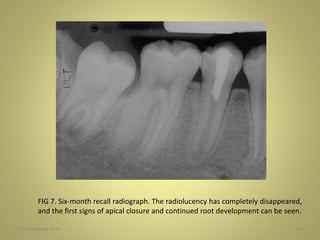
After 30 months they noted thickening of the
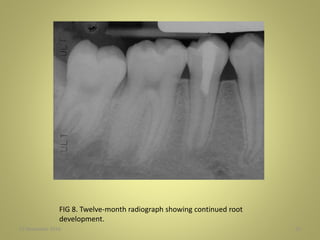
root canal walls by mineralized tissue and
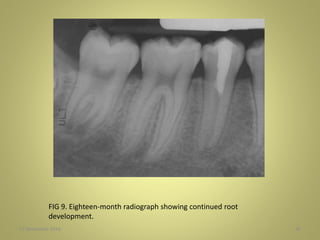
continued root development.
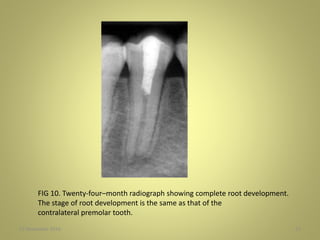
• Banchs and Trope (2004) described a
revascularization procedure for the treatment of
a necrotic immature mandibular second premolar
with an open apex and a large apical lesion.
527 November 2016
DEFINITION
• Trope [2008] claimed that the term revascularization was chosen
because the nature of the tissue formed posttreatment was
unpredictable, and the only certainty was the presence of a blood
supply; hence it was ‘‘revascularized.’’
• Lenzi and Trope 2012 suggested the term revitalization as being
more appropriate because it is descriptive of the nonspecific vital
tissue that forms in the root canal. Huang GT, 2008
Revascularization can be broadly defined as the restoration of
vascularity to a tissue or organ.
• Wigler R 2013 suggested that the term apexogenesis be used for
procedures designed to encourage continued apical development
in teeth with some vital tissue in the root canal, and the term
maturogenesis be used for procedures that promote continued
root development in infected immature permanent teeth, rather
than revascularization or revitalization.
627 November 2016
• Regenerative endodontic procedures are
biologically based procedures designed to
restore function to a damaged and
nonfunctioning pulp by stimulation of existing
stem and progenitor cells present in the root
canal and/or the introduction and stimulation
of new stem and dental pulp progenitor cells
into the root canal under conditions that are
favorable to their differentiation and
reestablishment of function.
727 November 2016
• The cells suspected of giving rise to new hard
tissue and root formation seen after
debridement and disinfection of the root
canal in immature teeth appear to be
surviving perivascular stem cells found in
niches located in the apical papilla. These are:
1. Stem and progenitor cells from the
periodontal ligament
2. Hertwig’s epithelial root sheath (HERS) cells
3. Mesenchymal stem cells from the bone
marrow and periodontal ligament
827 November 2016
9
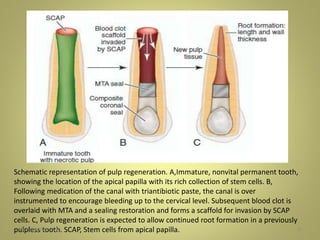
Schematic representation of pulp regeneration. A,Immature, nonvital permanent tooth,
showing the location of the apical papilla with its rich collection of stem cells. B,
Following medication of the canal with triantibiotic paste, the canal is over
instrumented to encourage bleeding up to the cervical level. Subsequent blood clot is
overlaid with MTA and a sealing restoration and forms a scaffold for invasion by SCAP
cells. C, Pulp regeneration is expected to allow continued root formation in a previously
pulpless tooth. SCAP, Stem cells from apical papilla.27 November 2016
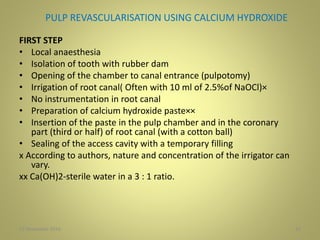
PULP REVASCULARISATION USING CALCIUM HYDROXIDE
FIRST STEP
• Local anaesthesia
• Isolation of tooth with rubber dam
• Opening of the chamber to canal entrance (pulpotomy)
• Irrigation of root canal( Often with 10 ml of 2.5%of NaOCl)×
• No instrumentation in root canal
• Preparation of calcium hydroxide paste××
• Insertion of the paste in the pulp chamber and in the coronary
part (third or half) of root canal (with a cotton ball)
• Sealing of the access cavity with a temporary filling
x According to authors, nature and concentration of the irrigator can
vary.
xx Ca(OH)2-sterile water in a 3 : 1 ratio.
1027 November 2016
PULP REVASCULARISATION USING CALCIUM HYDROXIDE
SECOND STEP
(two or three weeks later if asymptomatic tooth and/or absence of fistula)
• Local anesthesia without vasoconstrictor×××
• Isolation of the tooth with a rubber dam
• Opening the tooth to have a access to root canal
• Removal of the calcium hydroxide paste
• Copious irrigation of root canal with sodium hypochlorite
• Rinsing root canal with sterile water
• Drying root canal with paper cones
• An apical bleeding is caused by irritation of the apical region with a 15 K-file ××××
• Preparation of mineral trioxide aggregate (MTA) and its placement on the clot in
order to form a hermetic sealing
• Place a wet a cotton ball on MTA filling
• Sealing of the cavity with a temporary filling
xxx In order to not inhibit the future apical bleeding.
xxxx It takes 15 minutes to obtain a blood clot. If a root canal is not bleeding, it is
possible to transfer blood from one root canal to another. Blood level must be at
least 2-3mm below the cement-enamel junction
1127 November 2016
PULPREVASCULARIZATION USING A TRIPLE ANTIBIOTIC PASTE
(TAP).
FIRST STEP
• Local anesthesia
• Isolation of the tooth with a rubber dam
• Disinfection of the tooth with 10% povidone-iodine (iso-Betadine) before opening
it×
• Opening of the pulp chamber to canal entrance (pulpotomy)
• Irrigation of root canal×× with 20mL sodium hypochlorite (1.25%–5.25%) then with
physiological serum and finally with 2% chlorhexidine
• No instrumentation in root canal
• Drying root canal with paper cones
• Insertion of the triple antibiotic paste××× into root canal
• Place a cotton ball at the root canal entrance
• Sealing of the access cavity with a temporary filling
x According to the authors, disinfection is done or not.
xx According to the authors, irrigation may vary.
xxx Mixture of equal proportion of three antibiotics: metronidazole, ciprofloxacin, and minocycline bonded with
propylene glycol. Minocycline may be replaced by cefaclor to avoid inducing coloration.
1227 November 2016
SECOND STEP
(two or three weeks later if asymptomatic tooth and/or absence of fistula)
• Local anesthesia without vasoconstrictor×
• Isolation of the tooth with a rubber dam
• Disinfection of the tooth with 10% povidone-iodine (iso-Betadine) before
opening it××
• Opening the tooth to have a access to root canal
• Removal of the triple antibiotic paste using irrigation with sodium hypochlorite
(1.25%–5.25%) then with physiological serum and finally with 2%
chlorhexidine×××
• An apical bleeding is caused. Blood level must be at the cement-enamel
junction.
• Preparation of mineral trioxide aggregate (MTA) and its placement on the
clot×××× in order to form a hermetic sealing
• Place a wet a cotton ball on MTA filling
• Sealing of the cavity with a temporary filling
x In order to not inhibit the future apical bleeding.
xx According to the authors, disinfection is done or not.
xxx Irrigation is done in order to make space for the future bloodclot.
xxxx It takes 15 minutes to obtain a blood clot.
1327 November 2016
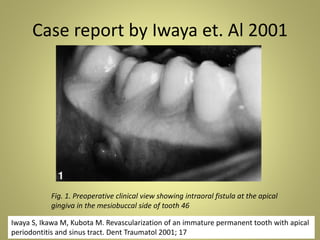
Case report by Iwaya et. Al 2001
27 November 2016 14
Fig. 1. Preoperative clinical view showing intraoral fistula at the apical
gingiva in the mesiobuccal side of tooth 46
Iwaya S, Ikawa M, Kubota M. Revascularization of an immature permanent tooth with apical
periodontitis and sinus tract. Dent Traumatol 2001; 17
27 November 2016 15
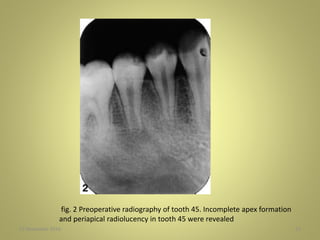
fig. 2 Preoperative radiography of tooth 45. Incomplete apex formation
and periapical radiolucency in tooth 45 were revealed
27 November 2016 16
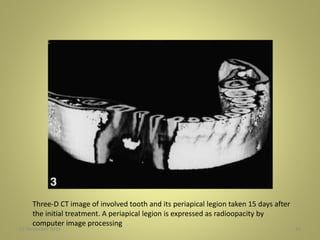
Three-D CT image of involved tooth and its periapical legion taken 15 days after
the initial treatment. A periapical legion is expressed as radioopacity by
computer image processing
27 November 2016 17
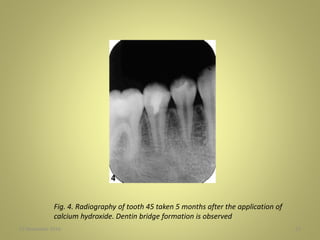
Fig. 4. Radiography of tooth 45 taken 5 months after the application of
calcium hydroxide. Dentin bridge formation is observed
27 November 2016 18
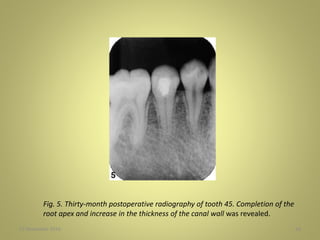
Fig. 5. Thirty-month postoperative radiography of tooth 45. Completion of the
root apex and increase in the thickness of the canal wall was revealed.
INSTRUMENTATION.
• Two types of cells are required to achieve a normal root
development: odontoblasts and epithelial cells of
Hertwig’s sheath. These two cell types are present in
abundance in the apical area of immature teeth and are
able to resist inflammation phenomena [N. Shah et al.
2008, A. Nosrat et al 2011].
• These cells will be able to differentiate into secondary
odontoblasts that will generate dentin on root canal
walls and thus allow root maturation.
• No instrumentation procedure remains consistent with
vital stem cells preservation and avoids weakening of
already thin root canal walls. Thus, elements
mentioned so far in favor of no instrumentation
protocol seem to be more advised.
1927 November 2016
IRRIGATION
• Irrigators play a role of primary disinfection Pulp infection can usually
spread to the apical region and create a canal acidic environment.
This one is not conducive to the creation of tissue regeneration.
• Bacterial invasion of root canal system causes the formation of
bacterial biofilms. Bacteria existing in depth and within the biofilm
are in lag phase and therefore refractory to action of antibiotics and
irrigators. To ensure optimal root canal disinfection for tissue
regeneration, it is necessary to disrupt or eliminate biofilms.
• Biofilms can be removed by using a tool such as fine “interdental
brush”. Disadvantage of this kind of tool is the potential risk of leaving
nonbiocompatible residues (hairbrush) into root canal.
• Activating the irrigation solution within the root canal system is the
only possibility to realize disintegration of the bacterial biofilm in
noninstrumented areas. It justifies the use of endosonics means. They
generate a process of cavitation that induces a temperature increase
of the irrigator and currents propelling the irrigator in all crevices. 2027 November 2016
Hydrogen Peroxide.
• Solvent properties of hydrogen peroxide are
almost nonexistent, but it has an interesting
hemostatic action.
• Hydrogen peroxide is antiseptic by release of
oxygen radical.
• Its action is too short and quickly neutralized
by organic debris. Moreover, it requires a rinse
to reduce pain and possible postoperative
gaseous emphysema.
2127 November 2016
Chlorhexidine
• Chlorhexidine 2% gel was proposed as a
temporary medication.
• It has good action on candida and gram+ bacteria
by the carryover effect.
• Its positively charged molecules confer the
property of being absorbed by the dentin walls
and thus allow release of chlorhexidine for at
least two to twelve weeks, preventing reinfection
of the root canal during this period.
• Despite this advantage, chlorhexidine does not
have an effective dissolving action.
2227 November 2016
Sodium Hypochlorite.
• It has a solvent action on necrotic tissue and an antiseptic
effect widely demonstrated. However, it must be
supplemented by a desalting.
• Recommended concentrations vary between 0.5% and
5.25%. Cytotoxicity of sodium hypochlorite is proportional
to its concentration.
• The concentration of 2.5% seems to be the best
compromise between efficiency and lack of toxicity [M.
Zehnder, 2006].
• Cunningham (1980) showed that elevation of the
temperature at 37°C of the 2.5% sodium hypochlorite
solution potentiates its solvent power and its efficiency
becomes comparable to that of the solution to 5,25% .
2327 November 2016
NaOCl
• Trevino et al (2008) found that the survival rate of human stem
cells of the apical papilla (SCAP) exposed to 6% NaOCl, followed
by 17% EDTA, 6% NaOCl again, was 74%.
• When irrigating with NaOCl, the needle should be introduced
into the root canal to a point 2 mm short of the apical foramen
and the NaOCl is slowly expressed from the syringe to prevent its
introduction into the periapical tissues.
• Restricting the needle to a position 2 mm short of the apex is
based on the finding that when a syringe plunger is slowly
compressed, the solution only extends 1 mm beyond the tip of
the needle. Accidents remain and then an inherent risk during
root canal irrigation and to minimize their occurrence, negative
pressure irrigation can be used, as advised by da Silva et al (2010).
Furthermore, they considered negative pressure irrigation as a
promising disinfection protocol and suggested that intracanal
medication might not be necessary. 2427 November 2016
Iodine
• Iodine is bactericide, antifungal, antiviral,
sporicidal, and sedative.
• Purulent secretions and blood do not
inactivate it.
• Its disadvantage is that it colors dental tissues
in brown.
2527 November 2016
Ethylene Diamine Tetraacetic Acid
(EDTA)
• Chelators are weak acids, which react with the mineral
portion of dentinal walls. They replace calcium ions with
sodium ions, which combine with the dentin to give soluble
salts.
• EDTA-type chelating allows better wettability of the irrigator
and a removal of the smear layer.
• 17% of EDTA is often used in cases of bacterial infection to
remove the smear layer and allow access to the entrance of
dentin tubules (allowing a better chance of joining tissue of
regeneration) and induce a better penetration of the irrigator
(increases wettability of the irrigator) and of root canal
medications [B.O. Aktener andU. Bilkay, 1993]
2627 November 2016
EDTA
• EDTA is also a “sealer” that maximizes bacteriostatic and
bactericidal effects of different agents. Its chelating effect
would allow the release of growth factors imprisoned in the
dentin during dentinogenesis. That would stimulate the
proliferation of stem cells .
• Ring et al. have compared effects of chlorhexidine and
hypochlorite after treatment with EDTA . They show that there
is no survival stem cell after using a combination of EDTA and
2% chlorhexidine. Moreover, precipitates chlorhexidine salts
are formed and maintained in root canal.
• These precipitates can be toxic and prevent cell adhesion to the
canal wall. The combination of EDTA and 6% of hypochlorite
seems to moderately reduce vitality of stem cells. It is also
recommended to rinse with saline after irrigating in order to
minimize the risk of possible precipitates and to remove
residual debris and remain of irrigant.
2727 November 2016
DISINFECTION
CALCIUM HYDROXIDE
• Calcium hydroxide, Ca(OH), is a strong base (pH = 12.5–12.8); its
ionic dissociation in Ca2+ and OH− induced genesis of hard tissue
(apexification, tertiary dentin) and has an antibacterial effect by
the release of ion OH− . These ions OH− damage the cytoplasmic
membrane, suppress the bacterial enzyme activity, denature
proteins, damage DNA and thus inhibit any replication, and
inactivate endotoxins.
• Ca(OH) increase the expression of some kind of kinases
(extracellular signals by phosphorylation) , which are indicators
of proliferation of stem cells from pulp and ligament. Therefore,
used in usual concentrations, it would not be cytotoxic for stem
cells and would support their proliferation. However, tricalcium
silicates cements, such as MTA, Ca(OH)2, or Biodentine, have a
weakening effect on dentin because of their pH.
2827 November 2016
CaOH
• Calcium hydroxide used at a concentration of
0.01 mg/mL for canal disinfection allows survival
of 100% of the apical stem cells.
• Even at higher concentration, 1mg/mL,
Ca(OH)would also give a maximal survival of stem
cells. At the same concentration, antibiotics paste
only allows between 33% and 56%cells survival.
Used in normal concentrations, antibiotics paste
is more toxic than Ca(OH), unless if they are used
in appropriate concentrations (lower
concentrations) [N. B. Ruparel et al 2012].
2927 November 2016
Triple Antibiotic Paste (TAP)
• No antibiotics have a spectrum large enough to be
active against all types of bacteria present in root
canals and apical regions; a combination of antibiotics
is essential to cover a maximum range of action.
• Antibiotics pastes must be used in proper
concentration for a balance between a lower
cytotoxicity against stem cells (cytotoxicity increases
with dose) and a maximum bacterial disinfection. An in
vitro study has shown that a TAP concentration of 39𝜇
g/mL would be best for application in disinfection root
canal [S.Chuensombat, 2013].
3027 November 2016
TAP
• Hoshino and Takushige in 1998 showed that mixture paste of three
antibiotics with propylene glycol put into root canal with a Lentulo
and at a concentration of 20 𝜇g/mL decreases by more than 99%;
the average number of bacterial colonies is present.
• Hoshino et al.1996 shows that each antibiotic used alone is
ineffective against bacteria present in pulp, dentine, and apical
lesions, while the trio of antibiotics allows complete sterilization of
germs.
• Sato et al. in 1996 developed triple antibiotic paste. Expected to
cover at best different root canal bacteria, the three antibiotics
consisting of the paste are minocycline 100 mg (spectrum of gram+
and gram−), ciprofloxacin 200 mg (spectrum of gram+ and gram−),
and metronidazole 500mg(spectrum of anaerobic bacteria and
protozoa) . Most of the revitalization regeneration procedures use a
triple antibiotic paste, called Hoshino’s paste The triple antibiotic
paste is placed in contact with the necrotic pulp inside the root canal
for up to 1 month prior to the revascularization procedure.
31
Sato I, Ando-Kurihara N, Kota K, Iwaku M, Hoshino E. Sterilization of infected root-canal
dentine by topical application of a mixture of ciprofloxacin, metronidazole and minocycline in
situ. Int Endod J 1996;29:118–24.
27 November 2016
TAP
Ph :
• Acidic pH of minocycline is not favorable for cultivation of stem
cells; it would probably facilitate cell permeability of the antibiotic,
which would keep long-term cytotoxicity.
• Ciprofloxacin has also an acidic ph.
• Metronidazole is the only antibiotic of the mixture to have a neutral
pH and thus it has no cytotoxicity for needed stem cells.
• Metronidazole and ciprofloxacin could induce the formation of
fibroblasts .
• According to Bose et al.,[2009] the use of triple antibiotic paste
shows the highest percentage increase in thickness of the dentinal
canal walls compared to the two other intracanal medications
(calcium dihydroxide and formocresol)
• According to Adl et al., antibiotics have a better action against
Enterococcus faecalis than calcium dihydroxide.
3227 November 2016
Limitations of TAP
1. Bacterial resistance. Recent reports have shown that this is already
developing in bacteria recovered from endodontic infections [sedgley CM,
lee EH. Et al. 2008].
2. A risk of precipitating an allergic reaction in a sensitive patient or inducing
sensitivity in a patient who has never been sensitive. These concerns
highlight the need for a full and comprehensive medical and dental
history of the patient before treatment, regardless of the method of
administering the antibiotic during the course of treatment.
3. Tooth discoloration due to tetracycline.
• Tetracycline would have ability to inhibit collagenase and
metalloproteinases; it is not cytotoxic and is capable of increasing the level
of interleukin-10 (anti-inflammatory cytokine). Minocycline is a
semisynthetic tetracycline derivative with a similar action spectrum. It may
be replaced by cefaclor in order to avoid any risk of unaesthetic coronary
coloring because minocycline binds to ions Ca++ by chelation and form
insoluble complexes. However, cefaclor appears to be less effective against
enterococci. An alternative could be to previously seal the dentinal tubules
of the pulp chamber (etching and bonding). 3327 November 2016
TAP
• Indeed, the triple antibiotic powder (metronidazole,
ciprofloxacin, and minocycline) combined with a saline
solution shows the lowest minimum inhibitory
concentration (MIC) against Enterococcus faecalis (MIC =
77.5 𝜇g/mL).
• The second place is for a combination of triple antibiotic
paste and 2% chlorhexidine with similar results than a
combination of minocycline and saline (MIC = 325mg/mL).
• The least effective group is combination of calcium
dihydroxide and chlorhexidine (MIC = 195 000𝜇g/mL).
• Calcium dihydroxide combined with saline is absolutely not
effective against Enterococcus faecalis. Triple antibiotic
paste is very effective against bacteria often present in
apical lesion and minocycline seems to be its most active
component.
3427 November 2016
PULP-CAPPING MATERIALS (MTA AND
BIODENTINE).
• After disinfection step, a suitable scaffold to encourage
generation of new tissue must fill the root canal. At the same
time, coronary access must be sealed to prevent further
reinfection . Induction of the root canal bleeding is done to
bring in situ fibrin, platelets, and growth factor.
• All these elements are indispensable to formation of tissue
regeneration. It would also create a matrix from which the
growth of new vital tissue is possible into root canal space.
• Previously prepared platelet rich fibrin (PRF) can be included
in root canal during bleeding. This would contribute to bring
more growth factors and to create a biological tissue
scaffold, which promotes tissue growth (reduction of waiting
time in comparison with time required for the formation of
coagulum).
3527 November 2016
PULP-CAPPING MATERIALS (MTA AND
BIODENTINE)
• In vitro studies have demonstrated that calcium
dihydroxide and MTA, with their high pH, exert a severe
weakening effect on dentin walls during a period of two
weeks to two months [A. P. Leiendecker, Y.-P. Qi, A. N.
Sawyer et al.2012] However, samples sealed with MTA
seem to recover their mechanical properties as fracture
toughness after one year. It is not the case with
calciumdihydroxide [S. Hatibovi´c-Kofman, et al 2008].
• Biodentine has the same mechanical characteristics as
human dentin. Moreover, upon application of this material
in a cavity, it seems to fully expand and fill the space by its
plasticity.
• Another advantage is absence of coloring the cervical area
unlike MTA, excepted using white MTA.
3627 November 2016
THE TISSUE REGENERATION
• Claus et al. [2004] and Ritter et al. [2004] described histological
tissue regeneration in animals. They described the existence of a
significant neovascularization and the presence of connective cells.
• Through studies on animal cuts, the apposition material-inducing
thickening of root walls may be of different nature dentin,
cementum, or even bone [X. Wang et al. 2010].
• Therefore, this procedure is not a process of pulp revascularization
but a process of tissue regeneration.
• The inability to obtain sections of human teeth after
revascularization is a handicap for understanding and validating
this process. Only radiographic assessments of in vivo clinical
studies and the use of a laser quantifying blood flow (laser Doppler
flowmetry) can give us an idea of treatment success. [H. Strobl et
al. 2003]. Testing vitality with cold also seems to be a good
indicator of success. 3727 November 2016
THE TISSUE REGENERATION
• Emi Shimizu et al. 2012 has done histological evaluation of
immature permanent tooth #9 after 3.5 wks of
revascularization procedure and found that more than one
half of the canal was filled with loose connective tissue
similar to the pulp tissue.
• A layer of flattened odontoblast-like cells lined along the
predentin. Layers of epithelial-like cells, similar to the
Hertwig’s epithelial root sheath, surrounded the root apex.
• No hard tissue was formed in the canal.
• Emi Shimizu, George Jong, Nicola Partridge, Paul A. Rosenberg, and Louis
M. Lin, Histologic observation of a human immature permanent tooth
with irreversible pulpitis after revascularization/regeneration procedure(J
Endod 2012;38:1293–1297)
27 November 2016 38
• Bacerra P et al. 2014 done a histological examination of a
revascularized mandibular premolar which was presented with
chronic periapical abscess, after 2 yr successful follow up which was
extracted for orthodontic reasons.
• They found that the large canal space of revascularized/revitalized
tooth was not empty and filled with fibrous connective tissue. The
apical closure was caused by cementum deposition without dentin.
Some cementum-like tissue was formed on the canal dentin walls.
Inflammatory cells were observed in the coronal and middle third
of revascularized/revitalized tissue.
• They conclude that the tissue formed in the canal of a human
revascularized/revitalized tooth was soft connective tissue similar
to that in the periodontal ligament and cementum-like or bonelike
hard tissue, which is comparable with the histology observed in the
canals of teeth from animal models of
revascularization/revitalization
27 November 2016 39
Bacerra P et al Histologic Study of a Human Immature Permanent Premolar with
Chronic Apical Abscess after Revascularization/ Revitalization(J Endod 2014;40:133–
139)
FOLLOW-UP AND TREATMENT
OUTCOME• No standard follow-up protocol exists for revascularization procedures. Different
clinicians have advised different follow-up periods in their case reports, with
some lasting as long as 5 years post treatment. In the majority of the cases,
improvement or resolution of the apical lesion can be expected in approximately
6 months and root elongation and apical closure, with thickening of the root
canal walls, within 12–24 months postoperatively (Neha K, Kansal R, Garg P, et al.
2011, Banchs F, Trope M. 2004;. Iwaya SI, Ikawa M, Kubota M 2001).
• Most clinicians suggest that during the first year, 3-month recalls should be
scheduled, followed by 6-month recalls unless clinical symptoms develop. In the
last decade, many successful maturation case reports and case series have been
published; most were performed on incisors and premolars of children 8–14 years
of age (Neha K, Kansal R, Garg P, et al. 2011, Banchs F, Trope M. 2004;. Iwaya SI,
Ikawa M, Kubota M 2001Chen MY, Chen KL, Chen CA, et al. 2012 , Huang GT.
2008; Shah N, Logani A, Bhaskar U, Aggarwal V. 2008).
• Successful revascularization case reports in older ages have also been published
(Shah N et al. 2008, Aggarwal V et al.2012).
4027 November 2016
UNFAVOURABLE OUTCOMES
• Lenzi and Trope 2012 found empty root canal space after
treatment of an immature maxillary central incisor with a necrotic
pulp.
• Nosrat et al. 20 12 showed the absence of vital tissue inside the
root canal space of treated immature maxillary incisors with
necrotic pulps after 6 years.
• Nosrat et al. 2013 presented a case where root maturation
occurred in a maxillary central incisor, even though a regenerative
endodontic procedure resulted in an empty root canal space.
• Even after using tissue engineering strategies, cementum-like hard
tissue was deposited on root canal walls, and bony islands were
found throughout the root canals.[Yamauchi N et al . 2011]
• Formation of a hard-tissue barrier inside the canals between the
coronal MTA plug and the root apex[ Chen MY et al. 2011] is
another reported unfavorable outcome.27 November 2016 41
TREATMENT OUTCOME
• There is no universal protocol described in the literature, but most
depend on the same principles:
(1) chemical disinfection of the canal without instrumentation,
(2) production of a suitable environment for a scaffold to support
tissue ingrowth; and
(3) a tight bacterial seal of the access opening to prevent the ingress of
bacteria.
• Long-term studies are warranted to assess subsequent outcomes
such as the redevelopment of apical periodontitis and the incidence
of pulp canal obliteration . Unless accompanied by signs and/or
symptoms of infection, it is advisable that no further treatment
beyond maturation be undertaken because most of these cases will
remain functional and disease free for many years.
4227 November 2016
CONCLUSION
• Before opening the tooth, it seems effective to isolate the tooth
with a rubber dam and disinfect it with 10% povidone iodine
(iso-Betadine) to maximal reduce of oral bacterial concentration.
• After opening of the pulp chamber, no root canal
instrumentation is still recommended to avoid altering dentinal
walls and stem cells present on their surfaces. However, the use
of a breast nerve may be useful to remove majority of the
infected and necrotic pulp without damaging the root walls of
immature teeth.
• Primary irrigation with EDTA combined with 6% sodium
hypochlorite seems to be the best solution as EDTA (little
cytotoxic and opening dentin tubules) allows better penetration
of the irrigants (and medications) in root canal crevices and
tubules. 4327 November 2016
Conclusion
• A release of growth factors imprisoned during dentinogenesis could
be expected. Sodium hypochlorite remains irrigator base for root
canal disinfection. If using a 2.5% sodium hypochlorite
concentration, its effectiveness and its solvent power may be
potentiated by warming at 37∘C.
• It also seems that rinsing with saline could only bring a benefit to
treatment.
• Regarding root canal temporary medication, triple antibiotic paste
used has good concentration that seems to be the most
appropriate in order to avoid any problems associated with calcium
dihydroxide (weakening dentinal walls, inducing tissue necrosis, and
decreasing effectiveness by infectious exudates).
• the three antibiotics cover at best action spectra of root canal
bacteria and show minimum stem cells cytotoxicity when used in
adequate concentration (0.39𝜇g/mL).
4427 November 2016
Conclusion
• During the second step of the procedure, the addition of
PRF in root canal may be beneficial. PRF provides an
additional supply of blood components, such as growth
factors and a more solid support (scaffold) allowing growth
of the generated tissue.
• Biodentine would be proposed for root canal capping
because it appears to have the necessary assets for this
procedure (same mechanical properties as human dentine
expand to entirely fill space by its plasticity that would
increase crown-root tightness, absence of cervical area
coloration, and very low cytotoxicity).
• For the final hermetic filling, the choice of material does
not greatly matter but it should be as airtight as possible
and sustainable.
4527 November 2016
4627 November 2016
CASE REPORTS
• Banch F , Trope M reported a case of 11 yr old child who had a
lingual swelling of the right mandibular area 1 month previously
with reported slight discomfort.
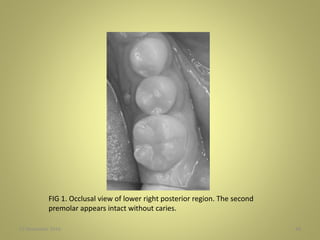
• On clinical examination, the patient was asymptomatic, and the
tooth appeared intact, without caries (Fig. 1). The presence of
occlusal tubercles on the other mandibular premolars suggested
that one may have been present on this tooth, which was fractured
during function, resulting in a microexposure and necrosis of the
pulp.
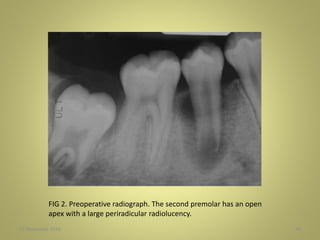
• The tooth had an open apex 4mm associated with a large
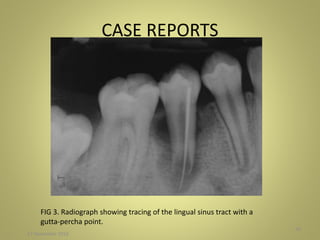
radiolucency (Fig. 2), and a lingual sinus tract was present that
traced to the apex of the tooth (Fig. 3).
• Periodontal probings were within normal limits for all teeth in the
lower right region. Diagnostic testing was inconclusive on cold and
electric pulp testing, with sensitivity on percussion and palpation.
27 November 2016 47
Banch F , Trope M Revascularization of immature permanent teeth with apical
periodontitis: new treatment protocol? JOE Vol30, No. 4, April 2004
27 November 2016 48
FIG 1. Occlusal view of lower right posterior region. The second
premolar appears intact without caries.
27 November 2016 49
FIG 2. Preoperative radiograph. The second premolar has an open
apex with a large periradicular radiolucency.
CASE REPORTS
27 November 2016
50
FIG 3. Radiograph showing tracing of the lingual sinus tract with a
gutta-percha point.
27 November 2016 51
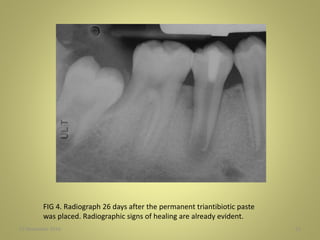
FIG 4. Radiograph 26 days after the permanent triantibiotic paste
was placed. Radiographic signs of healing are already evident.
27 November 2016 52
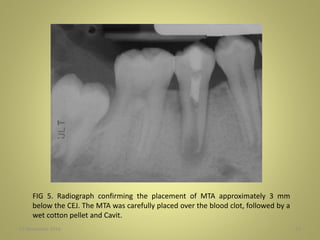
FIG 5. Radiograph confirming the placement of MTA approximately 3 mm
below the CEJ. The MTA was carefully placed over the blood clot, followed by a
wet cotton pellet and Cavit.
27 November 2016 53
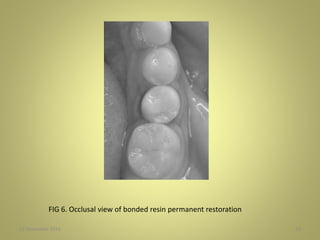
FIG 6. Occlusal view of bonded resin permanent restoration
27 November 2016 54
FIG 7. Six-month recall radiograph. The radiolucency has completely disappeared,
and the first signs of apical closure and continued root development can be seen.
27 November 2016 55
FIG 8. Twelve-month radiograph showing continued root
development.
27 November 2016 56
FIG 9. Eighteen-month radiograph showing continued root
development.
27 November 2016 57
FIG 10. Twenty-four–month radiograph showing complete root development.
The stage of root development is the same as that of the
contralateral premolar tooth.
CASE REPORT
27 November 2016 58
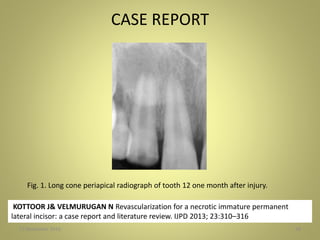
KOTTOOR J& VELMURUGAN N Revascularization for a necrotic immature permanent
lateral incisor: a case report and literature review. IJPD 2013; 23:310–316
Fig. 1. Long cone periapical radiograph of tooth 12 one month after injury.
27 November 2016 59
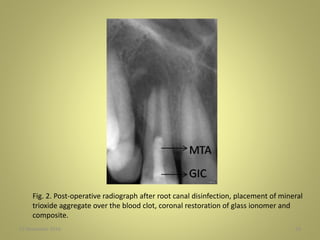
Fig. 2. Post-operative radiograph after root canal disinfection, placement of mineral
trioxide aggregate over the blood clot, coronal restoration of glass ionomer and
composite.
27 November 2016 60
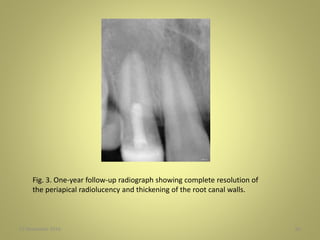
Fig. 3. One-year follow-up radiograph showing complete resolution of
the periapical radiolucency and thickening of the root canal walls.
27 November 2016 61
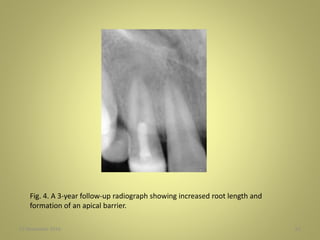
Fig. 4. A 3-year follow-up radiograph showing increased root length and
formation of an apical barrier.
27 November 2016 62
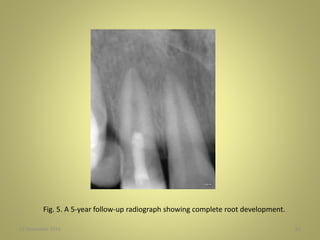
Fig. 5. A 5-year follow-up radiograph showing complete root development.

Revascularisation

  • 1.
  • 2.
    INTRODUCTION • Endodontic treatmentof immature permanent teeth with necrotic pulp, with or without apical pathosis, poses several clinical challenges. There is a risk of inducing a dentin wall fracture or extending gutta-percha into the periapical tissue during compaction of the root canal filling. • Although the use of calcium hydroxide apexification techniques or the placement of mineral trioxide aggregate as an apical stop has the potential to minimize apical extrusion of filling material, they do little in adding strength to the dentin walls. • It is a well-established fact that in reimplanted avulsed immature teeth, revascularization of the pulp followed by continued root development can occur under ideal circumstances. 227 November 2016
  • 3.
    HISTORY • Nygard Ostby, a pioneer of regenerative endodontic procedures in the early 1960s, showed that new vascularized tissue could be induced in the apical third of the root canal of endodontically treated mature teeth with necrotic pulps and apical lesions. • This was accomplished by the creation of a blood clot in the apical third of a cleaned and disinfected root canal by using an apically extended root canal file just before root canal filling. He proposed that through formation of a clot (scaffold), a vasculature could be established to support growth of new tissue into the unfilled portion of the root canal. 327 November 2016
  • 4.
    HISTORY • Revascularization withcontinued root development and continued deposition of hard tissue in the root canal has also been shown to occur over time when immature teeth were reimplanted after intentional or traumatically related avulsion (Cvek M, Cleaton-Jones P, Austin J, et al 1990,. Kling M, Cvek M, Mejare I 1986). • Skoglund and Tronstad (1981) investigated changes that occurred in the root canal of replanted and autotransplanted immature teeth in dogs and reported that during the first 6 months there was an ingrowth of vascularized, cell-rich connective tissue throughout the entire root canal. • After 6 months most teeth displayed a marked reduction in the number of cells and blood vessels and a newly formed atubular hard tissue. In some teeth, a pulp with a functioning odontoblastic layer was present. 427 November 2016
  • 5.
    • In 2001,Iwaya et al described a procedure, which they termed revascularization, that was undertaken on a necrotic immature mandibular second premolar with a chronic apical abscess. After 30 months they noted thickening of the root canal walls by mineralized tissue and continued root development. • Banchs and Trope (2004) described a revascularization procedure for the treatment of a necrotic immature mandibular second premolar with an open apex and a large apical lesion. 527 November 2016
  • 6.
    DEFINITION • Trope [2008]claimed that the term revascularization was chosen because the nature of the tissue formed posttreatment was unpredictable, and the only certainty was the presence of a blood supply; hence it was ‘‘revascularized.’’ • Lenzi and Trope 2012 suggested the term revitalization as being more appropriate because it is descriptive of the nonspecific vital tissue that forms in the root canal. Huang GT, 2008 Revascularization can be broadly defined as the restoration of vascularity to a tissue or organ. • Wigler R 2013 suggested that the term apexogenesis be used for procedures designed to encourage continued apical development in teeth with some vital tissue in the root canal, and the term maturogenesis be used for procedures that promote continued root development in infected immature permanent teeth, rather than revascularization or revitalization. 627 November 2016
  • 7.
    • Regenerative endodonticprocedures are biologically based procedures designed to restore function to a damaged and nonfunctioning pulp by stimulation of existing stem and progenitor cells present in the root canal and/or the introduction and stimulation of new stem and dental pulp progenitor cells into the root canal under conditions that are favorable to their differentiation and reestablishment of function. 727 November 2016
  • 8.
    • The cellssuspected of giving rise to new hard tissue and root formation seen after debridement and disinfection of the root canal in immature teeth appear to be surviving perivascular stem cells found in niches located in the apical papilla. These are: 1. Stem and progenitor cells from the periodontal ligament 2. Hertwig’s epithelial root sheath (HERS) cells 3. Mesenchymal stem cells from the bone marrow and periodontal ligament 827 November 2016
  • 9.
    9 Schematic representation ofpulp regeneration. A,Immature, nonvital permanent tooth, showing the location of the apical papilla with its rich collection of stem cells. B, Following medication of the canal with triantibiotic paste, the canal is over instrumented to encourage bleeding up to the cervical level. Subsequent blood clot is overlaid with MTA and a sealing restoration and forms a scaffold for invasion by SCAP cells. C, Pulp regeneration is expected to allow continued root formation in a previously pulpless tooth. SCAP, Stem cells from apical papilla.27 November 2016
  • 10.
    PULP REVASCULARISATION USINGCALCIUM HYDROXIDE FIRST STEP • Local anaesthesia • Isolation of tooth with rubber dam • Opening of the chamber to canal entrance (pulpotomy) • Irrigation of root canal( Often with 10 ml of 2.5%of NaOCl)× • No instrumentation in root canal • Preparation of calcium hydroxide paste×× • Insertion of the paste in the pulp chamber and in the coronary part (third or half) of root canal (with a cotton ball) • Sealing of the access cavity with a temporary filling x According to authors, nature and concentration of the irrigator can vary. xx Ca(OH)2-sterile water in a 3 : 1 ratio. 1027 November 2016
  • 11.
    PULP REVASCULARISATION USINGCALCIUM HYDROXIDE SECOND STEP (two or three weeks later if asymptomatic tooth and/or absence of fistula) • Local anesthesia without vasoconstrictor××× • Isolation of the tooth with a rubber dam • Opening the tooth to have a access to root canal • Removal of the calcium hydroxide paste • Copious irrigation of root canal with sodium hypochlorite • Rinsing root canal with sterile water • Drying root canal with paper cones • An apical bleeding is caused by irritation of the apical region with a 15 K-file ×××× • Preparation of mineral trioxide aggregate (MTA) and its placement on the clot in order to form a hermetic sealing • Place a wet a cotton ball on MTA filling • Sealing of the cavity with a temporary filling xxx In order to not inhibit the future apical bleeding. xxxx It takes 15 minutes to obtain a blood clot. If a root canal is not bleeding, it is possible to transfer blood from one root canal to another. Blood level must be at least 2-3mm below the cement-enamel junction 1127 November 2016
  • 12.
    PULPREVASCULARIZATION USING ATRIPLE ANTIBIOTIC PASTE (TAP). FIRST STEP • Local anesthesia • Isolation of the tooth with a rubber dam • Disinfection of the tooth with 10% povidone-iodine (iso-Betadine) before opening it× • Opening of the pulp chamber to canal entrance (pulpotomy) • Irrigation of root canal×× with 20mL sodium hypochlorite (1.25%–5.25%) then with physiological serum and finally with 2% chlorhexidine • No instrumentation in root canal • Drying root canal with paper cones • Insertion of the triple antibiotic paste××× into root canal • Place a cotton ball at the root canal entrance • Sealing of the access cavity with a temporary filling x According to the authors, disinfection is done or not. xx According to the authors, irrigation may vary. xxx Mixture of equal proportion of three antibiotics: metronidazole, ciprofloxacin, and minocycline bonded with propylene glycol. Minocycline may be replaced by cefaclor to avoid inducing coloration. 1227 November 2016
  • 13.
    SECOND STEP (two orthree weeks later if asymptomatic tooth and/or absence of fistula) • Local anesthesia without vasoconstrictor× • Isolation of the tooth with a rubber dam • Disinfection of the tooth with 10% povidone-iodine (iso-Betadine) before opening it×× • Opening the tooth to have a access to root canal • Removal of the triple antibiotic paste using irrigation with sodium hypochlorite (1.25%–5.25%) then with physiological serum and finally with 2% chlorhexidine××× • An apical bleeding is caused. Blood level must be at the cement-enamel junction. • Preparation of mineral trioxide aggregate (MTA) and its placement on the clot×××× in order to form a hermetic sealing • Place a wet a cotton ball on MTA filling • Sealing of the cavity with a temporary filling x In order to not inhibit the future apical bleeding. xx According to the authors, disinfection is done or not. xxx Irrigation is done in order to make space for the future bloodclot. xxxx It takes 15 minutes to obtain a blood clot. 1327 November 2016
  • 14.
    Case report byIwaya et. Al 2001 27 November 2016 14 Fig. 1. Preoperative clinical view showing intraoral fistula at the apical gingiva in the mesiobuccal side of tooth 46 Iwaya S, Ikawa M, Kubota M. Revascularization of an immature permanent tooth with apical periodontitis and sinus tract. Dent Traumatol 2001; 17
  • 15.
    27 November 201615 fig. 2 Preoperative radiography of tooth 45. Incomplete apex formation and periapical radiolucency in tooth 45 were revealed
  • 16.
    27 November 201616 Three-D CT image of involved tooth and its periapical legion taken 15 days after the initial treatment. A periapical legion is expressed as radioopacity by computer image processing
  • 17.
    27 November 201617 Fig. 4. Radiography of tooth 45 taken 5 months after the application of calcium hydroxide. Dentin bridge formation is observed
  • 18.
    27 November 201618 Fig. 5. Thirty-month postoperative radiography of tooth 45. Completion of the root apex and increase in the thickness of the canal wall was revealed.
  • 19.
    INSTRUMENTATION. • Two typesof cells are required to achieve a normal root development: odontoblasts and epithelial cells of Hertwig’s sheath. These two cell types are present in abundance in the apical area of immature teeth and are able to resist inflammation phenomena [N. Shah et al. 2008, A. Nosrat et al 2011]. • These cells will be able to differentiate into secondary odontoblasts that will generate dentin on root canal walls and thus allow root maturation. • No instrumentation procedure remains consistent with vital stem cells preservation and avoids weakening of already thin root canal walls. Thus, elements mentioned so far in favor of no instrumentation protocol seem to be more advised. 1927 November 2016
  • 20.
    IRRIGATION • Irrigators playa role of primary disinfection Pulp infection can usually spread to the apical region and create a canal acidic environment. This one is not conducive to the creation of tissue regeneration. • Bacterial invasion of root canal system causes the formation of bacterial biofilms. Bacteria existing in depth and within the biofilm are in lag phase and therefore refractory to action of antibiotics and irrigators. To ensure optimal root canal disinfection for tissue regeneration, it is necessary to disrupt or eliminate biofilms. • Biofilms can be removed by using a tool such as fine “interdental brush”. Disadvantage of this kind of tool is the potential risk of leaving nonbiocompatible residues (hairbrush) into root canal. • Activating the irrigation solution within the root canal system is the only possibility to realize disintegration of the bacterial biofilm in noninstrumented areas. It justifies the use of endosonics means. They generate a process of cavitation that induces a temperature increase of the irrigator and currents propelling the irrigator in all crevices. 2027 November 2016
  • 21.
    Hydrogen Peroxide. • Solventproperties of hydrogen peroxide are almost nonexistent, but it has an interesting hemostatic action. • Hydrogen peroxide is antiseptic by release of oxygen radical. • Its action is too short and quickly neutralized by organic debris. Moreover, it requires a rinse to reduce pain and possible postoperative gaseous emphysema. 2127 November 2016
  • 22.
    Chlorhexidine • Chlorhexidine 2%gel was proposed as a temporary medication. • It has good action on candida and gram+ bacteria by the carryover effect. • Its positively charged molecules confer the property of being absorbed by the dentin walls and thus allow release of chlorhexidine for at least two to twelve weeks, preventing reinfection of the root canal during this period. • Despite this advantage, chlorhexidine does not have an effective dissolving action. 2227 November 2016
  • 23.
    Sodium Hypochlorite. • Ithas a solvent action on necrotic tissue and an antiseptic effect widely demonstrated. However, it must be supplemented by a desalting. • Recommended concentrations vary between 0.5% and 5.25%. Cytotoxicity of sodium hypochlorite is proportional to its concentration. • The concentration of 2.5% seems to be the best compromise between efficiency and lack of toxicity [M. Zehnder, 2006]. • Cunningham (1980) showed that elevation of the temperature at 37°C of the 2.5% sodium hypochlorite solution potentiates its solvent power and its efficiency becomes comparable to that of the solution to 5,25% . 2327 November 2016
  • 24.
    NaOCl • Trevino etal (2008) found that the survival rate of human stem cells of the apical papilla (SCAP) exposed to 6% NaOCl, followed by 17% EDTA, 6% NaOCl again, was 74%. • When irrigating with NaOCl, the needle should be introduced into the root canal to a point 2 mm short of the apical foramen and the NaOCl is slowly expressed from the syringe to prevent its introduction into the periapical tissues. • Restricting the needle to a position 2 mm short of the apex is based on the finding that when a syringe plunger is slowly compressed, the solution only extends 1 mm beyond the tip of the needle. Accidents remain and then an inherent risk during root canal irrigation and to minimize their occurrence, negative pressure irrigation can be used, as advised by da Silva et al (2010). Furthermore, they considered negative pressure irrigation as a promising disinfection protocol and suggested that intracanal medication might not be necessary. 2427 November 2016
  • 25.
    Iodine • Iodine isbactericide, antifungal, antiviral, sporicidal, and sedative. • Purulent secretions and blood do not inactivate it. • Its disadvantage is that it colors dental tissues in brown. 2527 November 2016
  • 26.
    Ethylene Diamine TetraaceticAcid (EDTA) • Chelators are weak acids, which react with the mineral portion of dentinal walls. They replace calcium ions with sodium ions, which combine with the dentin to give soluble salts. • EDTA-type chelating allows better wettability of the irrigator and a removal of the smear layer. • 17% of EDTA is often used in cases of bacterial infection to remove the smear layer and allow access to the entrance of dentin tubules (allowing a better chance of joining tissue of regeneration) and induce a better penetration of the irrigator (increases wettability of the irrigator) and of root canal medications [B.O. Aktener andU. Bilkay, 1993] 2627 November 2016
  • 27.
    EDTA • EDTA isalso a “sealer” that maximizes bacteriostatic and bactericidal effects of different agents. Its chelating effect would allow the release of growth factors imprisoned in the dentin during dentinogenesis. That would stimulate the proliferation of stem cells . • Ring et al. have compared effects of chlorhexidine and hypochlorite after treatment with EDTA . They show that there is no survival stem cell after using a combination of EDTA and 2% chlorhexidine. Moreover, precipitates chlorhexidine salts are formed and maintained in root canal. • These precipitates can be toxic and prevent cell adhesion to the canal wall. The combination of EDTA and 6% of hypochlorite seems to moderately reduce vitality of stem cells. It is also recommended to rinse with saline after irrigating in order to minimize the risk of possible precipitates and to remove residual debris and remain of irrigant. 2727 November 2016
  • 28.
    DISINFECTION CALCIUM HYDROXIDE • Calciumhydroxide, Ca(OH), is a strong base (pH = 12.5–12.8); its ionic dissociation in Ca2+ and OH− induced genesis of hard tissue (apexification, tertiary dentin) and has an antibacterial effect by the release of ion OH− . These ions OH− damage the cytoplasmic membrane, suppress the bacterial enzyme activity, denature proteins, damage DNA and thus inhibit any replication, and inactivate endotoxins. • Ca(OH) increase the expression of some kind of kinases (extracellular signals by phosphorylation) , which are indicators of proliferation of stem cells from pulp and ligament. Therefore, used in usual concentrations, it would not be cytotoxic for stem cells and would support their proliferation. However, tricalcium silicates cements, such as MTA, Ca(OH)2, or Biodentine, have a weakening effect on dentin because of their pH. 2827 November 2016
  • 29.
    CaOH • Calcium hydroxideused at a concentration of 0.01 mg/mL for canal disinfection allows survival of 100% of the apical stem cells. • Even at higher concentration, 1mg/mL, Ca(OH)would also give a maximal survival of stem cells. At the same concentration, antibiotics paste only allows between 33% and 56%cells survival. Used in normal concentrations, antibiotics paste is more toxic than Ca(OH), unless if they are used in appropriate concentrations (lower concentrations) [N. B. Ruparel et al 2012]. 2927 November 2016
  • 30.
    Triple Antibiotic Paste(TAP) • No antibiotics have a spectrum large enough to be active against all types of bacteria present in root canals and apical regions; a combination of antibiotics is essential to cover a maximum range of action. • Antibiotics pastes must be used in proper concentration for a balance between a lower cytotoxicity against stem cells (cytotoxicity increases with dose) and a maximum bacterial disinfection. An in vitro study has shown that a TAP concentration of 39𝜇 g/mL would be best for application in disinfection root canal [S.Chuensombat, 2013]. 3027 November 2016
  • 31.
    TAP • Hoshino andTakushige in 1998 showed that mixture paste of three antibiotics with propylene glycol put into root canal with a Lentulo and at a concentration of 20 𝜇g/mL decreases by more than 99%; the average number of bacterial colonies is present. • Hoshino et al.1996 shows that each antibiotic used alone is ineffective against bacteria present in pulp, dentine, and apical lesions, while the trio of antibiotics allows complete sterilization of germs. • Sato et al. in 1996 developed triple antibiotic paste. Expected to cover at best different root canal bacteria, the three antibiotics consisting of the paste are minocycline 100 mg (spectrum of gram+ and gram−), ciprofloxacin 200 mg (spectrum of gram+ and gram−), and metronidazole 500mg(spectrum of anaerobic bacteria and protozoa) . Most of the revitalization regeneration procedures use a triple antibiotic paste, called Hoshino’s paste The triple antibiotic paste is placed in contact with the necrotic pulp inside the root canal for up to 1 month prior to the revascularization procedure. 31 Sato I, Ando-Kurihara N, Kota K, Iwaku M, Hoshino E. Sterilization of infected root-canal dentine by topical application of a mixture of ciprofloxacin, metronidazole and minocycline in situ. Int Endod J 1996;29:118–24. 27 November 2016
  • 32.
    TAP Ph : • AcidicpH of minocycline is not favorable for cultivation of stem cells; it would probably facilitate cell permeability of the antibiotic, which would keep long-term cytotoxicity. • Ciprofloxacin has also an acidic ph. • Metronidazole is the only antibiotic of the mixture to have a neutral pH and thus it has no cytotoxicity for needed stem cells. • Metronidazole and ciprofloxacin could induce the formation of fibroblasts . • According to Bose et al.,[2009] the use of triple antibiotic paste shows the highest percentage increase in thickness of the dentinal canal walls compared to the two other intracanal medications (calcium dihydroxide and formocresol) • According to Adl et al., antibiotics have a better action against Enterococcus faecalis than calcium dihydroxide. 3227 November 2016
  • 33.
    Limitations of TAP 1.Bacterial resistance. Recent reports have shown that this is already developing in bacteria recovered from endodontic infections [sedgley CM, lee EH. Et al. 2008]. 2. A risk of precipitating an allergic reaction in a sensitive patient or inducing sensitivity in a patient who has never been sensitive. These concerns highlight the need for a full and comprehensive medical and dental history of the patient before treatment, regardless of the method of administering the antibiotic during the course of treatment. 3. Tooth discoloration due to tetracycline. • Tetracycline would have ability to inhibit collagenase and metalloproteinases; it is not cytotoxic and is capable of increasing the level of interleukin-10 (anti-inflammatory cytokine). Minocycline is a semisynthetic tetracycline derivative with a similar action spectrum. It may be replaced by cefaclor in order to avoid any risk of unaesthetic coronary coloring because minocycline binds to ions Ca++ by chelation and form insoluble complexes. However, cefaclor appears to be less effective against enterococci. An alternative could be to previously seal the dentinal tubules of the pulp chamber (etching and bonding). 3327 November 2016
  • 34.
    TAP • Indeed, thetriple antibiotic powder (metronidazole, ciprofloxacin, and minocycline) combined with a saline solution shows the lowest minimum inhibitory concentration (MIC) against Enterococcus faecalis (MIC = 77.5 𝜇g/mL). • The second place is for a combination of triple antibiotic paste and 2% chlorhexidine with similar results than a combination of minocycline and saline (MIC = 325mg/mL). • The least effective group is combination of calcium dihydroxide and chlorhexidine (MIC = 195 000𝜇g/mL). • Calcium dihydroxide combined with saline is absolutely not effective against Enterococcus faecalis. Triple antibiotic paste is very effective against bacteria often present in apical lesion and minocycline seems to be its most active component. 3427 November 2016
  • 35.
    PULP-CAPPING MATERIALS (MTAAND BIODENTINE). • After disinfection step, a suitable scaffold to encourage generation of new tissue must fill the root canal. At the same time, coronary access must be sealed to prevent further reinfection . Induction of the root canal bleeding is done to bring in situ fibrin, platelets, and growth factor. • All these elements are indispensable to formation of tissue regeneration. It would also create a matrix from which the growth of new vital tissue is possible into root canal space. • Previously prepared platelet rich fibrin (PRF) can be included in root canal during bleeding. This would contribute to bring more growth factors and to create a biological tissue scaffold, which promotes tissue growth (reduction of waiting time in comparison with time required for the formation of coagulum). 3527 November 2016
  • 36.
    PULP-CAPPING MATERIALS (MTAAND BIODENTINE) • In vitro studies have demonstrated that calcium dihydroxide and MTA, with their high pH, exert a severe weakening effect on dentin walls during a period of two weeks to two months [A. P. Leiendecker, Y.-P. Qi, A. N. Sawyer et al.2012] However, samples sealed with MTA seem to recover their mechanical properties as fracture toughness after one year. It is not the case with calciumdihydroxide [S. Hatibovi´c-Kofman, et al 2008]. • Biodentine has the same mechanical characteristics as human dentin. Moreover, upon application of this material in a cavity, it seems to fully expand and fill the space by its plasticity. • Another advantage is absence of coloring the cervical area unlike MTA, excepted using white MTA. 3627 November 2016
  • 37.
    THE TISSUE REGENERATION •Claus et al. [2004] and Ritter et al. [2004] described histological tissue regeneration in animals. They described the existence of a significant neovascularization and the presence of connective cells. • Through studies on animal cuts, the apposition material-inducing thickening of root walls may be of different nature dentin, cementum, or even bone [X. Wang et al. 2010]. • Therefore, this procedure is not a process of pulp revascularization but a process of tissue regeneration. • The inability to obtain sections of human teeth after revascularization is a handicap for understanding and validating this process. Only radiographic assessments of in vivo clinical studies and the use of a laser quantifying blood flow (laser Doppler flowmetry) can give us an idea of treatment success. [H. Strobl et al. 2003]. Testing vitality with cold also seems to be a good indicator of success. 3727 November 2016
  • 38.
    THE TISSUE REGENERATION •Emi Shimizu et al. 2012 has done histological evaluation of immature permanent tooth #9 after 3.5 wks of revascularization procedure and found that more than one half of the canal was filled with loose connective tissue similar to the pulp tissue. • A layer of flattened odontoblast-like cells lined along the predentin. Layers of epithelial-like cells, similar to the Hertwig’s epithelial root sheath, surrounded the root apex. • No hard tissue was formed in the canal. • Emi Shimizu, George Jong, Nicola Partridge, Paul A. Rosenberg, and Louis M. Lin, Histologic observation of a human immature permanent tooth with irreversible pulpitis after revascularization/regeneration procedure(J Endod 2012;38:1293–1297) 27 November 2016 38
  • 39.
    • Bacerra Pet al. 2014 done a histological examination of a revascularized mandibular premolar which was presented with chronic periapical abscess, after 2 yr successful follow up which was extracted for orthodontic reasons. • They found that the large canal space of revascularized/revitalized tooth was not empty and filled with fibrous connective tissue. The apical closure was caused by cementum deposition without dentin. Some cementum-like tissue was formed on the canal dentin walls. Inflammatory cells were observed in the coronal and middle third of revascularized/revitalized tissue. • They conclude that the tissue formed in the canal of a human revascularized/revitalized tooth was soft connective tissue similar to that in the periodontal ligament and cementum-like or bonelike hard tissue, which is comparable with the histology observed in the canals of teeth from animal models of revascularization/revitalization 27 November 2016 39 Bacerra P et al Histologic Study of a Human Immature Permanent Premolar with Chronic Apical Abscess after Revascularization/ Revitalization(J Endod 2014;40:133– 139)
  • 40.
    FOLLOW-UP AND TREATMENT OUTCOME•No standard follow-up protocol exists for revascularization procedures. Different clinicians have advised different follow-up periods in their case reports, with some lasting as long as 5 years post treatment. In the majority of the cases, improvement or resolution of the apical lesion can be expected in approximately 6 months and root elongation and apical closure, with thickening of the root canal walls, within 12–24 months postoperatively (Neha K, Kansal R, Garg P, et al. 2011, Banchs F, Trope M. 2004;. Iwaya SI, Ikawa M, Kubota M 2001). • Most clinicians suggest that during the first year, 3-month recalls should be scheduled, followed by 6-month recalls unless clinical symptoms develop. In the last decade, many successful maturation case reports and case series have been published; most were performed on incisors and premolars of children 8–14 years of age (Neha K, Kansal R, Garg P, et al. 2011, Banchs F, Trope M. 2004;. Iwaya SI, Ikawa M, Kubota M 2001Chen MY, Chen KL, Chen CA, et al. 2012 , Huang GT. 2008; Shah N, Logani A, Bhaskar U, Aggarwal V. 2008). • Successful revascularization case reports in older ages have also been published (Shah N et al. 2008, Aggarwal V et al.2012). 4027 November 2016
  • 41.
    UNFAVOURABLE OUTCOMES • Lenziand Trope 2012 found empty root canal space after treatment of an immature maxillary central incisor with a necrotic pulp. • Nosrat et al. 20 12 showed the absence of vital tissue inside the root canal space of treated immature maxillary incisors with necrotic pulps after 6 years. • Nosrat et al. 2013 presented a case where root maturation occurred in a maxillary central incisor, even though a regenerative endodontic procedure resulted in an empty root canal space. • Even after using tissue engineering strategies, cementum-like hard tissue was deposited on root canal walls, and bony islands were found throughout the root canals.[Yamauchi N et al . 2011] • Formation of a hard-tissue barrier inside the canals between the coronal MTA plug and the root apex[ Chen MY et al. 2011] is another reported unfavorable outcome.27 November 2016 41
  • 42.
    TREATMENT OUTCOME • Thereis no universal protocol described in the literature, but most depend on the same principles: (1) chemical disinfection of the canal without instrumentation, (2) production of a suitable environment for a scaffold to support tissue ingrowth; and (3) a tight bacterial seal of the access opening to prevent the ingress of bacteria. • Long-term studies are warranted to assess subsequent outcomes such as the redevelopment of apical periodontitis and the incidence of pulp canal obliteration . Unless accompanied by signs and/or symptoms of infection, it is advisable that no further treatment beyond maturation be undertaken because most of these cases will remain functional and disease free for many years. 4227 November 2016
  • 43.
    CONCLUSION • Before openingthe tooth, it seems effective to isolate the tooth with a rubber dam and disinfect it with 10% povidone iodine (iso-Betadine) to maximal reduce of oral bacterial concentration. • After opening of the pulp chamber, no root canal instrumentation is still recommended to avoid altering dentinal walls and stem cells present on their surfaces. However, the use of a breast nerve may be useful to remove majority of the infected and necrotic pulp without damaging the root walls of immature teeth. • Primary irrigation with EDTA combined with 6% sodium hypochlorite seems to be the best solution as EDTA (little cytotoxic and opening dentin tubules) allows better penetration of the irrigants (and medications) in root canal crevices and tubules. 4327 November 2016
  • 44.
    Conclusion • A releaseof growth factors imprisoned during dentinogenesis could be expected. Sodium hypochlorite remains irrigator base for root canal disinfection. If using a 2.5% sodium hypochlorite concentration, its effectiveness and its solvent power may be potentiated by warming at 37∘C. • It also seems that rinsing with saline could only bring a benefit to treatment. • Regarding root canal temporary medication, triple antibiotic paste used has good concentration that seems to be the most appropriate in order to avoid any problems associated with calcium dihydroxide (weakening dentinal walls, inducing tissue necrosis, and decreasing effectiveness by infectious exudates). • the three antibiotics cover at best action spectra of root canal bacteria and show minimum stem cells cytotoxicity when used in adequate concentration (0.39𝜇g/mL). 4427 November 2016
  • 45.
    Conclusion • During thesecond step of the procedure, the addition of PRF in root canal may be beneficial. PRF provides an additional supply of blood components, such as growth factors and a more solid support (scaffold) allowing growth of the generated tissue. • Biodentine would be proposed for root canal capping because it appears to have the necessary assets for this procedure (same mechanical properties as human dentine expand to entirely fill space by its plasticity that would increase crown-root tightness, absence of cervical area coloration, and very low cytotoxicity). • For the final hermetic filling, the choice of material does not greatly matter but it should be as airtight as possible and sustainable. 4527 November 2016
  • 46.
  • 47.
    CASE REPORTS • BanchF , Trope M reported a case of 11 yr old child who had a lingual swelling of the right mandibular area 1 month previously with reported slight discomfort. • On clinical examination, the patient was asymptomatic, and the tooth appeared intact, without caries (Fig. 1). The presence of occlusal tubercles on the other mandibular premolars suggested that one may have been present on this tooth, which was fractured during function, resulting in a microexposure and necrosis of the pulp. • The tooth had an open apex 4mm associated with a large radiolucency (Fig. 2), and a lingual sinus tract was present that traced to the apex of the tooth (Fig. 3). • Periodontal probings were within normal limits for all teeth in the lower right region. Diagnostic testing was inconclusive on cold and electric pulp testing, with sensitivity on percussion and palpation. 27 November 2016 47 Banch F , Trope M Revascularization of immature permanent teeth with apical periodontitis: new treatment protocol? JOE Vol30, No. 4, April 2004
  • 48.
    27 November 201648 FIG 1. Occlusal view of lower right posterior region. The second premolar appears intact without caries.
  • 49.
    27 November 201649 FIG 2. Preoperative radiograph. The second premolar has an open apex with a large periradicular radiolucency.
  • 50.
    CASE REPORTS 27 November2016 50 FIG 3. Radiograph showing tracing of the lingual sinus tract with a gutta-percha point.
  • 51.
    27 November 201651 FIG 4. Radiograph 26 days after the permanent triantibiotic paste was placed. Radiographic signs of healing are already evident.
  • 52.
    27 November 201652 FIG 5. Radiograph confirming the placement of MTA approximately 3 mm below the CEJ. The MTA was carefully placed over the blood clot, followed by a wet cotton pellet and Cavit.
  • 53.
    27 November 201653 FIG 6. Occlusal view of bonded resin permanent restoration
  • 54.
    27 November 201654 FIG 7. Six-month recall radiograph. The radiolucency has completely disappeared, and the first signs of apical closure and continued root development can be seen.
  • 55.
    27 November 201655 FIG 8. Twelve-month radiograph showing continued root development.
  • 56.
    27 November 201656 FIG 9. Eighteen-month radiograph showing continued root development.
  • 57.
    27 November 201657 FIG 10. Twenty-four–month radiograph showing complete root development. The stage of root development is the same as that of the contralateral premolar tooth.
  • 58.
    CASE REPORT 27 November2016 58 KOTTOOR J& VELMURUGAN N Revascularization for a necrotic immature permanent lateral incisor: a case report and literature review. IJPD 2013; 23:310–316 Fig. 1. Long cone periapical radiograph of tooth 12 one month after injury.
  • 59.
    27 November 201659 Fig. 2. Post-operative radiograph after root canal disinfection, placement of mineral trioxide aggregate over the blood clot, coronal restoration of glass ionomer and composite.
  • 60.
    27 November 201660 Fig. 3. One-year follow-up radiograph showing complete resolution of the periapical radiolucency and thickening of the root canal walls.
  • 61.
    27 November 201661 Fig. 4. A 3-year follow-up radiograph showing increased root length and formation of an apical barrier.
  • 62.
    27 November 201662 Fig. 5. A 5-year follow-up radiograph showing complete root development.