OBSTETRICAL EMERGENCIES
•
•
•
•

Pre-eclampsia and eclampsia
HELLP syndrome
Post-partum haemorrhage
Amniotic fluid embolus
Pre-eclampsia and eclampsia
• The hallmark of pre-eclampsia is hypertension
with proteinuria. It is considered mild if
proteinuria is 0.25–2g/l and severe if >2g/l.
• Eclampsia is the same condition associated
with seizures.
Management
Circulatorymanagement
• To Treat High BP use controlled plasma
volume expansion as the first line treatment.
• Fluid management.
• Anti-hypertensives such as labetalol,
nifedipine or hydralazine.
Convulsions
• Convulsions are best avoided by good blood
pressure control.
• Benzodiazepines to control seizure
• Magnesium sulphate is the treatment of choice
for eclamptic convulsions. Magnesium levels
should be monitored and kept between 2.53.75mmol/l. Above 3.75mmol/l toxicity with
possible cardiorespiratory arrest may be seen.
• Prophylactic anticonvulsant therapy with
magnesium for pre-eclampsia.
• Elective intubation, mechanical hyperventilation
and further anticonvulsant therapy.
Early fetaldelivery
• If fetal maturity has been reached immediate
delivery after control of seizures and hypertension is necessary.
Drug dosages
•
•
•
•

Labetolol
Nifedipine
Hydralazine
Magnesium
HELLP syndrome
• HELLP syndrome is a pregnancy related
disorder associated with haemolysis, elevated
liver function tests and low platelets.
Clinical features
• Epigastric or right upper quadrant pain with
malaise.
• Nausea and vomiting.
• Generalised oedema is usual but hypertension
is less common. Presentation may occur postpartum.
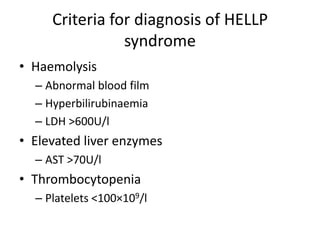
Criteria for diagnosis of HELLP
syndrome
• Haemolysis
– Abnormal blood film
– Hyperbilirubinaemia
– LDH >600U/l

• Elevated liver enzymes
– AST >70U/l

• Thrombocytopenia
– Platelets <100×109/l
Management
• Resuscitation and exclusion of hepatic
haemorrhage or ruptured liver.
• In case of ruptured liver an early Caesarean
section and definitive surgical repair are
urgent.
• Treat Microangiopathic haemolysis and
thrombocytopenia using plasma exchange and
fresh frozen plasma infusion.
• Platelet transfusions only in case of an active
bleeding.
Post-partum haemorrhage
• Resuscitation
• Aortic compression using the pressure
between the fist and vertebral column
• Stimulated uterine contraction-Prostaglandin
F2α injected locally in to the uterus or IM
• Arterialocclusion-Angiographic embolisation
or internal iliac artery ligation
Amniotic fluid embolus
• The initial response of the pulmonary vasculature
to the presence of amniotic fluid is intense
vasospasm resulting in severe pulmonary
hypertension and hypoxaemia.
• Amniotic fluid contains lipid-rich particulate
material which stimulates a systemic inflammatory
reaction. Hence it leads to capillary leak and
disseminated intravascular coagulation.
Management
• Respiratory support – Oxygen (FiO2 0.6–1.0).
• CPAP or mechanical ventilation.
• Cardiovascular support-controlled fluid
loading and inotropic support.
• Haematological management-blood product
therapy.
• Treatment with cryoprecipitate.
Thank you

Obstetrical emergencies

  • 1.
  • 2.
    OBSTETRICAL EMERGENCIES • • • • Pre-eclampsia andeclampsia HELLP syndrome Post-partum haemorrhage Amniotic fluid embolus
  • 3.
    Pre-eclampsia and eclampsia •The hallmark of pre-eclampsia is hypertension with proteinuria. It is considered mild if proteinuria is 0.25–2g/l and severe if >2g/l. • Eclampsia is the same condition associated with seizures.
  • 4.
    Management Circulatorymanagement • To TreatHigh BP use controlled plasma volume expansion as the first line treatment. • Fluid management. • Anti-hypertensives such as labetalol, nifedipine or hydralazine.
  • 5.
    Convulsions • Convulsions arebest avoided by good blood pressure control. • Benzodiazepines to control seizure • Magnesium sulphate is the treatment of choice for eclamptic convulsions. Magnesium levels should be monitored and kept between 2.53.75mmol/l. Above 3.75mmol/l toxicity with possible cardiorespiratory arrest may be seen. • Prophylactic anticonvulsant therapy with magnesium for pre-eclampsia. • Elective intubation, mechanical hyperventilation and further anticonvulsant therapy.
  • 6.
    Early fetaldelivery • Iffetal maturity has been reached immediate delivery after control of seizures and hypertension is necessary.
  • 7.
  • 8.
    HELLP syndrome • HELLPsyndrome is a pregnancy related disorder associated with haemolysis, elevated liver function tests and low platelets.
  • 9.
    Clinical features • Epigastricor right upper quadrant pain with malaise. • Nausea and vomiting. • Generalised oedema is usual but hypertension is less common. Presentation may occur postpartum.
  • 10.
    Criteria for diagnosisof HELLP syndrome • Haemolysis – Abnormal blood film – Hyperbilirubinaemia – LDH >600U/l • Elevated liver enzymes – AST >70U/l • Thrombocytopenia – Platelets <100×109/l
  • 11.
    Management • Resuscitation andexclusion of hepatic haemorrhage or ruptured liver. • In case of ruptured liver an early Caesarean section and definitive surgical repair are urgent. • Treat Microangiopathic haemolysis and thrombocytopenia using plasma exchange and fresh frozen plasma infusion. • Platelet transfusions only in case of an active bleeding.
  • 12.
    Post-partum haemorrhage • Resuscitation •Aortic compression using the pressure between the fist and vertebral column • Stimulated uterine contraction-Prostaglandin F2α injected locally in to the uterus or IM • Arterialocclusion-Angiographic embolisation or internal iliac artery ligation
  • 13.
    Amniotic fluid embolus •The initial response of the pulmonary vasculature to the presence of amniotic fluid is intense vasospasm resulting in severe pulmonary hypertension and hypoxaemia. • Amniotic fluid contains lipid-rich particulate material which stimulates a systemic inflammatory reaction. Hence it leads to capillary leak and disseminated intravascular coagulation.
  • 14.
    Management • Respiratory support– Oxygen (FiO2 0.6–1.0). • CPAP or mechanical ventilation. • Cardiovascular support-controlled fluid loading and inotropic support. • Haematological management-blood product therapy. • Treatment with cryoprecipitate.
  • 15.