www.helpingpsychology.com Obsessive Compulsive Disorder http://helpingpsychology.com/wp-content/uploads/2009/12/iStock_000001318594XSmall-300x240.jpg
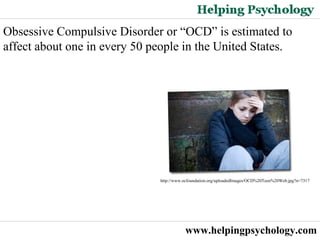
www.helpingpsychology.com Obsessive Compulsive Disorder or “OCD” is estimated to affect about one in every 50 people in the United States. http://www.ocfoundation.org/uploadedImages/OCD%20Teen%20Web.jpg?n=7317
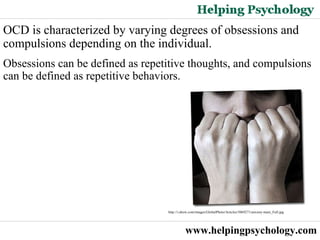
www.helpingpsychology.com OCD is characterized by varying degrees of obsessions and compulsions depending on the individual.  Obsessions can be defined as repetitive thoughts, and compulsions can be defined as repetitive behaviors.  http://i.ehow.com/images/GlobalPhoto/Articles/5069271/anxiety-main_Full.jpg
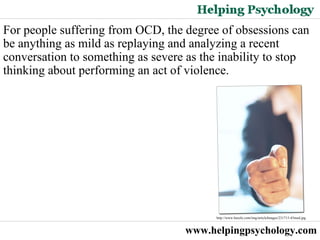
www.helpingpsychology.com For people suffering from OCD, the degree of obsessions can be anything as mild as replaying and analyzing a recent conversation to something as severe as the inability to stop thinking about performing an act of violence. http://www.buzzle.com/img/articleImages/231715-45med.jpg
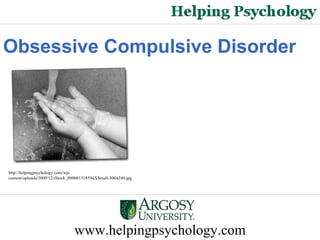
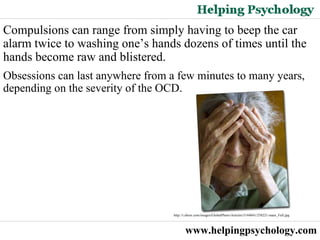
www.helpingpsychology.com Compulsions can range from simply having to beep the car alarm twice to washing one’s hands dozens of times until the hands become raw and blistered. Obsessions can last anywhere from a few minutes to many years, depending on the severity of the OCD.  http://i.ehow.com/images/GlobalPhoto/Articles/5144041/258221-main_Full.jpg
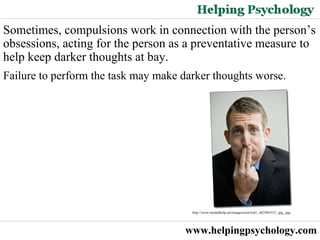
www.helpingpsychology.com Sometimes, compulsions work in connection with the person’s obsessions, acting for the person as a preventative measure to help keep darker thoughts at bay.  Failure to perform the task may make darker thoughts worse. http://www.mentalhelp.net/images/root/ocd1_id25963531_jpg_.jpg
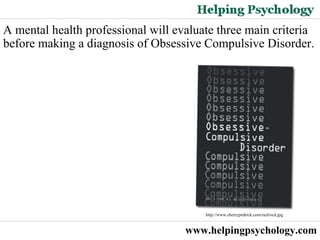
www.helpingpsychology.com A mental health professional will evaluate three main criteria before making a diagnosis of Obsessive Compulsive Disorder. http://www.cherrypedrick.com/ocd/ocd.jpg
www.helpingpsychology.com First, a therapist will determine if the patient suffers from the constant, disturbing thoughts that characterize obsession.  For example: Is the patient still thinking about an event that occurred some time ago? http://www.abc.net.au/reslib/200810/r302979_1317873.jpg
www.helpingpsychology.com The therapist will then need to know if the person suffers from the unrelenting need to perform certain tasks, signifying that compulsions are present.  Does the patient count ceiling tiles or constantly untie and retie their shoes? http://therapyworks.ca/storage/woman%20butterfly.jpg
www.helpingpsychology.com Finally, the therapist will try to establish whether these thoughts and actions are interfering with the patient’s everyday life. Is the person still able to work, to eat, to sleep, and interact with others?  http://www.holistic360.co.uk/images/Photo%20-%20Woman%20Cleaning%20Windows.jpg
www.helpingpsychology.com The most important step in treating OCD is seeing a doctor or psychologist.  Depending upon the severity of a person’s OCD, the doctor will outline a course of treatment specific to the patient.  Treatment http://farm4.static.flickr.com/3362/3572135000_1e67a3d67d.jpg
www.helpingpsychology.com If a person’s obsessive-compulsive behaviors are relatively mild and do not interfere with his or her ability to function in society, the therapist may choose to prescribe only behavioral or “exposure” therapy to help the patient overcome their obsessive-compulsive behaviors.  Group therapy, meditation, and/or restriction of caffeine and other stimulants all may be useful in the treatment of Obsessive Compulsive Disorder. http://1.bp.blogspot.com/_vbS7BIUoZ94/SeX0WvEP99I/AAAAAAAABrs/CgR3nn_-z50/s1600-h/ocd+2.jpg   http://www.ocdsymptoms.co.uk/images/7434.jpg
www.argosy.edu www.HelpingPsychology.com Helping Psychology Is Sponsored By

Obsessive Compulsive Disorder

  • 1.
    www.helpingpsychology.com Obsessive CompulsiveDisorder http://helpingpsychology.com/wp-content/uploads/2009/12/iStock_000001318594XSmall-300x240.jpg
  • 2.
    www.helpingpsychology.com Obsessive CompulsiveDisorder or “OCD” is estimated to affect about one in every 50 people in the United States. http://www.ocfoundation.org/uploadedImages/OCD%20Teen%20Web.jpg?n=7317
  • 3.
    www.helpingpsychology.com OCD ischaracterized by varying degrees of obsessions and compulsions depending on the individual. Obsessions can be defined as repetitive thoughts, and compulsions can be defined as repetitive behaviors. http://i.ehow.com/images/GlobalPhoto/Articles/5069271/anxiety-main_Full.jpg
  • 4.
    www.helpingpsychology.com For peoplesuffering from OCD, the degree of obsessions can be anything as mild as replaying and analyzing a recent conversation to something as severe as the inability to stop thinking about performing an act of violence. http://www.buzzle.com/img/articleImages/231715-45med.jpg
  • 5.
    www.helpingpsychology.com Compulsions canrange from simply having to beep the car alarm twice to washing one’s hands dozens of times until the hands become raw and blistered. Obsessions can last anywhere from a few minutes to many years, depending on the severity of the OCD. http://i.ehow.com/images/GlobalPhoto/Articles/5144041/258221-main_Full.jpg
  • 6.
    www.helpingpsychology.com Sometimes, compulsionswork in connection with the person’s obsessions, acting for the person as a preventative measure to help keep darker thoughts at bay. Failure to perform the task may make darker thoughts worse. http://www.mentalhelp.net/images/root/ocd1_id25963531_jpg_.jpg
  • 7.
    www.helpingpsychology.com A mentalhealth professional will evaluate three main criteria before making a diagnosis of Obsessive Compulsive Disorder. http://www.cherrypedrick.com/ocd/ocd.jpg
  • 8.
    www.helpingpsychology.com First, atherapist will determine if the patient suffers from the constant, disturbing thoughts that characterize obsession. For example: Is the patient still thinking about an event that occurred some time ago? http://www.abc.net.au/reslib/200810/r302979_1317873.jpg
  • 9.
    www.helpingpsychology.com The therapistwill then need to know if the person suffers from the unrelenting need to perform certain tasks, signifying that compulsions are present. Does the patient count ceiling tiles or constantly untie and retie their shoes? http://therapyworks.ca/storage/woman%20butterfly.jpg
  • 10.
    www.helpingpsychology.com Finally, thetherapist will try to establish whether these thoughts and actions are interfering with the patient’s everyday life. Is the person still able to work, to eat, to sleep, and interact with others? http://www.holistic360.co.uk/images/Photo%20-%20Woman%20Cleaning%20Windows.jpg
  • 11.
    www.helpingpsychology.com The mostimportant step in treating OCD is seeing a doctor or psychologist. Depending upon the severity of a person’s OCD, the doctor will outline a course of treatment specific to the patient. Treatment http://farm4.static.flickr.com/3362/3572135000_1e67a3d67d.jpg
  • 12.
    www.helpingpsychology.com If aperson’s obsessive-compulsive behaviors are relatively mild and do not interfere with his or her ability to function in society, the therapist may choose to prescribe only behavioral or “exposure” therapy to help the patient overcome their obsessive-compulsive behaviors. Group therapy, meditation, and/or restriction of caffeine and other stimulants all may be useful in the treatment of Obsessive Compulsive Disorder. http://1.bp.blogspot.com/_vbS7BIUoZ94/SeX0WvEP99I/AAAAAAAABrs/CgR3nn_-z50/s1600-h/ocd+2.jpg http://www.ocdsymptoms.co.uk/images/7434.jpg
  • 13.