Observation TypesBanyule Network Principal Class ConferenceBanyule Coaches
Observations1. What are they and how do they work?Instructional RoundsLiteracy/Numeracy WalksJapanese Lesson StudyPeer Observations/ TriadsPeer Shadowing/MentoringCoaching2. What would implementation look like at my school?3. Design Space – Banyule Principal Class Conference 2011
Instructional RoundsPurpose:  To build capacity of the observers through shared experience and discussionThere are 4 elements to an Instructional Round:A problem of practiceObservationDebriefFocus on the next level of work
ConsiderationsPlan for introductory briefingsAllocate an entire day for each roundDraw up a timetableProvide Morning tea and lunch
Literacy WalkPurpose:To build capacity of the observers through shared experience and discussion
What is a Literacy Walk?Focused classroom observations  Real-time data to make decisions for:		-Improving literacy teaching		-School improvement planning		-Professional learning planning  School-wide reflective practice  Increased student achievement
ProcessNCSL: Getting started with Networked Learning Walkshttp://www.ncsl.org.uk/media/9F5/89/nlc_PMA_LW_BOOK1.pdf
1. Agree on the focusAs a professional learning team, agree on the focus for the visitidentify the focus from professional learningIdentify what you would you expect to seeIdentify what you might observeStudentsTeachersTasks
Shared responsibility for literacy improvement across the teamShared understanding of purpose for visitsClarity of focus for visit – what is to be observedOpportunity for learning about leading literacy improvement2. Establish the team
3. Prepare for the literacy walkAgreement about focus for walkEstablishment of protocolsEnsure there is learning for each person involvedEnsure learning - rather than judgement – is the focusSupport each person to prepare for the  walkGain commitment to the process
4. Classroom visit Provides a snapshot of classroom practiceLasts no more than 15 minutesEvidence gathered from 4 sources:Classroom environmentTalk with studentsAnalysis of student workDiscussion & observation of teacher
5. Corridor TalkImmediately after classroom visit, walkers take time to share evidence related to focussed observations (non-judgemental)Focus on positives as well as constructive questionsEnsure observations are evidenced and data-drivenNote key issues for debrief meeting
6. Debrief and feedbackWalkers review evidence and questions raised during corridor talk and use this data to inform professional learning focusStructure debrief to allow personal and group reflectionFeedback reflects observed practiceFocus on what to do next
ConsiderationsTimetabling needs to be visible and includes the walkers and focus in advanceAllocate a half day to the walk, Time at staff meeting for introduction and establishing protocolsAny member of staff can be part of the walking team                 Allocate a Lead Walker to coordinate timetables, foci and facilitate feedback to staff
Numeracy WalkNumeracy Walks are no different to Literacy WalksStaff knew what was expected – outlined in documents:Numeracy Teaching at Glenroy WestGuiding Principles for Numeracy Lessons at Glenroy WestChecklist provided of what the walkers would look for on  the Numeracy WalkAfter the walk…feedback was documented and provided to teams
Japanese Lesson StudyPurpose: To improve the content and delivery of a particular lesson By improving a single lesson, a pathway to ongoing improvement in instruction is created
7 pathways to improvement that underlie successful lesson studyIncreased knowledge of subject matterIncreased knowledge of instructionIncreased ability to observe studentsStronger collegial networksStronger connection of daily practice to long term goalsStronger motivation and self efficacy Improved quality of lesson plans
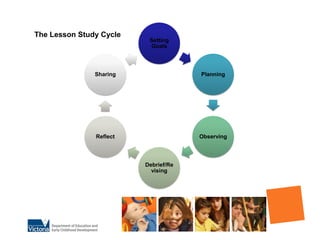
The Lesson Study Cycle
ConsiderationsPD for all staffTemplate for note takingGuiding questions to promptReflection document for debrief discussionsCycle needs to be communicated to the staff1 day over three days to plan, teach and debrief lesson
Peer Observation/Triads Purpose:To give immediate and constructive feedback to a teacher about an area of their practice that they wish to improve.  
Peer Observation/Triads Process:Teacher being observed identifies an area they would like to focus onObservers stay for the whole lessonTime for feedback discussion scheduledObservers provide non judgemental feedback   on the focusProcess then repeated with the next member until all members have been observed
The Process
Connections?School Improvement Team/Leadership TeamPLTPLTPLTTriadTriadTriadTriadTriadTriadPROFESSIONAL LEARNINGAiZ (Learning Leaders, PLT leaders)Coaches
Benefits Can be adapted to a more stricter model where strategies such as HRLTPS are observedCan be used across or within learning areas, year levels or for certain classes if the school chooses to organise it that way
ConsiderationsTime for triad to meet for the pre brief , observations and debriefWho should form the triad? – self selected or structured?Focus for the observations – ie could be linked to the problem of practice, your current PD and school focus eg structure of a lesson, or an aspect of the Developmental Management Approach
Peer shadowing/modellingPurpose:To build the capacity of the observer by watching an accomplished practitioner Lead into something bigger………
Process:Identify  a clear focus Identify appropriate mentorTimetabling arrangements Protocols for the processPre brief to discuss demonstrationTemplate to record learningsObservationsDebriefPlanning for implementation of ideas including time for mentor to observe mentoreeOngoing communication
Considerations:Time and ensuring the modelling is  appropriateAccountability/evidence of the learning being implementedExperience and level of expertise of the observer influences what is seen and what is missed – how to check for understanding
Coaching
CoachingPurpose:A skilled practitioner works alongside a teacher or group of teachers to build their capacity to improve student learning
Process:Hire/appoint  a trained, skilful coachExamine student data to determine areas of the school for improvementExamine staff skills and capacity to determine readiness for coaching Determine where and how the coach will work and with whomEstablish protocols for working together – clear expectations of roles and timesEstablish protocols for data collection and accountabilityWorkshop the above with the staffTemplates for pre brief, observations and debrief
Considerations:Determine the best way for the coach to work to support school improvement Timetable allowances required to enable coachingTime to workshop staff so that everyone is on board and understands what is expected and how it is going to workAccountability processes for the coach, coachee, team and leadershipData collection and monitoring processes
What would implementation look like at my school?Reflection time     -select an observation you wish to implement or improve-use  a Force Field analysis or Bone diagram5 minsTable Talk – share ideas10 mins
Resources – Design SpaceNMR Banyule Principal Class Conference 2011Video- Instructional RoundsPower pointsHandoutsReadings/Articles

Observations types

  • 1.
    Observation TypesBanyule NetworkPrincipal Class ConferenceBanyule Coaches
  • 2.
    Observations1. What arethey and how do they work?Instructional RoundsLiteracy/Numeracy WalksJapanese Lesson StudyPeer Observations/ TriadsPeer Shadowing/MentoringCoaching2. What would implementation look like at my school?3. Design Space – Banyule Principal Class Conference 2011
  • 3.
    Instructional RoundsPurpose: To build capacity of the observers through shared experience and discussionThere are 4 elements to an Instructional Round:A problem of practiceObservationDebriefFocus on the next level of work
  • 4.
    ConsiderationsPlan for introductorybriefingsAllocate an entire day for each roundDraw up a timetableProvide Morning tea and lunch
  • 5.
    Literacy WalkPurpose:To buildcapacity of the observers through shared experience and discussion
  • 6.
    What is aLiteracy Walk?Focused classroom observations Real-time data to make decisions for: -Improving literacy teaching -School improvement planning -Professional learning planning School-wide reflective practice Increased student achievement
  • 7.
    ProcessNCSL: Getting startedwith Networked Learning Walkshttp://www.ncsl.org.uk/media/9F5/89/nlc_PMA_LW_BOOK1.pdf
  • 8.
    1. Agree onthe focusAs a professional learning team, agree on the focus for the visitidentify the focus from professional learningIdentify what you would you expect to seeIdentify what you might observeStudentsTeachersTasks
  • 9.
    Shared responsibility forliteracy improvement across the teamShared understanding of purpose for visitsClarity of focus for visit – what is to be observedOpportunity for learning about leading literacy improvement2. Establish the team
  • 10.
    3. Prepare forthe literacy walkAgreement about focus for walkEstablishment of protocolsEnsure there is learning for each person involvedEnsure learning - rather than judgement – is the focusSupport each person to prepare for the walkGain commitment to the process
  • 11.
    4. Classroom visitProvides a snapshot of classroom practiceLasts no more than 15 minutesEvidence gathered from 4 sources:Classroom environmentTalk with studentsAnalysis of student workDiscussion & observation of teacher
  • 12.
    5. Corridor TalkImmediatelyafter classroom visit, walkers take time to share evidence related to focussed observations (non-judgemental)Focus on positives as well as constructive questionsEnsure observations are evidenced and data-drivenNote key issues for debrief meeting
  • 13.
    6. Debrief andfeedbackWalkers review evidence and questions raised during corridor talk and use this data to inform professional learning focusStructure debrief to allow personal and group reflectionFeedback reflects observed practiceFocus on what to do next
  • 14.
    ConsiderationsTimetabling needs tobe visible and includes the walkers and focus in advanceAllocate a half day to the walk, Time at staff meeting for introduction and establishing protocolsAny member of staff can be part of the walking team                 Allocate a Lead Walker to coordinate timetables, foci and facilitate feedback to staff
  • 15.
    Numeracy WalkNumeracy Walksare no different to Literacy WalksStaff knew what was expected – outlined in documents:Numeracy Teaching at Glenroy WestGuiding Principles for Numeracy Lessons at Glenroy WestChecklist provided of what the walkers would look for on the Numeracy WalkAfter the walk…feedback was documented and provided to teams
  • 16.
    Japanese Lesson StudyPurpose:To improve the content and delivery of a particular lesson By improving a single lesson, a pathway to ongoing improvement in instruction is created
  • 17.
    7 pathways toimprovement that underlie successful lesson studyIncreased knowledge of subject matterIncreased knowledge of instructionIncreased ability to observe studentsStronger collegial networksStronger connection of daily practice to long term goalsStronger motivation and self efficacy Improved quality of lesson plans
  • 18.
  • 19.
    ConsiderationsPD for allstaffTemplate for note takingGuiding questions to promptReflection document for debrief discussionsCycle needs to be communicated to the staff1 day over three days to plan, teach and debrief lesson
  • 20.
    Peer Observation/Triads Purpose:Togive immediate and constructive feedback to a teacher about an area of their practice that they wish to improve.  
  • 21.
    Peer Observation/Triads Process:Teacherbeing observed identifies an area they would like to focus onObservers stay for the whole lessonTime for feedback discussion scheduledObservers provide non judgemental feedback on the focusProcess then repeated with the next member until all members have been observed
  • 22.
  • 23.
    Connections?School Improvement Team/LeadershipTeamPLTPLTPLTTriadTriadTriadTriadTriadTriadPROFESSIONAL LEARNINGAiZ (Learning Leaders, PLT leaders)Coaches
  • 24.
    Benefits Can beadapted to a more stricter model where strategies such as HRLTPS are observedCan be used across or within learning areas, year levels or for certain classes if the school chooses to organise it that way
  • 25.
    ConsiderationsTime for triadto meet for the pre brief , observations and debriefWho should form the triad? – self selected or structured?Focus for the observations – ie could be linked to the problem of practice, your current PD and school focus eg structure of a lesson, or an aspect of the Developmental Management Approach
  • 26.
    Peer shadowing/modellingPurpose:To buildthe capacity of the observer by watching an accomplished practitioner Lead into something bigger………
  • 27.
    Process:Identify aclear focus Identify appropriate mentorTimetabling arrangements Protocols for the processPre brief to discuss demonstrationTemplate to record learningsObservationsDebriefPlanning for implementation of ideas including time for mentor to observe mentoreeOngoing communication
  • 28.
    Considerations:Time and ensuringthe modelling is  appropriateAccountability/evidence of the learning being implementedExperience and level of expertise of the observer influences what is seen and what is missed – how to check for understanding
  • 29.
  • 30.
    CoachingPurpose:A skilled practitionerworks alongside a teacher or group of teachers to build their capacity to improve student learning
  • 31.
    Process:Hire/appoint  a trained,skilful coachExamine student data to determine areas of the school for improvementExamine staff skills and capacity to determine readiness for coaching Determine where and how the coach will work and with whomEstablish protocols for working together – clear expectations of roles and timesEstablish protocols for data collection and accountabilityWorkshop the above with the staffTemplates for pre brief, observations and debrief
  • 32.
    Considerations:Determine the bestway for the coach to work to support school improvement Timetable allowances required to enable coachingTime to workshop staff so that everyone is on board and understands what is expected and how it is going to workAccountability processes for the coach, coachee, team and leadershipData collection and monitoring processes
  • 33.
    What would implementationlook like at my school?Reflection time -select an observation you wish to implement or improve-use a Force Field analysis or Bone diagram5 minsTable Talk – share ideas10 mins
  • 34.
    Resources – DesignSpaceNMR Banyule Principal Class Conference 2011Video- Instructional RoundsPower pointsHandoutsReadings/Articles

Editor's Notes

  • #3 What are they and how do they work? 40 minsWhat would implementation look like at my school? 15 minsResources Design Space – Banyule Principals’ Conference 5 mins
  • #18 Recent studies indicate..1&2 Improved content and pedagogical knowledge 3. Strengthens data collection, analysis, interpretation of evidenceFosters communication of practice in a safe, respectful learning environment, promotes exploration of different perspectives, reduces classroom isolation6. Believe they can make a difference in student learning, develop persistence and a desire to improve, develop leadership skills7. Changes the thinking from- “What am I covering today?” to “What do I want my students to learn”?
  • #19 Work together to plan a good lesson with what we currently know, try it out, collect data and analyse it to identify what in the lesson worked well and what in the lesson needs to be done differently to get to our desired outcomeSetting goals: Whole school- These are either school goals based on the strategic plan, AIP or data collected. Teachers/leaders narrow goal down to a specific focus eg. What makes a good reading lesson?Planning: Collaborative design a lesson. The goal in the first lesson is not to produce a perfect lesson, but the lesson will be improved throughout the processObserving- A member of the team teaches the lesson while others(including a guest) observe the learning and the learner(their thinking, response)s, not the teacher’s performance. This is what makes J.L.S so unique- it’s a safe place to learn, share and grow from one and other. Debrief/revising- Collate and analyse data (observations, students work). This is the time that enables teachers to move away from talking about students doing the work, but by truly watching and listening to them teachers will understand what they are struggling with and what skills we need to develop as a school.# Once lesson is refined, the following teacher teaches the lesson and steps 3 and 4 repeatReflect- Once all lesson are completed and discussed, teachers discuss what they have learned about teaching and learning, including implications for their future teachingSharing- Share results, finding with staff
  • #34 Move to work with your AP for discussion