The best 5 ideas on
  HOW to improve your own
      professional practice
as a teacher and/or as a leader
 of learning within your school.
                    Presenter: Tanya Thompson
           Acting Principal, St Andrews Middle School
We are all learners:
changing a school
     culture
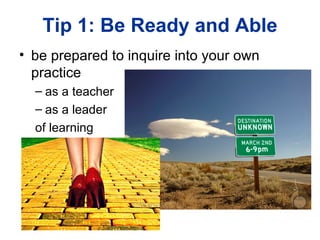
Tip 1: Be Ready and Able
• be prepared to inquire into your own
  practice
  – as a teacher
  – as a leader
  of learning
Discussion Point
• What mental model is needed to inquire
  into our own practice?

• How can we position ourselves to become
  ready and able??

• How can we position others around us??
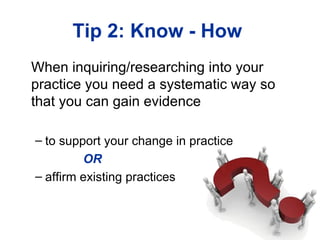
Tip 2: Know - How
When inquiring/researching into your
practice you need a systematic way so
that you can gain evidence

– to support your change in practice
         OR
– affirm existing practices
Action research is
  the study of a
 social situation
  with a view to
  improving the
 quality of action
     within it.

 Cardno and Piggot-Irvine, 1991
Action Research Process
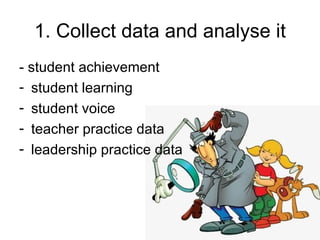
1. Collect data and analyse it
- student achievement
- student learning
- student voice
- teacher practice data
- leadership practice data
Be selective with data collection
        – stay focussed
2. Look at what research has to say

                     • Professional
                       readings
                     • Collegial
                       discussions
                     • Visit other
                       classrooms/
                        schools
3. Make a Plan and reflect on it
Set a simple action plan which targets your
 areas of
       – Concerns…
       – wonderings ….
       – low or poor performance….. etc
How do I know????
• Reflect and evaluate as you go
  – Can I collect evidence of learning?
  – Is it impacting on student learning?
           How do I know?
  – Is it impacting on my staff?
  School culture? How do I know?


• Where is my evidence????
4. Collect comparative data
              and analyse it
- student achievement
- student learning
- student voice
- teacher practice data
- leadership practice data

      Am I making a difference?
  Are my new or enhanced practices
            more effective?
How do I know? Where is my evidence?
5. Share it and celebrate
• We are all learners and we can teach
  each other so much

• Share your findings
       –   Other colleagues
       –   Students
       –   Parents
       –   The wider community
Teachers/Leaders
                        need to see the
                        necessity for
                        change for
                        themselves
Teachers/Leaders need to
see hard evidence

Teachers/Leaders need to
be supported when
modifying their practice.
No matter where you
      start…


  each component
spirals into the others
Discussion Point
• General Q and A re: process

• Examples available

                           Contact details:
                         Tanya Thompson
                   tanyat@sams.school.nz
Tip 3: Structures which support
     teacher/leader inquiry
Clear School-wide Expectations
•Trust established within the school culture
• A professional culture of learning and
teaching
•Inquiring about practice is the ‘norm’
•Data analysis
•Evidence based planning and assessment
•All learning should be transparent
Staff Meetings

Learning vs Organisation
Staff meetings are specifically set aside
for goal setting/assessment, discussion
  of professional readings and sharing
  and celebration of teachers/leaders
                 practice.
In-Class, On-the-Job, Hands-on
       Professional Support

•Modelling of best practice
•Release time
•Both in-house and consultant knowledge
base of best practice
•Individual/group support with practices
Appraisal Process
•set goals in relation to their practice in
appraisal documentation
•collect baseline/comparative data
•keep a reflective journal
•share and celebrate changes in practice
reflection within our practice
   leads to higher confidence
and a positive culture of change
Discussion Point
• What structures does your place of
  learning currently have which support
  inquiry in our own practice??

• What structures do you need to put in
  place to ensure success??
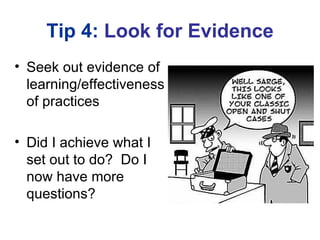
Tip 4: Look for Evidence
• Seek out evidence of
  learning/effectiveness
  of practices

• Did I achieve what I
  set out to do? Do I
  now have more
  questions?
Did I raise student achievement?
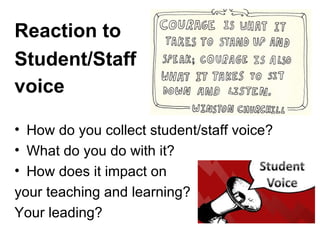
Reaction to
Student/Staff
voice

• How do you collect student/staff voice?
• What do you do with it?
• How does it impact on
your teaching and learning?
Your leading?
Discussion Point
• What evidence do you look for to know
  you are making a difference? Raising
  student achievement?

• Do you have hard evidence to support
  these?? How could you from now on??
Tip 5: ACTION IT
• Action your new
  practices

• Implement changes

• Look at measures to
  sustain the change
Be the change factor


– make the difference

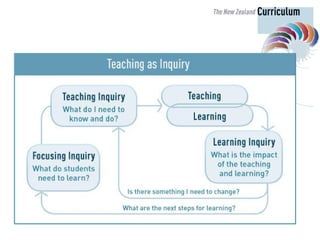
Teaching as Inquiry

  • 1.
    The best 5ideas on HOW to improve your own professional practice as a teacher and/or as a leader of learning within your school. Presenter: Tanya Thompson Acting Principal, St Andrews Middle School
  • 2.
    We are alllearners: changing a school culture
  • 3.
    Tip 1: BeReady and Able • be prepared to inquire into your own practice – as a teacher – as a leader of learning
  • 4.
    Discussion Point • Whatmental model is needed to inquire into our own practice? • How can we position ourselves to become ready and able?? • How can we position others around us??
  • 5.
    Tip 2: Know- How When inquiring/researching into your practice you need a systematic way so that you can gain evidence – to support your change in practice OR – affirm existing practices
  • 7.
    Action research is the study of a social situation with a view to improving the quality of action within it. Cardno and Piggot-Irvine, 1991
  • 8.
  • 9.
    1. Collect dataand analyse it - student achievement - student learning - student voice - teacher practice data - leadership practice data
  • 10.
    Be selective withdata collection – stay focussed
  • 11.
    2. Look atwhat research has to say • Professional readings • Collegial discussions • Visit other classrooms/ schools
  • 12.
    3. Make aPlan and reflect on it Set a simple action plan which targets your areas of – Concerns… – wonderings …. – low or poor performance….. etc
  • 13.
    How do Iknow???? • Reflect and evaluate as you go – Can I collect evidence of learning? – Is it impacting on student learning? How do I know? – Is it impacting on my staff? School culture? How do I know? • Where is my evidence????
  • 14.
    4. Collect comparativedata and analyse it - student achievement - student learning - student voice - teacher practice data - leadership practice data Am I making a difference? Are my new or enhanced practices more effective? How do I know? Where is my evidence?
  • 15.
    5. Share itand celebrate • We are all learners and we can teach each other so much • Share your findings – Other colleagues – Students – Parents – The wider community
  • 16.
    Teachers/Leaders need to see the necessity for change for themselves Teachers/Leaders need to see hard evidence Teachers/Leaders need to be supported when modifying their practice.
  • 17.
    No matter whereyou start… each component spirals into the others
  • 18.
    Discussion Point • GeneralQ and A re: process • Examples available Contact details: Tanya Thompson tanyat@sams.school.nz
  • 19.
    Tip 3: Structureswhich support teacher/leader inquiry
  • 20.
    Clear School-wide Expectations •Trustestablished within the school culture • A professional culture of learning and teaching •Inquiring about practice is the ‘norm’ •Data analysis •Evidence based planning and assessment •All learning should be transparent
  • 22.
    Staff Meetings Learning vsOrganisation Staff meetings are specifically set aside for goal setting/assessment, discussion of professional readings and sharing and celebration of teachers/leaders practice.
  • 23.
    In-Class, On-the-Job, Hands-on Professional Support •Modelling of best practice •Release time •Both in-house and consultant knowledge base of best practice •Individual/group support with practices
  • 24.
    Appraisal Process •set goalsin relation to their practice in appraisal documentation •collect baseline/comparative data •keep a reflective journal •share and celebrate changes in practice
  • 25.
    reflection within ourpractice leads to higher confidence and a positive culture of change
  • 26.
    Discussion Point • Whatstructures does your place of learning currently have which support inquiry in our own practice?? • What structures do you need to put in place to ensure success??
  • 27.
    Tip 4: Lookfor Evidence • Seek out evidence of learning/effectiveness of practices • Did I achieve what I set out to do? Do I now have more questions?
  • 28.
    Did I raisestudent achievement?
  • 29.
    Reaction to Student/Staff voice • Howdo you collect student/staff voice? • What do you do with it? • How does it impact on your teaching and learning? Your leading?
  • 30.
    Discussion Point • Whatevidence do you look for to know you are making a difference? Raising student achievement? • Do you have hard evidence to support these?? How could you from now on??
  • 31.
    Tip 5: ACTIONIT • Action your new practices • Implement changes • Look at measures to sustain the change
  • 32.
    Be the changefactor – make the difference

Editor's Notes

  • #8 A positive school culture that enables changes is essential. Action research was a place that we started but it doesn’t have to be this way.
  • #17 Allowing teachers to inquire about their classroom practice enables them to become better practitioners. See the need for change: All teachers complete Action Research projects and feed back results during staff meetings and appraisals Hard evidence: teacher practice data, student voice, student learning/achievement data – give examples Evidence of quality teaching and learning Evidence based Assessment, Planning and Evaluation Why are we doing what we are doing? Can we justify it? Supported in Practice Less teacher frustration with in-class modelling
  • #18 This is also true when trying to develop an “all-in” concept in deprivatised practice? Community of learners. It doesn’t really matter where you start
  • #21 The whole philosophy of assessment must be purposeful. Target setting in teams is more meaningful there more effective
  • #25 Data, Student voice, student achievement, teacher practice
  • #30 At first many teachers gather data because they have to and if they don’t have to – they don’t collect it. All teachers are at a different place in the journey – its important that this is recognised and people feel ok about this. This isn't always the case though and I think its important to accept that their will be rough patches, smooth patches etc