Audience Theory and Critical
Approaches
Terry & Jonathan
Uses and Gratifications Theory
• This theory elaborates on the the perception of
mass communication. The theory particularly
relates to and fixates upon the
audience/consumer. It expects that the audience
incorporates their own role and integrates their
own lives into the media.
• In addition, the theory refers to the audience
being responsible for the media they consume
and use to fulfill their specific gratifications.
(fulfillment/indulgence, especially when gained
from the satisfaction of a desire).
• Individuals actively consume and use the media to meet
desirable needs. Blumler and Katz (1974) manifested their
research and essentially listed and categorised four sectors
which relate to the viewers perspectives of watching
television/viewing the media.
• 1) Diversion – a form of escape or emotional release from
everyday pressure
• 2) Personal relationships – companionship via television
personalities, characters and sociability through discussion
about television with other people.
• 3) Personal Identity – the ability to compare an individuals
life with the characters and situations within programmes.
Furthermore, exploring personal problems and
perspectives.
• 4) Surveillance - a supply of information about ‘what's
going on’ in the world.
• Richard Dyer (1977) developed the understanding
of Blumler and Katz category research in
response to the uses and gratifications theory. His
research essentially relates to cinema and
television entertainment by attempting to convey
evidence on how ‘escapism’ essentially works.
• Audiences consume media products with a sense
set of pleasure to draw from that experience.
• Dyer expresses the Utopian theory as
gratification that allows escapism from people’s
real lives.
• He sees reality as full of negatives and
unfullfilment whilst the ‘mediated ‘ world
represents a hopeful in which to escape.
Stuart Hall’s Reception theory
• Negotiated reception of the media text
audiences can accept or reject the messages
show to them in a media text, it is not
passively accepted by the audience like
suggested in the hyperemic needle theory.
• Hall stressed that audiences will get different
readings of media texts depending on their
social positions in society
Types of Reading
• Dominant/Hegemonic- The reader fully accept the preferred
reading, the reading intended by the producer of the text, this
occurs when the audiences recognizes the meaning that the text is
trying to convey
• Negotiated - The negotiated reading Is when the audiences
recognize the preferred reading and may accept some elements of
the text but reject other elements, most audiences make a
negotiated most of the time as audiences are unlikely to accept a
full reading of any media text
• Oppositional – If the audience does not agree with the ‘preferred
reading’ or text they will reject it. This is called oppositional
reading.
The Hypodermic Needle theory
• The theory suggests that mass media could influence a
very large group of people directly and uniformly by
‘shooting’ or ‘injecting’ them with appropriate
messages designed to trigger a desired response.
• They express the view that the media is a dangerous
means of communicating an idea because the receiver
or audience is powerless to resist the impact of the
message .
• People are seen ad passive and are seen as having a
high amount of media material. People and up thinking
what they are told because there is no other source of
information.
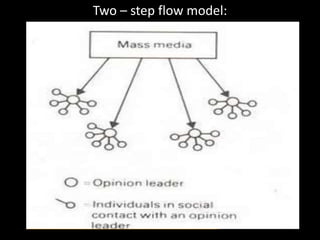
Two – step flow model:
Example of the hypodermic needle
theory being successful
• In 1938, the infamous radio dramatisation of the science fiction
novel ‘War of the Worlds’ by HG Wells was performed like a
contemporary new broadcast, a technique that had been used to
heighten a sense of realism and dramatic effect. However, as
audiences listen to this stimulation of a news broadcast as it
occurred every 40 minutes some people concluded that it was in
fact a real account of an invasion from Mars, headed to the roads,
hid in homes and loaded their weapons in an attempt to defend
themselves against the supposed imminent attack.
• millions of radio listeners were shocked when radio news alerts
announced the arrival of Martians. They panicked when they
learned of the Martians' ferocious and seemingly unstoppable
attack on Earth. Many ran out of their homes screaming while
others packed up their cars and fled.
Strengths and Weaknesses of the
theory
Strengths:
• Numbers and statistics can be effective and reliable way of seeing
trends
• Effect studies often involve a large number of participants and
sometimes extend over long periods of time
Weaknesses:
• Has little place in contemporary analysis of audience reception,
although it is possible that audiences revert to such thinking from
time to time and these types of instances are rare and don’t carry a
great deal of momentum. Audiences today tend to be a lot more
sophisticated and aware of how media messages are constructed.
• Too simplistic. Changes to attitudes and beliefs are not always
observable or easily measured. Audiences interpret media
differently.

Audience theory

  • 1.
    Audience Theory andCritical Approaches Terry & Jonathan
  • 2.
    Uses and GratificationsTheory • This theory elaborates on the the perception of mass communication. The theory particularly relates to and fixates upon the audience/consumer. It expects that the audience incorporates their own role and integrates their own lives into the media. • In addition, the theory refers to the audience being responsible for the media they consume and use to fulfill their specific gratifications. (fulfillment/indulgence, especially when gained from the satisfaction of a desire).
  • 3.
    • Individuals activelyconsume and use the media to meet desirable needs. Blumler and Katz (1974) manifested their research and essentially listed and categorised four sectors which relate to the viewers perspectives of watching television/viewing the media. • 1) Diversion – a form of escape or emotional release from everyday pressure • 2) Personal relationships – companionship via television personalities, characters and sociability through discussion about television with other people. • 3) Personal Identity – the ability to compare an individuals life with the characters and situations within programmes. Furthermore, exploring personal problems and perspectives. • 4) Surveillance - a supply of information about ‘what's going on’ in the world.
  • 4.
    • Richard Dyer(1977) developed the understanding of Blumler and Katz category research in response to the uses and gratifications theory. His research essentially relates to cinema and television entertainment by attempting to convey evidence on how ‘escapism’ essentially works. • Audiences consume media products with a sense set of pleasure to draw from that experience. • Dyer expresses the Utopian theory as gratification that allows escapism from people’s real lives. • He sees reality as full of negatives and unfullfilment whilst the ‘mediated ‘ world represents a hopeful in which to escape.
  • 5.
    Stuart Hall’s Receptiontheory • Negotiated reception of the media text audiences can accept or reject the messages show to them in a media text, it is not passively accepted by the audience like suggested in the hyperemic needle theory. • Hall stressed that audiences will get different readings of media texts depending on their social positions in society
  • 6.
    Types of Reading •Dominant/Hegemonic- The reader fully accept the preferred reading, the reading intended by the producer of the text, this occurs when the audiences recognizes the meaning that the text is trying to convey • Negotiated - The negotiated reading Is when the audiences recognize the preferred reading and may accept some elements of the text but reject other elements, most audiences make a negotiated most of the time as audiences are unlikely to accept a full reading of any media text • Oppositional – If the audience does not agree with the ‘preferred reading’ or text they will reject it. This is called oppositional reading.
  • 7.
    The Hypodermic Needletheory • The theory suggests that mass media could influence a very large group of people directly and uniformly by ‘shooting’ or ‘injecting’ them with appropriate messages designed to trigger a desired response. • They express the view that the media is a dangerous means of communicating an idea because the receiver or audience is powerless to resist the impact of the message . • People are seen ad passive and are seen as having a high amount of media material. People and up thinking what they are told because there is no other source of information.
  • 8.
    Two – stepflow model:
  • 9.
    Example of thehypodermic needle theory being successful • In 1938, the infamous radio dramatisation of the science fiction novel ‘War of the Worlds’ by HG Wells was performed like a contemporary new broadcast, a technique that had been used to heighten a sense of realism and dramatic effect. However, as audiences listen to this stimulation of a news broadcast as it occurred every 40 minutes some people concluded that it was in fact a real account of an invasion from Mars, headed to the roads, hid in homes and loaded their weapons in an attempt to defend themselves against the supposed imminent attack. • millions of radio listeners were shocked when radio news alerts announced the arrival of Martians. They panicked when they learned of the Martians' ferocious and seemingly unstoppable attack on Earth. Many ran out of their homes screaming while others packed up their cars and fled.
  • 10.
    Strengths and Weaknessesof the theory Strengths: • Numbers and statistics can be effective and reliable way of seeing trends • Effect studies often involve a large number of participants and sometimes extend over long periods of time Weaknesses: • Has little place in contemporary analysis of audience reception, although it is possible that audiences revert to such thinking from time to time and these types of instances are rare and don’t carry a great deal of momentum. Audiences today tend to be a lot more sophisticated and aware of how media messages are constructed. • Too simplistic. Changes to attitudes and beliefs are not always observable or easily measured. Audiences interpret media differently.