Magnetic Earth
Earth as a Magnet In the late 1500s, the English physician Sir William Gilbert became interested in compasses. He spoke with several navigators and experimented with his own compass. Gilbert confirmed that a compass always points in the same direction, no matter where it is. But no one knew why. Gilbert hypothesized that a compass behaves as it does because Earth acts as a giant magnet. Although many educated people of his time laughed at this idea, Gilbert turned out to be correct. Just like a bar magnet, Earth has a magnetic field surrounding it and two magnetic poles. The fact that Earth has a magnetic field explains why a compass works as it does. The poles of the magnetized needle on the compass align themselves with Earth’s magnetic field. 01/25/10 Template copyright www.brainybetty.com 2005
Earth’s core Gilbert thought that Earth’s center, or core, contains magnetic rock, but that cannot be the case, since the material inside Earth’s core is too hot to be solid. Also, the temperature is too high for the material to be magnetic. Earth’s magnetism is still not completely understood, but scientists do know that the circulation of molten material in Earth’s core is related to Earth’s magnetism. 01/25/10 Template copyright www.brainybetty.com 2005
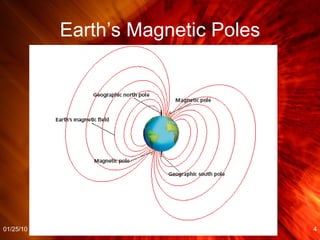
Earth’s Magnetic Poles 01/25/10 Template copyright www.brainybetty.com 2005
These magnetic poles are located on Earth’s surface where the magnetic force is strongest  the magnetic poles are not in the same place as the geographic poles.  For example, the magnetic pole in the Northern Hemisphere is located in northern Canada about 1,250 kilometers from the geographic North Pole.  01/25/10 Template copyright www.brainybetty.com 2005
Magnetic Declination If you use a compass, you have to account for the fact that Earth’s geographic and magnetic poles are different. Suppose you could draw a line between you and the geographic North Pole. The direction of this line is geographic north. Then imagine a second line drawn between you and the magnetic pole in the Northern Hemisphere. The angle between these two lines is the angle between geographic north and the north to which a compass needle points. This angle is known as  magnetic declination . So, magnetic declination differs depending on your location on Earth.  01/25/10 Template copyright www.brainybetty.com 2005
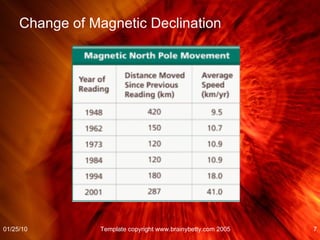
Change of Magnetic Declination 01/25/10 Template copyright www.brainybetty.com 2005
Earth’s Magnetic Field You learned that a material such as iron can be made into a magnet by a strong magnetic field. Since Earth produces a strong magnetic field, Earth itself can make magnets out of ferromagnetic materials. 01/25/10 Template copyright www.brainybetty.com 2005
Earth as  Magnet Maker Suppose you leave an iron bar lying in a north-south direction for many years. Earth’s magnetic field may attract the domains strongly enough to cause them to line up in the same direction. When the domains in the iron bar align, the bar becomes a magnet. This can happen to some everyday objects. So even though no one has tried to make metal objects such as file cabinets in your school into magnets, Earth might have done so anyway! 01/25/10 Template copyright www.brainybetty.com 2005
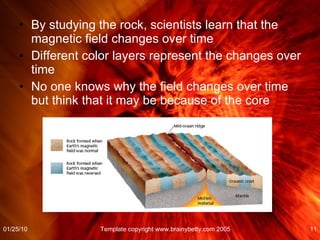
Earth’s magnetic field also acts on rocks that are on the ocean floor Rock is produced along the mid-ocean ridge when molten materials rises up and is cooled When the rock is molten, the iron it contains lines up in the direction of Earth’s magnetic field As the rock cools and hardens, the iron is locked in place which creates a permanent record of the magnetic field  01/25/10 Template copyright www.brainybetty.com 2005
By studying the rock, scientists learn that the magnetic field changes over time Different color layers represent the changes over time No one knows why the field changes over time but think that it may be because of the core 01/25/10 Template copyright www.brainybetty.com 2005
The magnetosphere Earth’s magnetic field extends into space where there are electrically charged particles Earth’s magnetic field affects the movements of electrically charged particles in space. Those charged particles also affect Earth’s magnetic field.  01/25/10 Template copyright www.brainybetty.com 2005
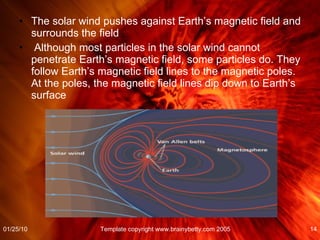
Between 1,000 and 25,000 kilometers above Earth’s surface are two doughnut-shaped regions called the  Van Allen belts These regions contain electrons and protons traveling at very high speeds  a stream of electrically charged particles flowing at high speeds from the sun The region of Earth’s magnetic field shaped by the solar wind is called the  magnetosphere . The solar wind constantly reshapes the magnetosphere as Earth rotates on its axis  01/25/10 Template copyright www.brainybetty.com 2005
The solar wind pushes against Earth’s magnetic field and surrounds the field Although most particles in the solar wind cannot penetrate Earth’s magnetic field, some particles do. They follow Earth’s magnetic field lines to the magnetic poles. At the poles, the magnetic field lines dip down to Earth’s surface  01/25/10 Template copyright www.brainybetty.com 2005
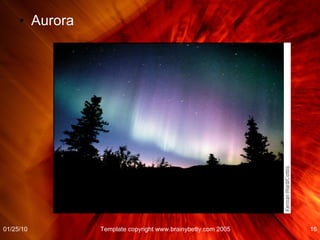
Auroras When high-speed, charged particles get close to Earth’s surface, they interact with atoms in the atmosphere.  This causes some of the atoms to give off light.  The result is one of Earth’s most spectacular displays—a curtain of shimmering bright light in the atmosphere.  A glowing region in the atmosphere caused by charged particles from the sun is called an  aurora .  In the Northern Hemisphere, an aurora is called the Northern Lights, or aurora borealis. In the Southern Hemisphere, it is called the Southern Lights, or aurora australis  01/25/10 Template copyright www.brainybetty.com 2005
Aurora 01/25/10 Template copyright www.brainybetty.com 2005

Magnetic Earth

  • 1.
  • 2.
    Earth as aMagnet In the late 1500s, the English physician Sir William Gilbert became interested in compasses. He spoke with several navigators and experimented with his own compass. Gilbert confirmed that a compass always points in the same direction, no matter where it is. But no one knew why. Gilbert hypothesized that a compass behaves as it does because Earth acts as a giant magnet. Although many educated people of his time laughed at this idea, Gilbert turned out to be correct. Just like a bar magnet, Earth has a magnetic field surrounding it and two magnetic poles. The fact that Earth has a magnetic field explains why a compass works as it does. The poles of the magnetized needle on the compass align themselves with Earth’s magnetic field. 01/25/10 Template copyright www.brainybetty.com 2005
  • 3.
    Earth’s core Gilbertthought that Earth’s center, or core, contains magnetic rock, but that cannot be the case, since the material inside Earth’s core is too hot to be solid. Also, the temperature is too high for the material to be magnetic. Earth’s magnetism is still not completely understood, but scientists do know that the circulation of molten material in Earth’s core is related to Earth’s magnetism. 01/25/10 Template copyright www.brainybetty.com 2005
  • 4.
    Earth’s Magnetic Poles01/25/10 Template copyright www.brainybetty.com 2005
  • 5.
    These magnetic polesare located on Earth’s surface where the magnetic force is strongest the magnetic poles are not in the same place as the geographic poles. For example, the magnetic pole in the Northern Hemisphere is located in northern Canada about 1,250 kilometers from the geographic North Pole. 01/25/10 Template copyright www.brainybetty.com 2005
  • 6.
    Magnetic Declination Ifyou use a compass, you have to account for the fact that Earth’s geographic and magnetic poles are different. Suppose you could draw a line between you and the geographic North Pole. The direction of this line is geographic north. Then imagine a second line drawn between you and the magnetic pole in the Northern Hemisphere. The angle between these two lines is the angle between geographic north and the north to which a compass needle points. This angle is known as magnetic declination . So, magnetic declination differs depending on your location on Earth. 01/25/10 Template copyright www.brainybetty.com 2005
  • 7.
    Change of MagneticDeclination 01/25/10 Template copyright www.brainybetty.com 2005
  • 8.
    Earth’s Magnetic FieldYou learned that a material such as iron can be made into a magnet by a strong magnetic field. Since Earth produces a strong magnetic field, Earth itself can make magnets out of ferromagnetic materials. 01/25/10 Template copyright www.brainybetty.com 2005
  • 9.
    Earth as Magnet Maker Suppose you leave an iron bar lying in a north-south direction for many years. Earth’s magnetic field may attract the domains strongly enough to cause them to line up in the same direction. When the domains in the iron bar align, the bar becomes a magnet. This can happen to some everyday objects. So even though no one has tried to make metal objects such as file cabinets in your school into magnets, Earth might have done so anyway! 01/25/10 Template copyright www.brainybetty.com 2005
  • 10.
    Earth’s magnetic fieldalso acts on rocks that are on the ocean floor Rock is produced along the mid-ocean ridge when molten materials rises up and is cooled When the rock is molten, the iron it contains lines up in the direction of Earth’s magnetic field As the rock cools and hardens, the iron is locked in place which creates a permanent record of the magnetic field 01/25/10 Template copyright www.brainybetty.com 2005
  • 11.
    By studying therock, scientists learn that the magnetic field changes over time Different color layers represent the changes over time No one knows why the field changes over time but think that it may be because of the core 01/25/10 Template copyright www.brainybetty.com 2005
  • 12.
    The magnetosphere Earth’smagnetic field extends into space where there are electrically charged particles Earth’s magnetic field affects the movements of electrically charged particles in space. Those charged particles also affect Earth’s magnetic field. 01/25/10 Template copyright www.brainybetty.com 2005
  • 13.
    Between 1,000 and25,000 kilometers above Earth’s surface are two doughnut-shaped regions called the Van Allen belts These regions contain electrons and protons traveling at very high speeds a stream of electrically charged particles flowing at high speeds from the sun The region of Earth’s magnetic field shaped by the solar wind is called the magnetosphere . The solar wind constantly reshapes the magnetosphere as Earth rotates on its axis 01/25/10 Template copyright www.brainybetty.com 2005
  • 14.
    The solar windpushes against Earth’s magnetic field and surrounds the field Although most particles in the solar wind cannot penetrate Earth’s magnetic field, some particles do. They follow Earth’s magnetic field lines to the magnetic poles. At the poles, the magnetic field lines dip down to Earth’s surface 01/25/10 Template copyright www.brainybetty.com 2005
  • 15.
    Auroras When high-speed,charged particles get close to Earth’s surface, they interact with atoms in the atmosphere. This causes some of the atoms to give off light. The result is one of Earth’s most spectacular displays—a curtain of shimmering bright light in the atmosphere. A glowing region in the atmosphere caused by charged particles from the sun is called an aurora . In the Northern Hemisphere, an aurora is called the Northern Lights, or aurora borealis. In the Southern Hemisphere, it is called the Southern Lights, or aurora australis 01/25/10 Template copyright www.brainybetty.com 2005
  • 16.
    Aurora 01/25/10 Templatecopyright www.brainybetty.com 2005

Editor's Notes

  • #2 01/25/10 Copyright 2005 Brainy Betty, Inc.
  • #3 01/25/10 Copyright 2005 Brainy Betty, Inc.
  • #4 01/25/10 Copyright 2005 Brainy Betty, Inc.
  • #5 01/25/10 Copyright 2005 Brainy Betty, Inc.
  • #6 01/25/10 Copyright 2005 Brainy Betty, Inc.
  • #7 01/25/10 Copyright 2005 Brainy Betty, Inc.
  • #8 01/25/10 Copyright 2005 Brainy Betty, Inc.
  • #9 01/25/10 Copyright 2005 Brainy Betty, Inc.
  • #10 01/25/10 Copyright 2005 Brainy Betty, Inc.
  • #11 01/25/10 Copyright 2005 Brainy Betty, Inc.
  • #12 01/25/10 Copyright 2005 Brainy Betty, Inc.
  • #13 01/25/10 Copyright 2005 Brainy Betty, Inc.
  • #14 01/25/10 Copyright 2005 Brainy Betty, Inc.
  • #15 01/25/10 Copyright 2005 Brainy Betty, Inc.
  • #16 01/25/10 Copyright 2005 Brainy Betty, Inc.
  • #17 01/25/10 Copyright 2005 Brainy Betty, Inc.