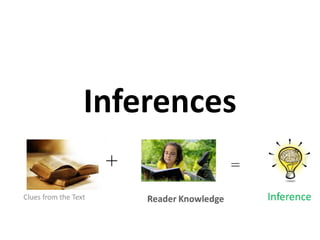
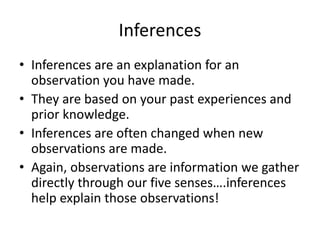
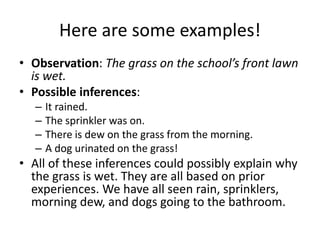
Inferences
Logical conclusions based on
observations and prior knowledge
What does it mean to make an inference?
Inferences
• Inferences are an explanation for an
observation you have made.
• They are based on your past experiences and
prior knowledge.
• Inferences are often changed when new
observations are made.
• Again, observations are information we gather
directly through our five senses….inferences
help explain those observations!
Here are some examples!
• Observation: The grass on the school’s front lawn
is wet.
• Possible inferences:
– It rained.
– The sprinkler was on.
– There is dew on the grass from the morning.
– A dog urinated on the grass!
• All of these inferences could possibly explain why
the grass is wet. They are all based on prior
experiences. We have all seen rain, sprinklers,
morning dew, and dogs going to the bathroom.
Here are some examples!
• Observation: The school fire alarm is going
off.
• Possible inferences:
– The school is on fire.
– We are having a fire drill.
– A student pulled the fire alarm.
• Again, these are all logical explanations for
why the fire alarm is going off.
Try this !
• Observation: A student is running towards a
teacher.
• Possible inferences:
?
Why might a student be sitting there?
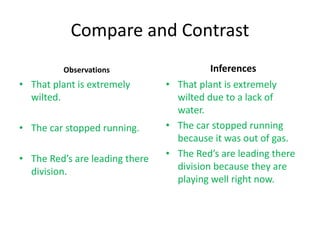
Compare and Contrast
Observations
• That plant is extremely
wilted.
• The car stopped running.
• The Red’s are leading there
division.
Inferences
• That plant is extremely
wilted due to a lack of
water.
• The car stopped running
because it was out of gas.
• The Red’s are leading there
division because they are
playing well right now.
Note the Difference.
• In laboratory exercises, record observations
NOT inferences
• Observations are used to summarize
• Inferences may be used when writing the
conclusion in your lab
• Inferences are used to explain

Inferences

  • 1.
  • 2.
    Logical conclusions basedon observations and prior knowledge What does it mean to make an inference?
  • 3.
    Inferences • Inferences arean explanation for an observation you have made. • They are based on your past experiences and prior knowledge. • Inferences are often changed when new observations are made. • Again, observations are information we gather directly through our five senses….inferences help explain those observations!
  • 4.
    Here are someexamples! • Observation: The grass on the school’s front lawn is wet. • Possible inferences: – It rained. – The sprinkler was on. – There is dew on the grass from the morning. – A dog urinated on the grass! • All of these inferences could possibly explain why the grass is wet. They are all based on prior experiences. We have all seen rain, sprinklers, morning dew, and dogs going to the bathroom.
  • 5.
    Here are someexamples! • Observation: The school fire alarm is going off. • Possible inferences: – The school is on fire. – We are having a fire drill. – A student pulled the fire alarm. • Again, these are all logical explanations for why the fire alarm is going off.
  • 6.
    Try this ! •Observation: A student is running towards a teacher. • Possible inferences: ? Why might a student be sitting there?
  • 7.
    Compare and Contrast Observations •That plant is extremely wilted. • The car stopped running. • The Red’s are leading there division. Inferences • That plant is extremely wilted due to a lack of water. • The car stopped running because it was out of gas. • The Red’s are leading there division because they are playing well right now.
  • 8.
    Note the Difference. •In laboratory exercises, record observations NOT inferences • Observations are used to summarize • Inferences may be used when writing the conclusion in your lab • Inferences are used to explain