Objectives
and
Specifications
Dr Nafisa Shaikh
Objectives
Objectives
What are Objectives?
Objectives
Objectives are specific,
measurable, short-term,
observable student behaviors.
They indicate the desirable
knowledge, skills, or attitudes to
be gained.
Objectives
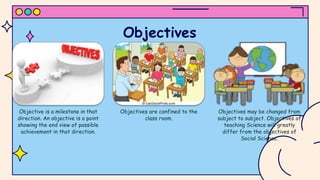
Objective is a milestone in that
direction. An objective is a point
showing the end view of possible
achievement in that direction.
Objectives are confined to the
class room.
Objectives may be changed from
subject to subject. Objectives of
teaching Science will greatly
differ from the objectives of
Social Science.
Objectives
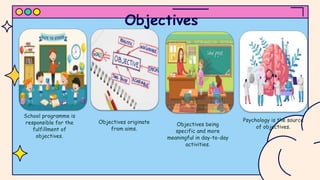
School programme is
responsible for the
fulfillment of
objectives.
Objectives originate
from aims.
Objectives being
specific and more
meaningful in day-to-day
activities.
Psychology is the source
of objectives.
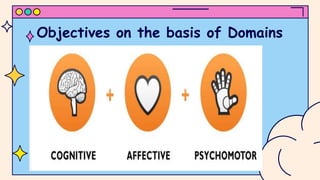
Objectives on the basis of Domains
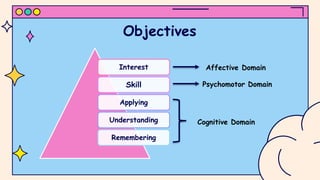
Objectives
Interest
Skill
Applying
Understanding
Remembering
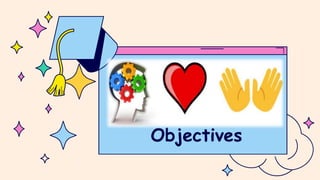
Cognitive Domain
Psychomotor Domain
Affective Domain
Remembering Objectives
Remembering Objectives involves
the recall of specifics and
universals, the recall of methods
and processes, or the recall of a
pattern, structure, or setting.
Understanding Objectives
refers to a type of
understanding such that the
individual knows what is being
communicated.
Applying Objectives
Applying Objective refers to the
use of abstractions in particular and
concrete situations.
Student selects, transfers and uses
data and principles to complete a
problem with a minimum of direction.
Skill Objectives
Skills objective describes the
ability of the students to
physically manipulate a tool or
instrument or develop appropriate
skill related to the subject.
Interest/Attitude Objectives
Objectives are designed
to change an individual's
attitude, choices, and
relationships.
Specification
Specification
Specification is a clear statement of
what a learner is expected to be able
to do, know about and/or value at the
completion of a unit of study, and how
well they should be expected to
achieve those outcomes.
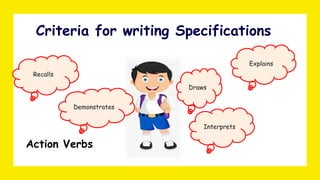
Criteria for writing Specifications
Explains
Draws
Recalls
Demonstrates
Interprets
Action Verbs
Verbs used in Specifications
Domains Objectives Specifications (verbs used)
Cognitive Remembering Recall, recognize, define, states, names
Understanding Explains, differentiates, answers, cites
example, sees relationship
Application Reasons, justifies, solves, predicts,
suggest.
Psychomotor Skill Draws accurately, reads correctly,
speaks fluently, labels correctly,
demonstrates
Affective Interest/Attitud
e
Develops positive attitude towards,
creates awareness, shows interest in
English – Be a Good Listener
● Pupil recalls characteristic of good listener
● Pupil frames sentences based on the new
vocabulary
● Pupil enlists the traits of a good and a bad
listener
● Pupil answers correctly to the listening activity
Specifications : Math - Fraction
● Pupil recognizes equivalent fractions.
● Pupil differentiates between equivalent and non
equivalent fraction.
● Pupil solves word problem related to addition of
fractions
● Pupil draws correctly the fractions in shaded form
Specification: Science – Methods of Preserving
Food
● Pupil states the methods of preserving food.
● Pupil differentiates between boiling and drying method of
preserving food
● Pupil justifies the method of preserving food for specific
food items
● Pupil suggest method of preserving food for new examples.
Specification: History – Stone tools
● Pupil recognizes different stone tools
● Pupil explains different stone tools
● Pupil suggest the use of each stone tool
correctly
● Pupil describes and draws each stone tool
objective specifications new.pptx

objective specifications new.pptx

  • 1.
  • 2.
  • 3.
  • 4.
  • 5.
    Objectives Objectives are specific, measurable,short-term, observable student behaviors. They indicate the desirable knowledge, skills, or attitudes to be gained.
  • 6.
    Objectives Objective is amilestone in that direction. An objective is a point showing the end view of possible achievement in that direction. Objectives are confined to the class room. Objectives may be changed from subject to subject. Objectives of teaching Science will greatly differ from the objectives of Social Science.
  • 7.
    Objectives School programme is responsiblefor the fulfillment of objectives. Objectives originate from aims. Objectives being specific and more meaningful in day-to-day activities. Psychology is the source of objectives.
  • 8.
    Objectives on thebasis of Domains
  • 9.
  • 10.
    Remembering Objectives Remembering Objectivesinvolves the recall of specifics and universals, the recall of methods and processes, or the recall of a pattern, structure, or setting.
  • 11.
    Understanding Objectives Understanding Objectives refersto a type of understanding such that the individual knows what is being communicated.
  • 12.
    Applying Objectives Applying Objectiverefers to the use of abstractions in particular and concrete situations. Student selects, transfers and uses data and principles to complete a problem with a minimum of direction.
  • 13.
    Skill Objectives Skills objectivedescribes the ability of the students to physically manipulate a tool or instrument or develop appropriate skill related to the subject.
  • 14.
    Interest/Attitude Objectives Objectives aredesigned to change an individual's attitude, choices, and relationships.
  • 15.
  • 16.
    Specification Specification is aclear statement of what a learner is expected to be able to do, know about and/or value at the completion of a unit of study, and how well they should be expected to achieve those outcomes.
  • 17.
    Criteria for writingSpecifications Explains Draws Recalls Demonstrates Interprets Action Verbs
  • 18.
    Verbs used inSpecifications Domains Objectives Specifications (verbs used) Cognitive Remembering Recall, recognize, define, states, names Understanding Explains, differentiates, answers, cites example, sees relationship Application Reasons, justifies, solves, predicts, suggest. Psychomotor Skill Draws accurately, reads correctly, speaks fluently, labels correctly, demonstrates Affective Interest/Attitud e Develops positive attitude towards, creates awareness, shows interest in
  • 19.
    English – Bea Good Listener ● Pupil recalls characteristic of good listener ● Pupil frames sentences based on the new vocabulary ● Pupil enlists the traits of a good and a bad listener ● Pupil answers correctly to the listening activity
  • 20.
    Specifications : Math- Fraction ● Pupil recognizes equivalent fractions. ● Pupil differentiates between equivalent and non equivalent fraction. ● Pupil solves word problem related to addition of fractions ● Pupil draws correctly the fractions in shaded form
  • 21.
    Specification: Science –Methods of Preserving Food ● Pupil states the methods of preserving food. ● Pupil differentiates between boiling and drying method of preserving food ● Pupil justifies the method of preserving food for specific food items ● Pupil suggest method of preserving food for new examples.
  • 22.
    Specification: History –Stone tools ● Pupil recognizes different stone tools ● Pupil explains different stone tools ● Pupil suggest the use of each stone tool correctly ● Pupil describes and draws each stone tool