Solid Geometry
The student is able to (I can):
• Classify three-dimensional figures according to their
properties.
• Use nets and cross sections to analyze three-dimensional
figures.
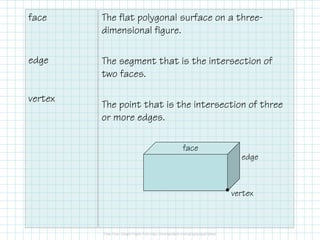
face
edge
vertex
The flat polygonal surface on a three-
dimensional figure.
The segment that is the intersection of
two faces.
The point that is the intersection of three
or more edges.
face
edge
vertex•
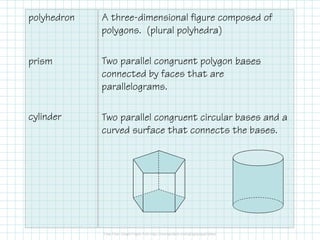
polyhedron
prism
cylinder
A three-dimensional figure composed of
polygons. (plural polyhedra)
Two parallel congruent polygon bases
connected by faces that are
parallelograms.
Two parallel congruent circular bases and a
curved surface that connects the bases.
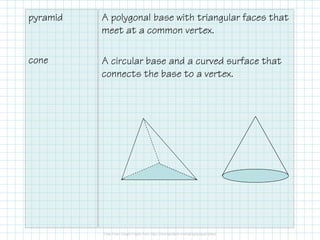
pyramid
cone
A polygonal base with triangular faces that
meet at a common vertex.
A circular base and a curved surface that
connects the base to a vertex.
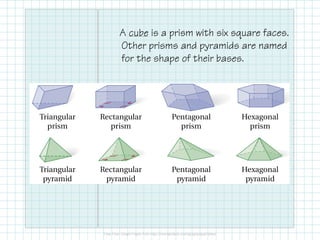
A cube is a prism with six square faces.
Other prisms and pyramids are named
for the shape of their bases.
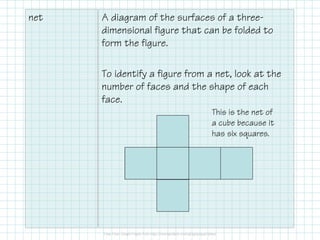
net A diagram of the surfaces of a three-
dimensional figure that can be folded to
form the figure.
To identify a figure from a net, look at the
number of faces and the shape of each
face.
This is the net of
a cube because it
has six squares.
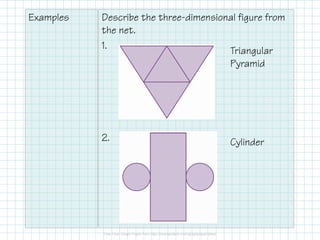
Examples Describe the three-dimensional figure from
the net.
1.
2.
Triangular
Pyramid
Cylinder
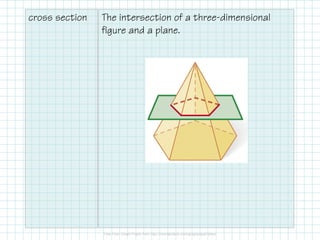
cross section The intersection of a three-dimensional
figure and a plane.
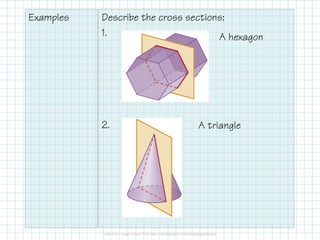
Examples Describe the cross sections:
1.
2.
A hexagon
A triangle
Euler’s
Formula
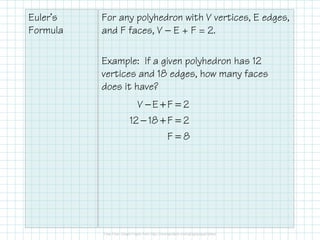
For any polyhedron with V vertices, E edges,
and F faces, V − E + F = 2.
Example: If a given polyhedron has 12
vertices and 18 edges, how many faces
does it have?
− + =
− + =
=
V E F 2
12 18 F 2
F 8
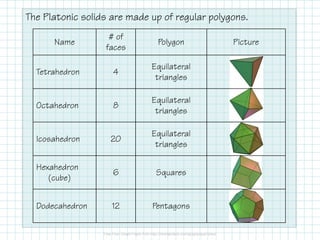
The Platonic solids are made up of regular polygons.
Name
# of
faces
Polygon Picture
Tetrahedron 4
Equilateral
triangles
Octahedron 8
Equilateral
triangles
Icosahedron 20
Equilateral
triangles
Hexahedron
(cube)
6 Squares
Dodecahedron 12 Pentagons

Obj. 42 Solid Geometry

  • 1.
    Solid Geometry The studentis able to (I can): • Classify three-dimensional figures according to their properties. • Use nets and cross sections to analyze three-dimensional figures.
  • 2.
    face edge vertex The flat polygonalsurface on a three- dimensional figure. The segment that is the intersection of two faces. The point that is the intersection of three or more edges. face edge vertex•
  • 3.
    polyhedron prism cylinder A three-dimensional figurecomposed of polygons. (plural polyhedra) Two parallel congruent polygon bases connected by faces that are parallelograms. Two parallel congruent circular bases and a curved surface that connects the bases.
  • 4.
    pyramid cone A polygonal basewith triangular faces that meet at a common vertex. A circular base and a curved surface that connects the base to a vertex.
  • 5.
    A cube isa prism with six square faces. Other prisms and pyramids are named for the shape of their bases.
  • 6.
    net A diagramof the surfaces of a three- dimensional figure that can be folded to form the figure. To identify a figure from a net, look at the number of faces and the shape of each face. This is the net of a cube because it has six squares.
  • 7.
    Examples Describe thethree-dimensional figure from the net. 1. 2. Triangular Pyramid Cylinder
  • 8.
    cross section Theintersection of a three-dimensional figure and a plane.
  • 9.
    Examples Describe thecross sections: 1. 2. A hexagon A triangle
  • 10.
    Euler’s Formula For any polyhedronwith V vertices, E edges, and F faces, V − E + F = 2. Example: If a given polyhedron has 12 vertices and 18 edges, how many faces does it have? − + = − + = = V E F 2 12 18 F 2 F 8
  • 11.
    The Platonic solidsare made up of regular polygons. Name # of faces Polygon Picture Tetrahedron 4 Equilateral triangles Octahedron 8 Equilateral triangles Icosahedron 20 Equilateral triangles Hexahedron (cube) 6 Squares Dodecahedron 12 Pentagons