Obj. 29 Area Formulas
The student is able to (I can):
• Develop and use formulas for finding the areas of
triangles and quadrilaterals
area

The number of square units that will
completely cover a shape without
overlapping

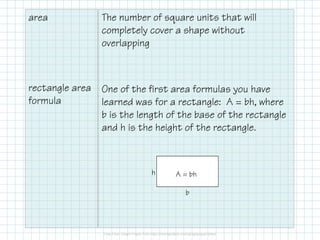
rectangle area One of the first area formulas you have
formula
learned was for a rectangle: A = bh, where
b is the length of the base of the rectangle
and h is the height of the rectangle.

h

A = bh
b
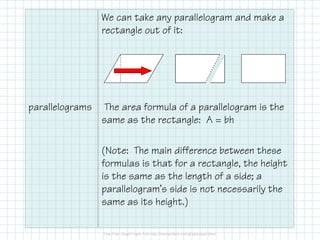
We can take any parallelogram and make a
rectangle out of it:

parallelograms

The area formula of a parallelogram is the
same as the rectangle: A = bh
(Note: The main difference between these
formulas is that for a rectangle, the height
is the same as the length of a side; a
parallelogram’s side is not necessarily the
same as its height.)
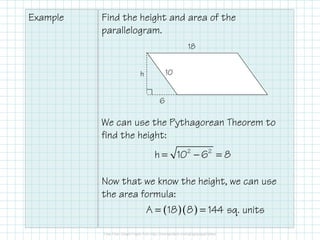
Example

Find the height and area of the
parallelogram.
18
10

h
6

We can use the Pythagorean Theorem to
find the height:

h = 102 − 62 = 8
Now that we know the height, we can use
the area formula:
A = ( 18 )( 8 ) = 144 sq. units
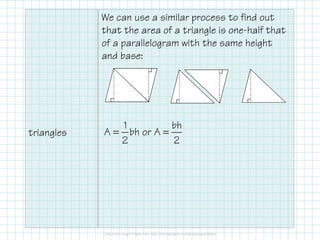
We can use a similar process to find out
that the area of a triangle is one-half that
of a parallelogram with the same height
and base:

triangles

1
bh
A = bh or A =
2
2
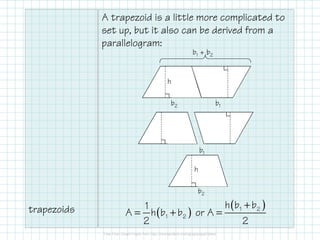
A trapezoid is a little more complicated to
set up, but it also can be derived from a
parallelogram:
b1 + b2

h
b2

b1

b1
h
b2

trapezoids

h (b1 + b2 )
1
A = h ( b 1 + b2 ) or A =
2
2
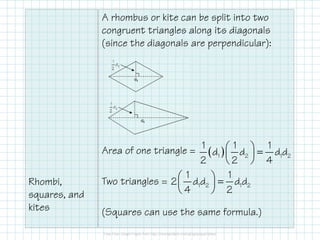
A rhombus or kite can be split into two
congruent triangles along its diagonals
(since the diagonals are perpendicular):

Rhombi,
squares, and
kites


Area of one triangle = 1 ( d1 )  1 d2  = 1 d1d2

2
2  4
1
 1
Two triangles = 2  d1d2  = d1d2

4
 2
(Squares can use the same formula.)
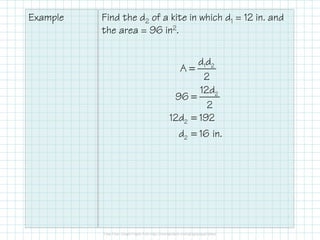
Example

Find the d2 of a kite in which d1 = 12 in. and
the area = 96 in2.
d1d2
A=
2
12d2
96 =
2
12d2 = 192
d2 = 16 in.

Obj. 29 Area Formulas

  • 1.
    Obj. 29 AreaFormulas The student is able to (I can): • Develop and use formulas for finding the areas of triangles and quadrilaterals
  • 2.
    area The number ofsquare units that will completely cover a shape without overlapping rectangle area One of the first area formulas you have formula learned was for a rectangle: A = bh, where b is the length of the base of the rectangle and h is the height of the rectangle. h A = bh b
  • 3.
    We can takeany parallelogram and make a rectangle out of it: parallelograms The area formula of a parallelogram is the same as the rectangle: A = bh (Note: The main difference between these formulas is that for a rectangle, the height is the same as the length of a side; a parallelogram’s side is not necessarily the same as its height.)
  • 4.
    Example Find the heightand area of the parallelogram. 18 10 h 6 We can use the Pythagorean Theorem to find the height: h = 102 − 62 = 8 Now that we know the height, we can use the area formula: A = ( 18 )( 8 ) = 144 sq. units
  • 5.
    We can usea similar process to find out that the area of a triangle is one-half that of a parallelogram with the same height and base: triangles 1 bh A = bh or A = 2 2
  • 6.
    A trapezoid isa little more complicated to set up, but it also can be derived from a parallelogram: b1 + b2 h b2 b1 b1 h b2 trapezoids h (b1 + b2 ) 1 A = h ( b 1 + b2 ) or A = 2 2
  • 7.
    A rhombus orkite can be split into two congruent triangles along its diagonals (since the diagonals are perpendicular): Rhombi, squares, and kites  Area of one triangle = 1 ( d1 )  1 d2  = 1 d1d2  2 2  4 1  1 Two triangles = 2  d1d2  = d1d2  4  2 (Squares can use the same formula.)
  • 8.
    Example Find the d2of a kite in which d1 = 12 in. and the area = 96 in2. d1d2 A= 2 12d2 96 = 2 12d2 = 192 d2 = 16 in.