Obj. 26 Parallelograms
The student is able to (I can):
• Prove and apply properties of parallelograms.
• Use properties of parallelograms to solve problems.
• Prove that a given quadrilateral is a parallelogram.
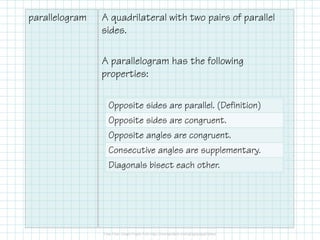
parallelogram

A quadrilateral with two pairs of parallel
sides.
A parallelogram has the following
properties:
Opposite sides are parallel. (Definition)
Opposite sides are congruent.
Opposite angles are congruent.
Consecutive angles are supplementary.
Diagonals bisect each other.
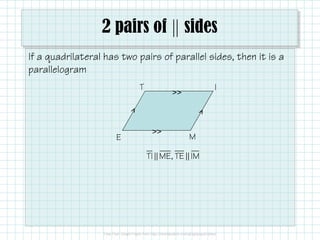
2 pairs of sides
If a quadrilateral has two pairs of parallel sides, then it is a
parallelogram
T

>>

E

I

>>

M

TI ME, TE IM
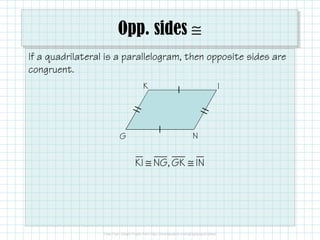
Opp. sides ≅
If a quadrilateral is a parallelogram, then opposite sides are
congruent.
K

G

I

N

KI ≅ NG, GK ≅ IN
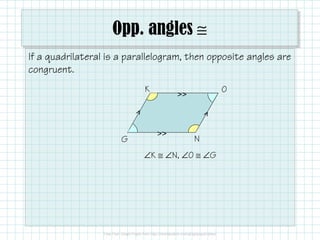
Opp. angles ≅
If a quadrilateral is a parallelogram, then opposite angles are
congruent.
K

>>

G

O

>>

N

∠K ≅ ∠N, ∠O ≅ ∠G
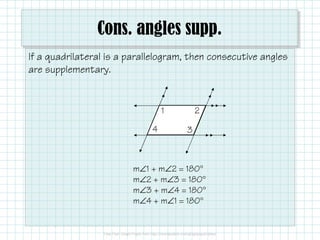
Cons. angles supp.
If a quadrilateral is a parallelogram, then consecutive angles
are supplementary.

1
4

2
3

m∠1 + m∠2 = 180°
m∠2 + m∠3 = 180°
m∠3 + m∠4 = 180°
m∠4 + m∠1 = 180°
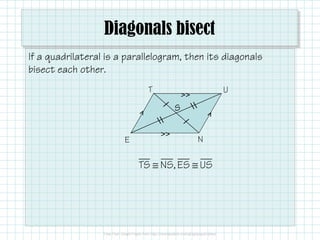
Diagonals bisect
If a quadrilateral is a parallelogram, then its diagonals
bisect each other.
T

U

>>

S
>>

E

N

TS ≅ NS, ES ≅ US
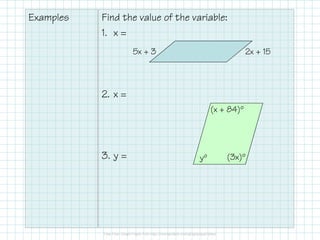
Examples

Find the value of the variable:
1. x =
5x + 3

2x + 15

2. x =
(x + 84)º

3. y =

yº

(3x)º
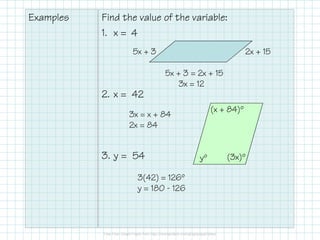
Examples

Find the value of the variable:
1. x = 4
5x + 3

2x + 15
5x + 3 = 2x + 15
3x = 12

2. x = 42
(x + 84)º

3x = x + 84
2x = 84

3. y = 54
3(42) = 126º
y = 180 - 126

yº

(3x)º
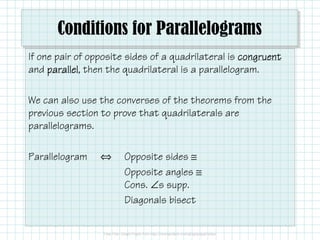
Conditions for Parallelograms
If one pair of opposite sides of a quadrilateral is congruent
and parallel then the quadrilateral is a parallelogram.
parallel,
We can also use the converses of the theorems from the
previous section to prove that quadrilaterals are
parallelograms.
Parallelogram

⇔

Opposite sides ≅
Opposite angles ≅
Cons. ∠s supp.
Diagonals bisect

Obj. 26 Parallelograms

  • 1.
    Obj. 26 Parallelograms Thestudent is able to (I can): • Prove and apply properties of parallelograms. • Use properties of parallelograms to solve problems. • Prove that a given quadrilateral is a parallelogram.
  • 2.
    parallelogram A quadrilateral withtwo pairs of parallel sides. A parallelogram has the following properties: Opposite sides are parallel. (Definition) Opposite sides are congruent. Opposite angles are congruent. Consecutive angles are supplementary. Diagonals bisect each other.
  • 3.
    2 pairs ofsides If a quadrilateral has two pairs of parallel sides, then it is a parallelogram T >> E I >> M TI ME, TE IM
  • 4.
    Opp. sides ≅ Ifa quadrilateral is a parallelogram, then opposite sides are congruent. K G I N KI ≅ NG, GK ≅ IN
  • 5.
    Opp. angles ≅ Ifa quadrilateral is a parallelogram, then opposite angles are congruent. K >> G O >> N ∠K ≅ ∠N, ∠O ≅ ∠G
  • 6.
    Cons. angles supp. Ifa quadrilateral is a parallelogram, then consecutive angles are supplementary. 1 4 2 3 m∠1 + m∠2 = 180° m∠2 + m∠3 = 180° m∠3 + m∠4 = 180° m∠4 + m∠1 = 180°
  • 7.
    Diagonals bisect If aquadrilateral is a parallelogram, then its diagonals bisect each other. T U >> S >> E N TS ≅ NS, ES ≅ US
  • 8.
    Examples Find the valueof the variable: 1. x = 5x + 3 2x + 15 2. x = (x + 84)º 3. y = yº (3x)º
  • 9.
    Examples Find the valueof the variable: 1. x = 4 5x + 3 2x + 15 5x + 3 = 2x + 15 3x = 12 2. x = 42 (x + 84)º 3x = x + 84 2x = 84 3. y = 54 3(42) = 126º y = 180 - 126 yº (3x)º
  • 10.
    Conditions for Parallelograms Ifone pair of opposite sides of a quadrilateral is congruent and parallel then the quadrilateral is a parallelogram. parallel, We can also use the converses of the theorems from the previous section to prove that quadrilaterals are parallelograms. Parallelogram ⇔ Opposite sides ≅ Opposite angles ≅ Cons. ∠s supp. Diagonals bisect