INTRODUCTION 
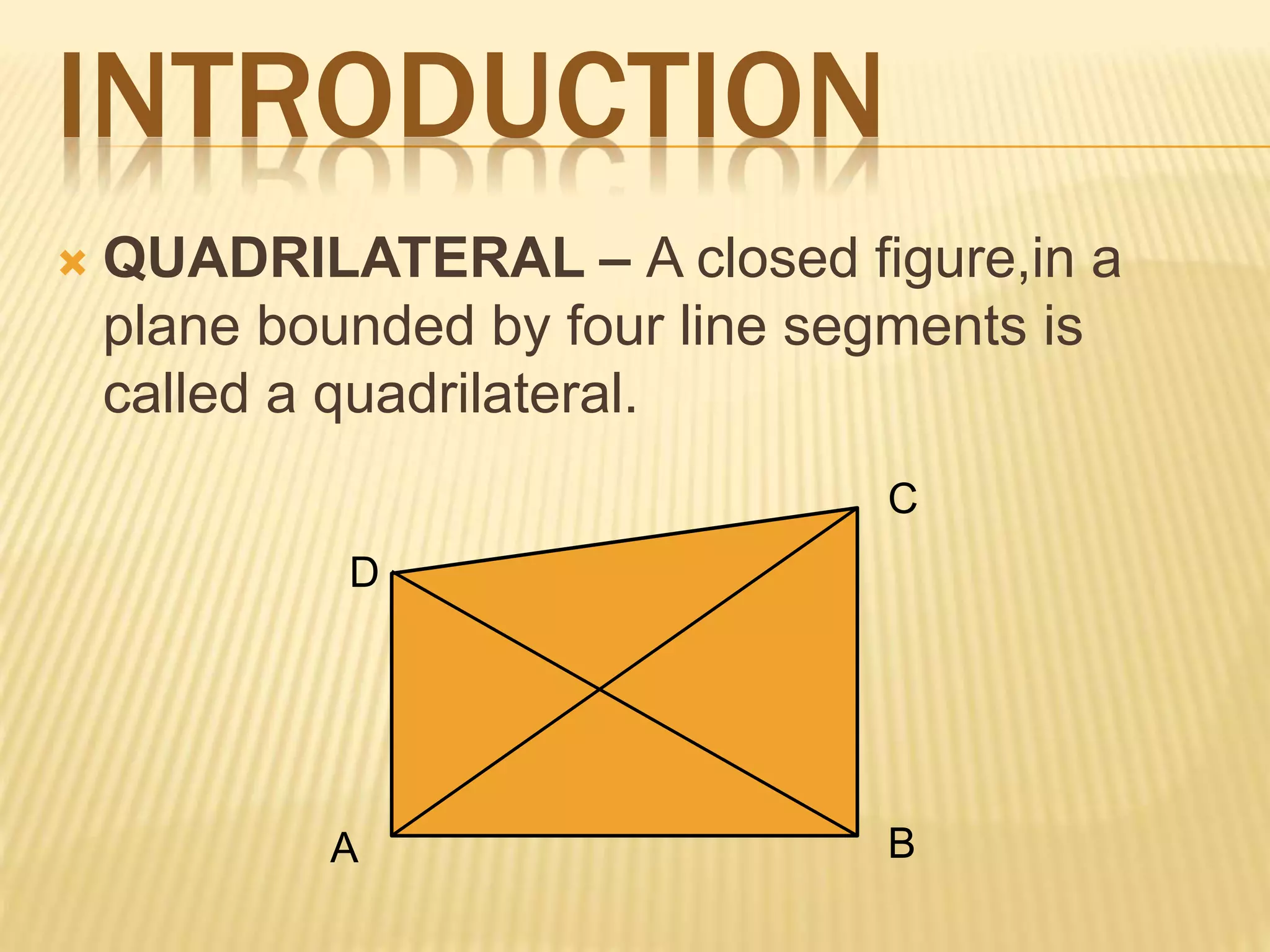
 QUADRILATERAL – A closed figure,in a 
plane bounded by four line segments is 
called a quadrilateral. 
C 
D 
A B
ANGLE SUM PROPERTY OF 
QUADRILATERAL 
 The sum of all the angles of a 
quadrilateral is 360°.This can be verified 
by drawing a diagonal and dividing a 
quadrilateral into two triangles. 
D C 
A B
TYPES OF QUADRILATERALS 
 Trapezium 
 Parallelogram 
 Rectangle 
 Rhombus 
 Square 
 Kite
TRAPEZIUM 
 A quadrilateral in which one pair of 
opposite side is parallel is called a 
TRAPEZIUM. 
 In figure , ABCD is a trapezium because 
here ,AB II DC. 
A 
Parallel sides never meet. 
A B 
D C
PARALLELOGRAM 
 A quadrilateral in which both pairs of 
opposite sides are parallel is called a 
PARALLELOGRAM. 
 In the figure , ABCD is a parallelogram 
because ABIIDC and DAIICB. 
A B 
Indicates equal 
sides 
D C
RECTANGLE 
 It is a special parallelogram whose one 
angle is right angle. 
 In the figure , ABCD is a rectangle 
because ABIICD and ADIIBC and A=90°. 
B 
Indicates equal sides 
Box indicates 900 angle 
A 
D C
RHOMBUS 
 It is a special parallelogram whose all 
sides are equal. 
 In the figure , ABCD is a rhombus 
because ABIICD , ADIIBC and 
AB=ABC=CD=DA. B 
D C 
All four sides are equal
SQUARE 
 It is a special parallelogram in which all 
the sides are equal and one angle is right 
angle. 
 In the figure , ABCD is a square because 
ABIICD ,ADIIBC and AB=BC=CD=DA and 
A=90°. Indicates equal sides 
Box indicates 900 angle
KITE 
 A quadrilateral in which two pairs of 
adjacent sides are equal is called a KITE. 
 In the figure , ABCD is a kite because 
AD=CD and AB=BC. 
Indicates equal 
sides
1.Karan Singh Rawat 
2.Abhishek Bhardwaj 
3.Samarth Sharma 
4.Harshit Sharma 
5.Atul Kumar 
6.Paras Gupta 
7.Diwaker Baggan 
8.Nitin Mehta

Quadrilateral

  • 2.
    INTRODUCTION  QUADRILATERAL– A closed figure,in a plane bounded by four line segments is called a quadrilateral. C D A B
  • 3.
    ANGLE SUM PROPERTYOF QUADRILATERAL  The sum of all the angles of a quadrilateral is 360°.This can be verified by drawing a diagonal and dividing a quadrilateral into two triangles. D C A B
  • 4.
    TYPES OF QUADRILATERALS  Trapezium  Parallelogram  Rectangle  Rhombus  Square  Kite
  • 5.
    TRAPEZIUM  Aquadrilateral in which one pair of opposite side is parallel is called a TRAPEZIUM.  In figure , ABCD is a trapezium because here ,AB II DC. A Parallel sides never meet. A B D C
  • 6.
    PARALLELOGRAM  Aquadrilateral in which both pairs of opposite sides are parallel is called a PARALLELOGRAM.  In the figure , ABCD is a parallelogram because ABIIDC and DAIICB. A B Indicates equal sides D C
  • 7.
    RECTANGLE  Itis a special parallelogram whose one angle is right angle.  In the figure , ABCD is a rectangle because ABIICD and ADIIBC and A=90°. B Indicates equal sides Box indicates 900 angle A D C
  • 8.
    RHOMBUS  Itis a special parallelogram whose all sides are equal.  In the figure , ABCD is a rhombus because ABIICD , ADIIBC and AB=ABC=CD=DA. B D C All four sides are equal
  • 9.
    SQUARE  Itis a special parallelogram in which all the sides are equal and one angle is right angle.  In the figure , ABCD is a square because ABIICD ,ADIIBC and AB=BC=CD=DA and A=90°. Indicates equal sides Box indicates 900 angle
  • 10.
    KITE  Aquadrilateral in which two pairs of adjacent sides are equal is called a KITE.  In the figure , ABCD is a kite because AD=CD and AB=BC. Indicates equal sides
  • 11.
    1.Karan Singh Rawat 2.Abhishek Bhardwaj 3.Samarth Sharma 4.Harshit Sharma 5.Atul Kumar 6.Paras Gupta 7.Diwaker Baggan 8.Nitin Mehta