Obj. 20 Coordinate Proof
The student is able to (I can):
• Prove conjectures about geometric figures on a
coordinate plane
coordinate
proof

A style of proof that uses coordinate
geometry and algebra. Once a figure is
placed in the coordinate plane, we can use
slope, the coordinates of the vertices, the
Distance Formula, or the Midpoint Formula
to prove statements about the figure.

Example

Given: Rectangle ABCD with A(0, 0),
B(4, 0), C(4, 10), and D(0, 10)
Prove: The diagonals bisect each other.
The midpoint of AC is (2, 5), and the
midpoint of BD is also (2, 5). Therefore,
the two diagonals bisect each other.
Example
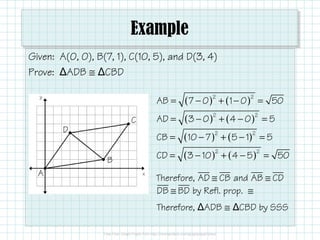
Given: A(0, 0), B(7, 1), C(10, 5), and D(3, 4)
Prove: ADB ≅ CBD
2

2

AB = ( 7 − 0 ) + ( 1 − 0 ) = 50
C
D

2

2

2

CB = ( 10 − 7 ) + ( 5 − 1) = 5
2

B
A

2

AD = ( 3 − 0 ) + ( 4 − 0 ) = 5

2

CD = ( 3 − 10 ) + ( 4 − 5 ) = 50
Therefore, AD ≅ CB and AB ≅ CD
DB ≅ BD by Refl. prop. ≅
Therefore, ADB ≅ CBD by SSS

Obj. 20 Coordinate Proof

  • 1.
    Obj. 20 CoordinateProof The student is able to (I can): • Prove conjectures about geometric figures on a coordinate plane
  • 2.
    coordinate proof A style ofproof that uses coordinate geometry and algebra. Once a figure is placed in the coordinate plane, we can use slope, the coordinates of the vertices, the Distance Formula, or the Midpoint Formula to prove statements about the figure. Example Given: Rectangle ABCD with A(0, 0), B(4, 0), C(4, 10), and D(0, 10) Prove: The diagonals bisect each other. The midpoint of AC is (2, 5), and the midpoint of BD is also (2, 5). Therefore, the two diagonals bisect each other.
  • 3.
    Example Given: A(0, 0),B(7, 1), C(10, 5), and D(3, 4) Prove: ADB ≅ CBD 2 2 AB = ( 7 − 0 ) + ( 1 − 0 ) = 50 C D 2 2 2 CB = ( 10 − 7 ) + ( 5 − 1) = 5 2 B A 2 AD = ( 3 − 0 ) + ( 4 − 0 ) = 5 2 CD = ( 3 − 10 ) + ( 4 − 5 ) = 50 Therefore, AD ≅ CB and AB ≅ CD DB ≅ BD by Refl. prop. ≅ Therefore, ADB ≅ CBD by SSS