Calculate The perimeter and
area of triangle and
Rectangular Shape
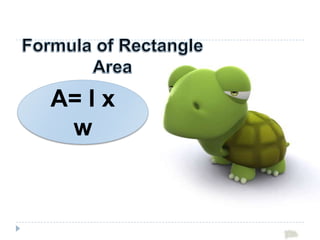
A= l x
w
Formula of
Perimeter
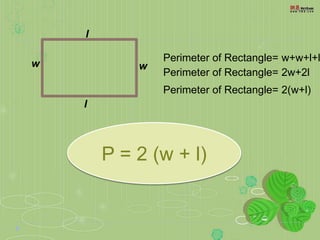
P = 2 (w + l)
l
w w
l
Perimeter of Rectangle= w+w+l+l
Perimeter of Rectangle= 2w+2l
Perimeter of Rectangle= 2(w+l)
Exercise
1. Calculate the perimeter and the area of rectangles
with the following measures:
a. Length is 17 dm and width is 7 dm.
b. Length is 20 mm and width is 5 mm.
c. Length is 25 m and width is 8 cm.
a c t i iv t y 2
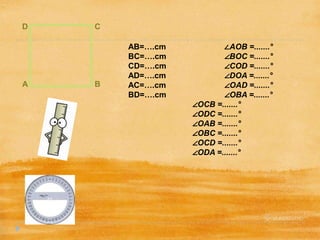
D
A B
C
AB=….cm ∠AOB =.......°
BC=….cm ∠BOC =.......°
CD=….cm ∠COD =.......°
AD=….cm ∠DOA =.......°
AC=….cm ∠OAD =.......°
BD=….cm ∠OBA =.......°
∠OCB =.......°
∠ODC =.......°
∠OAB =.......°
∠OBC =.......°
∠OCD =.......°
∠ODA =.......°
Properties
1. The opposite sides are parallel.
2. All of the angles are right angles.
3. The diagonals are equal and bisect each other.
4. All the sides are equal.
5. The diagonals 1. The opposite sides are parallel.
2. All of the angles are right angles.
3. The diagonals are equal and bisect each other.
4. All the sides are equal.
5. The diagonals bisect the angles.
6. The diagonals cross perpendicularly.
Definition
Based on those properties, we can
say that a square is a rectangle
with 4 equal sides and one of its
angle is right angle.
Formula of The
Area
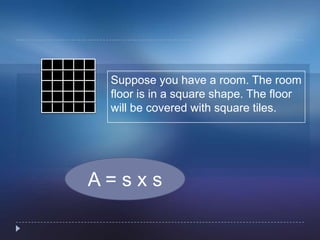
A = s x s
Suppose you have a room. The room
floor is in a square shape. The floor
will be covered with square tiles.
Formula of
Perimeter
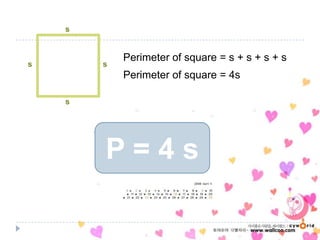
P = 4 s
s
s
s
s
Perimeter of square = s + s + s + s
Perimeter of square = 4s
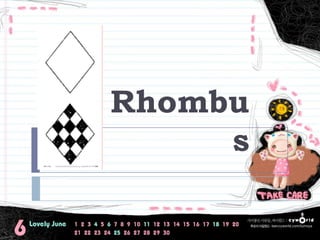
Rhombu
s
D
i
nf
e
i
i
ot
n
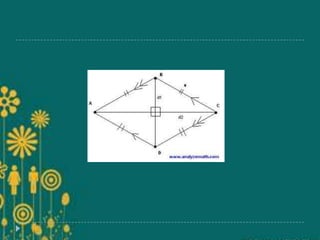
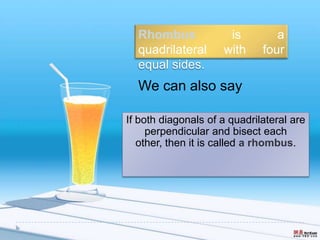
If both diagonals of a quadrilateral are
perpendicular and bisect each
other, then it is called a rhombus.
Rhombus is a
quadrilateral with four
equal sides.
We can also say
a c t i iv t y 3
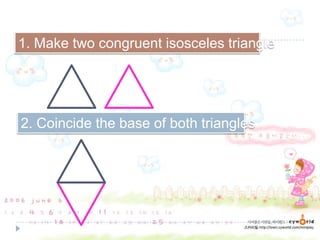
1. Make two congruent isosceles triangle
2. Coincide the base of both triangles
Properties
 All sides are equal
 Opposite sides are parallel
 Vertical angles are equal
 The diagonals bisect the angles
 Both diagonals are perpendicular and bisect
each other
 Diagonals bisect the rhombus or they are the
axis lines
 The sum of the two adjacent angles is 180°
Formula of
The Area
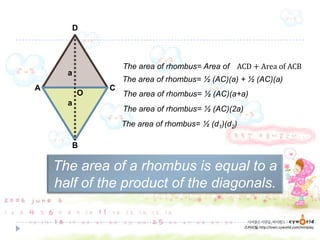
The area of rhombus= Area of ACD + Area of ACB
The area of rhombus= ½ (AC)(a) + ½ (AC)(a)
The area of rhombus= ½ (AC)(a+a)
The area of rhombus= ½ (AC)(2a)
The area of rhombus= ½ (d1)(d2)
a
a
C
D
A
B
O
The area of a rhombus is equal to a
half of the product of the diagonals.
Formula of
Perimeter
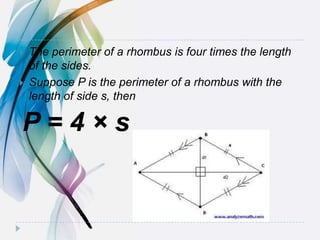
 The perimeter of a rhombus is four times the length
of the sides.

 Suppose P is the perimeter of a rhombus with the
length of side s, then
P = 4 × s
Exercise
The area of rhombus
ABCD is 180 cm2 .
The length of
diagonal AC is 24
cm. what is the
length of BD?
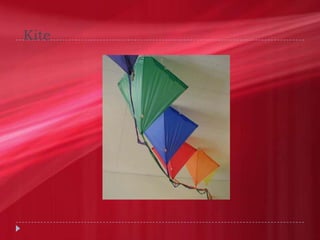
Kite
Kite is a quadrilateral with
diagonals perpendicular to each
other and one of the diagonals
bisects the other.
a c t i iv t y 4
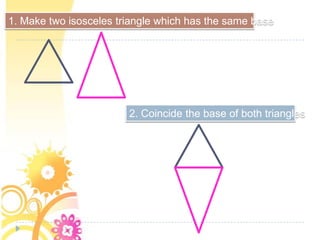
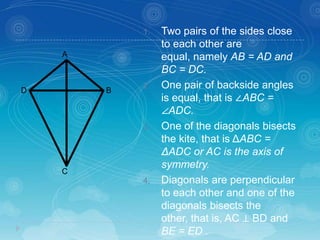
1. Make two isosceles triangle which has the same base
2. Coincide the base of both triangles
Propertie
s
1. Two pairs of the sides close
to each other are
equal, namely AB = AD and
BC = DC.
2. One pair of backside angles
is equal, that is ∠ABC =
∠ADC.
3. One of the diagonals bisects
the kite, that is ΔABC =
ΔADC or AC is the axis of
symmetry.
4. Diagonals are perpendicular
to each other and one of the
diagonals bisects the
other, that is, AC ⊥ BD and
BE = ED .
B
C
D
A
Formula of
The Area
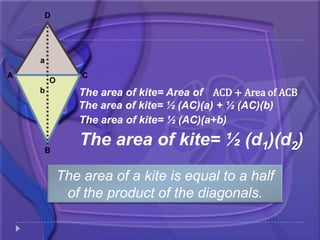
The area of kite= Area of ACD + Area of ACB
The area of kite= ½ (AC)(a) + ½ (AC)(b)
The area of kite= ½ (AC)(a+b)
The area of kite= ½ (d1)(d2)
a
b
C
D
A
B
O
The area of a kite is equal to a half
of the product of the diagonals.
Formula of
Perimeter
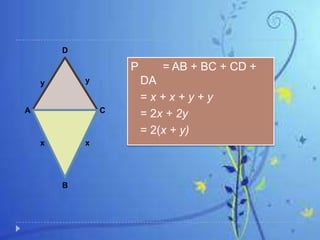
P = AB + BC + CD +
DA
= x + x + y + y
= 2x + 2y
= 2(x + y)
C
D
A
B
y y
x x
Exercise
Find the area of a kite with its diagonal:
a. 8cm and 12cm
b. 9cm and 16cm
c. 15cm and 18cm
d. 13cm and 21cm
Formula of The Area
D
i
s
c
v
o
e r
y
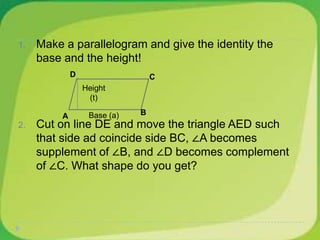
1. Make a parallelogram and give the identity the
base and the height!
2. Cut on line DE and move the triangle AED such
that side ad coincide side BC, ∠A becomes
supplement of ∠B, and ∠D becomes complement
of ∠C. What shape do you get?
B
D C
A
Height
(t)
Base (a)
3. What can you say about the area of the rectangle
and the area of the initial parallelogram? Are they
the same?
4. What is the area of a rectangular?
5. What can you conclude about the area of
parallelogram?
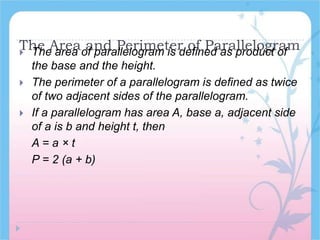
The Area and Perimeter of Parallelogram The area of parallelogram is defined as product of
the base and the height.
 The perimeter of a parallelogram is defined as twice
of two adjacent sides of the parallelogram.
 If a parallelogram has area A, base a, adjacent side
of a is b and height t, then
A = a × t
P = 2 (a + b)
T
A
N
K
H
u
y
o

Perimeter and area

  • 1.
    Calculate The perimeterand area of triangle and Rectangular Shape
  • 2.
  • 3.
  • 4.
    P = 2(w + l) l w w l Perimeter of Rectangle= w+w+l+l Perimeter of Rectangle= 2w+2l Perimeter of Rectangle= 2(w+l)
  • 5.
    Exercise 1. Calculate theperimeter and the area of rectangles with the following measures: a. Length is 17 dm and width is 7 dm. b. Length is 20 mm and width is 5 mm. c. Length is 25 m and width is 8 cm.
  • 6.
    a c ti iv t y 2
  • 7.
    D A B C AB=….cm ∠AOB=.......° BC=….cm ∠BOC =.......° CD=….cm ∠COD =.......° AD=….cm ∠DOA =.......° AC=….cm ∠OAD =.......° BD=….cm ∠OBA =.......° ∠OCB =.......° ∠ODC =.......° ∠OAB =.......° ∠OBC =.......° ∠OCD =.......° ∠ODA =.......°
  • 8.
  • 9.
    1. The oppositesides are parallel. 2. All of the angles are right angles. 3. The diagonals are equal and bisect each other. 4. All the sides are equal. 5. The diagonals 1. The opposite sides are parallel. 2. All of the angles are right angles. 3. The diagonals are equal and bisect each other. 4. All the sides are equal. 5. The diagonals bisect the angles. 6. The diagonals cross perpendicularly.
  • 10.
  • 11.
    Based on thoseproperties, we can say that a square is a rectangle with 4 equal sides and one of its angle is right angle.
  • 12.
  • 13.
    A = sx s Suppose you have a room. The room floor is in a square shape. The floor will be covered with square tiles.
  • 14.
  • 15.
    P = 4s s s s s Perimeter of square = s + s + s + s Perimeter of square = 4s
  • 16.
  • 18.
  • 19.
    If both diagonalsof a quadrilateral are perpendicular and bisect each other, then it is called a rhombus. Rhombus is a quadrilateral with four equal sides. We can also say
  • 20.
    a c ti iv t y 3
  • 21.
    1. Make twocongruent isosceles triangle 2. Coincide the base of both triangles
  • 22.
  • 23.
     All sidesare equal  Opposite sides are parallel  Vertical angles are equal  The diagonals bisect the angles  Both diagonals are perpendicular and bisect each other  Diagonals bisect the rhombus or they are the axis lines  The sum of the two adjacent angles is 180°
  • 24.
  • 25.
    The area ofrhombus= Area of ACD + Area of ACB The area of rhombus= ½ (AC)(a) + ½ (AC)(a) The area of rhombus= ½ (AC)(a+a) The area of rhombus= ½ (AC)(2a) The area of rhombus= ½ (d1)(d2) a a C D A B O The area of a rhombus is equal to a half of the product of the diagonals.
  • 26.
  • 27.
     The perimeterof a rhombus is four times the length of the sides.  Suppose P is the perimeter of a rhombus with the length of side s, then P = 4 × s

  • 28.
    Exercise The area ofrhombus ABCD is 180 cm2 . The length of diagonal AC is 24 cm. what is the length of BD?
  • 29.
  • 30.
    Kite is aquadrilateral with diagonals perpendicular to each other and one of the diagonals bisects the other.
  • 31.
    a c ti iv t y 4
  • 32.
    1. Make twoisosceles triangle which has the same base 2. Coincide the base of both triangles
  • 33.
  • 34.
    1. Two pairsof the sides close to each other are equal, namely AB = AD and BC = DC. 2. One pair of backside angles is equal, that is ∠ABC = ∠ADC. 3. One of the diagonals bisects the kite, that is ΔABC = ΔADC or AC is the axis of symmetry. 4. Diagonals are perpendicular to each other and one of the diagonals bisects the other, that is, AC ⊥ BD and BE = ED . B C D A
  • 35.
  • 36.
    The area ofkite= Area of ACD + Area of ACB The area of kite= ½ (AC)(a) + ½ (AC)(b) The area of kite= ½ (AC)(a+b) The area of kite= ½ (d1)(d2) a b C D A B O The area of a kite is equal to a half of the product of the diagonals.
  • 37.
  • 38.
    P = AB+ BC + CD + DA = x + x + y + y = 2x + 2y = 2(x + y) C D A B y y x x
  • 39.
    Exercise Find the areaof a kite with its diagonal: a. 8cm and 12cm b. 9cm and 16cm c. 15cm and 18cm d. 13cm and 21cm
  • 40.
  • 41.
  • 42.
    1. Make aparallelogram and give the identity the base and the height! 2. Cut on line DE and move the triangle AED such that side ad coincide side BC, ∠A becomes supplement of ∠B, and ∠D becomes complement of ∠C. What shape do you get? B D C A Height (t) Base (a)
  • 43.
    3. What canyou say about the area of the rectangle and the area of the initial parallelogram? Are they the same? 4. What is the area of a rectangular? 5. What can you conclude about the area of parallelogram?
  • 44.
    The Area andPerimeter of Parallelogram The area of parallelogram is defined as product of the base and the height.  The perimeter of a parallelogram is defined as twice of two adjacent sides of the parallelogram.  If a parallelogram has area A, base a, adjacent side of a is b and height t, then A = a × t P = 2 (a + b)
  • 45.