

Thinking differently 
about Social Presence 
in Online Courses 
Patrick R. Lowenthal 
Boise State University 
@plowenthal 
slides @ patricklowenthal.com
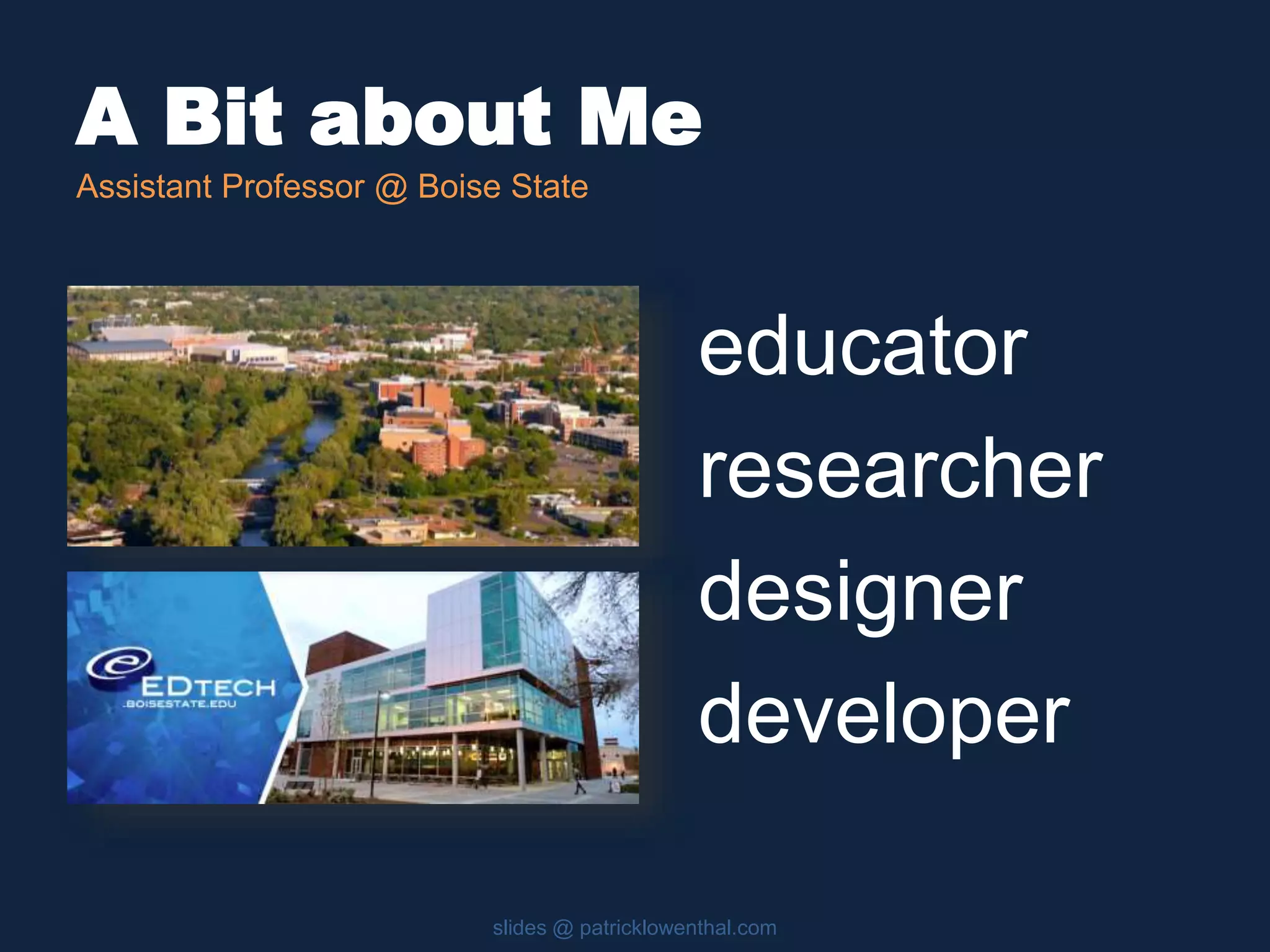
A Bit about Me 
Assistant Professor @ Boise State 
educator 
researcher 
designer 
developer 
slides @ patricklowenthal.com
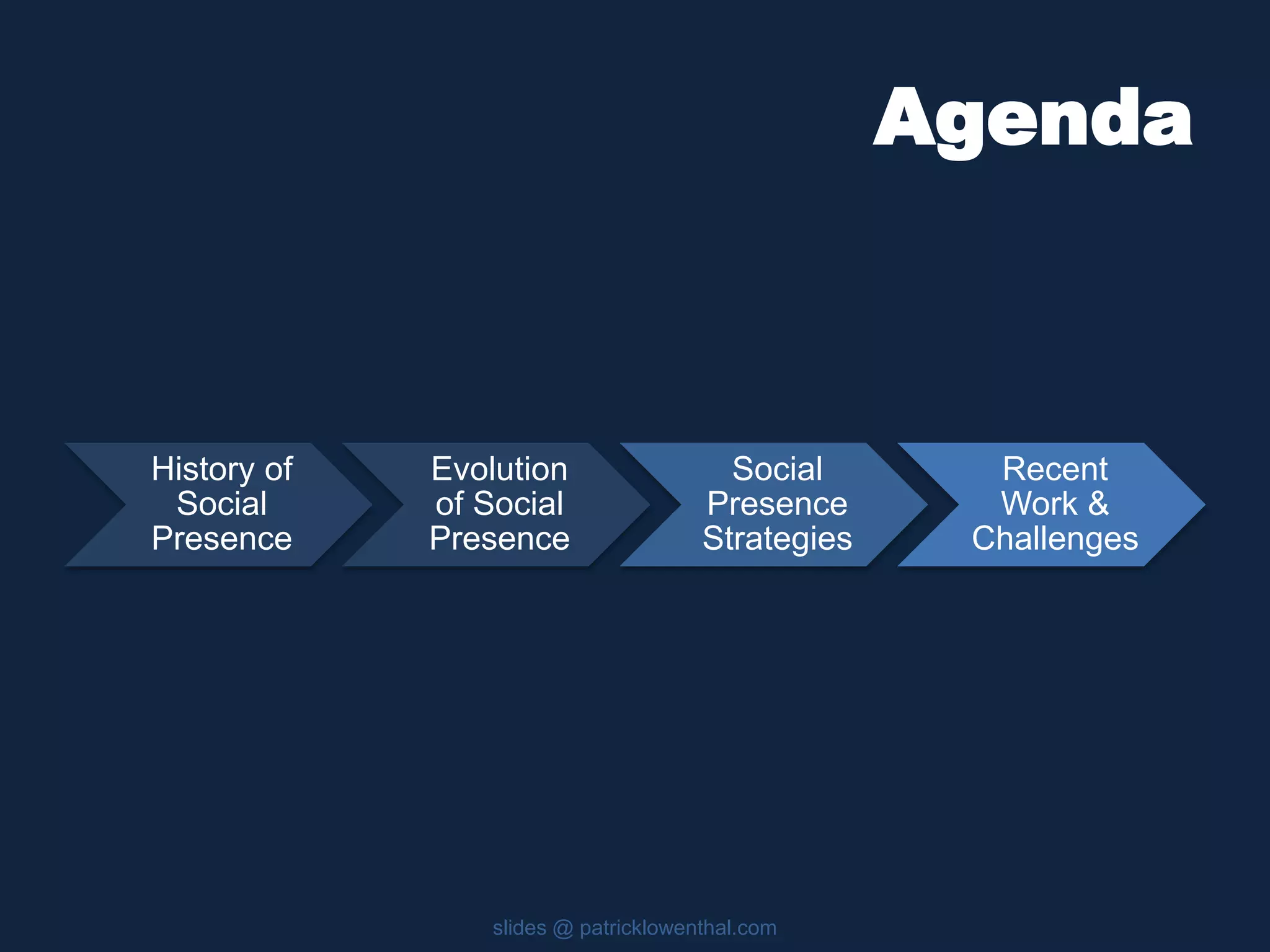
Agenda 
History of 
Social 
Presence 
Evolution 
of Social 
Presence 
Social 
Presence 
Strategies 
Recent 
Work & 
Challenges 
slides @ patricklowenthal.com
HISTORY OF SOCIAL PRESENCE 
slides @ patricklowenthal.com
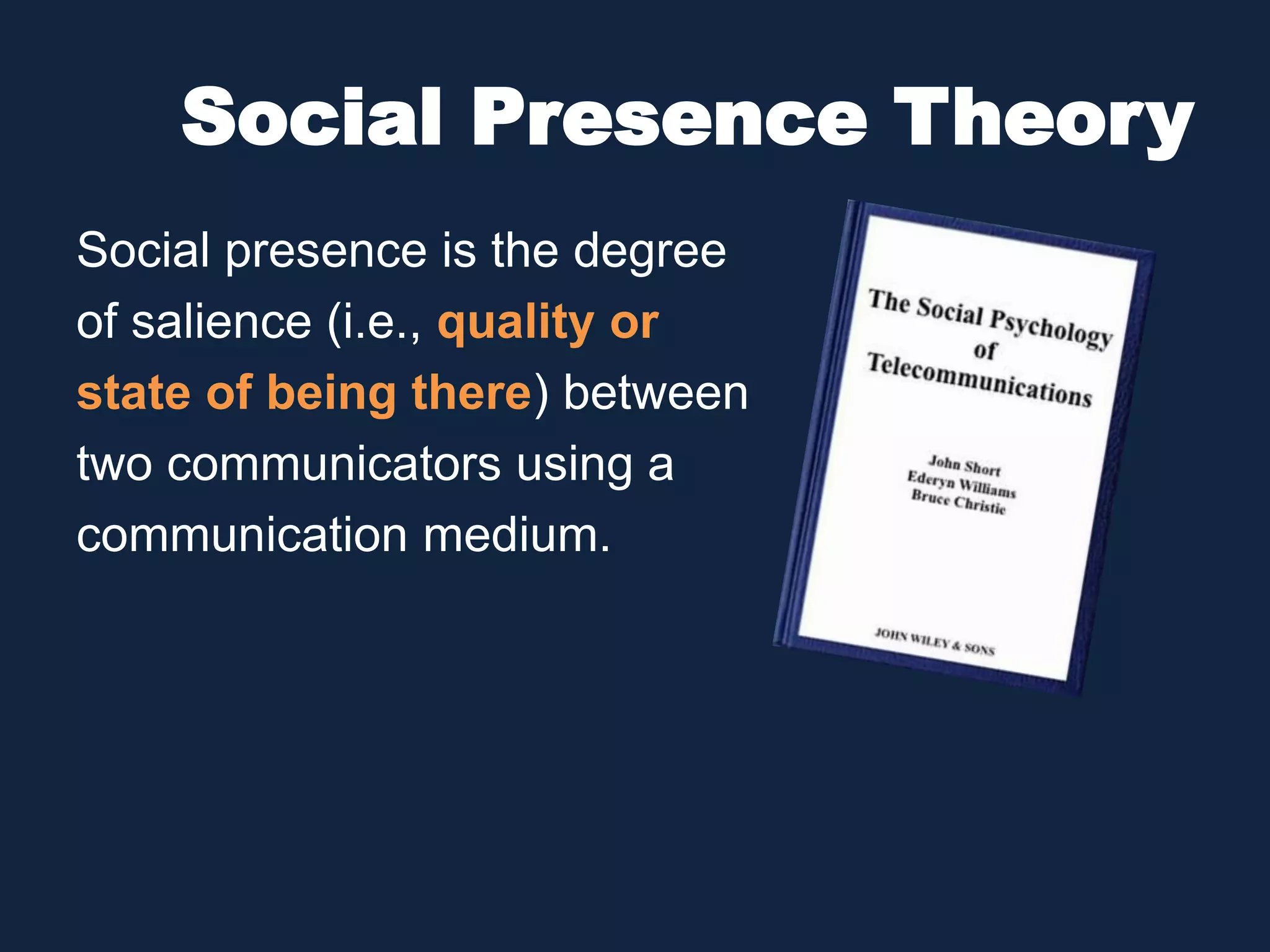
Social Presence Theory 
Social presence is the degree 
of salience (i.e., quality or 
state of being there) between 
two communicators using a 
communication medium.
What does this mean? 
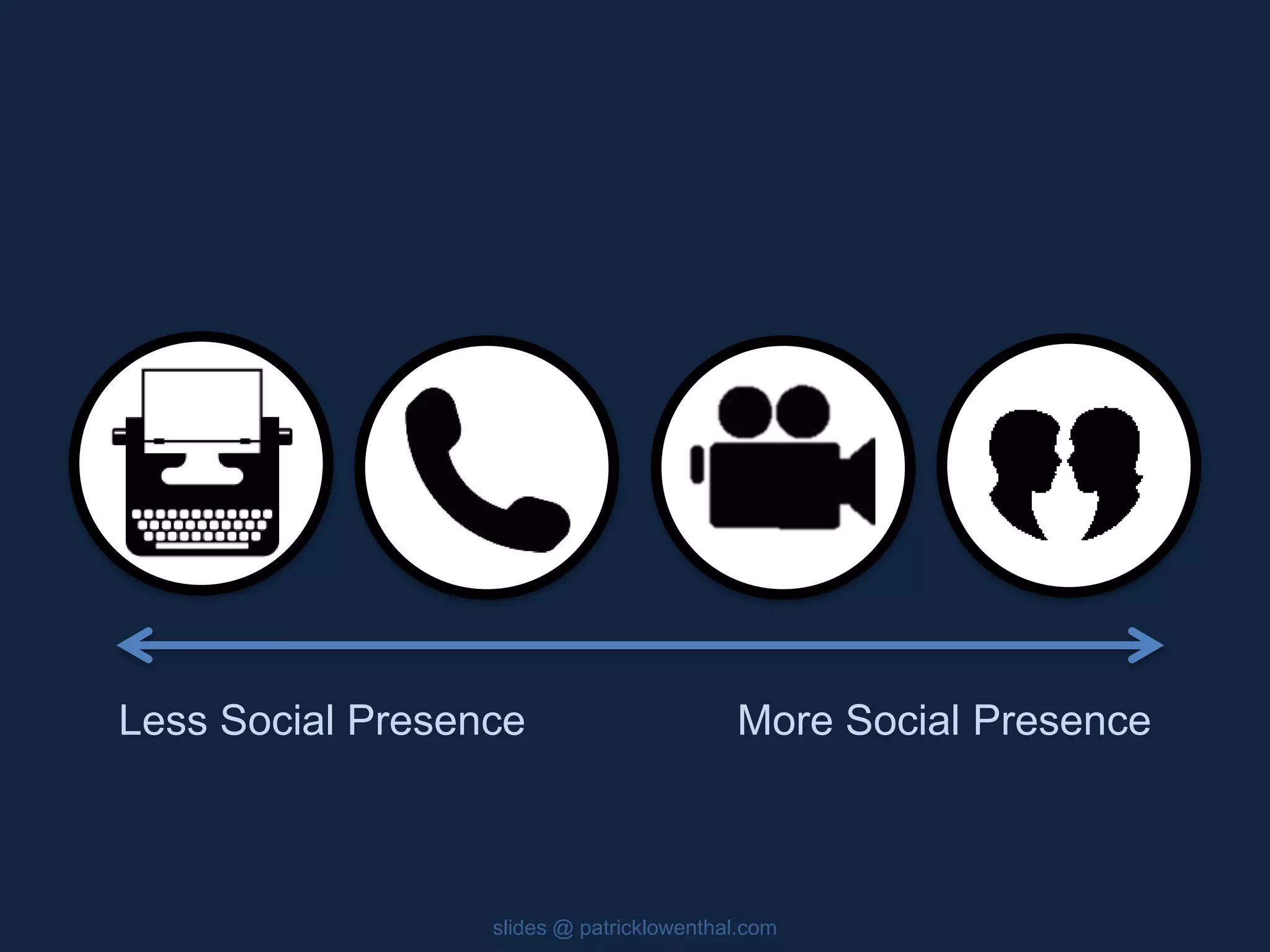
It’s a quality of a communication medium. 
Some media (e.g., video) have higher 
social presence than other media (e.g., 
audio) 
Media w/ high social presence are 
sociable, warm, & personal; media w/ low 
social presence are as less personal.
What does this mean? 
It’s a quality of a communication medium. 
Some media (e.g., video) have higher 
social presence than other media (e.g., 
audio) 
Media w/ high social presence are 
sociable, warm, & personal; media w/ low 
social presence are as less personal.
What does this mean? 
It’s a quality of a communication medium. 
Some media (e.g., video) have higher 
social presence than other media (e.g., 
audio) 
Media w/ high social presence are 
sociable, warm, & personal; media w/ low 
social presence are as less personal.
Less Social Presence More Social Presence 
slides @ patricklowenthal.com
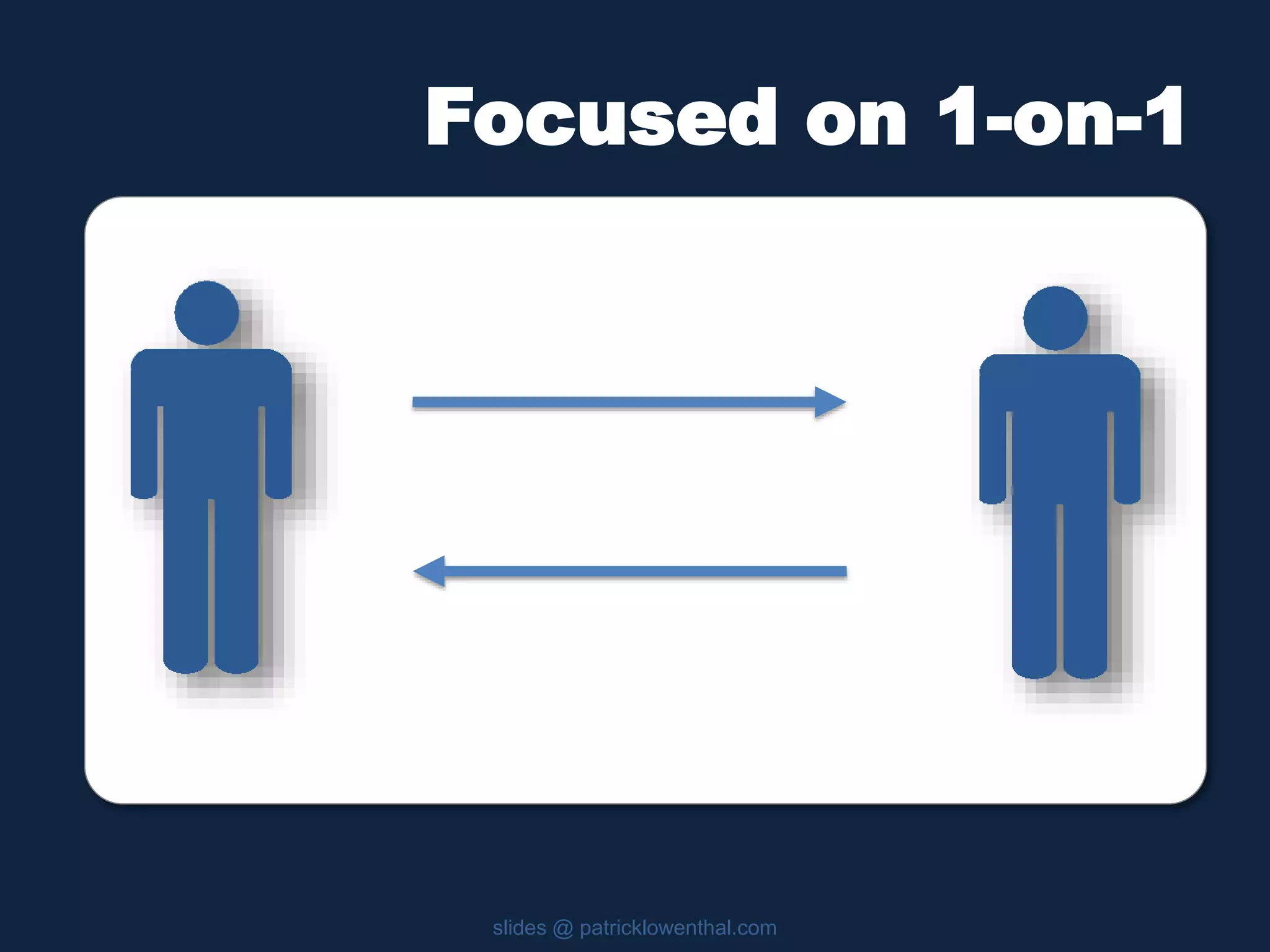
Focused on 1-on-1 
slides @ patricklowenthal.com
1980’s & CMC 
Cuelessness Theory 
developed by Rutter (1984, 1987) 
Media Richness Theory 
developed by Daft & Lengel 
(1984, 1986; Daft, Lengel, & 
Trevino, 1987) 
slides @ patricklowenthal.com
EVOLUTION OF SOCIAL PRESENCE 
slides @ patricklowenthal.com
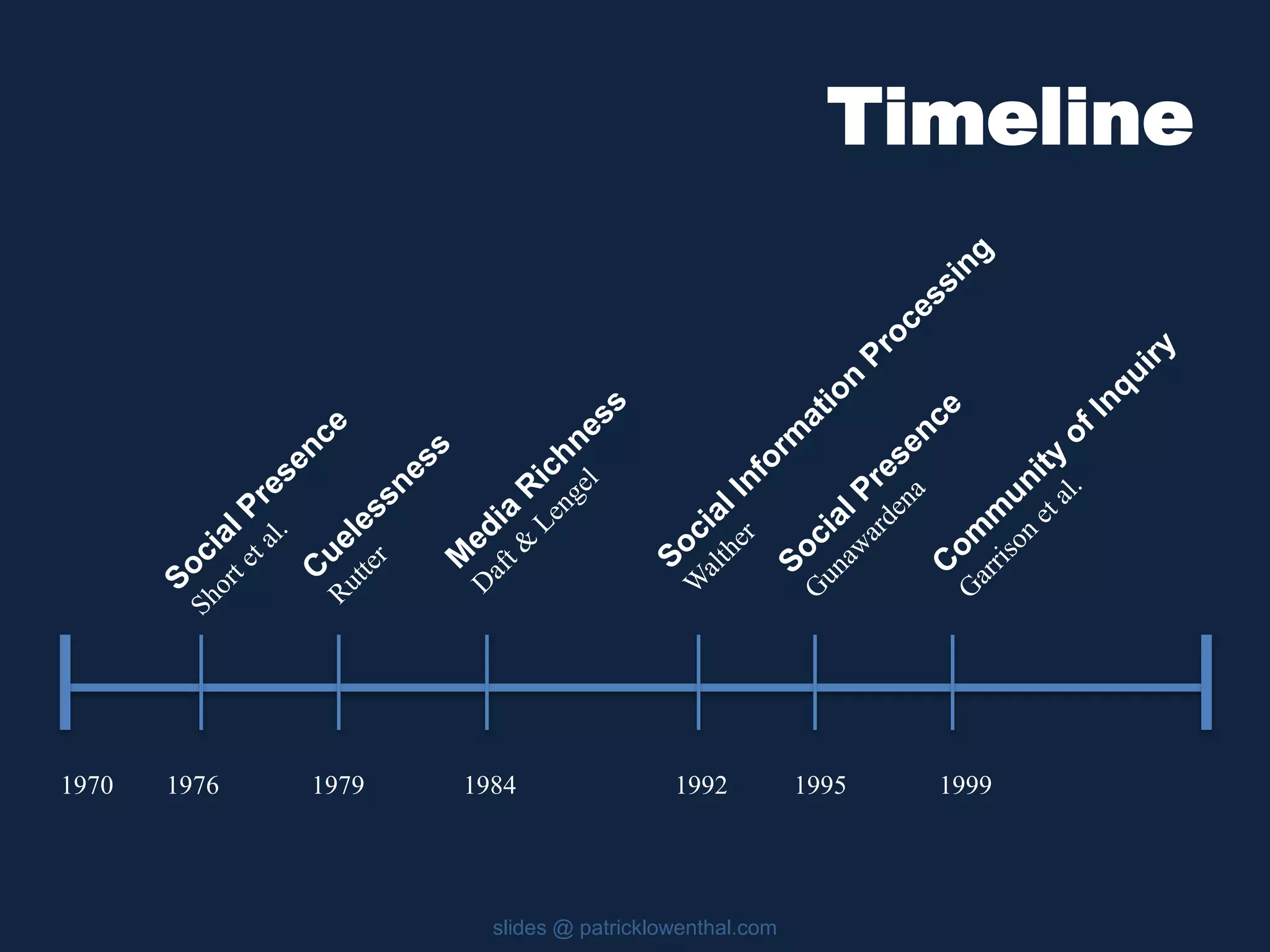
Timeline 
1970 1976 1979 1984 1992 1995 1999 
slides @ patricklowenthal.com
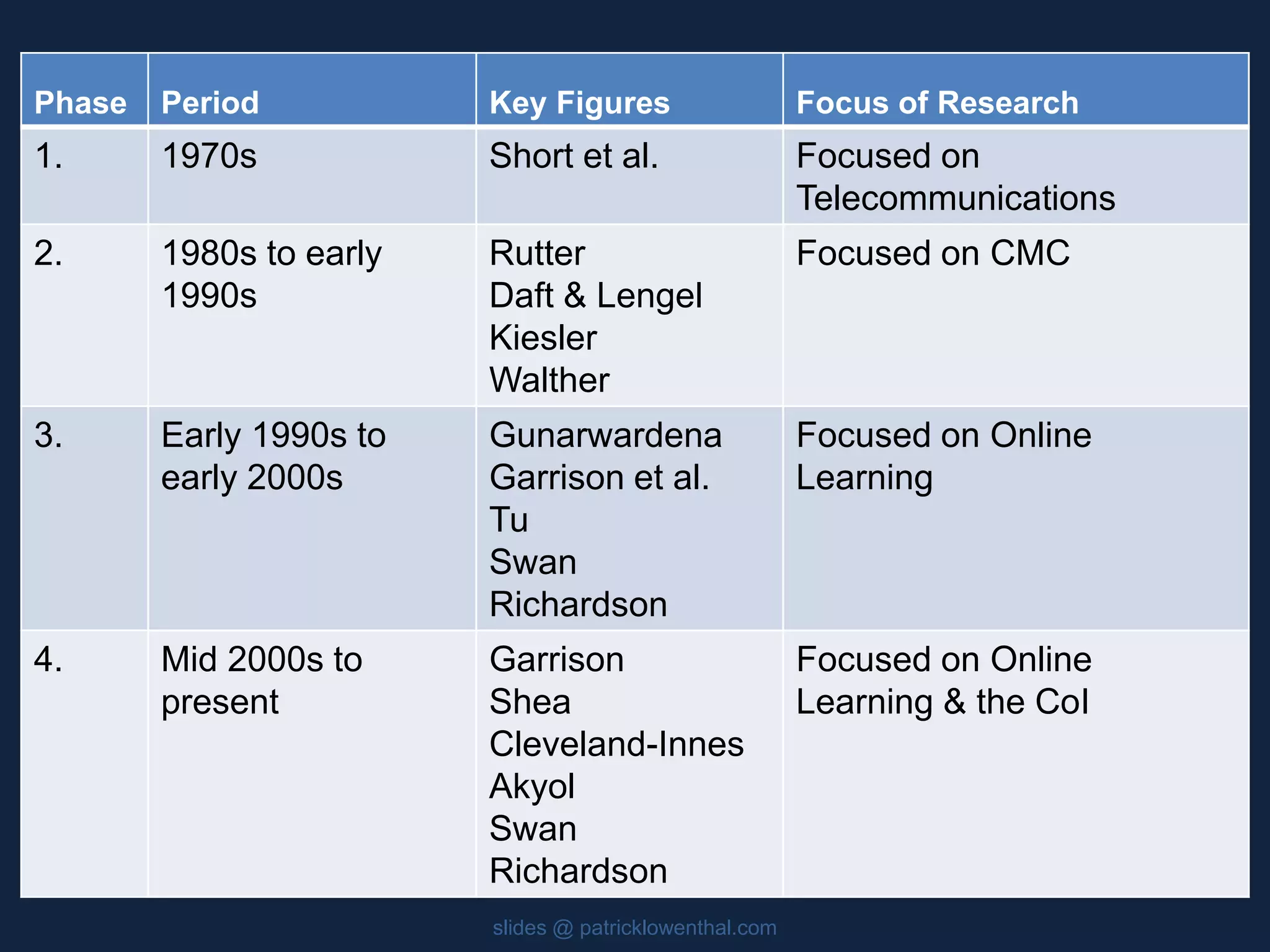
Phase Period Key Figures Focus of Research 
1. 1970s Short et al. Focused on 
Telecommunications 
2. 1980s to early 
1990s 
Rutter 
Daft & Lengel 
Kiesler 
Walther 
Focused on CMC 
3. Early 1990s to 
early 2000s 
Gunarwardena 
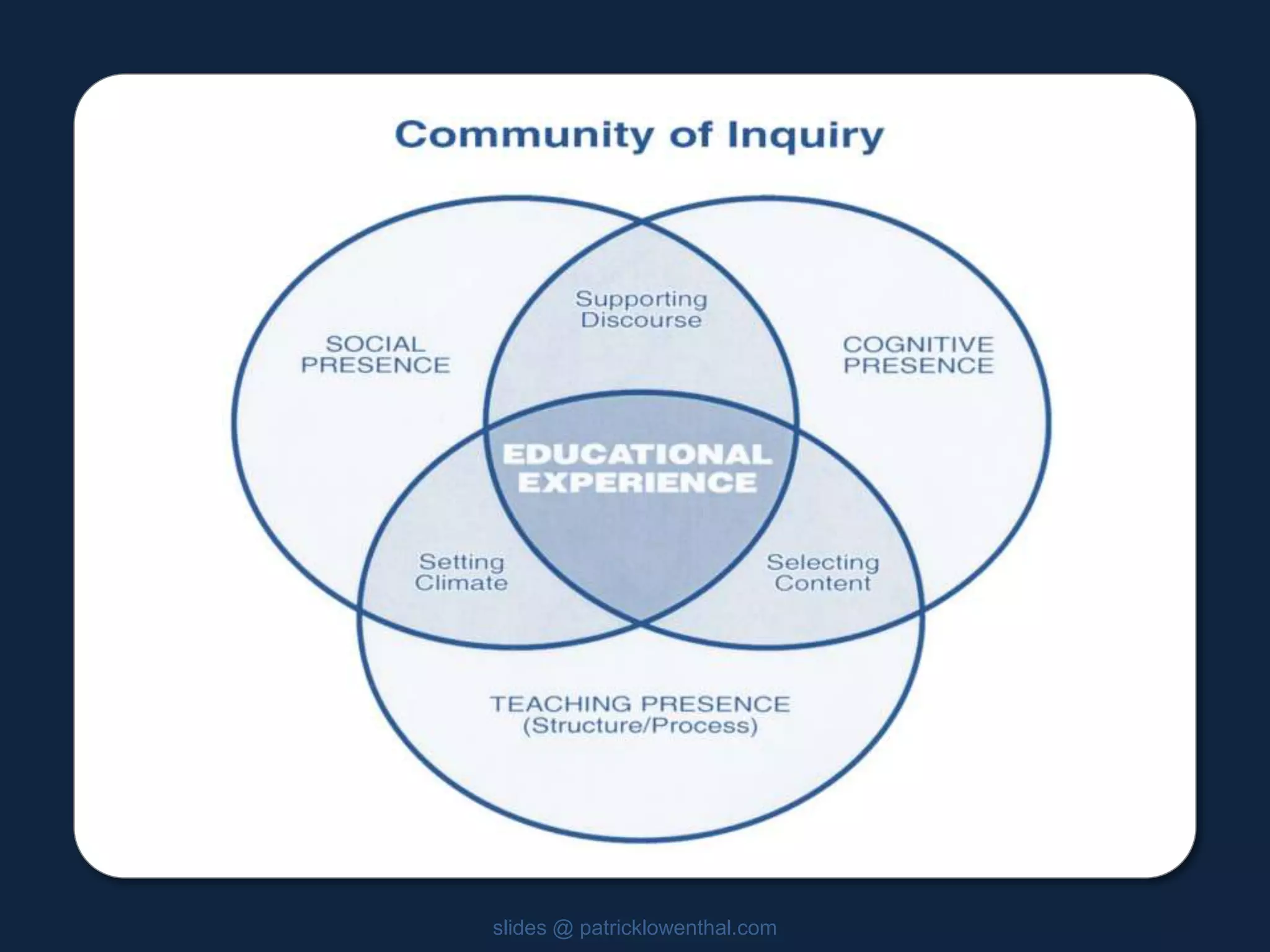
Garrison et al. 
Tu 
Swan 
Richardson 
Focused on Online 
Learning 
4. Mid 2000s to 
present 
Garrison 
Shea 
Cleveland-Innes 
Akyol 
Swan 
Richardson 
Focused on Online 
Learning & the CoI 
slides @ patricklowenthal.com
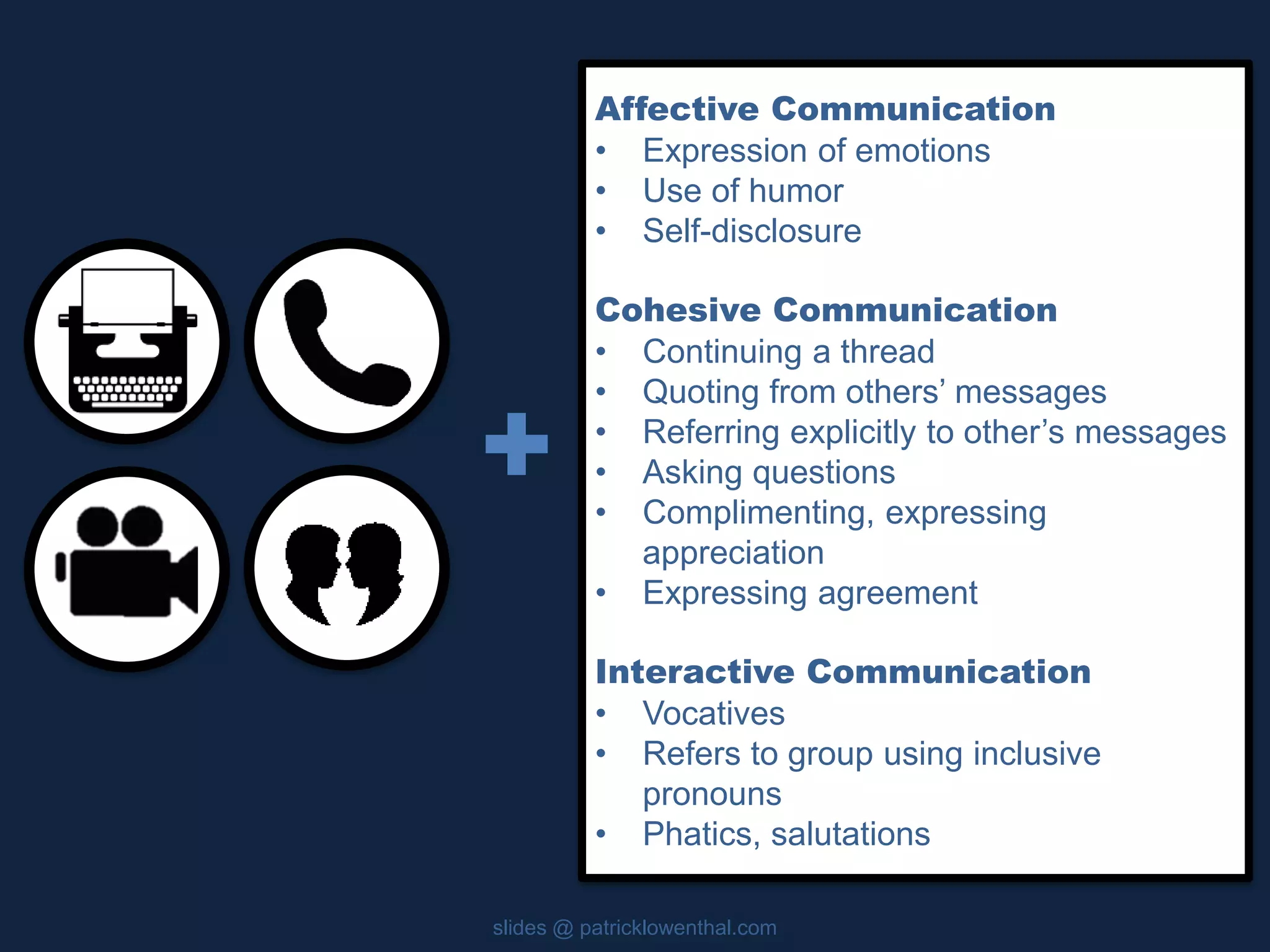
Affective Communication 
• Expression of emotions 
• Use of humor 
• Self-disclosure 
Cohesive Communication 
• Continuing a thread 
• Quoting from others’ messages 
• Referring explicitly to other’s messages 
• Asking questions 
• Complimenting, expressing 
appreciation 
• Expressing agreement 
Interactive Communication 
• Vocatives 
• Refers to group using inclusive 
pronouns 
• Phatics, salutations 
+ 
slides @ patricklowenthal.com
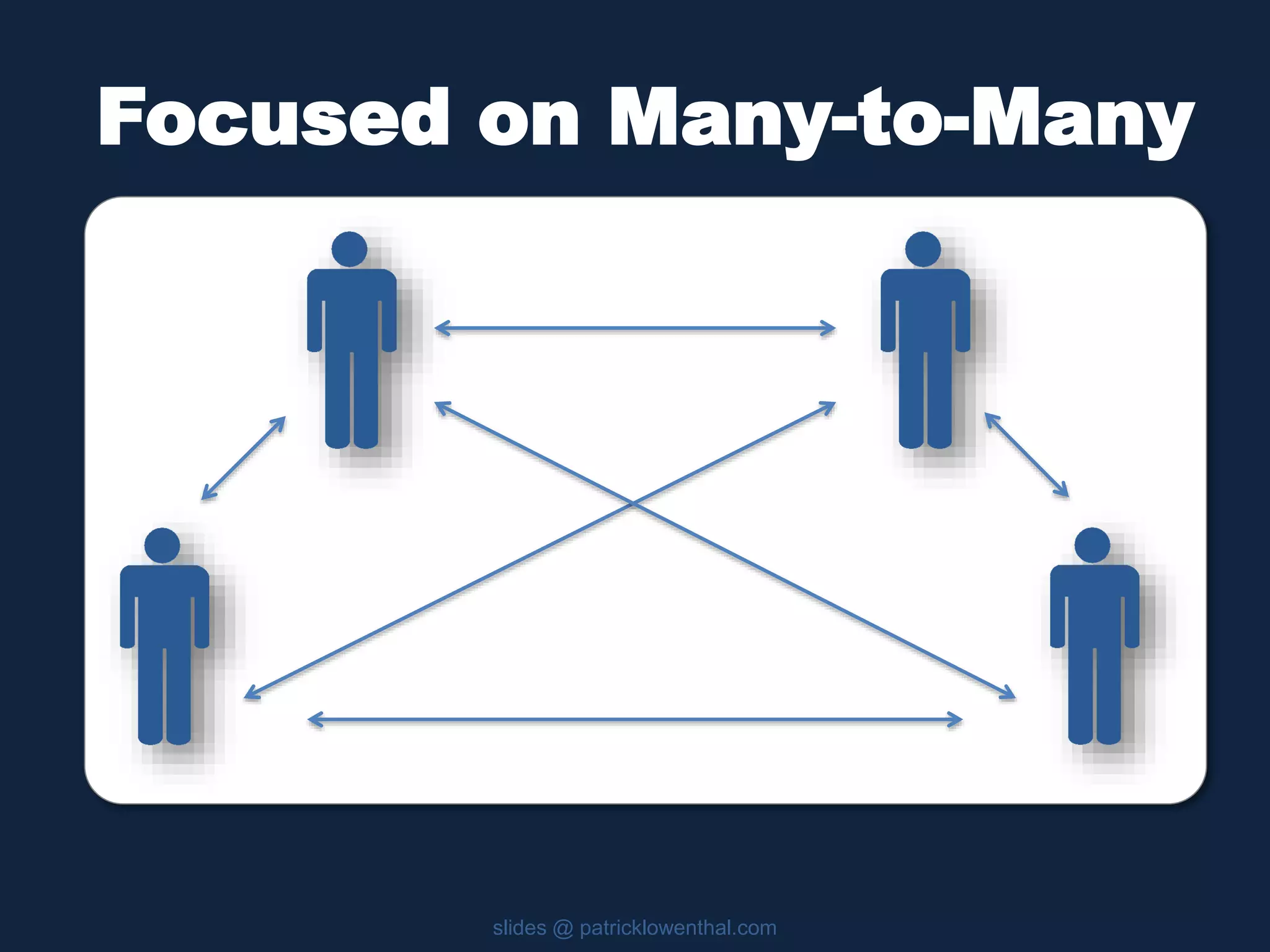
Focused on Many-to-Many 
slides @ patricklowenthal.com
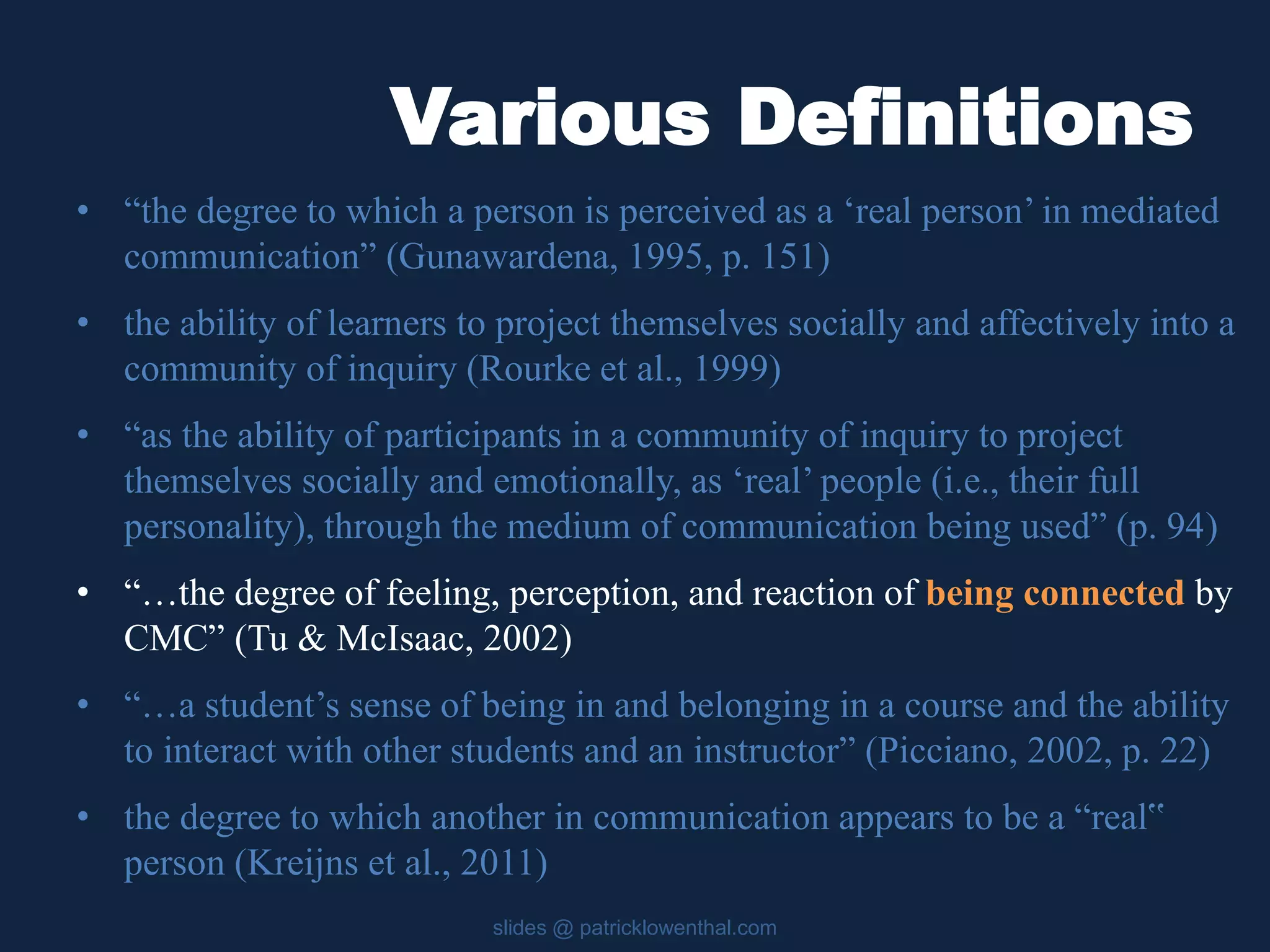
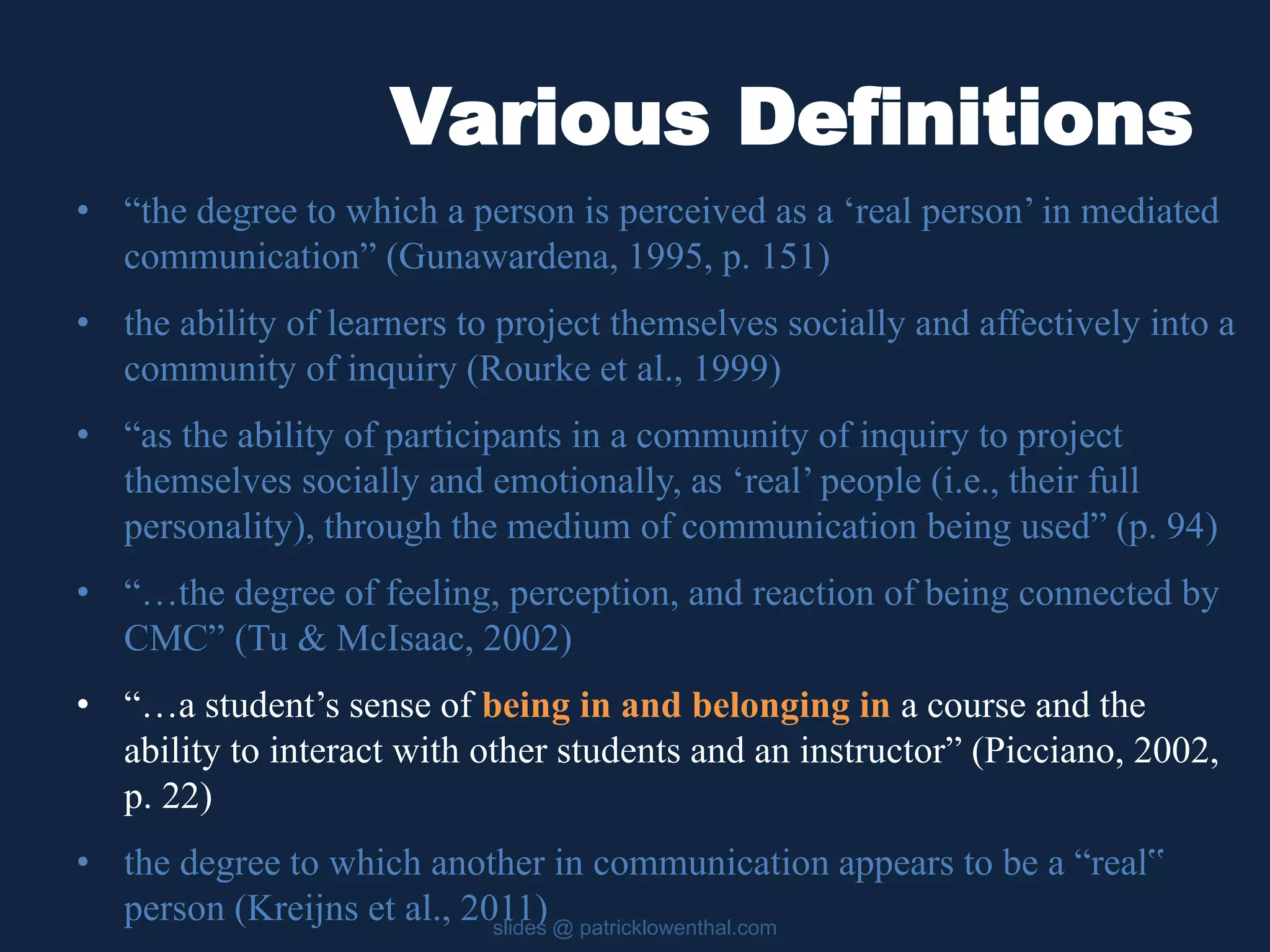
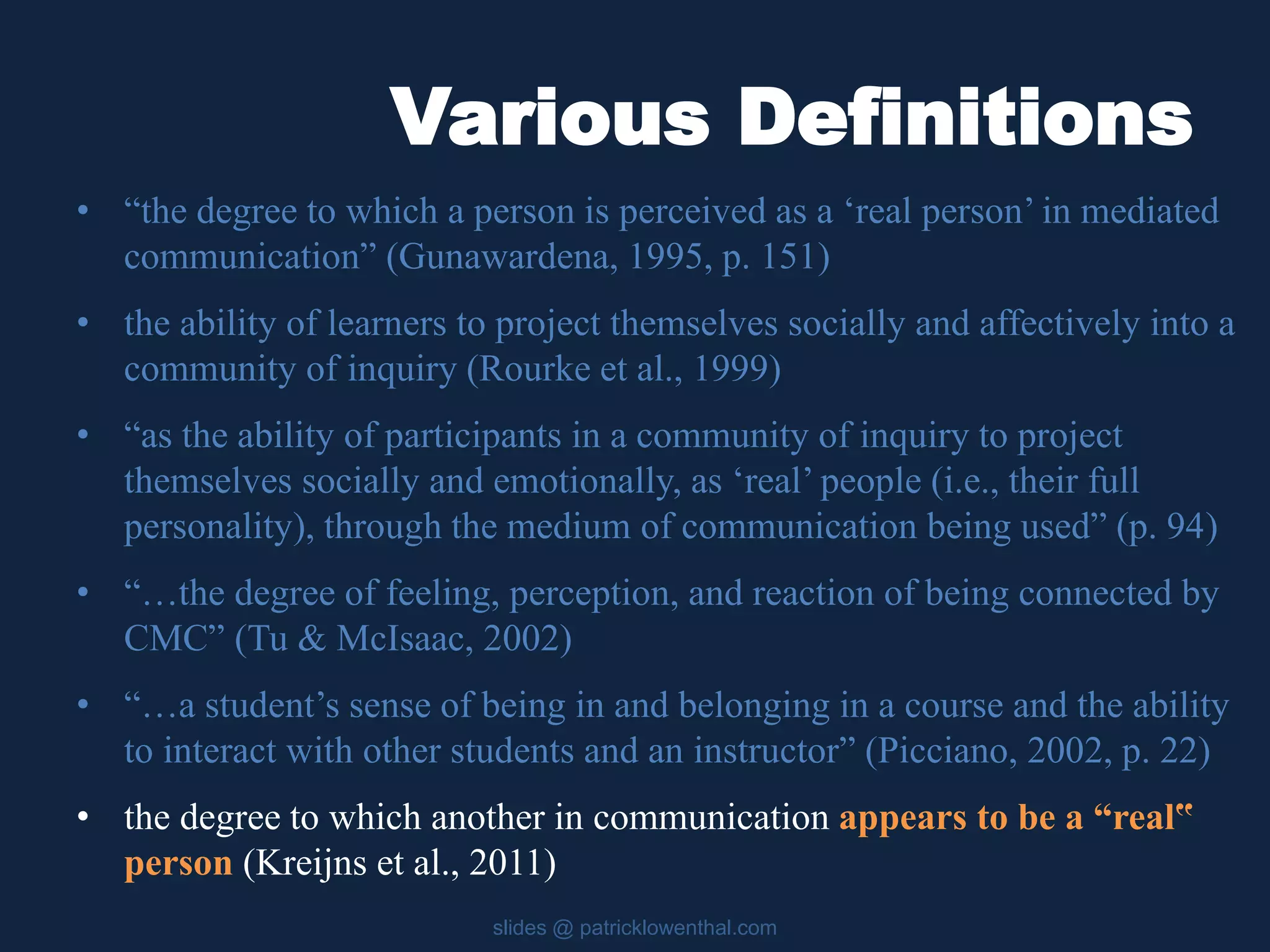
Various Definitions 
• “the degree to which a person is perceived as a ‘real person’ in 
mediated communication” (Gunawardena, 1995, p. 151) 
• the ability of learners to project themselves socially and affectively into a 
community of inquiry (Rourke et al., 1999) 
• “as the ability of participants in a community of inquiry to project 
themselves socially and emotionally, as ‘real’ people (i.e., their full 
personality), through the medium of communication being used” (p. 94) 
• “…the degree of feeling, perception, and reaction of being connected by 
CMC” (Tu & McIsaac, 2002) 
• “…a student’s sense of being in and belonging in a course and the ability 
to interact with other students and an instructor” (Picciano, 2002, p. 22) 
• the degree to which another in communication appears to be a “real‟ 
person (Kreijns et al., 2011) 
slides @ patricklowenthal.com
Various Definitions 
• “the degree to which a person is perceived as a ‘real person’ in mediated 
communication” (Gunawardena, 1995, p. 151) 
• the ability of learners to project themselves socially and affectively 
into a community of inquiry (Rourke et al., 1999) 
• “as the ability of participants in a community of inquiry to project 
themselves socially and emotionally, as ‘real’ people (i.e., their full 
personality), through the medium of communication being used” (p. 94) 
• “…the degree of feeling, perception, and reaction of being connected by 
CMC” (Tu & McIsaac, 2002) 
• “…a student’s sense of being in and belonging in a course and the ability 
to interact with other students and an instructor” (Picciano, 2002, p. 22) 
• the degree to which another in communication appears to be a “real‟ 
person (Kreijns et al., 2011) 
slides @ patricklowenthal.com
Various Definitions 
• “the degree to which a person is perceived as a ‘real person’ in mediated 
communication” (Gunawardena, 1995, p. 151) 
• the ability of learners to project themselves socially and affectively into a 
community of inquiry (Rourke et al., 1999) 
• “as the ability of participants in a community of inquiry to project 
themselves socially and emotionally, as ‘real’ people (i.e., their full 
personality), through the medium of communication being used” (p. 94) 
• “…the degree of feeling, perception, and reaction of being connected by 
CMC” (Tu & McIsaac, 2002) 
• “…a student’s sense of being in and belonging in a course and the ability 
to interact with other students and an instructor” (Picciano, 2002, p. 22) 
• the degree to which another in communication appears to be a “real‟ 
person (Kreijns et al., 2011) 
slides @ patricklowenthal.com
Various Definitions 
• “the degree to which a person is perceived as a ‘real person’ in mediated 
communication” (Gunawardena, 1995, p. 151) 
• the ability of learners to project themselves socially and affectively into a 
community of inquiry (Rourke et al., 1999) 
• “as the ability of participants in a community of inquiry to project 
themselves socially and emotionally, as ‘real’ people (i.e., their full 
personality), through the medium of communication being used” (p. 94) 
• “…the degree of feeling, perception, and reaction of being connected by 
CMC” (Tu & McIsaac, 2002) 
• “…a student’s sense of being in and belonging in a course and the ability 
to interact with other students and an instructor” (Picciano, 2002, p. 22) 
• the degree to which another in communication appears to be a “real‟ 
person (Kreijns et al., 2011) 
slides @ patricklowenthal.com
Various Definitions 
• “the degree to which a person is perceived as a ‘real person’ in mediated 
communication” (Gunawardena, 1995, p. 151) 
• the ability of learners to project themselves socially and affectively into a 
community of inquiry (Rourke et al., 1999) 
• “as the ability of participants in a community of inquiry to project 
themselves socially and emotionally, as ‘real’ people (i.e., their full 
personality), through the medium of communication being used” (p. 94) 
• “…the degree of feeling, perception, and reaction of being connected by 
CMC” (Tu & McIsaac, 2002) 
• “…a student’s sense of being in and belonging in a course and the 
ability to interact with other students and an instructor” (Picciano, 2002, 
p. 22) 
• the degree to which another in communication appears to be a “real‟ 
person (Kreijns et al., 2011) 
slides @ patricklowenthal.com
Various Definitions 
• “the degree to which a person is perceived as a ‘real person’ in mediated 
communication” (Gunawardena, 1995, p. 151) 
• the ability of learners to project themselves socially and affectively into a 
community of inquiry (Rourke et al., 1999) 
• “as the ability of participants in a community of inquiry to project 
themselves socially and emotionally, as ‘real’ people (i.e., their full 
personality), through the medium of communication being used” (p. 94) 
• “…the degree of feeling, perception, and reaction of being connected by 
CMC” (Tu & McIsaac, 2002) 
• “…a student’s sense of being in and belonging in a course and the ability 
to interact with other students and an instructor” (Picciano, 2002, p. 22) 
• the degree to which another in communication appears to be a “real‟ 
person (Kreijns et al., 2011) 
slides @ patricklowenthal.com
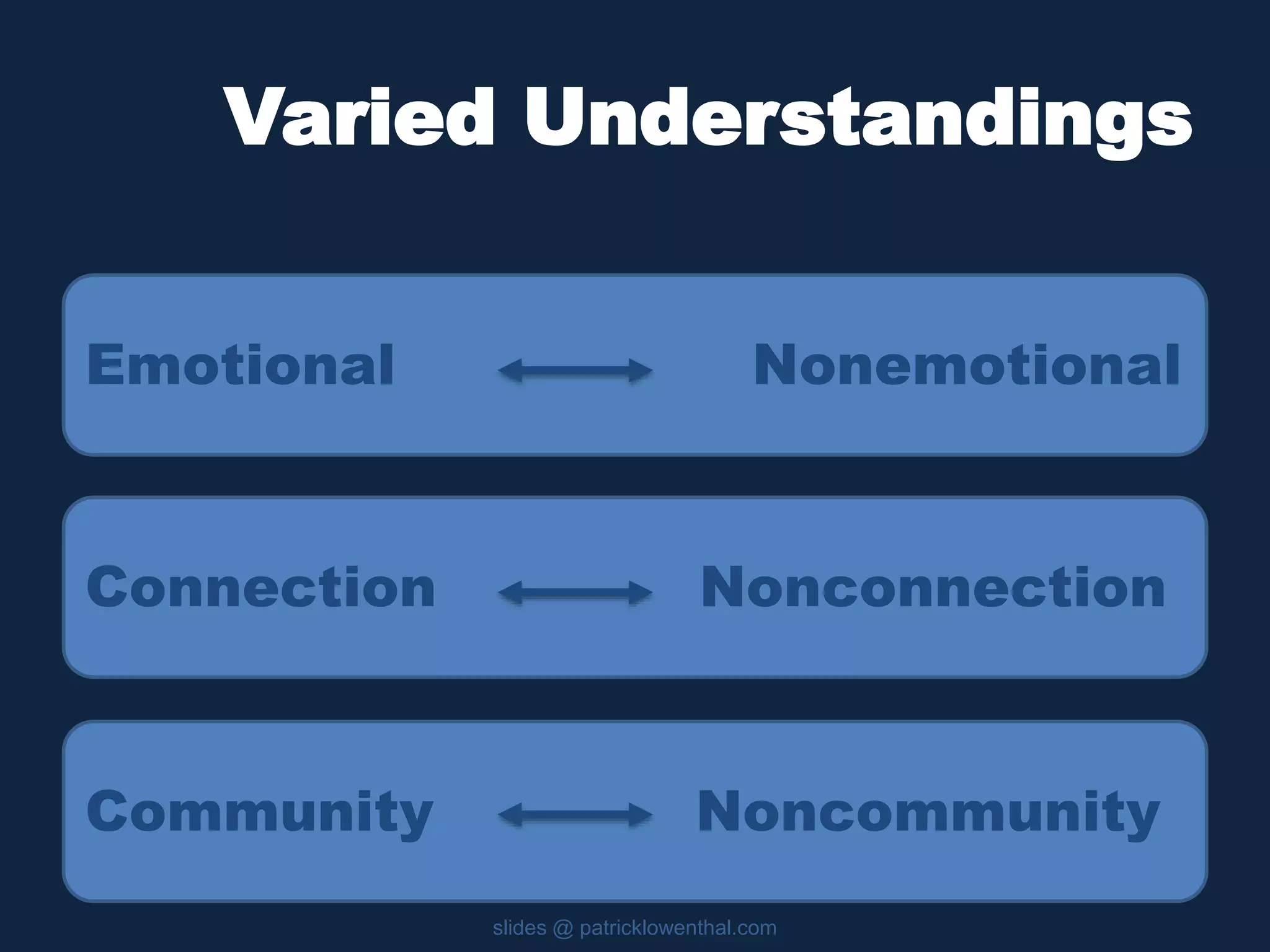
Varied Understandings 
Emotional Nonemotional 
Connection Nonconnection 
Community Noncommunity 
slides @ patricklowenthal.com
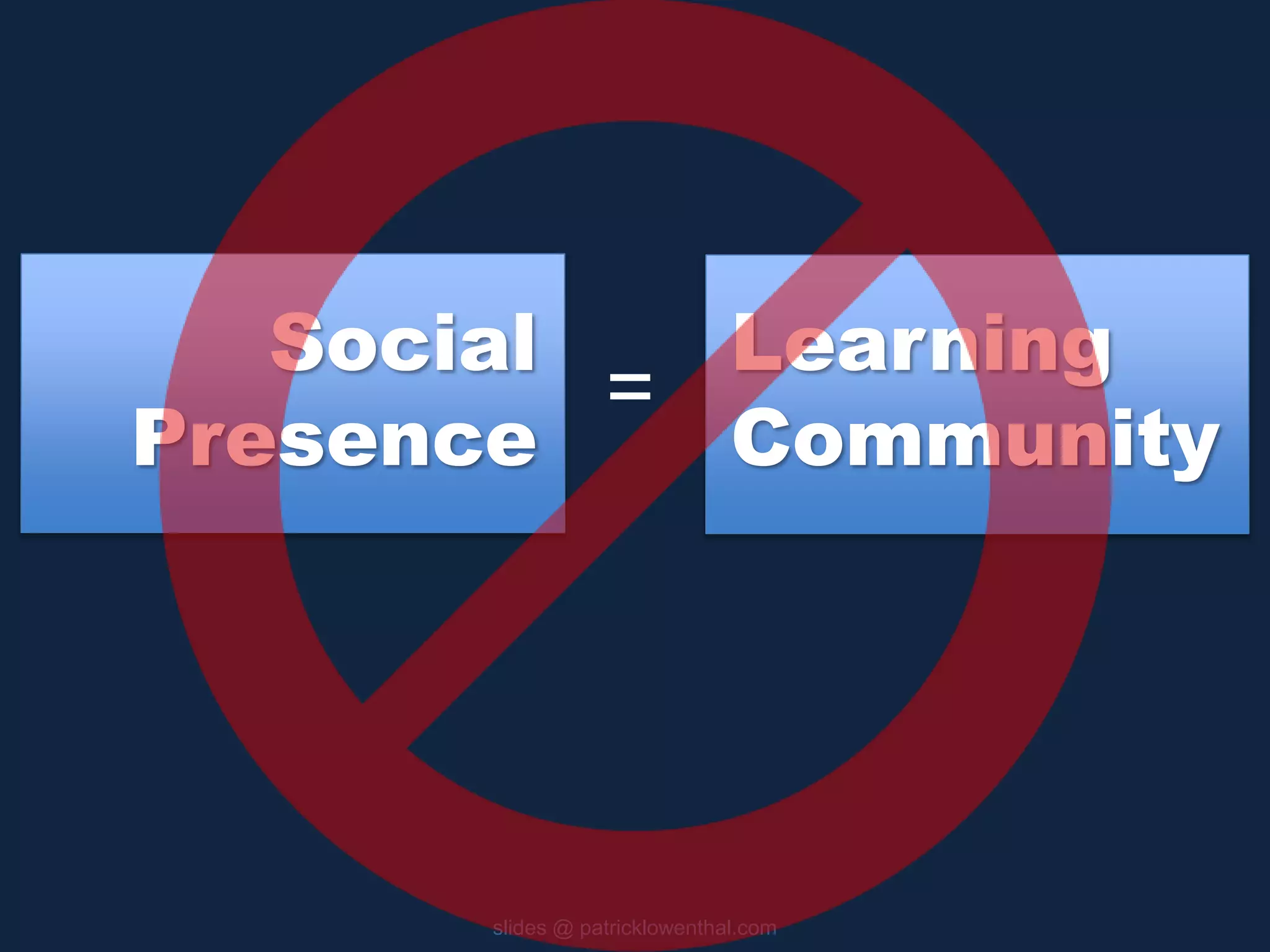
Social 
Presence 
Learning 
Community = 
slides @ patricklowenthal.com
slides @ patricklowenthal.com 
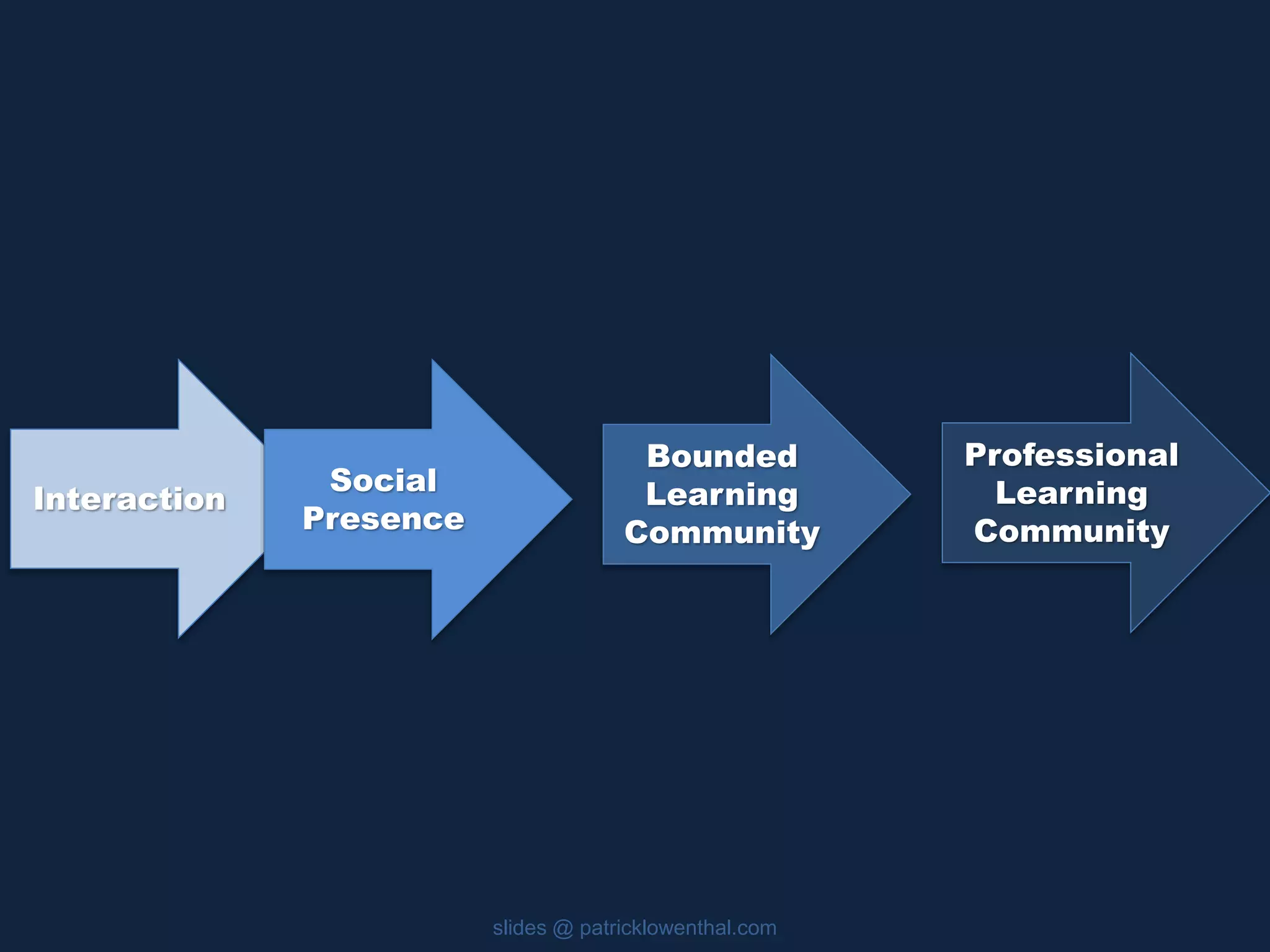
Interaction 
Bounded 
Learning 
Community 
Social 
Presence 
Professional 
Learning 
Community
SOCIAL PRESENCE STRATEGIES 
slides @ patricklowenthal.com
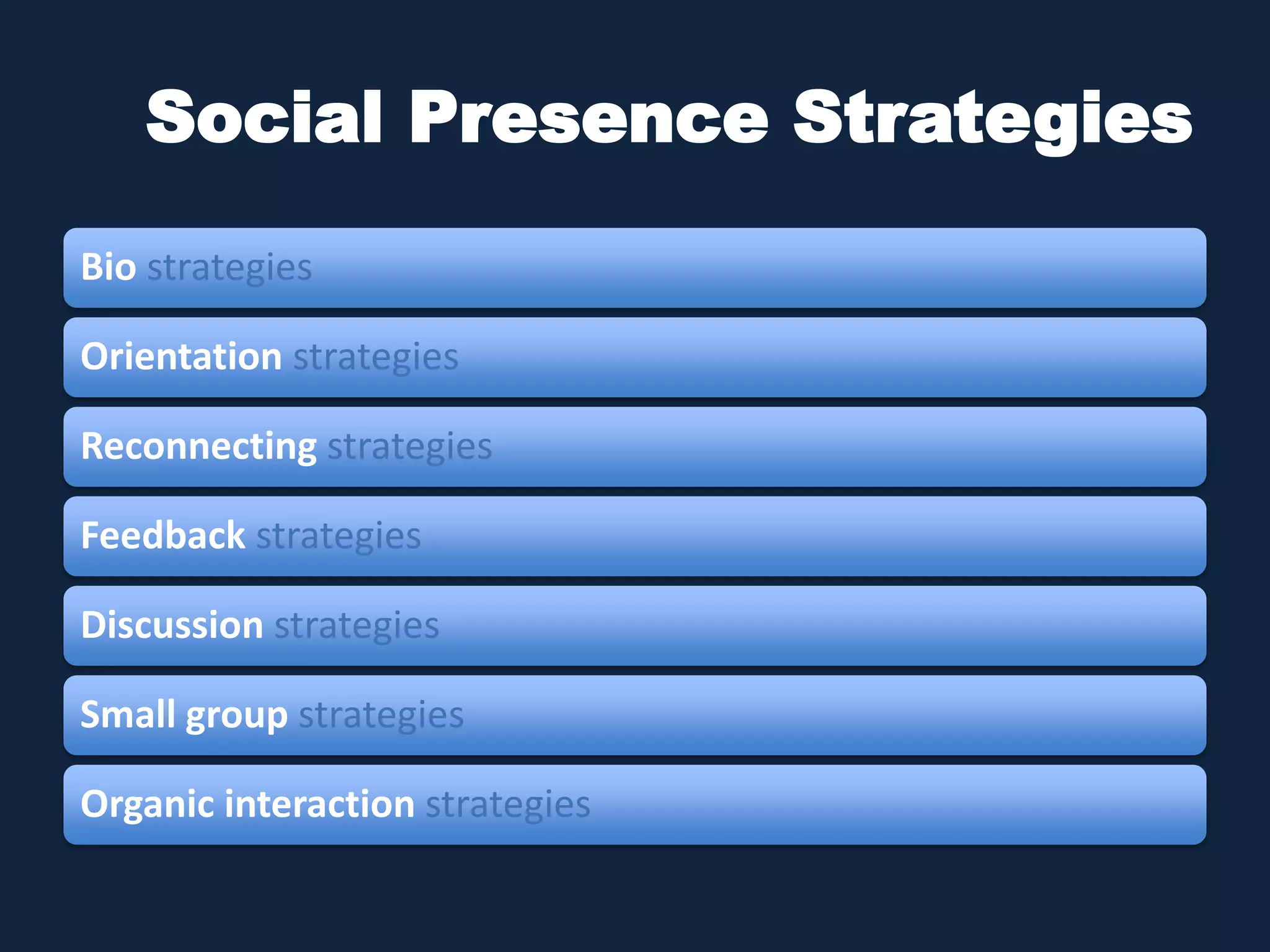
Social Presence Strategies 
Bio strategies 
Orientation strategies 
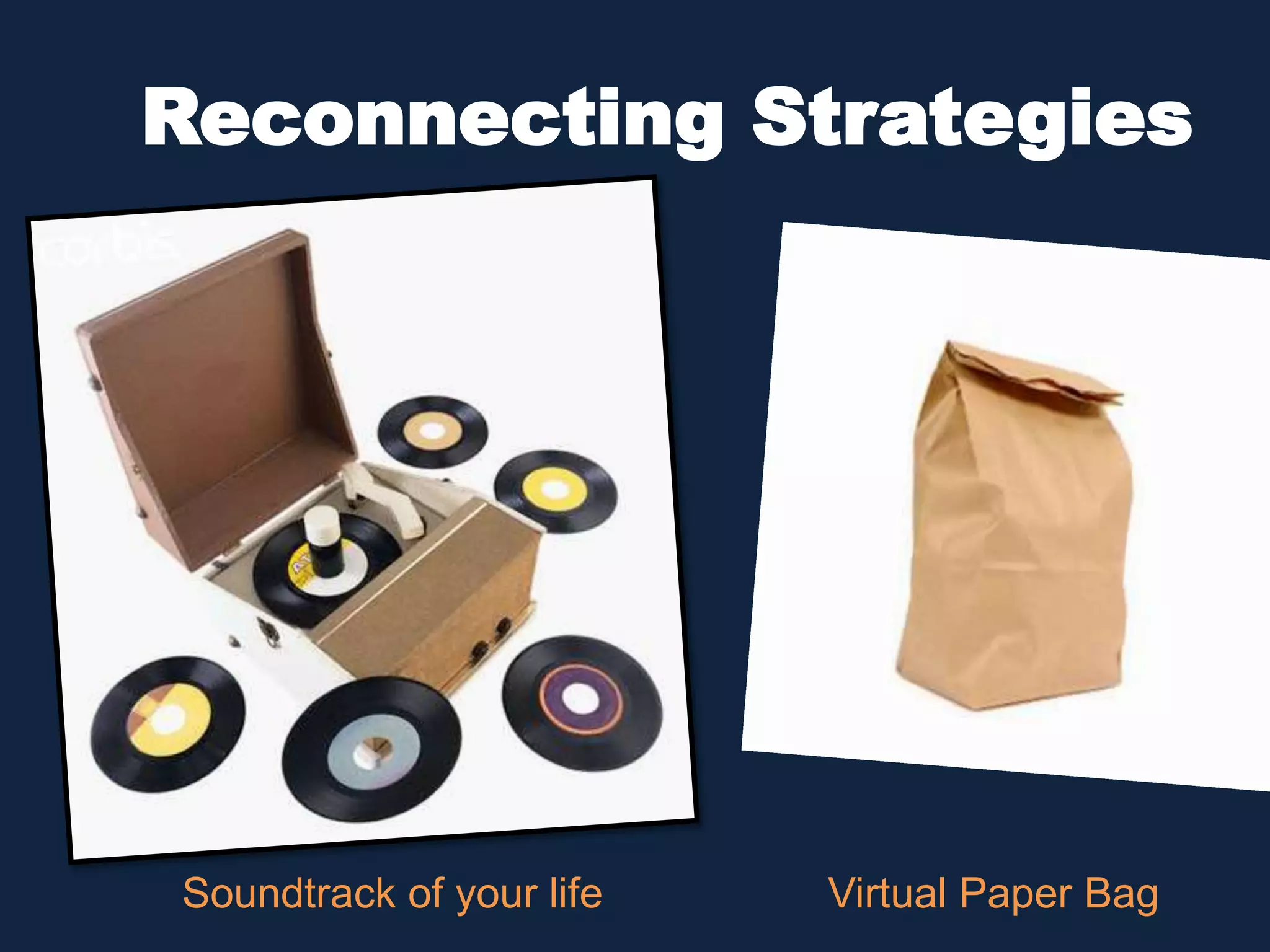
Reconnecting strategies 
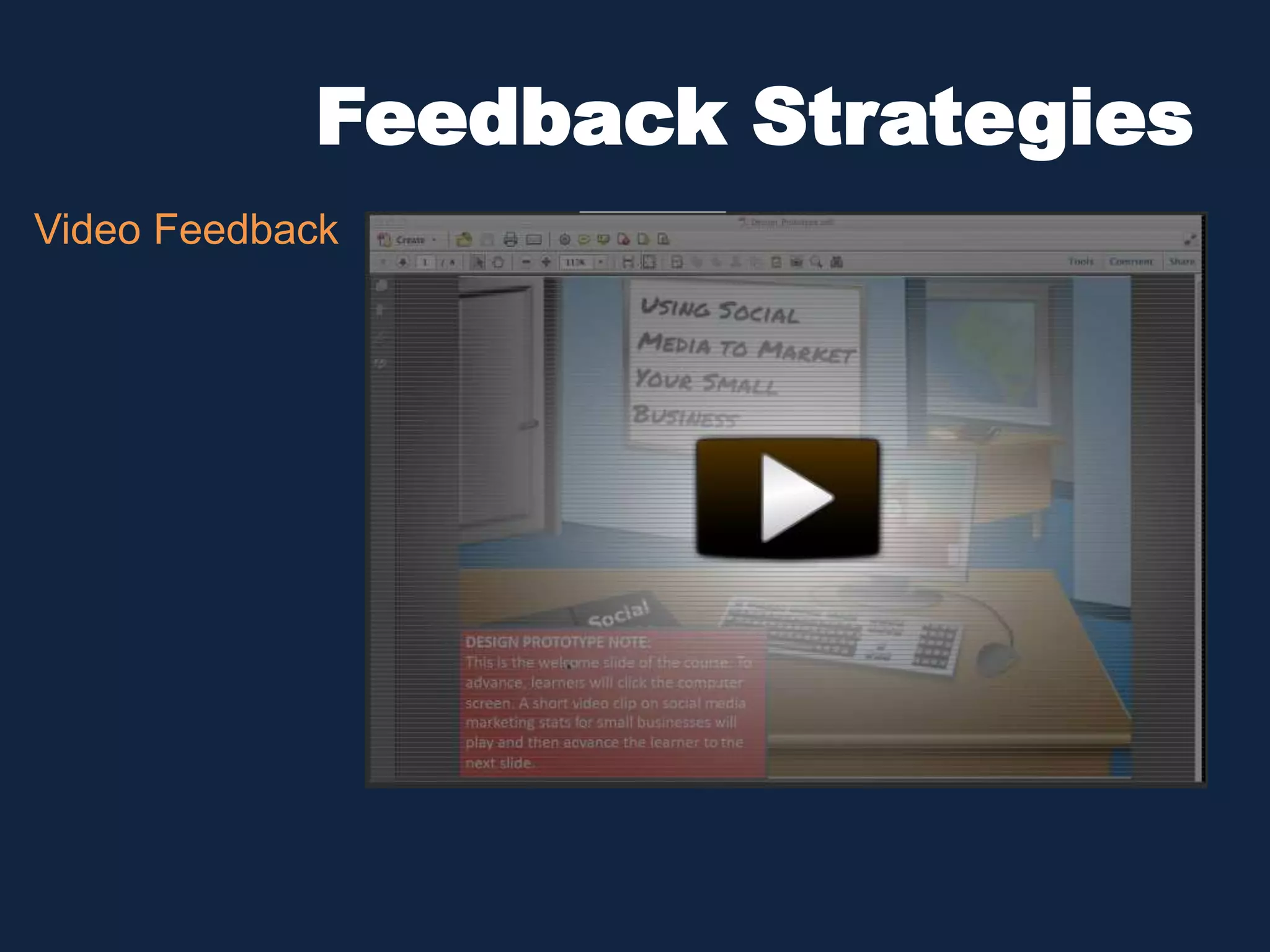
Feedback strategies 
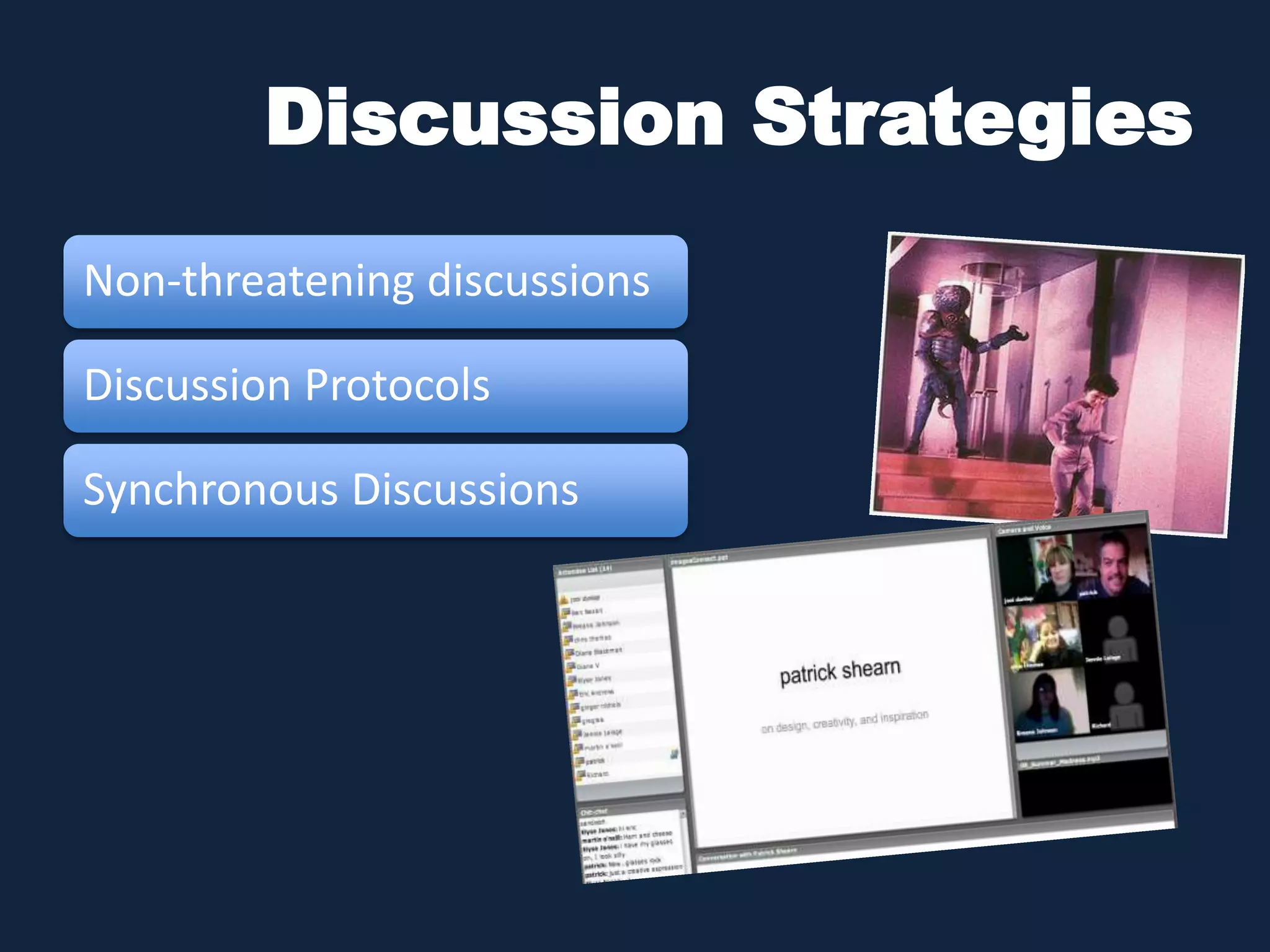
Discussion strategies 
Small group strategies 
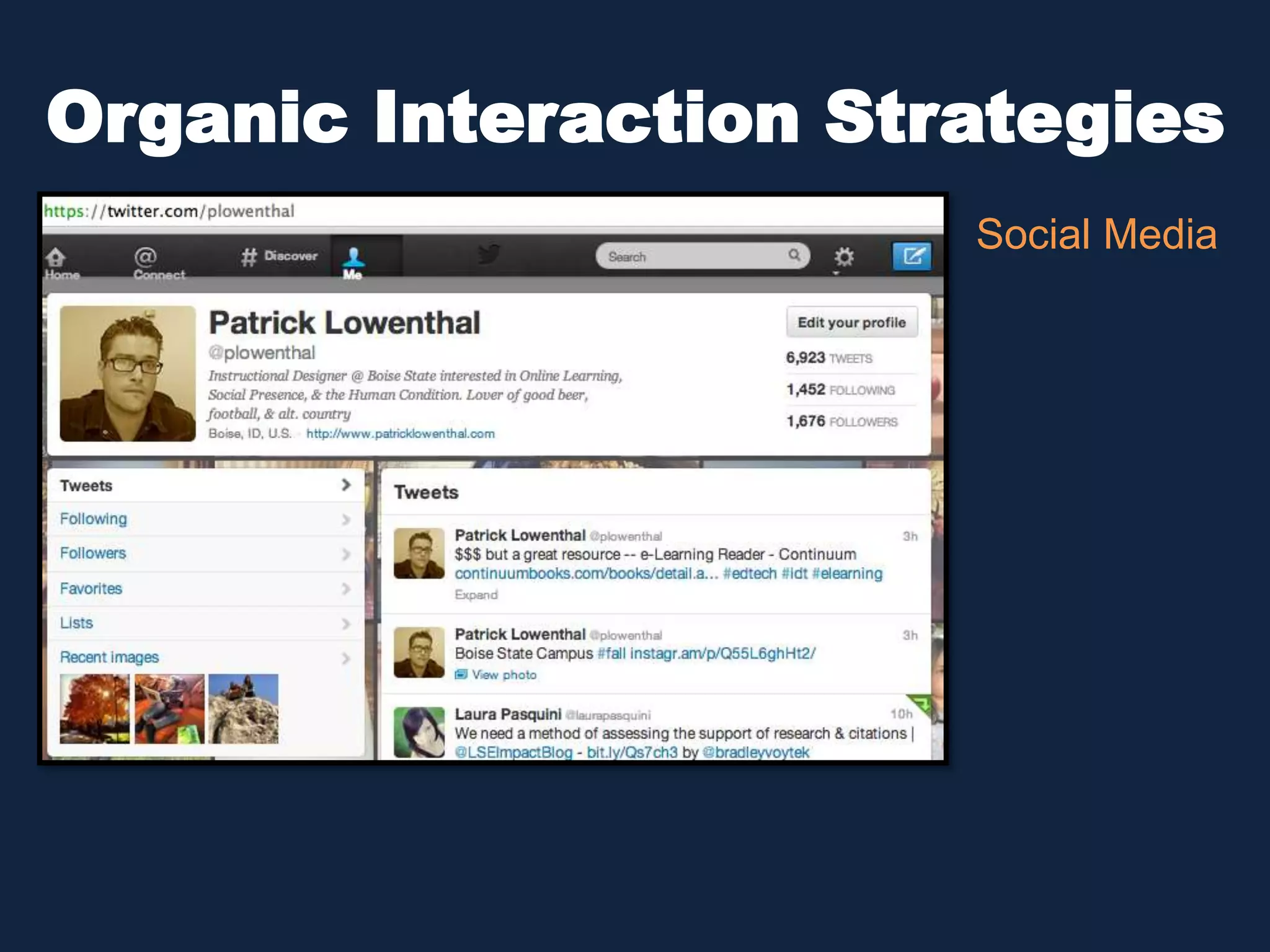
Organic interaction strategies
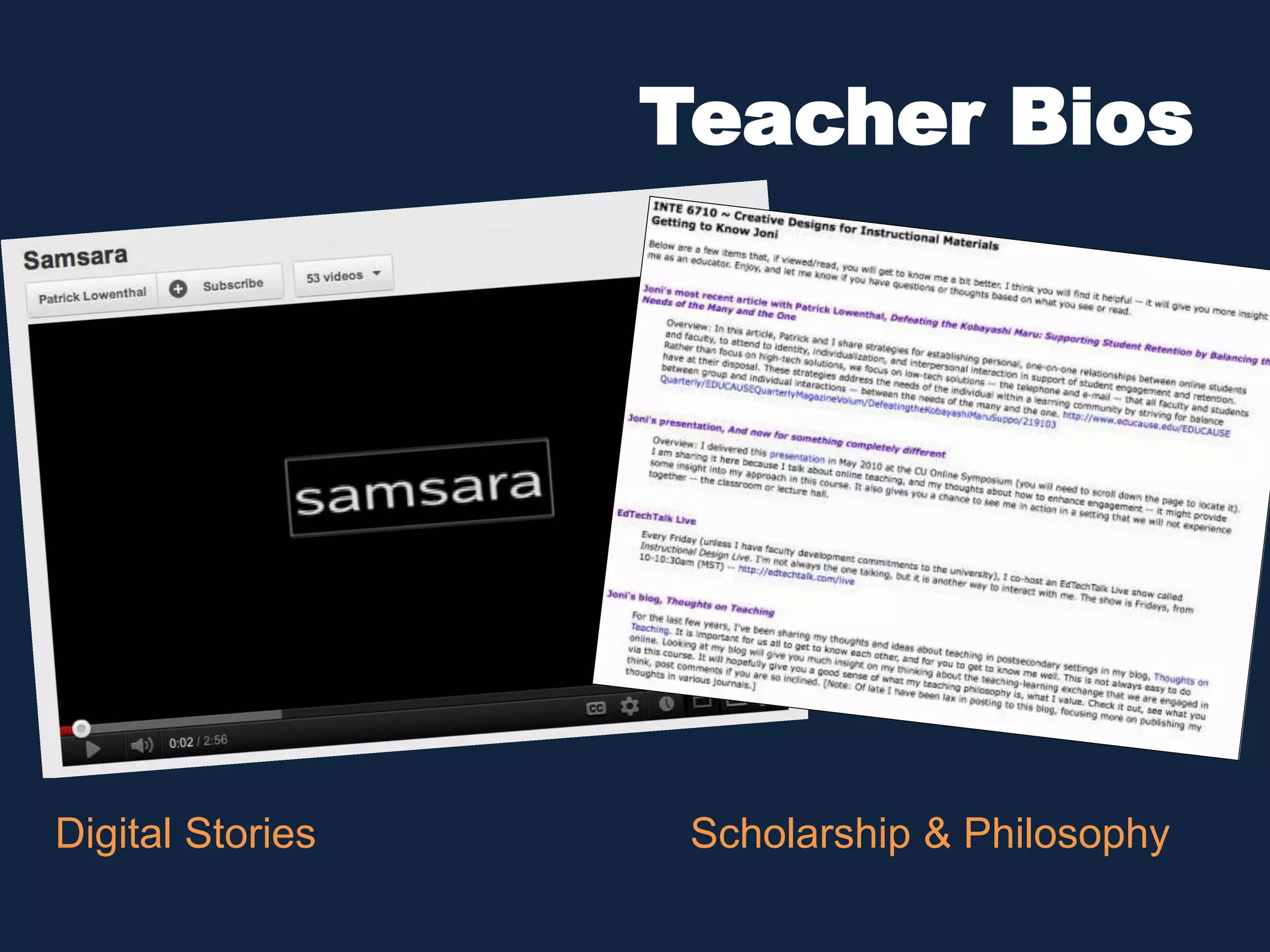
Teacher Bios 
Digital Stories Scholarship & Philosophy
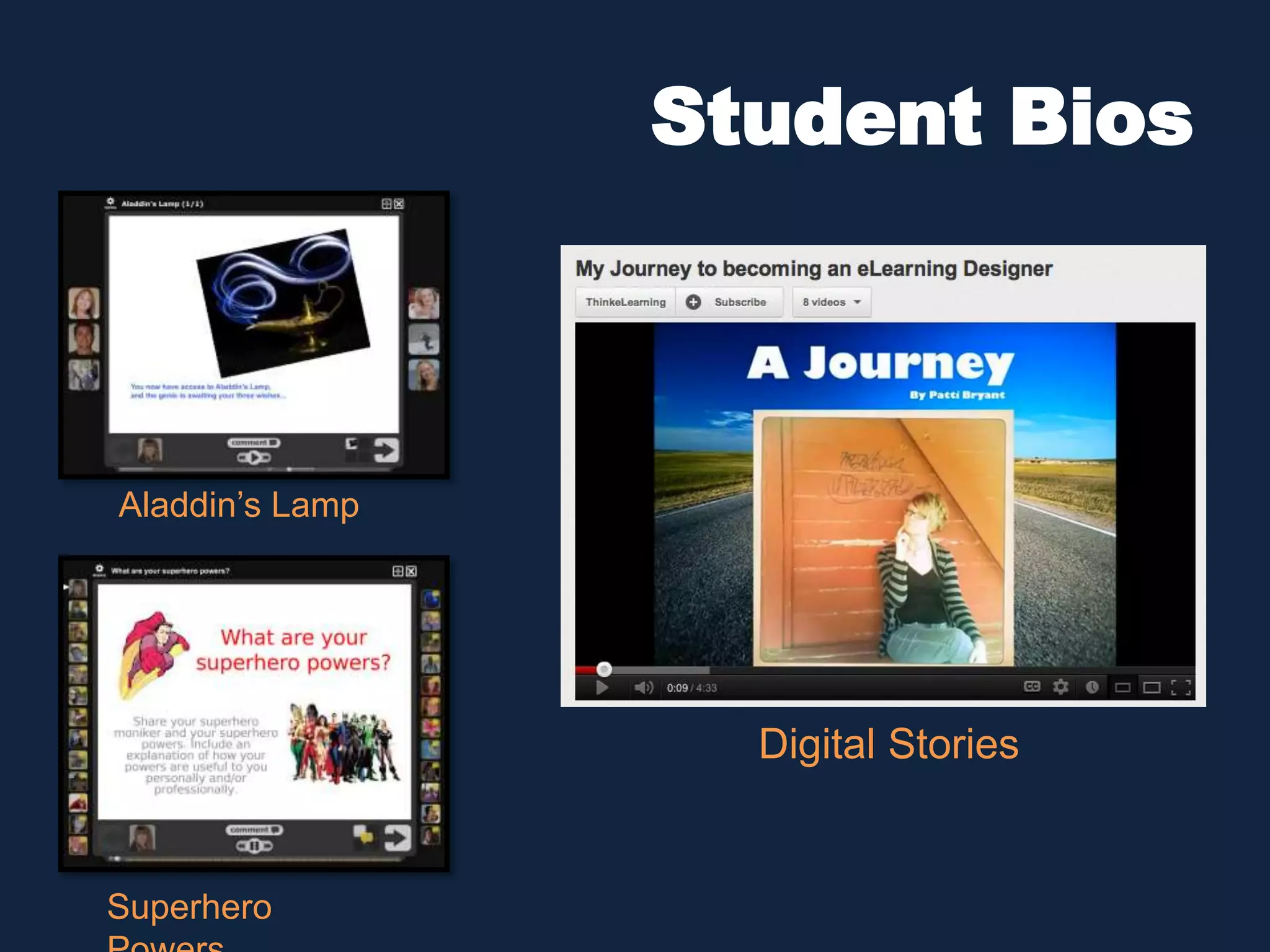
Student Bios 
Aladdin’s Lamp 
Superhero 
Powers 
Digital Stories
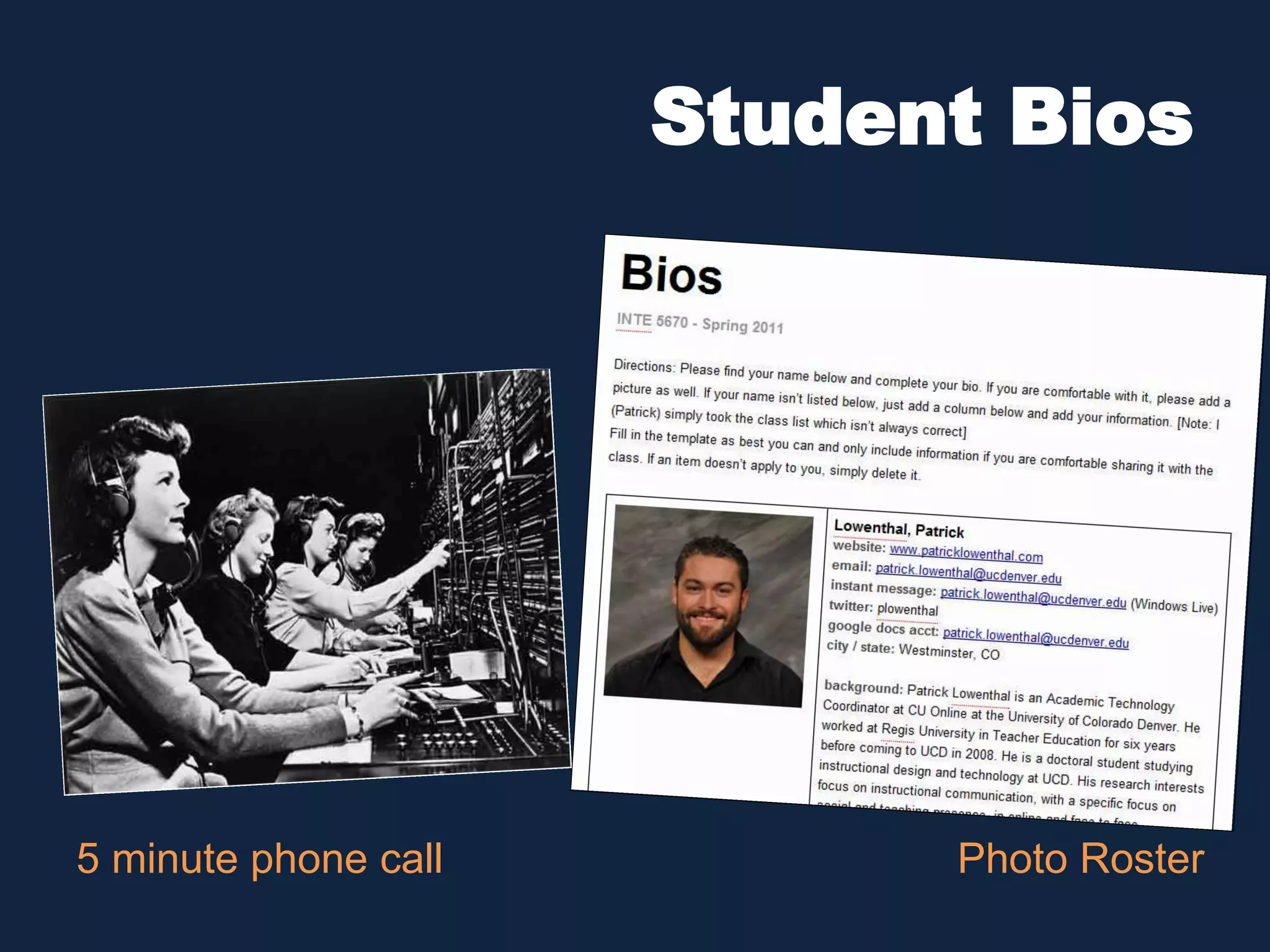
Student Bios 
5 minute phone call Photo Roster
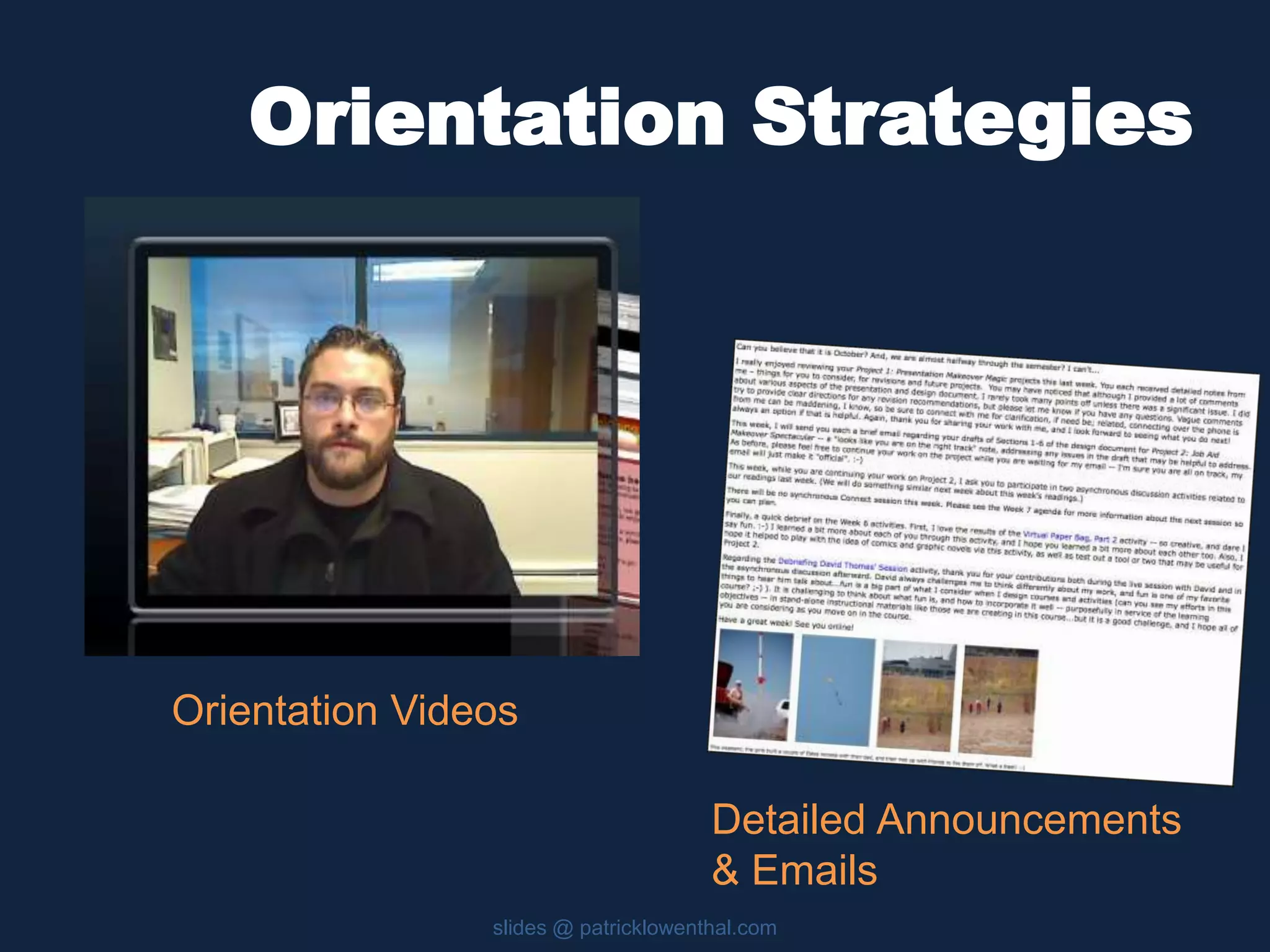
Orientation Strategies 
Orientation Videos 
Detailed Announcements 
& Emails 
slides @ patricklowenthal.com
Reconnecting Strategies 
Soundtrack of your life Virtual Paper Bag
Feedback Strategies 
Video Feedback
Discussion Strategies 
Non-threatening discussions 
Discussion Protocols 
Synchronous Discussions
Small Group Strategies 
Peer Review 
Group Work 
Document Co-Creation
Organic Interaction Strategies 
Social Media
RECENT WORK ON SOCIAL 
PRESENCE 
slides @ patricklowenthal.com
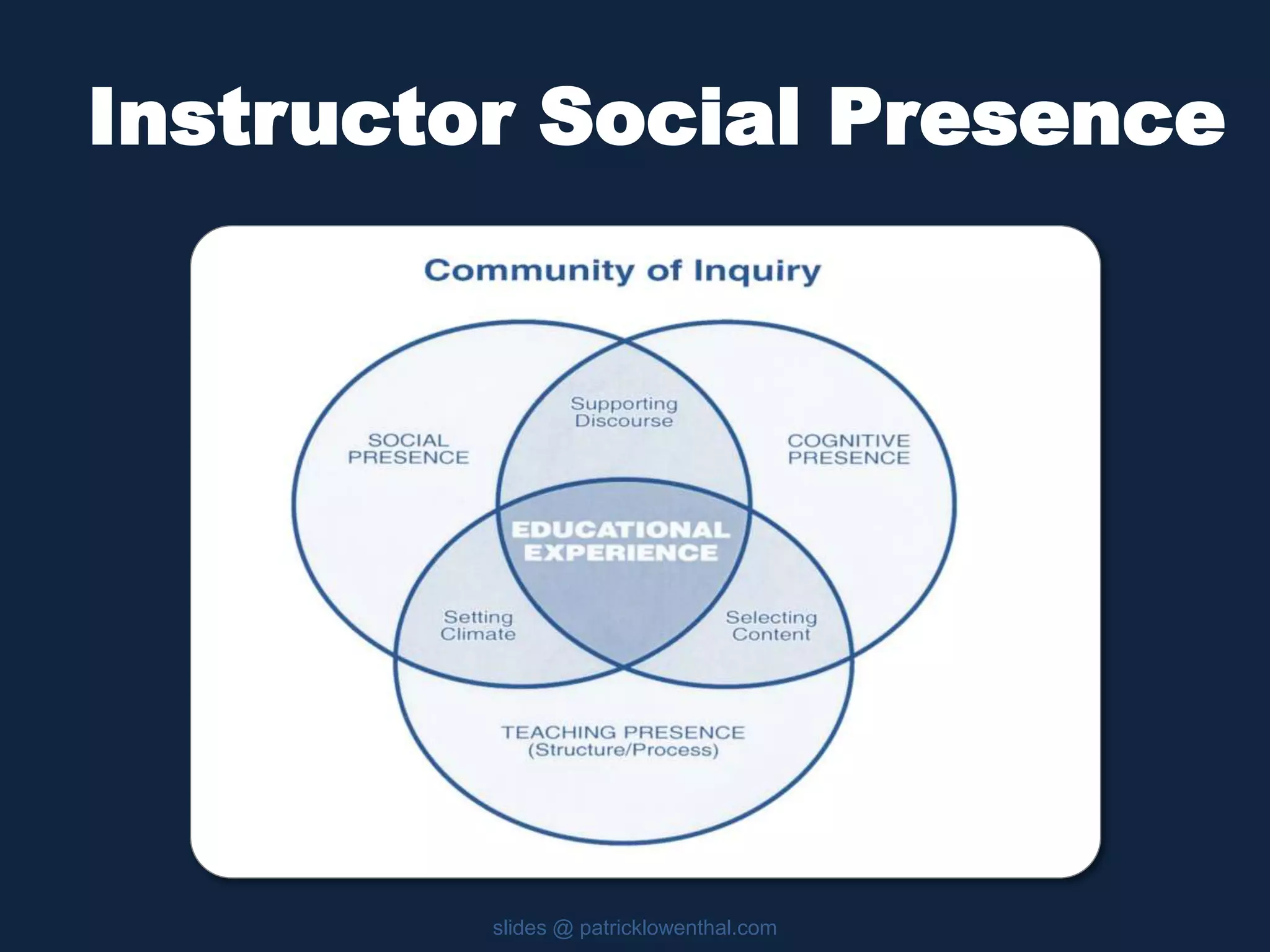
Instructor Social Presence 
slides @ patricklowenthal.com
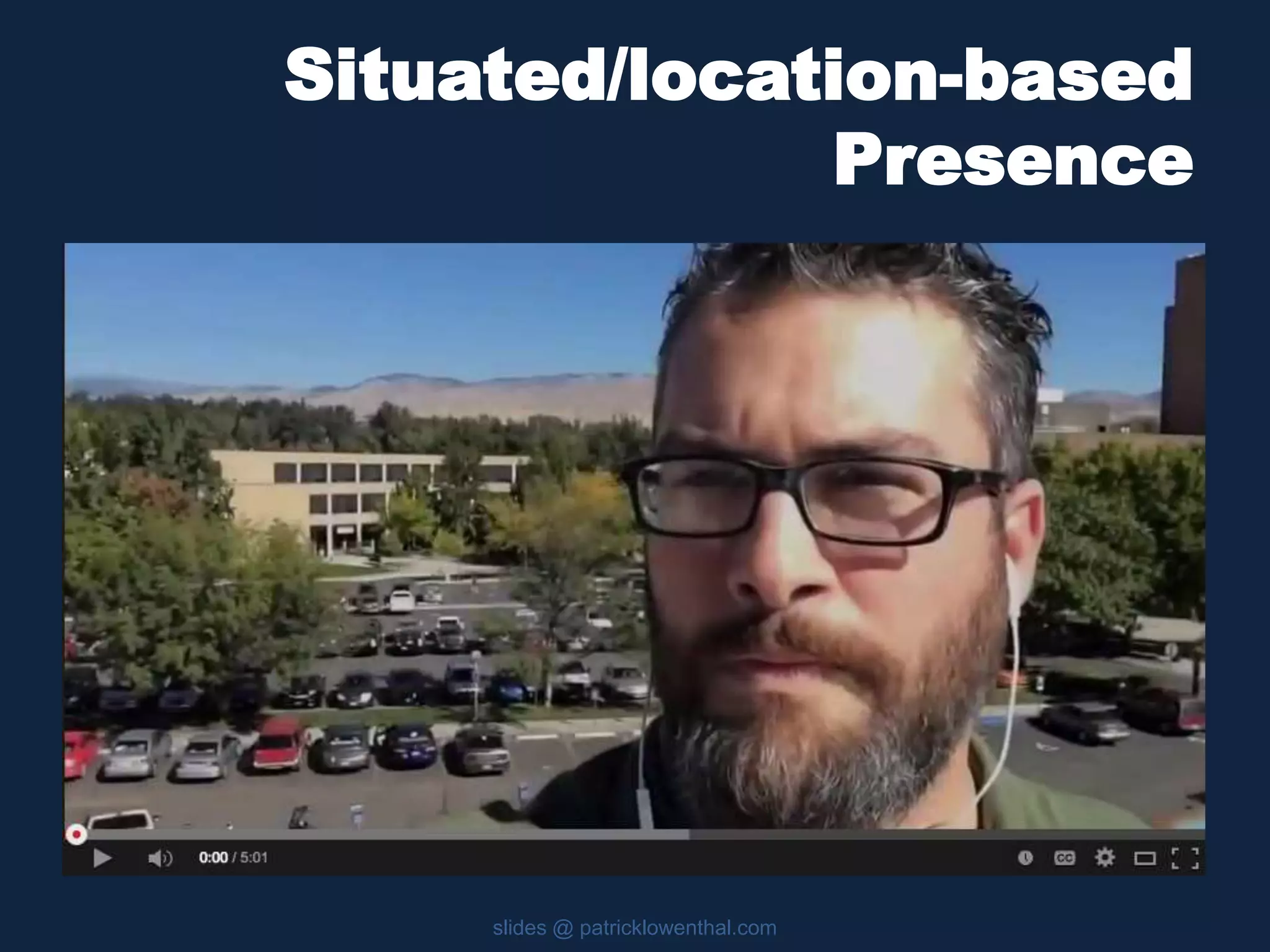
Situated/location-based 
Presence 
slides @ patricklowenthal.com
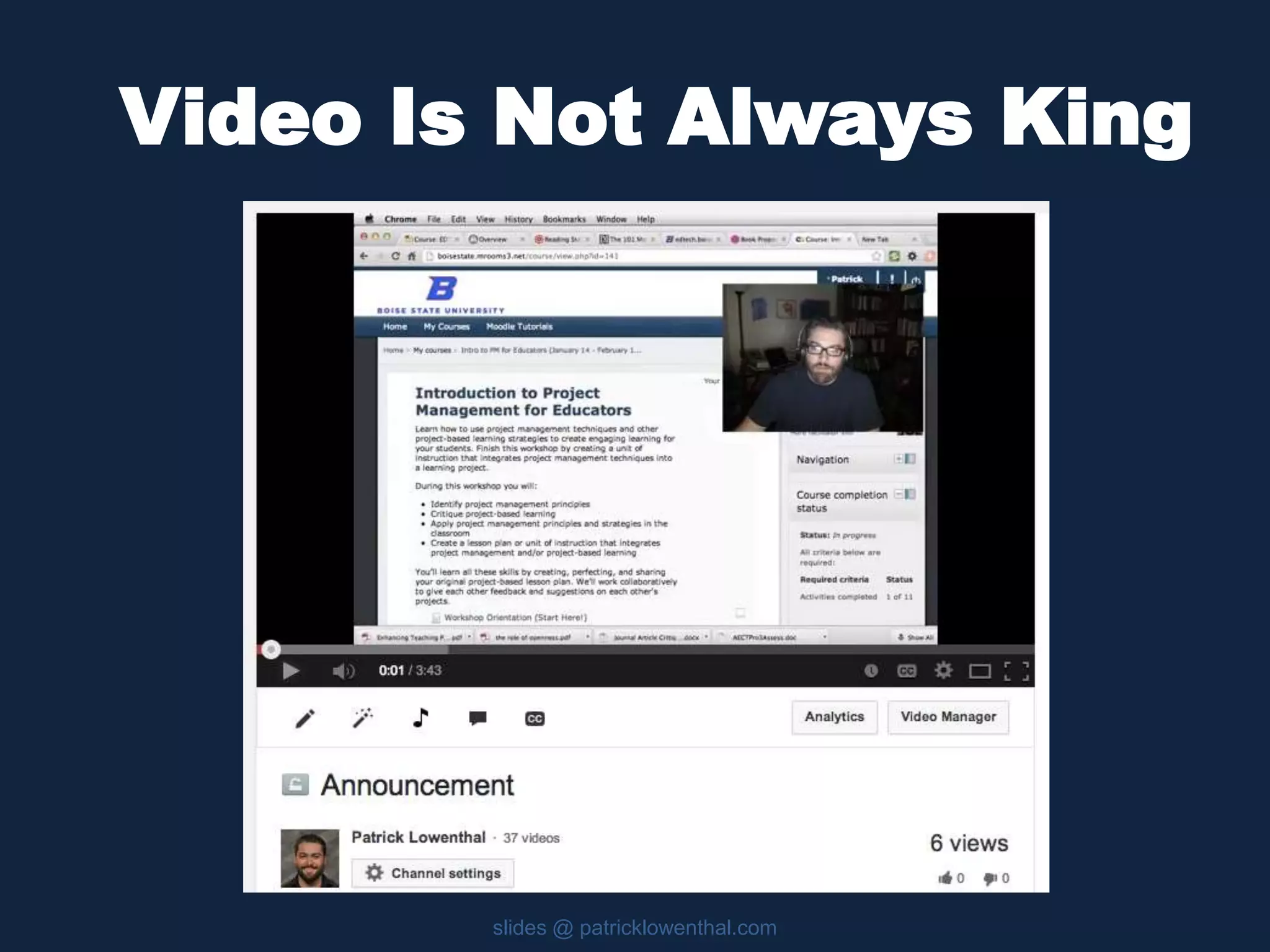
Video Is Not Always King 
slides @ patricklowenthal.com
Patrick Lowenthal 
patricklowenthal@boisestate.edu 
www.patricklowenthal.com 
CONTACT ME

Thinking Differently About Social Presence in Online Courses -- Northwest eLearn 2014

  • 1.
    Thinking differently aboutSocial Presence in Online Courses Patrick R. Lowenthal Boise State University @plowenthal slides @ patricklowenthal.com
  • 2.
    A Bit aboutMe Assistant Professor @ Boise State educator researcher designer developer slides @ patricklowenthal.com
  • 3.
    Agenda History of Social Presence Evolution of Social Presence Social Presence Strategies Recent Work & Challenges slides @ patricklowenthal.com
  • 4.
    HISTORY OF SOCIALPRESENCE slides @ patricklowenthal.com
  • 5.
    Social Presence Theory Social presence is the degree of salience (i.e., quality or state of being there) between two communicators using a communication medium.
  • 6.
    What does thismean? It’s a quality of a communication medium. Some media (e.g., video) have higher social presence than other media (e.g., audio) Media w/ high social presence are sociable, warm, & personal; media w/ low social presence are as less personal.
  • 7.
    What does thismean? It’s a quality of a communication medium. Some media (e.g., video) have higher social presence than other media (e.g., audio) Media w/ high social presence are sociable, warm, & personal; media w/ low social presence are as less personal.
  • 8.
    What does thismean? It’s a quality of a communication medium. Some media (e.g., video) have higher social presence than other media (e.g., audio) Media w/ high social presence are sociable, warm, & personal; media w/ low social presence are as less personal.
  • 9.
    Less Social PresenceMore Social Presence slides @ patricklowenthal.com
  • 10.
    Focused on 1-on-1 slides @ patricklowenthal.com
  • 11.
    1980’s & CMC Cuelessness Theory developed by Rutter (1984, 1987) Media Richness Theory developed by Daft & Lengel (1984, 1986; Daft, Lengel, & Trevino, 1987) slides @ patricklowenthal.com
  • 12.
    EVOLUTION OF SOCIALPRESENCE slides @ patricklowenthal.com
  • 13.
    Timeline 1970 19761979 1984 1992 1995 1999 slides @ patricklowenthal.com
  • 14.
    Phase Period KeyFigures Focus of Research 1. 1970s Short et al. Focused on Telecommunications 2. 1980s to early 1990s Rutter Daft & Lengel Kiesler Walther Focused on CMC 3. Early 1990s to early 2000s Gunarwardena Garrison et al. Tu Swan Richardson Focused on Online Learning 4. Mid 2000s to present Garrison Shea Cleveland-Innes Akyol Swan Richardson Focused on Online Learning & the CoI slides @ patricklowenthal.com
  • 15.
  • 16.
    Affective Communication •Expression of emotions • Use of humor • Self-disclosure Cohesive Communication • Continuing a thread • Quoting from others’ messages • Referring explicitly to other’s messages • Asking questions • Complimenting, expressing appreciation • Expressing agreement Interactive Communication • Vocatives • Refers to group using inclusive pronouns • Phatics, salutations + slides @ patricklowenthal.com
  • 17.
    Focused on Many-to-Many slides @ patricklowenthal.com
  • 18.
    Various Definitions •“the degree to which a person is perceived as a ‘real person’ in mediated communication” (Gunawardena, 1995, p. 151) • the ability of learners to project themselves socially and affectively into a community of inquiry (Rourke et al., 1999) • “as the ability of participants in a community of inquiry to project themselves socially and emotionally, as ‘real’ people (i.e., their full personality), through the medium of communication being used” (p. 94) • “…the degree of feeling, perception, and reaction of being connected by CMC” (Tu & McIsaac, 2002) • “…a student’s sense of being in and belonging in a course and the ability to interact with other students and an instructor” (Picciano, 2002, p. 22) • the degree to which another in communication appears to be a “real‟ person (Kreijns et al., 2011) slides @ patricklowenthal.com
  • 19.
    Various Definitions •“the degree to which a person is perceived as a ‘real person’ in mediated communication” (Gunawardena, 1995, p. 151) • the ability of learners to project themselves socially and affectively into a community of inquiry (Rourke et al., 1999) • “as the ability of participants in a community of inquiry to project themselves socially and emotionally, as ‘real’ people (i.e., their full personality), through the medium of communication being used” (p. 94) • “…the degree of feeling, perception, and reaction of being connected by CMC” (Tu & McIsaac, 2002) • “…a student’s sense of being in and belonging in a course and the ability to interact with other students and an instructor” (Picciano, 2002, p. 22) • the degree to which another in communication appears to be a “real‟ person (Kreijns et al., 2011) slides @ patricklowenthal.com
  • 20.
    Various Definitions •“the degree to which a person is perceived as a ‘real person’ in mediated communication” (Gunawardena, 1995, p. 151) • the ability of learners to project themselves socially and affectively into a community of inquiry (Rourke et al., 1999) • “as the ability of participants in a community of inquiry to project themselves socially and emotionally, as ‘real’ people (i.e., their full personality), through the medium of communication being used” (p. 94) • “…the degree of feeling, perception, and reaction of being connected by CMC” (Tu & McIsaac, 2002) • “…a student’s sense of being in and belonging in a course and the ability to interact with other students and an instructor” (Picciano, 2002, p. 22) • the degree to which another in communication appears to be a “real‟ person (Kreijns et al., 2011) slides @ patricklowenthal.com
  • 21.
    Various Definitions •“the degree to which a person is perceived as a ‘real person’ in mediated communication” (Gunawardena, 1995, p. 151) • the ability of learners to project themselves socially and affectively into a community of inquiry (Rourke et al., 1999) • “as the ability of participants in a community of inquiry to project themselves socially and emotionally, as ‘real’ people (i.e., their full personality), through the medium of communication being used” (p. 94) • “…the degree of feeling, perception, and reaction of being connected by CMC” (Tu & McIsaac, 2002) • “…a student’s sense of being in and belonging in a course and the ability to interact with other students and an instructor” (Picciano, 2002, p. 22) • the degree to which another in communication appears to be a “real‟ person (Kreijns et al., 2011) slides @ patricklowenthal.com
  • 22.
    Various Definitions •“the degree to which a person is perceived as a ‘real person’ in mediated communication” (Gunawardena, 1995, p. 151) • the ability of learners to project themselves socially and affectively into a community of inquiry (Rourke et al., 1999) • “as the ability of participants in a community of inquiry to project themselves socially and emotionally, as ‘real’ people (i.e., their full personality), through the medium of communication being used” (p. 94) • “…the degree of feeling, perception, and reaction of being connected by CMC” (Tu & McIsaac, 2002) • “…a student’s sense of being in and belonging in a course and the ability to interact with other students and an instructor” (Picciano, 2002, p. 22) • the degree to which another in communication appears to be a “real‟ person (Kreijns et al., 2011) slides @ patricklowenthal.com
  • 23.
    Various Definitions •“the degree to which a person is perceived as a ‘real person’ in mediated communication” (Gunawardena, 1995, p. 151) • the ability of learners to project themselves socially and affectively into a community of inquiry (Rourke et al., 1999) • “as the ability of participants in a community of inquiry to project themselves socially and emotionally, as ‘real’ people (i.e., their full personality), through the medium of communication being used” (p. 94) • “…the degree of feeling, perception, and reaction of being connected by CMC” (Tu & McIsaac, 2002) • “…a student’s sense of being in and belonging in a course and the ability to interact with other students and an instructor” (Picciano, 2002, p. 22) • the degree to which another in communication appears to be a “real‟ person (Kreijns et al., 2011) slides @ patricklowenthal.com
  • 24.
    Varied Understandings EmotionalNonemotional Connection Nonconnection Community Noncommunity slides @ patricklowenthal.com
  • 25.
    Social Presence Learning Community = slides @ patricklowenthal.com
  • 26.
    slides @ patricklowenthal.com Interaction Bounded Learning Community Social Presence Professional Learning Community
  • 27.
    SOCIAL PRESENCE STRATEGIES slides @ patricklowenthal.com
  • 28.
    Social Presence Strategies Bio strategies Orientation strategies Reconnecting strategies Feedback strategies Discussion strategies Small group strategies Organic interaction strategies
  • 29.
    Teacher Bios DigitalStories Scholarship & Philosophy
  • 30.
    Student Bios Aladdin’sLamp Superhero Powers Digital Stories
  • 31.
    Student Bios 5minute phone call Photo Roster
  • 32.
    Orientation Strategies OrientationVideos Detailed Announcements & Emails slides @ patricklowenthal.com
  • 33.
    Reconnecting Strategies Soundtrackof your life Virtual Paper Bag
  • 34.
  • 35.
    Discussion Strategies Non-threateningdiscussions Discussion Protocols Synchronous Discussions
  • 36.
    Small Group Strategies Peer Review Group Work Document Co-Creation
  • 37.
  • 38.
    RECENT WORK ONSOCIAL PRESENCE slides @ patricklowenthal.com
  • 39.
    Instructor Social Presence slides @ patricklowenthal.com
  • 40.
  • 41.
    Video Is NotAlways King slides @ patricklowenthal.com
  • 42.
    Patrick Lowenthal patricklowenthal@boisestate.edu www.patricklowenthal.com CONTACT ME