Creating and Maintaining  Virtual Communities  Tanya Joosten [email_address] http://www.uwm.edu/~tjoosten http://joostengroup.com
Who am I? University Wisconsin-Milwaukee http://www.uwm.edu  Department of Communication Learning Technology Center http://LTC.uwm.edu
Session Overview Importance of virtual community Challenges in virtual community Challenging interactions Miscommunication Role of technology Practical tips
Why is virtual community important?
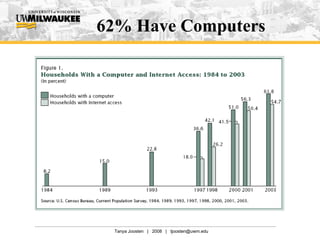
62% Have Computers
Changing Workplace Americans spend more than 100 hours commuting to work each year Two out of three Fortune 500 companies currently employ telecommuters. The United States Labor Department reported that 19 million people worked from home online or from another location in 2001 The Gartner Group estimated that by 2002 over 100 million people worldwide will be working outside traditional offices.
Making the Grade Nearly 3.2 million students were taking at least one online course during the fall 2005 term, a substantial increase over the 2.3 million reported the previous year. The more than 800,000 additional online students is more than twice the number added in any previous year. Doctoral/Research institutions have the greatest penetration of offering online programs as well as the highest overall rate (more than 80%) of having some form of online offering (either courses or full programs).
What challenges have you experienced in the creation and maintenance of your virtual community?
Challenges Building trust Transaction costs Anonymity Feeling detached Lack of recognition Failed expectations
Activity Write down the last time you had a challenging interaction using a digital form of communication? Describe the parties, the technology used, the perceived challenge, and the outcome
Activity What role did technology play in creating or managing the challenge? How did the perceptions of the other party effect the outcome? How did the interaction have an effect on your outcome?  How flexible were you?  How did this flexibility effect the productive or destructive nature of the interaction?
Why do we have problems communicating?
 
 
Why is perception important Perception is reality Perception affects the way we view the world, ourselves, others and our relationships
How does technology impact our interactions?
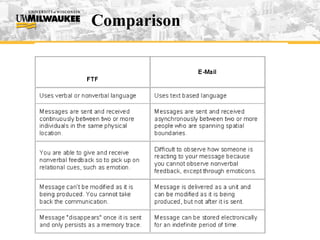
Comparison
Joosten || 2008
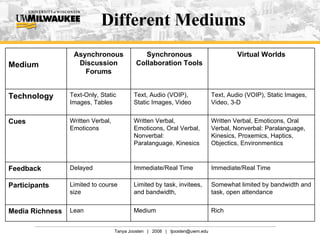
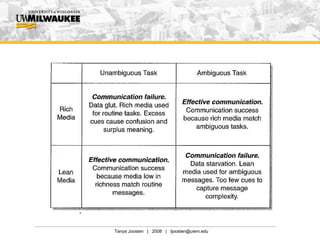
Different Mediums Medium Asynchronous Discussion Forums Synchronous Collaboration Tools Virtual Worlds Technology Text-Only, Static Images, Tables Text, Audio (VOIP), Static Images, Video Text, Audio (VOIP), Static Images, Video, 3-D Cues Written Verbal, Emoticons  Written Verbal, Emoticons, Oral Verbal, Nonverbal: Paralanguage, Kinesics Written Verbal, Emoticons, Oral Verbal, Nonverbal: Paralanguage, Kinesics, Proxemics, Haptics, Objectics, Environmentics Feedback Delayed Immediate/Real Time Immediate/Real Time Participants Limited to course size Limited by task, invitees, and bandwidth,  Somewhat limited by bandwidth and task, open attendance Media Richness Lean Medium Rich
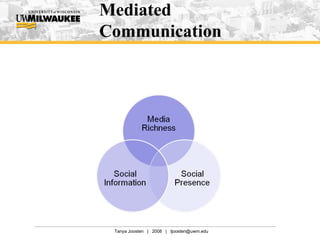
Mediated Communication


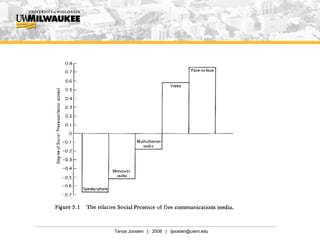
Media Effects and Characteristics Flaming (Uninhibited Behavior) Status-leveling, Equalization Filtering Social Presence Task communication Reduction of Cues Leanness of Media Efficiency of Interaction Regulating Feedback Depersonalization (Anonymity) Choice Shift
What can we do?
Creating constructive climates Evaluative vs. Descriptive Controlling vs. Problem -Oriented Strategic vs. Spontaneous Neutral vs. Empathetic Superiority vs. Equality Certain vs. Provisional
Building a virtual community Build Trust through behavioral consistency, integrity, and self-disclosure Allow others to predict your behavior Tell the truth and keep promises Keep communication accurate, open and explain decisions Demonstrate concern Use compliance-gaining techniques by being social, compliment, request
Provide positive feedback to colleagues Mediate conflict when it arises Confront, but don’t increase anxiety  Focus on similarities Discuss communication preferences Help manage relationships Meet f2f or pick up the phone!
If we change the way we react to others, they will change the way they react to us.
Activity Go back to your original interaction.  Answer the following questions: Were you making the other defensive? Did you use multiple mediums? Was your behavior predictable? Were you being flexible? Did you demonstrate concern? Were you being spontaneous? What could have you done different? What will you do in the future?
Tanya M. Joosten [email_address] Learning Technology Center Department of Communication University of Wisconsin-Milwaukee 480.861.8542 (mobile) 414.229.4319 (office)
Media Richness Theory What concepts and variables are discussed in Media Richness Theory? Uncertainty Equivocality Attribute space Media richness Joosten || 2008
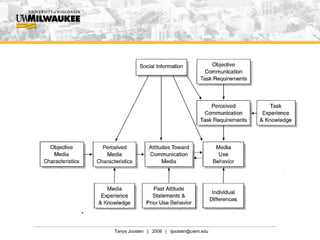
Two Premises of SIP Reflexive Monitoring Rationalization Joosten || 2008
Social Information Processing 1).  Encoding social cues 2).  Form a mental representation and interpretation of the cues 3).  Search for possible behavioral response 4).  Deciding on a response from those generated 5).  Enacting the response Joosten || 2008
Social Information Processing What argument does Fulk have against Daft and Lengel? Why does media richness theory not always hold true? Joosten || 2008

Virtual Communication in Educational Institutions

  • 1.
    Creating and Maintaining Virtual Communities Tanya Joosten [email_address] http://www.uwm.edu/~tjoosten http://joostengroup.com
  • 2.
    Who am I?University Wisconsin-Milwaukee http://www.uwm.edu Department of Communication Learning Technology Center http://LTC.uwm.edu
  • 3.
    Session Overview Importanceof virtual community Challenges in virtual community Challenging interactions Miscommunication Role of technology Practical tips
  • 4.
    Why is virtualcommunity important?
  • 5.
  • 6.
    Changing Workplace Americansspend more than 100 hours commuting to work each year Two out of three Fortune 500 companies currently employ telecommuters. The United States Labor Department reported that 19 million people worked from home online or from another location in 2001 The Gartner Group estimated that by 2002 over 100 million people worldwide will be working outside traditional offices.
  • 7.
    Making the GradeNearly 3.2 million students were taking at least one online course during the fall 2005 term, a substantial increase over the 2.3 million reported the previous year. The more than 800,000 additional online students is more than twice the number added in any previous year. Doctoral/Research institutions have the greatest penetration of offering online programs as well as the highest overall rate (more than 80%) of having some form of online offering (either courses or full programs).
  • 8.
    What challenges haveyou experienced in the creation and maintenance of your virtual community?
  • 9.
    Challenges Building trustTransaction costs Anonymity Feeling detached Lack of recognition Failed expectations
  • 10.
    Activity Write downthe last time you had a challenging interaction using a digital form of communication? Describe the parties, the technology used, the perceived challenge, and the outcome
  • 11.
    Activity What roledid technology play in creating or managing the challenge? How did the perceptions of the other party effect the outcome? How did the interaction have an effect on your outcome? How flexible were you? How did this flexibility effect the productive or destructive nature of the interaction?
  • 12.
    Why do wehave problems communicating?
  • 13.
  • 14.
  • 15.
    Why is perceptionimportant Perception is reality Perception affects the way we view the world, ourselves, others and our relationships
  • 16.
    How does technologyimpact our interactions?
  • 17.
  • 18.
  • 19.
    Different Mediums MediumAsynchronous Discussion Forums Synchronous Collaboration Tools Virtual Worlds Technology Text-Only, Static Images, Tables Text, Audio (VOIP), Static Images, Video Text, Audio (VOIP), Static Images, Video, 3-D Cues Written Verbal, Emoticons Written Verbal, Emoticons, Oral Verbal, Nonverbal: Paralanguage, Kinesics Written Verbal, Emoticons, Oral Verbal, Nonverbal: Paralanguage, Kinesics, Proxemics, Haptics, Objectics, Environmentics Feedback Delayed Immediate/Real Time Immediate/Real Time Participants Limited to course size Limited by task, invitees, and bandwidth, Somewhat limited by bandwidth and task, open attendance Media Richness Lean Medium Rich
  • 20.
  • 21.
  • 22.
  • 23.
  • 24.
    Media Effects andCharacteristics Flaming (Uninhibited Behavior) Status-leveling, Equalization Filtering Social Presence Task communication Reduction of Cues Leanness of Media Efficiency of Interaction Regulating Feedback Depersonalization (Anonymity) Choice Shift
  • 25.
  • 26.
    Creating constructive climatesEvaluative vs. Descriptive Controlling vs. Problem -Oriented Strategic vs. Spontaneous Neutral vs. Empathetic Superiority vs. Equality Certain vs. Provisional
  • 27.
    Building a virtualcommunity Build Trust through behavioral consistency, integrity, and self-disclosure Allow others to predict your behavior Tell the truth and keep promises Keep communication accurate, open and explain decisions Demonstrate concern Use compliance-gaining techniques by being social, compliment, request
  • 28.
    Provide positive feedbackto colleagues Mediate conflict when it arises Confront, but don’t increase anxiety Focus on similarities Discuss communication preferences Help manage relationships Meet f2f or pick up the phone!
  • 29.
    If we changethe way we react to others, they will change the way they react to us.
  • 30.
    Activity Go backto your original interaction. Answer the following questions: Were you making the other defensive? Did you use multiple mediums? Was your behavior predictable? Were you being flexible? Did you demonstrate concern? Were you being spontaneous? What could have you done different? What will you do in the future?
  • 31.
    Tanya M. Joosten[email_address] Learning Technology Center Department of Communication University of Wisconsin-Milwaukee 480.861.8542 (mobile) 414.229.4319 (office)
  • 32.
    Media Richness TheoryWhat concepts and variables are discussed in Media Richness Theory? Uncertainty Equivocality Attribute space Media richness Joosten || 2008
  • 33.
    Two Premises ofSIP Reflexive Monitoring Rationalization Joosten || 2008
  • 34.
    Social Information Processing1). Encoding social cues 2). Form a mental representation and interpretation of the cues 3). Search for possible behavioral response 4). Deciding on a response from those generated 5). Enacting the response Joosten || 2008
  • 35.
    Social Information ProcessingWhat argument does Fulk have against Daft and Lengel? Why does media richness theory not always hold true? Joosten || 2008