SENSE AND SENTIMENTALITY IN 
DIGITAL STORIES – A CASE OF 
PRE-SERVICE TEACHER 
EDUCATION IN SOUTH AFRICA 
Daniela Gachago 
Cape Peninsula University of Technology
Story circle 
 “Stories move in circles. They don’t move in 
straight lines. So it helps if you listen in circles. 
There are stories inside stories and stories 
between stories, and finding your way through 
them is as easy and as hard as finding your 
way home. And part of the finding is getting 
lost. And when you’re lost, you start to look 
around and listen.” 
(Lambert 2010, v).
Opening wounds 
 This story it freaked me out completely 
because it sort of scratched open wounds and 
not just surface wise. But I was digging 
deeper into getting an understanding of me 
and even just consolidating the things that I 
came up with, how I felt and how it impacted 
and unpacking that and sort of putting it back 
where it belongs again or rearranging your 
whole mode of thinking. … it’s unnerving and 
it left us sort of scattered, you know. (CF)
Vulnerability 
 Student 1: And then I think what - what the 
most challenging to me was having to read it 
out aloud - the story. 
Student 2: Sharing your story. 
Student 1: And then there was that dot - dot - 
dot moment where you just went I'm - I'm 
naked. I'm just exposed… And not knowing the 
responses that you are going to get ….
 You’ve got to delve into the lives of people who 
you’ve been with for four years, who you’ve 
greeted, who you’ve asked how are you but 
just on that level. But after Wednesday [day of 
screening] you still find people embracing 
each other whom they’ve never ever spoken 
really or hugged each other. (CF)
Emotions in education 
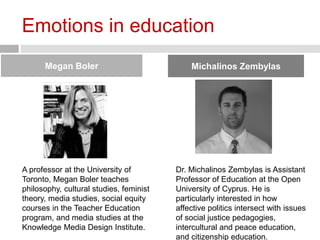
Megan Boler Michalinos Zembylas 
A professor at the University of 
Toronto, Megan Boler teaches 
philosophy, cultural studies, feminist 
theory, media studies, social equity 
courses in the Teacher Education 
program, and media studies at the 
Knowledge Media Design Institute. 
Dr. Michalinos Zembylas is Assistant 
Professor of Education at the Open 
University of Cyprus. He is 
particularly interested in how 
affective politics intersect with issues 
of social justice pedagogies, 
intercultural and peace education, 
and citizenship education.
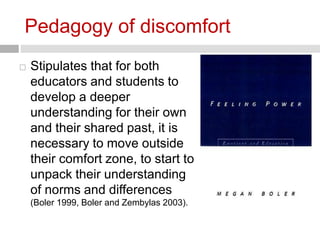
Pedagogy of discomfort 
 Stipulates that for both 
educators and students to 
develop a deeper 
understanding for their own 
and their shared past, it is 
necessary to move outside 
their comfort zone, to start to 
unpack their understanding 
of norms and differences 
(Boler 1999, Boler and Zembylas 2003).
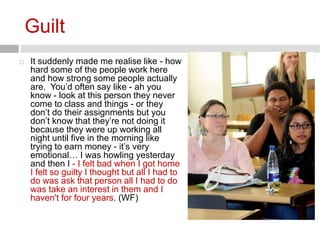
Guilt 
 It suddenly made me realise like - how 
hard some of the people work here 
and how strong some people actually 
are. You’d often say like - ah you 
know - look at this person they never 
come to class and things - or they 
don’t do their assignments but you 
don’t know that they’re not doing it 
because they were up working all 
night until five in the morning like 
trying to earn money - it’s very 
emotional… I was howling yesterday 
and then I - I felt bad when I got home 
I felt so guilty I thought but all I had to 
do was ask that person all I had to do 
was take an interest in them and I 
haven't for four years. (WF)
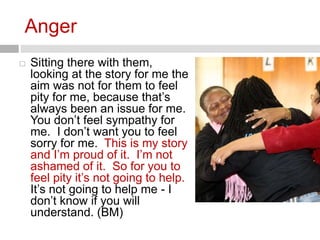
Anger 
 Sitting there with them, 
looking at the story for me the 
aim was not for them to feel 
pity for me, because that’s 
always been an issue for me. 
You don’t feel sympathy for 
me. I don’t want you to feel 
sorry for me. This is my story 
and I’m proud of it. I’m not 
ashamed of it. So for you to 
feel pity it’s not going to help. 
It’s not going to help me - I 
don’t know if you will 
understand. (BM)
Danger of sentimentality 
 Zembylas: sentimental reaction by students 
identifying with the privilege feeling guilt / 
defensiveness in privileged party and anger in 
the victim, leading to desensitization & 
disengagement (2011: 20)
Questions 
 How and what emotions are being constructed 
in digital stories? 
 What role does the multimodal nature of digital 
stories play in the construction of these 
emotions?
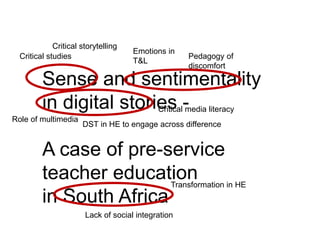
Emotions in 
T&L 
Pedagogy of 
discomfort 
Critical storytelling 
Critical studies 
Sense and sentimentality 
in digital stories - 
Critical media literacy 
A case of pre-service 
teacher education 
in South Africa 
Transformation in HE 
Lack of social integration 
Role of multimedia 
DST in HE to engage across difference
Sense and sentimentality 
in digital stories - 
A case of pre-service 
teacher education 
in South Africa 
Transformation in HE 
Lack of social integration
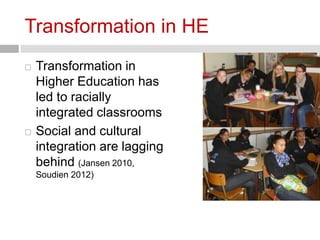
Transformation in HE 
 Transformation in 
Higher Education has 
led to racially 
integrated classrooms 
 Social and cultural 
integration are lagging 
behind (Jansen 2010, 
Soudien 2012)
Explosive emotions 
 Many educators shy away from difficult topics 
such as race and privilege for fear of the 
emotions that might come up, be it bitter 
feelings, anger, resentment and real pain 
(Burbules 2004) 
 But also growing interest in literature around 
practices that unsettle established beliefs and 
assumptions
Emotions in 
T&L 
Pedagogy of 
discomfort 
Sense and sentimentality 
in digital stories - 
A case of pre-service 
teacher education 
in South Africa
Pedagogy of discomfort 
 Stipulates that for both 
educators and students to 
develop a deeper 
understanding for their own 
and their shared past, it is 
necessary to move outside 
their comfort zone, to start to 
unpack their understanding 
of norms and differences 
(Boler 1999, Boler and Zembylas 2003).
Emotions 
 To engage in critical inquiry often means 
asking students to radically re-evaluate their 
world views. This process can incur feelings 
of anger, grief, disappointment, and 
resistance, but the process also offers 
students new windows on the world: to 
develop the capacity for critical inquiry 
regarding the production and construction of 
differences gives people a tool that will be 
useful over their lifetime. In short, this 
pedagogy of discomfort requires not only 
cognitive but emotional labor. (Boler and 
Zembylas 2003: 110)
Pedagogy of possibility 
 Result of pedagogy of discomfort: negative 
emotional labour such as vulnerability, anger, 
suffering. 
 Emotional labour can produce favourable 
results, including self-discovery, hope, passion 
an a sense of community.
Critical emotional reflexivity 
 ….a process of using emotions as catalysts, to 
allow the questioning of beliefs and 
assumptions, exposing privilege and comfort 
zones, with the aim for learners to find new 
ways of being with the ‘Other’, and ultimately 
leading to transformed ‘relationships, 
practices, and enactments that benefit 
teaching and learning for peace, mutual 
understanding, and reconciliation’ 
(Zembylas 2011: 2)
Critical storytelling 
Critical studies 
Sense and sentimentality 
in digital stories - 
A case of pre-service 
teacher education 
in South Africa
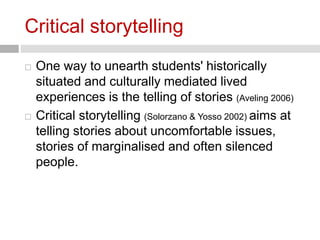
Critical storytelling 
 One way to unearth students' historically 
situated and culturally mediated lived 
experiences is the telling of stories (Aveling 2006) 
 Critical storytelling (Solorzano & Yosso 2002) aims at 
telling stories about uncomfortable issues, 
stories of marginalised and often silenced 
people.
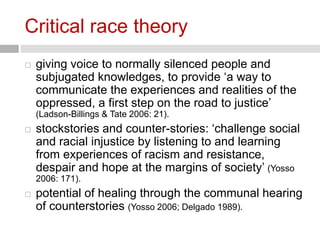
Critical race theory 
 giving voice to normally silenced people and 
subjugated knowledges, to provide ‘a way to 
communicate the experiences and realities of the 
oppressed, a first step on the road to justice’ 
(Ladson-Billings & Tate 2006: 21). 
 stockstories and counter-stories: ‘challenge social 
and racial injustice by listening to and learning 
from experiences of racism and resistance, 
despair and hope at the margins of society’ (Yosso 
2006: 171). 
 potential of healing through the communal hearing 
of counterstories (Yosso 2006; Delgado 1989).
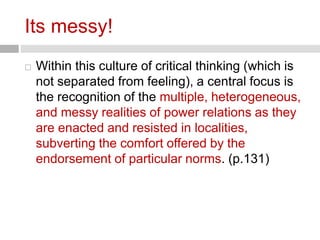
Its messy! 
 Within this culture of critical thinking (which is 
not separated from feeling), a central focus is 
the recognition of the multiple, heterogeneous, 
and messy realities of power relations as they 
are enacted and resisted in localities, 
subverting the comfort offered by the 
endorsement of particular norms. (p.131)
No one escapes hegemony 
 A POD invites not only members of the 
dominant culture but also members of the 
marginalized cultures to re-examine the 
hegemonic values inevitably internalized in the 
process of being exposed to curriculum and 
media that serve the interest of the ruling 
class. (Boler 1999)
Sense and sentimentality 
in digital stories - 
Role of multimedia 
Critical media literacy 
DST in HE to engage across difference 
A case of pre-service 
teacher education 
in South Africa
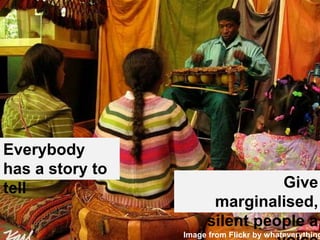
Everybody 
has a story to 
tell 
Give 
marginalised, 
silent people a 
Image from Flickr by whateverything voice
Studies on digital storytelling and 
difference 
 Lots of engagement around digital storytelling 
and difference 
 Less on difference & critical pedagogy 
 Only 2 references on digital storytelling & 
counterstories 
 Rolon-Dow (2011): Race(ing) stories: digital 
storytelling as a tool for critical race scholarship 
 Vaseduvan (2006): Making Known Differently: 
engaging visual modalities as spaces to author 
new selves
Multimodality 
 Multimodal pedagogy 
 Telling a story through different modes 
 Combination of different modes will result in 
different meanings (Kress and Van Leuwen 2001) 
 Critical media literacy: critically analyzing 
relationship between media and audiences, 
information and power (Kellner and Share 2007)
Critical media literacy 
 ‘Critical media literacy expands the notion of literacy 
to include different forms of mass communication and 
popular culture as well as deepens the potential of 
education to crit- ically analyze relationships between 
media and audiences, information and power. It 
involves cultivating skills in analyzing media codes 
and conventions, abilities to criticize stereotypes, 
dominant values, and ideologies, and competencies to 
interpret the multiple meanings and messages 
generated by media texts. Media literacy helps people 
to discriminate and evaluate media content, to 
critically dissect media forms, to investigate media 
effects and uses, to use media intelligently, and to 
construct alternative media.’ 
Kellner and Share (2007: 4)
Sentimentality in digital stories 
 originate directly from participants lived 
experiences, and often deal with significant 
episodes in somebody’s lives 
 tendency to be very emotional
 ‘Somewhat paradoxically from a critical 
perspective, it is the very qualities that mark 
digital stories as uncool, conservative, and 
ideologically suspect – ‘stock’ tropes, 
nostalgia, even sentimentality – that give them 
the power of social connectivity, while the 
sense of authentic self-expression that they 
convey lowers the barriers to empathy.‘ 
(Burgess 2006:10)
 The element of ‘emotional content’ is one of 
the ways in which personal stories are 
powerful and convincing and, in the context of 
‘Digital His-tories’, communicate a personal 
historically ‘situated truth’, one that is always 
partial and incomplete. (Coleborn and Bliss 2011)
Danger of sentimentality 
 ‘too sentimental, individualistic, and naively 
unself-conscious’ 
 call for everyone involved in digital stories to 
‘maintain a reflexive and critical attitude within 
a supportive and human purpose’ (Hartley and 
McWilliam 2009: 14)
References 
 Boler, M., & Zembylas, M. (2003). Discomforting Truths: The 
Emotional Terrain of Understanding Difference. In P. Trifonas 
(Ed.), Pedagogies of difference: Rethinking education for 
social change (pp. 110-136). New York: RoutledgeFalmer. 
 Bozalek, V. (2011). Acknowledging privilege through 
encounters with difference: Participatory Learning and Action 
techniques for decolonising methodologies in Southern 
contexts. International Journal of Social Research 
Methodology, 14(6), 469-484. 
 Hemson, C., Moletsane, R., & Muthukrishna, N. (2001). 
Transforming Racist Conditioning. Perspectives in Education, 
19(2), 85-97. 
 Jansen, J. (2010). Over the rainbow - race and reconciliation 
on university campuses in South Africa. Discourse, 38(1). 
 Lambert, J. (2010). Digital storytelling cookbook. Elements. 
Berkeley, CA: Center for Digital Storytelling.
 Pattman, R. (2010). Investigating “race” and social cohesion 
at the University of Kwa-Zulu Natal. South African Journal of 
Higher Education, 24(6), 953-971. 
 Soudien, C. (2012). Realising the dream. Cape Town: HSRC 
Press. Retrieved from 
http://www.hsrcpress.ac.za/product.php?productid=2291&free 
download=1 
 Zembylas, M. (2012). Teaching in Higher Education 
Pedagogies of strategic empathy: navigating through the 
emotional complexities of anti-racism in higher education. 
Teaching in Higher Education, (April), 37-41. 
 Zembylas, M. (2011). The politics of trauma in education. 
New York: Palgrave Macmillan. 
 Zembylas, M. (2007). Five pedagogies, a thousand 
possibilities. Rotterdam: Sense Publishers.
Acknowledgement 
 CPUT Research into Innovations in Teaching 
and Learning Fund (RIFTAL 2011, 2012) 
 CPUT University Research Fund 2012 
 National research foundation 2012-2015 
 Facilitators and students of 2011 ISP Digital 
Storytelling project

Sense and sentimentality in digital stories – a case of pre-service teacher education in South Africa (literature review)

  • 1.
    SENSE AND SENTIMENTALITYIN DIGITAL STORIES – A CASE OF PRE-SERVICE TEACHER EDUCATION IN SOUTH AFRICA Daniela Gachago Cape Peninsula University of Technology
  • 4.
    Story circle “Stories move in circles. They don’t move in straight lines. So it helps if you listen in circles. There are stories inside stories and stories between stories, and finding your way through them is as easy and as hard as finding your way home. And part of the finding is getting lost. And when you’re lost, you start to look around and listen.” (Lambert 2010, v).
  • 7.
    Opening wounds This story it freaked me out completely because it sort of scratched open wounds and not just surface wise. But I was digging deeper into getting an understanding of me and even just consolidating the things that I came up with, how I felt and how it impacted and unpacking that and sort of putting it back where it belongs again or rearranging your whole mode of thinking. … it’s unnerving and it left us sort of scattered, you know. (CF)
  • 8.
    Vulnerability  Student1: And then I think what - what the most challenging to me was having to read it out aloud - the story. Student 2: Sharing your story. Student 1: And then there was that dot - dot - dot moment where you just went I'm - I'm naked. I'm just exposed… And not knowing the responses that you are going to get ….
  • 9.
     You’ve gotto delve into the lives of people who you’ve been with for four years, who you’ve greeted, who you’ve asked how are you but just on that level. But after Wednesday [day of screening] you still find people embracing each other whom they’ve never ever spoken really or hugged each other. (CF)
  • 10.
    Emotions in education Megan Boler Michalinos Zembylas A professor at the University of Toronto, Megan Boler teaches philosophy, cultural studies, feminist theory, media studies, social equity courses in the Teacher Education program, and media studies at the Knowledge Media Design Institute. Dr. Michalinos Zembylas is Assistant Professor of Education at the Open University of Cyprus. He is particularly interested in how affective politics intersect with issues of social justice pedagogies, intercultural and peace education, and citizenship education.
  • 11.
    Pedagogy of discomfort  Stipulates that for both educators and students to develop a deeper understanding for their own and their shared past, it is necessary to move outside their comfort zone, to start to unpack their understanding of norms and differences (Boler 1999, Boler and Zembylas 2003).
  • 12.
    Guilt  Itsuddenly made me realise like - how hard some of the people work here and how strong some people actually are. You’d often say like - ah you know - look at this person they never come to class and things - or they don’t do their assignments but you don’t know that they’re not doing it because they were up working all night until five in the morning like trying to earn money - it’s very emotional… I was howling yesterday and then I - I felt bad when I got home I felt so guilty I thought but all I had to do was ask that person all I had to do was take an interest in them and I haven't for four years. (WF)
  • 13.
    Anger  Sittingthere with them, looking at the story for me the aim was not for them to feel pity for me, because that’s always been an issue for me. You don’t feel sympathy for me. I don’t want you to feel sorry for me. This is my story and I’m proud of it. I’m not ashamed of it. So for you to feel pity it’s not going to help. It’s not going to help me - I don’t know if you will understand. (BM)
  • 14.
    Danger of sentimentality  Zembylas: sentimental reaction by students identifying with the privilege feeling guilt / defensiveness in privileged party and anger in the victim, leading to desensitization & disengagement (2011: 20)
  • 15.
    Questions  Howand what emotions are being constructed in digital stories?  What role does the multimodal nature of digital stories play in the construction of these emotions?
  • 16.
    Emotions in T&L Pedagogy of discomfort Critical storytelling Critical studies Sense and sentimentality in digital stories - Critical media literacy A case of pre-service teacher education in South Africa Transformation in HE Lack of social integration Role of multimedia DST in HE to engage across difference
  • 17.
    Sense and sentimentality in digital stories - A case of pre-service teacher education in South Africa Transformation in HE Lack of social integration
  • 18.
    Transformation in HE  Transformation in Higher Education has led to racially integrated classrooms  Social and cultural integration are lagging behind (Jansen 2010, Soudien 2012)
  • 19.
    Explosive emotions Many educators shy away from difficult topics such as race and privilege for fear of the emotions that might come up, be it bitter feelings, anger, resentment and real pain (Burbules 2004)  But also growing interest in literature around practices that unsettle established beliefs and assumptions
  • 20.
    Emotions in T&L Pedagogy of discomfort Sense and sentimentality in digital stories - A case of pre-service teacher education in South Africa
  • 21.
    Pedagogy of discomfort  Stipulates that for both educators and students to develop a deeper understanding for their own and their shared past, it is necessary to move outside their comfort zone, to start to unpack their understanding of norms and differences (Boler 1999, Boler and Zembylas 2003).
  • 22.
    Emotions  Toengage in critical inquiry often means asking students to radically re-evaluate their world views. This process can incur feelings of anger, grief, disappointment, and resistance, but the process also offers students new windows on the world: to develop the capacity for critical inquiry regarding the production and construction of differences gives people a tool that will be useful over their lifetime. In short, this pedagogy of discomfort requires not only cognitive but emotional labor. (Boler and Zembylas 2003: 110)
  • 23.
    Pedagogy of possibility  Result of pedagogy of discomfort: negative emotional labour such as vulnerability, anger, suffering.  Emotional labour can produce favourable results, including self-discovery, hope, passion an a sense of community.
  • 24.
    Critical emotional reflexivity  ….a process of using emotions as catalysts, to allow the questioning of beliefs and assumptions, exposing privilege and comfort zones, with the aim for learners to find new ways of being with the ‘Other’, and ultimately leading to transformed ‘relationships, practices, and enactments that benefit teaching and learning for peace, mutual understanding, and reconciliation’ (Zembylas 2011: 2)
  • 25.
    Critical storytelling Criticalstudies Sense and sentimentality in digital stories - A case of pre-service teacher education in South Africa
  • 26.
    Critical storytelling One way to unearth students' historically situated and culturally mediated lived experiences is the telling of stories (Aveling 2006)  Critical storytelling (Solorzano & Yosso 2002) aims at telling stories about uncomfortable issues, stories of marginalised and often silenced people.
  • 27.
    Critical race theory  giving voice to normally silenced people and subjugated knowledges, to provide ‘a way to communicate the experiences and realities of the oppressed, a first step on the road to justice’ (Ladson-Billings & Tate 2006: 21).  stockstories and counter-stories: ‘challenge social and racial injustice by listening to and learning from experiences of racism and resistance, despair and hope at the margins of society’ (Yosso 2006: 171).  potential of healing through the communal hearing of counterstories (Yosso 2006; Delgado 1989).
  • 28.
    Its messy! Within this culture of critical thinking (which is not separated from feeling), a central focus is the recognition of the multiple, heterogeneous, and messy realities of power relations as they are enacted and resisted in localities, subverting the comfort offered by the endorsement of particular norms. (p.131)
  • 29.
    No one escapeshegemony  A POD invites not only members of the dominant culture but also members of the marginalized cultures to re-examine the hegemonic values inevitably internalized in the process of being exposed to curriculum and media that serve the interest of the ruling class. (Boler 1999)
  • 30.
    Sense and sentimentality in digital stories - Role of multimedia Critical media literacy DST in HE to engage across difference A case of pre-service teacher education in South Africa
  • 32.
    Everybody has astory to tell Give marginalised, silent people a Image from Flickr by whateverything voice
  • 33.
    Studies on digitalstorytelling and difference  Lots of engagement around digital storytelling and difference  Less on difference & critical pedagogy  Only 2 references on digital storytelling & counterstories  Rolon-Dow (2011): Race(ing) stories: digital storytelling as a tool for critical race scholarship  Vaseduvan (2006): Making Known Differently: engaging visual modalities as spaces to author new selves
  • 34.
    Multimodality  Multimodalpedagogy  Telling a story through different modes  Combination of different modes will result in different meanings (Kress and Van Leuwen 2001)  Critical media literacy: critically analyzing relationship between media and audiences, information and power (Kellner and Share 2007)
  • 35.
    Critical media literacy  ‘Critical media literacy expands the notion of literacy to include different forms of mass communication and popular culture as well as deepens the potential of education to crit- ically analyze relationships between media and audiences, information and power. It involves cultivating skills in analyzing media codes and conventions, abilities to criticize stereotypes, dominant values, and ideologies, and competencies to interpret the multiple meanings and messages generated by media texts. Media literacy helps people to discriminate and evaluate media content, to critically dissect media forms, to investigate media effects and uses, to use media intelligently, and to construct alternative media.’ Kellner and Share (2007: 4)
  • 36.
    Sentimentality in digitalstories  originate directly from participants lived experiences, and often deal with significant episodes in somebody’s lives  tendency to be very emotional
  • 37.
     ‘Somewhat paradoxicallyfrom a critical perspective, it is the very qualities that mark digital stories as uncool, conservative, and ideologically suspect – ‘stock’ tropes, nostalgia, even sentimentality – that give them the power of social connectivity, while the sense of authentic self-expression that they convey lowers the barriers to empathy.‘ (Burgess 2006:10)
  • 38.
     The elementof ‘emotional content’ is one of the ways in which personal stories are powerful and convincing and, in the context of ‘Digital His-tories’, communicate a personal historically ‘situated truth’, one that is always partial and incomplete. (Coleborn and Bliss 2011)
  • 39.
    Danger of sentimentality  ‘too sentimental, individualistic, and naively unself-conscious’  call for everyone involved in digital stories to ‘maintain a reflexive and critical attitude within a supportive and human purpose’ (Hartley and McWilliam 2009: 14)
  • 40.
    References  Boler,M., & Zembylas, M. (2003). Discomforting Truths: The Emotional Terrain of Understanding Difference. In P. Trifonas (Ed.), Pedagogies of difference: Rethinking education for social change (pp. 110-136). New York: RoutledgeFalmer.  Bozalek, V. (2011). Acknowledging privilege through encounters with difference: Participatory Learning and Action techniques for decolonising methodologies in Southern contexts. International Journal of Social Research Methodology, 14(6), 469-484.  Hemson, C., Moletsane, R., & Muthukrishna, N. (2001). Transforming Racist Conditioning. Perspectives in Education, 19(2), 85-97.  Jansen, J. (2010). Over the rainbow - race and reconciliation on university campuses in South Africa. Discourse, 38(1).  Lambert, J. (2010). Digital storytelling cookbook. Elements. Berkeley, CA: Center for Digital Storytelling.
  • 41.
     Pattman, R.(2010). Investigating “race” and social cohesion at the University of Kwa-Zulu Natal. South African Journal of Higher Education, 24(6), 953-971.  Soudien, C. (2012). Realising the dream. Cape Town: HSRC Press. Retrieved from http://www.hsrcpress.ac.za/product.php?productid=2291&free download=1  Zembylas, M. (2012). Teaching in Higher Education Pedagogies of strategic empathy: navigating through the emotional complexities of anti-racism in higher education. Teaching in Higher Education, (April), 37-41.  Zembylas, M. (2011). The politics of trauma in education. New York: Palgrave Macmillan.  Zembylas, M. (2007). Five pedagogies, a thousand possibilities. Rotterdam: Sense Publishers.
  • 42.
    Acknowledgement  CPUTResearch into Innovations in Teaching and Learning Fund (RIFTAL 2011, 2012)  CPUT University Research Fund 2012  National research foundation 2012-2015  Facilitators and students of 2011 ISP Digital Storytelling project

Editor's Notes

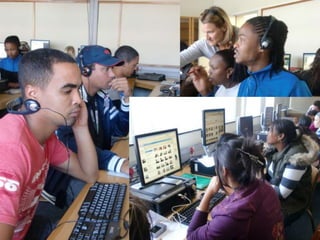
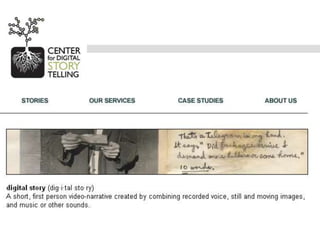
  • #4 What are digital stories?
  • #42 What are digital stories?